Within Track Progress
What Repeated Misses Can Tell You About Your Plan
Repeated misses at the same time or under the same conditions can reveal a scheduling problem rather than a motivation problem.
On this page
- Finding recurring conditions behind missed actions
- Separating plan design problems from vague self judgment
- Changing timing, context or fallback actions from the record
Page outline Jump by section
Introduction
A missed session is not automatically evidence of weak motivation. When misses keep clustering at the same time, place or circumstance, they can be evidence that the plan itself is poorly matched to real life. Three abandoned Tuesday-evening workouts after late meetings tell you something different from three misses scattered randomly across two months.
That is where progress tracking becomes diagnostic rather than merely numerical. Recording whether a planned action happened — alongside a few practical details about when and under what conditions it failed — can reveal recurring friction that memory tends to compress into “I wasn’t disciplined enough”. Behaviour-change research supports treating capability and opportunity, not just motivation, as causes of behaviour, while planning research shows the value of specifying when, where and how an action will happen and anticipating obstacles.[PubMed Central (PMC)]pmc.ncbi.nlm.nih.govPubMed Central (PMC)The behaviour change wheel: A new method for characterising and designing behaviour change interventions - PMCApril 2…
The useful question after repeated misses is therefore not simply “How do I make myself try harder?” It is “What does the pattern say about the conditions I have chosen?”
Look for conditions, not just a failure count
A completion percentage tells you how often the plan worked. The pattern of misses can tell you where the plan breaks.
Suppose someone plans four 30-minute study sessions each week and completes only half of them. “50% adherence” is useful feedback, but it hides the most actionable information. If nearly every morning session happens while nearly every session planned immediately after work is missed, the problem is concentrated in one context. Moving those sessions may be more sensible than demanding more commitment.
This interpretation fits established behaviour-change models. The COM-B model treats behaviour as the product of interacting capability, opportunity and motivation. Opportunity includes external conditions that make an action possible or prompt it. A recurring collision with childcare, work, transport, unavailable facilities or another commitment can therefore be a genuine behavioural constraint rather than merely an attitude problem. NICE similarly recommends examining social and environmental barriers and reviewing behavioural goals in light of experience.[NICE]nice.org.ukRecommendations | Behaviour change: individual approaches | Guidance | NICEJanuary 2, 2014…
For practical tracking, this means that a miss becomes much more informative when attached to a small amount of context. Useful fields might be:
- Planned: Tuesday, 18:00, 30-minute run
- Result: missed
- Condition: meeting finished at 18:20; hungry on arriving home
- Next comparable session: Thursday, 18:00
- Result: missed
- Condition: work overran again
After several repetitions, “I keep skipping running” becomes a more precise diagnosis: “18:00 on working days is unreliable because my finish time is unreliable.” The record has identified something the next plan can actually change.
The same reasoning applies beyond exercise. A person may repeatedly fail to write when working in a noisy shared room, miss language practice on commuting days, or abandon Sunday meal preparation whenever the weekend includes travel. The important signal is not that one particular session failed. It is that the same condition predicts failure repeatedly.
Repeated misses can expose a plan-design problem
Specific planning generally helps people turn intentions into behaviour. A major meta-analysis of 94 independent tests found a medium-to-large overall effect of implementation intentions — plans linking a situation to a response — on goal attainment. A much larger 2024 review covering 642 tests likewise found beneficial effects across cognitive, emotional and behavioural outcomes, with stronger effects when plans used an explicit contingent or “if–then” structure.[ScienceDirect]sciencedirect.comImplementation Intentions and Goal Achievement: A Meta‐analysis of Effects and Processes - ScienceDirect…
But specificity does not make an unrealistic plan realistic. “I will exercise at 18:00 after work” is precise; it is still badly designed if work routinely finishes at 18:30. Tracking lets specificity meet reality.
There are several recurring patterns worth treating as plan information rather than immediately translating them into self-judgement.
Misses concentrated at one time of day. If early sessions repeatedly happen and late sessions repeatedly fail, timing is an obvious candidate. The original plan may be competing with fatigue, unpredictable work, family responsibilities or other established routines.
Misses concentrated in one location or transition. “Study at the library” can fail because getting there adds enough travel friction to make a short session impractical. “Exercise straight after arriving home” can fail because going home itself cues dinner, childcare or relaxation.
Misses whenever another event runs late. This is a dependency problem. A plan whose start time depends on an unreliable preceding event inherits that event’s variability.
Misses under predictable obstacles. Bad weather, travel days, caring responsibilities and late shifts need not be surprises after they have appeared repeatedly. Once an obstacle is recurrent, a plan that continues to ignore it is under-specified.
Misses mainly when the full version feels impossible. A 45-minute planned session may repeatedly disappear on busy days even though a 10-minute version would have been feasible. That suggests a missing fallback rather than necessarily a missing intention.
Research on physical-activity planning illustrates the distinction between action planning and coping planning particularly clearly. Action planning specifies what, when, where or how; coping planning anticipates barriers and specifies ways of dealing with them. A meta-analysis of more than 150 effect sizes found associations between both forms of planning and physical activity, while a 2025 meta-analytic structural equation analysis of 57 samples and 19,883 participants found coping planning to be an important pathway between intention and exercise behaviour.[ScienceDirect]sciencedirect.comSpontaneous and experimentally induced action planning and coping planning for physical activity: A meta-analysis - ScienceD…
The broader lesson is not that every missed session requires a complicated contingency system. It is that a repeated obstacle deserves promotion from “excuse” to planning variable.

Separate a flawed plan from vague self-judgement
Tracking is especially useful because people are poor at diagnosing a pattern from isolated memories. A difficult week can produce a sweeping conclusion — “I’m terrible at sticking to things” — even when the record shows that six of eight planned actions happened and both failures occurred under the same unusual constraint.
That distinction matters because the two interpretations prescribe different responses. “I lack discipline” is broad, difficult to test and offers little guidance. “Sessions planned after my Wednesday late shift have failed four weeks running” is narrow, observable and changeable.
Behaviour-change guidance reflects this problem-solving orientation. NICE recommends self-monitoring alongside action planning, coping plans and regular review of goals, explicitly describing behavioural goals as something that should be reconsidered in light of experience.[NICE]nice.org.ukRecommendations | Behaviour change: individual approaches | Guidance | NICEJanuary 2, 2014… A systematic review of planning interventions for people with chronic conditions likewise identified self-monitoring and problem solving among techniques associated with effective longer-term interventions.[BMJ Open]bmjopen.bmj.comBMJ OpenBehaviour change techniques that constitute effective planning interventions to improve physical activity and diet behaviour for…
A simple way to keep the diagnosis grounded is to compare similar opportunities. If a person succeeds on 9 of 10 weekend walks but only 2 of 10 weekday-evening walks, the contrast is more revealing than an overall 11-of-20 score. Likewise, if writing happens whenever the first task of the morning is protected but disappears whenever email comes first, that repeated contrast deserves attention.
This does not prove that context is the sole cause. Tracking personal behaviour is not a controlled experiment, and several factors can change together. The appropriate conclusion is modest: the record has identified a plausible weak point worth changing and testing.
Nor should an occasional miss be over-interpreted. In a 12-week real-world habit-formation study, Phillippa Lally and colleagues found that missing a single opportunity did not materially disrupt the habit-formation process. One bad day is therefore a poor basis for redesigning an otherwise workable routine.[Wiley Online Library]onlinelibrary.wiley.comWiley Online LibraryHow are habits formed: Modelling habit formation in the real world - Lally - 2010 - European Journal of Social Psycho… The signal becomes more useful when failure repeats under comparable conditions.
Change one part of the plan and watch what happens
Once the pattern is visible, tracking should lead to a small redesign rather than endless documentation. The aim is to remove or route around the recurring point of friction.
If the record says “late workday → evening session missed”, there are three main levers.
Change the timing. Move the action to a period with fewer competing demands. The 18:00 workout might become a lunchtime walk or a morning session. This is particularly sensible when the old time repeatedly depends on an event that cannot reliably finish on schedule.
Change the context. Reduce the steps required before starting. Studying might move from a distant library to a quiet room near work; exercise might start near the workplace rather than after travelling home. Context deserves attention because research on intentional habit formation has found that greater context stability is associated with both stronger automaticity and better repetition-goal attainment. In one six-week study, students assigned to stable times and places developed their study habits more successfully than those instructed to vary those contexts.[PubMed Central (PMC)]pmc.ncbi.nlm.nih.govOpen source on nih.gov.
Add a fallback action. Decide in advance what happens when the known obstacle appears: “If my meeting runs beyond 18:00, I will do the 15-minute home version.” This is a coping plan rather than a licence to abandon the goal. NICE recommends well-rehearsed if–then plans and changes to the immediate environment as tools for maintaining behaviour when setbacks occur.[NICE]nice.org.ukOpen source on nice.org.uk.
The fallback should match the barrier rather than being generic. Research in which 152 people evaluated combinations of physical-activity barriers and coping strategies found substantial variation in which strategies people considered relevant to which barriers; very few barrier-strategy combinations were universally suitable.[PubMed]pubmed.ncbi.nlm.nih.govOpen source on nih.gov. “Have a backup plan” is therefore less useful than identifying the obstacle first and designing the backup around it.
After changing the plan, keep recording the same basic information for long enough to compare like with like. If moving a repeatedly missed Tuesday workout to Saturday morning changes completion from occasional to dependable, the new pattern is useful evidence that the original slot was part of the problem. If misses continue unchanged, the first diagnosis was probably incomplete and another constraint needs examining.
What a useful missed-session record looks like
The tracker does not need to become a diary. Its job is to retain just enough information for repeated conditions to become visible.
For many goals, four pieces of information are enough: what was planned, whether it happened, the relevant condition when it did not, and what adjustment was made. A week of entries might reveal that missed sessions cluster after late meetings; the next week can test a morning slot. Another record might show that the problem is not timing but duration: 40-minute sessions fail on busy days while 10-minute fallback sessions consistently survive.
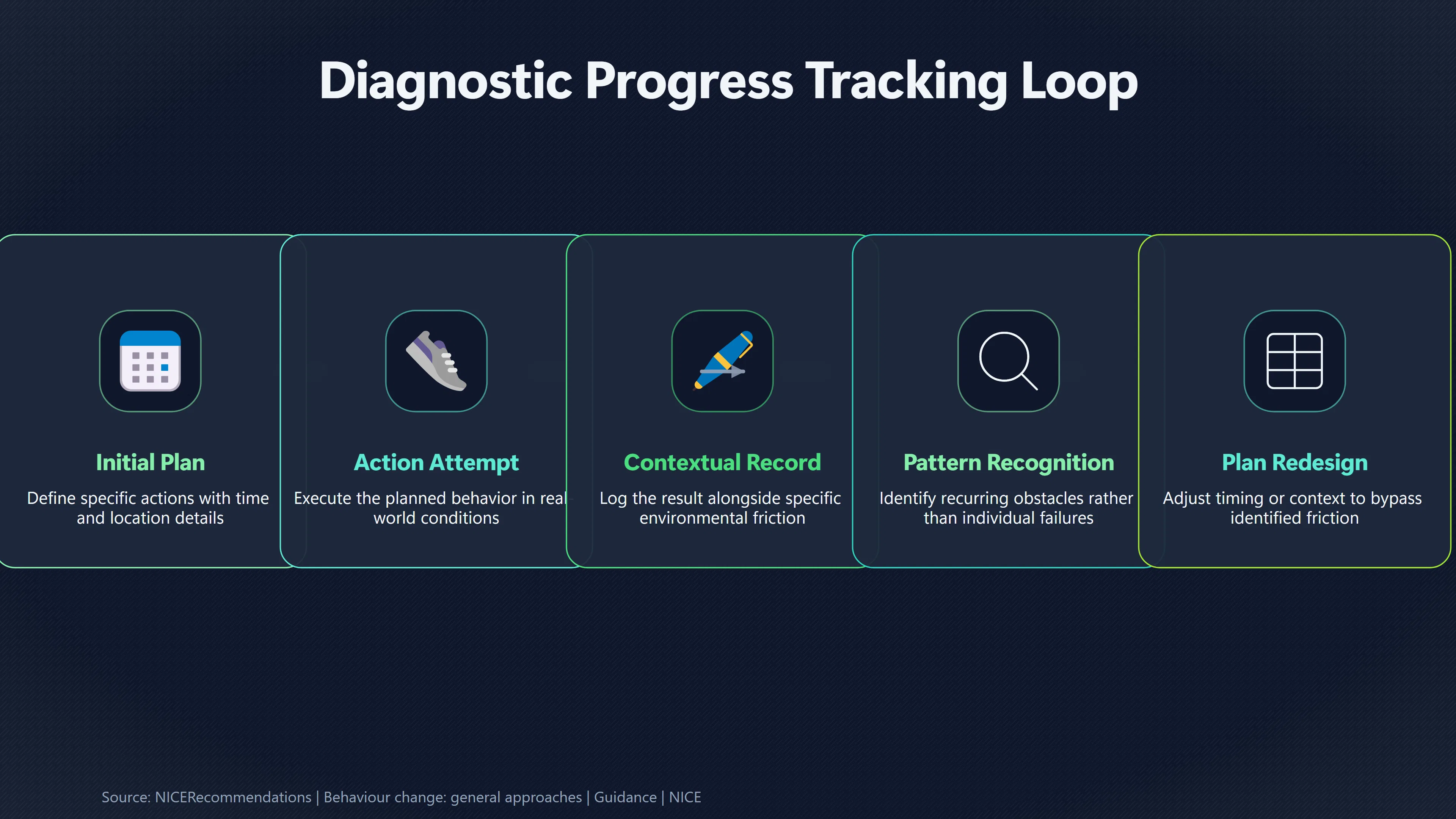
This turns progress tracking into a feedback loop:
plan → attempt → record → spot recurrence → redesign → test again.
The crucial shift is from treating every miss as the same event to asking whether misses share a cause. Planning interventions have a positive but variable effect on physical activity: a systematic review of 35 randomised trials involving 5,439 participants found an overall small-to-medium benefit, with substantial variation between studies. That variability is a useful reminder that “having a plan” is not a guarantee; the quality and fit of the plan matter.[PubMed Central (PMC)]pmc.ncbi.nlm.nih.govOpen source on nih.gov.
Repeated misses are therefore not merely dents in a streak. They are observations about how a plan behaves when it meets an actual week. When several failures point to the same hour, transition, location or obstacle, the most productive response may be neither greater guilt nor a more ambitious target. It may simply be to redesign the conditions under which the action is supposed to happen.
Amazon book picks
Further Reading
Books and field guides related to What Repeated Misses Can Tell You About Your Plan. Use these as the next step if you want deeper reading beyond the article.
Atomic Habits
Rating: 3.5/5 from 7 Google Books ratings
The #1 New York Times bestseller. Over 25 million copies sold! Translated into 60+ languages! Tiny Changes, Remarkable Results No matter...
Tiny Habits
Improving your life is much easier than you think. Whether it’s losing weight, sleeping more, or restoring your work/life balance – the s...
How to Change
Wall Street Journal bestseller “A welcome revelation.” --The Financial Times Award-winning Wharton Professor and Choiceology podcast host...

The Power of Habit
Rating: 4.0/5 from 145 Google Books ratings
Duhigg takes us to the edge of scientific discoveries that explain why habits exist and how they can be changed. Distilling information i...
eBay marketplace picks
Marketplace Samples
Live-tested eBay searches with available results related to this page.
Selected frommotivation poster oneBay.co.uk.

Current eBay listing
Gym Motivation Framed Wall Art Poster Canvas Print Picture

Current eBay listing
Motivation Quotes Framed Wall Art Poster Canvas Print Picture


Endnotes
1.
Source: nice.org.uk
Link:https://www.nice.org.uk/Guidance/PH49/chapter/recommendations
Source snippet
Recommendations | Behaviour change: individual approaches | Guidance | NICEJanuary 2, 2014...
Published: January 2, 2014
2.
Source: nice.org.uk
Title: NICERecommendations | Behaviour change: general approaches | Guidance | NICE
Link:https://www.nice.org.uk/guidance/ph6/chapter/recommendations
3.
Source: sciencedirect.com
Link:https://www.sciencedirect.com/science/article/abs/pii/S0065260106380021
Source snippet
Implementation Intentions and Goal Achievement: A Meta‐analysis of Effects and Processes - ScienceDirect...
4.
Source: sciencedirect.com
Link:https://www.sciencedirect.com/science/article/pii/S1469029212001148
Source snippet
Spontaneous and experimentally induced action planning and coping planning for physical activity: A meta-analysis - ScienceD...
5.
Source: bmjopen.bmj.com
Link:https://bmjopen.bmj.com/content/12/8/e058229
Source snippet
BMJ OpenBehaviour change techniques that constitute effective planning interventions to improve physical activity and diet behaviour for...
6.
Source: onlinelibrary.wiley.com
Link:https://onlinelibrary.wiley.com/doi/10.1002/ejsp.674
Source snippet
Wiley Online LibraryHow are habits formed: Modelling habit formation in the real world - Lally - 2010 - European Journal of Social Psycho...
7.
Source: sciencedirect.com
Link:https://www.sciencedirect.com/org/science/article/pii/S2369199926000698
8.
Source: sciencedirect.com
Link:https://www.sciencedirect.com/science/article/pii/S1499267126000948
9.
Source: onlinelibrary.wiley.com
Link:https://onlinelibrary.wiley.com/doi/10.1002/9781118410868.wbehibs1140
10.
Source: bpspsychub.onlinelibrary.wiley.com
Link:https://bpspsychub.onlinelibrary.wiley.com/doi/10.1111/bjhp.70019
11.
Source: sciencedirect.com
Link:https://www.sciencedirect.com/org/science/article/pii/S1438887124006885
12.
Source: sciencedirect.com
Link:https://www.sciencedirect.com/science/article/abs/pii/S1526590024003699
13.
Source: sciencedirect.com
Link:https://www.sciencedirect.com/org/science/article/pii/S2292949522001274
14.
Source: bpspsychub.onlinelibrary.wiley.com
Link:https://bpspsychub.onlinelibrary.wiley.com/doi/10.1111/bjhp.12433
15.
Source: sciencedirect.com
Title: A Theory-Based Exercise App to Enhance Exercise Adherence: A Pilot Study
Link:https://www.sciencedirect.com/org/science/article/pii/S2291522216000139
16.
Source: bpspsychub.onlinelibrary.wiley.com
Link:https://bpspsychub.onlinelibrary.wiley.com/doi/10.1111/bjc.12086
17.
Source: bpspsychub.onlinelibrary.wiley.com
Link:https://bpspsychub.onlinelibrary.wiley.com/doi/10.1348/135910707X216062
18.
Source: sciencedirect.com
Link:https://www.sciencedirect.com/science/article/pii/S000399930900673X
19.
Source: onlinelibrary.wiley.com
Link:https://onlinelibrary.wiley.com/doi/full/10.1002/ejsp.674
20.
Source: onlinelibrary.wiley.com
Link:https://onlinelibrary.wiley.com/doi/abs/10.1002/ejsp.674?MixPanelId=15e3fe314440-0468d8411-64220f54-100000-15e3fe314460
21.
Source: onlinelibrary.wiley.com
Link:https://onlinelibrary.wiley.com/doi/pdf/10.1002/ejsp.674
22.
Source: onlinelibrary.wiley.com
Link:https://onlinelibrary.wiley.com/doi/abs/10.1002/ejsp.674?source=content_type%3Areact%7Cfirst_level_url%3Aarticle%7Csection%3Amain_content%7Cbutton%3Abody_link
23.
Source: onlinelibrary.wiley.com
Link:https://onlinelibrary.wiley.com/doi/abs/10.1002/ejsp.674
24.
Source: onlinelibrary.wiley.com
Link:https://onlinelibrary.wiley.com/doi/abs/10.1002/ejsp.674?cf_chl_jschl_tk=pmd_EwcJDaCFBR9OVEL1O_0qjioww0Gc86ZzpBvCBFhrDcE-1635261061-0-gqNtZGzNAjujcnBszQi9
25.
Source: onlinelibrary.wiley.com
Link:https://onlinelibrary.wiley.com/doi/abs/10.1002/ejsp.674?msockid=038ed114f43667dd0790c4bef5146634
26.
Source: onlinelibrary.wiley.com
Link:https://onlinelibrary.wiley.com/doi/pdf/10.1002/ejsp.258
27.
Source: onlinelibrary.wiley.com
Link:https://onlinelibrary.wiley.com/doi/abs/10.1002/Ejsp.258
28.
Source: sciencedirect.com
Link:https://www.sciencedirect.com/science/chapter/bookseries/abs/pii/S0065260106380021
29.
Source: sciencedirect.com
Link:https://www.sciencedirect.com/science/article/pii/S1469029225000214
30.
Source: sciencedirect.com
Title: Coping Planning
Link:https://www.sciencedirect.com/topics/psychology/coping-planning
31.
Source: sciencedirect.com
Title: CO M-B Model
Link:https://www.sciencedirect.com/topics/psychology/com-b-model
32.
Source: com-b.org
Link:https://www.com-b.org/
33.
Source: pmc.ncbi.nlm.nih.gov
Link:https://pmc.ncbi.nlm.nih.gov/articles/3096582/
Source snippet
PubMed Central (PMC)The behaviour change wheel: A new method for characterising and designing behaviour change interventions - PMCApril 2...
34.
Source: doi.org
Link:https://doi.org/10.1080/10463283.2024.2334563
Source snippet
The when and how of planning: Meta-analysis of the scope and components of implementation intentions in 642 tests: European Review of...
35.
Source: pubmed.ncbi.nlm.nih.gov
Link:https://pubmed.ncbi.nlm.nih.gov/39952422/
Source snippet
Examining the impact of perceived behavioral control and planning on closing the [exercise intention]({{ 'intention-gap/' | relative_url }})-behavior gap: Insights from a m...
36.
Source: pmc.ncbi.nlm.nih.gov
Link:https://pmc.ncbi.nlm.nih.gov/articles/PMC9226889/
37.
Source: pubmed.ncbi.nlm.nih.gov
Link:https://pubmed.ncbi.nlm.nih.gov/35756236/
38.
Source: pubmed.ncbi.nlm.nih.gov
Link:https://pubmed.ncbi.nlm.nih.gov/39628965/
39.
Source: pmc.ncbi.nlm.nih.gov
Link:https://pmc.ncbi.nlm.nih.gov/articles/PMC9223740/
40.
Source: pubmed.ncbi.nlm.nih.gov
Link:https://pubmed.ncbi.nlm.nih.gov/42155677/
41.
Source: pubmed.ncbi.nlm.nih.gov
Link:https://pubmed.ncbi.nlm.nih.gov/41784001/
42.
Source: pubmed.ncbi.nlm.nih.gov
Link:https://pubmed.ncbi.nlm.nih.gov/41784001/%3Futm_source%3DFeedFetcher%26utm_medium%3Drss%26utm_campaign%3DNone%26utm_content%3D14UrQ4NgJAsHm8SXI5BaYp7FokEO6cTAmJLXI2aoiiNVJqzY1Q%26fc%3DNone%26ff%3D20260306143306%26v%3D2.19.0.post6%2B133c1fe
43.
Source: pmc.ncbi.nlm.nih.gov
Link:https://pmc.ncbi.nlm.nih.gov/articles/PMC12604158/
44.
Source: doi.org
Title: CO M‐B Model
Link:https://doi.org/10.1002/9781118410868.wbehibs1140
45.
Source: pubmed.ncbi.nlm.nih.gov
Link:https://pubmed.ncbi.nlm.nih.gov/41084835/
46.
Source: pmc.ncbi.nlm.nih.gov
Link:https://pmc.ncbi.nlm.nih.gov/articles/PMC11613413/
47.
Source: pubmed.ncbi.nlm.nih.gov
Link:https://pubmed.ncbi.nlm.nih.gov/39590901/
48.
Source: pubmed.ncbi.nlm.nih.gov
Link:https://pubmed.ncbi.nlm.nih.gov/38913732/
49.
Source: pubmed.ncbi.nlm.nih.gov
Link:https://pubmed.ncbi.nlm.nih.gov/38823146/?dopt=Abstract
50.
Source: pmc.ncbi.nlm.nih.gov
Link:https://pmc.ncbi.nlm.nih.gov/articles/PMC10186807/
51.
Source: pmc.ncbi.nlm.nih.gov
Link:https://pmc.ncbi.nlm.nih.gov/articles/PMC9925368/
52.
Source: ncbi.nlm.nih.gov
Link:https://www.ncbi.nlm.nih.gov/books/NBK587717/
53.
Source: pubmed.ncbi.nlm.nih.gov
Link:https://pubmed.ncbi.nlm.nih.gov/36775533/
54.
Source: pubmed.ncbi.nlm.nih.gov
Link:https://pubmed.ncbi.nlm.nih.gov/35742582/
55.
Source: doi.org
Link:https://doi.org/10.1177/20552076221093134
56.
Source: pmc.ncbi.nlm.nih.gov
Link:https://pmc.ncbi.nlm.nih.gov/articles/PMC9052022/
57.
Source: pmc.ncbi.nlm.nih.gov
Link:https://pmc.ncbi.nlm.nih.gov/articles/PMC8997544/
58.
Source: pubmed.ncbi.nlm.nih.gov
Link:https://pubmed.ncbi.nlm.nih.gov/35409564/
59.
Source: pubmed.ncbi.nlm.nih.gov
Link:https://pubmed.ncbi.nlm.nih.gov/35238791/
60.
Source: pmc.ncbi.nlm.nih.gov
Link:https://pmc.ncbi.nlm.nih.gov/articles/PMC8845016/
61.
Source: doi.org
Link:https://doi.org/10.1186/s11556-021-00269-7
62.
Source: pmc.ncbi.nlm.nih.gov
Link:https://pmc.ncbi.nlm.nih.gov/articles/PMC8207255/
63.
Source: pmc.ncbi.nlm.nih.gov
Link:https://pmc.ncbi.nlm.nih.gov/articles/PMC8149892/
64.
Source: pubmed.ncbi.nlm.nih.gov
Link:https://pubmed.ncbi.nlm.nih.gov/34054628/
65.
Source: communications.gov.uk
Title: The principles of behaviour change
Link:https://www.communications.gov.uk/publication/the-principles-of-behaviour-change-communications/
66.
Source: pubmed.ncbi.nlm.nih.gov
Link:https://pubmed.ncbi.nlm.nih.gov/33502088/
67.
Source: pmc.ncbi.nlm.nih.gov
Link:https://pmc.ncbi.nlm.nih.gov/articles/PMC7539442/
68.
Source: pmc.ncbi.nlm.nih.gov
Link:https://pmc.ncbi.nlm.nih.gov/articles/7507843/
69.
Source: communications.gov.uk
Title: A behavioural approach to strategic communications
Link:https://www.communications.gov.uk/publication/strategic-communications-a-behavioural-approach/
70.
Source: pmc.ncbi.nlm.nih.gov
Link:https://pmc.ncbi.nlm.nih.gov/articles/PMC7571594/
71.
Source: pmc.ncbi.nlm.nih.gov
Link:https://pmc.ncbi.nlm.nih.gov/articles/PMC7429262/
72.
Source: pubmed.ncbi.nlm.nih.gov
Link:https://pubmed.ncbi.nlm.nih.gov/31125588/
73.
Source: pmc.ncbi.nlm.nih.gov
Link:https://pmc.ncbi.nlm.nih.gov/articles/PMC6796229/
74.
Source: pmc.ncbi.nlm.nih.gov
Link:https://pmc.ncbi.nlm.nih.gov/articles/PMC4945448/
75.
Source: pubmed.ncbi.nlm.nih.gov
Link:https://pubmed.ncbi.nlm.nih.gov/26479070/
76.
Source: pmc.ncbi.nlm.nih.gov
Link:https://pmc.ncbi.nlm.nih.gov/articles/PMC4529491/
77.
Source: pubmed.ncbi.nlm.nih.gov
Link:https://pubmed.ncbi.nlm.nih.gov/26236214/
78.
Source: pubmed.ncbi.nlm.nih.gov
Link:https://pubmed.ncbi.nlm.nih.gov/25965276/
79.
Source: pmc.ncbi.nlm.nih.gov
Link:https://pmc.ncbi.nlm.nih.gov/articles/PMC4320609/
80.
Source: pmc.ncbi.nlm.nih.gov
Link:https://pmc.ncbi.nlm.nih.gov/articles/PMC4147713/
81.
Source: pubmed.ncbi.nlm.nih.gov
Link:https://pubmed.ncbi.nlm.nih.gov/24999905/
82.
Source: nice.org.uk
Link:https://www.nice.org.uk/Guidance/PH49
83.
Source: pmc.ncbi.nlm.nih.gov
Link:https://pmc.ncbi.nlm.nih.gov/articles/PMC3505409/
84.
Source: pubmed.ncbi.nlm.nih.gov
Link:https://pubmed.ncbi.nlm.nih.gov/19969161/
85.
Source: pubmed.ncbi.nlm.nih.gov
Link:https://pubmed.ncbi.nlm.nih.gov/18096108/
86.
Source: pmc.ncbi.nlm.nih.gov
Link:https://pmc.ncbi.nlm.nih.gov/articles/PMC2435095/
87.
Source: nice.org.uk
Link:https://www.nice.org.uk/guidance/ph6/chapter/Considerations
88.
Source: pubmed.ncbi.nlm.nih.gov
Link:https://pubmed.ncbi.nlm.nih.gov/17553212/
89.
Source: pubmed.ncbi.nlm.nih.gov
Link:https://pubmed.ncbi.nlm.nih.gov/17511531/
90.
Source: pubmed.ncbi.nlm.nih.gov
Link:https://pubmed.ncbi.nlm.nih.gov/17678574/
91.
Source: pubmed.ncbi.nlm.nih.gov
Link:https://pubmed.ncbi.nlm.nih.gov/12088128/
92.
Source: pubmed.ncbi.nlm.nih.gov
Link:https://pubmed.ncbi.nlm.nih.gov/18272806/
93.
Source: pubmed.ncbi.nlm.nih.gov
Link:https://pubmed.ncbi.nlm.nih.gov/15951362/
Additional References
94.
Source: youtube.com
Title: How to Set Up Your Space to Build Good Habits Without Willpower
Link:https://www.youtube.com/watch?v=-AqPeVOi4e8
Source snippet
To see how structural barriers and capability issues cause behavioral breakdowns rather than mere lack of motivation, check out Behavior...
95.
Source: youtube.com
Link:https://www.youtube.com/watch?v=f9RzrFVYVJc
Source snippet
How to Automate Your Focus: The Science of If-Then Rules...
96.
Source: youtube.com
Title: What really changes behaviour? | Professor Susan Michie
Link:https://www.youtube.com/watch?v=4GzrNxPx1fg
Source snippet
“Mental contrasting gives the possibility to overcome obstacles” Dr. Gabriele Oettingen - WOOP...
97.
Source: youtube.com
Title: Behavior Change Wheel & COM B Designing Effective Public Health Interventions
Link:https://www.youtube.com/watch?v=wFpcyeJROiw
Source snippet
What really changes behaviour? | Professor Susan Michie...
98.
Source: nature.com
Link:https://www.nature.com/articles/s41562
99.
Source: youtube.com
Title: How to Automate Your Focus: The Science of If-Then Rules
Link:https://www.youtube.com/watch?v=MSPjnh5AEyE
Source snippet
How to Set Up Your Space to Build Good Habits Without Willpower...
100.
Source: researchgate.net
Link:https://www.researchgate.net/publication/37367696_Implementation_Intentions_and_Goal_Achievement_A_Meta-Analysis_of_Effects_and_Processes
101.
Source: ucl.ac.uk
Link:https://www.ucl.ac.uk/brain-sciences/behaviour-change/resources/advancing-behavioural-science
102.
Source: besci.org
Link:https://besci.org/models/capability-oppportunity-motivation-behavior
103.
Source: doaj.org
Link:https://doaj.org/article/5e28c7cd6cc848099ff7ce3a555ff69f