Within Small Habits
Choose Habit Cues Your Real Schedule Repeats
A cue works best when it recurs in real life, so flexible event-based cues can outperform exact clock times when daily schedules vary.
On this page
- Why stable context helps habits become automatic
- When exact times become fragile cues
- Using recurring daily events as more durable anchors
Page outline Jump by section
Introduction
When your days keep changing, the most useful habit cue may be something that happens reliably rather than something that happens at a reliable hour. “At 7.30 am” is a workable cue if 7.30 am repeatedly finds you in the right circumstances. For a shift worker, frequent traveller, parent with variable mornings or anyone whose working day moves around, “after I brush my teeth”, “when I finish lunch” or “after I close my laptop for the day” may preserve more of the context that habit learning needs.
The important distinction is not simply clock cue versus routine cue. Research shows that both can support habit formation. The deeper requirement is repeated enactment in a sufficiently stable context: a cue has to recur, be noticed and lead to the behaviour often enough for the association to strengthen.[PubMed]pubmed.ncbi.nlm.nih.govHabit formation following routine-based versus time-based cue planning: A randomized controlled trial - PubMedJanuary 6, 2021… For an irregular life, flexibility therefore means finding stability inside the variability, not changing the cue every day.
Why stable context helps habits become automatic
Psychological accounts of habit describe it as an association through which a recurring context can increasingly prompt a response without a fresh decision each time. In other words, repetition alone is not the whole story. Repetition in relation to recurring cues is what gives the environment an increasing role in getting the behaviour started.[PubMed Central (PMC)]pmc.ncbi.nlm.nih.govPubMed Central (PMC)A review and analysis of the use of ‘habit’ in understanding, predicting and influencing health-related behaviour - P…
That helps explain why context stability matters. In a 2022 study, Marco Stojanovic and colleagues tested this directly. In one experiment, 95 university students built study habits for six weeks; one group was instructed to vary rooms and times, while another kept the performance context stable. A second study examined 308 habits recorded by 218 users of a habit-building app. Across both datasets, greater context stability predicted greater automaticity and better attainment of the goal for each habit repetition.[Frontiers]frontiersin.orgFrontiersFrontiers | Context Stability in Habit Building Increases Automaticity and Goal AttainmentJune 10, 2022…
Older research demonstrates the same principle from the opposite direction. Wendy Wood and colleagues followed university students through a move to a new university and examined exercising, television watching and newspaper reading. Established behaviours were more likely to be disrupted when important features of their usual performance contexts changed. Habits survived changes better when relevant aspects of the old context remained similar.[USC Dornsife]dornsife.usc.eduDornsife Journal of Personality and Social PsychologyUSC DornsifeJournal of Personality and Social PsychologyJune 20, 2005…
For someone with an irregular schedule, this creates an apparent problem. If Monday begins at home at 6 am, Tuesday in a hotel at 8 am and Wednesday after a night shift, there may be no single stable combination of time, place and surrounding activity available every day.
But context does not have to mean a particular room at a particular clock time. Habit researchers treat contextual cues more broadly: they can include locations, preceding actions, other people and recurring events. Practical habit-formation guidance has therefore long recommended cues embedded in existing routines, such as taking an action after breakfast or when beginning a lunch break.[PubMed Central (PMC)]pmc.ncbi.nlm.nih.govPubMed Central (PMC)Making health habitual: the psychology of ‘habit-formation’ and general practice - PMCDecember 1, 2012…
The useful question becomes: what part of my day stays recognisably the same even when its timing changes?
When exact times become fragile cues
An exact clock time is not inherently a bad habit cue. The strongest direct comparison of clock-based and routine-based cueing actually cautions against claiming that event cues are universally superior.
In a 2021 randomised controlled trial, Jan Keller and colleagues assigned 192 adults to link a self-selected nutrition behaviour either to a daily routine or to a particular time. Participants then completed daily assessments for 84 days. Automaticity and plan enactment increased in both conditions, with no significant group-level advantage for routine cues over time cues. Among participants whose habit formation followed the expected successful trajectory, the median modelled time to reach 95% of peak automaticity was 59 days. Most importantly for practice, repeatedly carrying out the behaviour in response to the planned cue predicted increasing automaticity.[UCL Discovery]discovery.ucl.ac.ukUCL DiscoveryHabit formation following routine-based versus time-based cue planning: A randomized controlled trial - UCL Discovery…
So “always use an event, never use a time” would go beyond the evidence. A person who predictably takes a break at 10.30 am may do perfectly well with a 10.30 cue.
The problem arises when clock stability and life stability diverge. Suppose you plan five minutes of mobility work at 7 am. On a normal office day, 7 am finds you awake and at home. After a late shift it finds you asleep; during travel you may be in transit; on a weekend you may simply wake later. The clock continues to produce 7 am with perfect reliability, but the circumstances that make the behaviour feasible have disappeared.
This distinction also makes sense from research on prospective memory — remembering to carry out a future intention. Time-based intentions require a person to monitor time, whereas event-based intentions can be retrieved when an external event occurs.[PubMed Central (PMC)]pmc.ncbi.nlm.nih.govOpen source on nih.gov. That literature is not identical to habit research, so it should not be treated as proof that event cues necessarily create stronger habits. It does, however, illuminate one practical cost of a clock cue: before an association becomes automatic, “do this at 10 am” may require some degree of remembering or checking that 10 am has arrived.
A routine event can instead carry the reminder with it. Finishing breakfast, putting away a toothbrush, getting into a car or shutting down a computer produces a perceptible transition in the environment. Habit-formation guidance accordingly recommends cues that are sufficiently noticeable and encountered consistently, and identifies established daily routines as convenient starting points.[PubMed Central (PMC)]pmc.ncbi.nlm.nih.govPubMed Central (PMC)Making health habitual: the psychology of ‘habit-formation’ and general practice - PMCDecember 1, 2012…
For variable schedules, then, the comparison is better framed this way:
- “At 7 am” is stable in clock time but may occur in radically different practical circumstances.
- “After my first meal” can move several hours while retaining the same position in the day’s behavioural sequence.
- “When I arrive home” can survive changing finishing times, although it fails on days when you do not return home in the usual way.
- “After I brush my teeth before sleep” can travel across shifts and time zones if that existing behaviour itself remains dependable.
The best cue is the one whose real-world recurrence most closely matches the opportunities you actually have to perform the habit.

Use daily events as durable anchors
For an irregular schedule, choosing a flexible cue starts with observation rather than an ideal timetable. Look for events that already recur across different versions of your day. Meals, hygiene routines, opening or closing a work session, arriving somewhere, making a first drink, plugging in a phone, changing clothes and preparing for sleep are candidates only if they genuinely recur in your life.
Then make the relationship between cue and action specific. “Exercise sometime after work” leaves considerable interpretation. “After I take off my work shoes, I do five minutes of mobility” defines a clearer cue-response pairing. This resembles an implementation intention: specifying in advance the circumstance in which an intended action will occur. Research on prospective memory finds that implementation-intention techniques can help connect intended actions with future cues, although this evidence concerns remembering intentions and should not be confused with evidence that the resulting behaviour has already become habitual.[PubMed Central (PMC)]pmc.ncbi.nlm.nih.govOpen source on nih.gov.
The anchor also needs to occur at roughly the right frequency. An event that is memorable but happens twice a month cannot cue a behaviour you intend to practise daily. Conversely, “whenever I look at my phone” is so frequent and diffuse that it may not identify one clean opportunity. Habit-formation guidance emphasises a context that is encountered and detected frequently and consistently.[PubMed Central (PMC)]pmc.ncbi.nlm.nih.govPubMed Central (PMC)Making health habitual: the psychology of ‘habit-formation’ and general practice - PMCDecember 1, 2012…
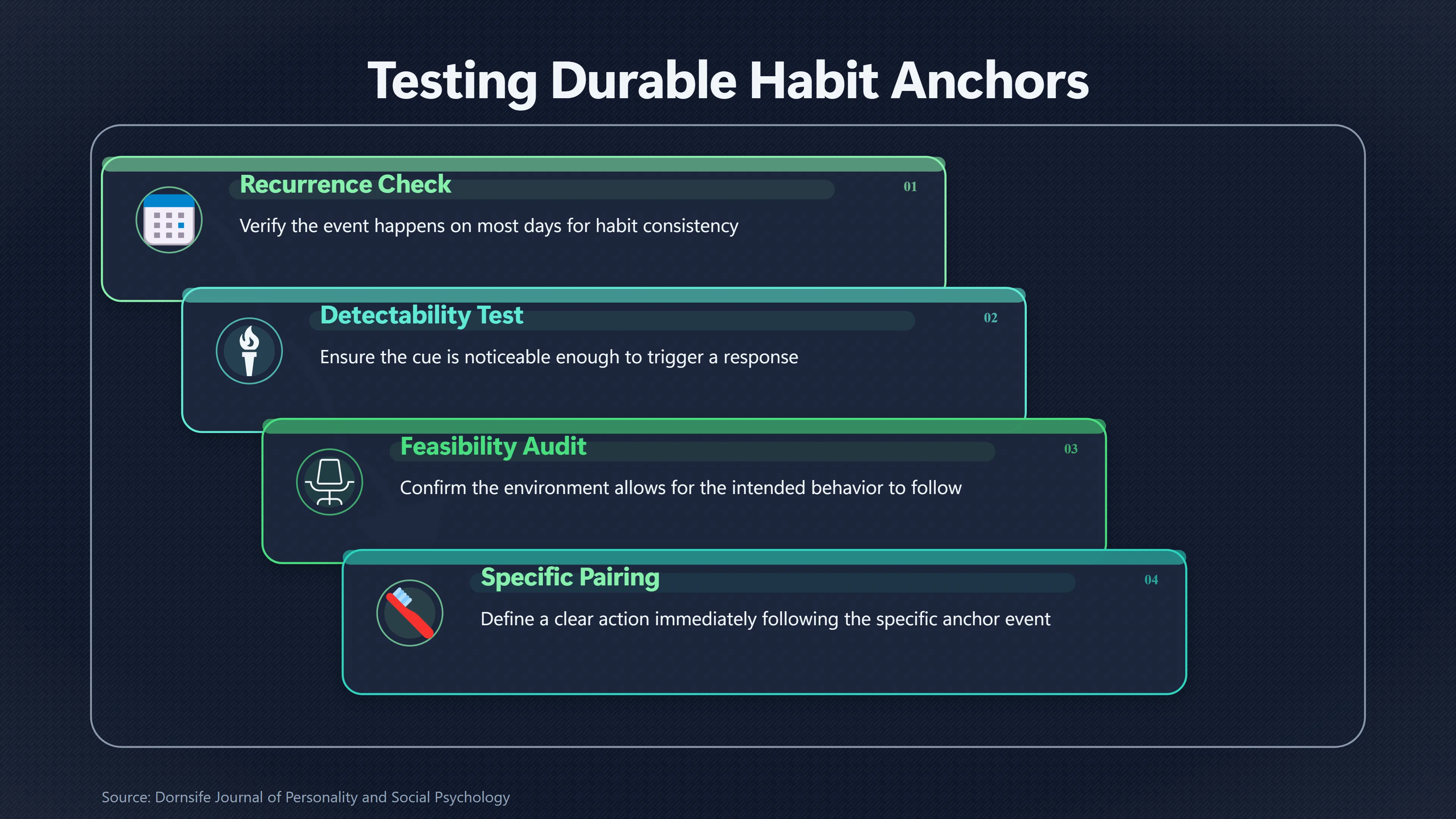
A practical cue for an unstable schedule therefore passes three tests:
- Recurrence: does this event happen on most of the days when the habit should happen?
- Detectability: will you actually notice that the event has occurred?
- Feasibility: when it occurs, are you normally in circumstances where the behaviour can follow?
Consider a worker alternating early and late shifts who wants to read every day. “Read at 9 pm” may collide with work on some days and bedtime on others. “Read after dinner” is better only if dinner remains a recognisable recurring event. If meals are equally irregular, “read two pages after brushing my teeth before sleep” may provide the more durable anchor. The reading time moves, but the relationship between cue and response stays fixed.
That is the useful form of flexibility. It is not “read whenever there is time”. That removes the recurring trigger and hands the decision back to attention and motivation every day. Instead, the schedule is allowed to move while the behavioural sequence remains stable: this event happens; then I do this small action.
Preserve the cue when the setting changes
Routine cues are not magically independent of context. “After lunch” can mean something very different at home, in an office, on a train and during a conference. Research showing stronger automaticity under stable contexts suggests that unnecessary variation in the surrounding circumstances may still make habit acquisition harder.[Frontiers]frontiersin.orgFrontiersFrontiers | Context Stability in Habit Building Increases Automaticity and Goal AttainmentJune 10, 2022…
The goal is therefore to preserve as many useful constants as ordinary life permits without demanding an unrealistically rigid day. If the location must vary, keep the preceding event and behaviour constant. If the time must vary, keep the event and perhaps the location constant. If travel changes both time and location, an existing portable routine — brushing teeth, taking medication as prescribed, opening a laptop or preparing for sleep — may provide the remaining continuity.
This is also why an anchor should be revised when it repeatedly fails. In Keller and colleagues’ trial, the critical predictor was not merely having written down a cue plan: people who more frequently enacted their behaviour in response to their cue were more likely to develop automaticity. Multiple omissions impeded the process.[DOI]doi.orgHabit formation following routine‐based versus time‐based cue planning: A randomized controlled trial - Keller - 2021 - British Journa… A cue that looks elegant on paper but rarely coincides with a genuine opportunity is not serving its purpose.
That does not mean treating an occasional disruption as failure. Ordinary life will sometimes remove the anchor entirely. The more useful distinction is between an exception and a structural mismatch. Missing “after lunch” because of one extraordinary day is an exception. Discovering that you skip lunch or eat it unpredictably four days each week suggests that lunch was never a sufficiently dependable anchor for this particular habit.
Flexible cues work by keeping one relationship stable
Flexible habit design can sound paradoxical because habit research repeatedly emphasises consistency. The resolution is that your entire day does not have to be consistent. The part that matters is the recurring relationship between a detectable cue and the behaviour that follows it.
The research does not establish that routine-based cues categorically beat clock times. A direct randomised comparison found both approaches capable of supporting habit formation.[PubMed]pubmed.ncbi.nlm.nih.govHabit formation following routine-based versus time-based cue planning: A randomized controlled trial - PubMedJanuary 6, 2021… Nor does it imply that someone with an unpredictable life can ignore context: experimentally varying habit contexts has been associated with weaker automaticity than maintaining greater contextual stability.[PubMed]pubmed.ncbi.nlm.nih.govContext Stability in Habit Building Increases Automaticity and Goal Attainment - PubMed…
What the evidence supports is a more useful principle for real life: choose the stable context you actually possess. For someone with a conventional timetable, that may include an exact time. For someone whose mornings, shifts or locations keep changing, the stable element may instead be an event in a behavioural sequence.
That makes flexible cues particularly compatible with small habits designed to survive ordinary life. The clock can move, the workplace can change and the day can run late, while one simple relationship remains recognisable: after this thing I already do, I do this small thing I want to become easier.

Amazon book picks
Further Reading
Books and field guides related to Choose Habit Cues Your Real Schedule Repeats. Use these as the next step if you want deeper reading beyond the article.
Good Habits, Bad Habits
'The world's leading expert on habits' - Matthew Syed, bestselling author of Black Box Thinking and Rebel IdeasWhat if you could harness...
Tiny Habits
Improving your life is much easier than you think. Whether it’s losing weight, sleeping more, or restoring your work/life balance – the s...
Atomic Habits
Rating: 3.5/5 from 7 Google Books ratings
The #1 New York Times bestseller. Over 25 million copies sold! Translated into 60+ languages! Tiny Changes, Remarkable Results No matter...
The Power of Habit
Rating: 4.0/5 from 145 Google Books ratings
Duhigg takes us to the edge of scientific discoveries that explain why habits exist and how they can be changed. Distilling information i...
eBay marketplace picks
Marketplace Samples
Live-tested eBay searches with available results related to this page.
Selected fromself improvement wall art oneBay.co.uk.


Current eBay listing
Self Improvement Quote Framed Wall Art Poster Canvas Print Picture
Current eBay listing
Self improvement Framed Wall Art Poster Canvas Print Picture

Endnotes
1.
Source: dornsife.usc.edu
Title: Dornsife Journal of Personality and Social Psychology
Link:https://dornsife.usc.edu/wendy-wood/wp-content/uploads/sites/183/2023/10/Wood.Tam_.GuerreroWitt.2005_Changing_circumstances_disrupting_habits.pdf
Source snippet
USC DornsifeJournal of Personality and Social PsychologyJune 20, 2005...
Published: June 20, 2005
2.
Source: doi.org
Link:https://doi.org/10.1111/bjhp.12504
Source snippet
Habit formation following routine‐based versus time‐based cue planning: A randomized controlled trial - Keller - 2021 - British Journa...
3.
Source: doi.org
Link:https://doi.org/10.1111/bjhp.12637
4.
Source: doi.org
Link:https://doi.org/10.1080%2F17437199.2022.2034516
5.
Source: doi.org
Link:https://doi.org/10.1371/journal.pone.0153490
6.
Source: pubmed.ncbi.nlm.nih.gov
Link:https://pubmed.ncbi.nlm.nih.gov/33405284/
Source snippet
Habit formation following routine-based versus time-based cue planning: A randomized controlled trial - PubMedJanuary 6, 2021...
Published: January 6, 2021
7.
Source: pubmed.ncbi.nlm.nih.gov
Link:https://pubmed.ncbi.nlm.nih.gov/35756236/
Source snippet
Context Stability in Habit Building Increases Automaticity and Goal Attainment - PubMed...
8.
Source: pmc.ncbi.nlm.nih.gov
Link:https://pmc.ncbi.nlm.nih.gov/articles/PMC4566897/
Source snippet
PubMed Central (PMC)A review and analysis of the use of ‘habit’ in understanding, predicting and influencing health-related behaviour - P...
9.
Source: frontiersin.org
Link:https://www.frontiersin.org/journals/psychology/articles/10.3389/fpsyg.2022.883795/full
Source snippet
FrontiersFrontiers | Context Stability in Habit Building Increases Automaticity and Goal AttainmentJune 10, 2022...
Published: June 10, 2022
10.
Source: pmc.ncbi.nlm.nih.gov
Link:https://pmc.ncbi.nlm.nih.gov/articles/PMC3505409/
Source snippet
PubMed Central (PMC)Making health habitual: the psychology of ‘habit-formation’ and general practice - PMCDecember 1, 2012...
Published: December 1, 2012
11.
Source: discovery.ucl.ac.uk
Link:https://discovery.ucl.ac.uk/id/eprint/10118622/
Source snippet
UCL DiscoveryHabit formation following routine-based versus time-based cue planning: A randomized controlled trial - UCL Discovery...
12.
Source: pmc.ncbi.nlm.nih.gov
Link:https://pmc.ncbi.nlm.nih.gov/articles/PMC9274250/
13.
Source: pmc.ncbi.nlm.nih.gov
Link:https://pmc.ncbi.nlm.nih.gov/articles/PMC9226889/
14.
Source: pubmed.ncbi.nlm.nih.gov
Link:https://pubmed.ncbi.nlm.nih.gov/42053513/
15.
Source: pmc.ncbi.nlm.nih.gov
Link:https://pmc.ncbi.nlm.nih.gov/articles/PMC13269919/
16.
Source: pubmed.ncbi.nlm.nih.gov
Link:https://pubmed.ncbi.nlm.nih.gov/41664442/
17.
Source: pmc.ncbi.nlm.nih.gov
Link:https://pmc.ncbi.nlm.nih.gov/articles/PMC12829381/
18.
Source: pmc.ncbi.nlm.nih.gov
Link:https://pmc.ncbi.nlm.nih.gov/articles/PMC12368084/
19.
Source: pmc.ncbi.nlm.nih.gov
Link:https://pmc.ncbi.nlm.nih.gov/articles/PMC12281556/
20.
Source: pubmed.ncbi.nlm.nih.gov
Link:https://pubmed.ncbi.nlm.nih.gov/40309919/
21.
Source: pubmed.ncbi.nlm.nih.gov
Link:https://pubmed.ncbi.nlm.nih.gov/40080255/
22.
Source: pmc.ncbi.nlm.nih.gov
Link:https://pmc.ncbi.nlm.nih.gov/articles/PMC12589293/
23.
Source: pmc.ncbi.nlm.nih.gov
Link:https://pmc.ncbi.nlm.nih.gov/articles/PMC11920387/
24.
Source: pmc.ncbi.nlm.nih.gov
Link:https://pmc.ncbi.nlm.nih.gov/articles/PMC11641623/
25.
Source: pubmed.ncbi.nlm.nih.gov
Link:https://pubmed.ncbi.nlm.nih.gov/39225981/
26.
Source: pmc.ncbi.nlm.nih.gov
Link:https://pmc.ncbi.nlm.nih.gov/articles/PMC11161714/
27.
Source: frontiersin.org
Link:https://www.frontiersin.org/journals/public-health/articles/10.3389/fpubh.2024.1283543/full
28.
Source: pubmed.ncbi.nlm.nih.gov
Link:https://pubmed.ncbi.nlm.nih.gov/35086431/
29.
Source: pubmed.ncbi.nlm.nih.gov
Link:https://pubmed.ncbi.nlm.nih.gov/36749452/
30.
Source: pmc.ncbi.nlm.nih.gov
Link:https://pmc.ncbi.nlm.nih.gov/articles/PMC9372943/
31.
Source: frontiersin.org
Link:https://www.frontiersin.org/journals/psychology/articles/10.3389/fpsyg.2022.883795/full?infclid=98ed75048fad41069048c53e63b2394c
32.
Source: pmc.ncbi.nlm.nih.gov
Link:https://pmc.ncbi.nlm.nih.gov/articles/PMC12318445/
33.
Source: pubmed.ncbi.nlm.nih.gov
Link:https://pubmed.ncbi.nlm.nih.gov/34283681/
34.
Source: pubmed.ncbi.nlm.nih.gov
Link:https://pubmed.ncbi.nlm.nih.gov/33761841/
35.
Source: pubmed.ncbi.nlm.nih.gov
Link:https://pubmed.ncbi.nlm.nih.gov/33502088/
36.
Source: bpspsychub.onlinelibrary.wiley.com
Link:https://bpspsychub.onlinelibrary.wiley.com/doi/abs/10.1111/bjhp.12504
37.
Source: pubmed.ncbi.nlm.nih.gov
Link:https://pubmed.ncbi.nlm.nih.gov/32730052/
38.
Source: pubmed.ncbi.nlm.nih.gov
Link:https://pubmed.ncbi.nlm.nih.gov/32497925/
39.
Source: pubmed.ncbi.nlm.nih.gov
Link:https://pubmed.ncbi.nlm.nih.gov/32228721/
40.
Source: pmc.ncbi.nlm.nih.gov
Link:https://pmc.ncbi.nlm.nih.gov/articles/PMC7106637/
41.
Source: pubmed.ncbi.nlm.nih.gov
Link:https://pubmed.ncbi.nlm.nih.gov/31789564/
42.
Source: pmc.ncbi.nlm.nih.gov
Link:https://pmc.ncbi.nlm.nih.gov/articles/PMC7042030/
43.
Source: pmc.ncbi.nlm.nih.gov
Link:https://pmc.ncbi.nlm.nih.gov/articles/PMC6667662/
44.
Source: pubmed.ncbi.nlm.nih.gov
Link:https://pubmed.ncbi.nlm.nih.gov/31002710/
45.
Source: pubmed.ncbi.nlm.nih.gov
Link:https://pubmed.ncbi.nlm.nih.gov/30580269/
46.
Source: pubmed.ncbi.nlm.nih.gov
Link:https://pubmed.ncbi.nlm.nih.gov/29349282/
47.
Source: pubmed.ncbi.nlm.nih.gov
Link:https://pubmed.ncbi.nlm.nih.gov/27120333/
48.
Source: pmc.ncbi.nlm.nih.gov
Link:https://pmc.ncbi.nlm.nih.gov/articles/PMC4847906/
49.
Source: pubmed.ncbi.nlm.nih.gov
Link:https://pubmed.ncbi.nlm.nih.gov/26361052/
50.
Source: pubmed.ncbi.nlm.nih.gov
Link:https://pubmed.ncbi.nlm.nih.gov/26361052/?dopt=Abstract
51.
Source: pmc.ncbi.nlm.nih.gov
Link:https://pmc.ncbi.nlm.nih.gov/articles/PMC4216661/
52.
Source: pmc.ncbi.nlm.nih.gov
Link:https://pmc.ncbi.nlm.nih.gov/articles/PMC4296343/
53.
Source: pmc.ncbi.nlm.nih.gov
Link:https://pmc.ncbi.nlm.nih.gov/articles/3505409/
54.
Source: pubmed.ncbi.nlm.nih.gov
Link:https://pubmed.ncbi.nlm.nih.gov/19130080/
55.
Source: pubmed.ncbi.nlm.nih.gov
Link:https://pubmed.ncbi.nlm.nih.gov/37452826/
56.
Source: pubmed.ncbi.nlm.nih.gov
Link:https://pubmed.ncbi.nlm.nih.gov/23211256/
57.
Source: pubmed.ncbi.nlm.nih.gov
Link:https://pubmed.ncbi.nlm.nih.gov/12747489/
58.
Source: db.cngb.org
Link:https://db.cngb.org/data_resources/literature/35756236
59.
Source: ouci.dntb.gov.ua
Link:https://ouci.dntb.gov.ua/en/works/7XJjALMl/
60.
Source: ouci.dntb.gov.ua
Link:https://ouci.dntb.gov.ua/en/works/4zVQWP14/
61.
Source: ouci.dntb.gov.ua
Link:https://ouci.dntb.gov.ua/en/works/4zEDRXa7/
Additional References
62.
Source: compass.onlinelibrary.wiley.com
Link:https://compass.onlinelibrary.wiley.com/doi/full/10.1111/spc3.12975
Source snippet
What is habit and how can it be used to change real‐world behaviour? Narrowing the theory‐reality gap - Gardner - 2024 - Social an...
63.
Source: youtube.com
Link:https://www.youtube.com/watch?v=h71_r9ocI3A
Source snippet
The Habit Blueprint: Unlocking Lasting Change with Dr. Wendy Wood & Charles Good...
64.
Source: youtube.com
Title: Habit Stacking: The Science of Linking Habits for Automatic Behavior
Link:https://www.youtube.com/watch?v=PvU2oC7mfEQ
Source snippet
Habit stacking BJ Fogg anchor habit cue routine Routines Beat Willpower: Why 40% of Your Day Is Habit...
65.
Source: youtube.com
Title: The Habit Blueprint: Unlocking Lasting Change with Dr. Wendy Wood & Charles Good
Link:https://www.youtube.com/watch?v=_dU7VVTJjIw
Source snippet
The Science of Making & Breaking Habits: How to Change Your Life in 1 Month...
66.
Source: youtube.com
Title: The Science of Making & Breaking Habits: How to Change Your Life in 1 Month
Link:https://www.youtube.com/watch?v=8dHEG7WxR4c
Source snippet
Habit Stacking: The Science of Linking Habits for Automatic Behavior...
67.
Source: nature.com
Link:https://www.nature.com/articles/s42003-026-09994-0
68.
Source: youtube.com
Title: Wendy Wood: How Habits Guide Behavior
Link:https://www.youtube.com/watch?v=OWiDYOjgEFI
Source snippet
The Science of Good and Bad Habits with Dr. Wendy Wood | The Brainy Business podcast ep 428...
69.
Source: researchgate.net
Link:https://www.researchgate.net/publication/358189258_A_machine-learning_assisted_review_of_the_use_of_habit_formation_in_medication_adherence_interventions_for_long-term_conditions
70.
Source: researchgate.net
Link:https://www.researchgate.net/publication/259287063A_review_and_analysis_of_the_use_of%27habit%27_in_understanding_predicting_and_influencing_health-related_behaviour
71.
Source: researchgate.net
Link:https://www.researchgate.net/publication/342379317_Does_habit_weaken_the_relationship_between_intention_and_behaviour_Revisiting_the_habit-intention_interaction_hypothesis