Within Evidence Limits
Do Self Improvement Studies Prove Why Their Techniques Work?
Many self-improvement studies show behaviour change without proving that the proposed psychological mechanism actually caused it.
On this page
- The difference between outcome effects and mechanism evidence
- What the self regulation meta review found
- Why untested mechanisms weaken confident advice
Page outline Jump by section
Introduction
A self-improvement technique can change behaviour without proving the psychological reason it supposedly works. That distinction is easy to lose. A study may find that goal setting, feedback or self-monitoring improves an outcome, then describe the result in terms of greater self-regulation. But unless researchers actually measure the proposed self-regulatory process and test whether changing it predicts the behavioural change, the mechanism remains a hypothesis rather than an established explanation.
A systematic meta-review of 66 meta-analyses makes the scale of this problem unusually clear. Although almost all of the reviews compared intervention components associated with self-regulation, only 6% directly examined whether change in a self-regulation mechanism predicted change in behaviour.[PubMed Central (PMC)]pmc.ncbi.nlm.nih.govPubMed Central (PMC)Self-Regulation Mechanisms in Health Behaviour Change: A Systematic Meta-Review of Meta-Analyses, 2006–2017 - PMCMarc… That is an important qualification for evidence-based self-improvement: knowing that a technique helps is not the same as knowing why it helps.
An outcome effect is not mechanism evidence
Consider an intervention that asks people to set goals and then finds that they exercise more. The experiment may provide evidence that the intervention caused additional exercise. It does not automatically demonstrate the longer causal story: goal setting improved a particular self-regulatory capacity, and that improvement caused the additional exercise.
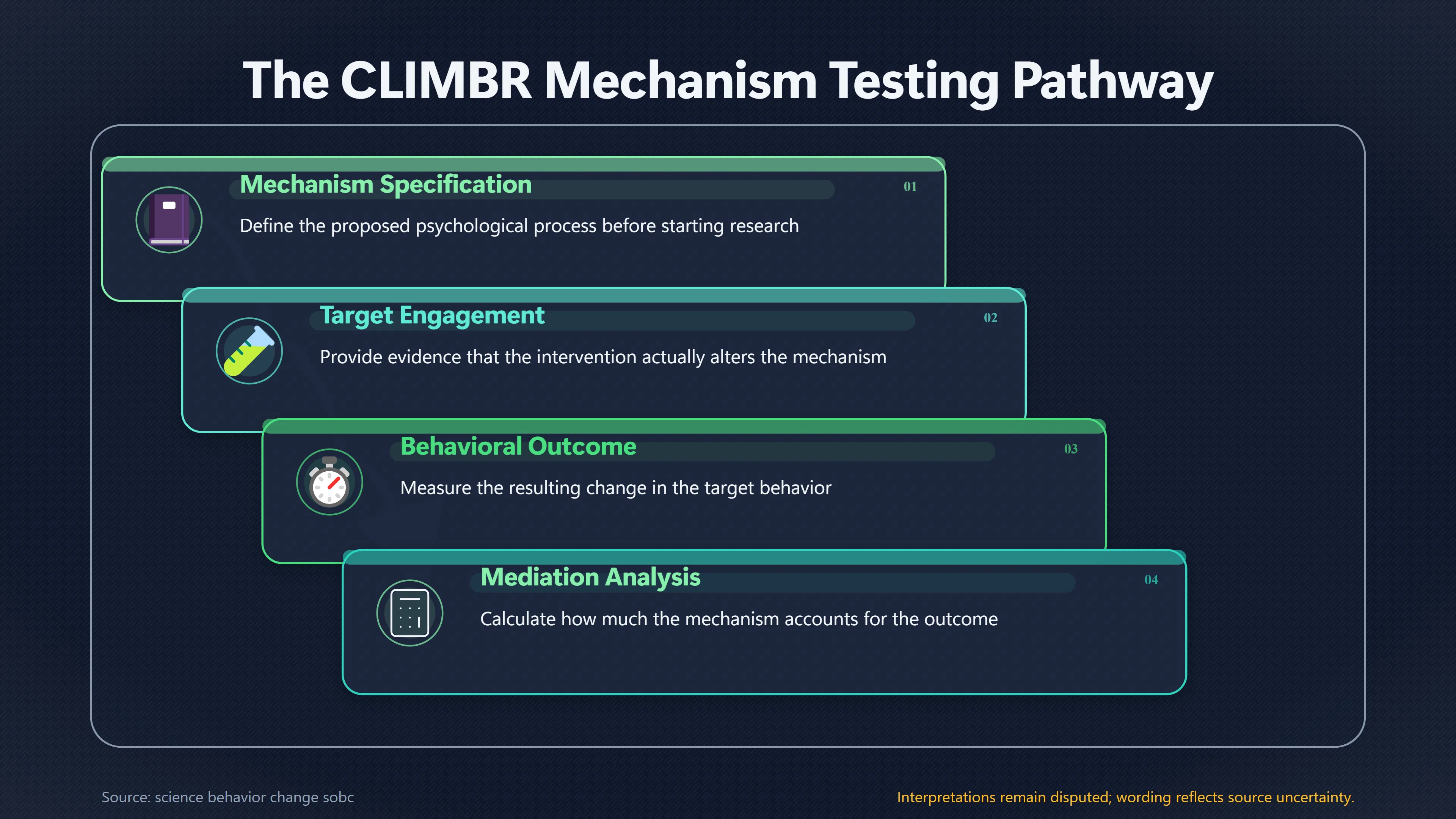
Those are separate questions. A convincing mechanism test needs to establish the links along the proposed pathway. Researchers need a defined and measurable mechanism, evidence that the intervention changes that mechanism — often called target engagement — and evidence connecting the resulting change in the mechanism to the subsequent change in behaviour. The US National Institutes of Health’s Science of Behavior Change programme developed its experimental-medicine approach precisely around this distinction.[PubMed Central (PMC)]pmc.ncbi.nlm.nih.govPubMed Central (PMC)The NIH Science of Behavior Change Program: Transforming the science through a focus on mechanisms of change - PMC…
The distinction matters because behaviour-change techniques can have several plausible routes to the same outcome. Recording daily exercise might increase awareness of progress, make a goal more salient, provide feedback, create a sense of accountability or simply serve as a reminder. An intervention’s success cannot, by itself, tell researchers which of these explanations is responsible.
There is a related classification problem. Behaviour change techniques (BCTs) are things an intervention does — such as prompting goal setting, giving feedback or asking someone to monitor behaviour. Mechanisms of action are the processes through which those techniques are hypothesised to affect behaviour. A synthesis of 277 published intervention articles found many proposed links between BCTs and mechanisms, but its authors emphasised that there was no widely shared understanding of exactly which mechanisms individual techniques operate through.[PubMed Central (PMC)]pmc.ncbi.nlm.nih.govPubMed Central (PMC)Behavior Change Techniques and Their Mechanisms of Action: A Synthesis of Links Described in Published Intervention L… A plausible theoretical link is useful for forming a hypothesis; it is not a substitute for testing it.
The meta-review found a large mechanism gap
Emily Hennessy and colleagues’ systematic meta-review provides the clearest numerical snapshot. The researchers searched literature published from January 2006 to August 2017 and ultimately included 66 meta-analyses quantitatively examining aspects of self-regulation in health-behaviour interventions. The underlying behaviours included areas such as physical activity, diet, medical adherence, sleep, self-care and substance use.[PubMed Central (PMC)]pmc.ncbi.nlm.nih.govPubMed Central (PMC)Self-Regulation Mechanisms in Health Behaviour Change: A Systematic Meta-Review of Meta-Analyses, 2006–2017 - PMCMarc…
The headline contrast was striking:
- 97% of the meta-analyses assessed self-regulation through comparisons involving intervention components.
- Only 6% — four meta-analyses — directly examined whether changes in self-regulation predicted behavioural change.
- Those direct tests covered only a narrow set of proposed mechanisms: self-efficacy, frequency of self-monitoring and cognitive bias.
- Review quality was itself uneven. Only 27% reported a protocol and 11% used GRADE, a system for assessing certainty of evidence; across AMSTAR 2 methodological criteria, the reviews averaged 45.45%.[PubMed Central (PMC)]pmc.ncbi.nlm.nih.govPubMed Central (PMC)Self-Regulation Mechanisms in Health Behaviour Change: A Systematic Meta-Review of Meta-Analyses, 2006–2017 - PMCMarc…
This does not mean that 94% of the literature was worthless or that the interventions did not work. It means something more specific: most of the synthesis literature was better equipped to identify potentially useful intervention components than to establish the psychological mechanisms responsible for their effects.
That distinction is especially important because the component evidence was not uniform. The meta-review found promising results for techniques including personalised feedback, goal setting and self-monitoring, but no component was consistently successful across all the health behaviours and populations in which it had been studied. Some components were supported only by lower-quality reviews.[PubMed]pubmed.ncbi.nlm.nih.govSelf-regulation mechanisms in health behavior change: a systematic meta-review of meta-analyses, 2006-2017 - PubMed… A statement such as “self-monitoring can improve some outcomes” can therefore be substantially better supported than a sweeping explanation of why self-monitoring works.

The rare direct tests show why mechanism testing matters
The small collection of direct tests was not merely a technical footnote. It produced examples in which measuring the proposed mechanism changed what researchers could reasonably conclude.
Progress monitoring provides one of the stronger cases. A meta-analysis by Benjamin Harkin and colleagues included 138 randomised studies and 19,951 participants. Interventions intended to promote monitoring produced a very large increase in the frequency of progress monitoring (d = 1.98) and a more modest improvement in goal attainment (d = 0.40). Crucially, the researchers went beyond showing both effects independently: changes in monitoring frequency mediated the intervention’s effect on goal attainment.[PubMed]pubmed.ncbi.nlm.nih.govOpen source on nih.gov.
That provides more informative evidence than simply observing that programmes containing self-monitoring outperform programmes without it. It supports a pathway in which the intervention changes monitoring and the change in monitoring helps account for improved goal attainment. Even then, mediation evidence needs careful causal interpretation, but it moves the evidence much closer to the proposed mechanism.
Cognitive bias modification provides an instructive counterexample. A 2016 meta-analysis of 25 randomised trials in alcohol problems and smoking found that the interventions produced a moderate post-treatment change in the targeted cognitive biases (g = 0.60), yet there was no significant post-treatment effect on addiction outcomes (g = 0.08) or craving (g = 0.05). More importantly for the mechanism claim, greater changes in cognitive bias were not significantly associated with greater changes in addiction outcomes. Risk of bias was also high or uncertain across much of the evidence.[PLOS]journals.plos.orgOpen source on plos.org.
This is exactly the kind of result that mechanism testing can reveal: an intervention can successfully move its proposed psychological target without producing the behavioural result expected from that theory.
The story has continued to develop rather than resolving into a simple verdict. A 2026 individual-participant-data Bayesian meta-analysis covering 23 studies and 8,297 participants with problematic drinking or alcohol use disorder found evidence that cognitive bias modification reduced cognitive bias and relapse risk, but not alcohol consumption; effects also varied with factors such as delivery context and additional therapy.[PubMed]pubmed.ncbi.nlm.nih.govOpen source on nih.gov. The changing findings reinforce the central point: establishing what psychological variable changes, whether behaviour changes, and whether those two changes are causally connected requires more than labelling an intervention with its presumed mechanism.
Why assumed mechanisms weaken self-improvement advice
Mechanism uncertainty does not make an effective technique ineffective. It changes what can responsibly be said about it.
If repeated trials show that a particular form of progress monitoring improves goal attainment, a reader has a reasonable empirical basis for trying that technique under comparable circumstances. But if researchers have not established the causal pathway, advice should stop short of claiming that the technique works because it strengthens a specific mental faculty.
That restraint has practical value. A correct mechanism can help explain when an intervention should transfer to a new problem, which component can be removed without losing the effect and how the intervention might be improved. A wrong mechanism can produce precisely the opposite: researchers and self-help writers may generalise a successful package to situations where the supposed mechanism is irrelevant.
It also affects troubleshooting. Suppose an intervention produces no behavioural improvement. Without mechanism measurements, researchers may not know whether the technique failed to alter the psychological target, whether the target changed but proved unimportant for behaviour, or whether the mechanism works only under particular circumstances. The NIH experimental-medicine framework separates these possibilities by asking researchers to demonstrate target engagement and then connect that engagement to behavioural outcomes.[PubMed Central (PMC)]pmc.ncbi.nlm.nih.govPubMed Central (PMC)The NIH Science of Behavior Change Program: Transforming the science through a focus on mechanisms of change - PMC…
What stronger mechanism evidence looks like
More recent methodological guidance makes the standard explicit. The Checklist for Investigating Mechanisms in Behavior-change Research (CLIMBR), developed from the Science of Behavior Change programme, says proposed mechanisms should be specified in advance, measured rather than merely invoked, assessed with sound measures and experimentally engaged where possible. To call a mechanism a demonstrated driver, the framework requires evidence both that an intervention reliably changes it and that change in the mechanism subsequently leads to change in the predicted behaviour.[PubMed Central (PMC)]pmc.ncbi.nlm.nih.govOpen source on nih.gov.
For intervention studies capable of testing the full pathway, CLIMBR also recommends reporting mediation analyses that estimate how much of the behavioural effect is accounted for by change in the measured mechanism.[PubMed Central (PMC)]pmc.ncbi.nlm.nih.govOpen source on nih.gov. This turns “the intervention probably works through self-regulation” into a proposition that can fail as well as succeed.
That possibility of failure is scientifically valuable. If the target changes but behaviour does not, the theory needs revision. If behaviour changes without detectable target engagement, researchers need to investigate another mechanism or question the measure. If both change and the proposed pathway is supported, confidence in the explanation grows.
The useful conclusion is narrower than the self-help story
The Hennessy meta-review should not be read as evidence that self-regulation techniques generally fail. Its more important finding is an evidence mismatch. The literature contained considerable information about whether interventions incorporating goal setting, monitoring, feedback and related techniques changed outcomes, but surprisingly little meta-analytic evidence establishing that their presumed self-regulatory mechanisms actually produced those changes.[PubMed Central (PMC)]pmc.ncbi.nlm.nih.govPubMed Central (PMC)Self-Regulation Mechanisms in Health Behaviour Change: A Systematic Meta-Review of Meta-Analyses, 2006–2017 - PMCMarc…
For someone looking for self-improvement that works, this creates a useful hierarchy of confidence. Evidence that a technique improves behaviour supports trying the technique. Evidence that it changes a proposed psychological target adds another piece of the causal chain. Evidence that experimentally changing that target reliably produces the behavioural improvement is stronger still.
Popular self-improvement explanations often collapse all three levels into one sentence: this technique works because it strengthens X. The research reviewed here shows why that sentence frequently contains two claims with different evidential support. An intervention can have a credible outcome effect while its explanation remains provisional. Keeping those claims separate is not excessive scepticism; it is what prevents a promising self-improvement technique from being turned into a psychological law before the mechanism has actually been tested.
Amazon book picks
Further Reading
Books and field guides related to Do Self Improvement Studies Prove Why Their Techniques Work?. Use these as the next step if you want deeper reading beyond the article.
The Willpower Instinct
Based on Stanford University psychologist Kelly McGonigal's wildly popular course "The Science of Willpower," The Willpower Instinct is t...
Thinking, Fast and Slow
Why is there more chance we'll believe something if it's in a bold type face? Why are judges more likely to deny parole before lunch? Why...
The Book of Why
The hugely influential book on how the understanding of causality revolutionized science and the world, by the pioneer of artificial inte...
How to Read a Paper
The best-selling introduction to evidence-based medicine In a clear and engaging style, How to Read a Paper demystifies evidence-based me...
eBay marketplace picks
Marketplace Samples
Live-tested eBay searches with available results related to this page.
Selected frompsychology poster oneBay.co.uk.




Endnotes
1.
Source: pmc.ncbi.nlm.nih.gov
Link:https://pmc.ncbi.nlm.nih.gov/articles/PMC7571594/
Source snippet
PubMed Central (PMC)Self-Regulation Mechanisms in Health Behaviour Change: A Systematic Meta-Review of Meta-Analyses, 2006–2017 - PMCMarc...
2.
Source: pubmed.ncbi.nlm.nih.gov
Link:https://pubmed.ncbi.nlm.nih.gov/31662031/
Source snippet
Self-regulation mechanisms in health behavior change: a systematic meta-review of meta-analyses, 2006-2017 - PubMed...
3.
Source: pmc.ncbi.nlm.nih.gov
Link:https://pmc.ncbi.nlm.nih.gov/articles/PMC5756516/
Source snippet
PubMed Central (PMC)The NIH Science of Behavior Change Program: Transforming the science through a focus on mechanisms of change - PMC...
4.
Source: nia.nih.gov
Link:https://www.nia.nih.gov/news/adopting-healthy-habits-what-do-we-know-about-science-behavior-change
5.
Source: pmc.ncbi.nlm.nih.gov
Link:https://pmc.ncbi.nlm.nih.gov/articles/PMC6636886/
Source snippet
PubMed Central (PMC)Behavior Change Techniques and Their Mechanisms of Action: A Synthesis of Links Described in Published Intervention L...
6.
Source: pubmed.ncbi.nlm.nih.gov
Link:https://pubmed.ncbi.nlm.nih.gov/26479070/
7.
Source: journals.plos.org
Link:https://journals.plos.org/plosone/article?id=10.1371%2Fjournal.pone.0162226
8.
Source: pmc.ncbi.nlm.nih.gov
Link:https://pmc.ncbi.nlm.nih.gov/articles/PMC5017662/
9.
Source: pubmed.ncbi.nlm.nih.gov
Link:https://pubmed.ncbi.nlm.nih.gov/41653812/
10.
Source: pmc.ncbi.nlm.nih.gov
Link:https://pmc.ncbi.nlm.nih.gov/articles/PMC10279971/
11.
Source: nia.nih.gov
Title: science behavior change sobc
Link:https://www.nia.nih.gov/research/dbsr/science-behavior-change-sobc
12.
Source: commonfund.nih.gov
Title: health relevance
Link:https://commonfund.nih.gov/behaviorchange/health-relevance
13.
Source: pmc.ncbi.nlm.nih.gov
Link:https://pmc.ncbi.nlm.nih.gov/articles/PMC11960000/
14.
Source: pmc.ncbi.nlm.nih.gov
Link:https://pmc.ncbi.nlm.nih.gov/articles/PMC9843482/
15.
Source: pmc.ncbi.nlm.nih.gov
Link:https://pmc.ncbi.nlm.nih.gov/articles/PMC10331559/
16.
Source: pubmed.ncbi.nlm.nih.gov
Link:https://pubmed.ncbi.nlm.nih.gov/37330260/
17.
Source: pmc.ncbi.nlm.nih.gov
Link:https://pmc.ncbi.nlm.nih.gov/articles/PMC10370829/
18.
Source: ncbi.nlm.nih.gov
Link:https://www.ncbi.nlm.nih.gov/books/NBK580336/
19.
Source: pubmed.ncbi.nlm.nih.gov
Link:https://pubmed.ncbi.nlm.nih.gov/35353414/
20.
Source: pubmed.ncbi.nlm.nih.gov
Link:https://pubmed.ncbi.nlm.nih.gov/31662031/?dopt=Abstract
21.
Source: pmc.ncbi.nlm.nih.gov
Link:https://pmc.ncbi.nlm.nih.gov/articles/PMC7018570/
22.
Source: pubmed.ncbi.nlm.nih.gov
Link:https://pubmed.ncbi.nlm.nih.gov/31856664/
23.
Source: pmc.ncbi.nlm.nih.gov
Link:https://pmc.ncbi.nlm.nih.gov/articles/PMC7429262/
24.
Source: pmc.ncbi.nlm.nih.gov
Link:https://pmc.ncbi.nlm.nih.gov/articles/PMC7254887/
25.
Source: pubmed.ncbi.nlm.nih.gov
Link:https://pubmed.ncbi.nlm.nih.gov/31707938/
26.
Source: pubmed.ncbi.nlm.nih.gov
Link:https://pubmed.ncbi.nlm.nih.gov/30534971/
27.
Source: pubmed.ncbi.nlm.nih.gov
Link:https://pubmed.ncbi.nlm.nih.gov/30304386/
28.
Source: pubmed.ncbi.nlm.nih.gov
Link:https://pubmed.ncbi.nlm.nih.gov/30452535/
29.
Source: pubmed.ncbi.nlm.nih.gov
Link:https://pubmed.ncbi.nlm.nih.gov/30644025/
30.
Source: pmc.ncbi.nlm.nih.gov
Link:https://pmc.ncbi.nlm.nih.gov/articles/PMC6499757/
31.
Source: pmc.ncbi.nlm.nih.gov
Link:https://pmc.ncbi.nlm.nih.gov/articles/PMC6636885/
32.
Source: pubmed.ncbi.nlm.nih.gov
Link:https://pubmed.ncbi.nlm.nih.gov/28759865/
33.
Source: pubmed.ncbi.nlm.nih.gov
Link:https://pubmed.ncbi.nlm.nih.gov/29110885/
34.
Source: pmc.ncbi.nlm.nih.gov
Link:https://pmc.ncbi.nlm.nih.gov/articles/PMC5364185/
35.
Source: pubmed.ncbi.nlm.nih.gov
Link:https://pubmed.ncbi.nlm.nih.gov/27611692/
36.
Source: pubmed.ncbi.nlm.nih.gov
Link:https://pubmed.ncbi.nlm.nih.gov/27280365/
37.
Source: pubmed.ncbi.nlm.nih.gov
Link:https://pubmed.ncbi.nlm.nih.gov/27280365/?dopt=Abstract
38.
Source: pmc.ncbi.nlm.nih.gov
Link:https://pmc.ncbi.nlm.nih.gov/articles/PMC4408562/
39.
Source: grants.nih.gov
Link:https://grants.nih.gov/grants/guide/notice-files/NOT-RM-15-003.html
40.
Source: pubmed.ncbi.nlm.nih.gov
Link:https://pubmed.ncbi.nlm.nih.gov/31973666/
41.
Source: pubmed.ncbi.nlm.nih.gov
Link:https://pubmed.ncbi.nlm.nih.gov/32833474/
42.
Source: ncbi.nlm.nih.gov
Link:https://www.ncbi.nlm.nih.gov/books/NBK568103/
43.
Source: pubmed.ncbi.nlm.nih.gov
Link:https://pubmed.ncbi.nlm.nih.gov/23731175/
44.
Source: youtube.com
Title: SOBC 101: Science of Behavior Change for Psychological Scientists
Link:https://www.youtube.com/watch?v=TxopQidhwFs
Source snippet
CLIMBR - Checklist for Investigating Mechanisms in Behavior-change Research...
45.
Source: youtube.com
Link:https://www.youtube.com/watch?v=ZLkvmrXM3cI
Source snippet
Why Behavioral Interventions Work (or Don't Work)...
Additional References
46.
Source: academic.oup.com
Link:https://academic.oup.com/abm/article/53/8/693/5126198
Source snippet
OUP AcademicBehavior Change Techniques and Their Mechanisms of Action: A Synthesis of Links Described in Published Intervention Literatur...
47.
Source: youtube.com
Title: SOBC & HBCP
Link:https://www.youtube.com/watch?v=lqaWbKP2lyw
Source snippet
This presentation on SOBC 101: Science of Behavior Change for Psychological Scientists directly explains the experimental medicine method...
48.
Source: researchgate.net
Link:https://www.researchgate.net/publication/23508888_A_Principal-Agent_Model_for_Investigating_Traceability_Systems_Incentives_for_Food_Safety
49.
Source: researchgate.net
Link:https://www.researchgate.net/publication/291335719_Does_Monitoring_Goal_Progress_Promote_Goal_Attainment_A_Meta-Analysis_of_the_Experimental_Evidence
50.
Source: researchgate.net
Link:https://www.researchgate.net/publication/336901634_Self-Regulation_Mechanisms_in_Health_Behaviour_Change_A_Systematic_Meta-Review_of_Meta-Analyses
51.
Source: ichgcp.net
Link:https://ichgcp.net/clinical-trials-registry/publications/67812-self-regulation-mechanisms-in-health-behavior-change-a-systematic-meta-review-of-meta-analyses-2006
52.
Source: equator-network.org
Link:https://www.equator-network.org/reporting-guidelines-keyword/checklist-for-investigating-mechanisms-in-behavior-change-research/
53.
Source: sciencedirect.com
Link:https://www.sciencedirect.com/science/article/pii/S0272735826000188
54.
Source: 1library.net
Link:https://1library.net/document/rz3x7o7z-does-monitoring-progress-promote-attainment-analysis-experimental-evidence.html
55.
Source: eurekamag.com
Link:https://eurekamag.com/research/057/653/057653112.php