Within Behaviour Goals
Is Your Goal Really Under Your Control?
Strong behaviour goals can be performed deliberately, verified clearly and repeated in a way that plausibly helps the outcome.
On this page
- The deliberate action test
- The clear yes or no completion test
- The usefulness test for productive looking habits
Page outline Jump by section
Introduction
A behaviour goal is truly controllable when you can deliberately perform the action, tell clearly whether you performed it, and reasonably expect repeated performance to help the outcome you care about. Specificity and measurability are not enough. “Get seven hours of sleep”, “feel confident in meetings” and “receive three job offers” are all measurable, but none is fully produced by an act of will. By contrast, “switch off screens at 10.30 pm”, “ask one prepared question in the meeting” and “submit four tailored applications this week” describe actions you can actually initiate.
This distinction matters because goal setting directs attention and effort. A poorly chosen target can therefore make you diligently pursue something you cannot control — or become extremely consistent at an activity that contributes little to the result. Research on goal setting, implementation intentions and progress monitoring supports moving the target towards observable action, while research on poorly specified targets shows why the right thing must be measured, not merely something easy to count.[DOI]doi.orgThe Intention–Behavior GapThe Intention–Behavior Gap - Sheeran - 2016 - Social and Personality Psychology Compass - Wiley Online LibrarySeptember 5, 2016…
The deliberate-action test
The first test is simple: could you perform the goal deliberately, on command, when the relevant opportunity arrives?
This separates an action from an outcome, reaction or internal state. Consider these pairs:
- “Fall asleep by 11 pm” → “Get into bed at 10.45 pm with my phone outside the bedroom.” You can create conditions favourable to sleep; you cannot directly command sleep to begin.
- “Be confident during presentations” → “Deliver my opening paragraph without rushing and make eye contact with three parts of the room.” Confidence may follow, but it is not itself a reliable voluntary action.
- “Make my manager recognise my contribution” → “Send a Friday update summarising completed work, decisions and blockers.” Your communication is controllable; your manager’s judgement is not.
- “Get an interview” → “Submit one carefully tailored application to a suitable vacancy.” An employer controls the invitation.
- “Run a personal best” → “Complete the planned interval session at the prescribed effort.” Training behaviour is directly available to you; race-day performance also depends on conditions, health and other variables.
This does not mean outcomes are irrelevant. They tell you where you want the behaviour to lead. The mistake is treating an outcome as though it were the action itself.
The distinction fits the broader evidence on the intention–behaviour gap: wanting a result does not guarantee that the required behaviour occurs. Implementation intentions address precisely this problem by linking a recognisable situation with a specified response — in effect, defining what the person will do when the opportunity appears. A major 2006 meta-analysis covering 94 independent tests found a medium-to-large overall effect of implementation intentions on goal attainment, while a much larger 2024 synthesis of 642 tests found benefits across behavioural, cognitive and affective outcomes, with stronger effects for genuinely contingent if–then plans.[ScienceDirect]sciencedirect.comImplementation Intentions and Goal Achievement: A Meta‐analysis of Effects and Processes - ScienceDirect…
There is an important qualification. “Under your control” should not be interpreted as “guaranteed to happen”. Illness, emergencies, caring responsibilities, equipment failure and other constraints can prevent even a well-defined behaviour. The useful distinction is direct agency rather than certainty. “Walk for 20 minutes after lunch” passes because walking is an action you can normally initiate. It does not fail the test merely because a sprained ankle could occasionally make it impossible.
A useful diagnostic question is therefore:
If the outcome went badly despite my doing exactly what this goal says, could I still truthfully say that I completed the goal?
If the answer is no, the wording probably still contains an outcome. You can complete four applications and receive no interviews. You can practise piano for 30 focused minutes and still play badly at tomorrow’s recital. You can prepare carefully for a difficult conversation and still receive an unfavourable response. A controllable behaviour goal separates execution, which you can judge immediately, from effectiveness, which has to be evaluated over time.
The clear yes-or-no completion test
A behaviour can be voluntary yet still be too vague to regulate action. “Work on my dissertation”, “eat better”, “be more organised” and “practise properly” all describe desirable directions, but they leave enough interpretive room for the standard to change after the event.
The second test is therefore: at the end of the relevant period, can a reasonable observer answer yes or no about whether the behaviour occurred?
“Study hard tonight” fails. “Complete and mark 20 retrieval-practice questions before 8 pm” passes. “Network more” fails. “Send one personalised message to a professional contact on Tuesday” passes. “Spend less online” is ambiguous; “wait 24 hours before completing any non-essential online purchase above £30” gives a much cleaner completion rule.
That clarity is valuable partly because self-regulation depends on feedback. The American Psychological Association’s summary of goal-setting theory notes that goals focus activity and that feedback about performance or progress is important to their effectiveness. More directly, a meta-analysis of 138 experimental studies involving 19,951 participants found that interventions designed to increase progress monitoring increased both monitoring and goal attainment; effects on attainment were larger when progress was physically recorded or reported publicly.[APA Dictionary]dictionary.apa.orgDictionary APA Dictionary of PsychologyAPA DictionaryAPA Dictionary of PsychologyApril 19, 2018…
A binary completion rule does not, however, mean reducing every activity to a crude number. This is where popular advice about making goals “SMART” can mislead. A review of SMART goals in physical activity concluded that the familiar acronym has much weaker scientific foundations than its ubiquity suggests and, importantly, does not adequately distinguish between different types of goals. The review also found that empirical evidence does not support treating every element of the acronym as universally necessary.[PubMed]pubmed.ncbi.nlm.nih.govThe (over)use of SMART goals for physical activity promotion: A narrative review and critique - PubMedJanuary 31, 2022…
The control test is asking something more fundamental than “Is it measurable?” It asks what the measurement represents.
“Read 30 pages” is beautifully measurable, for example, but it does not establish that you understood anything. If understanding matters, a better completion criterion might be “read the section and answer five retrieval questions without looking at the text”. Similarly, “write 1,000 words” may be useful during a rough first draft but potentially counterproductive during final editing, when deleting 500 unnecessary words could be better work.
The completion rule should therefore be precise enough to prevent self-deception without becoming so crude that the metric replaces the purpose.
The usefulness test
The hardest test comes after controllability and clarity: if you repeatedly completed this behaviour, is there a credible reason to expect it to improve the desired outcome?
This catches the most deceptive failure mode because low-value behaviours often feel productive. They can be scheduled, measured and ticked off with satisfying precision.
Suppose someone wants to improve an examination result. All of these are under their control:
- spend 45 minutes colour-coding notes;
- reorganise the revision timetable;
- watch three study-advice videos;
- complete and mark a set of practice questions;
- retrieve key ideas from memory and check errors afterwards.
Controllability alone cannot distinguish among them. The third test forces the person to ask what mechanism connects the activity to the desired change.
This is why “process” should not become synonymous with “anything I can count”. Goal-setting interventions themselves do not work uniformly across behaviours and populations. A large meta-review of health behaviour research found goal setting, self-monitoring and other self-regulation techniques useful in some circumstances but not consistently effective across every behaviour and population. Another meta-review found notably mixed evidence for several commonly recommended self-regulation techniques in physical activity.[PubMed Central (PMC)]pmc.ncbi.nlm.nih.govPubMed Central (PMC)Self-Regulation Mechanisms in Health Behaviour Change: A Systematic Meta-Review of Meta-Analyses, 2006–2017 - PMCMarc…
The practical implication is not that behaviour goals are unreliable. It is that a controllable goal is an execution tool, not proof that the chosen behaviour is effective. The underlying behaviour still needs a plausible causal connection to the outcome.
When the metric changes the behaviour
A particularly useful warning comes from an experiment on procedural learning. Eighty students repeatedly practised tying blood-vessel ligatures and were randomly assigned either a speed goal or a quality goal part-way through the task. Those given the speed goal eventually worked 18% faster than the quality-goal group — but produced fewer leak-free ligatures. At a given performance time, the speed-goal group was also more likely to produce leaks.[PubMed]pubmed.ncbi.nlm.nih.govSpeed and quality goals in procedural skills learning: A randomized experiment - PubMed…
Both goals were controllable. Both were measurable. Both successfully changed behaviour. They changed it in different directions.
That is the crucial risk in productive-looking habits: once a metric becomes the target, attention and effort can shift towards whatever earns the tick. Research critiques of aggressive goal setting have similarly warned that narrow goals can cause people to neglect important dimensions that were left outside the target.[Academy of Management Journals]journals.aom.orgOpen source on aom.org.
For personal goals, the consequences are usually less dramatic but structurally similar. A reading target can encourage finishing pages rather than understanding them. A daily writing streak can encourage low-value words merely to preserve the streak. An inbox-zero target can turn email processing into the day’s main achievement. A step target can encourage extra movement, which may be exactly what is wanted, but it should not automatically be mistaken for a complete measure of fitness.
A good behaviour goal therefore survives a counterfactual question: If I became exceptionally good at hitting this target while the underlying outcome stayed unchanged, would I still regard the behaviour as worthwhile? If not, the metric probably needs revision.
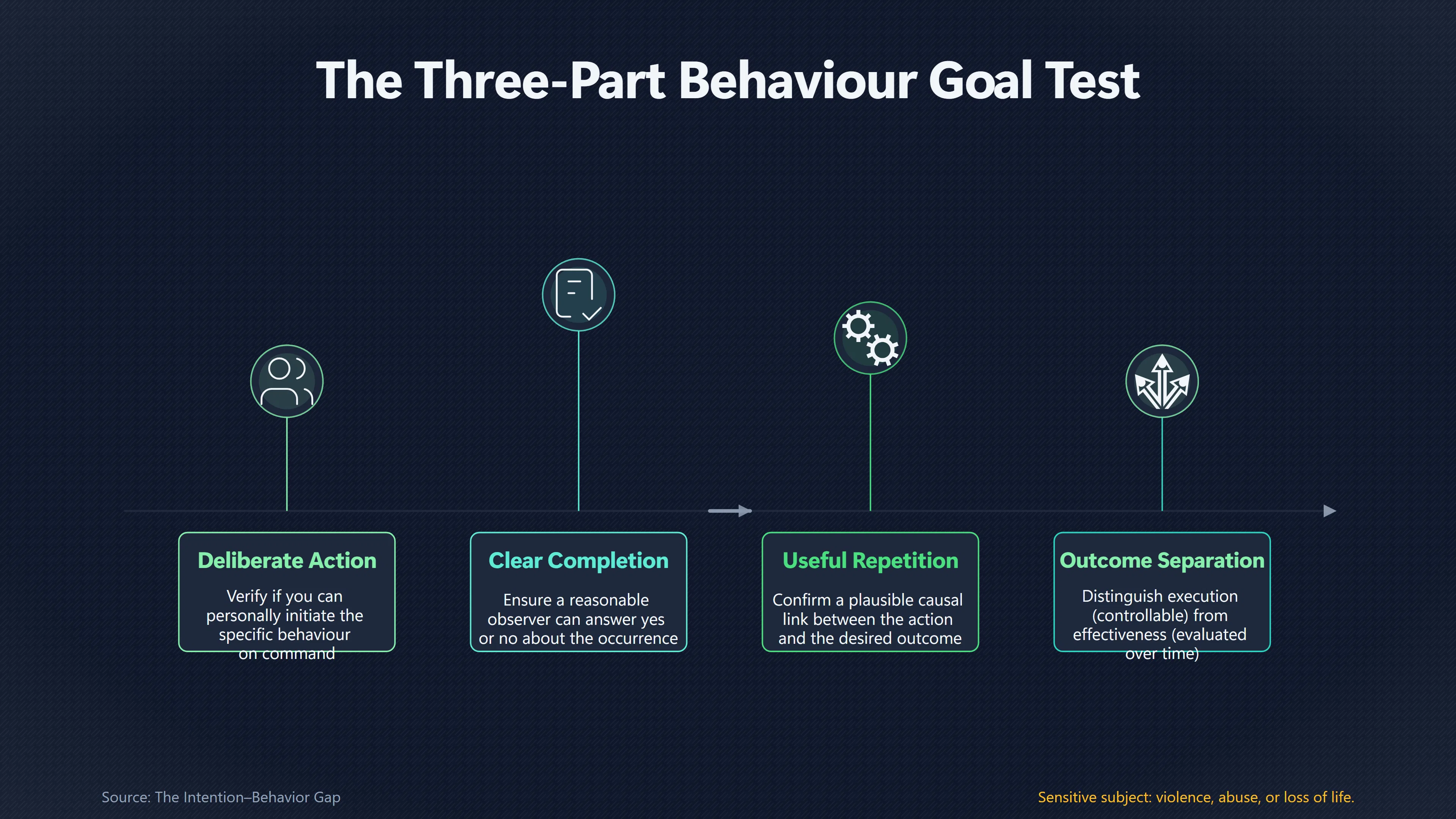
A three-part control test
The three tests work best together rather than as separate goal-setting rules.[sciencedirect.com]sciencedirect.comGoal Setting TheoryGoal Setting Theory
1. Deliberate action: Can I personally initiate this behaviour?
If success requires somebody else’s decision, an emotional state, a biological response or an external result, move the goal one step towards your own action.
2. Clear completion: Could I tell, without arguing with myself afterwards, whether I did it?
Replace interpretive language such as “properly”, “more”, “better” or “seriously” with an observable completion rule where that improves clarity.
3. Useful repetition: If I kept doing this, why should it help?
Name the connection between the behaviour and the desired outcome. If the answer amounts to “because it feels productive”, reconsider the target.
A goal should normally pass all three. “Get promoted this year” fails the first. “Work harder” fails the second. “Spend an hour every morning perfecting my productivity spreadsheet” may pass the first two while failing the third.
By contrast, “before starting email each weekday, spend 30 minutes drafting the highest-priority report” is deliberately executable and plainly verifiable. Whether it ultimately improves work performance remains an empirical question, which is exactly why the behaviour and the outcome should remain separate.
That separation also makes adaptation easier. Monitoring research suggests that tracking progress can improve goal attainment, but tracking is most useful when it produces information you can act on.[PubMed]pubmed.ncbi.nlm.nih.govDoes monitoring goal progress promote goal attainment? A meta-analysis of the experimental evidence - PubMed… If the behaviour is happening consistently but the desired outcome is not improving after a meaningful interval, the response need not be “try harder”. The behaviour itself may be poorly chosen.

Control without pretending you control the outcome
The purpose of the control test is not to make life perfectly predictable. It is to put the immediate success criterion where your agency is strongest while leaving the larger outcome available as feedback.
That creates two distinct questions:
Did I execute the behaviour? Judge this frequently and directly.
Is the behaviour producing useful results? Judge this over an appropriate period, using evidence from the outcome.
Keeping those questions separate prevents two common errors. The first is blaming yourself for an outcome that was never fully controllable: the rejected application, disrupted night’s sleep, disappointing race time or other person’s reaction. The second is rewarding yourself indefinitely for faithfully completing a behaviour that is not working.
The strongest behaviour goal therefore does something more precise than make an aspiration measurable. It defines a deliberate, observable and repeatable action with a defensible connection to the result. That is the point at which a goal stops being merely well worded and becomes genuinely useful for turning intention into action.
Amazon book picks
Further Reading
Books and field guides related to Is Your Goal Really Under Your Control?. Use these as the next step if you want deeper reading beyond the article.
Tiny Habits
The world's leading expert on habit formation shows how you can have a happier, healthier life: by starting small. Myth: Change is hard....
Succeed: How We Can Reach Our Goals
Do you ever wonder why Asian students are able to achieve so much more than their American counterparts? Even very smart, very accomplish...
Rethinking Positive Thinking
“The solution isn’t to do away with dreaming and positive thinking. Rather, it’s making the most of our fantasies by brushing them up aga...
Atomic Habits
Rating: 3.5/5 from 7 Google Books ratings
The #1 New York Times bestseller. Over 25 million copies sold! Translated into 60+ languages! Tiny Changes, Remarkable Results No matter...
eBay marketplace picks
Marketplace Samples
Live-tested eBay searches with available results related to this page.
Selected frommotivational poster oneBay.co.uk.


Current eBay listing
Motivational Quotes Framed Wall Art Poster Canvas Print Picture


Current eBay listing
Gym Motivational Posters Work Out Insperational Quotes Wall Art
Endnotes
1.
Source: doi.org
Title: The Intention–Behavior Gap
Link:https://doi.org/10.1111/spc3.12265
Source snippet
The Intention–Behavior Gap - Sheeran - 2016 - Social and Personality Psychology Compass - Wiley Online LibrarySeptember 5, 2016...
Published: September 5, 2016
2.
Source: doi.org
Link:https://doi.org/10.1080/10463283.2024.2334563
Source snippet
The when and how of planning: Meta-analysis of the scope and components of implementation intentions in 642 tests: European Review of...
3.
Source: sciencedirect.com
Link:https://www.sciencedirect.com/science/article/abs/pii/S0065260106380021
Source snippet
Implementation Intentions and Goal Achievement: A Meta‐analysis of Effects and Processes - ScienceDirect...
4.
Source: dictionary.apa.org
Title: Dictionary APA Dictionary of Psychology
Link:https://dictionary.apa.org/lockes-theory-of-goal-setting
Source snippet
APA DictionaryAPA Dictionary of PsychologyApril 19, 2018...
Published: April 19, 2018
5.
Source: doi.org
Link:https://doi.org/10.1007/s40279-025-02373-5
6.
Source: doi.org
Link:https://doi.org/10.1080%2F17437199.2025.2467695
7.
Source: doi.org
Link:https://doi.org/10.1080/1750984X.2022.2116723?urlappend=%3Futm_source%3Dresearchgate.net%26utm_medium%3Darticle
8.
Source: doi.org
Link:https://doi.org/10.1080/1750984X.2021.1901298
9.
Source: doi.org
Link:https://doi.org/10.1111/apps.12239
10.
Source: apa.org
Title: journal articles
Link:https://www.apa.org/monitor/2019/12/journal-articles
11.
Source: dictionary.apa.org
Title: goal setting
Link:https://dictionary.apa.org/goal-setting
12.
Source: doi.org
Title: Full article: Priorities and targets: supporting target-setting in healthcare
Link:https://doi.org/10.1080/09540962.2017.1295728
13.
Source: sciencedirect.com
Title: The effect of priming learning vs. performance goals on a complex task
Link:https://www.sciencedirect.com/science/article/abs/pii/S0749597814000508
14.
Source: sciencedirect.com
Link:https://www.sciencedirect.com/science/article/abs/pii/S0149206301001088
15.
Source: sciencedirect.com
Title: Goal Setting Effects on Implicit and Explicit Learning of Complex Tasks
Link:https://www.sciencedirect.com/science/article/pii/S0749597896900023
16.
Source: sciencedirect.com
Title: Separating the effects of goal specificity from goal level
Link:https://www.sciencedirect.com/science/article/pii/0749597889900538
17.
Source: sciencedirect.com
Link:https://www.sciencedirect.com/science/article/abs/pii/0749597887900458
18.
Source: sciencedirect.com
Link:https://www.sciencedirect.com/science/chapter/bookseries/abs/pii/S0065260106380021
19.
Source: sciencedirect.com
Link:https://www.sciencedirect.com/science/article/pii/0749597887900458
20.
Source: sciencedirect.com
Link:https://www.sciencedirect.com/science/article/abs/pii/S002210310600028X
21.
Source: sciencedirect.com
Title: Immoral goals: how goal setting may lead to unethical behavior
Link:https://www.sciencedirect.com/science/article/pii/S2352250X15001633
22.
Source: sciencedirect.com
Link:https://www.sciencedirect.com/science/article/pii/S0749597817304594
23.
Source: sciencedirect.com
Title: Goal Setting Theory
Link:https://www.sciencedirect.com/topics/social-sciences/goal-setting-theory
24.
Source: sciencedirect.com
Link:https://www.sciencedirect.com/science/article/pii/S0749597813000423
25.
Source: sciencedirect.com
Title: Goal Setting Effects on Implicit and Explicit Learning of Complex Tasks
Link:https://www.sciencedirect.com/science/article/abs/pii/S0749597896900023
26.
Source: apa.org
Link:https://www.apa.org/ed/schools/teaching-learning/top-twenty/motivation
27.
Source: apa.org
Link:https://www.apa.org/ed/schools/teaching-learning/top-twenty/disabilities/motivation
28.
Source: apa.org
Link:https://www.apa.org/ed/schools/teaching-learning/top-twenty/early-childhood/motivation
29.
Source: apa.org
Link:https://www.apa.org/ed/schools/teaching-learning/top-twenty/creative-talented/motivation
30.
Source: apa.org
Link:https://www.apa.org/education-career/k12/top-ten-principles-families
31.
Source: apa.org
Link:https://www.apa.org/gradpsych/2012/09/cover-success
32.
Source: apa.org
Link:https://www.apa.org/pubs/journals/xhp/sample.html?page=1
33.
Source: apa.org
Link:https://www.apa.org/ed/schools/myth-busters
34.
Source: apa.org
Link:https://www.apa.org/gradpsych/2009/09/bad-habits
35.
Source: pubmed.ncbi.nlm.nih.gov
Link:https://pubmed.ncbi.nlm.nih.gov/31595825/
Source snippet
Speed and quality goals in procedural skills learning: A randomized experiment - PubMed...
36.
Source: pubmed.ncbi.nlm.nih.gov
Link:https://pubmed.ncbi.nlm.nih.gov/26479070/
Source snippet
Does monitoring goal progress promote goal attainment? A meta-analysis of the experimental evidence - PubMed...
37.
Source: pubmed.ncbi.nlm.nih.gov
Link:https://pubmed.ncbi.nlm.nih.gov/35094640/
Source snippet
The (over)use of SMART goals for physical activity promotion: A narrative review and critique - PubMedJanuary 31, 2022...
Published: January 31, 2022
38.
Source: pmc.ncbi.nlm.nih.gov
Link:https://pmc.ncbi.nlm.nih.gov/articles/PMC7571594/
Source snippet
PubMed Central (PMC)Self-Regulation Mechanisms in Health Behaviour Change: A Systematic Meta-Review of Meta-Analyses, 2006–2017 - PMCMarc...
39.
Source: pmc.ncbi.nlm.nih.gov
Link:https://pmc.ncbi.nlm.nih.gov/articles/PMC7429262/
Source snippet
PubMed Central (PMC)Self-regulatory behavior change techniques in interventions to promote healthy eating, physical activity, or weight l...
40.
Source: journals.aom.org
Link:https://journals.aom.org/doi/10.5465/AMP.2009.37007999
41.
Source: pubmed.ncbi.nlm.nih.gov
Link:https://pubmed.ncbi.nlm.nih.gov/41784001/
42.
Source: pmc.ncbi.nlm.nih.gov
Link:https://pmc.ncbi.nlm.nih.gov/articles/PMC13018065/
43.
Source: pmc.ncbi.nlm.nih.gov
Link:https://pmc.ncbi.nlm.nih.gov/articles/PMC13340623/
44.
Source: pubmed.ncbi.nlm.nih.gov
Link:https://pubmed.ncbi.nlm.nih.gov/40720280/
45.
Source: pmc.ncbi.nlm.nih.gov
Link:https://pmc.ncbi.nlm.nih.gov/articles/PMC12103685/
46.
Source: pmc.ncbi.nlm.nih.gov
Link:https://pmc.ncbi.nlm.nih.gov/articles/PMC9223740/
47.
Source: pmc.ncbi.nlm.nih.gov
Link:https://pmc.ncbi.nlm.nih.gov/articles/PMC8815876/
48.
Source: pmc.ncbi.nlm.nih.gov
Link:https://pmc.ncbi.nlm.nih.gov/articles/PMC8490751/
49.
Source: pmc.ncbi.nlm.nih.gov
Link:https://pmc.ncbi.nlm.nih.gov/articles/PMC8149892/
50.
Source: pmc.ncbi.nlm.nih.gov
Link:https://pmc.ncbi.nlm.nih.gov/articles/PMC8167273/
51.
Source: pmc.ncbi.nlm.nih.gov
Link:https://pmc.ncbi.nlm.nih.gov/articles/PMC7018570/
52.
Source: pubmed.ncbi.nlm.nih.gov
Link:https://pubmed.ncbi.nlm.nih.gov/30990131/
53.
Source: pmc.ncbi.nlm.nih.gov
Link:https://pmc.ncbi.nlm.nih.gov/articles/PMC6099114/
54.
Source: pubmed.ncbi.nlm.nih.gov
Link:https://pubmed.ncbi.nlm.nih.gov/29498547/
55.
Source: pubmed.ncbi.nlm.nih.gov
Link:https://pubmed.ncbi.nlm.nih.gov/29466911/
56.
Source: journals.aom.org
Link:https://journals.aom.org/doi/10.5465/ambpp.2016.11095abstract
57.
Source: pubmed.ncbi.nlm.nih.gov
Link:https://pubmed.ncbi.nlm.nih.gov/29176800/
58.
Source: ncbi.nlm.nih.gov
Link:https://www.ncbi.nlm.nih.gov/books/NBK543706/
59.
Source: pmc.ncbi.nlm.nih.gov
Link:https://pmc.ncbi.nlm.nih.gov/articles/PMC5370453/
60.
Source: compass.onlinelibrary.wiley.com
Link:https://compass.onlinelibrary.wiley.com/doi/10.1111/spc3.12265
61.
Source: pubmed.ncbi.nlm.nih.gov
Link:https://pubmed.ncbi.nlm.nih.gov/27183304/
62.
Source: pmc.ncbi.nlm.nih.gov
Link:https://pmc.ncbi.nlm.nih.gov/articles/PMC4500900/
63.
Source: pubmed.ncbi.nlm.nih.gov
Link:https://pubmed.ncbi.nlm.nih.gov/25965276/
64.
Source: pubmed.ncbi.nlm.nih.gov
Link:https://pubmed.ncbi.nlm.nih.gov/752413/
65.
Source: pubmed.ncbi.nlm.nih.gov
Link:https://pubmed.ncbi.nlm.nih.gov/15647124/
66.
Source: pubmed.ncbi.nlm.nih.gov
Link:https://pubmed.ncbi.nlm.nih.gov/28199047/
67.
Source: cancercontrol.cancer.gov
Title: implementation intentions
Link:https://cancercontrol.cancer.gov/brp/research/constructs/implementation-intentions
Additional References
68.
Source: youtube.com
Title: What Is the Difference Between Outcome and [Process Goals]({{ ‘process-goals/’ | relative_url }}) in Sport Psychology?
Link:https://www.youtube.com/watch?v=dVSfpAmTA7s
Source snippet
2 Minute Tip: The Important Difference Between Outcome Goals & Process Goals...
69.
Source: youtube.com
Title: Process Goals VS Outcome Goals: How to Set Goals You Can Actually Achieve
Link:https://www.youtube.com/watch?v=tfQftLaQQ7Y
Source snippet
What Is the Difference Between Outcome and Process Goals in Sport Psychology?...
70.
Source: nature.com
Link:https://www.nature.com/nature-index/topics/l4/behavioral-strategies-for-goal-achievement
71.
Source: youtube.com
Title: 2 Minute Tip: The Important Difference Between Outcome Goals & Process Goals
Link:https://www.youtube.com/watch?v=RYP1ft2iLhk
Source snippet
What is Locus of Control | Explained in 2 min...
72.
Source: youtube.com
Title: Dreams vs. Goals
Link:https://www.youtube.com/watch?v=FwY6XpRubMo
Source snippet
"Locus of control" "goal setting" behavior E3: Managing Your Own Accountability (Locus of Control)...
73.
Source: researchgate.net
Link:https://www.researchgate.net/publication/291335719_Does_Monitoring_Goal_Progress_Promote_Goal_Attainment_A_Meta-Analysis_of_the_Experimental_Evidence
74.
Source: researchgate.net
Link:https://www.researchgate.net/publication/280687748_Goals_Gone_Wild_The_Systematic_Side_Effects_of_Overprescribing_Goal_Setting?_tp=eyJjb250ZXh0Ijp7InBhZ2UiOiJzY2llbnRpZmljQ29udHJpYnV0aW9ucyIsInByZXZpb3VzUGFnZSI6bnVsbCwic3ViUGFnZSI6bnVsbH19
75.
Source: researchgate.net
Link:https://www.researchgate.net/publication/280687748_Goals_Gone_Wild_The_Systematic_Side_Effects_of_Overprescribing_Goal_Setting
76.
Source: researchgate.net
Link:https://www.researchgate.net/publication/37367696_Implementation_Intentions_and_Goal_Achievement_A_Meta-Analysis_of_Effects_and_Processes
77.
Source: researchgate.net
Link:https://www.researchgate.net/publication/280081888_Task_Complexity_as_a_Moderator_of_Goal_Effects_A_Meta-Analysis