Within Behaviour Goals
What Will You Do When the Plan Breaks?
When the same obstacle repeatedly derails a goal, a preplanned fallback can preserve action without relying on fresh willpower.
On this page
- Action planning versus coping planning
- How to identify the obstacle that usually wins
- Designing realistic fallback behaviours
Page outline Jump by section
Introduction
A behaviour goal works best when it survives ordinary disruption. If the same obstacle repeatedly defeats a useful action — rain cancels the walk, a late meeting wipes out the study session, tiredness turns cooking into takeaway, or an interruption consumes the only planned work period — the answer need not be another burst of motivation. A coping plan decides in advance what to do when that predictable barrier appears.
The basic structure is simple: “If this obstacle occurs, then I will use this fallback.” Research distinguishes this from an action plan, which specifies when, where and how the intended behaviour will happen. Coping planning instead anticipates threats to that plan and prepares a response. Studies suggest that the technique can help, particularly when people receive support in making useful plans, although effects vary substantially across settings.[Wiley Online Library]onlinelibrary.wiley.comWiley Online LibraryAction planning and coping planning for long‐term lifestyle change: theory and assessment - Sniehotta - 2005 - Europe…
The practical lesson is not to prepare for everything that might go wrong. Identify the obstacle that actually tends to win, then design a fallback realistic enough to use on a difficult day.
Action planning versus coping planning
An action plan answers: How will I do the behaviour when things go normally? A coping plan answers: What will I do when the normal plan becomes difficult or impossible? In the foundational work separating the two, action planning specified when, where and how to exercise, whereas coping planning involved mentally anticipating barriers and ways of overcoming them.[Wiley Online Library]onlinelibrary.wiley.comWiley Online LibraryAction planning and coping planning for long‐term lifestyle change: theory and assessment - Sniehotta - 2005 - Europe…
Consider a goal of exercising three evenings a week:
- Behaviour goal: exercise three times this week.
- Action plan: on Monday, Wednesday and Friday at 18:00, go for a 30-minute run from home.
- Coping plan for weather: if heavy rain makes the run impractical, do the 20-minute indoor workout instead.
- Coping plan for a late meeting: if work runs beyond 18:30, take a 20-minute walk after dinner rather than cancelling the session.
- Coping plan for low energy: if I am too tired for the planned 30 minutes, start the 10-minute version and allow myself to stop after it.
The distinction matters because the two forms of planning solve different problems. Action planning helps turn a general intention into an executable behaviour. Coping planning protects that behaviour once circumstances start interfering. Research with cardiac rehabilitation patients found action planning was more influential earlier in behaviour change, while coping planning became more important later; greater coping planning after discharge was associated with more exercise at four months.[Wiley Online Library]onlinelibrary.wiley.comWiley Online LibraryAction planning and coping planning for long‐term lifestyle change: theory and assessment - Sniehotta - 2005 - Europe…
A randomised cardiac-rehabilitation study provides a more direct test. Patients received standard care, action planning alone, or action planning combined with coping planning. Two months after discharge, the combined-planning group reported significantly more exercise than either of the other groups.[BPS Psych Hub]bpspsychub.onlinelibrary.wiley.comBPS Psych HubAction plans and coping plans for physical exercise: A longitudinal intervention study in cardiac rehabilitation - Sniehotta… Another rehabilitation study involving 373 adults found evidence of a delayed role for coping planning, consistent with the idea that dealing with barriers becomes especially relevant to maintaining a behaviour after the initial start.[PubMed]pubmed.ncbi.nlm.nih.govAdoption and maintenance of physical activity: Planning interventions in young, middle-aged, and older adults - PubMed…
This makes coping plans particularly relevant to a familiar self-improvement puzzle: “I know how to do this and I genuinely intend to do it, so why do I keep stopping?” Once initiation is no longer the main problem, recurring friction may be.
Find the obstacle that usually wins
Good coping planning starts with diagnosis, not creativity. The useful question is not “What could conceivably go wrong?” but “What has actually stopped this behaviour before?”
Behaviour-change frameworks treat barrier identification as a specific process: identify an obstacle to performing the intended behaviour and plan a way of overcoming it. The Behaviour Change Technique Taxonomy developed through University College London distinguishes these techniques precisely so that interventions can specify what people are actually being asked to do rather than simply telling them to “plan better”.[UCL Discovery]discovery.ucl.ac.ukUCL DiscoveryThe Behavior Change Technique Taxonomy (v1) of 93 Hierarchically Clustered Techniques: Building an International Consensus f…
Look backwards before looking forwards. Take the last several occasions on which the behaviour was supposed to happen but did not. What happened immediately beforehand? The pattern is often more concrete than the explanation people initially give themselves.
“I lack discipline”, for example, is difficult to plan around. “When I arrive home hungry at 19:30, I abandon the planned meal and order food” is actionable. So is “when my first meeting overruns, I never return to the morning writing session” or “when it rains, I skip the walk because I have not decided what counts as a substitute”.
Barriers can come from several places: competing demands, environmental conditions, physical states, thoughts or emotions, and other people. Earlier behaviour-change classifications explicitly included behavioural, cognitive, emotional, environmental, social and physical barriers.[ResearchGate]researchgate.netResearchGate(PDF) Standardising Behaviour Change Intervention Reports and ManualsJanuary 1, 2008… The important distinction is whether the barrier is sufficiently predictable to justify a prepared response.
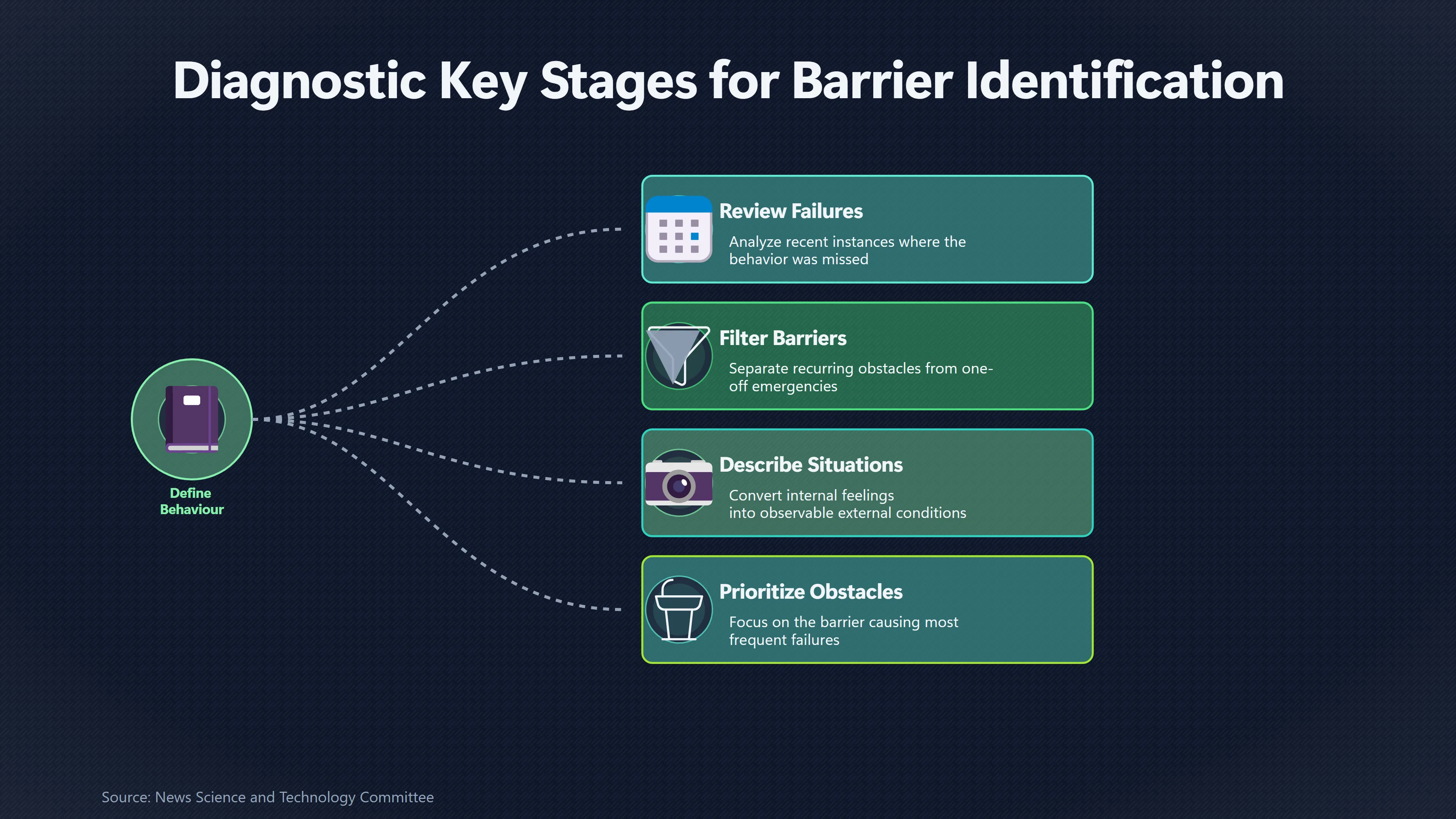
A useful diagnostic sequence is:
- Name the planned behaviour precisely. “Study” is too broad; “complete 20 retrieval-practice questions after dinner” is easier to troubleshoot.
- Review recent failures. Identify what was happening when the behaviour was missed, shortened or postponed.
- Separate recurring barriers from one-offs. A once-a-year emergency does not need a standing coping plan. A meeting that overruns twice a week probably does.
- Describe the barrier as an observable situation. Replace “I lose motivation” with something such as “after a poor night’s sleep, I decide at 06:30 that I am too tired to train”.
- Start with the barrier responsible for the most failures. One robust fallback for a common problem is generally more useful than a catalogue of elaborate responses to unlikely ones.
Digital behaviour-change interventions have used much the same process. In the MyPlan programme, participants first identified difficult situations they expected during the coming week and then selected or generated a solution relevant to that particular barrier. One example was an unusually busy working week creating a perceived lack of time for physical activity.[PubMed Central (PMC)]pmc.ncbi.nlm.nih.govPubMed Central (PMC)Which behaviour change techniques are effective to promote physical activity and reduce sedentary behaviour in adults…
That specificity prevents coping planning from deteriorating into positive thinking. “I will try harder when things get difficult” does not remove a decision. “If my lunchtime meeting overruns, I will take the 15-minute walking route home” does.

Design a fallback you will actually use
The best fallback is not necessarily an equally demanding replacement for the original behaviour. Its job is to preserve useful action under worse conditions.
This point is easy to miss. Suppose the normal plan is an hour at the gym. A fallback of “go to a different gym for an hour” solves only a narrow location problem. It does nothing when the real barrier is insufficient time or energy. A 15-minute home routine may produce less exercise than the ideal session, but it fits the condition that caused the original plan to fail.
Three properties make coping plans more usable.
Match the response to the barrier. If rain is the problem, move the behaviour indoors or prepare appropriate clothing. If interruption is the problem, establish a restart cue. If fatigue is the problem, reduce the minimum viable version or move it to a better time. If forgetting is the problem, use an external prompt or preparation step. Rehabilitation guidance provides similarly concrete examples: someone anticipating fatigue during a walk might plan to rest at a particular bench, while someone worried about forgetting information might prepare a written list beforehand.[G-AP Framework]g-apframework.scotG-AP Framework» Coping PlanningG-AP Framework» Coping Planning
Keep the fallback easier than the disrupted plan when necessary. The alternative has to remain feasible under the conditions that triggered it. “If I cannot do the full workout, I will do ten minutes at home” is logically coherent. “If I am exhausted, I will compensate with an even harder workout” fights the obstacle rather than planning around it.
Make the trigger recognisable. “If my schedule gets difficult” requires interpretation at precisely the moment when cognitive bandwidth may be limited. “If I am still at work at 18:30” gives a clear signal that the alternative plan is now active.
Recent work on physical-activity coping plans reinforces the importance of the fit between barrier and strategy. Researchers examining more than a thousand candidate barrier–strategy combinations found that people did not regard coping strategies as universally interchangeable: some pairings were consistently judged relevant and others consistently irrelevant, with additional conditions sometimes needed for a strategy to work.[PubMed Central (PMC)]pmc.ncbi.nlm.nih.govOpen source on nih.gov. A coping plan therefore needs to solve this obstacle, not merely sound sensible in isolation.
Build the plan around real failure modes
Coping plans become easier to design when the obstacle and response are treated as a pair.
Predictable failureWeak responseMore usable coping planBad weather cancels an outdoor walk“Be more committed”If heavy rain starts before my walk, I will do the indoor walking routineWork overruns the planned study period“Study later”If I leave work after 19:00, I will do 15 practice questions after dinnerMorning fatigue defeats a workout“Force myself to train”If I am too tired for the full session, I will do the 10-minute versionAn interruption breaks focused work“Get back to it eventually”If I am interrupted, I will write the next action before leaving and restart thereA companion cancels“Maybe exercise tomorrow”If my exercise partner cancels, I will use my solo route at the same scheduled timeTravel disrupts the normal routine“Restart when I get home”If I am away, I will use the travel version of the routine immediately after breakfast
The principle is continuity, not perfection. The fallback may preserve the full behaviour, a shortened version, or a closely related action that keeps the goal moving. What matters is that disruption no longer automatically produces zero action.
There is also value in preparing the fallback before the obstacle occurs. The UK Society for Behavioural Medicine has illustrated coping planning with examples such as keeping rainwear available for bad weather or switching a missed evening walk to the following morning. The key feature is that the response is already available when circumstances change.[Parliament News]parliament.ukNews Science and Technology CommitteeNews Science and Technology Committee
For personal goals, a compact template is enough:
Normal plan: When __, I will __.
Likely obstacle: This often fails when ___.
Coping plan: If __ happens, then I will __ instead.
Feasibility check: Could I realistically do that response while the obstacle is actually happening?
That final question catches many bad plans. A fallback that requires more time, equipment, energy or co-operation than will be available in the difficult situation is merely another ideal plan.
Do not turn coping planning into obstacle collecting
Coping planning has a plausible mechanism and encouraging evidence, but it should not be treated as a guaranteed behavioural trick. A systematic review of 11 eligible studies concluded that coping-planning interventions appeared useful when people were supported in forming their plans, and that combining coping and action plans appeared more effective than action planning alone. Crucially, however, the reviewers described the overall efficacy as variable.[Taylor & Francis Online]tandfonline.comTaylor & Francis OnlineDoes planning how to cope with anticipated barriers facilitate health-related behaviour change? A systematic revie…
Broader evidence is similarly mixed. A 2022 systematic review and meta-analysis covering 41 randomised trials and 5,439 participants found a positive overall effect of planning interventions on physical activity, but substantial variation between studies. The review combined forms of planning rather than establishing that coping planning alone reliably produces the effect.[PubMed]pubmed.ncbi.nlm.nih.govOpen source on nih.gov. A meta-review of self-regulatory techniques likewise found that most reviews examining relapse-prevention or coping-planning components did not show a clear additional physical-activity benefit from including that component.[PubMed Central (PMC)]pmc.ncbi.nlm.nih.govOpen source on nih.gov.
There are even settings where more coping planning is not automatically better. A study of maintained safe-water consumption examined an intervention that had adversely affected maintenance and found evidence that changes in behavioural intention helped explain the negative effect; prior perceived difficulty also mattered.[IAAP Journals]iaap-journals.onlinelibrary.wiley.comOpen source on wiley.com. This is a useful warning against the simplistic idea that asking people to imagine more obstacles must always strengthen persistence.
The practical implication is restrained: use coping planning for barriers you have reason to expect, rather than rehearsing every possible reason the goal might fail. If the original action is already straightforward and reliable, extra contingency planning may add little. If the same identifiable disruption keeps causing failure, the case for a prepared response is much stronger.
When the plan breaks, learn from the break
A coping plan is a hypothesis about what will work under pressure. Experience supplies the test.
If the fallback works, keep it. If the obstacle occurs and the fallback repeatedly goes unused, examine why. Perhaps the trigger was too vague. Perhaps the substitute behaviour was still too demanding. Perhaps what looked like one obstacle was actually another: “lack of time” may really mean that the only available alternative requires equipment left at home.
This makes coping planning an iterative form of practical problem-solving rather than a one-off worksheet. Some digital interventions have deliberately revisited action and coping plans weekly, asking participants to anticipate barriers for the coming week and choose responses appropriate to them.[PubMed Central (PMC)]pmc.ncbi.nlm.nih.govOpen source on nih.gov. Research on web-based interventions has also suggested that asking people to identify barriers and strategies for the immediate future, such as the following week, may be useful because the circumstances are concrete enough to anticipate.[PubMed Central (PMC)]pmc.ncbi.nlm.nih.govOpen source on nih.gov.
A useful rule is therefore to revise the plan after evidence, not after guilt. When a goal fails, ask: What obstacle actually occurred? Did my fallback address it? Was the fallback feasible at that moment? What smaller or better-matched response would have kept some useful action alive?
That shifts self-improvement away from repeatedly recommitting to an ideal schedule and towards designing behaviour that can tolerate real life. An action plan says what you will do when the day cooperates. A coping plan makes sure that one predictable disruption does not get the final say.
Amazon book picks
Further Reading
Books and field guides related to What Will You Do When the Plan Breaks?. Use these as the next step if you want deeper reading beyond the article.
Atomic Habits
Rating: 3.5/5 from 7 Google Books ratings
The #1 New York Times bestseller. Over 25 million copies sold! Translated into 60+ languages! Tiny Changes, Remarkable Results No matter...
Tiny Habits
The world's leading expert on habit formation shows how you can have a happier, healthier life: by starting small. Myth: Change is hard....
Rethinking Positive Thinking
“The solution isn’t to do away with dreaming and positive thinking. Rather, it’s making the most of our fantasies by brushing them up aga...

Succeed: How We Can Reach Our Goals
Do you ever wonder why Asian students are able to achieve so much more than their American counterparts? Even very smart, very accomplish...
eBay marketplace picks
Marketplace Samples
Live-tested eBay searches with available results related to this page.
Selected frommotivational poster oneBay.co.uk.




Endnotes
1.
Source: onlinelibrary.wiley.com
Link:https://onlinelibrary.wiley.com/doi/pdf/10.1002/ejsp.258
Source snippet
Wiley Online LibraryAction planning and coping planning for long‐term lifestyle change: theory and assessment - Sniehotta - 2005 - Europe...
2.
Source: onlinelibrary.wiley.com
Link:https://onlinelibrary.wiley.com/doi/abs/10.1002/Ejsp.258
Source snippet
Wiley Online LibraryAction planning and coping planning for long‐term lifestyle change: theory and assessment - Sniehotta - 2005 - Europe...
3.
Source: bpspsychub.onlinelibrary.wiley.com
Link:https://bpspsychub.onlinelibrary.wiley.com/doi/10.1348/135910705X43804
Source snippet
BPS Psych HubAction plans and coping plans for physical exercise: A longitudinal intervention study in cardiac rehabilitation - Sniehotta...
4.
Source: researchgate.net
Link:https://www.researchgate.net/publication/261145727_Standardising_Behaviour_Change_Intervention_Reports_and_Manuals
Source snippet
ResearchGate(PDF) Standardising Behaviour Change Intervention Reports and ManualsJanuary 1, 2008...
Published: January 1, 2008
5.
Source: parliament.uk
Title: News Science and Technology Committee
Link:https://www.parliament.uk/globalassets/documents/lords-committees/science-technology/behaviourchange/BCwrittenEvidenceStoZ.pdf
6.
Source: iaap-journals.onlinelibrary.wiley.com
Link:https://iaap-journals.onlinelibrary.wiley.com/doi/10.1111/aphw.12130
7.
Source: bpspsychub.onlinelibrary.wiley.com
Link:https://bpspsychub.onlinelibrary.wiley.com/doi/10.1111/bjep.70014
8.
Source: onlinelibrary.wiley.com
Link:https://onlinelibrary.wiley.com/doi/full/10.1002/hpja.713
9.
Source: wchh.onlinelibrary.wiley.com
Link:https://wchh.onlinelibrary.wiley.com/doi/10.1002/pdi.2229
10.
Source: onlinelibrary.wiley.com
Link:https://onlinelibrary.wiley.com/doi/10.1002/pdi.2229
11.
Source: researchgate.net
Link:https://www.researchgate.net/publication/260486103_Implementation_Intention_and_Action_Planning_Interventions_in_Health_Contexts_State_of_the_Research_and_Proposals_for_the_Way_Forward
12.
Source: iaap-journals.onlinelibrary.wiley.com
Link:https://iaap-journals.onlinelibrary.wiley.com/doi/10.1111/aphw.12017
13.
Source: researchgate.net
Link:https://www.researchgate.net/publication/263504602_The_Behaviour_Change_Technique_Taxonomy_BCTTv1_of_93_hierarchically-clustered_techniques_testing_reliability_of_the_taxonomy_in_specifying_the_content_of_behaviour_change_interventions
14.
Source: researchgate.net
Link:https://www.researchgate.net/publication/232230840_A_Volitional_Help_Sheet_to_Reduce_Alcohol_Consumption_in_the_General_Population_A_Field_Experiment
15.
Source: researchgate.net
Link:https://www.researchgate.net/publication/51223889_A_Refined_Taxonomy_of_Behaviour_Change_Techniques_to_Help_People_Change_Their_Physical_Activity_and_Healthy_Eating_Behaviours_The_CALO-RE_Taxonomy
16.
Source: onlinelibrary.wiley.com
Link:https://onlinelibrary.wiley.com/doi/abs/10.1348/135910707X216062
17.
Source: bpspsychub.onlinelibrary.wiley.com
Link:https://bpspsychub.onlinelibrary.wiley.com/doi/full/10.1348/135910705X43804
18.
Source: researchgate.net
Link:https://www.researchgate.net/publication/235652465_Does_planning_how_to_cope_with_anticipated_barriers_facilitate_health-related_behavior_change_A_systematic_review
19.
Source: tandfonline.com
Link:https://www.tandfonline.com/doi/abs/10.1080/17437199.2013.766832
Source snippet
Taylor & Francis OnlineDoes planning how to cope with anticipated barriers facilitate health-related behaviour change? A systematic revie...
20.
Source: doi.org
Link:https://doi.org/10.1348/135910705X43804
Source snippet
Action plans and coping plans for physical exercise: A longitudinal intervention study in cardiac rehabilitation - Sniehotta - 2006...
21.
Source: pubmed.ncbi.nlm.nih.gov
Link:https://pubmed.ncbi.nlm.nih.gov/21985115/
Source snippet
Adoption and maintenance of physical activity: Planning interventions in young, middle-aged, and older adults - PubMed...
22.
Source: discovery.ucl.ac.uk
Link:https://discovery.ucl.ac.uk/1400691/
Source snippet
UCL DiscoveryThe Behavior Change Technique Taxonomy (v1) of 93 Hierarchically Clustered Techniques: Building an International Consensus f...
23.
Source: discovery.ucl.ac.uk
Link:https://discovery.ucl.ac.uk/1400691/1/Michie_et%2520al.%2520%28in%2520press%29%2520-%2520BCT%2520Taxonomy%2520v1%2520development%2520paper.pdf
24.
Source: pmc.ncbi.nlm.nih.gov
Link:https://pmc.ncbi.nlm.nih.gov/articles/PMC7539442/
Source snippet
PubMed Central (PMC)Which behaviour change techniques are effective to promote physical activity and reduce sedentary behaviour in adults...
25.
Source: pmc.ncbi.nlm.nih.gov
Link:https://pmc.ncbi.nlm.nih.gov/articles/PMC9746174/
26.
Source: g-apframework.scot
Title: G-AP Framework» Coping Planning
Link:https://g-apframework.scot/g-ap-training/coping-planning/
27.
Source: pmc.ncbi.nlm.nih.gov
Link:https://pmc.ncbi.nlm.nih.gov/articles/PMC11613413/
28.
Source: tandfonline.com
Link:https://www.tandfonline.com/doi/full/10.1080/21642850.2024.2434140
29.
Source: pubmed.ncbi.nlm.nih.gov
Link:https://pubmed.ncbi.nlm.nih.gov/35742582/
30.
Source: pmc.ncbi.nlm.nih.gov
Link:https://pmc.ncbi.nlm.nih.gov/articles/PMC7429262/
31.
Source: pmc.ncbi.nlm.nih.gov
Link:https://pmc.ncbi.nlm.nih.gov/articles/PMC9052022/
32.
Source: pubmed.ncbi.nlm.nih.gov
Link:https://pubmed.ncbi.nlm.nih.gov/42384955/
33.
Source: ucl.ac.uk
Title: Behaviour Change Interventions: | UCL Faculty of Brain Sciences
Link:https://www.ucl.ac.uk/brain-sciences/events/2026/may/behaviour-change-interventions
34.
Source: pmc.ncbi.nlm.nih.gov
Link:https://pmc.ncbi.nlm.nih.gov/articles/PMC12016669/
35.
Source: pmc.ncbi.nlm.nih.gov
Link:https://pmc.ncbi.nlm.nih.gov/articles/PMC12001932/
36.
Source: pubmed.ncbi.nlm.nih.gov
Link:https://pubmed.ncbi.nlm.nih.gov/39952422/
37.
Source: pubmed.ncbi.nlm.nih.gov
Link:https://pubmed.ncbi.nlm.nih.gov/39628965/
38.
Source: tandfonline.com
Link:https://www.tandfonline.com/doi/full/10.1080/2372966X.2024.2365624
39.
Source: tandfonline.com
Link:https://www.tandfonline.com/doi/abs/10.1080/2372966X.2024.2365624
40.
Source: pmc.ncbi.nlm.nih.gov
Link:https://pmc.ncbi.nlm.nih.gov/articles/PMC10758936/
41.
Source: pmc.ncbi.nlm.nih.gov
Link:https://pmc.ncbi.nlm.nih.gov/articles/PMC10318642/
42.
Source: doi.org
Link:https://doi.org/10.1186/s12877-023-04080-0
43.
Source: doi.org
Link:https://doi.org/10.1177/02692155231153341
44.
Source: pmc.ncbi.nlm.nih.gov
Link:https://pmc.ncbi.nlm.nih.gov/articles/PMC9634605/
45.
Source: pmc.ncbi.nlm.nih.gov
Link:https://pmc.ncbi.nlm.nih.gov/articles/PMC9223740/
46.
Source: ncbi.nlm.nih.gov
Link:https://www.ncbi.nlm.nih.gov/books/NBK580337/
47.
Source: doi.org
Title: Journal of Medical Internet Research
Link:https://doi.org/10.2196/35614
48.
Source: pmc.ncbi.nlm.nih.gov
Link:https://pmc.ncbi.nlm.nih.gov/articles/PMC9131156/
49.
Source: pmc.ncbi.nlm.nih.gov
Link:https://pmc.ncbi.nlm.nih.gov/articles/PMC8997544/
50.
Source: pmc.ncbi.nlm.nih.gov
Link:https://pmc.ncbi.nlm.nih.gov/articles/PMC7913932/
51.
Source: tandfonline.com
Link:https://www.tandfonline.com/doi/full/10.1080/21642850.2020.1840379
52.
Source: pubmed.ncbi.nlm.nih.gov
Link:https://pubmed.ncbi.nlm.nih.gov/33028335/
53.
Source: pmc.ncbi.nlm.nih.gov
Link:https://pmc.ncbi.nlm.nih.gov/articles/PMC7447562/
54.
Source: ucl.ac.uk
Title: Advancing behavioural science | Centre for Behaviour Change
Link:https://www.ucl.ac.uk/behaviour-change/resources/other-resources
55.
Source: pmc.ncbi.nlm.nih.gov
Link:https://pmc.ncbi.nlm.nih.gov/articles/PMC7189695/
56.
Source: pmc.ncbi.nlm.nih.gov
Link:https://pmc.ncbi.nlm.nih.gov/articles/PMC8009798/
57.
Source: doi.org
Link:https://doi.org/10.1007%2Fs12529-020-09864-x
58.
Source: pubmed.ncbi.nlm.nih.gov
Link:https://pubmed.ncbi.nlm.nih.gov/31614535/
59.
Source: pmc.ncbi.nlm.nih.gov
Link:https://pmc.ncbi.nlm.nih.gov/articles/PMC6235272/
60.
Source: tandfonline.com
Link:https://www.tandfonline.com/doi/abs/10.1080/21642850.2016.1269233
61.
Source: pubmed.ncbi.nlm.nih.gov
Link:https://pubmed.ncbi.nlm.nih.gov/27779370/
62.
Source: pmc.ncbi.nlm.nih.gov
Link:https://pmc.ncbi.nlm.nih.gov/articles/PMC4582718/
63.
Source: pubmed.ncbi.nlm.nih.gov
Link:https://pubmed.ncbi.nlm.nih.gov/24313446/
64.
Source: pmc.ncbi.nlm.nih.gov
Link:https://pmc.ncbi.nlm.nih.gov/articles/PMC3671148/
65.
Source: pmc.ncbi.nlm.nih.gov
Link:https://pmc.ncbi.nlm.nih.gov/articles/PMC3359226/
66.
Source: tandfonline.com
Link:https://www.tandfonline.com/doi/abs/10.1080/1476832050018891
67.
Source: pubmed.ncbi.nlm.nih.gov
Link:https://pubmed.ncbi.nlm.nih.gov/19969161/
68.
Source: pubmed.ncbi.nlm.nih.gov
Link:https://pubmed.ncbi.nlm.nih.gov/19087949/
69.
Source: doi.org
Link:https://doi.org/10.1348/135910705X43804?urlappend=%3Futm_source%3Dresearchgate.net%26utm_medium%3Darticle
70.
Source: pubmed.ncbi.nlm.nih.gov
Link:https://pubmed.ncbi.nlm.nih.gov/16480553/
71.
Source: pubmed.ncbi.nlm.nih.gov
Link:https://pubmed.ncbi.nlm.nih.gov/17827449/
72.
Source: pubmed.ncbi.nlm.nih.gov
Link:https://pubmed.ncbi.nlm.nih.gov/18823182/
73.
Source: pubmed.ncbi.nlm.nih.gov
Link:https://pubmed.ncbi.nlm.nih.gov/24591064/
74.
Source: pubmed.ncbi.nlm.nih.gov
Link:https://pubmed.ncbi.nlm.nih.gov/23054196/
75.
Source: pubmed.ncbi.nlm.nih.gov
Link:https://pubmed.ncbi.nlm.nih.gov/20309777/
76.
Source: ncbi.nlm.nih.gov
Link:https://www.ncbi.nlm.nih.gov/books/NBK98320/
77.
Source: ucl.ac.uk
Link:https://www.ucl.ac.uk/brain-sciences/behaviour-change/resources/advancing-behavioural-science
78.
Source: discovery.ucl.ac.uk
Link:https://discovery.ucl.ac.uk/id/eprint/10189254
79.
Source: ucl.ac.uk
Link:https://www.ucl.ac.uk/brain-sciences/archived-bcttv1-publications
80.
Source: discovery.ucl.ac.uk
Link:https://discovery.ucl.ac.uk/id/eprint/10163652/
81.
Source: discovery.ucl.ac.uk
Link:https://discovery.ucl.ac.uk/id/eprint/10176196/
82.
Source: discovery.ucl.ac.uk
Link:https://discovery.ucl.ac.uk/id/eprint/10154268/
83.
Source: discovery.ucl.ac.uk
Link:https://discovery.ucl.ac.uk/id/eprint/1472961/
84.
Source: discovery.ucl.ac.uk
Link:https://discovery.ucl.ac.uk/id/eprint/1449082/
85.
Source: discovery.ucl.ac.uk
Link:https://discovery.ucl.ac.uk/1430434/
86.
Source: sciencedirect.com
Title: Coping Planning
Link:https://www.sciencedirect.com/topics/psychology/coping-planning
Additional References
87.
Source: youtube.com
Title: The WOOP process
Link:https://www.youtube.com/watch?v=fEbtgjHqxYk
Source snippet
"Coping planning" "action planning" psychology Coping Skill Series: Planning...
88.
Source: scispace.com
Link:https://scispace.com/papers/a-component-analysis-of-implementation-planning-examining-i4kcfdeo
89.
Source: thieme-connect.de
Link:https://www.thieme-connect.de/products/ejournals/html/10.1055/s-0029-1240975?id=&lang=en
90.
Source: sciencedirect.com
Link:https://www.sciencedirect.com/org/science/article/pii/S1438887108000356
91.
Source: stir.ac.uk
Link:https://www.stir.ac.uk/research/hub/publication/2278009
92.
Source: sciencedirect.com
Link:https://www.sciencedirect.com/science/article/abs/pii/S0738399120302007
93.
Source: sciencedirect.com
Link:https://www.sciencedirect.com/science/article/pii/S2561326X23006169
94.
Source: studylib.net
Link:https://studylib.net/doc/28174196/a-refined-taxonomy-of-behaviour-change-intervention
95.
Source: ehps.net
Link:https://ehps.net/ehp/index.php/contents/article/view/2882
96.
Source: habitdex.com
Link:https://habitdex.com/methods/coping-planning