Within Written Records
Should You Log Habits Right After They Happen?
Recording a habit soon after it happens reduces the amount of repeated behaviour you must reconstruct from memory later.
On this page
- Why delayed reconstruction weakens accuracy
- What momentary assessment research suggests
- Choosing a practical recording window
Page outline Jump by section
Introduction
Logging a habit soon after it happens is usually a better basis for judging progress than trying to reconstruct the whole week from memory. The advantage is not that an immediate tick in a tracker is infallible. It is that the recording task is smaller: instead of remembering several similar episodes, deciding which belonged to the relevant period and summarising them afterwards, you record one recent event while its details are still comparatively accessible.
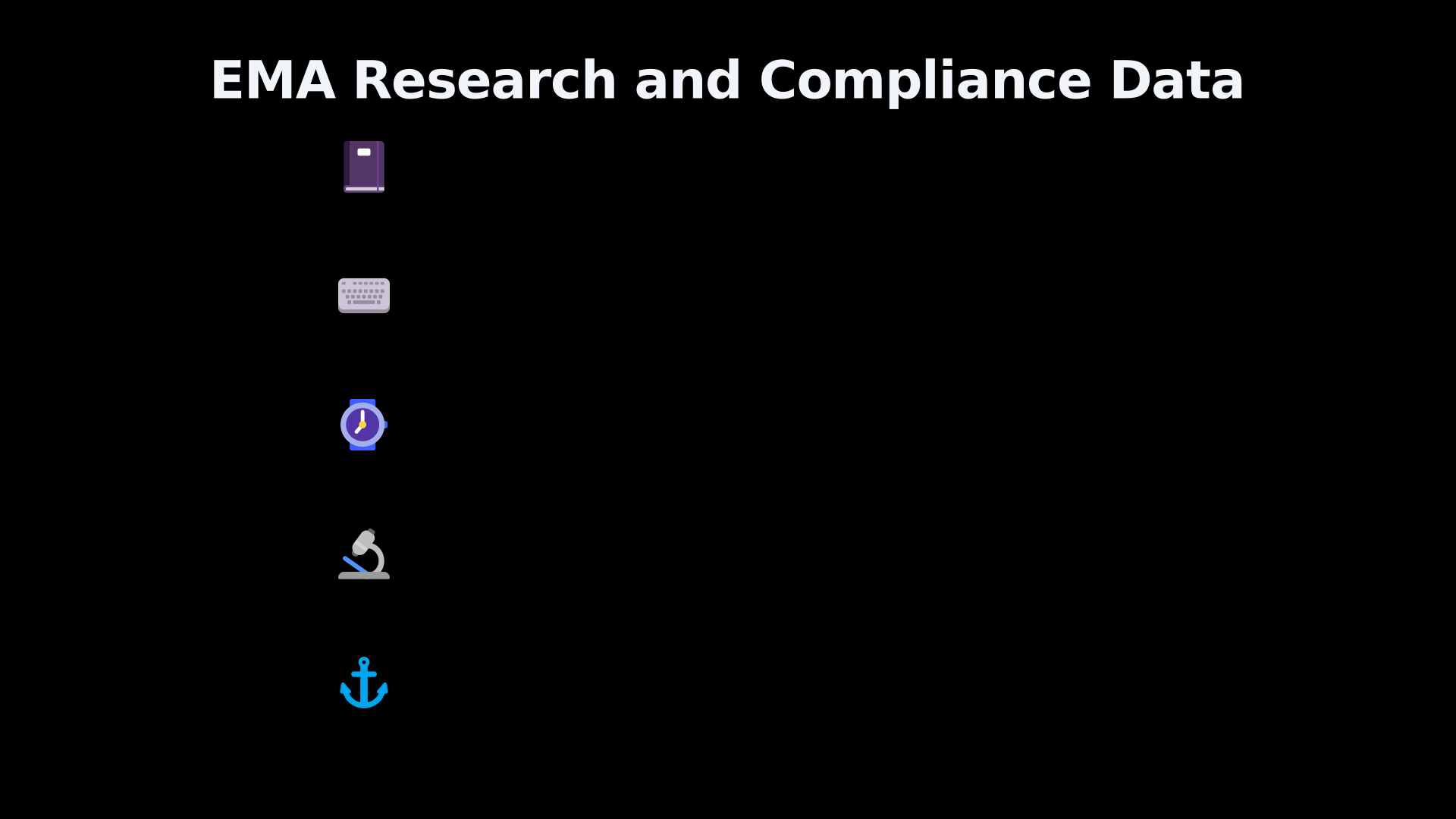
Research on ecological momentary assessment (EMA) — repeated measurement of behaviour or experience in everyday life — was developed partly to reduce the recall problems created by longer retrospective reports. Reviews consistently identify reduced dependence on memory as one of its central advantages.[Annual Reviews]annualreviews.orgAnnual Reviews Ecological Momentary Assessment | Annual ReviewsAnnual ReviewsEcological Momentary Assessment | Annual ReviewsApril 27, 2008… For self-improvement, that supports a simple principle: where practical, turn “How many times did I do this last week?” into a series of small records made during the week.
Why delayed reconstruction weakens accuracy
An end-of-week question can look deceptively simple: “How many times did I exercise?” Yet answering it requires more than retrieving a stored total. Unless the person has already been counting, they must search memory for individual episodes, distinguish one similar day from another and then construct a weekly estimate.
Repeated behaviours are particularly awkward because individual instances can resemble one another. A Monday walk, Wednesday walk and Friday walk may not leave three neatly labelled memory traces. Retrospective reports can therefore be influenced by what happened recently, what was unusually noticeable and what fits the respondent’s present state or general impression. Reviews of experience-sampling research describe recency, salience and mood-congruent remembering among the processes that can separate retrospective reports from reports made closer to experience.[PubMed Central (PMC)]pmc.ncbi.nlm.nih.govPubMed Central (PMC)Using Experience Sampling Methods/Ecological Momentary Assessment (ESM/EMA) in Clinical Assessment and Clinical Resea…
The practical danger is not merely forgetting. Reconstruction can change the pattern that the record is supposed to reveal. Someone trying to establish four study sessions a week, for example, might reach Sunday remembering Tuesday’s particularly productive session and Saturday’s long session, then conclude that the week was broadly successful. Four tiny entries made as sessions occurred could instead show that those were the only two sessions. The near-event record has reduced the problem from reconstructing a seven-day pattern to recording four individual yes-or-no events.
Research comparing momentary and retrospective measurements demonstrates that these are not necessarily interchangeable views of the same period. In a study of 68 people with chronic pain, correspondence between weekly recall and aggregated momentary reports was moderate to high when comparing different people, but within-person correspondence was low. That distinction matters for self-improvement: the important question is often not whether one person is generally more active than another, but whether your own behaviour improved this week compared with last week.[PubMed]pubmed.ncbi.nlm.nih.govUnderstanding recall of weekly pain from a momentary assessment perspective: absolute agreement, between- and within-person consist…
Retrospective summaries can also give disproportionate weight to distinctive experiences. Research on weekly pain found that greater variability in momentary pain was associated with higher recalled pain relative to the average of the momentary reports, consistent with a peak or salience effect.[PubMed]pubmed.ncbi.nlm.nih.govVariability of momentary pain predicts recall of weekly pain: a consequence of the peak (or salience) memory heuristic - PubMed… The finding concerns pain rather than habits, so it should not be mechanically generalised to every behaviour. It does, however, illustrate the underlying measurement problem: remembering a period is not always equivalent to averaging what actually occurred during it.
Even shortening recall from a week to a day does not eliminate reconstruction entirely. Two studies comparing repeated momentary ratings with end-of-day ratings found a memory–experience gap for negative affect; the day’s peak and most recent negative affect also predicted the retrospective rating. At the same time, correspondence was reasonably good on some measures, showing why the evidence does not support an absolutist rule that every entry must be instantaneous.[PubMed]pubmed.ncbi.nlm.nih.govHow was your day? Convergence of aggregated momentary and retrospective end-of-day affect ratings across the adult life span - PubM…
What momentary assessment research suggests
EMA provides the closest research analogue to near-event habit logging. Rather than asking participants for one broad report after a long interval, researchers repeatedly ask about current or very recent behaviour in normal daily settings. The classic review by Saul Shiffman, Arthur Stone and Michael Hufford identifies minimising recall bias as a core reason for using the method.[PubMed]pubmed.ncbi.nlm.nih.govPub Med Ecological momentary assessmentEcological momentary assessment - PubMed…
A particularly relevant 2025 study compared near-momentary physical-activity reports with seven-day retrospective reports while 258 adults also wore accelerometers. Participants answered questions five times a day, with the near-momentary questions covering roughly the previous five to 120 minutes, and later supplied end-of-week reports covering the same week. For sedentary time, the near-momentary reports were closer in magnitude to the accelerometer measurements than the weekly recall reports were.[PubMed Central (PMC)]pmc.ncbi.nlm.nih.govPubMed Central (PMC)Seeking to improve criterion and construct validity of retrospective self-reports of physical activity with brief rep…
That result is useful but also supplies an important warning against overselling habit trackers. Both near-momentary and retrospective self-reports showed limitations: correlations with accelerometer measurements were generally low to modest, and self-reports overestimated physical activity relative to the device measurements. Near-event self-report therefore removes some dependence on long-term recall; it does not transform subjective recording into objective observation.[PubMed]pubmed.ncbi.nlm.nih.govOpen source on nih.gov.
A 2022 systematic review makes the same qualification more broadly. Across 32 studies comparing mobile EMA with more objective measures of health behaviour or environmental events, reported correspondence varied enormously — from 1.8% to 100% — and the reviewers could not identify one set of factors that reliably produced high accuracy. Their conclusion was that EMA can provide accurate measurements, not that it necessarily does so.[PubMed Central (PMC)]pmc.ncbi.nlm.nih.govOpen source on nih.gov.
For personal habit records, the defensible inference is therefore narrower than “real-time tracking is accurate”. It is that recording closer to behaviour removes much of the need to reconstruct a long sequence later. Other errors remain: a person can misunderstand what counts as a session, forget to log an event, exaggerate a duration or deliberately record what they hoped to do rather than what they did.
There is striking evidence that apparently detailed diaries can themselves become retrospective reports when entries are postponed. In a study of people with chronic pain asked to complete paper diaries three times daily for 21 days, submitted diary cards suggested that 90% of scheduled entries had been completed within the required 15-minute window. Hidden electronic monitoring of when the paper diary was actually opened put verified compliance at only 11%. On 32% of study days, the binder was never opened even though reported completion for those days exceeded 90%. Participants using an electronic diary with time-stamped, compliance-supporting features achieved 94% actual compliance.[PubMed]pubmed.ncbi.nlm.nih.govPub Med Patient compliance with paper and electronic diariesPub Med Patient compliance with paper and electronic diaries
The lesson is not that a phone is intrinsically superior to paper. The electronic system also included prompts and restrictions that made delayed completion harder, so the study was not a clean comparison of writing materials alone. The important point for habit tracking is that a diary dated Monday is not necessarily a Monday observation. If several empty boxes are filled in on Sunday night, the tracker has quietly become an end-of-week memory exercise.

Choosing a practical recording window
The evidence supports near-event logging more strongly than it supports an arbitrary rule such as “record everything immediately”. Researchers themselves have to balance recall against burden. A systematic review of EMA studies on physical activity and sedentary behaviour found substantial variation in assessment design, with reporting windows ranging from “now” to the previous 3.5 hours. The authors stressed the need to consider reporting periods, reminders and participant burden rather than assuming one sampling schedule suits every purpose.[PubMed Central (PMC)]pmc.ncbi.nlm.nih.govOpen source on nih.gov.
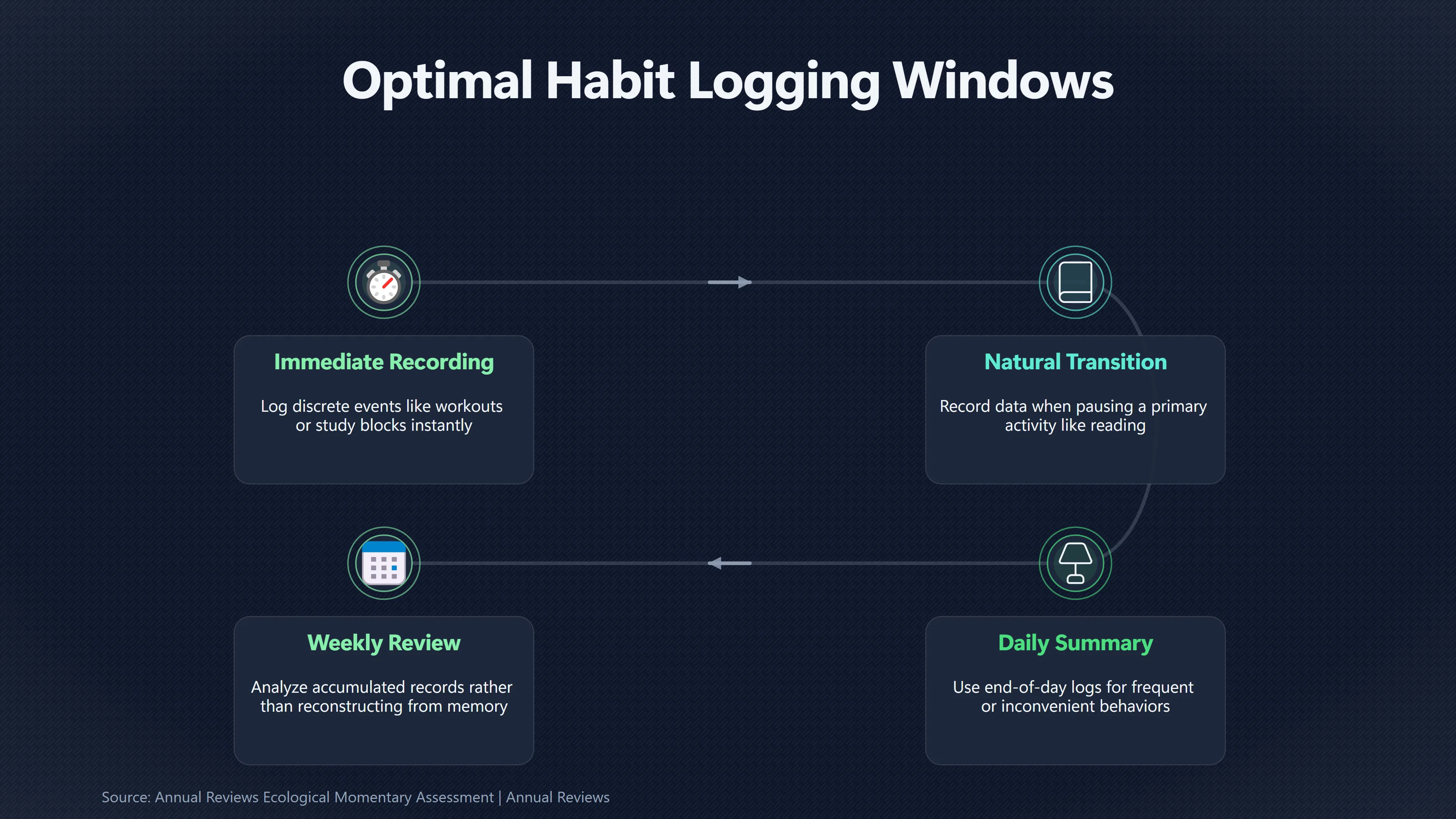
For an ordinary habit record, the useful window is therefore the shortest one that can be followed reliably without making tracking more troublesome than the habit. A practical hierarchy is:
- Immediately afterwards works well for discrete events with an obvious finish: completing a workout, taking a planned walk, practising an instrument or finishing a study block.
- At the next natural transition can work when stopping to record would interrupt the behaviour itself. Logging a completed reading session when putting the book away preserves most of the advantage without introducing needless friction.
- At the end of the day is a reasonable compromise for frequent or inconvenient-to-log behaviour, especially when the alternatives are either excessive interruption or reconstructing an entire week. Research has shown that end-of-day reporting can achieve high adherence in appropriately designed digital diaries, although it remains retrospective rather than truly momentary.[PubMed Central (PMC)]pmc.ncbi.nlm.nih.govOpen source on nih.gov.
- End-of-week reconstruction is the weakest option when the aim is to establish how many repeated events actually occurred. It asks memory to rebuild the very evidence that the tracking system was meant to preserve.
The best window also depends on what is being measured. “Did I go to the gym today?” is a salient, discrete event that may remain easy to answer that evening. “How many times did I check social media?” consists of numerous small, similar events and becomes much harder to reconstruct. Recording frequency should follow the memory demands of the behaviour rather than an abstract ideal of perfect tracking.
There is also a point at which measurement becomes counterproductive. Frequent prompts can annoy participants and produce missing data, while EMA researchers explicitly recognise the trade-off between richer information and respondent burden.[GOV.UK]GOV.UKEcological momentary assessmentEcological momentary assessment A habit system that demands a detailed questionnaire after every occurrence may therefore be less useful in practice than a one-tap mark made promptly.
The record should preserve events, not recreate them
The central distinction is between logging and reconstruction. Logging captures a small piece of evidence while the relevant event is recent. Reconstruction asks memory to manufacture that evidence after several events have accumulated.
This changes what a weekly review is for. The review can still happen on Sunday, but Sunday should preferably be when the records are read, not when they are first created. Five ticks accumulated after five planned walks allow the person to review a pattern. Sitting down on Sunday and deciding that there were “probably five walks” produces an estimate of that pattern instead.
Near-event recording is therefore most valuable when it remains deliberately small: the date, whether the behaviour occurred, and perhaps one measurement that matters, such as duration or repetitions. More elaborate reflection can wait. The aim at the point of action is to preserve enough evidence that the later review does not depend on reconstructing a week from memory.
That is the practical contribution of record timing to self-improvement that works. A written record does not merely externalise memory; when the record is made determines how much memory it still requires. Research on momentary assessment does not establish that every immediate self-report is true or that weekly reflection has no value. It supports the more useful conclusion that, when the question is what repeatedly happened, shortening the distance between behaviour and recording reduces one major opportunity for the past to be rewritten during recall.[Annual Reviews]annualreviews.orgOpen source on annualreviews.org.
Amazon book picks
Further Reading
Books and field guides related to Should You Log Habits Right After They Happen?. Use these as the next step if you want deeper reading beyond the article.
Atomic Habits
Rating: 3.5/5 from 7 Google Books ratings
The #1 New York Times bestseller. Over 25 million copies sold! Translated into 60+ languages! Tiny Changes, Remarkable Results No matter...
The Organized Mind
'Thought-provoking and practical ... Good advice based on sound neuroscientific principles' Sunday Times In The Organized Mind, New York...
Thinking, Fast and Slow
Why is there more chance we'll believe something if it's in a bold type face? Why are judges more likely to deny parole before lunch? Why...
eBay marketplace picks
Marketplace Samples
Live-tested eBay searches with available results related to this page.
Selected fromfitness tracker band oneBay.co.uk.
Endnotes
1.
Source: annualreviews.org
Title: Annual Reviews Ecological Momentary Assessment | Annual Reviews
Link:https://www.annualreviews.org/content/journals/10.1146/annurev.clinpsy.3.022806.091415
Source snippet
Annual ReviewsEcological Momentary Assessment | Annual ReviewsApril 27, 2008...
Published: April 27, 2008
2.
Source: annualreviews.org
Link:https://www.annualreviews.org/content/journals/10.1146/annurev-clinpsy-080921-083128
3.
Source: pmc.ncbi.nlm.nih.gov
Link:https://pmc.ncbi.nlm.nih.gov/articles/PMC4255457/
Source snippet
PubMed Central (PMC)Using Experience Sampling Methods/Ecological Momentary Assessment (ESM/EMA) in Clinical Assessment and Clinical Resea...
4.
Source: pubmed.ncbi.nlm.nih.gov
Title: Pub Med Ecological momentary assessment
Link:https://pubmed.ncbi.nlm.nih.gov/18509902/
Source snippet
Ecological momentary assessment - PubMed...
5.
Source: pubmed.ncbi.nlm.nih.gov
Link:https://pubmed.ncbi.nlm.nih.gov/14715390/
Source snippet
Understanding recall of weekly pain from a momentary assessment perspective: absolute agreement, between- and within-person consist...
6.
Source: pubmed.ncbi.nlm.nih.gov
Link:https://pubmed.ncbi.nlm.nih.gov/16143666/
Source snippet
Variability of momentary pain predicts recall of weekly pain: a consequence of the peak (or salience) memory heuristic - PubMed...
7.
Source: pubmed.ncbi.nlm.nih.gov
Link:https://pubmed.ncbi.nlm.nih.gov/31070397/
Source snippet
How was your day? Convergence of aggregated momentary and retrospective end-of-day affect ratings across the adult life span - PubM...
8.
Source: pmc.ncbi.nlm.nih.gov
Link:https://pmc.ncbi.nlm.nih.gov/articles/PMC6842033/
Source snippet
PubMed Central (PMC)How was your day? Convergence of aggregated momentary and retrospective end-of-day affect ratings across the adult li...
9.
Source: pmc.ncbi.nlm.nih.gov
Link:https://pmc.ncbi.nlm.nih.gov/articles/PMC12480897/
Source snippet
PubMed Central (PMC)Seeking to improve criterion and construct validity of retrospective self-reports of physical activity with brief rep...
10.
Source: pubmed.ncbi.nlm.nih.gov
Link:https://pubmed.ncbi.nlm.nih.gov/41022900/
11.
Source: pmc.ncbi.nlm.nih.gov
Link:https://pmc.ncbi.nlm.nih.gov/articles/PMC9163273/
12.
Source: pubmed.ncbi.nlm.nih.gov
Link:https://pubmed.ncbi.nlm.nih.gov/35719870/
13.
Source: pubmed.ncbi.nlm.nih.gov
Title: Pub Med Patient compliance with paper and electronic diaries
Link:https://pubmed.ncbi.nlm.nih.gov/12689739/
14.
Source: pmc.ncbi.nlm.nih.gov
Link:https://pmc.ncbi.nlm.nih.gov/articles/PMC7063739/
15.
Source: pubmed.ncbi.nlm.nih.gov
Link:https://pubmed.ncbi.nlm.nih.gov/32151251/
16.
Source: pmc.ncbi.nlm.nih.gov
Link:https://pmc.ncbi.nlm.nih.gov/articles/PMC8663435/
17.
Source: GOV.UK
Title: Ecological momentary assessment
Link:https://www.gov.uk/guidance/ecological-momentary-assessment
18.
Source: pmc.ncbi.nlm.nih.gov
Link:https://pmc.ncbi.nlm.nih.gov/articles/PMC13000383/
19.
Source: pmc.ncbi.nlm.nih.gov
Link:https://pmc.ncbi.nlm.nih.gov/articles/PMC12991416/
20.
Source: annualreviews.org
Link:https://www.annualreviews.org/content/journals/10.1146/annurev-clinpsy-080921-083128?crawler=true
21.
Source: annualreviews.org
Link:https://www.annualreviews.org/content/journals/10.1146/annurev-clinpsy-080921-083128?TRACK=RSS
22.
Source: pubmed.ncbi.nlm.nih.gov
Link:https://pubmed.ncbi.nlm.nih.gov/36786931/
23.
Source: pmc.ncbi.nlm.nih.gov
Link:https://pmc.ncbi.nlm.nih.gov/articles/PMC10121527/
24.
Source: pmc.ncbi.nlm.nih.gov
Link:https://pmc.ncbi.nlm.nih.gov/articles/PMC10225010/
25.
Source: pmc.ncbi.nlm.nih.gov
Link:https://pmc.ncbi.nlm.nih.gov/articles/PMC7669448/
26.
Source: pmc.ncbi.nlm.nih.gov
Link:https://pmc.ncbi.nlm.nih.gov/articles/PMC7545330/
27.
Source: pmc.ncbi.nlm.nih.gov
Link:https://pmc.ncbi.nlm.nih.gov/articles/PMC7919385/
28.
Source: pmc.ncbi.nlm.nih.gov
Link:https://pmc.ncbi.nlm.nih.gov/articles/7055033/
29.
Source: pubmed.ncbi.nlm.nih.gov
Link:https://pubmed.ncbi.nlm.nih.gov/32130154/
30.
Source: pubmed.ncbi.nlm.nih.gov
Link:https://pubmed.ncbi.nlm.nih.gov/31039099/
31.
Source: pubmed.ncbi.nlm.nih.gov
Link:https://pubmed.ncbi.nlm.nih.gov/31094349/
32.
Source: pmc.ncbi.nlm.nih.gov
Link:https://pmc.ncbi.nlm.nih.gov/articles/PMC7745111/
33.
Source: pmc.ncbi.nlm.nih.gov
Link:https://pmc.ncbi.nlm.nih.gov/articles/PMC6128594/
34.
Source: pmc.ncbi.nlm.nih.gov
Link:https://pmc.ncbi.nlm.nih.gov/articles/PMC5565708/
35.
Source: pmc.ncbi.nlm.nih.gov
Link:https://pmc.ncbi.nlm.nih.gov/articles/PMC4909979/
36.
Source: pmc.ncbi.nlm.nih.gov
Link:https://pmc.ncbi.nlm.nih.gov/articles/PMC4689672/
37.
Source: pmc.ncbi.nlm.nih.gov
Link:https://pmc.ncbi.nlm.nih.gov/articles/PMC4324627/
38.
Source: pubmed.ncbi.nlm.nih.gov
Link:https://pubmed.ncbi.nlm.nih.gov/23915773/
39.
Source: pmc.ncbi.nlm.nih.gov
Link:https://pmc.ncbi.nlm.nih.gov/articles/PMC3740272/
40.
Source: pubmed.ncbi.nlm.nih.gov
Link:https://pubmed.ncbi.nlm.nih.gov/21909804/
41.
Source: pmc.ncbi.nlm.nih.gov
Link:https://pmc.ncbi.nlm.nih.gov/articles/PMC3012151/
42.
Source: pmc.ncbi.nlm.nih.gov
Link:https://pmc.ncbi.nlm.nih.gov/articles/PMC2972290/
43.
Source: pubmed.ncbi.nlm.nih.gov
Link:https://pubmed.ncbi.nlm.nih.gov/20620239/
44.
Source: pmc.ncbi.nlm.nih.gov
Link:https://pmc.ncbi.nlm.nih.gov/articles/PMC3638997/
45.
Source: pmc.ncbi.nlm.nih.gov
Link:https://pmc.ncbi.nlm.nih.gov/articles/PMC2757263/
46.
Source: pmc.ncbi.nlm.nih.gov
Link:https://pmc.ncbi.nlm.nih.gov/articles/PMC2617790/
47.
Source: pmc.ncbi.nlm.nih.gov
Link:https://pmc.ncbi.nlm.nih.gov/articles/PMC2606655/
48.
Source: pubmed.ncbi.nlm.nih.gov
Link:https://pubmed.ncbi.nlm.nih.gov/17577653/
49.
Source: pmc.ncbi.nlm.nih.gov
Link:https://pmc.ncbi.nlm.nih.gov/articles/PMC2796846/
50.
Source: pubmed.ncbi.nlm.nih.gov
Link:https://pubmed.ncbi.nlm.nih.gov/1955263/
51.
Source: pubmed.ncbi.nlm.nih.gov
Link:https://pubmed.ncbi.nlm.nih.gov/18509902/?dopt=Abstract
52.
Source: pmc.ncbi.nlm.nih.gov
Link:https://pmc.ncbi.nlm.nih.gov/articles/PMC5935118/
53.
Source: pmc.ncbi.nlm.nih.gov
Link:https://pmc.ncbi.nlm.nih.gov/articles/PMC6905458/
54.
Source: pubmed.ncbi.nlm.nih.gov
Link:https://pubmed.ncbi.nlm.nih.gov/14679368/
55.
Source: pubmed.ncbi.nlm.nih.gov
Link:https://pubmed.ncbi.nlm.nih.gov/18580384/
56.
Source: pubmed.ncbi.nlm.nih.gov
Link:https://pubmed.ncbi.nlm.nih.gov/22582336/
57.
Source: annualreviews.org
Title: Volume 4 | Annual Reviews ANNUAL REVIEW OF CLINICAL PSYCHOLOGY
Link:https://www.annualreviews.org/content/journals/clinpsy/4/1
58.
Source: annualreviews.org
Link:https://www.annualreviews.org/content/journals/clinpsy/19/1
Additional References
59.
Source: journals.sagepub.com
Link:https://journals.sagepub.com/doi/10.1177/0146167205275615
Source snippet
Sage JournalsVariability of Momentary Pain Predicts Recall of Weekly Pain: A Consequence of the Peak (or Salience) Memory Heuristic - Art...
60.
Source: youtube.com
Title: Descriptive Experience Sampling and Myths of the Mind with Russell Hurlburt
Link:https://www.youtube.com/watch?v=TfSuvAJB3JU
Source snippet
To understand why real-time tracking outmatches retrospective memory recall in behavioral science, watch Ecological Momentary Assessment...
61.
Source: youtube.com
Link:https://www.youtube.com/watch?v=tE_27W3GZts
Source snippet
Sensors, Methods and Tools for Ecological Momentary Assessment...
62.
Source: youtube.com
Title: Digital Methods in Behavioral Research with Dr. Kat Houghton
Link:https://www.youtube.com/watch?v=cH_T-tAAk_A
Source snippet
Descriptive Experience Sampling and Myths of the Mind with Russell Hurlburt...
63.
Source: nature.com
Link:https://www.nature.com/articles/s41599-026-07553-w
64.
Source: nature.com
Link:https://www.nature.com/articles/1601746
65.
Source: nature.com
Link:https://www.nature.com/articles/s41598-025-16741-8
66.
Source: youtube.com
Title: Sensors, Methods and Tools for Ecological Momentary Assessment
Link:https://www.youtube.com/watch?v=tQGzPaeYqJ4
Source snippet
Don't Listen to Users, Sample Their Experience...
67.
Source: youtube.com
Title: Don’t Listen to Users, Sample Their Experience!
Link:https://www.youtube.com/watch?v=gq7ZfeQSBzY
Source snippet
Digital Methods in Behavioral Research with Dr. Kat Houghton...
68.
Source: researchgate.net
Link:https://www.researchgate.net/publication/6436666_Assessing_Clients_in_Their_Natural_Environments_With_Electronic_Diaries_Rationale_Benefits_Limitations_and_Barriers