Within Exercise
How Small Should Your Minimum Workout Start Be?
Defining a tiny successful start lets you preserve the exercise routine without committing in advance to the full workout.
On this page
- Separating starting criteria from performance criteria
- Examples for walking, running, and strength training
- When a minimum start should remain small instead of expanding
Page outline Jump by section
Introduction
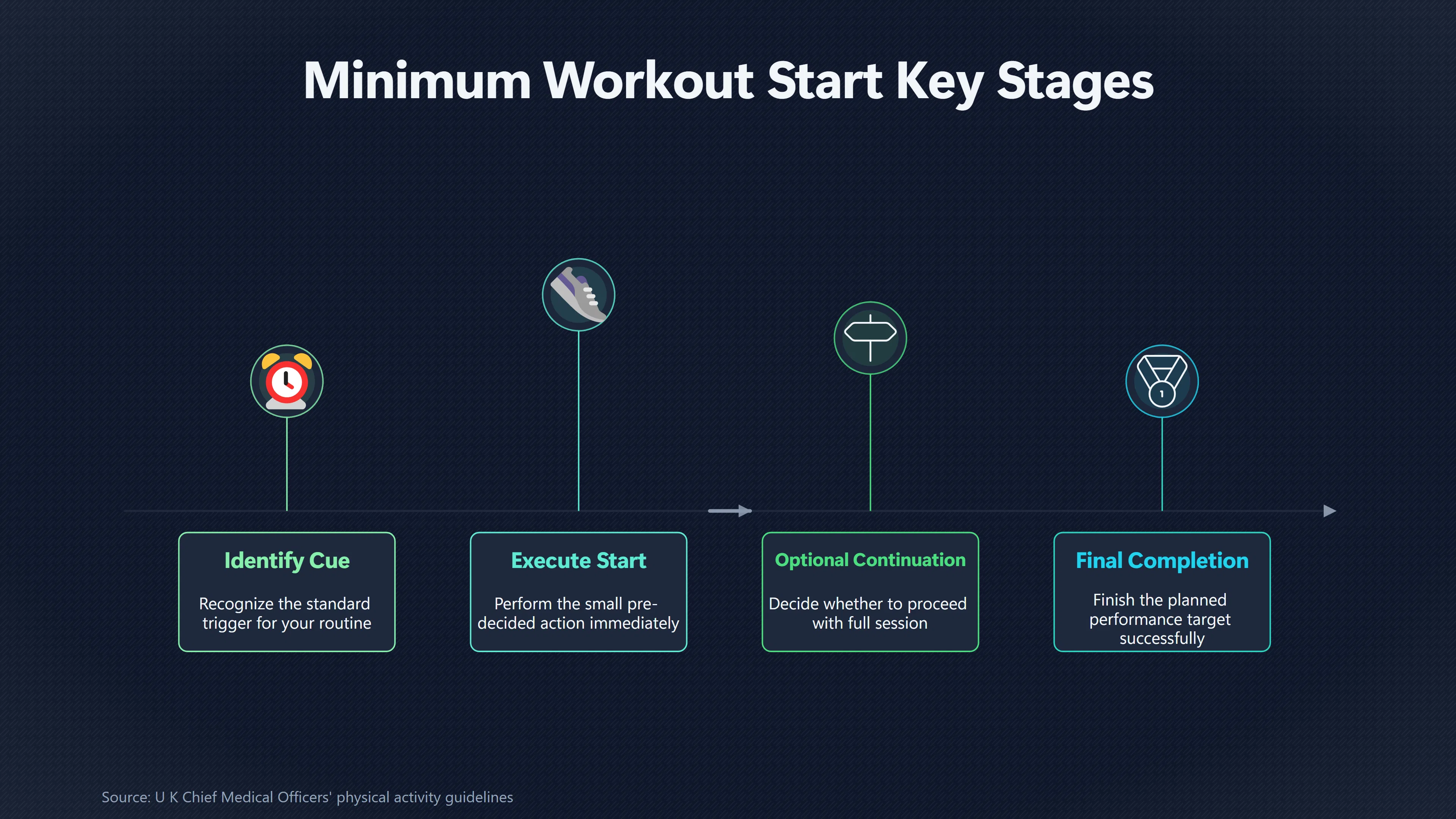
A minimum workout start is the smallest pre-decided action that counts as beginning a planned exercise session on a difficult day. It is not a miniature fitness target and it does not need to deliver the benefits of the full workout. Its job is narrower: when motivation is low, make the threshold for responding to the usual exercise cue small enough that starting remains realistic.
For a walker, that might mean putting on walking shoes and going outside for five minutes. For a runner, it could mean changing into running kit and beginning an easy five-minute warm-up. For strength training, it might mean setting up and completing the first warm-up set. After that minimum has been completed, continuing is optional.
This distinction matters because research on exercise habits suggests that instigating a workout and executing the workout are different behavioural problems. The evidence does not establish a scientifically optimal five-minute, one-set or one-kilometre minimum. Instead, it supports a practical policy: define the start separately from the performance standard, keep that start easy to execute under predictable barriers, and allow the full session to remain the goal without making it the price of beginning.[PubMed]pubmed.ncbi.nlm.nih.govHabitual exercise instigation (vs. execution) predicts healthy adults' exercise frequency - PubMedJanuary 1, 2016…
Separate starting criteria from performance criteria
The most useful way to set a minimum is to maintain two standards rather than lowering one standard.
The starting criterion answers: What do I have to do when my exercise cue occurs for this routine to have begun? The performance criterion answers: What workout am I normally trying to complete? On an ordinary day, the two flow together. On a difficult day, they can separate.
Suppose Tuesday’s planned workout is a 40-minute run. The performance criterion can remain 40 minutes while the minimum start is simply: change into running clothes, leave the house and run or walk easily for five minutes. Reaching five minutes does not magically make a five-minute outing equivalent to the planned run. It means the person has successfully carried out the start policy. At that point, they can continue, shorten the session or stop.
That distinction fits an important finding from exercise-habit research. In a study of 123 healthy adults who reported exercise through daily electronic diaries for a month, L. Alison Phillips and Benjamin Gardner distinguished instigation habit — automatically deciding or preparing to exercise — from execution habit, the automatic performance of the exercise sequence itself. Instigation habit was the only unique habit predictor of exercise frequency. The study was observational rather than a trial of minimum workouts, so it cannot prove that tiny starts cause better adherence. But it provides a strong reason to treat “getting the workout started” as a behavioural target in its own right.[PubMed]pubmed.ncbi.nlm.nih.govHabitual exercise instigation (vs. execution) predicts healthy adults' exercise frequency - PubMedJanuary 1, 2016…
Gardner and colleagues subsequently developed the distinction beyond exercise, describing habitual instigation as a cue triggering the selection and initiation of an action, while habitual execution concerns progression through its component actions. Their results again indicated that instigation was more closely associated with behaviour frequency. For a minimum-workout policy, the implication is useful: standardise the doorway into exercise without requiring the whole workout to be standardised or automatic.[PubMed]pubmed.ncbi.nlm.nih.govHabitual instigation and habitual execution: Definition, measurement, and effects on behaviour frequency - PubMed…
This also explains why “do at least 30 minutes” is often a poor definition of a minimum start. Thirty minutes is a duration target. It says how much exercise to perform, not what observable action constitutes beginning. A better start criterion occurs near the front of the sequence: shoes on and outside; onto the treadmill and moving; at the rack with the warm-up set begun.
How small should the minimum be?
There is no research-backed universal number of minutes, steps, repetitions or sets that constitutes the ideal minimum workout start. Claims that everyone should use exactly two minutes, five minutes or one set should therefore be understood as rules of thumb rather than established physiological or behavioural thresholds.
A more defensible test is functional: the minimum should be small enough that you would normally still do it on a low-motivation day, but substantial enough to constitute unmistakable entry into the exercise sequence. “Think about running” is too early. “Complete the entire programmed run” defeats the purpose. “Put on my kit, go outside and start the warm-up” sits between them.
Planning research provides support for making this response concrete. A 2022 systematic review and meta-analysis covering 41 randomised trials, with 35 included in the meta-analysis, found that physical-activity planning interventions produced a small-to-moderate improvement in activity compared with control conditions. These interventions typically specify when, where or how action will occur; some also use coping plans for anticipated barriers. An earlier systematic review likewise concluded that implementation-intention approaches appeared to promote physical activity, particularly when plans addressed obstacles. Neither literature specifically validates “minimum workouts”, but both support deciding the response to a difficult situation before that situation occurs.[PubMed Central (PMC)]pmc.ncbi.nlm.nih.govPubMed Central (PMC)The Effectiveness of Planning Interventions for Improving Physical Activity in the General Population: A Systematic R…
A useful policy can therefore be written in advance:
When my normal workout cue occurs and I strongly want to skip the session, I will complete my minimum start. After completing it, I may stop without treating the day as a failure.
The last sentence matters. If “five minutes” secretly means “once I start, I must force myself through 45 minutes”, the five-minute rule ceases to be a genuine minimum. It becomes a bargaining tactic whose real cost is still the full workout.
Public-health guidance also makes room for small amounts of activity. The UK Chief Medical Officers state that adults should aim to be active every day, that any activity is better than none and that more is better, while the World Health Organization advises inactive adults to begin with small amounts and gradually increase frequency, intensity and duration. These recommendations concern health-enhancing physical activity rather than habit design, but they help avoid the false conclusion that a shortened session is physically worthless.[GOV.UK]GOV.UKU K Chief Medical Officers' physical activity guidelinesUK Chief Medical Officers' physical activity guidelines - GOV.UKJuly 10, 2026…
Minimum starts for walking, running and strength training
A minimum start works best when it is attached to the existing cue and normal exercise sequence. It should not require inventing a second complicated workout for bad days.
For walking, a normal plan might be a 30-minute brisk walk after lunch. A workable minimum could be: put on walking shoes, leave the building and walk for five minutes. Someone beginning from very low activity might simply walk to a predetermined nearby point and back. NHS guidance explicitly encourages people to start gradually, and current Better Health advice emphasises that every minute counts while people build towards recommended weekly activity levels.[nhs.uk]nhs.ukHow to be more activeBetter Health - NHSFebruary 17, 2023…
For running, the minimum should usually preserve the act of starting without demanding normal pace or distance: change into running kit, go outside and complete five minutes of easy walking and jogging. That is preferable to defining success as “run one kilometre as fast as usual”, because intensity adds another performance demand precisely when the policy is intended to reduce the starting threshold. Research on affect during exercise also cautions against assuming harder is always behaviourally better: reviews find that exercise intensity influences pleasure and displeasure, with responses generally becoming less positive at sufficiently demanding intensities and self-selected intensity often producing a more tolerable experience.[PubMed]pubmed.ncbi.nlm.nih.govOpen source on nih.gov.
For strength training, a minimum might be: arrive at the training area, perform the normal warm-up and complete the first warm-up or working set of the first programmed exercise. Another option for a home routine is one deliberately easy set each of two familiar movements. The crucial point is to decide the rule beforehand rather than negotiating repetitions while already tempted to skip.
The minimum should not be confused with a complete strength prescription. NHS guidance recommends muscle-strengthening work involving the major muscle groups on at least two days each week and describes multiple sets as a normal training target. A one-set minimum can therefore function as an entry criterion without being presented as an equivalent substitute for a properly designed strength programme.[nhs.uk]nhs.ukHow to improve your strength and flexibilityHow to improve your strength and flexibility
Across all three examples, the pattern is the same:
- Walking: begin the actual walk; duration can remain tiny.
- Running: begin the normal run sequence; pace and distance can be relaxed.
- Strength: begin the normal lifting sequence; total exercises, sets and load can be reduced.
- Successful minimum: the specified start happened.
- Successful full session: the planned training target was completed.
Keeping those final two outcomes separate prevents an important accounting error: treating every reduced workout as either a complete failure or a complete substitute for normal training.
Continuing is a bonus, not a hidden requirement
A minimum start often creates an opportunity to continue. Once someone is dressed, outside and moving, several barriers to exercise have already disappeared. But the policy becomes more robust if continuation is treated as an option rather than an obligation.
There is a behavioural reason for this restraint. Exercise-habit research suggests that simple, consistent initiation deserves particular attention, while research with new gym members has associated consistency, lower behavioural complexity, environmental factors and positive affective judgements with stronger habit development. The latter study followed 111 new gym members for 12 weeks and found that frequent repetition was associated with habit formation; it should not be read as establishing a universal timetable for forming an exercise habit, but it reinforces the value of repeatable, uncomplicated behaviour.[PubMed]pubmed.ncbi.nlm.nih.govPub Med Exercise habit formation in new gym members: a longitudinal studyPub Med Exercise habit formation in new gym members: a longitudinal study
There is also a motivational reason. How exercise feels can influence subsequent exercise behaviour. Reviews of the exercise-affect literature have linked more positive affective responses with better prospects for adherence, while finding meaningful differences according to intensity and individual experience. A minimum-start system that repeatedly turns an exhausted person’s five-minute commitment into a compulsory punishing workout risks teaching the opposite lesson from the one intended: that beginning exercise carries an unpredictable and unpleasant cost.[PubMed]pubmed.ncbi.nlm.nih.govOpen source on nih.gov.
This does not mean stopping at the minimum whenever exercise becomes mildly uncomfortable. On ordinary days, the planned session remains the target. The distinction is that the low-motivation fallback has a genuine stopping point. If energy improves after the warm-up, continue. If the original barrier still matters after the minimum — an exceptionally demanding day, poor sleep, limited time or simply an unusually difficult start — the minimum can remain the whole session.
When the minimum should stay small
The purpose of a minimum start is easily lost through gradual expansion. Five minutes becomes ten; one set becomes three; “just put your shoes on and walk outside” becomes “and you may as well complete the usual route”. Eventually the fallback becomes demanding enough that it no longer solves the original problem.
Keep the minimum deliberately small when the main problem is initiation. If you routinely complete the full workout once you begin, making the minimum larger adds little. The bottleneck is crossing the threshold, so the policy should concentrate there.
Keep it small when the day is genuinely constrained. A fallback is particularly useful because real barriers are not identical. Coping-planning research treats barriers as situations for which responses can be specified in advance. A minimum start is one possible response to the barrier “I have little motivation or time today”; it should not pretend that the barrier has disappeared.[PubMed Central (PMC)]pmc.ncbi.nlm.nih.govPubMed Central (PMC)Impact of implementation intentions on physical activity practice in adults: A systematic review and meta-analysis of…
Keep it small when expansion would make you hesitate to start. This is perhaps the simplest diagnostic. If you readily begin when the rule is “five easy minutes” but begin bargaining with yourself when it becomes “at least 20”, the larger threshold is performing a different job. Put the additional 15 minutes back on the performance side of the boundary.
And keep it small enough that it does not compete with the full programme. The minimum is a fallback for preserving the act of starting; it is not a rationale for permanently replacing progressive training with token activity. UK guidance still recommends adults accumulate at least 150 minutes of moderate activity, 75 minutes of vigorous activity or an appropriate combination each week, alongside muscle-strengthening activity on at least two days. “Any activity is better than none” and “more is better still” belong together.[GOV.UK]GOV.UKU K Chief Medical Officers' physical activity guidelinesUK Chief Medical Officers' physical activity guidelines - GOV.UKJuly 10, 2026…

A minimum that actually works
The best minimum is therefore not the smallest action imaginable. It is the smallest credible beginning of the real exercise behaviour that remains easy enough to perform when willingness is unusually low.
It should have four properties: it starts after the same recognisable cue as the normal workout; it specifies an observable action rather than a vague intention; it is substantially easier than the full performance target; and completing it genuinely gives permission to stop. Those features turn “I should at least do something” into a policy that can be executed without another round of negotiation.
That is the larger value of a minimum workout start within a cue-and-convenience exercise routine. The full workout still matters for fitness. The minimum serves a different purpose: protecting the transition from cue to action on precisely the days when demanding full performance before you have even begun makes starting least likely. The research base is stronger for exercise instigation, planning, gradual progression and the value of some activity than it is for any particular “tiny workout” formula. A sensible minimum uses those findings without pretending that five minutes, one set or any other convenient number is a scientifically established magic threshold.[nih.gov]pubmed.ncbi.nlm.nih.govHabitual exercise instigation (vs. execution) predicts healthy adults' exercise frequency - PubMedJanuary 1, 2016…
Amazon book picks
Further Reading
Books and field guides related to How Small Should Your Minimum Workout Start Be?. Use these as the next step if you want deeper reading beyond the article.
Atomic Habits
Rating: 3.5/5 from 7 Google Books ratings
The #1 New York Times bestseller. Over 25 million copies sold! Translated into 60+ languages! Tiny Changes, Remarkable Results No matter...
Tiny Habits
Improving your life is much easier than you think. Whether it’s losing weight, sleeping more, or restoring your work/life balance – the s...
The Power of Habit
Rating: 4.0/5 from 145 Google Books ratings
Duhigg takes us to the edge of scientific discoveries that explain why habits exist and how they can be changed. Distilling information i...
No Sweat
Do you secretly hate exercising? Struggle to stick with a program? Millions of people try and fail to stay fit. But what if "exercising"...
eBay marketplace picks
Marketplace Samples
Live-tested eBay searches with available results related to this page.
Selected fromfitness poster oneBay.co.uk.
Endnotes
1.
Source: GOV.UK
Title: U K Chief Medical Officers’ physical activity guidelines
Link:https://www.gov.uk/government/publications/physical-activity-guidelines-uk-chief-medical-officers-report/uk-chief-medical-officers-physical-activity-guidelines
Source snippet
UK Chief Medical Officers' physical activity guidelines - GOV.UKJuly 10, 2026...
Published: July 10, 2026
2.
Source: nhs.uk
Title: How to be more active
Link:https://www.nhs.uk/better-health/get-active/how-to-be-more-active/
Source snippet
Better Health - NHSFebruary 17, 2023...
Published: February 17, 2023
3.
Source: nhs.uk
Title: Exercise for depression
Link:https://www.nhs.uk/mental-health/self-help/guides-tools-and-activities/exercise-for-depression/
4.
Source: nhs.uk
Title: How to improve your strength and flexibility
Link:https://www.nhs.uk/live-well/exercise/how-to-improve-strength-flexibility/
5.
Source: nelft.nhs.uk
Title: General health | NELFT NHS Foundation Trust
Link:https://www.nelft.nhs.uk/general-health/
6.
Source: myhealthlondon.nhs.uk
Title: exercise and physical activity healthy living
Link:https://www.myhealthlondon.nhs.uk/resources/internal/exercise-and-physical-activity-healthy-living/
7.
Source: odphp.health.gov
Title: top 10 things know
Link:https://odphp.health.gov/our-work/nutrition-physical-activity/physical-activity-guidelines/current-guidelines/top-10-things-know
8.
Source: odphp.health.gov
Title: scientific report
Link:https://odphp.health.gov/our-work/nutrition-physical-activity/physical-activity-guidelines/current-guidelines/scientific-report
9.
Source: odphp.health.gov
Title: questions answers
Link:https://odphp.health.gov/our-work/nutrition-physical-activity/physical-activity-guidelines/about-physical-activity-guidelines/questions-answers
10.
Source: odphp.health.gov
Title: supplementary material
Link:https://odphp.health.gov/our-work/nutrition-physical-activity/physical-activity-guidelines/current-guidelines/scientific-report/supplementary-material
11.
Source: odphp.health.gov
Title: current guidelines
Link:https://odphp.health.gov/our-work/nutrition-physical-activity/physical-activity-guidelines/current-guidelines
12.
Source: odphp.health.gov
Title: about physical activity guidelines
Link:https://odphp.health.gov/our-work/nutrition-physical-activity/physical-activity-guidelines/about-physical-activity-guidelines
13.
Source: odphp.health.gov
Title: media resources
Link:https://odphp.health.gov/our-work/nutrition-physical-activity/physical-activity-guidelines/current-guidelines/media-resources
14.
Source: odphp.health.gov
Title: charge 2018 physical activity guidelines advisory committee
Link:https://odphp.health.gov/our-work/nutrition-physical-activity/physical-activity-guidelines/current-guidelines/advisory-committee/resources/charge-2018-physical-activity-guidelines-advisory-committee
15.
Source: odphp.health.gov
Link:https://odphp.health.gov/our-work/nutrition-physical-activity/physical-activity-guidelines/current-guidelines/advisory-committee/resources
16.
Source: wchc.nhs.uk
Title: I want to get more active
Link:https://www.wchc.nhs.uk/health-care/improve-health/i-want-to-get-more-active/
17.
Source: bsw.icb.nhs.uk
Title: icb.nhs.uk Every Move Matters
Link:https://bsw.icb.nhs.uk/every-move-matters/
18.
Source: england.nhs.uk
Title: NH S England — South West » Every Move Matters: what moves you?
Link:https://www.england.nhs.uk/south/2025/07/21/every-move-matters-what-moves-you/
19.
Source: nth.nhs.uk
Title: Getting more active
Link:https://www.nth.nhs.uk/live-well/move/active/
20.
Source: GOV.UK
Title: www.gov.uk Physical activity guidelines
Link:https://www.gov.uk/government/collections/physical-activity-guidelines
21.
Source: GOV.UK
Title: www.gov.uk Physical activity guidelines: UK Chief Medical Officers’ report
Link:https://www.gov.uk/government/publications/physical-activity-guidelines-uk-chief-medical-officers-report?form=MG0AV3
22.
Source: myhealthlondon.nhs.uk
Link:https://www.myhealthlondon.nhs.uk/be-healthier/healthy-lifestyle/move/
23.
Source: bradfordhospitals.nhs.uk
Link:https://www.bradfordhospitals.nhs.uk/preparing-for-surgery/exercise/
24.
Source: cht.nhs.uk
Link:https://www.cht.nhs.uk/patients-visitors/preparing-for-surgery/exercise
25.
Source: odphp.health.gov
Title: physical activity guidelines americans 2nd edition
Link:https://odphp.health.gov/healthypeople/tools-action/browse-evidence-based-resources/physical-activity-guidelines-americans-2nd-edition
26.
Source: odphp.health.gov
Title: 2018 physical activity guidelines advisory committee scientific report
Link:https://odphp.health.gov/healthypeople/tools-action/browse-evidence-based-resources/2018-physical-activity-guidelines-advisory-committee-scientific-report
27.
Source: odphp.health.gov
Title: data methodology
Link:https://odphp.health.gov/healthypeople/objectives-and-data/browse-objectives/physical-activity/increase-proportion-adults-who-do-enough-aerobic-and-muscle-strengthening-activity-pa-05/data-methodology
28.
Source: pubmed.ncbi.nlm.nih.gov
Link:https://pubmed.ncbi.nlm.nih.gov/26148187/
Source snippet
Habitual exercise instigation (vs. execution) predicts healthy adults' exercise frequency - PubMedJanuary 1, 2016...
Published: January 1, 2016
29.
Source: pubmed.ncbi.nlm.nih.gov
Link:https://pubmed.ncbi.nlm.nih.gov/26991427/
Source snippet
Habitual instigation and habitual execution: Definition, measurement, and effects on behaviour frequency - PubMed...
30.
Source: pmc.ncbi.nlm.nih.gov
Link:https://pmc.ncbi.nlm.nih.gov/articles/PMC6235272/
Source snippet
PubMed Central (PMC)Impact of implementation intentions on physical activity practice in adults: A systematic review and meta-analysis of...
31.
Source: pmc.ncbi.nlm.nih.gov
Link:https://pmc.ncbi.nlm.nih.gov/articles/PMC9223740/
Source snippet
PubMed Central (PMC)The Effectiveness of Planning Interventions for Improving Physical Activity in the General Population: A Systematic R...
32.
Source: ncbi.nlm.nih.gov
Link:https://www.ncbi.nlm.nih.gov/books/NBK566046/
Source snippet
WHO Guidelines on Physical Activity and Sedentary Behaviour - NCBI Bookshelf...
33.
Source: pubmed.ncbi.nlm.nih.gov
Link:https://pubmed.ncbi.nlm.nih.gov/18971508/
34.
Source: pubmed.ncbi.nlm.nih.gov
Link:https://pubmed.ncbi.nlm.nih.gov/21780850/
35.
Source: pubmed.ncbi.nlm.nih.gov
Title: Pub Med Exercise habit formation in new gym members: a longitudinal study
Link:https://pubmed.ncbi.nlm.nih.gov/25851609/
36.
Source: pubmed.ncbi.nlm.nih.gov
Link:https://pubmed.ncbi.nlm.nih.gov/34112041/
37.
Source: pubmed.ncbi.nlm.nih.gov
Link:https://pubmed.ncbi.nlm.nih.gov/36750220/
38.
Source: pmc.ncbi.nlm.nih.gov
Link:https://pmc.ncbi.nlm.nih.gov/articles/PMC6440859/
39.
Source: pmc.ncbi.nlm.nih.gov
Link:https://pmc.ncbi.nlm.nih.gov/articles/PMC12016669/
40.
Source: cdc.gov
Title: physical activity
Link:https://www.cdc.gov/disability-and-health/conditions/physical-activity.html
41.
Source: pmc.ncbi.nlm.nih.gov
Link:https://pmc.ncbi.nlm.nih.gov/articles/PMC11588932/
42.
Source: cdc.gov
Link:https://www.cdc.gov/physical-activity-basics/guidelines/adults.html
43.
Source: pubmed.ncbi.nlm.nih.gov
Link:https://pubmed.ncbi.nlm.nih.gov/37496882/
44.
Source: pmc.ncbi.nlm.nih.gov
Link:https://pmc.ncbi.nlm.nih.gov/articles/PMC10183157/
45.
Source: pubmed.ncbi.nlm.nih.gov
Link:https://pubmed.ncbi.nlm.nih.gov/36775533/
46.
Source: pmc.ncbi.nlm.nih.gov
Link:https://pmc.ncbi.nlm.nih.gov/articles/PMC9471053/
47.
Source: pmc.ncbi.nlm.nih.gov
Link:https://pmc.ncbi.nlm.nih.gov/articles/PMC9403139/
48.
Source: pmc.ncbi.nlm.nih.gov
Link:https://pmc.ncbi.nlm.nih.gov/articles/PMC9043878/
49.
Source: pmc.ncbi.nlm.nih.gov
Link:https://pmc.ncbi.nlm.nih.gov/articles/PMC8997544/
50.
Source: pubmed.ncbi.nlm.nih.gov
Link:https://pubmed.ncbi.nlm.nih.gov/35356357/
51.
Source: pubmed.ncbi.nlm.nih.gov
Link:https://pubmed.ncbi.nlm.nih.gov/34782996/
52.
Source: pubmed.ncbi.nlm.nih.gov
Link:https://pubmed.ncbi.nlm.nih.gov/31923898/
53.
Source: pmc.ncbi.nlm.nih.gov
Link:https://pmc.ncbi.nlm.nih.gov/articles/PMC8009798/
54.
Source: pmc.ncbi.nlm.nih.gov
Link:https://pmc.ncbi.nlm.nih.gov/articles/PMC7429262/
55.
Source: pubmed.ncbi.nlm.nih.gov
Link:https://pubmed.ncbi.nlm.nih.gov/30742334/
56.
Source: pubmed.ncbi.nlm.nih.gov
Link:https://pubmed.ncbi.nlm.nih.gov/30596272/
57.
Source: pmc.ncbi.nlm.nih.gov
Link:https://pmc.ncbi.nlm.nih.gov/articles/PMC6411298/
58.
Source: pubmed.ncbi.nlm.nih.gov
Link:https://pubmed.ncbi.nlm.nih.gov/30336306/
59.
Source: pmc.ncbi.nlm.nih.gov
Link:https://pmc.ncbi.nlm.nih.gov/articles/PMC5899425/
60.
Source: pubmed.ncbi.nlm.nih.gov
Link:https://pubmed.ncbi.nlm.nih.gov/27610096/
61.
Source: pmc.ncbi.nlm.nih.gov
Link:https://pmc.ncbi.nlm.nih.gov/articles/PMC4500900/
62.
Source: nice.org.uk
Link:https://www.nice.org.uk/guidance/ph44/chapter/recommendations
63.
Source: pubmed.ncbi.nlm.nih.gov
Link:https://pubmed.ncbi.nlm.nih.gov/22726453/
64.
Source: pmc.ncbi.nlm.nih.gov
Link:https://pmc.ncbi.nlm.nih.gov/articles/PMC4222174/
65.
Source: pubmed.ncbi.nlm.nih.gov
Link:https://pubmed.ncbi.nlm.nih.gov/27383469/
66.
Source: pubmed.ncbi.nlm.nih.gov
Link:https://pubmed.ncbi.nlm.nih.gov/14596707/
67.
Source: pmc.ncbi.nlm.nih.gov
Link:https://pmc.ncbi.nlm.nih.gov/articles/PMC7872013/
68.
Source: pubmed.ncbi.nlm.nih.gov
Link:https://pubmed.ncbi.nlm.nih.gov/21694556/
69.
Source: pubmed.ncbi.nlm.nih.gov
Link:https://pubmed.ncbi.nlm.nih.gov/11735680/
70.
Source: pubmed.ncbi.nlm.nih.gov
Link:https://pubmed.ncbi.nlm.nih.gov/10593646/
71.
Source: pubmed.ncbi.nlm.nih.gov
Link:https://pubmed.ncbi.nlm.nih.gov/30117398/
72.
Source: pmc.ncbi.nlm.nih.gov
Link:https://pmc.ncbi.nlm.nih.gov/articles/PMC4180306/
73.
Source: ncsem-em.org.uk
Link:https://www.ncsem-em.org.uk/get-active/guidelines/physical-activity-guidelines-for-adults/
Additional References
74.
Source: bpspsychub.onlinelibrary.wiley.com
Link:https://bpspsychub.onlinelibrary.wiley.com/doi/10.1111/bjhp.12189
Source snippet
BPS Psych HubHabitual instigation and habitual execution: Definition, measurement, and effects on behaviour frequency - Gardner - 2016...
75.
Source: kclpure.kcl.ac.uk
Link:https://kclpure.kcl.ac.uk/portal/en/publications/habitual-exercise-instigation-vs-execution-predicts-healthy-adult/
Source snippet
King's College LondonHabitual exercise instigation (vs. execution) predicts healthy adults' exercise frequency - King's College London...
76.
Source: youtube.com
Link:https://www.youtube.com/watch?v=UhxHYcjz_94
Source snippet
For an explanation of setting very small starting thresholds to bypass low motivation and maintain behavioral momentum, watch Break Your...
77.
Source: youtube.com
Title: Say Goodbye to Excuses: James Clear’s 2-Minute Fitness Trick Changes Everything!
Link:https://www.youtube.com/watch?v=LNhSwiVRXH8
Source snippet
How to Stop Procrastinating by Using the Two-Minute Rule | Atomic Habits by James Clear (Chapter 13)...
78.
Source: youtube.com
Link:https://www.youtube.com/watch?v=5wx43V_wRqE
Source snippet
Say Goodbye to Excuses: James Clear's 2-Minute Fitness Trick Changes Everything...
79.
Source: cdc.gov
Link:https://www.cdc.gov/pcd/issues/2012/11_0332.htm
80.
Source: cdc.gov
Link:https://www.cdc.gov/pcd/issues/2020/19_0321.htm
81.
Source: researchgate.net
Link:https://www.researchgate.net/publication/274728787_Exercise_habit_formation_in_new_gym_members_A_longitudinal_study
82.
Source: researchgate.net
Link:https://www.researchgate.net/publication/279807291_Habitual_Exercise_Instigation_vs_Execution_Predicts_Healthy_Adults%27_Exercise_Frequency
83.
Source: simplimove.health
Link:https://simplimove.health/move-better-live-better/healthy-habits/10-ways-to-build-an-exercise-habit/