Within Learning Goals
Can Two Small Tests Reveal a Better Method?
Comparing two approaches under similar conditions can turn repeated attempts into evidence about which method works better and when.
On this page
- Choosing two approaches worth comparing
- Keeping comparisons similar enough to learn from
- Recording what changed and what to try next
Page outline Jump by section
Introduction
For an unfamiliar, complex task, a useful learning goal is not simply “practise more”. It can be: test two plausible methods under similar conditions, compare what happens, then use the result to choose the next test. That turns repeated attempts into evidence. Instead of asking only whether performance improved, the learner asks which approach worked better, on what kind of problem, and why.
This approach follows directly from research showing that learning goals are valuable when effective strategies still have to be discovered. It also draws on research into contrasting cases, deliberate practice, reflection and single-case experiments. Together, these fields support a practical principle: comparisons become informative when the alternatives are genuinely plausible, the conditions are similar enough to make the contrast meaningful, and the learner records enough detail to explain the result rather than merely declaring a winner.[aom.org]journals.aom.orgAcademy of Management JournalsLearning versus performance goals: When should each be used? | Academy of Management PerspectivesFebruary 1…
Choosing two approaches worth comparing
A test-and-compare goal is most useful when there is real uncertainty about method. If the learner already knows that one procedure is correct and the other is plainly defective, comparison adds little. The interesting case is when two reasonable strategies could work but their relative strengths are unclear.
Goal-setting research provides the underlying rationale. Seijts and Latham argue that when a task principally requires acquiring knowledge or skill, a challenging learning goal should direct attention towards discovering effective strategies rather than merely demanding a difficult outcome. In an experiment using a moderately complex scheduling task, a specific difficult learning goal produced better performance than a “do your best” instruction, and the discovery and implementation of task-relevant strategies were positively associated with performance.[Academy of Management Journals]journals.aom.orgAcademy of Management JournalsLearning versus performance goals: When should each be used? | Academy of Management PerspectivesFebruary 1…
A test-and-compare goal makes that strategy search concrete. Suppose someone is learning to analyse unfamiliar reports. Instead of setting “finish the next report 20% faster”, they might compare:
- Method A: read the whole document before taking notes;
- Method B: first identify the decision question, then read selectively and record evidence against a fixed set of headings.
The goal for two comparable reports becomes something such as: try each method once, measure time and the number of important points missed, then explain which method should be tested again. The immediate target is knowledge about the process, not a flattering performance number.
The alternatives should differ in something that could plausibly cause a useful difference. “Work normally” versus “try harder” is a poor comparison because the intervention is vague. “Retrieve answers from memory before checking notes” versus “reread notes before answering” is much more diagnostic because the behavioural difference is clear.
There is also a strong case for comparing methods side by side rather than learning each in isolation. In a study of 70 seventh-grade pupils learning algebra, Bethany Rittle-Johnson and Jon Star randomly assigned pupils either to compare alternative solution methods or to reflect on the same methods separately. The comparison group made greater gains in procedural knowledge and flexibility, while conceptual gains were similar. The finding is especially relevant to complex-task learning because flexibility — knowing that more than one procedure exists and selecting appropriately — is different from becoming faster at one familiar routine.[EBSCO OpenURL]openurl.ebsco.comEBSCO OpenURLDoes comparing solution methods facilitate conceptual and procedural knowledge? An experimental study on learning to solve e…
Comparison is not automatically beneficial, however. Research on fraction division found that simply presenting contrasting cases without prompting learners to explain them did not improve conceptual understanding. Self-explanation did. That is an important qualification: a test-and-compare goal should require the learner to articulate what differed and why that difference might have produced the result, rather than merely placing two scores next to each other.[ScienceDirect]sciencedirect.comHow do contrasting cases and self-explanation promote learning? Evidence from fraction division - ScienceDirectDecember 1, 2015…
Keeping the comparison similar enough to teach you something
The hardest part of a personal comparison is not trying two methods. It is making the attempts comparable enough that the result means anything.
Imagine using Method A on a short, familiar assignment on Monday morning and Method B on a difficult new assignment late on Friday afternoon. If Method A wins, the learner cannot tell whether the method mattered or whether task difficulty, prior knowledge, fatigue or some other difference produced the gap. A test-and-compare goal therefore needs a simple version of experimental control: change the method while keeping important surrounding conditions reasonably similar.
This principle is well established in single-case experimental research. Alternating-treatments designs compare two or more interventions within the same individual through repeated, closely spaced exposure to the different conditions. Their value comes from making the conditions comparable and looking for a consistent difference across repeated observations rather than relying on one before-and-after impression. Randomisation or constrained alternation of condition order can further reduce the risk that time or sequence systematically favours one treatment.[PubMed Central (PMC)]pmc.ncbi.nlm.nih.govPubMed Central (PMC)Quantitative Techniques and Graphical Representations for Interpreting Results from Alternating Treatment Design - PM…
A self-improvement exercise does not need to pretend to be a clinical experiment, but it can borrow the underlying discipline. Useful controls include giving each method tasks of similar difficulty, using the same time allowance and success criterion, alternating which method goes first, and repeating each approach rather than treating one unusually good or bad attempt as decisive.
For learning tasks, equivalence matters more than literal sameness. You often cannot perform exactly the same novel task twice because the first attempt changes what you know. Research on adapted alternating-treatments designs faces a similar problem when studying skills that are acquired and therefore cannot simply be reset. One solution is to compare methods using different but carefully matched sets of learning material.[Wiley Online Library]onlinelibrary.wiley.comWiley Online LibraryExperimental control in the adapted alternating treatments design: A review of procedures and outcomes - Cariveau - 2…
That suggests a practical pattern. If someone wants to compare two ways of learning vocabulary, programming concepts or technical procedures, each method should receive a different set of items matched as closely as possible for difficulty and prior familiarity. Later, swap or repeat the comparison with fresh matched sets. The aim is not laboratory perfection; it is to prevent obvious differences between the tasks from overwhelming the difference between the methods.
The same logic explains why changing several things simultaneously is usually a bad learning test. Suppose Method A involves morning study, retrieval practice and a quiet room, while Method B involves evening study, rereading and background music. A difference in performance cannot identify the useful ingredient. Small comparisons are more informative when they isolate one strategically important contrast.
There are limits. Rapid alternation is inappropriate when one method has strong carry-over effects into the next condition, and single-case research explicitly recognises interference between treatments as a threat to interpretation. Learning itself creates carry-over: after discovering a powerful strategy under Method A, you cannot unknow it when trying Method B. In such cases, matched new tasks, longer test periods or comparisons conducted at different stages of learning may be more sensible than rapid alternation.[PubMed Central (PMC)]pmc.ncbi.nlm.nih.govPubMed Central (PMC)Single-Case Experimental Designs to Evaluate Novel Technology-Based Health Interventions - PMCFebruary 8, 2013…
What should count as “better”?
A comparison can be carefully controlled and still teach the wrong lesson if it measures the wrong outcome. For complex learning, the quickest method is not necessarily the better method.
Consider two study techniques. One produces fluent, comfortable practice and high scores immediately; the other feels harder but produces better unaided performance later. Judging only the practice session could select the wrong strategy. Similarly, a problem-solving method might initially be slower but lead to fewer errors or better transfer to unfamiliar problems.
The measure should therefore follow the reason for testing the methods. Depending on the task, useful outcomes might include accuracy, time, errors requiring rework, unaided recall after a delay, ability to solve a new problem, quality judged against a rubric, or the amount of help required. Two measures are often more informative than one: for example, completion time plus error rate prevents “faster” from silently meaning “faster but worse”.
Deliberate-practice research reinforces this emphasis on defined objectives and informative measurement. Reviews of simulation-based education describe deliberate practice as combining well-defined learning tasks, focused repetition, reliable measurement, informative feedback, error correction and further practice. The important distinction from raw repetition is that performance information changes what the learner does next.[DOI]doi.orgOpen source on doi.org.
Feedback also needs to be sufficiently specific to guide the next attempt. In a 36-day randomised field study involving 194 university students, participants who received adaptive daily feedback showed better average goal setting, planning and adherence to schedules, as well as higher self-efficacy and satisfaction with the study day, than participants using learning diaries without that feedback. Not every outcome improved — procrastination and effort did not — which is itself a useful warning against treating any intervention as universally effective.[PubMed Central (PMC)]pmc.ncbi.nlm.nih.govOpen source on nih.gov.
The OECD’s discussion of self-regulated learning similarly identifies experimentation, explicit feedback and information-seeking as complementary opportunities within extended learning tasks. Experimentation allows learners to test ideas; feedback lets them judge progress. A test without a meaningful signal is simply another experience.[OECD]oecd.orgOpen source on oecd.org.
Recording what changed and what to try next
The smallest useful record is not a diary of everything that happened. It is a compact account that preserves the comparison.
For each attempt, record method, task, conditions, result and interpretation. For example: “Method B; unfamiliar 1,500-word report; 40 minutes; identified 8/10 reference points; missed both points embedded in tables; next test: use Method B but scan tables before selective reading.” That final field matters because it converts an observation into a new hypothesis.
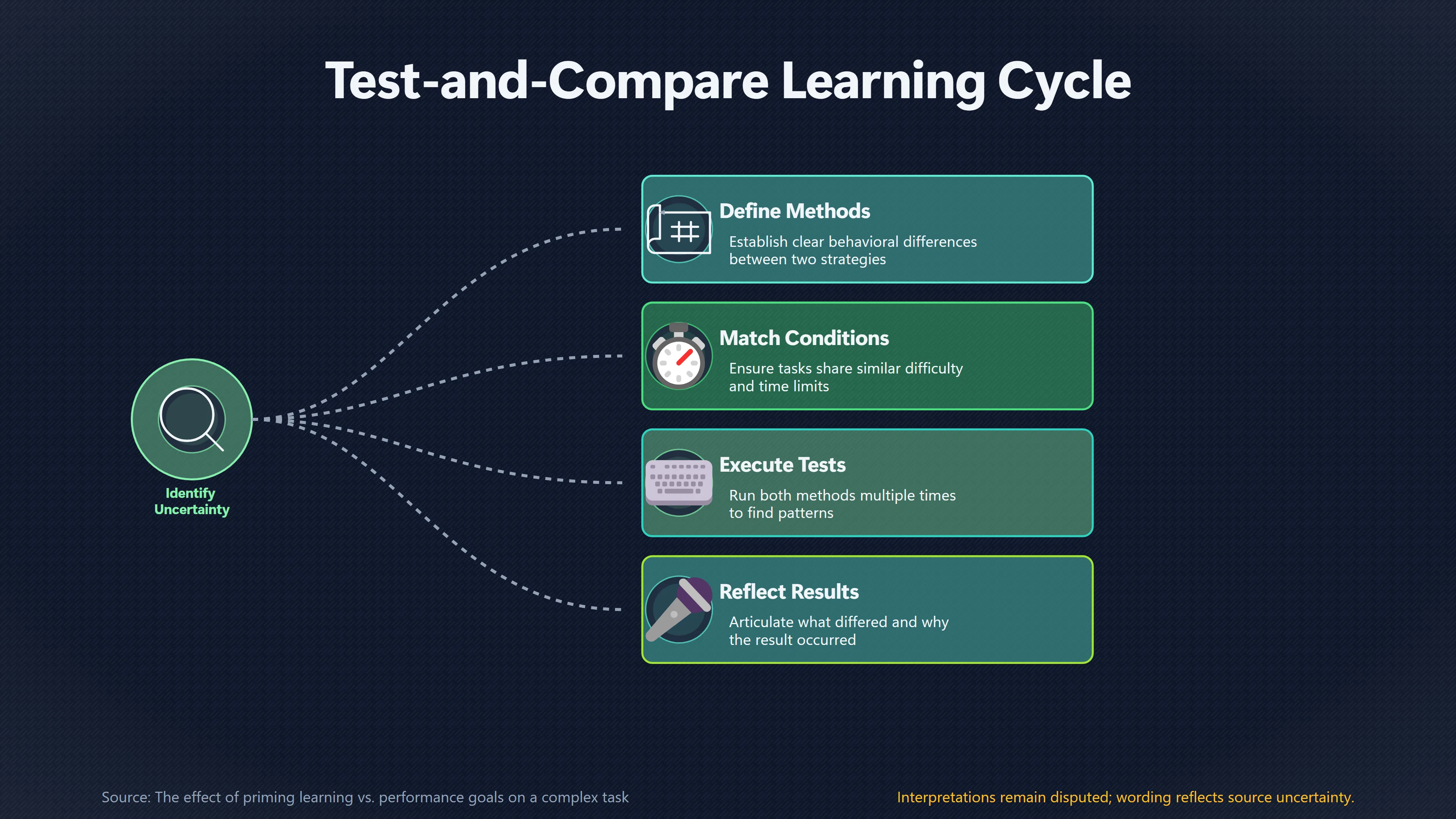
A simple comparison cycle can therefore be:
- Name the uncertainty. “I do not know whether planning before starting or planning after a quick first attempt produces better solutions.”
- Define A and B precisely. Make the behavioural difference observable.
- Choose comparable attempts. Match task difficulty, time and other important conditions as far as practical.
- Decide what ‘better’ means before testing. Use outcomes that reflect learning, not merely comfort.
- Run both methods more than once where feasible. Look for a pattern rather than a memorable outlier.
- Explain the contrast. Record what appeared to help, hurt or depend on circumstances.
- Choose the next experiment. Retest the apparent winner, modify it, or investigate the condition under which the result changed.
The reflection stage has independent empirical support. Research combining laboratory experiments with a field experiment at a business-process outsourcing company found that deliberately reflecting on accumulated experience could produce greater subsequent performance gains than spending the equivalent time accumulating more experience. The proposed mechanism was not merely “thinking more”, but articulating and codifying lessons from what had already happened.[Academy of Management Journals]journals.aom.orgOpen source on aom.org.
That finding helps distinguish test-and-compare learning from endless optimisation. The objective is not to keep switching methods in search of tiny gains. It is to extract an increasingly useful model of the task: this approach reduces errors when the material is unfamiliar; that one is faster once I understand the structure; this step adds effort without improving later performance. Reflection turns results into rules that can guide future choices.
When two small tests are not enough
“Test two methods” should be understood as a learning policy, not a promise that two observations establish the truth. Human performance varies from attempt to attempt. Difficulty, sleep, prior knowledge, motivation, chance and simple measurement error can all create apparent differences.
Formal single-case research consequently relies on repeated measurements and replication, not a single A-versus-B contest. Reviews of these designs stress repeated observation, comparable conditions and repeated demonstrations of an effect as safeguards against mistaking ordinary variation for an intervention effect.[PubMed Central (PMC)]pmc.ncbi.nlm.nih.govOpen source on nih.gov.
Educational comparison research supplies another caution: even seemingly well-designed contrasts do not invariably improve learning. A 2020 experiment with 181 secondary-school pupils tested problem solving with and without contrasting cases, before or after instruction. The contrasting cases did not improve the measured post-test outcomes. That null result matters because it prevents a useful principle — comparison can expose informative differences — from becoming the much stronger and unsupported claim that comparison always improves learning.[Springer Link]link.springer.comOpen source on springer.com.
The practical response is not to abandon small experiments but to match confidence to evidence. One clear contrast can justify a second test. Several similar contrasts can justify adopting a method provisionally. Mixed results should trigger a search for moderators: perhaps one strategy works better on easy tasks and another on difficult ones, or one helps early learning while another becomes useful after basic competence develops.
That conditional knowledge can be more valuable than finding a universal winner. Research on interleaving illustrates why: juxtaposing different kinds of examples can help learners notice distinctions between similar categories, and explicit comparison prompts can support flexible strategy selection. What matters is learning not only how a method works, but also when to choose it.[Springer Link]link.springer.comOpen source on springer.com.
From repetition to evidence
For unfamiliar and complex tasks, test-and-compare goals provide a practical bridge between “I need to learn this” and “I know how to perform it well”. They replace undirected repetition with a sequence of small questions: Which two methods are worth comparing? Can I make the attempts reasonably comparable? What outcome will reveal a meaningful difference? What did the contrast teach me, and what should I test next?
The strongest version is modest. It does not treat a two-attempt personal experiment as proof, nor does it demand scientific control that ordinary life cannot provide. It simply makes repeated practice more informative. Learning-goal research says strategy discovery matters when knowledge and skill are still being acquired; comparison research shows that contrasting methods can reveal differences that isolated practice misses; deliberate-practice research emphasises measurement, feedback and correction; and reflection research shows why experience becomes more valuable when its lessons are explicitly extracted.[aom.org]journals.aom.orgAcademy of Management JournalsLearning versus performance goals: When should each be used? | Academy of Management PerspectivesFebruary 1…
The resulting goal is more useful than “do it again”: run a fairer comparison, explain what changed, and let that evidence determine the next attempt.
Amazon book picks
Further Reading
Books and field guides related to Can Two Small Tests Reveal a Better Method?. Use these as the next step if you want deeper reading beyond the article.
Ultralearning: Master Hard Skills, Outsmart the Competition,...
Now a Wall Street Journal bestseller. Learn a new talent, stay relevant, reinvent yourself, and adapt to whatever the workplace throws yo...
Make It Stick: The Science of Successful Learning
To most of us, learning something "the hard way" implies wasted time and effort. Good teaching, we believe, should be creatively tailored...
Peak: Secrets from the New Science of Expertise
El mayor experto mundial en rendimiento y desarrollo de habilidades, Anders Ericsson, nos enseña los secretos para conseguir ser el mejor...
Range: Why Generalists Triumph in a Specialized World
The #1 New York Times bestseller that has all America talking: as seen/heard on CNN's Fareed Zakaria GPS, Morning Joe, CBS This Morning,...
eBay marketplace picks
Marketplace Samples
Live-tested eBay searches with available results related to this page.
Selected fromlearning motivation poster oneBay.co.uk.

Endnotes
1.
Source: onlinelibrary.wiley.com
Link:https://onlinelibrary.wiley.com/doi/pdf/10.1002/job.70
Source snippet
Wiley Online LibraryThe effect of distal learning, outcome, and proximal goals on a moderately complex task - Seijts - 2001 - Journal of...
2.
Source: openurl.ebsco.com
Link:https://openurl.ebsco.com/contentitem/pdh%3A2007-11761-008
Source snippet
EBSCO OpenURLDoes comparing solution methods facilitate conceptual and procedural knowledge? An experimental study on learning to solve e...
3.
Source: sciencedirect.com
Link:https://www.sciencedirect.com/science/article/pii/S0959475215300207
Source snippet
How do contrasting cases and self-explanation promote learning? Evidence from fraction division - ScienceDirectDecember 1, 2015...
Published: December 1, 2015
4.
Source: onlinelibrary.wiley.com
Link:https://onlinelibrary.wiley.com/doi/10.1002/bin.1865
Source snippet
Wiley Online LibraryExperimental control in the adapted alternating treatments design: A review of procedures and outcomes - Cariveau - 2...
5.
Source: onlinelibrary.wiley.com
Link:https://onlinelibrary.wiley.com/doi/abs/10.1002/bin.1865
Source snippet
Wiley Online LibraryExperimental control in the adapted alternating treatments design: A review of procedures and outcomes - Cariveau - 2...
6.
Source: doi.org
Link:https://doi.org/10.3109/0142159X.2013.818632
7.
Source: oecd.org
Link:https://www.oecd.org/en/publications/2023/04/innovating-assessments-to-measure-and-support-complex-skills_b0255009/full-report/component-16.html
8.
Source: link.springer.com
Link:https://link.springer.com/article/10.1007/s11251-020-09504-7
9.
Source: link.springer.com
Link:https://link.springer.com/article/10.1007/s10648-021-09613-w
10.
Source: sciencedirect.com
Link:https://www.sciencedirect.com/science/article/pii/S1041608025001803
11.
Source: link.springer.com
Link:https://link.springer.com/article/10.1186/s41235-025-00680-z
12.
Source: link.springer.com
Link:https://link.springer.com/article/10.1007/s10758-024-09812-8
13.
Source: link.springer.com
Link:https://link.springer.com/article/10.1186/s40359-024-02015-x
14.
Source: link.springer.com
Link:https://link.springer.com/article/10.1186/s13063-024-08100-1
15.
Source: link.springer.com
Link:https://link.springer.com/article/10.1186/s12909-024-05101-1
16.
Source: doi.org
Link:https://doi.org/10.1111/jcal.12868
17.
Source: onlinelibrary.wiley.com
Link:https://onlinelibrary.wiley.com/doi/10.1111/jcal.12868
18.
Source: link.springer.com
Link:https://link.springer.com/article/10.1007/s10212-023-00723-3
19.
Source: onlinelibrary.wiley.com
Link:https://onlinelibrary.wiley.com/doi/full/10.1111/dmcn.15513
20.
Source: onlinelibrary.wiley.com
Link:https://onlinelibrary.wiley.com/doi/full/10.1002/pits.22638
21.
Source: link.springer.com
Link:https://link.springer.com/article/10.1007/s10664-021-10077-3
22.
Source: doi.org
Link:https://doi.org/10.1007/S11251-020-09504-7
23.
Source: link.springer.com
Link:https://link.springer.com/article/10.1186/s12909
24.
Source: doi.org
Link:https://doi.org/10.1080/17437199.2017.1316672
25.
Source: sciencedirect.com
Link:https://www.sciencedirect.com/science/article/pii/S0959475215300037
26.
Source: doi.org
Link:https://doi.org/10.1136/bmj.h1793
27.
Source: doi.org
Link:https://doi.org/10.1136/bmj.h1738
28.
Source: sciencedirect.com
Title: The effect of priming learning vs. performance goals on a complex task
Link:https://www.sciencedirect.com/science/article/abs/pii/S0749597814000508
29.
Source: sciencedirect.com
Link:https://www.sciencedirect.com/science/article/pii/S002244051200043X
30.
Source: iaap-journals.onlinelibrary.wiley.com
Title: j.1464 0597.2006.00246.x
Link:https://iaap-journals.onlinelibrary.wiley.com/doi/10.1111/j.1464-0597.2006.00246.x
31.
Source: onlinelibrary.wiley.com
Link:https://onlinelibrary.wiley.com/doi/10.1002/job.70
32.
Source: onlinelibrary.wiley.com
Link:https://onlinelibrary.wiley.com/doi/10.1002/%28SICI%291099-1379%28199907%2920%3A4%3C421%3A%3AAID-JOB896%3E3.0.CO%3B2-%23
33.
Source: doi.org
Link:https://doi.org/10.1016/j.lindif.2025.102804
34.
Source: sciencedirect.com
Link:https://www.sciencedirect.com/science/article/pii/S0360131510001739
35.
Source: sciencedirect.com
Title: Degree of Learning
Link:https://www.sciencedirect.com/topics/psychology/degree-of-learning
36.
Source: sciencedirect.com
Title: Comparison of Methods
Link:https://www.sciencedirect.com/topics/social-sciences/comparison-of-methods
37.
Source: sciencedirect.com
Link:https://www.sciencedirect.com/science/article/pii/S0895435610001940
38.
Source: sciencedirect.com
Title: Arnica and stinging nettle for treating burns – A self-experiment
Link:https://www.sciencedirect.com/science/article/abs/pii/S0965229911001075
39.
Source: sciencedirect.com
Title: Alternating Treatments Design
Link:https://www.sciencedirect.com/topics/psychology/alternating-treatments-design
40.
Source: onlinelibrary.wiley.com
Title: jaba.1979.12 199
Link:https://onlinelibrary.wiley.com/doi/10.1901/jaba.1979.12-199
41.
Source: onlinelibrary.wiley.com
Title: jaba.1979.12 199
Link:https://onlinelibrary.wiley.com/doi/abs/10.1901/jaba.1979.12-199
42.
Source: openurl.ebsco.com
Link:https://openurl.ebsco.com/contentitem/doi%3A10.1002%2Fjob.70?id=ebsco%3Adoi%3A10.1002%2Fjob.70&sid=ebsco%3Aplink%3Acrawler
43.
Source: journals.aom.org
Link:https://journals.aom.org/doi/10.5465/ame.2005.15841964
Source snippet
Academy of Management JournalsLearning versus performance goals: When should each be used? | Academy of Management PerspectivesFebruary 1...
44.
Source: pmc.ncbi.nlm.nih.gov
Link:https://pmc.ncbi.nlm.nih.gov/articles/PMC8894511/
Source snippet
PubMed Central (PMC)Quantitative Techniques and Graphical Representations for Interpreting Results from Alternating Treatment Design - PM...
45.
Source: pmc.ncbi.nlm.nih.gov
Link:https://pmc.ncbi.nlm.nih.gov/articles/PMC6955662/
Source snippet
PubMed Central (PMC)Randomized Single-Case Experimental Designs in Healthcare Research: What, Why, and How? - PMC...
46.
Source: pmc.ncbi.nlm.nih.gov
Link:https://pmc.ncbi.nlm.nih.gov/articles/PMC3636286/
Source snippet
PubMed Central (PMC)Single-Case Experimental Designs to Evaluate Novel Technology-Based Health Interventions - PMCFebruary 8, 2013...
Published: February 8, 2013
47.
Source: pmc.ncbi.nlm.nih.gov
Link:https://pmc.ncbi.nlm.nih.gov/articles/PMC3992321/
48.
Source: pmc.ncbi.nlm.nih.gov
Link:https://pmc.ncbi.nlm.nih.gov/articles/3102783/
49.
Source: pmc.ncbi.nlm.nih.gov
Link:https://pmc.ncbi.nlm.nih.gov/articles/PMC10233063/
50.
Source: pubmed.ncbi.nlm.nih.gov
Link:https://pubmed.ncbi.nlm.nih.gov/37275690/
51.
Source: journals.aom.org
Link:https://journals.aom.org/doi/10.5465/ambpp.2015.12709abstract
52.
Source: pmc.ncbi.nlm.nih.gov
Link:https://pmc.ncbi.nlm.nih.gov/articles/PMC3652808/
53.
Source: pmc.ncbi.nlm.nih.gov
Link:https://pmc.ncbi.nlm.nih.gov/articles/PMC5492992/
54.
Source: pmc.ncbi.nlm.nih.gov
Link:https://pmc.ncbi.nlm.nih.gov/articles/PMC6385790/
55.
Source: pmc.ncbi.nlm.nih.gov
Link:https://pmc.ncbi.nlm.nih.gov/articles/PMC13394772/
56.
Source: pmc.ncbi.nlm.nih.gov
Link:https://pmc.ncbi.nlm.nih.gov/articles/PMC12176654/
57.
Source: pmc.ncbi.nlm.nih.gov
Link:https://pmc.ncbi.nlm.nih.gov/articles/PMC11729724/
58.
Source: pmc.ncbi.nlm.nih.gov
Link:https://pmc.ncbi.nlm.nih.gov/articles/PMC11241860/
59.
Source: pmc.ncbi.nlm.nih.gov
Link:https://pmc.ncbi.nlm.nih.gov/articles/PMC10097352/
60.
Source: pmc.ncbi.nlm.nih.gov
Link:https://pmc.ncbi.nlm.nih.gov/articles/PMC7484775/
61.
Source: pubmed.ncbi.nlm.nih.gov
Link:https://pubmed.ncbi.nlm.nih.gov/32852278/
62.
Source: GOV.UK
Title: www.gov.uk N-of-1 study: comparative studies
Link:https://www.gov.uk/guidance/n-of-1-study-comparative-studies
63.
Source: pubmed.ncbi.nlm.nih.gov
Link:https://pubmed.ncbi.nlm.nih.gov/32695047/
64.
Source: pmc.ncbi.nlm.nih.gov
Link:https://pmc.ncbi.nlm.nih.gov/articles/PMC7339948/
65.
Source: pmc.ncbi.nlm.nih.gov
Link:https://pmc.ncbi.nlm.nih.gov/articles/PMC7336867/
66.
Source: GOV.UK
Title: www.gov.uk A/B testing: comparative studies
Link:https://www.gov.uk/guidance/ab-testing-comparative-studies
67.
Source: pmc.ncbi.nlm.nih.gov
Link:https://pmc.ncbi.nlm.nih.gov/articles/PMC7011411/
68.
Source: pubmed.ncbi.nlm.nih.gov
Link:https://pubmed.ncbi.nlm.nih.gov/30975213/
69.
Source: pmc.ncbi.nlm.nih.gov
Link:https://pmc.ncbi.nlm.nih.gov/articles/PMC6460682/
70.
Source: pmc.ncbi.nlm.nih.gov
Link:https://pmc.ncbi.nlm.nih.gov/articles/PMC6427051/
71.
Source: pmc.ncbi.nlm.nih.gov
Link:https://pmc.ncbi.nlm.nih.gov/articles/PMC6398612/
72.
Source: pmc.ncbi.nlm.nih.gov
Link:https://pmc.ncbi.nlm.nih.gov/articles/PMC5948910/
73.
Source: pubmed.ncbi.nlm.nih.gov
Link:https://pubmed.ncbi.nlm.nih.gov/28816472/
74.
Source: journals.aom.org
Link:https://journals.aom.org/doi/10.5465/ambpp.2016.11095abstract
75.
Source: pmc.ncbi.nlm.nih.gov
Link:https://pmc.ncbi.nlm.nih.gov/articles/PMC5214372/
76.
Source: prevention.nih.gov
Title: n 1 and novel within subject trial methods
Link:https://prevention.nih.gov/education-training/methods-mind-gap/n-1-and-novel-within-subject-trial-methods
77.
Source: pmc.ncbi.nlm.nih.gov
Link:https://pmc.ncbi.nlm.nih.gov/articles/PMC4784513/
78.
Source: pmc.ncbi.nlm.nih.gov
Link:https://pmc.ncbi.nlm.nih.gov/articles/PMC6095104/
79.
Source: pubmed.ncbi.nlm.nih.gov
Link:https://pubmed.ncbi.nlm.nih.gov/25202296/
80.
Source: pubmed.ncbi.nlm.nih.gov
Link:https://pubmed.ncbi.nlm.nih.gov/23138567/
81.
Source: pmc.ncbi.nlm.nih.gov
Link:https://pmc.ncbi.nlm.nih.gov/articles/PMC3223022/
82.
Source: pmc.ncbi.nlm.nih.gov
Link:https://pmc.ncbi.nlm.nih.gov/articles/PMC2963698/
83.
Source: pubmed.ncbi.nlm.nih.gov
Link:https://pubmed.ncbi.nlm.nih.gov/16984636/
84.
Source: journals.aom.org
Link:https://journals.aom.org/doi/abs/10.5465/AME.2005.15841964
85.
Source: ncbi.nlm.nih.gov
Link:https://www.ncbi.nlm.nih.gov/books/NBK223329/
86.
Source: pmc.ncbi.nlm.nih.gov
Link:https://pmc.ncbi.nlm.nih.gov/articles/PMC9508921/
87.
Source: ncbi.nlm.nih.gov
Link:https://www.ncbi.nlm.nih.gov/books/NBK613902/
88.
Source: pmc.ncbi.nlm.nih.gov
Link:https://pmc.ncbi.nlm.nih.gov/articles/1311363/
89.
Source: pubmed.ncbi.nlm.nih.gov
Link:https://pubmed.ncbi.nlm.nih.gov/489478/
90.
Source: pmc.ncbi.nlm.nih.gov
Link:https://pmc.ncbi.nlm.nih.gov/articles/PMC1311363/?page=9
91.
Source: remnote.com
Title: Goal setting
Link:https://www.remnote.com/learn/social-science/industrial-psychology/goal-setting-limitations-controversies-and-negative-effects-study-deck
Additional References
92.
Source: youtube.com
Title: Eduardo Briceño: The Performance Paradox
Link:https://www.youtube.com/watch?v=QVlRVfncEHc
Source snippet
For a closer look at how comparing methods and testing strategies drives mastery, check out Does Learning by Doing Actually Work?. This v...
93.
Source: contextualscience.org
Link:https://contextualscience.org/publications/alternating_treatments_design_one_strategy_comparing_effects_two_treatments_single
94.
Source: nature.com
Link:https://www.nature.com/articles/s41746-025-02317-3
95.
Source: youtube.com
Title: Contrasting Cases: A Simple Strategy for Deep Understanding
Link:https://www.youtube.com/watch?v=XFMZ3cVHZnA
Source snippet
The Science of Goal Setting with Dr. Gary Latham...
96.
Source: researchgate.net
Link:https://www.researchgate.net/publication/22651759_Alternating_treatments_design_One_strategy_for_comparing_the_effects_of_two_treatments_in_a_single_subject
97.
Source: researchgate.net
Link:https://www.researchgate.net/publication/228677000_Compared_With_What_The_Effects_of_Different_Comparisons_on_Conceptual_Knowledge_and_Procedural_Flexibility_for_Equation_Solving
98.
Source: researchgate.net
Link:https://www.researchgate.net/publication/228339259_Does_Comparing_Solution_Methods_Facilitate_Conceptual_and_Procedural_Knowledge_An_Experimental_Study_on_Learning_to_Solve_Equations
99.
Source: researchgate.net
Link:https://www.researchgate.net/publication/277668862_Effects_of_Comparing_Contrasting_Cases_on_Learning_From_Subsequent_Explanations
100.
Source: researchgate.net
Link:https://www.researchgate.net/publication/353832571_Exploring_the_Effects_of_Goal_Setting_When_Training_for_Complex_Crowdsourcing_Tasks_Extended_Abstract
101.
Source: researchgate.net
Link:https://www.researchgate.net/publication/320609499_Goal_Setting_and_Goal_Orientation_An_Integration_of_Two_Different_yet_Related_Literatures