Within Accountability
When Does Accountability Become Too Much Pressure?
Reporting can stop helping when judgement, pressure or surveillance makes people hide failures, avoid check-ins or focus on pleasing the observer.
On this page
- How judgement can distort progress reporting
- Keeping accountability focused on controllable processes
- Preserving visibility, autonomy and usefulness together
Page outline Jump by section
Introduction
Accountability becomes too much pressure when the cost of admitting a miss starts to compete with the purpose of reporting it. If a check-in feels like a test of character, competence or worth, people have stronger reasons to soften bad news, omit awkward details, delay the conversation or concentrate on whatever will look best to the observer. At that point, accountability may still produce reports, but the reports become less useful.
This is not an argument against social accountability. Research shows that making goals known to other people can increase commitment, while well-designed coaching can strengthen self-monitoring without damaging the relationship. The important distinction is between supportive visibility and threatening evaluation. Accountability works best when another person can see what happened and help the individual respond to it; it becomes risky when failure carries enough judgement, embarrassment or consequence that managing the observer’s impression becomes a competing goal.[nih.gov]pubmed.ncbi.nlm.nih.govWhen goals are known: The effects of audience relative status on goal commitment and performance - PubMed…
How judgement can distort progress reporting
The basic vulnerability is familiar from research on social desirability bias: people do not always report behaviour as it happened when truthful disclosure could make them look bad. Reviews of sensitive-question research find that respondents tend to underreport socially undesirable behaviour and overreport desirable behaviour, with misreporting influenced by the social situation rather than being simply a fixed tendency of dishonest individuals. Fear of embarrassment, exposure or repercussions can all affect what gets disclosed.[DOI]doi.orgDeterminants of social desirability bias in sensitive surveys: a literature review | Quality & Quantity | Springer Nature LinkNovember…
An accountability check-in can create a milder version of the same problem. Imagine agreeing to report five planned study sessions to a friend every Sunday. After completing only two, there are several possible responses: report two honestly; count a ten-minute glance at the textbook as a “session”; explain at length why the week should not count; avoid the check-in; or report a more flattering number. The more the relationship communicates that five means disciplined and two means disappointing, the more reporting itself acquires stakes.
That does not mean ordinary accountability routinely causes lying. Direct evidence on dishonesty in informal self-improvement partnerships is limited. But adjacent experimental evidence shows why the risk deserves attention. In a classic goal-setting experiment, Maurice Schweitzer, Lisa Ordóñez and Bambi Douma found that participants who had not met specific goals were more likely to behave unethically than people instructed simply to do their best. The effect appeared even without financial incentives and was particularly pronounced when people narrowly missed the target.[Academy of Management Journals]journals.aom.orgAcademy of Management JournalsGoal Setting as a Motivator of Unethical Behavior | Academy of Management JournalJune 1, 2004…
Later research has reinforced the broader warning that intense performance goals can create unintended incentives. Reviews link demanding outcome goals with mechanisms including moral disengagement and greater willingness to take questionable shortcuts, while experimental work has found that repeated high-performance goals can increase unethical behaviour over successive rounds. These studies largely concern workplaces and laboratory tasks rather than personal habit check-ins, so they should not be treated as direct estimates of what happens between accountability partners. They do show, however, that making a target more consequential can change more than effort: it can change how people respond when their actual performance is inconvenient.[sciencedirect.com]sciencedirect.comScienceDirect Immoral goals: how goal setting may lead to unethical behaviorImmoral goals: how goal setting may lead to unethical behavior - ScienceDirect…
The distinction matters because a reporting system can appear successful while its information quality deteriorates. If the person begins redefining misses, selecting only favourable metrics or concealing lapses, the observer sees a tidier trajectory precisely when accurate feedback is most needed. Research on managers’ expectations about performance reporting illustrates the concern: in four studies involving 738 managers, respondents generally recognised that performance goals and low performance could increase the likelihood of overstating accomplishments.[sjwop.com]sjwop.comOpen source on sjwop.com.
There is also newer evidence that uncertainty surrounding evaluation can matter. A 2025 series of six studies on performance reporting found that people who were particularly intolerant of uncertainty experienced more negative emotion when evaluation was uncertain, which in turn was associated with impulsive performance misreporting. The setting is organisational rather than personal self-improvement, but it highlights a useful design principle: an accountability partner who reacts unpredictably can make disclosure itself stressful.[ScienceDirect]sciencedirect.comOpen source on sciencedirect.com.
Pressure can rise without anyone explicitly threatening you
A partner does not have to issue punishments for accountability to become evaluative. Simply making a goal known to somebody can increase what psychologists call evaluation apprehension: concern about how that person will judge your performance. Experiments examining publicised goals found that goal commitment and subsequent performance increased when the audience was perceived as relatively high status, with evaluation apprehension helping to explain the effect.[PubMed]pubmed.ncbi.nlm.nih.govWhen goals are known: The effects of audience relative status on goal commitment and performance - PubMed…
That is the useful and dangerous edge of social accountability. Caring what another person thinks can make “I will do it” more consequential. But the same concern can make “I did not do it” harder to say. More pressure is therefore not automatically better accountability.
The risk becomes especially clear when monitoring starts resembling surveillance. A meta-analysis covering 94 independent samples and 23,461 workers found no evidence that electronic performance monitoring improved performance overall, while monitoring was associated with greater stress. More transparent and less invasive monitoring was associated with more favourable attitudes. A separate meta-analysis of 70 independent samples likewise found small increases in stress and decreases in job satisfaction, no overall performance relationship, and a small positive relationship with counterproductive work behaviour.[DOI]doi.orgOpen source on doi.org.
Personal accountability is plainly different from workplace surveillance: a voluntarily chosen friend seeing a weekly habit total is not equivalent to an employer tracking workers electronically. The comparison is useful because it shows why visibility and control should not be treated as the same thing. Increasing the amount of information another person can see does not guarantee better behaviour, particularly if the monitoring reduces autonomy or feels invasive.
Keep accountability focused on controllable processes
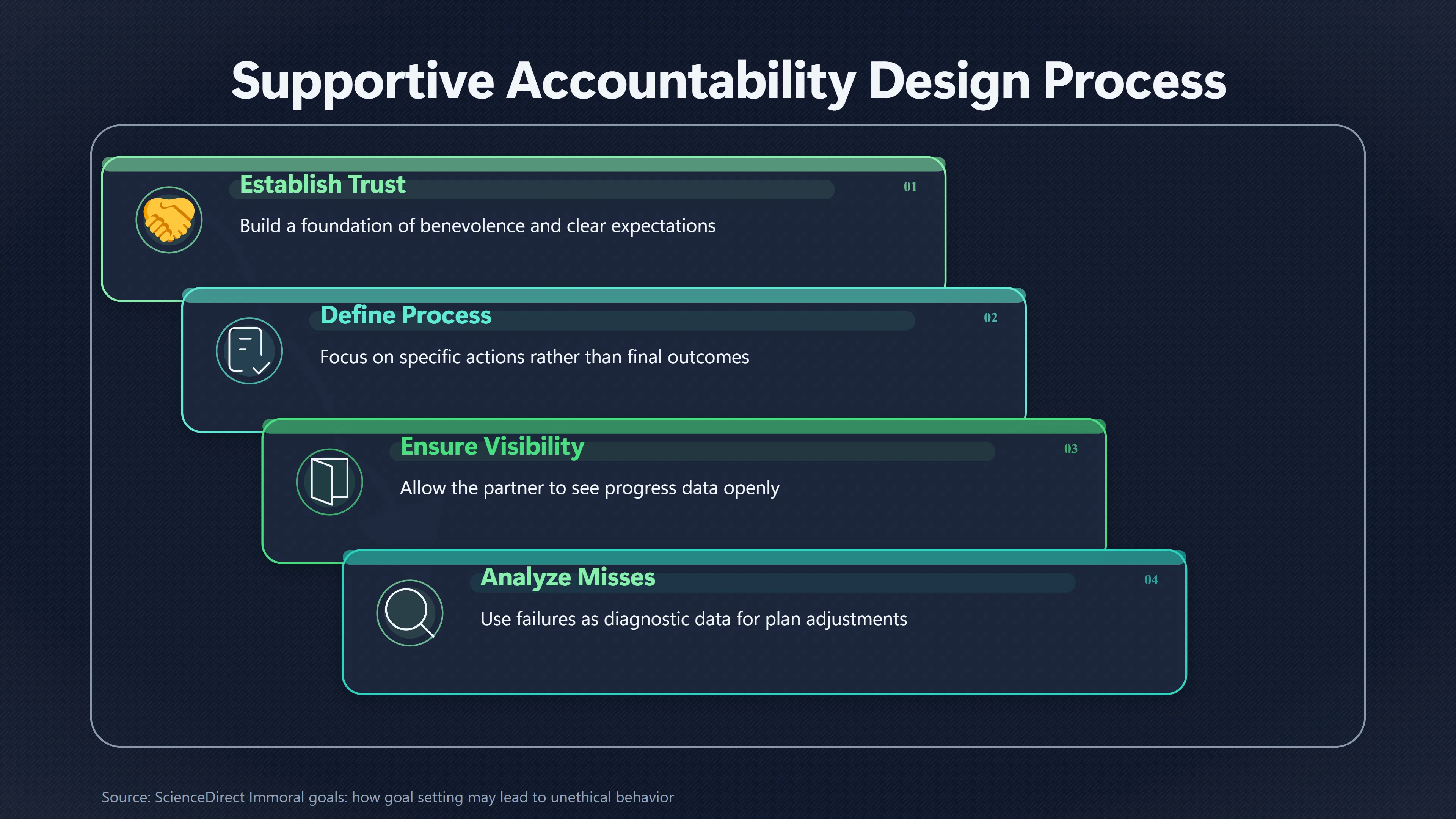
One of the clearest safeguards is to make the report primarily about actions the person can choose, rather than outcomes they can only partly control. The supportive-accountability model developed by David Mohr, Pim Cuijpers and Kenneth Lehman argues that effective human support should involve clear expectations, participation by the person being supported and an emphasis on process rather than outcome accountability. It also stresses trust, benevolence and an understandable benefit to the person receiving support.[PubMed Central (PMC)]pmc.ncbi.nlm.nih.govPubMed Central (PMC)Supportive Accountability: A Model for Providing Human Support to Enhance Adherence to eHealth Interventions - PMC…
That distinction changes the emotional meaning of a miss. Compare:
Outcome-centred: “Did you lose a kilogram this week?”
Process-centred: “On how many of the four planned days did you do the behaviour you chose?”
The first can turn the check-in into a verdict on an outcome affected by noise and circumstances. The second generates information that can be acted upon. The supportive-accountability model specifically warns that outcome accountability can produce detrimental effects such as distress and lower adherence, whereas process expectations give the person clearer control over what is being asked of them.[PubMed Central (PMC)]pmc.ncbi.nlm.nih.govPubMed Central (PMC)Supportive Accountability: A Model for Providing Human Support to Enhance Adherence to eHealth Interventions - PMC…
Process accountability should not become process perfectionism, however. If “four sessions” becomes a rigid score that must be defended every week, the same distortion can reappear one level down. A useful report therefore separates measurement from judgement: “two of four happened” is information first. The next question is what prevented the other two and whether the plan needs changing.
This approach also limits a common form of metric gaming. When success is defined by a single visible number, attention can migrate from improving the underlying behaviour to producing the desired number. Research on goal setting’s unintended consequences warns particularly about difficult outcome goals and incentives that make target attainment disproportionately important.[ScienceDirect]sciencedirect.comScienceDirect Immoral goals: how goal setting may lead to unethical behaviorImmoral goals: how goal setting may lead to unethical behavior - ScienceDirect…
For self-improvement, that means the accountability partner should be more interested in the diagnostic value of a miss than in preserving a perfect streak. An accurate “zero” can be more useful than a flattering “three” if it reveals that the plan is unrealistic.

Preserving visibility, autonomy and usefulness together
The alternative to excessive pressure is not removing accountability whenever it becomes uncomfortable. Some evaluation apprehension may be part of why social reporting motivates action in the first place. The design problem is to retain enough visibility that commitments matter while making truthful bad news safe enough to remain informative.
A practical arrangement has several characteristics:
- Misses are expected to be reportable. Agree in advance that “I did none this week” is a valid check-in, not a failure to participate in accountability.
- The observer asks before judging. Questions such as “What got in the way?” and “Does the target still make sense?” preserve the information-gathering function of the conversation.
- The metric describes behaviour rather than identity. “Two sessions completed” is less threatening and more actionable than “you weren’t disciplined”.
- The person retains a voice in the target. Supportive-accountability theory explicitly places participation in setting expectations alongside clarity and trust.[PubMed Central (PMC)]pmc.ncbi.nlm.nih.govPubMed Central (PMC)Supportive Accountability: A Model for Providing Human Support to Enhance Adherence to eHealth Interventions - PMC…
- Consequences do not make honesty irrational. If admitting a miss reliably produces humiliation, anger or escalating punishment, concealment becomes increasingly attractive.
- Monitoring is no broader than necessary. Evidence from electronic performance monitoring suggests that transparency and lower intrusiveness produce better attitudes than indiscriminate surveillance.[DOI]doi.orgOpen source on doi.org.
- A bad result triggers adjustment, not merely pressure. Persistent misses may mean the plan, environment or target needs redesigning rather than that the person needs a more intimidating observer.
This is consistent with evidence showing that visibility itself need not damage a supportive relationship. In a 2024 randomised study of 322 adults in a behavioural weight-loss programme, participants whose coaches could access digital self-monitoring records logged eating and physical activity more consistently and lost slightly more weight over 12 weeks. Importantly for the pressure question, coach access did not significantly worsen attendance or working alliance, and researchers found no evidence of harmful effects from sharing the data in that programme.[DOI]doi.orgOpen source on doi.org.
That result is an important counterweight to simplistic warnings about surveillance. Being observed is not inherently corrosive. In the study, monitoring occurred within a structured coaching relationship in which coaches used the information for praise, encouragement, goal setting and problem-solving as well as expressing concern about poor adherence. Participants with coach-visible data actually reported greater supportive accountability.[PubMed Central (PMC)]pmc.ncbi.nlm.nih.govPubMed Central (PMC)Coach access to digital self-monitoring data: An experimental test of short-term effects in behavioral weight loss tr…
The crucial question, then, is not simply “Can someone else see my progress?” It is “What happens when they see that I have fallen short?”
The warning sign is deterioration in information quality
There is no research-backed universal threshold at which accountability suddenly becomes excessive. Personality, relationship, stakes and context all matter, and much of the strongest evidence on reporting distortion comes from organisational, experimental or survey settings rather than ordinary self-improvement partnerships. Claims that a particular number of check-ins, observers or missed targets is inherently “too much” would go beyond the evidence.
A more useful threshold is functional. Accountability is becoming counterproductive when protecting one’s image begins interfering with accurate monitoring. Warning signs include postponing check-ins after poor weeks, selectively reporting successes, changing definitions after the fact, feeling compelled to justify every miss, choosing easier targets primarily to avoid embarrassment, or becoming more concerned with the observer’s reaction than with learning what actually happened.
Survey methodology provides a useful parallel. Socially desirable responding is not merely a theoretical nuisance: a 2026 systematic review examined 121 experiments in 79 papers testing methods intended to reduce it. Results varied substantially by method and topic, but the broader finding was clear enough for accountability design: the conditions under which people report can affect how candidly they report.[Springer]link.springer.comOpen source on springer.com.
For social accountability, honest reporting is not an optional virtue layered on top of the system. It is part of the mechanism. The observer cannot help detect obstacles, revise an unrealistic plan or recognise a genuine relapse if the monitoring record has been cleaned up to preserve approval.
The most useful accountability relationship therefore makes a paradoxical promise: your actions will remain visible, but a bad report will not make reporting dangerous. That preserves the social consequence that can strengthen commitment without giving the person a powerful reason to hide exactly the failures the arrangement was created to reveal.
Amazon book picks
Further Reading
Books and field guides related to When Does Accountability Become Too Much Pressure?. Use these as the next step if you want deeper reading beyond the article.
The Coaching Habit
Coaching is an essential skill for leaders. But for most busy, overworked managers, coaching employees is done badly, or not at all. They...
Atomic Habits
Rating: 3.5/5 from 7 Google Books ratings
The #1 New York Times bestseller. Over 25 million copies sold! Translated into 60+ languages! Tiny Changes, Remarkable Results No matter...
Drive
A book that will change how you think and transform how you live Forget everything you thought you knew about how to motivate people - at...
eBay marketplace picks
Marketplace Samples
Live-tested eBay searches with available results related to this page.
Selected fromaffirmation poster oneBay.co.uk.


Endnotes
1.
Source: doi.org
Link:https://doi.org/10.1007/s11135
Source snippet
Determinants of social desirability bias in sensitive surveys: a literature review | Quality & Quantity | Springer Nature LinkNovember...
2.
Source: sciencedirect.com
Title: ScienceDirect Immoral goals: how goal setting may lead to unethical behavior
Link:https://www.sciencedirect.com/science/article/pii/S2352250X15001633
Source snippet
Immoral goals: how goal setting may lead to unethical behavior - ScienceDirect...
3.
Source: doi.org
Link:https://doi.org/10.1002/job.2467
Source snippet
Motivated to disengage: The ethical consequences of goal commitment and moral disengagement in goal setting - Welsh - 2020 - Journal o...
4.
Source: sciencedirect.com
Link:https://www.sciencedirect.com/science/article/abs/pii/S0749597813000757
Source snippet
The dark side of consecutive high performance goals: Linking goal setting, depletion, and unethical behavior - ScienceDirect...
5.
Source: sjwop.com
Link:https://sjwop.com/articles/10.16993/sjwop.49
6.
Source: sciencedirect.com
Link:https://www.sciencedirect.com/science/article/pii/S0361368225000431
7.
Source: doi.org
Link:https://doi.org/10.1111/peps.12514
8.
Source: sciencedirect.com
Link:https://www.sciencedirect.com/science/article/pii/S2451958822000616
9.
Source: doi.org
Link:https://doi.org/10.1002/oby.24138
10.
Source: link.springer.com
Link:https://link.springer.com/article/10.1007/s11135-026-02664-7
11.
Source: sciencedirect.com
Link:https://www.sciencedirect.com/org/science/article/pii/S1438887124003091
12.
Source: sciencedirect.com
Link:https://www.sciencedirect.com/org/science/article/pii/S1438887120006068
13.
Source: link.springer.com
Link:https://link.springer.com/article/10.1007/s41449-018-00140-z
14.
Source: sciencedirect.com
Title: Supervisor motivating styles and legitimacy: moderation and mediation models
Link:https://www.sciencedirect.com/org/science/article/pii/S0268394617000333
15.
Source: doi.org
Title: Psychological Safety: A Meta‐Analytic Review and Extension
Link:https://doi.org/10.1111/peps.12183
16.
Source: doi.org
Link:https://doi.org/10.1007%2Fs11135
17.
Source: link.springer.com
Link:https://link.springer.com/article/10.1007/s10551
18.
Source: sciencedirect.com
Link:https://www.sciencedirect.com/org/science/article/pii/S1438887111000513
19.
Source: sciencedirect.com
Link:https://www.sciencedirect.com/science/article/pii/S1469029206000896
20.
Source: sciencedirect.com
Link:https://www.sciencedirect.com/science/article/pii/S0361368205000541
21.
Source: sciencedirect.com
Link:https://www.sciencedirect.com/science/article/abs/pii/S0361368205000541
22.
Source: sciencedirect.com
Title: Immoral goals: how goal setting may lead to unethical behavior
Link:https://www.sciencedirect.com/science/article/abs/pii/S2352250X15001633
23.
Source: sciencedirect.com
Link:https://www.sciencedirect.com/science/article/pii/S0749597813000757
24.
Source: sciencedirect.com
Title: Complete anonymity compromises the accuracy of self-reports
Link:https://www.sciencedirect.com/science/article/pii/S0022103112001321
25.
Source: sciencedirect.com
Title: The effects of social desirability bias on applied measures of goal orientation
Link:https://www.sciencedirect.com/science/article/pii/S0191886904003678
26.
Source: sciencedirect.com
Title: Complete anonymity compromises the accuracy of self-reports
Link:https://www.sciencedirect.com/science/article/abs/pii/S0022103112001321
27.
Source: sciencedirect.com
Title: Effects of Procedural and Outcome Accountability on Judgment Quality
Link:https://www.sciencedirect.com/science/article/pii/S0749597896900011
28.
Source: sciencedirect.com
Link:https://www.sciencedirect.com/science/article/pii/S2214782921000397
29.
Source: sciencedirect.com
Link:https://www.sciencedirect.com/science/article/pii/S146902920600118X
30.
Source: sciencedirect.com
Link:https://www.sciencedirect.com/science/article/pii/S1469029213000046
31.
Source: sciencedirect.com
Link:https://www.sciencedirect.com/science/article/pii/S1469029218304424
32.
Source: sciencedirect.com
Title: Accountability and ideology: When left looks right and right looks left
Link:https://www.sciencedirect.com/science/article/pii/S0749597813000411
33.
Source: sciencedirect.com
Link:https://www.sciencedirect.com/science/article/abs/pii/S0749597811000264
34.
Source: sciencedirect.com
Link:https://www.sciencedirect.com/science/article/pii/S0742051X1831117X
35.
Source: pubmed.ncbi.nlm.nih.gov
Link:https://pubmed.ncbi.nlm.nih.gov/31414830/
Source snippet
When goals are known: The effects of audience relative status on goal commitment and performance - PubMed...
36.
Source: pmc.ncbi.nlm.nih.gov
Link:https://pmc.ncbi.nlm.nih.gov/articles/PMC3221353/
Source snippet
PubMed Central (PMC)Supportive Accountability: A Model for Providing Human Support to Enhance Adherence to eHealth Interventions - PMC...
37.
Source: pmc.ncbi.nlm.nih.gov
Link:https://pmc.ncbi.nlm.nih.gov/articles/PMC11537830/
Source snippet
PubMed Central (PMC)Coach access to digital self-monitoring data: An experimental test of short-term effects in behavioral weight loss tr...
38.
Source: pubmed.ncbi.nlm.nih.gov
Title: Pub Med Sensitive questions in surveys
Link:https://pubmed.ncbi.nlm.nih.gov/17723033/
Source snippet
Sensitive questions in surveys - PubMed...
39.
Source: journals.aom.org
Link:https://journals.aom.org/doi/10.5465/20159591
Source snippet
Academy of Management JournalsGoal Setting as a Motivator of Unethical Behavior | Academy of Management JournalJune 1, 2004...
Published: June 1, 2004
40.
Source: pubmed.ncbi.nlm.nih.gov
Link:https://pubmed.ncbi.nlm.nih.gov/21393123/
41.
Source: pmc.ncbi.nlm.nih.gov
Link:https://pmc.ncbi.nlm.nih.gov/articles/PMC13230293/
42.
Source: pubmed.ncbi.nlm.nih.gov
Link:https://pubmed.ncbi.nlm.nih.gov/42245766/
43.
Source: pmc.ncbi.nlm.nih.gov
Link:https://pmc.ncbi.nlm.nih.gov/articles/PMC12887546/
44.
Source: pmc.ncbi.nlm.nih.gov
Link:https://pmc.ncbi.nlm.nih.gov/articles/PMC12866403/
45.
Source: pmc.ncbi.nlm.nih.gov
Link:https://pmc.ncbi.nlm.nih.gov/articles/PMC12514419/
46.
Source: pmc.ncbi.nlm.nih.gov
Link:https://pmc.ncbi.nlm.nih.gov/articles/PMC12109202/
47.
Source: pubmed.ncbi.nlm.nih.gov
Link:https://pubmed.ncbi.nlm.nih.gov/39358838/
48.
Source: onlinelibrary.wiley.com
Link:https://onlinelibrary.wiley.com/doi/10.1002/oby.24138
49.
Source: onlinelibrary.wiley.com
Link:https://onlinelibrary.wiley.com/doi/abs/10.1002/oby.24138
50.
Source: pmc.ncbi.nlm.nih.gov
Link:https://pmc.ncbi.nlm.nih.gov/articles/PMC11200516/
51.
Source: pmc.ncbi.nlm.nih.gov
Link:https://pmc.ncbi.nlm.nih.gov/articles/PMC10599306/
52.
Source: pmc.ncbi.nlm.nih.gov
Link:https://pmc.ncbi.nlm.nih.gov/articles/PMC10394603/
53.
Source: pmc.ncbi.nlm.nih.gov
Link:https://pmc.ncbi.nlm.nih.gov/articles/PMC10231946/
54.
Source: pubmed.ncbi.nlm.nih.gov
Link:https://pubmed.ncbi.nlm.nih.gov/37091553/
55.
Source: pmc.ncbi.nlm.nih.gov
Link:https://pmc.ncbi.nlm.nih.gov/articles/PMC10120817/
56.
Source: pubmed.ncbi.nlm.nih.gov
Link:https://pubmed.ncbi.nlm.nih.gov/35802929/
57.
Source: pmc.ncbi.nlm.nih.gov
Link:https://pmc.ncbi.nlm.nih.gov/articles/PMC9191356/
58.
Source: pmc.ncbi.nlm.nih.gov
Link:https://pmc.ncbi.nlm.nih.gov/articles/PMC9094407/
59.
Source: onlinelibrary.wiley.com
Link:https://onlinelibrary.wiley.com/doi/10.1111/peps.12514
60.
Source: pmc.ncbi.nlm.nih.gov
Link:https://pmc.ncbi.nlm.nih.gov/articles/PMC8917098/
61.
Source: pubmed.ncbi.nlm.nih.gov
Link:https://pubmed.ncbi.nlm.nih.gov/33593153/
62.
Source: pmc.ncbi.nlm.nih.gov
Link:https://pmc.ncbi.nlm.nih.gov/articles/PMC8935530/
63.
Source: pmc.ncbi.nlm.nih.gov
Link:https://pmc.ncbi.nlm.nih.gov/articles/PMC8260852/
64.
Source: pmc.ncbi.nlm.nih.gov
Link:https://pmc.ncbi.nlm.nih.gov/articles/PMC8176029/
65.
Source: pubmed.ncbi.nlm.nih.gov
Link:https://pubmed.ncbi.nlm.nih.gov/34093312/
66.
Source: pmc.ncbi.nlm.nih.gov
Link:https://pmc.ncbi.nlm.nih.gov/articles/PMC8122167/
67.
Source: pmc.ncbi.nlm.nih.gov
Link:https://pmc.ncbi.nlm.nih.gov/articles/PMC9225718/
68.
Source: pmc.ncbi.nlm.nih.gov
Link:https://pmc.ncbi.nlm.nih.gov/articles/PMC8628117/
69.
Source: pmc.ncbi.nlm.nih.gov
Link:https://pmc.ncbi.nlm.nih.gov/articles/PMC7011517/
70.
Source: pmc.ncbi.nlm.nih.gov
Link:https://pmc.ncbi.nlm.nih.gov/articles/PMC8323847/
71.
Source: journals.aom.org
Link:https://journals.aom.org/doi/10.5465/ambpp.2013.10497abstract
72.
Source: journals.aom.org
Link:https://journals.aom.org/doi/10.5465/ambpp.2013.15917abstract
73.
Source: pubmed.ncbi.nlm.nih.gov
Link:https://pubmed.ncbi.nlm.nih.gov/29048175/
74.
Source: pmc.ncbi.nlm.nih.gov
Link:https://pmc.ncbi.nlm.nih.gov/articles/PMC4756120/
75.
Source: pubmed.ncbi.nlm.nih.gov
Link:https://pubmed.ncbi.nlm.nih.gov/26924997/
76.
Source: journals.aom.org
Link:https://journals.aom.org/doi/abs/10.5465/apbpp.2002.7517522
77.
Source: pubmed.ncbi.nlm.nih.gov
Link:https://pubmed.ncbi.nlm.nih.gov/12219856/
78.
Source: pubmed.ncbi.nlm.nih.gov
Link:https://pubmed.ncbi.nlm.nih.gov/35330866/
79.
Source: pubmed.ncbi.nlm.nih.gov
Link:https://pubmed.ncbi.nlm.nih.gov/41664590/
80.
Source: pmc.ncbi.nlm.nih.gov
Link:https://pmc.ncbi.nlm.nih.gov/articles/1955340/
81.
Source: ncbi.nlm.nih.gov
Link:https://www.ncbi.nlm.nih.gov/books/NBK583164/
82.
Source: pubmed.ncbi.nlm.nih.gov
Link:https://pubmed.ncbi.nlm.nih.gov/10087938/
83.
Source: periodicos.capes.gov.br
Link:https://www.periodicos.capes.gov.br/index.php/acervo/buscador.html?id=W2169732069&task=detalhes
Additional References
84.
Source: experts.arizona.edu
Title: University of Arizona Goal setting as a motivator of unethical behavior
Link:https://experts.arizona.edu/en/publications/goal-setting-as-a-motivator-of-unethical-behavior/
Source snippet
University of ArizonaGoal setting as a motivator of unethical behavior - University of Arizona...
85.
Source: youtube.com
Title: What is Goodhart’s Law? And Why does it Matter?
Link:https://www.youtube.com/watch?v=uKVZ3Zxi1no
Source snippet
For a deeper exploration of how high pressure without psychological safety undermines honest feedback, check out Accountability and Psych...
86.
Source: youtube.com
Title: Why learning to fail can teach us to thrive | Amy Edmondson | RSA REPLAY
Link:https://www.youtube.com/watch?v=JCq0t8rynaw
Source snippet
Why Accountability Feels So Hard (And How to Make It Work for You)...
87.
Source: ahrq.gov
Link:https://www.ahrq.gov/diagnostic-safety/resources/issue-briefs/dxsafety-psychological-safety-2.html
88.
Source: psnet.ahrq.gov
Link:https://psnet.ahrq.gov/issue/speaking-and-taking-action-psychological-safety-and-joint-problem-solving-orientation-safety
89.
Source: youtube.com
Title: Why Accountability Feels So Hard (And How to Make It Work for You)
Link:https://www.youtube.com/watch?v=5q2gF_jifs4
Source snippet
What is Goodhart's Law? And Why does it Matter?...
90.
Source: psnet.ahrq.gov
Link:https://psnet.ahrq.gov/issue/individual-characteristics-promote-or-prevent-psychological-safety-and-error-reporting
91.
Source: youtube.com
Title: Psychological Safety with Amy Edmondson
Link:https://www.youtube.com/watch?v=sKo9KvpA7eE
Source snippet
Why learning to fail can teach us to thrive | Amy Edmondson | RSA REPLAY...
92.
Source: researchgate.net
Link:https://www.researchgate.net/publication/13203036_Accounting_for_The_Effects_of_Accountability
93.
Source: researchgate.net
Link:https://www.researchgate.net/publication/275859410_Goal_Setting_as_a_Motivator_of_Unethical_Behavior