Within Stable Contexts
Choose Habit Cues That Leave Room to Act
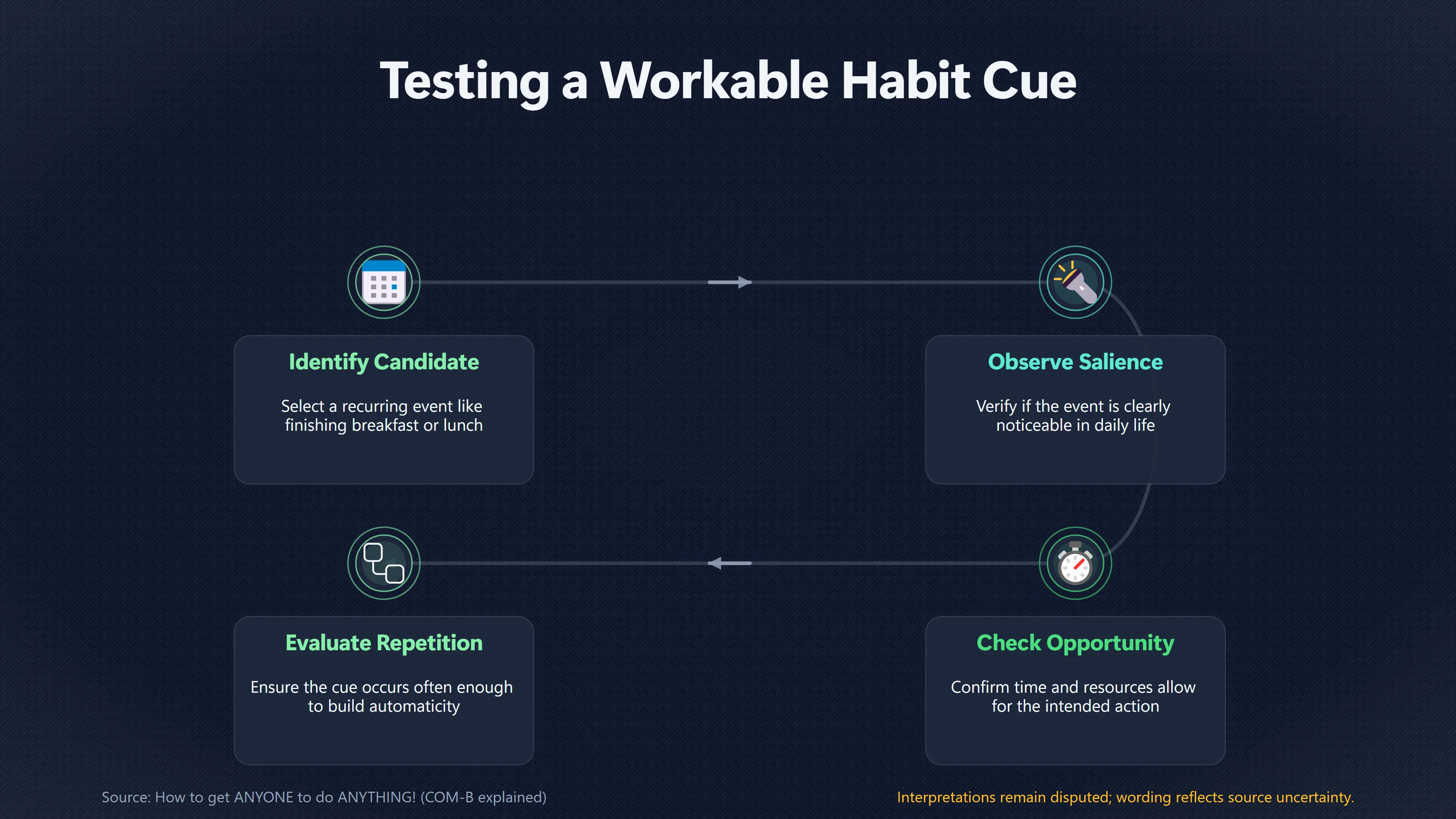
A useful habit cue must recur often, be noticeable and usually leave enough opportunity to perform the intended behaviour.
On this page
- The three qualities of a workable habit cue
- Why frequent but inconvenient cues create poor practice
- Testing whether a cue fits the behaviour in real life
Page outline Jump by section
Introduction
A habit cue is useful only if it arrives when the behaviour is genuinely possible. A cue may be frequent and memorable, but if it usually appears while your hands are full, you are travelling, the necessary equipment is elsewhere, or there is no time to act, it repeatedly creates a prompt without a performance. That matters because habits are learned through repeated cue–behaviour pairings, not through repeated reminders alone.[Compass]compass.onlinelibrary.wiley.comWhat is habit and how can it be used to change real‐world behaviour? Narrowing the theory‐reality gap - Gardner - 2024 - Social an…
For practical habit building, therefore, a workable cue needs three qualities: it should recur often enough to provide practice, be noticeable enough to register, and coincide with a real opportunity to perform the intended action. The third requirement is easy to overlook. Behavioural science distinguishes a prompt from the physical and social opportunity that makes behaviour possible; a good habit design brings the two together.[Health Education England]hee.nhs.ukHealth Education EnglandFurther COM-B information | NHS England | Workforce, training and educationSeptember 26, 2022…
The three qualities of a workable habit cue
Habit formation depends on learning an association between a recurring context and a response. Repetition strengthens that association, so that encountering the context can eventually trigger an impulse to act with less deliberate decision-making. The practical implication is that cue selection should be judged by the number of usable repetitions it is likely to generate, rather than by how clever or memorable the cue sounds.[OUP Academic]academic.oup.comOUP AcademicHabit Formation and Behavior Change | Oxford Research Encyclopedia of Psychology | Oxford AcademicApril 26, 2019…
It recurs often enough. A cue that appears only occasionally offers relatively few chances to practise the cue–behaviour pairing. For an intended daily behaviour, an everyday event such as finishing breakfast may therefore be more useful than an irregular event such as receiving a particular type of email. Frequency is not valuable by itself, however: what matters is repeatedly performing the behaviour when that cue occurs. In a randomised trial of 192 adults forming healthy-eating habits, repeated enactment of the planned cue–behaviour link predicted increasing automaticity. Simply doing the desired behaviour at unrelated moments is not the same learning experience.[PubMed]pubmed.ncbi.nlm.nih.govHabit formation following routine-based versus time-based cue planning: A randomized controlled trial - PubMedJanuary 6, 2021…
It is noticeable. A recurring circumstance cannot reliably guide action if it routinely passes unnoticed. Reviews of habit formation consequently emphasise cues that are salient, perceptible and accessible. Existing events in the flow of daily life can work well because their occurrence is already apparent: finishing lunch, putting away a toothbrush or arriving home provides a clearer transition than an indistinct intention such as “sometime this afternoon”.[PubMed Central (PMC)]pmc.ncbi.nlm.nih.govPubMed Central (PMC)Applying the Science of Habit Formation to Evidence-Based Psychological Treatments for Mental Illness - PMCMarch 1, 2022… Implementation-intention research supports the underlying mechanism: specifying a future situation in an if–then plan can make that situation easier to identify when it occurs. Experiments by Thomas Webb and Paschal Sheeran found faster or more accurate detection of specified cues without corresponding costs for irrelevant or ambiguous stimuli.[Wiley Online Library]onlinelibrary.wiley.comOpen source on wiley.com.
It leaves room to act. This is the crucial filter. Opportunity in the COM-B model of behaviour refers to external circumstances that make an action possible or prompt it; physical opportunity includes such basics as time, resources and an accessible location.[Health Education England]hee.nhs.ukHealth Education EnglandFurther COM-B information | NHS England | Workforce, training and educationSeptember 26, 2022… A cue can therefore be excellent as a reminder but poor as a habit-building context. “When I get on the train, I will practise the piano” is unmistakable and frequent but usually unusable. “After I put my bag down at home, I will practise for five minutes” is more promising because cue and opportunity coincide.
This distinction also prevents a common design error: treating a notification as though it were the habit itself. A phone can reliably announce 6 pm, but the notification does not create the privacy needed to meditate, the trainers needed to run or the kitchen needed to prepare food. In a four-week study of technology-supported habit formation, reminders supported repetition but reliance on reminders did not support habit development as well as event-based cues; the authors argued that apps should connect behaviour more closely to contextual cues rather than simply issuing alerts.[University of Bristol]research-information.bris.ac.ukOpen source on bris.ac.uk.
Why frequent but inconvenient cues create poor practice
Imagine trying to establish a ten-minute walk using “when I finish lunch” as the cue. On paper it looks excellent: lunch happens daily, its ending is obvious, and the cue is naturally tied to an existing routine. But suppose lunch usually ends five minutes before the next meeting. The cue occurs perfectly while the intended behaviour is regularly impossible.
The problem is not primarily weak motivation. The design has separated the signal to act from the opportunity to complete the response. Habit formation requires cue-linked behavioural repetitions; if the cue repeatedly occurs without the planned response, the learner loses precisely the practice that is supposed to establish the association. Research tracking real-world habit formation accordingly treats changes in motivation, capability or opportunity as prerequisites for the early performances from which habits can develop.[Taylor & Francis Online]tandfonline.comOpen source on tandfonline.com.
This is why “choose something that happens every day” is incomplete advice. A cue can score highly on frequency yet produce few usable repetitions:
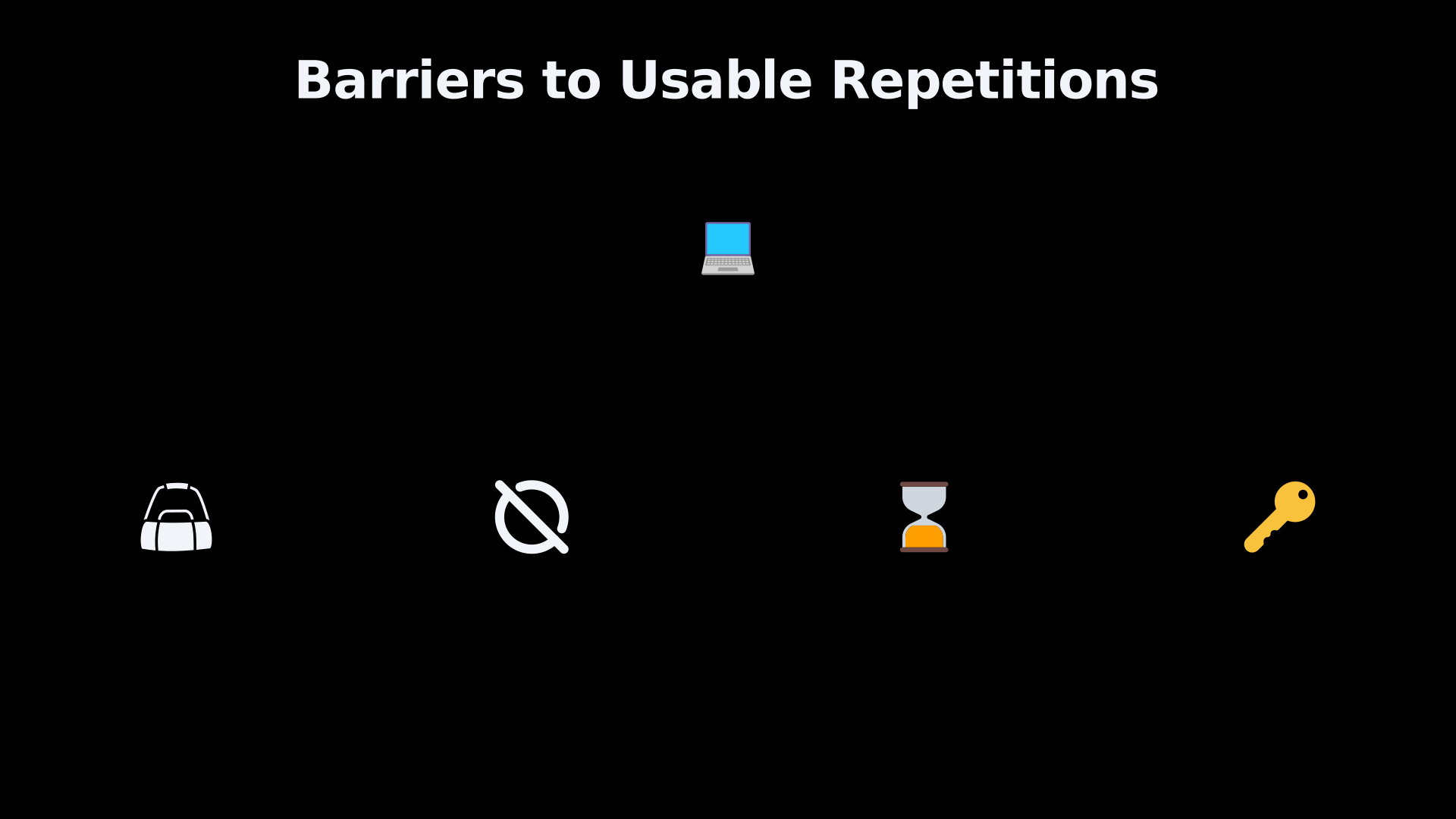
- The cue arrives during a competing obligation. A 9 am stretching cue is weak in practice if 9 am usually means joining a meeting.
- The required resources are elsewhere. Arriving at work cannot reliably cue taking a medicine that is normally left at home.
- The setting restricts the action. Finishing a commute may be predictable, but it is unsuitable for an action requiring privacy or specialised equipment.
- The available window is shorter than the behaviour. A predictable five-minute gap cannot consistently support a 30-minute routine.
- Other people control the opportunity. A cue may recur reliably while access to a shared room, equipment, childcare or social permission varies.
These are not minor inconveniences. Opportunity is one of the conditions required for behaviour in the COM-B framework, alongside capability and motivation. Research applying the model in real settings repeatedly identifies time, resources, accessible locations and social circumstances as factors that determine whether an intended action is feasible.[Wiley Online Library]onlinelibrary.wiley.comA deductive framework analysis using the Capability, Opportunity, Motivation and Behaviour (COM‐B) behavioural science model - Stocker…
There is also an important difference between a cue triggering an impulse and the behaviour actually happening. Contemporary habit theory does not require the cue to force behaviour mechanically; rather, a learned cue–behaviour association can activate an impulse to act. Whether that impulse becomes behaviour still depends on circumstances and competing responses. Gardner’s 2024 review gives the converse example: adding enough friction to an unwanted behaviour can make it difficult or impossible to enact even when its habitual impulse has already been triggered.[Compass]compass.onlinelibrary.wiley.comOpen source on wiley.com. The same principle applies in reverse when building a wanted habit: the intended response should be readily accessible when its cue arrives.

Match the cue to the behaviour, not a preferred formula
Routine-based cues are often attractive because an existing action provides a naturally noticeable event. Yet there is no evidence that everyone should always choose “after X” rather than a clock time. In the 2021 randomised trial of healthy nutrition habits, participants linked their chosen behaviour either to a daily routine such as breakfast or to a specific time. Both groups increased plan enactment and automaticity, with no significant difference between the two cue types. Among those whose habit-formation trajectories were successfully modelled as reaching a plateau, the median time to 95% of peak automaticity was 59 days.[PubMed]pubmed.ncbi.nlm.nih.govHabit formation following routine-based versus time-based cue planning: A randomized controlled trial - PubMedJanuary 6, 2021…
The more important result for cue selection was that repeatedly carrying out the behaviour in response to the chosen cue predicted automaticity.[DOI]doi.orgHabit formation following routine‐based versus time‐based cue planning: A randomized controlled trial - Keller - 2021 - British Journa… That shifts the practical question from “What is scientifically the best kind of cue?” towards “Which cue–behaviour combination can I actually enact again and again?”
A clock cue can therefore be entirely workable when the behaviour is reliably possible at that time. “At 10 pm, put the phone on charge outside the bedroom” may fit someone with a stable evening schedule. A routine cue may be better for someone whose clock times vary but whose sequence of activities does not: “after brushing my teeth, put the phone outside the bedroom”. Conversely, “after breakfast” is a poor anchor for a 20-minute exercise session if breakfast normally ends as the person rushes out of the door. The cue type matters less than whether the resulting pairing survives ordinary life.
The scale of the intended response matters too. Habit researchers distinguish between habitual instigation—automatically initiating or deciding to start an activity—and habitual execution, in which the component actions themselves become automatic.[BPS Psych Hub]bpspsychub.onlinelibrary.wiley.comOpen source on wiley.com. For a complex behaviour such as exercising, studying or cooking, it may therefore be more realistic to attach a cue to a small, controllable starting action: opening the study document after sitting at the desk, putting on trainers after arriving home, or beginning food preparation after clearing the evening dishes. The cue then asks for something that can actually happen at that moment rather than attempting to automate an entire extended activity at once.
Test the cue in real life before committing to it
A cue that sounds sensible in advance can fail once it meets a normal week. The simplest way to assess it is to observe several actual occurrences and ask whether cue and opportunity genuinely overlap. This is a small practical test of the mechanism rather than a test of personal discipline.
For each candidate cue, check three questions:
- Did I clearly notice it? If the event was vague or routinely escaped attention, make the cue more specific or choose a more salient transition.
- Could I have started the behaviour then? Check the actual constraints: time, place, equipment, privacy, other people and competing obligations.
- Does this happen often enough to generate repeated cue-linked practice? A dependable cue that appears once a month will usually be a poor anchor for a behaviour intended to become an everyday routine.
This test also exposes the difference between an occasional failure and a structural mismatch. Missing one repetition need not destroy habit formation; early real-world research found that a single missed opportunity did not materially disrupt the automaticity trajectory.[University College London]ucl.ac.ukUniversity College London How long does it take to form a habit? | UCL NewsUniversity College London How long does it take to form a habit? | UCL News But a cue that routinely arrives when action is impossible creates a different problem: missed enactment is built into the plan.
When that happens, change the cue or reduce the behaviour rather than merely adding more reminders. If “after lunch, walk for 20 minutes” repeatedly collides with work, a usable alternative might be “after closing my laptop at the end of work, put on my walking shoes”. If “at 7 pm, study for an hour” fails because evenings are unpredictable, “after making my first morning drink, open my study notes and answer one practice question” may create a more dependable pairing. The exact replacement is personal; what matters is engineering a recurring moment in which the response is both recognisable and feasible.
The strongest cue is therefore not necessarily the loudest, most frequent or most precisely timed. It is the cue that repeatedly finds you in a position to act. Stable contexts can help behaviour become automatic only when those contexts supply genuine opportunities for the cue and response to occur together often enough for the association to be learned.[DOI]doi.orgHabit formation following routine‐based versus time‐based cue planning: A randomized controlled trial - Keller - 2021 - British Journa…
Amazon book picks
Further Reading
Books and field guides related to Choose Habit Cues That Leave Room to Act. Use these as the next step if you want deeper reading beyond the article.
Tiny Habits
Improving your life is much easier than you think. Whether it’s losing weight, sleeping more, or restoring your work/life balance – the s...
Atomic Habits
Rating: 3.5/5 from 7 Google Books ratings
The #1 New York Times bestseller. Over 25 million copies sold! Translated into 60+ languages! Tiny Changes, Remarkable Results No matter...
The Power of Habit
Rating: 4.0/5 from 145 Google Books ratings
Duhigg takes us to the edge of scientific discoveries that explain why habits exist and how they can be changed. Distilling information i...
Good Habits, Bad Habits
'The world's leading expert on habits' - Matthew Syed, bestselling author of Black Box Thinking and Rebel IdeasWhat if you could harness...
eBay marketplace picks
Marketplace Samples
Live-tested eBay searches with available results related to this page.
Selected frommotivational desk sign oneBay.co.uk.

Endnotes
1.
Source: compass.onlinelibrary.wiley.com
Link:https://compass.onlinelibrary.wiley.com/doi/full/10.1111/spc3.12975
Source snippet
What is habit and how can it be used to change real‐world behaviour? Narrowing the theory‐reality gap - Gardner - 2024 - Social an...
2.
Source: doi.org
Link:https://doi.org/10.1111/bjhp.12504
Source snippet
Habit formation following routine‐based versus time‐based cue planning: A randomized controlled trial - Keller - 2021 - British Journa...
3.
Source: onlinelibrary.wiley.com
Link:https://onlinelibrary.wiley.com/doi/full/10.1111/dme.70367
Source snippet
A deductive framework analysis using the Capability, Opportunity, Motivation and Behaviour (COM‐B) behavioural science model - Stocker...
4.
Source: academic.oup.com
Link:https://academic.oup.com/edited-volume/62246/chapter-abstract/550940636
Source snippet
OUP AcademicHabit Formation and Behavior Change | Oxford Research Encyclopedia of Psychology | Oxford AcademicApril 26, 2019...
Published: April 26, 2019
5.
Source: onlinelibrary.wiley.com
Link:https://onlinelibrary.wiley.com/doi/10.1002/ejsp.205
6.
Source: compass.onlinelibrary.wiley.com
Link:https://compass.onlinelibrary.wiley.com/doi/10.1111/spc3.12975
7.
Source: bpspsychub.onlinelibrary.wiley.com
Link:https://bpspsychub.onlinelibrary.wiley.com/doi/abs/10.1111/bjhp.12504
8.
Source: bpspsychub.onlinelibrary.wiley.com
Link:https://bpspsychub.onlinelibrary.wiley.com/doi/10.1111/bjhp.12189
9.
Source: onlinelibrary.wiley.com
Link:https://onlinelibrary.wiley.com/doi/10.1111/dme.70367
10.
Source: iaap-journals.onlinelibrary.wiley.com
Link:https://iaap-journals.onlinelibrary.wiley.com/doi/10.1111/aphw.70144?af=R
11.
Source: iaap-journals.onlinelibrary.wiley.com
Link:https://iaap-journals.onlinelibrary.wiley.com/doi/10.1111/aphw.70016
12.
Source: doi.org
Link:https://doi.org/10.1111/bjhp.12795
13.
Source: bpspsychub.onlinelibrary.wiley.com
Link:https://bpspsychub.onlinelibrary.wiley.com/doi/full/10.1111/bjhp.12795
14.
Source: iaap-journals.onlinelibrary.wiley.com
Link:https://iaap-journals.onlinelibrary.wiley.com/doi/10.1111/aphw.12605
15.
Source: doi.org
Link:https://doi.org/10.1111/aphw.12589
16.
Source: iaap-journals.onlinelibrary.wiley.com
Link:https://iaap-journals.onlinelibrary.wiley.com/doi/10.1111/aphw.12589
17.
Source: compass.onlinelibrary.wiley.com
Link:https://compass.onlinelibrary.wiley.com/doi/abs/10.1111/spc3.12975
18.
Source: compass.onlinelibrary.wiley.com
Link:https://compass.onlinelibrary.wiley.com/doi/epdf/10.1111/spc3.12975
19.
Source: onlinelibrary.wiley.com
Link:https://onlinelibrary.wiley.com/doi/full/10.1002/jeab.893
20.
Source: academic.oup.com
Link:https://academic.oup.com/abm/article/57/11/910/7198616
21.
Source: doi.org
Link:https://doi.org/10.1186/s12966-022-01343-8
22.
Source: onlinelibrary.wiley.com
Link:https://onlinelibrary.wiley.com/doi/full/10.1111/cdoe.12624
23.
Source: compass.onlinelibrary.wiley.com
Link:https://compass.onlinelibrary.wiley.com/doi/abs/10.1111/spc3.12553
24.
Source: compass.onlinelibrary.wiley.com
Link:https://compass.onlinelibrary.wiley.com/doi/10.1111/spc3.12553
25.
Source: doi.org
Link:https://doi.org/10.1002/EJSP.205
26.
Source: iaap-journals.onlinelibrary.wiley.com
Link:https://iaap-journals.onlinelibrary.wiley.com/doi/epdf/10.1111/aphw.12597
27.
Source: youtube.com
Title: How to get ANYONE to do ANYTHING! (COM-B explained)
Link:https://www.youtube.com/watch?v=lC7UK_mSSVs
Source snippet
The COM-B Model...
28.
Source: youtube.com
Title: The COM-B Model
Link:https://www.youtube.com/watch?v=9uUXgMNS23k
Source snippet
Fogg Behavior Model Explained | 3 Types of Prompts...
29.
Source: hee.nhs.uk
Link:https://www.hee.nhs.uk/our-work/workforce-transformation/health-psychology-workforce-transformation-programme/further-com-b-information
Source snippet
Health Education EnglandFurther COM-B information | NHS England | Workforce, training and educationSeptember 26, 2022...
Published: September 26, 2022
30.
Source: pmc.ncbi.nlm.nih.gov
Link:https://pmc.ncbi.nlm.nih.gov/articles/PMC11635918/
Source snippet
PubMed Central (PMC)HabitWalk: A micro‐randomized trial to understand and promote habit formation in [physical activity]({{ 'physical-capacity/' | relative_url }}) - PMC...
31.
Source: pubmed.ncbi.nlm.nih.gov
Link:https://pubmed.ncbi.nlm.nih.gov/33405284/
Source snippet
Habit formation following routine-based versus time-based cue planning: A randomized controlled trial - PubMedJanuary 6, 2021...
Published: January 6, 2021
32.
Source: pmc.ncbi.nlm.nih.gov
Link:https://pmc.ncbi.nlm.nih.gov/articles/PMC12318445/
Source snippet
PubMed Central (PMC)Applying the Science of Habit Formation to Evidence-Based Psychological Treatments for Mental Illness - PMCMarch 1, 2022...
Published: March 1, 2022
33.
Source: research-information.bris.ac.uk
Link:https://research-information.bris.ac.uk/en/publications/beyond-self-tracking-and-reminders-designing-smartphone-apps-that/
34.
Source: tandfonline.com
Link:https://www.tandfonline.com/doi/full/10.1080/23311908.2022.2041277
35.
Source: ucl.ac.uk
Title: University College London How long does it take to form a habit? | UCL News
Link:https://www.ucl.ac.uk/news/2009/aug/how-long-does-it-take-form-habit
36.
Source: pmc.ncbi.nlm.nih.gov
Link:https://pmc.ncbi.nlm.nih.gov/articles/PMC13059544/
37.
Source: pmc.ncbi.nlm.nih.gov
Link:https://pmc.ncbi.nlm.nih.gov/articles/PMC13114073/
38.
Source: tandfonline.com
Link:https://www.tandfonline.com/doi/full/10.1080/08870446.2026.2626493
39.
Source: pmc.ncbi.nlm.nih.gov
Link:https://pmc.ncbi.nlm.nih.gov/articles/PMC11920387/
40.
Source: pmc.ncbi.nlm.nih.gov
Link:https://pmc.ncbi.nlm.nih.gov/articles/PMC11574773/
41.
Source: pmc.ncbi.nlm.nih.gov
Link:https://pmc.ncbi.nlm.nih.gov/articles/PMC11297519/
42.
Source: pmc.ncbi.nlm.nih.gov
Link:https://pmc.ncbi.nlm.nih.gov/articles/PMC11161714/
43.
Source: pmc.ncbi.nlm.nih.gov
Link:https://pmc.ncbi.nlm.nih.gov/articles/PMC11001585/
44.
Source: pmc.ncbi.nlm.nih.gov
Link:https://pmc.ncbi.nlm.nih.gov/articles/PMC10119442/
45.
Source: tandfonline.com
Link:https://www.tandfonline.com/doi/abs/10.1080/21670811.2022.2112519?scroll=top&tab=permissions
46.
Source: pmc.ncbi.nlm.nih.gov
Link:https://pmc.ncbi.nlm.nih.gov/articles/PMC9372943/
47.
Source: cnwl.nhs.uk
Title: march 2022 improvement academy newsletter
Link:https://www.cnwl.nhs.uk/ia/news/march-2022-improvement-academy-newsletter
Published: march 2022
48.
Source: tandfonline.com
Link:https://www.tandfonline.com/doi/full/10.1080/08870446.2021.2003362
49.
Source: tandfonline.com
Link:https://www.tandfonline.com/doi/abs/10.1080/08870446.2021.2003362
50.
Source: tandfonline.com
Link:https://www.tandfonline.com/doi/full/10.1080/1750984X.2021.1904434
51.
Source: pmc.ncbi.nlm.nih.gov
Link:https://pmc.ncbi.nlm.nih.gov/articles/PMC7645026/
52.
Source: pmc.ncbi.nlm.nih.gov
Link:https://pmc.ncbi.nlm.nih.gov/articles/PMC6302524/
53.
Source: tandfonline.com
Link:https://www.tandfonline.com/doi/full/10.3109/14992027.2015.1120894
54.
Source: pmc.ncbi.nlm.nih.gov
Link:https://pmc.ncbi.nlm.nih.gov/articles/PMC4216661/
55.
Source: pmc.ncbi.nlm.nih.gov
Link:https://pmc.ncbi.nlm.nih.gov/articles/PMC4566897/
56.
Source: tandfonline.com
Link:https://www.tandfonline.com/doi/full/10.1080/17437199.2013.876238
57.
Source: pubmed.ncbi.nlm.nih.gov
Link:https://pubmed.ncbi.nlm.nih.gov/23954303/
58.
Source: pmc.ncbi.nlm.nih.gov
Link:https://pmc.ncbi.nlm.nih.gov/articles/3505409/
59.
Source: pmc.ncbi.nlm.nih.gov
Link:https://pmc.ncbi.nlm.nih.gov/articles/PMC3505409/
Additional References
60.
Source: youtube.com
Title: Boost motivation (and ability) by starting tiny
Link:https://www.youtube.com/watch?v=HNeoIdOte2o
Source snippet
COM-B model capability opportunity motivation behaviour change COM-B model and Behavior Change Wheel #ai #statistics #motivation #publich...
61.
Source: chinarxiv.org
Link:https://chinarxiv.org/items/chinaxiv-202510.00112
62.
Source: researchgate.net
Link:https://www.researchgate.net/publication/370374699_Combining_Behavioral_Economics-Based_Incentives_With_the_Anchoring_Strategy_Protocol_for_a_Randomized_Controlled_Trial
63.
Source: researchgate.net
Link:https://www.researchgate.net/publication/356209185_Developing_habit-based_health_behaviour_change_interventions_twenty-one_questions_to_guide_future_research
64.
Source: researchgate.net
Link:https://www.researchgate.net/publication/342379317_Does_habit_weaken_the_relationship_between_intention_and_behaviour_Revisiting_the_habit-intention_interaction_hypothesis
65.
Source: researchgate.net
Link:https://www.researchgate.net/publication/227955629Experimental_tests_of_prospective[remembering
66.
Source: researchgate.net
Link:https://www.researchgate.net/publication/348328187_Habit_formation_following_routine-based_versus_time-based_cue_planning_A_randomized_controlled_trial
67.
Source: researchgate.net
Link:https://www.researchgate.net/publication/355113346_What_makes_implementation_intentions_ineffective_for_physical_activity_among_older_adults
68.
Source: guilfordjournals.com
Link:https://guilfordjournals.com/doi/10.1521/soco.2007.25.2.248
69.
Source: sciencedirect.com
Link:https://www.sciencedirect.com/org/science/article/pii/S2369199925000199