Within Physical Capacity
Can Exercise Make Better Sleep Easier to Sustain?
Regular exercise can improve sleep quality and efficiency, making it easier to sustain concentration and effort elsewhere.
On this page
- What exercise research finds about sleep quality
- Why better sleep can increase capacity for other goals
- Building enough activity to help without exhausting yourself
Page outline Jump by section
Introduction
Exercise can make better sleep easier to sustain without turning sleep into another complicated self-improvement project. Across randomised trials, regular exercise improves how people rate their sleep and produces smaller but measurable improvements in objective sleep efficiency — the proportion of time in bed actually spent asleep. A 2024 meta-analysis of 81 randomised controlled trials involving 6,193 participants found that exercise improved both measures, while newer evidence suggests the people starting with poorer sleep may have the most to gain.[PubMed]pubmed.ncbi.nlm.nih.govEffects of exercise on sleep quality in general population: Meta-analysis and systematic review - PubMedNovember 12, 2024…
The practical message is simpler than the research literature can make it appear. There is no clearly established single best workout, exact hour or elaborate exercise prescription that everyone needs for sleep. Walking, other aerobic activity, resistance exercise and mixed approaches have all shown benefits in research. For someone using physical activity to support studying, working or everyday responsibilities, the useful target is therefore repeatable activity that helps sleep without creating so much fatigue, scheduling difficulty or bedtime stimulation that the routine defeats its purpose.[PubMed Central (PMC)]pmc.ncbi.nlm.nih.govPubMed Central (PMC)Effects of different types of exercise on sleep quality based on Pittsburgh Sleep Quality Index in middle-aged and ol…
What exercise research finds about sleep quality
The strongest broad evidence supports a modest but genuine sleep benefit rather than a dramatic cure. In the 81-trial meta-analysis, exercise reduced scores on the Pittsburgh Sleep Quality Index (PSQI) by an average of 1.77 points. The PSQI is a questionnaire covering aspects such as perceived sleep quality, time taken to fall asleep, sleep duration and daytime problems. Across trials that objectively measured sleep, exercise also increased sleep efficiency by an average of 4.81 percentage points.[PubMed]pubmed.ncbi.nlm.nih.govEffects of exercise on sleep quality in general population: Meta-analysis and systematic review - PubMedNovember 12, 2024…
Those two findings are worth distinguishing. People do not merely report feeling somewhat better about their sleep; objective measurements provide some support for an improvement too. At the same time, the effects are not identical across every sleep measure or every population. A 2026 systematic review and Bayesian meta-analysis covering 200 trials and 23,523 adults found a beneficial average effect on subjective sleep quality but only a small improvement in objective sleep efficiency. It also judged the overall certainty of its evidence to be very low, reflecting limitations and variation across the underlying studies.[PubMed]pubmed.ncbi.nlm.nih.govDeterminants and interrelations of exercise effects on sleep quality: A multimethod meta-analysis - PubMed…
This is one reason not to overinterpret rankings of particular workouts. The 2024 general-population analysis ranked mind-body exercise highest for subjective sleep quality and aerobic exercise highest for objective sleep efficiency. Another 2024 network meta-analysis suggested that combined exercise might perform especially well under particular combinations of frequency, intensity and programme length, but its authors explicitly cautioned that the number of studies was limited. Among middle-aged and older adults, a separate analysis instead ranked aerobic exercise highest for overall PSQI scores.[nih.gov]pubmed.ncbi.nlm.nih.govEffects of exercise on sleep quality in general population: Meta-analysis and systematic review - PubMedNovember 12, 2024…
The disagreement is useful rather than disappointing: it argues against believing that sleep requires one optimised exercise formula. Different reviews include different populations, interventions and outcomes, and network rankings can make small or uncertain differences look more decisive than they are. The stable finding underneath them is that several forms of regular activity can help.
There is also evidence that the starting point matters. The large 2026 review found baseline sleep quality to be one of the main determinants of response: people whose sleep was already reasonably good had less room to improve, whereas those beginning with poorer sleep were more likely to experience a clinically important change.[PubMed]pubmed.ncbi.nlm.nih.govDeterminants and interrelations of exercise effects on sleep quality: A multimethod meta-analysis - PubMed… This makes intuitive sense and puts the average effects in perspective. Exercise should not be expected to transform every good sleeper’s night, but it may be more consequential when sleep is already a weak point.
Why better sleep can increase capacity for other goals
The value of this effect becomes clearer when exercise is treated as support for other goals rather than another performance target. Sleep deficiency interferes with learning, concentration, reaction time, decision-making and emotional regulation. The US National Heart, Lung, and Blood Institute notes that people who are sleep deficient can take longer to complete tasks and make more mistakes at work or school.[NHLBI, NIH]nhlbi.nih.govNHLBI, NIHSleep Deprivation and DeficiencyWhat Are Sleep Deprivation and Deficiency? | NHLBI, NIHMarch 24, 2022…
Experimental evidence makes the connection more concrete. A 2024 meta-analysis of 44 studies found that even one night in which adults were restricted to a two-to-six-hour opportunity for sleep substantially increased sleepiness and impaired sustained attention, including slower responses and more attentional lapses. It did not find significant impairment in every cognitive measure examined, so the lesson is not that one short night destroys mental performance. Rather, sustained attention — precisely the capacity needed to remain engaged with many ordinary tasks — appears particularly vulnerable.[PubMed]pubmed.ncbi.nlm.nih.govImpact of one night of sleep restriction on sleepiness and cognitive function: A systematic review and meta-analysis - PubMedApril…
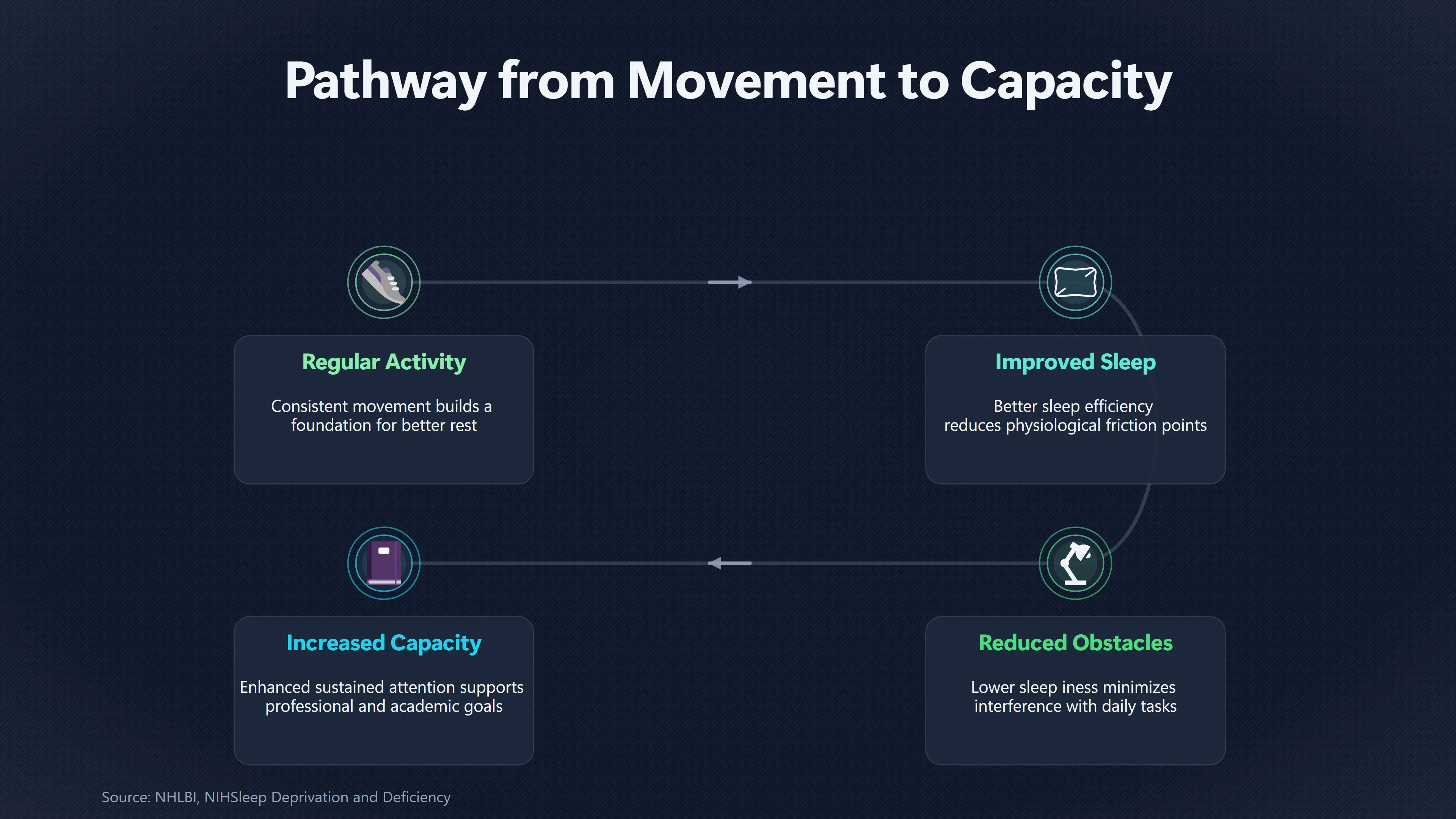
That creates a plausible pathway from movement to greater day-to-day capacity:
regular activity → somewhat better sleep → fewer sleep-related obstacles to sustained effort.
The important word is somewhat. Exercise cannot guarantee concentration, motivation or academic and professional performance. Nor does evidence that exercise improves sleep prove that every downstream improvement in a person’s work is caused by that sleep change. The useful conclusion is narrower: if physical activity makes sleep more efficient or consistently better, it may reduce one source of friction that makes other goals harder.
This also changes how exercise itself can be evaluated. A 30-minute walk that never produces impressive fitness statistics can still be useful if it is easy to repeat and contributes to better nights and more functional days. In a self-improvement system, that indirect return may matter more than maximising the difficulty of each session.
Building enough activity to help without exhausting yourself
A sleep-supporting exercise routine does not need its own complicated optimisation system. UK physical-activity guidance recommends that adults accumulate at least 150 minutes of moderate-intensity activity each week, or 75 minutes of vigorous activity, or a combination, while doing muscle-strengthening activity on at least two days. But those figures are public-health targets, not a minimum dose below which movement suddenly becomes useless. UK guidance explicitly says that any activity is better than none and notes that benefits are measurable at lower activity levels. WHO likewise advises inactive people to start with small amounts and increase frequency, intensity and duration gradually.[GOV.UK]GOV.UKU K Chief Medical Officers' physical activity guidelinesUK Chief Medical Officers' physical activity guidelines - GOV.UKJuly 10, 2026…
That makes a deliberately uncomplicated approach reasonable:
- Start with an activity you can repeat. Brisk walking, cycling, swimming, jogging, resistance training and combinations of aerobic and strengthening activity can all count. The research does not justify abandoning an enjoyable, convenient form of exercise simply because another modality tops one particular statistical ranking.[PubMed Central (PMC)]pmc.ncbi.nlm.nih.govPubMed Central (PMC)Effects of different types of exercise on sleep quality based on Pittsburgh Sleep Quality Index in middle-aged and ol…
- Use moderate activity as an easy default. In UK guidance, moderate intensity means breathing faster while still being able to talk. This gives a practical intensity marker without heart-rate zones, wearable data or complicated programming.[GOV.UK]GOV.UKOpen source on gov.uk.
- Build gradually rather than compensating with exhausting sessions. If the aim is sustainable capacity, a routine that repeatedly leaves someone too sore, depleted or reluctant to exercise again is poorly matched to the goal. WHO specifically recommends starting small and progressing over time.[NCBI]ncbi.nlm.nih.govWHO Guidelines on Physical Activity and Sedentary Behaviour - NCBI Bookshelf…
- Treat consistency as more important than finding the theoretically perfect workout. Exercise trials showing sleep benefits commonly run for weeks rather than relying on isolated heroic sessions, while recent meta-analytic work suggests programme duration can influence outcomes.[PubMed Central (PMC)]pmc.ncbi.nlm.nih.govPubMed Central (PMC)Optimal exercise dose and type for improving sleep quality: a systematic review and network meta-analysis of RCTs - PMC…
- Adjust late exercise according to your actual response. Evening activity is not automatically bad for sleep. If energetic exercise close to bed repeatedly leaves you alert, however, moving it earlier or reducing its intensity is a sensible personal adjustment.[PubMed]pubmed.ncbi.nlm.nih.govOpen source on nih.gov.
That last point corrects a particularly persistent oversimplification. A systematic review and meta-analysis of 23 studies found that evening exercise generally did not harm subsequent sleep and produced some favourable changes in sleep architecture. The main warning signal concerned vigorous exercise finishing within roughly an hour of bedtime, which might impair sleep onset, total sleep time or sleep efficiency. A later review of high-intensity evening exercise similarly found that sessions ending two to four hours before bed generally did not disrupt sleep in healthy young and middle-aged adults.[PubMed]pubmed.ncbi.nlm.nih.govOpen source on nih.gov.
More recent evidence has not established a universally superior time of day either. A 2025 meta-analysis comparing morning and evening exercise found no significant difference in sleep latency, although the sleep evidence came from relatively few studies and was heterogeneous.[PubMed]pubmed.ncbi.nlm.nih.govOpen source on nih.gov. For practical purposes, this weakens the case for rearranging an entire day merely to achieve a supposedly optimal exercise hour. The NHS takes a similarly flexible approach: exercise regularly, but avoid energetic activity during the 90 minutes before bed if you find that it prevents you sleeping.[nhs.uk]nhs.ukFall asleep faster and sleep betterFall asleep faster and sleep better
When exercise is support rather than the solution
Exercise is best understood as one contributor to healthy sleep, not a substitute for assessing a persistent sleep disorder. Chronic insomnia, for example, has treatments with substantially more specific clinical evidence. The American Academy of Sleep Medicine strongly recommends multicomponent cognitive behavioural therapy for insomnia (CBT-I) for adults with chronic insomnia, and the American College of Physicians likewise recommends CBT-I as initial treatment.[PubMed Central (PMC)]pmc.ncbi.nlm.nih.govOpen source on nih.gov.
That boundary matters because an otherwise useful self-improvement idea can become counterproductive when it turns into “exercise harder until sleep improves”. Persistent difficulty falling or staying asleep, significant daytime impairment or other ongoing sleep problems deserve attention on their own terms rather than ever-increasing workout volume.
For ordinary routine-building, however, the evidence supports a much less demanding conclusion. Physical activity is one of the behaviours capable of improving sleep, and it does not require a perfect modality, elaborate tracking system or universally prescribed time of day.[CDC]cdc.govOpen source on cdc.gov. The practical aim is enough repeatable movement to make good sleep somewhat easier — while leaving enough time and energy for the studying, working and everyday life that the exercise routine was supposed to support in the first place.
Amazon book picks
Further Reading
Books and field guides related to Can Exercise Make Better Sleep Easier to Sustain?. Use these as the next step if you want deeper reading beyond the article.
Why We Sleep
"Sleep is one of the most important but least understood aspects of our life, wellness, and longevity ... An explosion of scientific disc...
The Sleep Solution
With cutting-edge sleep science and time-tested techniques, The Sleep Solution will help anyone achieve healthy sleep and eliminate pills...
Exercised
The book tells the story of how we never evolved to exercise - to do voluntary physical activity for the sake of health. Using his own re...
Built to Move
INSTANT NEW YORK TIMES BEST SELLER • Simple but powerful physical practices to dramatically improve the way your body feels and prolong y...
eBay marketplace picks
Marketplace Samples
Live-tested eBay searches with available results related to this page.
Selected fromfitness tracker watch oneBay.co.uk.

Endnotes
1.
Source: pubmed.ncbi.nlm.nih.gov
Link:https://pubmed.ncbi.nlm.nih.gov/39556996/
Source snippet
Effects of exercise on sleep quality in general population: Meta-analysis and systematic review - PubMedNovember 12, 2024...
Published: November 12, 2024
2.
Source: pubmed.ncbi.nlm.nih.gov
Link:https://pubmed.ncbi.nlm.nih.gov/41650690/
Source snippet
Determinants and interrelations of exercise effects on sleep quality: A multimethod meta-analysis - PubMed...
3.
Source: pmc.ncbi.nlm.nih.gov
Link:https://pmc.ncbi.nlm.nih.gov/articles/PMC11217626/
Source snippet
PubMed Central (PMC)Effects of different types of exercise on sleep quality based on Pittsburgh Sleep Quality Index in middle-aged and ol...
4.
Source: pmc.ncbi.nlm.nih.gov
Link:https://pmc.ncbi.nlm.nih.gov/articles/PMC11484100/
Source snippet
PubMed Central (PMC)Optimal exercise dose and type for improving sleep quality: a systematic review and network meta-analysis of RCTs - PMC...
5.
Source: nhlbi.nih.gov
Title: NHLBI, NIHSleep Deprivation and Deficiency
Link:https://www.nhlbi.nih.gov/health/sleep-deprivation
Source snippet
What Are Sleep Deprivation and Deficiency? | NHLBI, NIHMarch 24, 2022...
Published: March 24, 2022
6.
Source: nhlbi.nih.gov
Title: NHLBI, NIHSleep Deprivation and Deficiency
Link:https://www.nhlbi.nih.gov/health/sleep-deprivation/health-effects
Source snippet
How Sleep Affects Your Health | NHLBI, NIH...
7.
Source: pubmed.ncbi.nlm.nih.gov
Link:https://pubmed.ncbi.nlm.nih.gov/38759474/
Source snippet
Impact of one night of [sleep restriction]({{ 'mental-habits/' | relative_url }}) on sleepiness and cognitive function: A systematic review and meta-analysis - PubMedApril...
8.
Source: GOV.UK
Title: U K Chief Medical Officers’ physical activity guidelines
Link:https://www.gov.uk/government/publications/physical-activity-guidelines-uk-chief-medical-officers-report/uk-chief-medical-officers-physical-activity-guidelines
Source snippet
UK Chief Medical Officers' physical activity guidelines - GOV.UKJuly 10, 2026...
Published: July 10, 2026
9.
Source: ncbi.nlm.nih.gov
Link:https://www.ncbi.nlm.nih.gov/books/NBK566046/
Source snippet
WHO Guidelines on Physical Activity and Sedentary Behaviour - NCBI Bookshelf...
10.
Source: GOV.UK
Link:https://www.gov.uk/government/publications/physical-activity-guidelines-adults-and-older-adults/physical-activity-for-adults-and-older-adults-19-and-over-text-of-the-infographic
11.
Source: pubmed.ncbi.nlm.nih.gov
Link:https://pubmed.ncbi.nlm.nih.gov/30374942/
12.
Source: nhs.uk
Title: Fall asleep faster and sleep better
Link:https://www.nhs.uk/every-mind-matters/mental-wellbeing-tips/how-to-fall-asleep-faster-and-sleep-better/
13.
Source: pubmed.ncbi.nlm.nih.gov
Link:https://pubmed.ncbi.nlm.nih.gov/34416428/
14.
Source: pubmed.ncbi.nlm.nih.gov
Link:https://pubmed.ncbi.nlm.nih.gov/41032147/
15.
Source: pmc.ncbi.nlm.nih.gov
Link:https://pmc.ncbi.nlm.nih.gov/articles/PMC7853203/
16.
Source: pubmed.ncbi.nlm.nih.gov
Link:https://pubmed.ncbi.nlm.nih.gov/27136449/
17.
Source: cdc.gov
Link:https://www.cdc.gov/physical-activity-basics/health-benefits/adults.html
18.
Source: pubmed.ncbi.nlm.nih.gov
Link:https://pubmed.ncbi.nlm.nih.gov/42454328/
19.
Source: pmc.ncbi.nlm.nih.gov
Link:https://pmc.ncbi.nlm.nih.gov/articles/PMC13262546/
20.
Source: pubmed.ncbi.nlm.nih.gov
Link:https://pubmed.ncbi.nlm.nih.gov/42180720/
21.
Source: pmc.ncbi.nlm.nih.gov
Link:https://pmc.ncbi.nlm.nih.gov/articles/PMC13188796/
22.
Source: pubmed.ncbi.nlm.nih.gov
Link:https://pubmed.ncbi.nlm.nih.gov/41975142/
23.
Source: pmc.ncbi.nlm.nih.gov
Link:https://pmc.ncbi.nlm.nih.gov/articles/PMC13076838/
24.
Source: pmc.ncbi.nlm.nih.gov
Link:https://pmc.ncbi.nlm.nih.gov/articles/PMC12919316/
25.
Source: cdc.gov
Link:https://www.cdc.gov/physical-activity-basics/benefits/
26.
Source: cdc.gov
Link:https://www.cdc.gov/physicalactivity/basics/index.htm
27.
Source: pubmed.ncbi.nlm.nih.gov
Link:https://pubmed.ncbi.nlm.nih.gov/41114024/
28.
Source: cdc.gov
Title: boost brain health
Link:https://www.cdc.gov/physical-activity/features/boost-brain-health.html
29.
Source: pmc.ncbi.nlm.nih.gov
Link:https://pmc.ncbi.nlm.nih.gov/articles/PMC12293783/
30.
Source: pmc.ncbi.nlm.nih.gov
Link:https://pmc.ncbi.nlm.nih.gov/articles/PMC12238623/
31.
Source: pubmed.ncbi.nlm.nih.gov
Link:https://pubmed.ncbi.nlm.nih.gov/40575963/
32.
Source: pmc.ncbi.nlm.nih.gov
Link:https://pmc.ncbi.nlm.nih.gov/articles/PMC11987399/
33.
Source: pubmed.ncbi.nlm.nih.gov
Link:https://pubmed.ncbi.nlm.nih.gov/40964219/
34.
Source: pubmed.ncbi.nlm.nih.gov
Link:https://pubmed.ncbi.nlm.nih.gov/40115345/
35.
Source: pmc.ncbi.nlm.nih.gov
Link:https://pmc.ncbi.nlm.nih.gov/articles/PMC11891529/
36.
Source: uclh.nhs.uk
Link:https://www.uclh.nhs.uk/patients-and-visitors/patient-information-pages/sleep-hygeine
37.
Source: pubmed.ncbi.nlm.nih.gov
Link:https://pubmed.ncbi.nlm.nih.gov/39706783/
38.
Source: pubmed.ncbi.nlm.nih.gov
Link:https://pubmed.ncbi.nlm.nih.gov/39477903/
39.
Source: pmc.ncbi.nlm.nih.gov
Link:https://pmc.ncbi.nlm.nih.gov/articles/PMC11256039/
40.
Source: cdc.gov
Title: sleep and heart health
Link:https://www.cdc.gov/heart-disease/about/sleep-and-heart-health.html
41.
Source: cdc.gov
Link:https://www.cdc.gov/sleep/about/index.html?linkId=821098919
42.
Source: pubmed.ncbi.nlm.nih.gov
Link:https://pubmed.ncbi.nlm.nih.gov/38641082/
43.
Source: nhs.uk
Title: www.nhs.uk Insomnia
Link:https://www.nhs.uk/conditions/insomnia/?source=post_page—————————
44.
Source: pubmed.ncbi.nlm.nih.gov
Link:https://pubmed.ncbi.nlm.nih.gov/38006755/
45.
Source: nhs.uk
Title: www.nhs.uk Self-help tips to fight tiredness
Link:https://www.nhs.uk/live-well/sleep-and-tiredness/self-help-tips-to-fight-fatigue/
46.
Source: pubmed.ncbi.nlm.nih.gov
Link:https://pubmed.ncbi.nlm.nih.gov/37946447/
47.
Source: pmc.ncbi.nlm.nih.gov
Link:https://pmc.ncbi.nlm.nih.gov/articles/PMC10636512/
48.
Source: pubmed.ncbi.nlm.nih.gov
Link:https://pubmed.ncbi.nlm.nih.gov/37454606/
49.
Source: pmc.ncbi.nlm.nih.gov
Link:https://pmc.ncbi.nlm.nih.gov/articles/PMC10900040/
50.
Source: pmc.ncbi.nlm.nih.gov
Link:https://pmc.ncbi.nlm.nih.gov/articles/PMC9760070/
51.
Source: pubmed.ncbi.nlm.nih.gov
Link:https://pubmed.ncbi.nlm.nih.gov/36540196/
52.
Source: nih.gov
Link:https://www.nih.gov/news-events/nih-research-matters/childrens-sleep-linked-brain-development
53.
Source: pmc.ncbi.nlm.nih.gov
Link:https://pmc.ncbi.nlm.nih.gov/articles/PMC9299578/
54.
Source: pmc.ncbi.nlm.nih.gov
Link:https://pmc.ncbi.nlm.nih.gov/articles/PMC9116725/
55.
Source: nhlbi.nih.gov
Title: why sleep important
Link:https://www.nhlbi.nih.gov/health/sleep/why-sleep-important
56.
Source: nhlbi.nih.gov
Title: healthy sleep habits
Link:https://www.nhlbi.nih.gov/health/sleep-deprivation/healthy-sleep-habits
57.
Source: nhlbi.nih.gov
Title: body clock
Link:https://www.nhlbi.nih.gov/health/sleep-deprivation/body-clock
58.
Source: pmc.ncbi.nlm.nih.gov
Link:https://pmc.ncbi.nlm.nih.gov/articles/PMC8599432/
59.
Source: pubmed.ncbi.nlm.nih.gov
Link:https://pubmed.ncbi.nlm.nih.gov/34649821/
60.
Source: who.int
Title: Physical activity
Link:https://www.who.int/europe/news-room/fact-sheets/item/physical-activity
61.
Source: pmc.ncbi.nlm.nih.gov
Link:https://pmc.ncbi.nlm.nih.gov/articles/PMC8215288/
62.
Source: pmc.ncbi.nlm.nih.gov
Link:https://pmc.ncbi.nlm.nih.gov/articles/PMC9219310/
63.
Source: nhs.uk
Title: www.nhs.uk Fall asleep faster and sleep better
Link:https://www.nhs.uk/every-mind-matters/mental-wellbeing-tips/how-to-fall-asleep-faster-and-sleep-better/?trk=public_post_main-feed-card-text
64.
Source: who.int
Title: WH O guidelines on physical activity and sedentary behaviour: at a glance
Link:https://www.who.int/poland/publications/9789240014886
65.
Source: pmc.ncbi.nlm.nih.gov
Link:https://pmc.ncbi.nlm.nih.gov/articles/PMC8338757/
66.
Source: pubmed.ncbi.nlm.nih.gov
Link:https://pubmed.ncbi.nlm.nih.gov/33164742/
67.
Source: pmc.ncbi.nlm.nih.gov
Link:https://pmc.ncbi.nlm.nih.gov/articles/PMC7853211/
68.
Source: pmc.ncbi.nlm.nih.gov
Link:https://pmc.ncbi.nlm.nih.gov/articles/PMC7719906/
69.
Source: cdc.gov
Link:https://www.cdc.gov/niosh/bulletin/2020/sleep.html
70.
Source: cdc.gov
Title: fatigue work
Link:https://www.cdc.gov/niosh/blogs/2020/fatigue-work.html
71.
Source: archive.cdc.gov
Link:https://archive.cdc.gov/www_cdc_gov/niosh/emres/longhourstraining/impaired.html
72.
Source: archive.cdc.gov
Link:https://archive.cdc.gov/www_cdc_gov/niosh/emres/longhourstraining/misconceptions.html
73.
Source: archive.cdc.gov
Link:https://archive.cdc.gov/www_cdc_gov/niosh/emres/longhourstraining/sleepdeprivation.html
74.
Source: archive.cdc.gov
Link:https://archive.cdc.gov/www_cdc_gov/niosh/work-hour-training-for-nurses/longhours/mod6/08.html
75.
Source: cdc.gov
Link:https://www.cdc.gov/niosh/work-hour-training-for-nurses/longhours/mod3/04.html
76.
Source: cdc.gov
Link:https://www.cdc.gov/niosh/work-hour-training-for-nurses/longhours/mod3/05.html
77.
Source: cdc.gov
Link:https://www.cdc.gov/niosh/work-hour-training-for-nurses/longhours/mod3/02.html
78.
Source: cdc.gov
Link:https://www.cdc.gov/niosh/work-hour-training-for-nurses/longhours/mod3/03.html
79.
Source: pmc.ncbi.nlm.nih.gov
Link:https://pmc.ncbi.nlm.nih.gov/articles/PMC6989626/
80.
Source: pubmed.ncbi.nlm.nih.gov
Link:https://pubmed.ncbi.nlm.nih.gov/31813044/
81.
Source: stacks.cdc.gov
Link:https://stacks.cdc.gov/view/cdc/121857
82.
Source: pmc.ncbi.nlm.nih.gov
Link:https://pmc.ncbi.nlm.nih.gov/articles/PMC6045928/
83.
Source: nidirect.gov.uk
Title: Insomnia | nidirect
Link:https://www.nidirect.gov.uk/conditions/insomnia
84.
Source: wellnessatnih.ors.od.nih.gov
Title: Why Is Sleep Important.aspx
Link:https://wellnessatnih.ors.od.nih.gov/news/Pages/Why-Is-Sleep-Important.aspx
85.
Source: pubmed.ncbi.nlm.nih.gov
Link:https://pubmed.ncbi.nlm.nih.gov/28757454/
86.
Source: pmc.ncbi.nlm.nih.gov
Link:https://pmc.ncbi.nlm.nih.gov/articles/PMC5263087/
87.
Source: pubmed.ncbi.nlm.nih.gov
Link:https://pubmed.ncbi.nlm.nih.gov/28276627/
88.
Source: stacks.cdc.gov
Link:https://stacks.cdc.gov/view/cdc/216077
89.
Source: pubmed.ncbi.nlm.nih.gov
Link:https://pubmed.ncbi.nlm.nih.gov/25850114/
90.
Source: stacks.cdc.gov
Link:https://stacks.cdc.gov/view/cdc/194313
91.
Source: pmc.ncbi.nlm.nih.gov
Link:https://pmc.ncbi.nlm.nih.gov/articles/PMC3290659/
92.
Source: pmc.ncbi.nlm.nih.gov
Link:https://pmc.ncbi.nlm.nih.gov/articles/2576317/
93.
Source: pubmed.ncbi.nlm.nih.gov
Link:https://pubmed.ncbi.nlm.nih.gov/8776790/
94.
Source: stacks.cdc.gov
Link:https://stacks.cdc.gov/view/cdc/243243
95.
Source: stacks.cdc.gov
Link:https://stacks.cdc.gov/view/cdc/184300
96.
Source: who.int
Link:https://www.who.int/initiatives/behealthy/physical-activity
97.
Source: who.int
Link:https://www.who.int/health-topics/noncommunicable-diseases/physical-activity
98.
Source: emro.who.int
Title: int WH O EMRO
Link:https://www.emro.who.int/health-education/physical-activity/promoting-physical-activity/What-is-the-recommended-amount-of-exerci.html
99.
Source: ncbi.nlm.nih.gov
Link:https://www.ncbi.nlm.nih.gov/books/NBK566048/
100.
Source: pubmed.ncbi.nlm.nih.gov
Link:https://pubmed.ncbi.nlm.nih.gov/30217831/
101.
Source: pubmed.ncbi.nlm.nih.gov
Link:https://pubmed.ncbi.nlm.nih.gov/20438143/
102.
Source: pubmed.ncbi.nlm.nih.gov
Link:https://pubmed.ncbi.nlm.nih.gov/28875581/
103.
Source: ncbi.nlm.nih.gov
Link:https://www.ncbi.nlm.nih.gov/books/NBK19958/
104.
Source: ncbi.nlm.nih.gov
Link:https://www.ncbi.nlm.nih.gov/books/NBK610814/
105.
Source: nichd.nih.gov
Link:https://www.nichd.nih.gov/health/topics/factsheets/sleep
106.
Source: nhs.uk
Title: www.nhs.uk Fall asleep faster and sleep better
Link:https://www.nhs.uk/every-mind-matters/mental-wellbeing-tips/how-to-fall-asleep-faster-and-sleep-better/?wt.tsrc=paid_search
107.
Source: nhs.uk
Title: www.nhs.uk Fall asleep faster and sleep better
Link:https://www.nhs.uk/every-mind-matters/mental-wellbeing-tips/how-to-fall-asleep-faster-and-sleep-better/?=__psv__p_49344716__t_w
108.
Source: slam.nhs.uk
Link:https://slam.nhs.uk/insomnia
109.
Source: stacks.cdc.gov
Link:https://stacks.cdc.gov/view/cdc/116724
110.
Source: guysandstthomas.nhs.uk
Title: Sleep problems
Link:https://www.guysandstthomas.nhs.uk/health-information/sleep-problems
111.
Source: myhealthlondon.nhs.uk
Link:https://www.myhealthlondon.nhs.uk/be-healthier/healthy-lifestyle/sleep/
112.
Source: ouci.dntb.gov.ua
Link:https://ouci.dntb.gov.ua/en/works/4L0K1qj4/
113.
Source: nhsinform.scot
Title: Insomnia | NHS inform
Link:https://www.nhsinform.scot/illnesses-and-conditions/mental-health/insomnia
114.
Source: restoredcdc.org
Link:https://www.restoredcdc.org/www.cdc.gov/physical-activity-basics/health-benefits/adults.html
Additional References
115.
Source: youtube.com
Title: This Sucks, But It’ll Help Seniors Sleep Better Instantly
Link:https://www.youtube.com/watch?v=gBsmlk1hnS4
Source snippet
Exercise for better sleep science 6 tips for better sleep | Sleeping with Science, a TED series...
116.
Source: youtube.com
Title: 6 tips for better sleep | Sleeping with Science, a TED series
Link:https://www.youtube.com/watch?v=t0kACis_dJE
Source snippet
Dr. Matt Walker: Protocols to Improve Your Sleep | Huberman Lab Guest Series...
117.
Source: youtube.com
Title: Dr. Matt Walker: Protocols to Improve Your Sleep | Huberman Lab Guest Series
Link:https://www.youtube.com/watch?v=hvPGfcAgk9Y
Source snippet
Sleep Better At Night With Simple Evening Exercises...
118.
Source: youtube.com
Title: Sleep Better Tonight! Nighttime Stretching Routine For Relaxation
Link:https://www.youtube.com/watch?v=4XX6AHSYgHA
Source snippet
This Sucks, But It'll Help Seniors Sleep Better Instantly...
119.
Source: youtube.com
Title: Sleep Better At Night With Simple Evening Exercises!
Link:https://www.youtube.com/watch?v=Yr_ffMZHdE4
Source snippet
Sleep Better Tonight! Nighttime Stretching Routine For Relaxation...
120.
Source: researchgate.net
Link:https://www.researchgate.net/publication/393868710_Effects_of_Aerobic_Exercise_on_Sleep_Quality_Insomnia_and_Inflammatory_Markers_A_Systematic_Review_and_Meta-Analysis
121.
Source: researchgate.net
Link:https://www.researchgate.net/publication/328582368_Effects_of_Evening_Exercise_on_Sleep_in_Healthy_Participants_A_Systematic_Review_and_Meta-Analysis
122.
Source: visualize.jove.com
Link:https://visualize.jove.com/39556996-effects-of-exercise-on-sleep-quality-in-general-population-meta-analysis-and-systematic-review
123.
Source: guidelinecentral.com
Link:https://www.guidelinecentral.com/guideline/309965/
124.
Source: acponline.org
Link:https://www.acponline.org/acp-newsroom/acp-recommends-cognitive-behavioral-therapy-as-initial-treatment-forchronic-insomnia