Within The Idea That Inconsistent People Simply Need “more Willpower”
How Long Does a Habit Really Take?
Habit automaticity usually develops over weeks or months, with wide variation between people and behaviors rather than one universal deadline.
On this page
- What researchers mean by habit automaticity
- Why formation times vary so widely
- What one missed repetition actually means
Page outline Jump by section
Introduction
There is no scientifically established 21-day deadline for forming a habit. Modern habit research instead finds a gradual process that commonly unfolds over weeks or months, with large differences between people and behaviours. The best-known real-world study found a median of about 66 days to approach peak automaticity, but individual estimates ranged from 18 to 254 days. A 2024 systematic review found an even broader range across health-behaviour studies: 4 to 335 days.[Wiley Online Library]onlinelibrary.wiley.comWiley Online LibraryHow are habits formed: Modelling habit formation in the real world - Lally - 2010 - European Journal of Social Psycho…
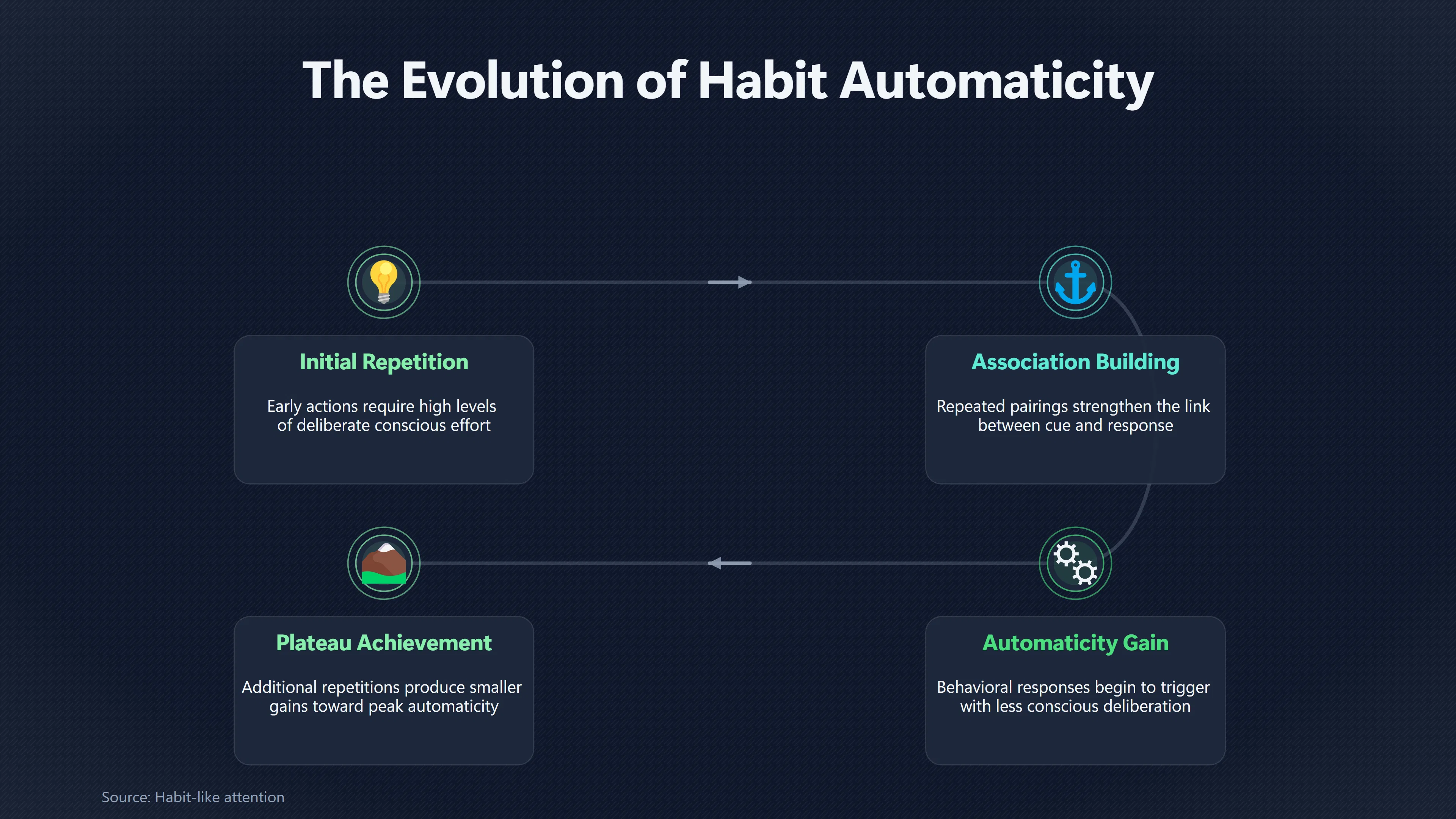
That variation is more important than replacing the 21-day myth with a new slogan such as “habits take 66 days”. Habit formation is not a countdown to a switch being flipped. Researchers generally study how repeated behaviour becomes increasingly automatic in response to a recurring cue or context. Early repetitions may require deliberate effort; later ones can be initiated with less conscious deliberation.[PubMed]pubmed.ncbi.nlm.nih.govPub Med Measuring context-response associations that drive habitsMeasuring context-response associations that drive habits - PubMedDecember 4, 2023…
For self-improvement, this changes the question. Instead of asking, “Have I been disciplined for enough days?”, it is more useful to ask whether repeated performances in a sufficiently stable context are strengthening the cue-response link.
Where the 21-day rule came from
The familiar number did not originate in a controlled experiment on habit formation. It can be traced to plastic surgeon Maxwell Maltz’s 1960 self-help book Psycho-Cybernetics. Maltz discussed observations such as patients becoming accustomed to their appearance after surgery and people adjusting to a new home. Crucially, he described a minimum of about 21 days for a perceptible change in a “mental image”; he was not reporting evidence that arbitrary behaviours become automatic on day 21.[Penguin Random House Canada]penguinrandomhouse.caOpen source on penguinrandomhouse.ca.
The distinction matters because getting used to a change and learning an automatically cued behavioural response are not the same phenomenon. University College London researchers have specifically noted that the popular rule may partly reflect a loss of the distinction between habituation — becoming accustomed to something — and habit formation.[UCL Blogs]blogs.ucl.ac.ukUCL BlogsJune | 2012 | UCL ‘Health Chatter’: Research Department of Behavioural Science and Health Blog…
Even Maltz’s original wording was more cautious than the rule that subsequently entered popular culture. “Minimum” became, in effect, a deadline. A loose observation about psychological adjustment became the much stronger claim that repeating any behaviour for three weeks makes it habitual.
Habit research does not support that claim.
What researchers mean by habit automaticity
In contemporary behavioural research, calling something a habit usually means more than saying that it happens frequently. A habit involves an association through which a recurring contextual cue can activate a learned response with increasing automaticity. Repetition matters because repeated pairings strengthen that association. Experimental work published in 2023, for example, found that greater practice strengthened measurable cue-response associations, which in turn supported performance without corresponding improvements in participants’ intentions or motivation.[PubMed]pubmed.ncbi.nlm.nih.govPub Med Measuring context-response associations that drive habitsMeasuring context-response associations that drive habits - PubMedDecember 4, 2023…
Researchers therefore often measure automaticity rather than waiting for a participant to declare that a habit has suddenly “formed”. Instruments such as the Self-Report Behavioural Automaticity Index ask about experiences associated with automatic behaviour — for example, whether an action occurs without conscious remembering or much thought. These measures are imperfect, not least because they rely on self-report, but they allow habit strength to be treated as a continuum rather than a yes-or-no state.[IAAP Journals]iaap-journals.onlinelibrary.wiley.comIAAP JournalsCan—and should—automaticity be self‐reported using a single item? A secondary analysis of 16 datasets - Gardner - 2024 - App…
That distinction explains why asking for the exact day on which a habit forms can be misleading. Automaticity normally develops as a learning curve. Repetition initially produces relatively large gains; as the behaviour becomes increasingly automatic, additional repetitions tend to produce smaller gains towards a plateau.[Wiley Online Library]onlinelibrary.wiley.comWiley Online LibraryHow are habits formed: Modelling habit formation in the real world - Lally - 2010 - European Journal of Social Psycho…
Someone on day 40, in other words, need not be either “without a habit” or “fully habitual”. The useful behaviour may already require less prompting than it did on day five while still having considerable room to become more automatic.
Why 66 days is not the new 21 days
The figure most often used to correct the 21-day claim comes from Phillippa Lally and colleagues’ influential real-world study. Ninety-six volunteers chose an eating, drinking or physical-activity behaviour and attempted to perform it daily in the same context for 12 weeks. Participants recorded both performance and their subjective automaticity.[Wiley Online Library]onlinelibrary.wiley.comWiley Online LibraryHow are habits formed: Modelling habit formation in the real world - Lally - 2010 - European Journal of Social Psycho…
For participants whose development could be modelled appropriately, the estimated time required to reach 95% of their eventual automaticity plateau varied dramatically: 18 to 254 days. The frequently quoted central estimate was about 66 days.[Wiley Online Library]onlinelibrary.wiley.comWiley Online LibraryHow are habits formed: Modelling habit formation in the real world - Lally - 2010 - European Journal of Social Psycho…
That makes “66 days to form a habit” a poor replacement for “21 days to form a habit”. The study’s main lesson is arguably the spread around the number, not the number itself.
More recent evidence reinforces that point. A 2024 systematic review and meta-analysis examined 20 studies involving 2,601 participants across behaviours including exercise, diet, water consumption and dental flossing. Only four included studies directly reported time-to-habit estimates. Their median estimates were 59–66 days, while reported means ranged from 106 to 154 days. Across the relevant studies, individual formation times extended from 4 to 335 days.[PubMed Central (PMC)]pmc.ncbi.nlm.nih.govOpen source on nih.gov.
The review also comes with important limitations. Eleven of the 20 included studies were rated at high risk of bias, and the evidence base was uneven across behaviours. The authors therefore describe the findings as emerging evidence rather than establishing a universal timetable.[PubMed Central (PMC)]pmc.ncbi.nlm.nih.govOpen source on nih.gov.
The defensible summary is consequently not “science says 66 days”. It is: habit automaticity often takes substantially longer than three weeks, and there is no single formation time that applies reliably across people and behaviours.
Why formation times vary so widely
The enormous range becomes less surprising once habit formation is understood as learning rather than calendar time. A “day” only contributes to the process insofar as the relevant behaviour and cue are actually paired.

Repetitions matter more than dates
A randomised study of 192 adults illustrates the point. Participants selected a nutrition behaviour and linked it either to a daily routine or to a specific time. Among those who successfully developed the habit, median time to peak automaticity was 59 days. But whether the cue was routine-based or time-based was less important than repeatedly carrying out the planned behaviour when the cue occurred. Repeated plan enactment was a key predictor of automaticity.[DOI]doi.orgHabit formation following routine‐based versus time‐based cue planning: A randomized controlled trial - Keller - 2021 - British Journa…
This makes calendar streaks an incomplete measure of progress. Thirty days containing 25 well-cued repetitions are not psychologically equivalent to 30 days in which the behaviour happens sporadically under constantly changing circumstances.
Behavioural complexity changes the curve
Not every action asks the brain to learn the same thing. A brief behaviour such as drinking a glass of water after breakfast is simpler to repeat consistently than a longer sequence involving preparation, equipment, travel or sustained physical effort. Analysis of the original Lally work reported that simple actions reached their automaticity peaks more quickly than more elaborate behaviours such as larger exercise routines.[PubMed Central (PMC)]pmc.ncbi.nlm.nih.govOpen source on nih.gov.
This is another reason universal deadlines are implausible. “Form a habit” can refer to behaviours ranging from taking a tablet after breakfast to completing a lengthy workout. Treating both as equivalent units of learning hides precisely the differences that influence formation time.
Stable contexts help the association develop
Habit learning also depends on what surrounds the behaviour. A 2022 study examined context stability using two datasets: 95 university students forming study habits over six weeks and 218 users of a habit-building app, representing 308 habits. Across the datasets, greater context stability predicted greater automaticity and better attainment of repetition goals.[PubMed]pubmed.ncbi.nlm.nih.govOpen source on nih.gov.
A stable context need not mean constructing a perfectly identical day. The relevant principle is that sufficiently recognisable cues repeatedly precede the same response. “After breakfast, take the vitamin” gives learning a recurring event to attach to. A behaviour attempted at different times, in different places and under different preceding conditions offers a less consistent learning history.
That is where habit timing connects directly to the broader case for better systems rather than greater willpower. The aim is not merely to endure enough days of effort. It is to create enough reliable cue-response repetitions that initiating the useful behaviour gradually demands less deliberate control. A 2024 review of habits and self-control describes this as effectively outsourcing some behavioural control to stable features of the environment.[ScienceDirect]sciencedirect.comBeyond deliberate self-control: Habits automatically achieve long-term goals - ScienceDirect…
What one missed repetition actually means
The 21-day idea encourages an all-or-nothing interpretation of consistency: miss day 17 and perhaps the clock must restart. The evidence does not support that conclusion.
In Lally and colleagues’ real-world study, missing one opportunity to perform the behaviour did not materially disrupt the habit-formation process. Automaticity could continue developing after the lapse.[Wiley Online Library]onlinelibrary.wiley.comWiley Online LibraryHow are habits formed: Modelling habit formation in the real world - Lally - 2010 - European Journal of Social Psycho…
That makes sense if habit formation is cumulative associative learning rather than completion of an uninterrupted challenge. Suppose someone repeatedly goes for a walk after lunch. Over many repetitions, “finishing lunch” becomes increasingly associated with “start walking”. Missing Tuesday does not erase the associations established on Monday and the preceding weeks.
This should not be distorted into the opposite claim that consistency is irrelevant. Repeated enactment remains central, and persistent non-performance means fewer opportunities to strengthen the association. The useful distinction is between an isolated lapse and a breakdown of the repeating pattern. One missed walk is not a reset; repeatedly abandoning the walk when its cue occurs is a different learning history.[DOI]doi.orgHabit formation following routine‐based versus time‐based cue planning: A randomized controlled trial - Keller - 2021 - British Journa…
Qualitative research offers a related insight. Participants trying to establish health habits reported that weekends and holidays could temporarily disrupt performance when their usual work-based cues disappeared, yet the habits could reappear when those familiar contexts returned.[PubMed]pubmed.ncbi.nlm.nih.govPub Med Experiences of habit formation: a qualitative studyPub Med Experiences of habit formation: a qualitative study This helps explain why a behaviour can feel unexpectedly difficult while travelling without necessarily having been “lost”.
The more useful response to a lapse is therefore not to calculate how many days have been wasted. It is to restore the cue-response pattern at the next suitable opportunity.

The better question is whether the behaviour is becoming easier to start
A fixed deadline offers psychological certainty, but it measures the wrong thing. At day 21, day 66 or day 100, the meaningful question is not whether a calendar has certified the behaviour as a habit. It is whether the recurring situation is increasingly prompting the response with less conscious negotiation.
That change can be gradual. Early on, a person may have to remember the behaviour, decide to do it and push themselves to begin. With repeated performance in a stable context, initiation can become increasingly cue-driven. Research on context-response associations supports this learning account, while longitudinal studies show automaticity rising with repetition rather than appearing suddenly after a prescribed number of days.[PubMed]pubmed.ncbi.nlm.nih.govPub Med Measuring context-response associations that drive habitsMeasuring context-response associations that drive habits - PubMedDecember 4, 2023…
The evidence therefore supports three practical conclusions:
- Think in months as readily as weeks. Two months is a more evidence-compatible expectation for many simple health habits than three weeks, but some habits take considerably longer.[PubMed Central (PMC)]pmc.ncbi.nlm.nih.govOpen source on nih.gov.
- Track repetitions and automaticity, not merely streak length. The important development is a strengthening relationship between the cue and the behaviour, not survival to an arbitrary calendar date.[DOI]doi.orgHabit formation following routine‐based versus time‐based cue planning: A randomized controlled trial - Keller - 2021 - British Journa…
- Treat occasional misses as interruptions, not resets. Restore the normal cue and repeat the behaviour rather than concluding that all previous progress has disappeared.[Wiley Online Library]onlinelibrary.wiley.comWiley Online LibraryHow are habits formed: Modelling habit formation in the real world - Lally - 2010 - European Journal of Social Psycho…
The 21-day myth makes habit formation sound like a short test of discipline. The research points to a more useful model: repeated learning under sufficiently consistent conditions, accumulating at different rates for different behaviours and different people. That is less tidy than a three-week rule, but it gives self-improvement a more realistic target. The goal is not to demonstrate perfect willpower until a magic date arrives. It is to keep making the desired response easier for the relevant cue to evoke.
Amazon book picks
Further Reading
Books and field guides related to How Long Does a Habit Really Take?. Use these as the next step if you want deeper reading beyond the article.
Good Habits, Bad Habits
'The world's leading expert on habits' - Matthew Syed, bestselling author of Black Box Thinking and Rebel IdeasWhat if you could harness...
Atomic Habits
Rating: 3.5/5 from 7 Google Books ratings
The #1 New York Times bestseller. Over 25 million copies sold! Translated into 60+ languages! Tiny Changes, Remarkable Results No matter...
The Power of Habit
Rating: 4.0/5 from 145 Google Books ratings
Duhigg takes us to the edge of scientific discoveries that explain why habits exist and how they can be changed. Distilling information i...
Tiny Habits
Improving your life is much easier than you think. Whether it’s losing weight, sleeping more, or restoring your work/life balance – the s...
eBay marketplace picks
Marketplace Samples
Live-tested eBay searches with available results related to this page.
Selected frommotivational wall art oneBay.co.uk.



Endnotes
1.
Source: onlinelibrary.wiley.com
Link:https://onlinelibrary.wiley.com/doi/10.1002/ejsp.674
Source snippet
Wiley Online LibraryHow are habits formed: Modelling habit formation in the real world - Lally - 2010 - European Journal of Social Psycho...
2.
Source: sciencedirect.com
Link:https://www.sciencedirect.com/science/article/pii/S2352250X24000939
Source snippet
Beyond deliberate self-control: Habits automatically achieve long-term goals - ScienceDirect...
3.
Source: iaap-journals.onlinelibrary.wiley.com
Link:https://iaap-journals.onlinelibrary.wiley.com/doi/10.1111/aphw.12600
Source snippet
IAAP JournalsCan—and should—automaticity be self‐reported using a single item? A secondary analysis of 16 datasets - Gardner - 2024 - App...
4.
Source: doi.org
Link:https://doi.org/10.1111/bjhp.12504
Source snippet
Habit formation following routine‐based versus time‐based cue planning: A randomized controlled trial - Keller - 2021 - British Journa...
5.
Source: onlinelibrary.wiley.com
Link:https://onlinelibrary.wiley.com/doi/abs/10.1002/ejsp.674?MixPanelId=15e3fe314440-0468d8411-64220f54-100000-15e3fe314460
6.
Source: doi.org
Link:https://doi.org/10.3390/healthcare12232488
7.
Source: iaap-journals.onlinelibrary.wiley.com
Link:https://iaap-journals.onlinelibrary.wiley.com/doi/abs/10.1111/aphw.12612
8.
Source: compass.onlinelibrary.wiley.com
Link:https://compass.onlinelibrary.wiley.com/doi/10.1111/spc3.12975?af=R
9.
Source: onlinelibrary.wiley.com
Link:https://onlinelibrary.wiley.com/doi/10.1111/mila.12467
10.
Source: bpspsychub.onlinelibrary.wiley.com
Link:https://bpspsychub.onlinelibrary.wiley.com/doi/abs/10.1111/bjhp.12504
11.
Source: doi.org
Link:https://doi.org/10.1080/17437199.2011.603640%C2%A0
12.
Source: myscp.onlinelibrary.wiley.com
Link:https://myscp.onlinelibrary.wiley.com/doi/10.1016/j.jcps.2009.08.003
13.
Source: myscp.onlinelibrary.wiley.com
Link:https://myscp.onlinelibrary.wiley.com/doi/abs/10.1016/j.jcps.2009.08.003
14.
Source: onlinelibrary.wiley.com
Link:https://onlinelibrary.wiley.com/doi/pdf/10.1002/ejsp.674
15.
Source: onlinelibrary.wiley.com
Link:https://onlinelibrary.wiley.com/doi/abs/10.1002/ejsp.674
16.
Source: onlinelibrary.wiley.com
Link:https://onlinelibrary.wiley.com/doi/abs/10.1002/ejsp.674?source=content_type%3Areact%7Cfirst_level_url%3Aarticle%7Csection%3Amain_content%7Cbutton%3Abody_link
17.
Source: onlinelibrary.wiley.com
Link:https://onlinelibrary.wiley.com/doi/abs/10.1002/ejsp.674?msockid=038ed114f43667dd0790c4bef5146634
18.
Source: onlinelibrary.wiley.com
Link:https://onlinelibrary.wiley.com/doi/abs/10.1002/ejsp.674?cf_chl_jschl_tk=pmd_EwcJDaCFBR9OVEL1O_0qjioww0Gc86ZzpBvCBFhrDcE-1635261061-0-gqNtZGzNAjujcnBszQi9
19.
Source: onlinelibrary.wiley.com
Link:https://onlinelibrary.wiley.com/doi/10.1002/ejsp.674?538fcd4b_page=1&947f74f7page=3&=%2Fen-gt%2Four-commitment%23kI3HdLdDj7HLFW4BJlUYoy23RoHF9sl3JcIXrw%3D%3D
20.
Source: sciencedirect.com
Link:https://www.sciencedirect.com/science/article/pii/S002210311100254X
21.
Source: sciencedirect.com
Title: Habit-like attention
Link:https://www.sciencedirect.com/science/article/pii/S2352250X18301738
22.
Source: sciencedirect.com
Link:https://www.sciencedirect.com/science/article/abs/pii/S0005796725000890
23.
Source: pmc.ncbi.nlm.nih.gov
Link:https://pmc.ncbi.nlm.nih.gov/articles/PMC11641623/
24.
Source: pubmed.ncbi.nlm.nih.gov
Title: Pub Med Measuring context-response associations that drive habits
Link:https://pubmed.ncbi.nlm.nih.gov/38047612/
Source snippet
Measuring context-response associations that drive habits - PubMedDecember 4, 2023...
Published: December 4, 2023
25.
Source: penguinrandomhouse.ca
Link:https://www.penguinrandomhouse.ca/books/318795/psycho-cybernetics-by-maxwell-maltz-md-fics/9780399176135/excerpt
26.
Source: blogs.ucl.ac.uk
Link:https://blogs.ucl.ac.uk/bsh/2012/06/
Source snippet
UCL BlogsJune | 2012 | UCL ‘Health Chatter’: Research Department of Behavioural Science and Health Blog...
27.
Source: pmc.ncbi.nlm.nih.gov
Link:https://pmc.ncbi.nlm.nih.gov/articles/PMC9226889/
Source snippet
PubMed Central (PMC)Context Stability in Habit Building Increases Automaticity and Goal Attainment - PMC...
28.
Source: pmc.ncbi.nlm.nih.gov
Link:https://pmc.ncbi.nlm.nih.gov/articles/PMC3505409/
29.
Source: pubmed.ncbi.nlm.nih.gov
Link:https://pubmed.ncbi.nlm.nih.gov/35756236/
30.
Source: pubmed.ncbi.nlm.nih.gov
Title: Pub Med Experiences of habit formation: a qualitative study
Link:https://pubmed.ncbi.nlm.nih.gov/21749245/
31.
Source: pubmed.ncbi.nlm.nih.gov
Link:https://pubmed.ncbi.nlm.nih.gov/42053513/
32.
Source: pmc.ncbi.nlm.nih.gov
Link:https://pmc.ncbi.nlm.nih.gov/articles/PMC13114073/
33.
Source: pubmed.ncbi.nlm.nih.gov
Link:https://pubmed.ncbi.nlm.nih.gov/39685110/
34.
Source: pmc.ncbi.nlm.nih.gov
Link:https://pmc.ncbi.nlm.nih.gov/articles/PMC11635905/
35.
Source: pmc.ncbi.nlm.nih.gov
Link:https://pmc.ncbi.nlm.nih.gov/articles/PMC10578412/
36.
Source: pmc.ncbi.nlm.nih.gov
Link:https://pmc.ncbi.nlm.nih.gov/articles/PMC7020232/
37.
Source: pmc.ncbi.nlm.nih.gov
Link:https://pmc.ncbi.nlm.nih.gov/articles/PMC6667662/
38.
Source: dojowell.com
Title: 21 day myth
Link:https://dojowell.com/atlas/21-day-myth
39.
Source: surrey.ac.uk
Title: phillippa lally
Link:https://www.surrey.ac.uk/people/phillippa-lally
Additional References
40.
Source: youtube.com
Title: The 21-Day Habit Myth. Maxwell Maltz Started a 70-Year Lie
Link:http://www.youtube.com/watch?v=yY0qRqxGcSE
Source snippet
"21 days" habit myth Phillippa Lally 66 days Day 5: Why 21 Days Is a Lie — The Real Science of Habits (Lally 2010)...
41.
Source: youtube.com
Link:http://www.youtube.com/watch?v=W1Z9DGs4-MA
Source snippet
The 21-Day Habit Myth. Maxwell Maltz Started a 70-Year Lie...
42.
Source: youtube.com
Title: The Science of Habits (And the 21 Day MYTH)!!!
Link:http://www.youtube.com/watch?v=K38Vy0IJilg
Source snippet
Day 5: Why 21 Days Is a Lie — The Real Science of Habits (Lally 2010)...
43.
Source: youtube.com
Title: How Long Does It Take to Build a Habit? HINT: It’s NOT 21 Days
Link:http://www.youtube.com/watch?v=cJ2gxIsScmk
Source snippet
How Long Does it Take to Form A New Habit?...
44.
Source: researchgate.net
Link:https://www.researchgate.net/publication/348328187_Habit_formation_following_routine-based_versus_time-based_cue_planning_A_randomized_controlled_trial
45.
Source: researchgate.net
Link:https://www.researchgate.net/publication/386593213_Time_to_Form_a_Habit_A_Systematic_Review_and_Meta-Analysis_of_Health_Behaviour_Habit_Formation_and_Its_Determinants
46.
Source: visualize.jove.com
Link:https://visualize.jove.com/39685110-time-to-form-a-habit-a-systematic-review-and-meta-analysis-of-health-behaviour-habit-formation-and-its-determinants
47.
Source: daybreakscience.com
Link:https://daybreakscience.com/research/papers/how-habits-form/
48.
Source: womensbrainhealth.org
Link:https://womensbrainhealth.org/think-tank/change-of-habit
49.
Source: doaj.org
Link:https://doaj.org/article/5e28c7cd6cc848099ff7ce3a555ff69f