Within Useful Cues
Where Should You Put a Behaviour Cue?
A cue placed at the start of a behaviour removes memory steps and makes immediate action more likely than a reminder seen somewhere else.
On this page
- Why the action start location matters
- Examples for reading, walking, practice, and planning
- Reducing the gap between seeing and starting
Page outline Jump by section
Introduction
The best place for a behaviour cue is usually the point where the desired action can begin. Put the book on the chair where you will read it, the walking shoes beside the door you will leave through, the instrument at the place where you can pick it up and play, or the planning sheet on the desk where tomorrow’s plan will be made. The aim is not merely to remember the behaviour earlier in the day; it is to encounter the cue when the next useful response is immediately available.
Research does not establish a universal rule that every cue must sit literally beside the first object used. But several evidence streams converge on the same practical principle. Point-of-decision prompts work when people meet them at a behavioural choice, prospective-memory research shows advantages when cues are closely tied to the activity in progress, and habit research finds that repeating actions in stable contexts strengthens automaticity.[nih.gov]pubmed.ncbi.nlm.nih.govPoint-of-decision prompts to increase stair use. A systematic review update - PubMed…
For self-improvement, that means thinking less about where a reminder is easiest to display and more about where seeing it can turn directly into doing.
Why the action-start location matters
A reminder can succeed at attracting attention while still fail at producing behaviour. Imagine seeing a note saying “walk tonight” on the bathroom mirror in the morning. The intention has been recalled, but walking cannot conveniently begin. Between the reminder and the walk lie hours of other activity, another transition, and another requirement to remember what was intended.
A cue at the front door works differently. If the shoes, coat or walking prompt is encountered as you reach the point where leaving is possible, remembering and beginning are brought together. This is the distinction that matters: a memory cue can make an intention come to mind, whereas an action-start cue is encountered when the response can actually be initiated.
Prospective-memory research helps explain why reducing this separation is useful. Prospective memory is the ability to remember to carry out an intended action later. Doing that involves maintaining an intention, detecting the relevant opportunity and initiating the response. Research shows that monitoring for future-action cues can itself consume attention, while cues that fit what a person is already attending to can support less effortful retrieval. In experiments, strategic monitoring has been particularly effective when ongoing activity naturally directs attention towards the relevant contextual information.[PubMed Central (PMC)]pmc.ncbi.nlm.nih.govPubMed Central (PMC)Context Cue Focality Influences Strategic Prospective Memory Monitoring - PMC…
This does not prove that a book on an armchair will outperform a book elsewhere by a particular percentage. Laboratory prospective-memory tasks are not identical to home habit design. They do, however, support a useful design principle: make the intended action easier to retrieve from the situation in which it belongs rather than requiring continuous mental monitoring for it.
Implementation-intention research reaches a related conclusion from another direction. An implementation intention specifies the situation in which a response should occur — effectively linking an “if” cue to a “then” action. A major meta-analysis of 94 independent tests found a medium-to-large overall effect on goal attainment, and later work indicated that the mechanism involves both increased accessibility of the specified cue and a stronger cue-response association. A much larger 2024 review, covering 642 independent tests, continued to find beneficial effects across cognitive, emotional and behavioural outcomes and found larger effects for contingent if-then plans.[sciencedirect.com]sciencedirect.comImplementation Intentions and Goal Achievement: A Meta‐analysis of Effects and Processes - ScienceDirect…
Physical cue placement can be understood as an environmental version of the same logic. Instead of repeatedly thinking, “When I reach the desk, I should practise”, the practice materials waiting on that desk can help make the situation itself carry part of the instruction.
The clearest real-world model: prompt at the decision
Stair-use research provides an unusually concrete demonstration because researchers can place a prompt at a particular location and then observe what people actually do.
Point-of-decision prompts are signs positioned near stairs, lifts or escalators where people choose how to move between floors. A Community Guide systematic-review update covering 16 qualifying peer-reviewed studies concluded that there was strong evidence that such prompts increased stair use. The intervention is explicitly defined by its placement at or near the behavioural decision: people encounter the message when taking the stairs is an available response.[PubMed]pubmed.ncbi.nlm.nih.govPoint-of-decision prompts to increase stair use. A systematic review update - PubMed…
That timing is important. A poster about physical activity in a distant corridor might improve awareness, but it leaves the reader to remember the message at the later choice. A sign beside the lift can convert the same broad intention — “I ought to move more” — into a present opportunity: the stairs are here; I can take them now. The US Centers for Disease Control and Prevention describes these signs as reminders about an immediate opportunity to be physically active.[CDC]cdc.govencouraging physical activityStrategies for Prompts to Encourage Physical Activity | Physical Activity | CDCJanuary 27, 2025…
Message specificity can sharpen that effect. In a university worksite study, the specific-message condition produced about twice the odds of stair use compared with baseline (OR 2.04, 95% CI 1.46–2.84), and significantly greater odds than a general-message condition (OR 1.57, 95% CI 1.13–2.20). Both signs were presented in the decision-point area near the stairs and lift; only the specific message significantly increased stair use over baseline.[PubMed]pubmed.ncbi.nlm.nih.govThe results indicate that a specific message may be more effective at promoting stair use.Read more…
There are limits to what this evidence can establish. Stair studies compare prompts with no prompts or different messages much more often than they experimentally compare the same cue at several distances from the action. Indeed, the Community Guide review identified the possible “critical distance” between stairs and lifts as a question still requiring research.[CDC Stacks]stacks.cdc.govStacks Point-of-Decision Prompts to Increase Stair UseStacks Point-of-Decision Prompts to Increase Stair Use It would therefore be too strong to claim that behavioural science has identified an exact optimal number of centimetres or seconds between cue and action.
The better-supported conclusion is narrower: prompts can influence behaviour when they are encountered at the relevant choice, and this provides a strong model for personal cue design.
What this looks like in everyday self-improvement
The practical test is simple: after encountering the cue, what is the first physical action required, and can it happen here? A well-placed cue makes the answer obvious.
- Reading: Instead of putting “read more” on a general to-do list, leave the chosen book at the place where reading normally starts — for example, on the armchair, bedside table or commuting bag. An open book or visible bookmark can make the next response even more specific: sit down and read the next page.
- Walking: Put walking shoes, coat or another distinctive walking cue at the exit you actually use. The important location is not simply “somewhere visible in the house”; it is the transition point at which putting on the shoes and leaving can follow immediately. This mirrors point-of-decision prompting: the cue arrives as the behavioural choice becomes available.[PubMed]pubmed.ncbi.nlm.nih.govPoint-of-decision prompts to increase stair use. A systematic review update - PubMed…
- Practice: Place the instrument, sketchbook, language cards or other practice materials at the intended practice position, prepared sufficiently that the first repetition can start. A guitar stored safely in its case may still need protection, for example, but putting the case beside the practice chair is more action-linked than relying on a reminder displayed elsewhere.
- Planning: If the desired behaviour is planning tomorrow, put the notebook, planner or planning card where that process will actually happen. A notebook beside the keyboard at the end of the working day creates a more direct cue-response relationship than a planning reminder encountered during breakfast if no planning will occur until evening.
These examples deliberately focus on the beginning, not on redesigning the whole activity. A walking cue does not need to solve the entire exercise routine. Its job is to make the first relevant response — putting on the shoes or going through the door — more likely to occur.
Reduce the gap between seeing and starting
A useful way to audit cue placement is to count the intervening steps. Suppose you see a reminder to practise a language while sitting on the sofa. To act, you must finish what you are doing, remember the intention, get up, go to another room, find the materials and begin. Each transition creates another opportunity for attention to move elsewhere.
Now move the cue to the desk where the language materials are already waiting. Seeing it can be followed by opening the exercise and answering the first question. The intended behaviour has not become intrinsically easier, but the cue-to-start gap has shrunk.
This principle should not be exaggerated into a claim that human behaviour is mechanically controlled by object placement. Motivation, competing activities, physical effort and the attractiveness of alternatives still matter. Point-of-decision stair prompts generally produce modest rather than transformative behavioural changes, and reviews have found substantial variation by setting. One systematic review, for example, found significant increases in 28 of 32 results involving escalators but only three of ten involving lifts.[Sage Journals]journals.sagepub.comOpen source on sagepub.com. A cue changes the probability of starting; it does not guarantee the response.
There is also evidence that prompts can lose effectiveness with repeated exposure. An eight-week field experiment in Paris Métro stations found immediate increases in stair use but no lasting post-intervention effect; the researchers suggested that people may eventually habituate to the prompts.[ScienceDirect]sciencedirect.comOpen source on sciencedirect.com. That is a reason to favour cues that are functionally embedded in the action — the shoes you must pick up, the notebook occupying the working space — rather than assuming that another permanent motivational poster will remain noticeable indefinitely.
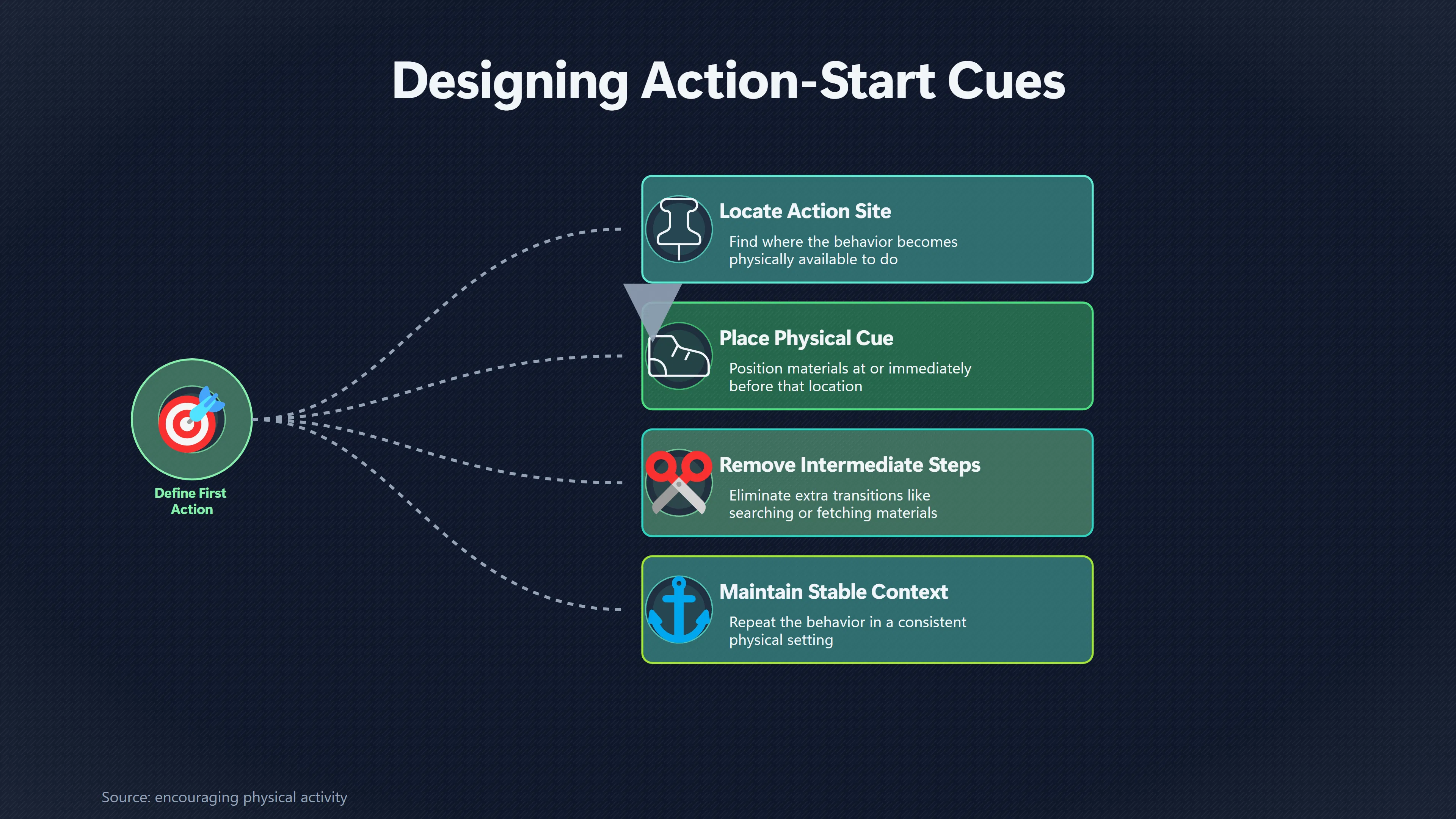
A practical cue-placement sequence is therefore:
- Define the first observable action. “Read more” becomes “open the book and read the next page”; “exercise” becomes “put on walking shoes and leave”.
- Identify the location where that action can occur. Not where you think about the goal, but where the behaviour becomes physically available.
- Put the cue there or immediately before it. The book goes at the reading place; the shoes at the exit; the practice material at the practice station.
- Remove unnecessary intermediate steps. If seeing the cue still requires searching, fetching, setting up or remembering again much later, move it closer to the start.
- Keep the context reasonably stable. Repeatedly encountering the same cue in the same action setting gives the situation a chance to acquire a stronger association with the behaviour.

Repetition can turn the location itself into a cue
Placement is especially useful when it is consistent. In the influential everyday habit-formation study by Phillippa Lally and colleagues, 96 volunteers selected an eating, drinking or activity behaviour and attempted it daily in the same context for 12 weeks. Automaticity generally increased with repetition in that consistent context, although the rate varied greatly between individuals.[Wiley Online Library]onlinelibrary.wiley.comOpen source on wiley.com.
Later longitudinal research tested context stability more directly. In one study, 95 university students building study habits over six weeks were assigned either to keep the performance context stable or deliberately vary rooms and times. A second dataset examined 308 habits reported by 218 app users. Across both datasets, greater context stability predicted greater automaticity and better attainment of repetition goals. The authors caution that their samples and habit types limit generalisation, but the convergence of the two studies supports deliberately specifying a stable time and place when building a habit.[Frontiers]frontiersin.orgOpen source on frontiersin.org.
That gives cue placement a longer-term purpose. Initially, the conspicuous book, shoes or practice materials may function as an explicit reminder. With repeated behaviour in the same setting, more of the surrounding context can become associated with the response. The reading chair, arriving home, sitting at the practice desk or reaching the end of the working day may increasingly participate in triggering what comes next.
This is why “put reminders everywhere” is a weaker rule than put the cue where the behaviour starts, then keep using that relationship. A scattered reminder asks for attention. A cue anchored to the action-start location can do something more useful: identify the opportunity, specify the next response and shorten the distance between intention and behaviour.
Amazon book picks
Further Reading
Books and field guides related to Where Should You Put a Behaviour Cue?. Use these as the next step if you want deeper reading beyond the article.
Atomic Habits
Rating: 3.5/5 from 7 Google Books ratings
The #1 New York Times bestseller. Over 25 million copies sold! Translated into 60+ languages! Tiny Changes, Remarkable Results No matter...
Tiny Habits
Improving your life is much easier than you think. Whether it’s losing weight, sleeping more, or restoring your work/life balance – the s...
The Power of Habit
Rating: 4.0/5 from 145 Google Books ratings
Duhigg takes us to the edge of scientific discoveries that explain why habits exist and how they can be changed. Distilling information i...
Good Habits, Bad Habits
'The world's leading expert on habits' - Matthew Syed, bestselling author of Black Box Thinking and Rebel IdeasWhat if you could harness...
eBay marketplace picks
Marketplace Samples
Live-tested eBay searches with available results related to this page.
Selected fromentryway reminder sign oneBay.co.uk.
Endnotes
1.
Source: sciencedirect.com
Link:https://www.sciencedirect.com/science/article/abs/pii/S0065260106380021
Source snippet
Implementation Intentions and Goal Achievement: A Meta‐analysis of Effects and Processes - ScienceDirect...
2.
Source: bpspsychub.onlinelibrary.wiley.com
Link:https://bpspsychub.onlinelibrary.wiley.com/doi/full/10.1348/014466607X267010
Source snippet
BPS PsycHubMechanisms of implementation intention effects: The role of goal intentions, self‐efficacy, and accessibility of plan componen...
3.
Source: cdc.gov
Title: encouraging physical activity
Link:https://www.cdc.gov/physical-activity/php/strategies/encouraging-physical-activity.html
Source snippet
Strategies for Prompts to Encourage Physical Activity | Physical Activity | CDCJanuary 27, 2025...
Published: January 27, 2025
4.
Source: stacks.cdc.gov
Title: Stacks Point-of-Decision Prompts to Increase Stair Use
Link:https://stacks.cdc.gov/view/cdc/168569/cdc_168569_DS4.pdf
5.
Source: sciencedirect.com
Link:https://www.sciencedirect.com/science/article/abs/pii/S0277953617305403
6.
Source: onlinelibrary.wiley.com
Link:https://onlinelibrary.wiley.com/doi/10.1002/ejsp.674
7.
Source: sciencedirect.com
Link:https://www.sciencedirect.com/science/article/pii/S030105112600147X
8.
Source: bpspsychub.onlinelibrary.wiley.com
Link:https://bpspsychub.onlinelibrary.wiley.com/doi/10.1111/bjhp.70090
9.
Source: sciencedirect.com
Link:https://www.sciencedirect.com/science/article/pii/S0022096525001110
10.
Source: sciencedirect.com
Link:https://www.sciencedirect.com/org/science/article/pii/S1438887124006046
11.
Source: sciencedirect.com
Link:https://www.sciencedirect.com/org/science/article/pii/S1438887124002619
12.
Source: sciencedirect.com
Link:https://www.sciencedirect.com/org/science/article/pii/S2561326X2200717X
13.
Source: bpspsychub.onlinelibrary.wiley.com
Link:https://bpspsychub.onlinelibrary.wiley.com/doi/10.1111/bjhp.12509
14.
Source: sciencedirect.com
Title: Medication adherence: A method for designing context-aware reminders
Link:https://www.sciencedirect.com/science/article/pii/S138650561930543X
15.
Source: sciencedirect.com
Link:https://www.sciencedirect.com/org/science/article/pii/S1438887118000900
16.
Source: sciencedirect.com
Link:https://www.sciencedirect.com/science/article/pii/S1071581916301021
17.
Source: bpspsychub.onlinelibrary.wiley.com
Link:https://bpspsychub.onlinelibrary.wiley.com/doi/10.1111/bjc.12086
18.
Source: sciencedirect.com
Link:https://www.sciencedirect.com/science/article/abs/pii/S0091743514004010
19.
Source: sciencedirect.com
Link:https://www.sciencedirect.com/science/article/pii/S0022096513002105
20.
Source: onlinelibrary.wiley.com
Link:https://onlinelibrary.wiley.com/doi/full/10.1002/acp.2960
21.
Source: sciencedirect.com
Link:https://www.sciencedirect.com/science/article/abs/pii/S1053810012000645
22.
Source: sciencedirect.com
Title: Neural substrates of implicit cueing effect on prospective memory
Link:https://www.sciencedirect.com/science/article/pii/S1053811910010207
23.
Source: sciencedirect.com
Title: Point-of-Decision Prompts to Increase Stair Use: A Systematic Review Update
Link:https://www.sciencedirect.com/science/article/abs/pii/S0749379709007508
24.
Source: sciencedirect.com
Link:https://www.sciencedirect.com/science/article/abs/pii/S0749379709007533
25.
Source: onlinelibrary.wiley.com
Link:https://onlinelibrary.wiley.com/doi/abs/10.1002/ejsp.674?source=content_type%3Areact%7Cfirst_level_url%3Aarticle%7Csection%3Amain_content%7Cbutton%3Abody_link
26.
Source: onlinelibrary.wiley.com
Link:https://onlinelibrary.wiley.com/doi/abs/10.1002/ejsp.674?MixPanelId=15e3fe314440-0468d8411-64220f54-100000-15e3fe314460
27.
Source: onlinelibrary.wiley.com
Link:https://onlinelibrary.wiley.com/doi/abs/10.1002/ejsp.674?aff_id=24772
28.
Source: onlinelibrary.wiley.com
Link:https://onlinelibrary.wiley.com/doi/abs/10.1002/ejsp.674
29.
Source: onlinelibrary.wiley.com
Link:https://onlinelibrary.wiley.com/doi/abs/10.1002/ejsp.674?538fcd4b_page=6&947f74f7_page=5
30.
Source: onlinelibrary.wiley.com
Link:https://onlinelibrary.wiley.com/doi/abs/10.1002/ejsp.674?msockid=038ed114f43667dd0790c4bef5146634
31.
Source: bpspsychub.onlinelibrary.wiley.com
Link:https://bpspsychub.onlinelibrary.wiley.com/doi/10.1348/014466607X267010
32.
Source: stacks.cdc.gov
Link:https://stacks.cdc.gov/view/cdc/168569
33.
Source: onlinelibrary.wiley.com
Link:https://onlinelibrary.wiley.com/doi/10.1002/ejsp.205
34.
Source: sciencedirect.com
Link:https://www.sciencedirect.com/science/article/abs/pii/S002210311100254X
35.
Source: sciencedirect.com
Link:https://www.sciencedirect.com/science/article/abs/pii/S002210310600028X
36.
Source: sciencedirect.com
Link:https://www.sciencedirect.com/science/chapter/bookseries/abs/pii/S0065260106380021
37.
Source: sciencedirect.com
Link:https://www.sciencedirect.com/topics/social-sciences/intention
38.
Source: sciencedirect.com
Title: More than planned: Implementation intention effects in non-planned situations
Link:https://www.sciencedirect.com/science/article/pii/S0001691816304048
39.
Source: sciencedirect.com
Link:https://www.sciencedirect.com/author/7005986164/upkar-varshney
40.
Source: sciencedirect.com
Link:https://www.sciencedirect.com/science/article/abs/pii/S146902921830116X
41.
Source: pubmed.ncbi.nlm.nih.gov
Link:https://pubmed.ncbi.nlm.nih.gov/20117614/
Source snippet
Point-of-decision prompts to increase stair use. A systematic review update - PubMed...
42.
Source: pmc.ncbi.nlm.nih.gov
Link:https://pmc.ncbi.nlm.nih.gov/articles/PMC6070398/
Source snippet
PubMed Central (PMC)Context Cue Focality Influences Strategic Prospective Memory Monitoring - PMC...
43.
Source: pubmed.ncbi.nlm.nih.gov
Link:https://pubmed.ncbi.nlm.nih.gov/35756236/
Source snippet
Context Stability in Habit Building Increases Automaticity and Goal Attainment - PubMed...
44.
Source: pmc.ncbi.nlm.nih.gov
Link:https://pmc.ncbi.nlm.nih.gov/articles/PMC2864946/
Source snippet
PubMed Central (PMC)Focal/Nonfocal Cue Effects in Prospective Memory: Monitoring Difficulty or Different Retrieval Processes? - PMC...
45.
Source: doi.org
Link:https://doi.org/10.1080/10463283.2024.2334563
Source snippet
The when and how of planning: Meta-analysis of the scope and components of implementation intentions in 642 tests: European Review of...
46.
Source: pubmed.ncbi.nlm.nih.gov
Link:https://pubmed.ncbi.nlm.nih.gov/24670074/
Source snippet
The results indicate that a specific message may be more effective at promoting stair use.Read more...
47.
Source: journals.sagepub.com
Link:https://journals.sagepub.com/doi/pdf/10.1177/1403494810375865
48.
Source: frontiersin.org
Link:https://www.frontiersin.org/journals/psychology/articles/10.3389/fpsyg.2022.883795/full
49.
Source: pubmed.ncbi.nlm.nih.gov
Link:https://pubmed.ncbi.nlm.nih.gov/42053513/
50.
Source: journals.sagepub.com
Link:https://journals.sagepub.com/doi/full/10.1177/01461672261440446
51.
Source: pubmed.ncbi.nlm.nih.gov
Link:https://pubmed.ncbi.nlm.nih.gov/41784001/
52.
Source: pmc.ncbi.nlm.nih.gov
Link:https://pmc.ncbi.nlm.nih.gov/articles/PMC12466827/
53.
Source: doi.org
Link:https://doi.org/10.1145/3719160.3736637
54.
Source: pmc.ncbi.nlm.nih.gov
Link:https://pmc.ncbi.nlm.nih.gov/articles/11781985/
55.
Source: pubmed.ncbi.nlm.nih.gov
Link:https://pubmed.ncbi.nlm.nih.gov/38888717/
56.
Source: pmc.ncbi.nlm.nih.gov
Link:https://pmc.ncbi.nlm.nih.gov/articles/PMC10497694/
57.
Source: pubmed.ncbi.nlm.nih.gov
Link:https://pubmed.ncbi.nlm.nih.gov/36945870/
58.
Source: pubmed.ncbi.nlm.nih.gov
Link:https://pubmed.ncbi.nlm.nih.gov/35962435/
59.
Source: pmc.ncbi.nlm.nih.gov
Link:https://pmc.ncbi.nlm.nih.gov/articles/PMC9372943/
60.
Source: pubmed.ncbi.nlm.nih.gov
Link:https://pubmed.ncbi.nlm.nih.gov/35916693/
61.
Source: pmc.ncbi.nlm.nih.gov
Link:https://pmc.ncbi.nlm.nih.gov/articles/PMC9379785/
62.
Source: pmc.ncbi.nlm.nih.gov
Link:https://pmc.ncbi.nlm.nih.gov/articles/PMC9226889/
63.
Source: frontiersin.org
Link:https://www.frontiersin.org/journals/psychology/articles/10.3389/fpsyg.2022.883795/full?infclid=98ed75048fad41069048c53e63b2394c
64.
Source: pmc.ncbi.nlm.nih.gov
Link:https://pmc.ncbi.nlm.nih.gov/articles/PMC9030994/
65.
Source: pubmed.ncbi.nlm.nih.gov
Link:https://pubmed.ncbi.nlm.nih.gov/35311306/
66.
Source: pmc.ncbi.nlm.nih.gov
Link:https://pmc.ncbi.nlm.nih.gov/articles/PMC8149892/
67.
Source: pmc.ncbi.nlm.nih.gov
Link:https://pmc.ncbi.nlm.nih.gov/articles/PMC8137900/
68.
Source: pubmed.ncbi.nlm.nih.gov
Link:https://pubmed.ncbi.nlm.nih.gov/33420709/
69.
Source: pmc.ncbi.nlm.nih.gov
Link:https://pmc.ncbi.nlm.nih.gov/articles/PMC7140383/
70.
Source: pubmed.ncbi.nlm.nih.gov
Link:https://pubmed.ncbi.nlm.nih.gov/31586826/
71.
Source: pubmed.ncbi.nlm.nih.gov
Link:https://pubmed.ncbi.nlm.nih.gov/31002710/
72.
Source: pubmed.ncbi.nlm.nih.gov
Link:https://pubmed.ncbi.nlm.nih.gov/29364055/
73.
Source: pubmed.ncbi.nlm.nih.gov
Link:https://pubmed.ncbi.nlm.nih.gov/30687189/
74.
Source: pmc.ncbi.nlm.nih.gov
Link:https://pmc.ncbi.nlm.nih.gov/articles/PMC6333704/
75.
Source: pmc.ncbi.nlm.nih.gov
Link:https://pmc.ncbi.nlm.nih.gov/articles/PMC6302524/
76.
Source: pmc.ncbi.nlm.nih.gov
Link:https://pmc.ncbi.nlm.nih.gov/articles/PMC6239140/
77.
Source: pubmed.ncbi.nlm.nih.gov
Link:https://pubmed.ncbi.nlm.nih.gov/29318922/
78.
Source: pmc.ncbi.nlm.nih.gov
Link:https://pmc.ncbi.nlm.nih.gov/articles/PMC5719260/
79.
Source: pmc.ncbi.nlm.nih.gov
Link:https://pmc.ncbi.nlm.nih.gov/articles/PMC4868976/
80.
Source: pubmed.ncbi.nlm.nih.gov
Link:https://pubmed.ncbi.nlm.nih.gov/27185531/
81.
Source: pmc.ncbi.nlm.nih.gov
Link:https://pmc.ncbi.nlm.nih.gov/articles/PMC4500900/
82.
Source: frontiersin.org
Link:https://www.frontiersin.org/journals/human-neuroscience/articles/10.3389/fnhum.2015.00395/full
83.
Source: pubmed.ncbi.nlm.nih.gov
Link:https://pubmed.ncbi.nlm.nih.gov/25965276/
84.
Source: journals.sagepub.com
Link:https://journals.sagepub.com/doi/10.1080/17470218.2014.972963
85.
Source: journals.sagepub.com
Title: ajhp.120816 ARB 398
Link:https://journals.sagepub.com/doi/10.4278/ajhp.120816-ARB-398
86.
Source: pmc.ncbi.nlm.nih.gov
Link:https://pmc.ncbi.nlm.nih.gov/articles/PMC4448673/
87.
Source: pmc.ncbi.nlm.nih.gov
Link:https://pmc.ncbi.nlm.nih.gov/articles/PMC2840878/
88.
Source: pmc.ncbi.nlm.nih.gov
Link:https://pmc.ncbi.nlm.nih.gov/articles/PMC2998278/
89.
Source: pubmed.ncbi.nlm.nih.gov
Link:https://pubmed.ncbi.nlm.nih.gov/18096108/
90.
Source: digitalcommons.usm.maine.edu
Link:https://digitalcommons.usm.maine.edu/psychology/63/
91.
Source: doi.org
Link:https://doi.org/10.1002/EJSP.205
92.
Source: pubmed.ncbi.nlm.nih.gov
Link:https://pubmed.ncbi.nlm.nih.gov/25449692/
93.
Source: pubmed.ncbi.nlm.nih.gov
Link:https://pubmed.ncbi.nlm.nih.gov/11708569/
94.
Source: pubmed.ncbi.nlm.nih.gov
Link:https://pubmed.ncbi.nlm.nih.gov/17678574/
95.
Source: pubmed.ncbi.nlm.nih.gov
Link:https://pubmed.ncbi.nlm.nih.gov/17295981/
96.
Source: pubmed.ncbi.nlm.nih.gov
Link:https://pubmed.ncbi.nlm.nih.gov/15250185/
97.
Source: pubmed.ncbi.nlm.nih.gov
Link:https://pubmed.ncbi.nlm.nih.gov/19353934/
98.
Source: pubmed.ncbi.nlm.nih.gov
Link:https://pubmed.ncbi.nlm.nih.gov/7796305/
99.
Source: pubmed.ncbi.nlm.nih.gov
Link:https://pubmed.ncbi.nlm.nih.gov/26651467/
100.
Source: pubmed.ncbi.nlm.nih.gov
Link:https://pubmed.ncbi.nlm.nih.gov/29435962/
101.
Source: pubmed.ncbi.nlm.nih.gov
Link:https://pubmed.ncbi.nlm.nih.gov/25588275/
102.
Source: pubmed.ncbi.nlm.nih.gov
Link:https://pubmed.ncbi.nlm.nih.gov/11011871/
103.
Source: pubmed.ncbi.nlm.nih.gov
Link:https://pubmed.ncbi.nlm.nih.gov/10538638/
104.
Source: journals.sagepub.com
Link:https://journals.sagepub.com/doi/10.2466/pms.1998.87.3f.1387
105.
Source: journals.sagepub.com
Link:https://journals.sagepub.com/doi/10.2466/pms.2000.91.1.55
106.
Source: journals.sagepub.com
Title: ajhp.120816 ARB 398
Link:https://journals.sagepub.com/doi/pdf/10.4278/ajhp.120816-ARB-398
107.
Source: doi.org
Link:https://doi.org/10.1007/978-3-642-21498
108.
Source: frontiersin.org
Link:https://www.frontiersin.org/journals/public-health/articles/10.3389/fpubh.2023.1079241/full
109.
Source: ten2030.org
Link:https://www.ten2030.org/promisepractice/index/view?pid=4050
Additional References
110.
Source: odphp.health.gov
Title: physical activity point decision prompts encourage use stairs
Link:https://odphp.health.gov/healthypeople/tools-action/browse-evidence-based-resources/physical-activity-point-decision-prompts-encourage-use-stairs
Source snippet
Activity: Point-of-Decision Prompts to Encourage Use of Stairs - Healthy People 2030 | odphp.health.gov...
111.
Source: nature.com
Link:https://www.nature.com/articles/srep25983
112.
Source: nature.com
Link:https://www.nature.com/articles/s41599-026-07553-w
113.
Source: youtube.com
Title: Notes in the Margins: Cue-Based Planning
Link:https://www.youtube.com/watch?v=GSijwDzibb0
Source snippet
Point of decision prompts physical activity stairs How Stair Design Influences Physical Activity...
114.
Source: youtube.com
Title: Forget big change, start with a tiny habit: BJ Fogg at TEDx Fremont
Link:https://www.youtube.com/watch?v=AdKUJxjn-R8
Source snippet
Fogg behavior model in 2 minutes and 30 seconds...
115.
Source: researchgate.net
Link:https://www.researchgate.net/publication/37367717_Action_Control_by_Implementation_Intentions_Effective_Cue_Detection_and_Efficient_Response_Initiation
116.
Source: researchgate.net
Link:https://www.researchgate.net/publication/24264329_The_valence_of_event-based_prospective_memory_cues_or_the_context_in_which_they_occur_affects_their_detection
117.
Source: researchgate.net
Link:https://www.researchgate.net/publication/241646503_The_Use_of_Prompts_Increased_Accessibility_Visibility_and_Aesthetics_of_the_Stairwell_to_Promote_Stair_Use_in_a_University_Building
118.
Source: guilfordjournals.com
Link:https://guilfordjournals.com/doi/10.1521/soco.2007.25.2.248
119.
Source: elifesciences.org
Link:https://elifesciences.org/articles/87346