Within Meal Prep
Batch Components Without Eating the Same Meal
Cooking flexible components together can turn dinner into a quick assembly choice instead of a fresh planning and cooking task.
On this page
- Building a small set of mix and match meal components
- Combining grains vegetables proteins and sauces through the week
- Avoiding repetition and unused leftovers
Page outline Jump by section
Introduction
Component cooking is a form of meal preparation that does not decide every dinner in advance. Instead, it prepares a small set of versatile building blocks — perhaps a grain, one or two vegetables, a protein or pulse, and a couple of sauces or flavourings — and leaves the final combination until mealtime. The important distinction is that the evening choice becomes “Which of these ready components shall I combine?” rather than “What shall I cook from scratch?”
That makes component cooking particularly useful when the aim is to remove daily food decision-making without committing to five identical portions. There is good observational evidence that meal planning is associated with greater dietary variety and better diet quality, although this does not establish cause and effect. Direct research comparing component cooking with conventional batch cooking is much thinner. Its strongest case therefore comes from a combination of established findings about planning, time pressure and healthy eating, plus the practical mechanics of making several meals from the same prepared ingredients.[PubMed Central (PMC)]pmc.ncbi.nlm.nih.govOpen source on nih.gov.
Build a small set of components, not a week’s menu
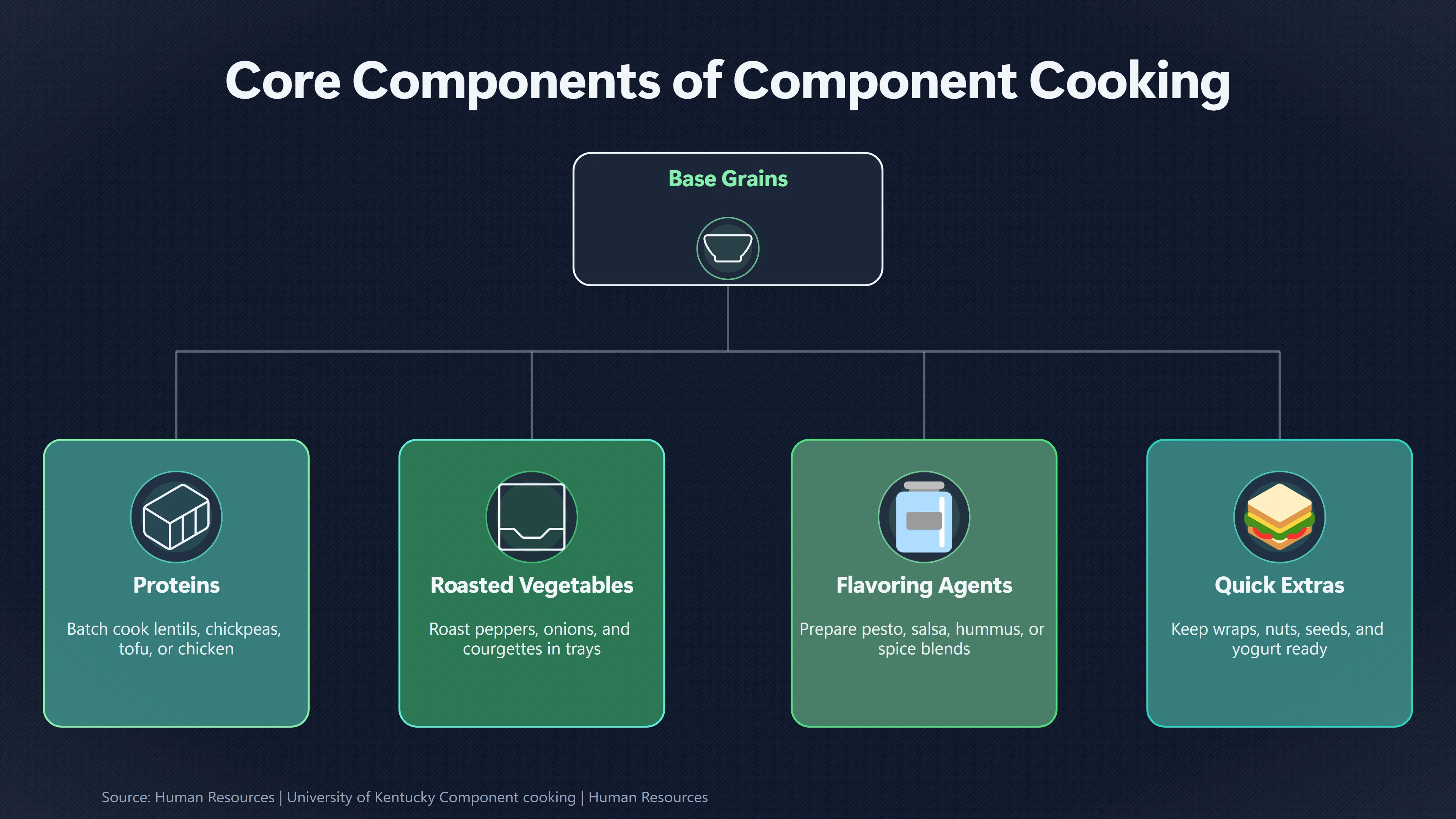
The basic unit of component cooking is not a recipe but a reusable ingredient with several possible destinations. University of Kentucky nutrition guidance describes the method as preparing individual meal elements and combining them in different ways. Its examples span carbohydrates such as brown rice, quinoa, potatoes and wholegrain breads; proteins including beans, lentils, eggs and tofu as well as meat and fish; vegetables; and flavour components such as hummus, pesto, salsa, dressings and spices.[Human Resources | University of Kentucky]hr.uky.eduHuman Resources | University of Kentucky Component cooking | Human ResourcesHuman Resources | University of Kentucky Component cooking | Human Resources
A workable batch therefore does not need to be large. For example:
- Base: brown rice, quinoa, potatoes or another grain or starch.
- Vegetables: a tray of roasted peppers, onions and courgettes, plus something fresh or frozen for contrast.
- Protein: lentils, chickpeas, tofu, eggs, chicken or another protein that suits the household.
- Flavour: two substantially different sauces, dressings or seasoning combinations.
- Quick extras: wraps, salad leaves, herbs, yoghurt, nuts, seeds or other ingredients that need little or no preparation.
This structure has an important advantage over cooking five complete meals. The expensive decisions — what food to buy, which ingredients need cooking, whether there will be a useful protein and vegetables available — have already been made. The remaining choice is deliberately small.
That is consistent with research on implementation intentions, in which a desired behaviour is tied to a predetermined situation or response. A meta-analysis of 23 studies found a moderate effect for implementation intentions intended to increase healthy eating, and a later meta-regression covering 70 interventions also found a significant, though smaller, overall effect. Component cooking is not itself an implementation-intention intervention, so those findings should not be treated as direct evidence for the method. They do, however, support the broader mechanism of translating a vague intention such as “eat better this week” into an easier, pre-arranged action.[PubMed]pubmed.ncbi.nlm.nih.govDo implementation intentions help to eat a healthy diet? A systematic review and meta-analysis of the empirical evidence - PubMedFe…
How the same components become different meals
Variety comes less from cooking more ingredients than from changing format, flavour and texture around a stable core. A batch of lentils, rice and roasted vegetables need not produce three servings of the same grain bowl.
On one evening, rice, vegetables and lentils could become a warm bowl with a yoghurt-herb dressing. On another, the vegetables and lentils could go into a wrap with leaves and a sharper sauce. Later, rice can become the base of a quick stir-fry with an additional frozen vegetable and egg. The ingredients overlap substantially, but the eating experience changes because the assembly and seasoning change.
This is where sauces and finishing ingredients do disproportionate work. Preparing every component with a highly specific flavour can lock it into one meal; keeping the main components relatively adaptable allows the final seasoning to establish the identity of the dish. Practical component-cooking guidance consequently treats dressings, pesto, salsa, hummus, sauces, spices and seasoning blends as a component category in their own right.[Human Resources | University of Kentucky]hr.uky.eduHuman Resources | University of Kentucky Component cooking | Human ResourcesHuman Resources | University of Kentucky Component cooking | Human Resources
The meal format can change too. University of Kentucky’s component-cooking examples include bowls, stir-fries, tacos and quesadillas, wraps, salads, pasta dishes, egg dishes and open-faced toast. That list illustrates the central mechanism: the cook is not trying to invent a new recipe each evening, but routing already-prepared food into one of a small number of familiar formats.[Human Resources | University of Kentucky]hr.uky.eduHuman Resources | University of Kentucky Component cooking | Human ResourcesHuman Resources | University of Kentucky Component cooking | Human Resources
There is also no nutritional requirement for every individual assembly to reproduce a perfect plate. The NHS Eatwell Guide explicitly says that dietary balance does not have to be achieved at every meal; it can be considered across a day or even a week. That makes a component system particularly compatible with weekly thinking. Across the available components, it is possible to make vegetables, higher-fibre starchy foods and varied protein sources easy defaults without requiring exactly the same proportions every evening.[nhs.uk]nhs.ukThe Eatwell GuideNovember 29, 2022…
Variety without restoring the planning burden
There is an apparent paradox here. More combinations create variety, but too many combinations can recreate the decision problem that meal preparation was supposed to solve. A fridge containing twelve unrelated prepared foods may simply replace “What shall I cook?” with “What am I supposed to do with all this?”
The solution is bounded variety: enough components to create noticeably different meals, but few enough that the available combinations remain obvious. One grain or starch, one main protein, two or three vegetables and two contrasting flavour options can already produce multiple combinations. Convenient components — canned pulses, frozen vegetables, bagged leaves, wholegrain wraps or ready-made hummus — can extend the system without creating another batch-cooking job. University of Kentucky explicitly includes such prepared foods within its component approach rather than assuming that everything must be made from scratch.[Human Resources | University of Kentucky]hr.uky.eduHuman Resources | University of Kentucky Component cooking | Human ResourcesHuman Resources | University of Kentucky Component cooking | Human Resources
This matters because preparation time is a genuine constraint, not simply a motivation problem. In a population study of 1,319 adults, people who spent less time preparing and cleaning up food were more likely to be working adults who prioritised convenience; greater preparation time was associated with more frequent consumption of foods including vegetables and fruit, while spending less than an hour a day on preparation was associated with more fast-food use and spending on food away from home. The study was cross-sectional, so it cannot show that cooking time itself caused the healthier pattern. It nevertheless makes the practical constraint clear: a system designed for real life has to compete on convenience.[PubMed Central (PMC)]pmc.ncbi.nlm.nih.govPubMed Central (PMC)Time Spent on Home Food Preparation and Indicators of Healthy Eating - PMC…
Component cooking attempts to do that by concentrating high-friction work. The oven can roast several vegetables while a grain cooks and a sauce is mixed. On subsequent evenings, much of the washing, chopping, cooking and cleaning has disappeared. Some final assembly remains, but that is a feature rather than a failure: it preserves enough flexibility to choose between a bowl, wrap, salad or quick hot dish without returning to a full cooking session.

Avoid repetition by changing the high-impact elements
Component cooking can still become monotonous if every meal has the same base, texture and seasoning. The useful target is not maximum ingredient variety but perceptible variety.
A few principles make a relatively small batch feel less repetitive:
Keep at least one component uncommitted. A neutral batch of chickpeas or roasted vegetables can accept different flavour profiles later. If every ingredient is covered in the same sauce during preparation, most combinations will taste like the same meal.
Separate wet and crisp ingredients. Sauce stored independently can be added at serving time; leaves, herbs, seeds and other fresh or crunchy elements can likewise be added during assembly. Besides protecting texture, this means one batch can be finished in different ways.
Change the format, not just the topping. Moving the same ingredients from a bowl to a wrap, salad, pasta dish or egg-based meal creates more meaningful variation than repeatedly changing one garnish. Component-cooking guidance specifically lends itself to this movement between formats.[Human Resources | University of Kentucky]hr.uky.eduHuman Resources | University of Kentucky Component cooking | Human ResourcesHuman Resources | University of Kentucky Component cooking | Human Resources
Use convenience strategically. Frozen vegetables, canned beans and lentils, ready-to-use wholegrains and prepared sauces can act as spare components. The aim is not to maximise the percentage of food cooked personally; it is to keep the assembly system sufficiently easy that it still works on a difficult evening.[EatWell | University of Kentucky]eatwell.uky.eduEat Well | University of Kentucky COMPONENT COOKINGEat Well | University of Kentucky COMPONENT COOKING
That last point keeps the method aligned with its real purpose. “Self improvement that works” does not require turning Sunday into an elaborate food-production project. A preparation routine that is too demanding merely moves the burden to another day.
Prevent unused components from becoming leftovers
Flexibility introduces a different failure mode from conventional batch cooking. Five complete labelled meals have obvious destinations; a tub of cooked lentils or roasted carrots does not. Component cooking therefore works best when each major batch ingredient has more than one obvious use before it is cooked.
A simple test is: If I do not want the meal I first imagined, where else can this component go? Roasted vegetables might work in a bowl, wrap and omelette. Chickpeas might work in a salad, warm grain dish and quick tomato sauce. If an ingredient has only one destination, it is effectively part of a pre-planned recipe rather than a genuinely flexible component.
Quantity matters as much as versatility. Preparing enormous amounts because batch cooking feels efficient can produce the opposite result: a refrigerator full of food competing against its own shelf life. Research on household leftovers indicates that planning, inventory and storage management influence leftover waste, while recent work also identifies inefficient storage and cooking behaviours among contributors to meal waste.[ScienceDirect]sciencedirect.comOpen source on sciencedirect.com.
A better starting rule is to batch only the foods that remove meaningful work later. Cooking a grain may save substantial evening time; washing enough salad leaves for a month clearly will not. Likewise, ingredients that deteriorate quickly may be better left unprepared until needed. Component cooking is therefore selective preparation, not a requirement to process the entire week’s shopping at once.
Storage sets the real limit on a batch
The useful size of a component batch is partly determined by food safety. In the UK, the Food Standards Agency (FSA) advises that cooked leftovers should be cooled and refrigerated within two hours and eaten within 48 hours, or frozen if they will not be eaten in that period. Reheated leftovers should be steaming hot throughout and should only be reheated once.[GOV.UK]food.gov.ukUK Cooking your food | Food Standards AgencyUK Cooking your food | Food Standards Agency
Rice needs particular care. FSA guidance explains that uncooked rice can contain bacterial spores that survive cooking; if cooked rice sits at room temperature, bacteria can multiply and may produce toxins that reheating will not remove. Its guidance for rice prepared for later use says to chill it as quickly as possible — within one hour — keep it refrigerated and use it within 24 hours, with reheated rice heated thoroughly.[GOV.UK]food.gov.ukUKSAF E METHODUKSAF E METHOD
Those limits favour a rolling component system over the assumption that everything prepared on Sunday should sit in the refrigerator until Friday. Prepare smaller amounts, freeze suitable portions promptly, or refresh one or two components partway through the week. The freezer can also preserve the decision-reducing benefit: a frozen portion of an earlier component can become an additional choice without another full preparation session.
Separate storage helps for another reason. If the grain, vegetables, protein and sauce are immediately mixed into complete portions, the system loses much of its flexibility. Keeping compatible components separate allows the household to use the food that needs using first, alter quantities, change sauces and assemble a different format.

The useful middle ground between planning and improvising
The distinctive strength of component cooking is that it occupies the space between two extremes. At one end is complete improvisation: every evening requires choosing a dish, checking ingredients and starting the cooking process. At the other is rigid batch preparation: the week’s meals are completely decided and assembled in advance.
Component cooking pre-decides the difficult part while leaving the easy part open. The household has already ensured that useful foods exist in a ready-to-use state, but nobody has to predict on Sunday exactly what they will want on Thursday.
That balance is especially relevant because the evidence for meal planning does not suggest that variety has to be sacrificed for predictability. In the large French NutriNet-Santé study of 40,554 adults, people who reported planning meals were more likely to fall into the highest quartile for overall food variety as well as having better adherence to nutritional guidelines. Because the study was observational and cross-sectional, those associations cannot demonstrate that planning caused either outcome. They do, however, challenge the assumption that planning necessarily means repetitive eating.[PubMed Central (PMC)]pmc.ncbi.nlm.nih.govOpen source on nih.gov.
Component cooking takes that principle one step further operationally. The weekly preparation decision becomes something like “rice, lentils, roasted vegetables and two sauces”, rather than a schedule containing five separate recipes. Dinner still contains choice, but it is choice among prepared possibilities rather than choice among every meal that could theoretically be cooked. That is the mechanism that makes the approach useful: enough structure to remove the exhausting daily food problem, and enough flexibility that the solution does not taste identical every night.
Amazon book picks
Further Reading
Books and field guides related to Batch Components Without Eating the Same Meal. Use these as the next step if you want deeper reading beyond the article.
An Everlasting Meal
Tamar weaves philosophy and instruction into approachable lessons on instinctive cooking. By wresting cooking from doctrine and doldrums,...
Cook Once, Eat All Week
Cook Once, Eat All Week is a revolutionary way to get a delicious, healthy, and affordable dinner on the table FAST. Author Cassy Joy Gar...
The Food Lab
A New York Times Bestseller Winner of the James Beard Award for General Cooking Winner of the IACP Cookbook of the Year Award "The one bo...
Salt, Fat, Acid, Heat
The international sensation – award-winning chef Samin Nosrat distills the four key principles anyone can use to elevate their food and l...
eBay marketplace picks
Marketplace Samples
Live-tested eBay searches with available results related to this page.
Selected frommeal memorabilia oneBay.co.uk.



Endnotes
1.
Source: hr.uky.edu
Title: Human Resources | University of Kentucky Component cooking | Human Resources
Link:https://hr.uky.edu/work-life-and-well-being/nutrition/food-preparation/component-cooking
2.
Source: nhs.uk
Title: The Eatwell Guide
Link:https://www.nhs.uk/live-well/eat-well/food-guidelines-and-food-labels/the-eatwell-guide/
Source snippet
November 29, 2022...
Published: November 29, 2022
3.
Source: nhs.uk
Title: Eating a balanced diet
Link:https://www.nhs.uk/live-well/eat-well/how-to-eat-a-balanced-diet/eating-a-balanced-diet/
4.
Source: sciencedirect.com
Link:https://www.sciencedirect.com/science/article/pii/S0950329324002295
5.
Source: sciencedirect.com
Link:https://www.sciencedirect.com/science/article/pii/S0950329324002180
6.
Source: food.gov.uk
Title: UK Cooking your food | Food Standards Agency
Link:https://www.food.gov.uk/safety-hygiene/cooking-your-food?ContensisTextOnly=true
7.
Source: food.gov.uk
Title: UK Not reheating leftovers until steaming hot throughout | Food Standards Agency
Link:https://www.food.gov.uk/research/behaviour-and-perception/not-reheating-leftovers-until-steaming-hot-throughout
8.
Source: food.gov.uk
Title: UKSAF E METHOD
Link:https://www.food.gov.uk/sites/default/files/media/document/sfbb-indian-05-cooking-06-rice_0.pdf
9.
Source: GOV.UK
Title: www.gov.uk Student guide to food safety and hygiene
Link:https://www.gov.uk/government/publications/student-guide-to-food-safety-and-hygiene/student-guide-to-food-safety-and-hygiene
10.
Source: cityoflondon.gov.uk
Title: Food waste
Link:https://www.cityoflondon.gov.uk/services/waste-and-recycling/household-waste-and-recycling/waste-and-recycling-services/food-waste
11.
Source: richmond.gov.uk
Title: Food waste recycling in houses
Link:https://www.richmond.gov.uk/services/waste_and_recycling/your_weekly_collections/food_waste_recycling/food_waste_recycling_in_houses
12.
Source: richmond.gov.uk
Title: How to reduce your food waste
Link:https://www.richmond.gov.uk/services/waste_and_recycling/your_weekly_collections/food_waste_recycling/how_to_reduce_food_waste
13.
Source: uclh.nhs.uk
Title: Eating Well for Less: University College London Hospitals NHS Foundation Trust
Link:https://www.uclh.nhs.uk/patients-and-visitors/patient-information-pages/eating-well-less
14.
Source: nhs.uk
Title: www.nhs.uk The vegetarian diet
Link:https://www.nhs.uk/live-well/eat-well/how-to-eat-a-balanced-diet/the-vegetarian-diet/
15.
Source: nhs.uk
Title: www.nhs.uk Children’s food: safety and hygiene
Link:https://www.nhs.uk/baby/weaning-and-feeding/childrens-food-safety-and-hygiene/
16.
Source: food.gov.uk
Title: F&Y2 Wave 8: Chapter 6 Eating at home | Food Standards Agency
Link:https://www.food.gov.uk/research/fy2-wave-8-chapter-6-eating-at-home
17.
Source: food.gov.uk
Title: F&Y2 Wave 8: Chapter 6 Eating at home | Food Standards Agency
Link:https://www.food.gov.uk/research/fy2-wave-8-chapter-6-eating-at-home?navref=quicklink
18.
Source: myhealthlondon.nhs.uk
Title: fibre and wholegrains
Link:https://www.myhealthlondon.nhs.uk/resources/internal/fibre-and-wholegrains/
19.
Source: food.gov.uk
Link:https://www.food.gov.uk/news-alerts/news/flatmates-fridges-and-food-safety-the-food-standards-agencys-guide-for-students-in-the-kitchen
20.
Source: food.gov.uk
Title: F&Y2 Wave 9, Chapter 6: Eating at home | Food Standards Agency
Link:https://www.food.gov.uk/research/fy2-wave-9-chapter-6-eating-at-home?navref=quicklink
21.
Source: GOV.UK
Title: www.gov.uk Simpler recycling: household recycling in England
Link:https://www.gov.uk/guidance/simpler-recycling-household-recycling-in-england
22.
Source: food.gov.uk
Title: Food and You 2: Wave 9 Key Findings | Food Standards Agency
Link:https://www.food.gov.uk/research/food-and-you-2/food-and-you-2-wave-9-key-findings?print=1
23.
Source: myhealthlondon.nhs.uk
Title: the eatwell guide
Link:https://www.myhealthlondon.nhs.uk/resources/archive-resources/internal-archive/the-eatwell-guide/
24.
Source: food.gov.uk
Title: The creation of food waste | Food Standards Agency
Link:https://www.food.gov.uk/research/behaviour-and-perception/the-creation-of-food-waste
25.
Source: food.gov.uk
Title: Storing chilled foods at incorrect temperatures | Food Standards Agency
Link:https://www.food.gov.uk/research/behaviour-and-perception/storing-chilled-foods-at-incorrect-temperatures
26.
Source: food.gov.uk
Title: K L2: Appendix | Food Standards Agency
Link:https://www.food.gov.uk/research/kl2-appendix
27.
Source: food.gov.uk
Title: The creation of food waste | Food Standards Agency
Link:https://www.food.gov.uk/research/behaviour-and-perception/the-creation-of-food-waste?navref=quicklink
28.
Source: nhs.uk
Title: www.nhs.uk Storing and reheating baby food
Link:https://www.nhs.uk/best-start-in-life/baby/weaning/safe-weaning/storing-and-reheating-food/
29.
Source: nhs.uk
Title: www.nhs.uk Starchy foods and carbohydrates
Link:https://www.nhs.uk/live-well/eat-well/food-types/starchy-foods-and-carbohydrates/
30.
Source: cuh.nhs.uk
Title: food safety advice for people who are at an increased risk of infection
Link:https://www.cuh.nhs.uk/patient-information/food-safety-advice-for-people-who-are-at-an-increased-risk-of-infection/
31.
Source: nhs.uk
Title: www.nhs.uk8 tips for healthy eating
Link:https://www.nhs.uk/live-well/eat-well/how-to-eat-a-balanced-diet/eight-tips-for-healthy-eating/
32.
Source: nhs.uk
Title: www.nhs.uk5 A Day – Food Facts – Healthier Families
Link:https://www.nhs.uk/healthier-families/food-facts/5-a-day/
33.
Source: food.gov.uk
Title: Chapter 6: Eating at home | Food Standards Agency
Link:https://www.food.gov.uk/research/chapter-6-eating-at-home?navref=quicklink
34.
Source: nhs.uk
Title: www.nhs.uk5 A Day portion sizes
Link:https://www.nhs.uk/live-well/eat-well/5-a-day/portion-sizes/
35.
Source: food.gov.uk
Title: Reduce food waste and stay safe this Christmas | Food Standards Agency
Link:https://www.food.gov.uk/news-alerts/news/reduce-food-waste-and-stay-safe-this-christmas
36.
Source: sciencedirect.com
Link:https://www.sciencedirect.com/science/article/pii/S0002916522006359
37.
Source: ajcn.nutrition.org
Link:https://ajcn.nutrition.org/article/S0002-9165%2822%2900635-9/fulltext
38.
Source: sciencedirect.com
Link:https://www.sciencedirect.com/science/article/pii/S1499404620303559
39.
Source: sciencedirect.com
Link:https://www.sciencedirect.com/science/article/pii/S0195666318314363
40.
Source: sciencedirect.com
Link:https://www.sciencedirect.com/science/article/abs/pii/S0195666318314363
41.
Source: food.gov.uk
Title: Food and You
Link:https://www.food.gov.uk/research/food-and-you/food-and-you-wave-three?navref=quicklink
42.
Source: GOV.UK
Title: www.gov.uk Cooking your food
Link:https://www.gov.uk/government/publications/cooking-your-food/cooking-your-food
43.
Source: sciencedirect.com
Title: Time Spent on Home Food Preparation and Indicators of Healthy Eating
Link:https://www.sciencedirect.com/science/article/pii/S0749379714004000
44.
Source: GOV.UK
Title: www.gov.uk T13: treating waste food
Link:https://www.gov.uk/guidance/waste-exemption-t13-treating-waste-food
45.
Source: sciencedirect.com
Link:https://www.sciencedirect.com/science/article/pii/S1499404612005726
46.
Source: GOV.UK
Title: www.gov.uk Household food and drink waste and purchases
Link:https://www.gov.uk/government/publications/household-food-and-drink-waste-and-purchases
47.
Source: sciencedirect.com
Link:https://www.sciencedirect.com/science/article/pii/S0889157509000374
48.
Source: myhealthlondon.nhs.uk
Link:https://www.myhealthlondon.nhs.uk/be-healthier/healthy-lifestyle/eat/
49.
Source: sciencedirect.com
Link:https://www.sciencedirect.com/science/article/abs/pii/S0195666311006696
50.
Source: sciencedirect.com
Link:https://www.sciencedirect.com/science/article/pii/S2475299123093502
51.
Source: sciencedirect.com
Link:https://www.sciencedirect.com/science/article/pii/S2475299123135098
52.
Source: sciencedirect.com
Link:https://www.sciencedirect.com/science/article/pii/S1499404621000014
53.
Source: sciencedirect.com
Link:https://www.sciencedirect.com/science/article/pii/S0016718523001173
54.
Source: sciencedirect.com
Title: Preparing meals under time stress. The experience of working mothers
Link:https://www.sciencedirect.com/science/article/pii/S0195666310005234
55.
Source: sciencedirect.com
Link:https://www.sciencedirect.com/science/article/pii/S0195666310005325
56.
Source: sciencedirect.com
Title: Meal planning under uncertainty: How shopping frequency affects food waste
Link:https://www.sciencedirect.com/science/article/pii/S2352550925001137
57.
Source: westlondon.nhs.uk
Link:https://www.westlondon.nhs.uk/ealing-talking-therapies/move-4-mood/eat-well-feel-well/eatwell-guide
58.
Source: harrow.gov.uk
Link:https://www.harrow.gov.uk/bins-waste-recycling/food-waste-caddy
59.
Source: bexley.gov.uk
Link:https://www.bexley.gov.uk/services/rubbish-and-recycling/food-waste
60.
Source: ealing.gov.uk
Link:https://www.ealing.gov.uk/info/201171/recycling_services/278/food_waste_recycling
61.
Source: towerhamlets.gov.uk
Link:https://www.towerhamlets.gov.uk/lgnl/environment_and_waste/recycling_and_waste/Waste-services/Household-waste-and-recycling/food_waste_collections.aspx
62.
Source: sevenoaks.gov.uk
Link:https://www.sevenoaks.gov.uk/info/20000/rubbish_and_recycling/871/food_waste_collection_service
63.
Source: guysandstthomas.nhs.uk
Title: Diet advice during chemotherapy
Link:https://www.guysandstthomas.nhs.uk/health-information/diet-advice-during-chemotherapy/food-safety
64.
Source: pmc.ncbi.nlm.nih.gov
Link:https://pmc.ncbi.nlm.nih.gov/articles/PMC5288891/
65.
Source: pmc.ncbi.nlm.nih.gov
Link:https://pmc.ncbi.nlm.nih.gov/articles/PMC4254327/
Source snippet
PubMed Central (PMC)Time Spent on Home Food Preparation and Indicators of Healthy Eating - PMC...
66.
Source: eatwell.uky.edu
Title: Eat Well | University of Kentucky COMPONENT COOKING
Link:https://eatwell.uky.edu/sites/default/files/2025-07/component-cooking-2025.pdf
67.
Source: pubmed.ncbi.nlm.nih.gov
Link:https://pubmed.ncbi.nlm.nih.gov/21056605/
Source snippet
Do implementation intentions help to eat a healthy diet? A systematic review and meta-analysis of the empirical evidence - PubMedFe...
68.
Source: pubmed.ncbi.nlm.nih.gov
Link:https://pubmed.ncbi.nlm.nih.gov/31125588/
Source snippet
What makes implementation intention interventions effective for promoting healthy eating behaviours? A meta-regression - PubMed...
69.
Source: pubmed.ncbi.nlm.nih.gov
Title: Pub Med Time spent on home food preparation and indicators of healthy eating
Link:https://pubmed.ncbi.nlm.nih.gov/25245799/
70.
Source: pubmed.ncbi.nlm.nih.gov
Link:https://pubmed.ncbi.nlm.nih.gov/28153017/
71.
Source: pmc.ncbi.nlm.nih.gov
Link:https://pmc.ncbi.nlm.nih.gov/articles/PMC13195971/
72.
Source: pubmed.ncbi.nlm.nih.gov
Link:https://pubmed.ncbi.nlm.nih.gov/41987207/
73.
Source: pubmed.ncbi.nlm.nih.gov
Link:https://pubmed.ncbi.nlm.nih.gov/40414295/
74.
Source: pubmed.ncbi.nlm.nih.gov
Link:https://pubmed.ncbi.nlm.nih.gov/38041070/
75.
Source: pubmed.ncbi.nlm.nih.gov
Link:https://pubmed.ncbi.nlm.nih.gov/37121486/
76.
Source: pubmed.ncbi.nlm.nih.gov
Link:https://pubmed.ncbi.nlm.nih.gov/34587544/
77.
Source: pubmed.ncbi.nlm.nih.gov
Link:https://pubmed.ncbi.nlm.nih.gov/33541769/
78.
Source: pubmed.ncbi.nlm.nih.gov
Link:https://pubmed.ncbi.nlm.nih.gov/33759788/
79.
Source: pubmed.ncbi.nlm.nih.gov
Link:https://pubmed.ncbi.nlm.nih.gov/33515033/
80.
Source: pmc.ncbi.nlm.nih.gov
Link:https://pmc.ncbi.nlm.nih.gov/articles/PMC7948867/
81.
Source: pmc.ncbi.nlm.nih.gov
Link:https://pmc.ncbi.nlm.nih.gov/articles/PMC7469020/
82.
Source: pmc.ncbi.nlm.nih.gov
Link:https://pmc.ncbi.nlm.nih.gov/articles/PMC7232892/?c=MY2024
83.
Source: pmc.ncbi.nlm.nih.gov
Link:https://pmc.ncbi.nlm.nih.gov/articles/PMC6729029/
84.
Source: pubmed.ncbi.nlm.nih.gov
Link:https://pubmed.ncbi.nlm.nih.gov/31492141/
85.
Source: pmc.ncbi.nlm.nih.gov
Link:https://pmc.ncbi.nlm.nih.gov/articles/PMC6337812/
86.
Source: pmc.ncbi.nlm.nih.gov
Link:https://pmc.ncbi.nlm.nih.gov/articles/PMC5409581/
87.
Source: pubmed.ncbi.nlm.nih.gov
Link:https://pubmed.ncbi.nlm.nih.gov/28244173/
88.
Source: pubmed.ncbi.nlm.nih.gov
Link:https://pubmed.ncbi.nlm.nih.gov/27839899/
89.
Source: pubmed.ncbi.nlm.nih.gov
Link:https://pubmed.ncbi.nlm.nih.gov/26321418/
90.
Source: pmc.ncbi.nlm.nih.gov
Link:https://pmc.ncbi.nlm.nih.gov/articles/PMC4589128/
91.
Source: pubmed.ncbi.nlm.nih.gov
Link:https://pubmed.ncbi.nlm.nih.gov/22200413/
92.
Source: pubmed.ncbi.nlm.nih.gov
Link:https://pubmed.ncbi.nlm.nih.gov/20937335/
93.
Source: pmc.ncbi.nlm.nih.gov
Link:https://pmc.ncbi.nlm.nih.gov/articles/PMC2935112/
94.
Source: pubmed.ncbi.nlm.nih.gov
Link:https://pubmed.ncbi.nlm.nih.gov/16503233/
95.
Source: ncbi.nlm.nih.gov
Link:https://www.ncbi.nlm.nih.gov/books/NBK81362/
Additional References
96.
Source: youtube.com
Title: Quick, Cheap and Healthy Lunch Meal Prep: Easy & Gluten Free
Link:https://www.youtube.com/watch?v=XDkZQJHYPCk
Source snippet
For a practical demonstration of prepping versatile bases and proteins to assemble varied meals without cooking from scratch every night...
97.
Source: nature.com
Link:https://www.nature.com/articles/s41430
98.
Source: youtube.com
Title: High Protein Vegan Meal Prep! Fall Falafel Bowl
Link:https://www.youtube.com/watch?v=QQgb0AO0-Pk
Source snippet
Quick, Cheap and Healthy Lunch Meal Prep: Easy & Gluten Free...
99.
Source: youtube.com
Title: Mix and Match Meal Prep
Link:https://www.youtube.com/watch?v=qb4JbUjr5tM
Source snippet
High Protein Vegan Meal Prep! Fall Falafel Bowl...
100.
Source: drizzlelemons.com
Link:https://www.drizzlelemons.com/blog/batch-cooking-meal-prep-guide
101.
Source: cravecooking.com
Link:https://cravecooking.com/learn/batch-cooking-meal-prep
102.
Source: worknotes.cc
Link:https://worknotes.cc/reports/batch-cook-components-not-full-meals/
103.
Source: sageappliances.com
Link:https://www.sageappliances.com/uk/en/blog/cooking/how-to-meal-prep.html
104.
Source: cursa.app
Link:https://cursa.app/en/page/meal-prep-sauces-and-flavor-boosters-two-sauces-five-different-meals
105.
Source: doi.org
Link:https://doi.org/10.1186/s12966