Within Simple Metrics
When Study Time Stops Being the Right Metric
Once study sessions happen consistently, a small delayed-recall or unseen-practice test can reveal whether the routine is producing learning.
On this page
- Why completed sessions answer an adherence question rather than a learning question
- Using delayed recall or unseen practice to test learning
- Knowing when to keep, reduce or replace session count tracking
Page outline Jump by section
Introduction
Once study sessions are happening reliably, counting them can become the wrong metric. “Four sessions completed this week” answers an adherence question: did the routine happen? It does not answer the question that now matters: did the routine produce learning that remains available after the material is no longer in front of you?
At that point, a small learning check is usually more informative than another week of session counts. The useful check is not an elaborate mock examination. It can be a few questions answered from memory after a delay, or several unfamiliar problems that require the same knowledge in a new form. Delaying the check matters because performance during or immediately after study can give a misleading impression of durable learning. Research on retrieval practice repeatedly finds that studying can look better in the short term while retrieval-based conditions produce better retention later.[Association for Psychological Science]psychologicalscience.orgAssociation for Psychological Science Test-Enhanced LearningAssociation for Psychological ScienceTest-Enhanced Learning - Psychological Science - APS…
The metric should therefore change when the uncertainty changes: establish that study happens, then test whether learning survives.
Why completed sessions stop answering the important question
A session count is a measure of behaviour, not a direct measure of its educational result. If somebody plans four study sessions and completes only one, that distinction hardly matters yet: adherence is the obvious problem. But after several weeks of reliably completing four out of four, another “4/4” supplies very little new information. The routine has demonstrated that it can happen.
What remains unknown is whether those sessions produce knowledge that can later be retrieved or used. This is a particularly important distinction because performance during study and learning are not the same thing. Soderstrom and Bjork’s review of the learning–performance distinction argues that observable performance during acquisition can be an unreliable indicator of the relatively lasting changes that constitute learning. Some conditions make practice feel or look successful without producing correspondingly durable knowledge; other, more difficult conditions can depress immediate performance while improving later retention.[Association for Psychological Science]psychologicalscience.orgAssociation for Psychological Science Learning Versus PerformanceAssociation for Psychological ScienceLearning Versus Performance - Perspectives on Psychological Science - APS…
A classic experiment by Henry Roediger and Jeffrey Karpicke makes the problem concrete. Students either repeatedly studied prose passages or practised recalling them. Five minutes later, repeated study produced better performance. But when the final test came two days or a week later, previous testing produced substantially better retention. Students who repeatedly studied were also more confident about how much they would remember.[Association for Psychological Science]psychologicalscience.orgAssociation for Psychological Science Test-Enhanced LearningAssociation for Psychological ScienceTest-Enhanced Learning - Psychological Science - APS…
That creates a measurement trap for a consistent student. Hours studied, chapters reviewed and sessions completed can all rise while the important outcome remains uncertain. Familiarity with notes can also make material feel accessible because the answer is present or has just been encountered. A learning check changes the task from recognising familiar material to demonstrating what remains available without that support.
The shift is therefore not “stop caring about consistency”. It is stop using an adherence metric as though it were an outcome metric.
Use delayed recall to find out what survived
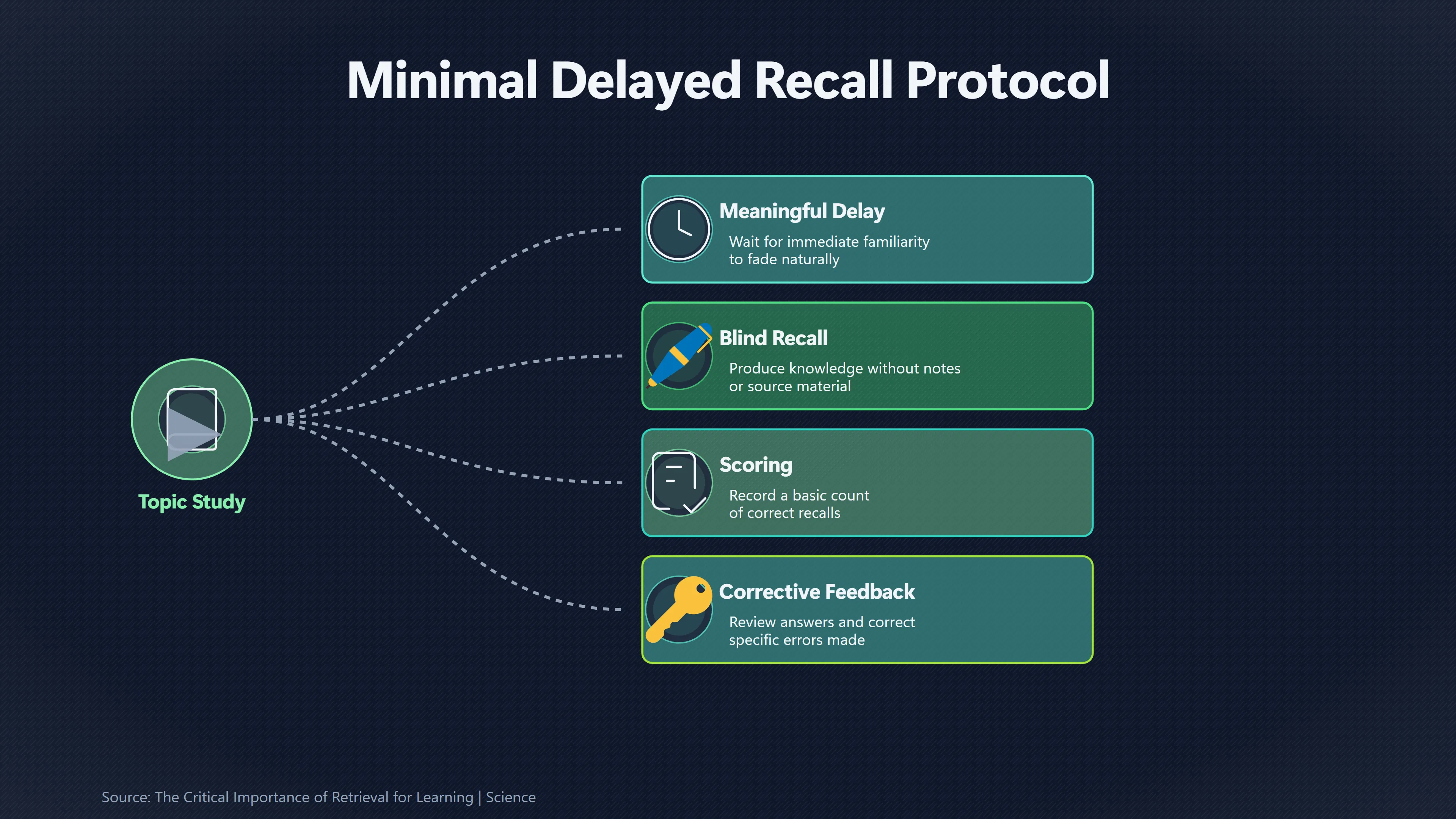
The simplest replacement is a small delayed-recall check. Study normally, put the material away, allow enough time for immediate familiarity to fade, and then try to produce the important knowledge from memory before looking at the answer.
The delay does not have to turn every study cycle into an examination. Its purpose is diagnostic: to introduce some forgetting so that the check distinguishes information that remains retrievable from information that merely felt fluent while studying. The appropriate interval should reflect the goal. Material needed tomorrow warrants a shorter check than knowledge expected to remain useful weeks or months later.
The evidence for making retrieval central is unusually substantial. In Roediger and Karpicke’s prose experiments, the advantage of retrieval emerged on delayed rather than five-minute tests. Karpicke and Roediger subsequently found that repeatedly testing already recalled material substantially improved recall one week later, whereas repeatedly studying already recalled material did not provide the same benefit.[ScienceDirect]sciencedirect.comRepeated retrieval during learning is the key to long-term retention - ScienceDirect… A 2021 systematic review of 50 experiments conducted in schools and classrooms, involving 5,374 learners, likewise found retrieval-practice benefits across different education levels, subjects, test formats and delays, although the authors noted that the geographical diversity of the evidence was limited.[DOI]doi.orgRetrieval Practice Consistently Benefits Student Learning: a Systematic Review of Applied Research in Schools and Classrooms | Educati… A larger meta-analysis of classroom quizzing, covering 222 studies and 48,478 students, estimated a medium overall achievement benefit, while also finding that the size of the effect varied with factors such as feedback, repetition and test format.[PubMed]pubmed.ncbi.nlm.nih.govTesting (quizzing) boosts classroom learning: A systematic and meta-analytic review - PubMedApril 1, 2021…
For personal tracking, however, there is an important wrinkle: a learning check is both measurement and practice. Attempting retrieval can itself strengthen later memory.[Annual Reviews]annualreviews.orgAnnual Reviews Practicing Retrieval Facilitates Learning | Annual ReviewsAnnual ReviewsPracticing Retrieval Facilitates Learning | Annual ReviewsJanuary 4, 2021… That is not a reason to avoid it. It simply means a five-question recall check is not a chemically pure measurement instrument. In self-improvement, that is often an advantage: the same few minutes can reveal weaknesses and contribute to learning.
A minimal version might look like this:
- After studying a topic, choose a small number of important prompts rather than testing every detail.
- Wait until a meaningful delay has passed.
- Answer without notes, answer keys or the source material visible.
- Record something simple, such as 4/6 recalled correctly, rather than building a detailed scoring system.
- Check the answers and correct important errors.
Corrective feedback is especially sensible when recall fails, because an incorrect or missing answer should not simply be rehearsed as though it were correct. Reviews of retrieval research generally find that feedback can strengthen the benefits of testing, although the exact contribution varies across conditions.[PubMed]pubmed.ncbi.nlm.nih.govPub Med The critical role of retrieval practice in long-term retentionThe critical role of retrieval practice in long-term retention - PubMed… Interestingly, failed retrieval need not make the attempt worthless: experimental work has found that an unsuccessful attempt followed by exposure to the correct answer can itself improve subsequent learning.[PubMed]pubmed.ncbi.nlm.nih.govPub Med Unsuccessful retrieval attempts enhance subsequent learningPub Med Unsuccessful retrieval attempts enhance subsequent learning
The score’s job is not to produce a flattering percentage. It is to reveal whether the present study method leaves important knowledge accessible after the study context has disappeared.

Unseen practice tests whether knowledge travels
Recall is not always the real goal. A student of anatomy may need factual recall, but somebody learning mathematics, programming, statistics or professional judgement may ultimately need to recognise when and how to apply what they know. Repeating yesterday’s exact question can overstate readiness for that task.
That is where unseen practice becomes useful. Instead of asking only the same questions used during study, give yourself a new problem that depends on the same principle. For example, after studying how to select a statistical test, do not merely recite the definition of a particular test. Take a previously unseen research scenario and decide which analysis fits, then explain why. After learning a programming concept, solve a fresh problem rather than reproducing the worked example.
Research supports this distinction, but also warns against assuming that successful retrieval automatically produces unlimited transfer. Pan and Rickard’s meta-analysis examined 192 transfer effects from 122 experiments involving 10,382 participants. Practice testing produced a positive average transfer effect relative to re-exposure, but the benefit varied substantially with the kind of transfer required. Application and inference questions were among the circumstances in which useful transfer occurred, while some other forms showed weaker effects.[PubMed]pubmed.ncbi.nlm.nih.govPub Med Transfer of test-enhanced learning: Meta-analytic review and synthesisPub Med Transfer of test-enhanced learning: Meta-analytic review and synthesis Experiments have also found that retrieving and applying knowledge across different examples can improve subsequent performance on new examples.[PubMed]pubmed.ncbi.nlm.nih.govOpen source on nih.gov.
More recent work reinforces the need for care rather than a simplistic “testing always wins” rule. A 2025 study of complex educational concepts found benefits for retention and, under some experimental conditions, application to unseen questions; the application advantage was more evident after sufficient retrieval practice and a delayed final test.[ScienceDirect]sciencedirect.comOpen source on sciencedirect.com. Meanwhile, a 2025 systematic review comparing retrieval practice with other active or elaborative learning methods found only a small overall advantage for retrieval, with results depending importantly on feedback and the comparison activity. Retrieval’s superiority is much clearer against passive restudy than against every plausible active-learning alternative.[DOI]doi.orgOpen source on doi.org.
That matters for measurement. A good learning check should resemble the capability you actually want, not merely whichever quiz is easiest to score. If the goal is remembering vocabulary, delayed recall may be enough. If the goal is solving unfamiliar problems, at least some checks should be unfamiliar problems. If the goal combines factual knowledge and application, a tiny check can contain both.
Do not turn the learning check into another vanity metric
Replacing “sessions completed” with “quiz percentage” does not automatically improve the feedback loop. A badly designed score can be just as misleading as an activity count.
The most obvious risk is repeatedly testing the same narrow questions. Scores may rise because those particular cue–answer relationships have become familiar, while broader understanding remains weak. Evidence on transfer shows precisely why performance on practised material should not simply be assumed to generalise to every new task.[PubMed]pubmed.ncbi.nlm.nih.govPub Med Transfer of test-enhanced learning: Meta-analytic review and synthesisPub Med Transfer of test-enhanced learning: Meta-analytic review and synthesis Mixing in unseen questions is a practical defence when transfer matters.
A second risk is checking too soon. Immediate success can reward study methods that support short-lived accessibility rather than durable retention. The experimental crossover between immediate and delayed performance is one reason delayed checks are more informative when long-term memory is the objective.[DOI]doi.orgTest-Enhanced LearningTest-Enhanced Learning
A third risk is making the measurement system so elaborate that maintaining it becomes a second project. For personal use, there is rarely a reason to construct a psychometrically sophisticated examination after every study block. The aim is not precise certification; it is to obtain enough evidence for the next decision. A six-question delayed check that repeatedly exposes the same weakness can be more useful than a spreadsheet containing study hours, pages, concentration ratings, flashcards reviewed and a composite productivity score.
Finally, retrieval practice should not be promoted beyond what the evidence supports. Applied reviews generally favour it, but effects depend on what it replaces, how questions are constructed, whether feedback is available and what later performance requires. One classroom-focused review, for example, found clearer advantages over rereading and no activity than over some stronger active-learning comparisons.[Frontiers]frontiersin.orgOpen source on frontiersin.org. The sensible conclusion is not that every study activity should become a quiz. It is that when you need evidence of retained learning, actual retrieval or application provides more direct information than counting exposure to study.
When to keep, reduce or replace session counts
There is no need for a ceremonial moment when one metric permanently replaces another. The cleaner approach is to let each measure survive only while it changes a decision.
Keep session counts when adherence is still unstable. If the plan is four sessions and the pattern remains 1, 2, 0, 3, the behaviour itself is still uncertain. A disappointing learning check cannot tell you much about a study routine that is rarely executed as planned.
Reduce session tracking when adherence has become predictably high. At that stage, recording every successful session may add little information. A lightweight exception rule — notice only when planned study repeatedly fails — can preserve visibility without keeping adherence at the centre of the system.
Make learning checks primary when study reliably happens and the unresolved question is whether it works. The useful signal might become “5/7 important ideas recalled after a week” or “3/5 unseen problems solved without help”. Those numbers are imperfect, but they address the new uncertainty much more directly than “four sessions completed”.
The results should lead to different actions. Consistent sessions plus improving delayed performance suggest that the routine is doing its job; there is little reason to add measurement. Consistent sessions plus persistently weak delayed recall suggest changing how material is studied, retrieved, spaced or corrected. Strong recall but weak unseen-problem performance suggests that remembering information is not the same bottleneck as applying it. Falling session completion, meanwhile, is a reason to bring adherence back into view rather than interpreting every poor learning score as a failure of study technique.
That produces a deliberately small feedback system: count sessions while the uncertainty is whether you will study; use delayed recall when the uncertainty is whether you will remember; use unseen practice when the uncertainty is whether you can apply what you learnt. The point is not to accumulate progressively more metrics. It is to retire or demote a metric once it has answered the question it was introduced to answer.
Amazon book picks
Further Reading
Books and field guides related to When Study Time Stops Being the Right Metric. Use these as the next step if you want deeper reading beyond the article.
Atomic Habits
Rating: 3.5/5 from 7 Google Books ratings
The #1 New York Times bestseller. Over 25 million copies sold! Translated into 60+ languages! Tiny Changes, Remarkable Results No matter...
Make It Stick
To most of us, learning something "the hard way" implies wasted time and effort. Good teaching, we believe, should be creatively tailored...
A Mind for Numbers
Engineering professor Barbara Oakley knows firsthand how it feels to struggle with math. In her book, she offers you the tools needed to...
Ultralearning
Now a Wall Street Journal bestseller. Learn a new talent, stay relevant, reinvent yourself, and adapt to whatever the workplace throws yo...
eBay marketplace picks
Marketplace Samples
Live-tested eBay searches with available results related to this page.
Selected fromdesk organizer oneBay.co.uk.



Endnotes
1.
Source: sciencedirect.com
Link:https://www.sciencedirect.com/science/article/pii/S0749596X06001367
Source snippet
Repeated retrieval during learning is the key to long-term retention - ScienceDirect...
2.
Source: doi.org
Title: The Critical Importance of Retrieval for Learning | Science
Link:https://doi.org/10.1126/science.1152408
Source snippet
The Critical Importance of Retrieval for Learning | Science...
3.
Source: doi.org
Link:https://doi.org/10.1007/s10648-021-09595-9
Source snippet
Retrieval Practice Consistently Benefits Student Learning: a Systematic Review of Applied Research in Schools and Classrooms | Educati...
4.
Source: sciencedirect.com
Title: ScienceDirect How Retrieval Attempts Affect Learning: A Review and Synthesis
Link:https://www.sciencedirect.com/science/chapter/bookseries/abs/pii/S0079742116000165
5.
Source: sciencedirect.com
Link:https://www.sciencedirect.com/science/article/pii/S0959475225001434
6.
Source: doi.org
Link:https://doi.org/10.1007/s10648-025-10076-6
7.
Source: doi.org
Title: Test-Enhanced Learning
Link:https://doi.org/10.1111/j.1467-9280.2006.01693.x
8.
Source: sciencedirect.com
Link:https://www.sciencedirect.com/science/article/pii/S0749596X22000894
9.
Source: doi.org
Link:https://doi.org/10.1038/s44159-022-00089-1
10.
Source: sciencedirect.com
Link:https://www.sciencedirect.com/science/article/pii/S221136811630225X
11.
Source: sciencedirect.com
Title: Is disfluency desirable for learning?
Link:https://www.sciencedirect.com/science/article/abs/pii/S095947521730107X
12.
Source: sciencedirect.com
Title: Multiple-choice testing as a desirable difficulty in the classroom
Link:https://www.sciencedirect.com/science/article/abs/pii/S2211368114000205
13.
Source: doi.org
Title: Improving Students’ Learning With Effective Learning Techniques
Link:https://doi.org/10.1177/1529100612453266
14.
Source: sciencedirect.com
Link:https://www.sciencedirect.com/science/article/pii/S0166432811008278
15.
Source: sciencedirect.com
Title: Brain–behavior correlates of optimizing learning through interleaved practice
Link:https://www.sciencedirect.com/science/article/pii/S1053811911002229
16.
Source: sciencedirect.com
Title: Repeated retrieval during learning is the key to long-term retention
Link:https://www.sciencedirect.com/science/article/abs/pii/S0749596X06001367
17.
Source: sciencedirect.com
Link:https://www.sciencedirect.com/science/article/abs/pii/S221136811630225X
18.
Source: sciencedirect.com
Link:https://www.sciencedirect.com/science/article/pii/S0959475217301810
19.
Source: sciencedirect.com
Link:https://www.sciencedirect.com/science/article/pii/S0959475222001001
20.
Source: psychologicalscience.org
Title: Association for Psychological Science Test-Enhanced Learning
Link:https://www.psychologicalscience.org/journals/psychological-science/j.1467-9280.2006.01693.x/
Source snippet
Association for Psychological ScienceTest-Enhanced Learning - Psychological Science - APS...
21.
Source: psychologicalscience.org
Title: Association for Psychological Science Learning Versus Performance
Link:https://www.psychologicalscience.org/journals/perspectives/1745691615569000/
Source snippet
Association for Psychological ScienceLearning Versus Performance - Perspectives on Psychological Science - APS...
22.
Source: pmc.ncbi.nlm.nih.gov
Title: Pub Med Central (PMC)Remembering What We Learn
Link:https://pmc.ncbi.nlm.nih.gov/articles/PMC6353106/
Source snippet
PubMed Central (PMC)Remembering What We Learn - PMC...
23.
Source: pubmed.ncbi.nlm.nih.gov
Title: Pub Med Test-enhanced learning: taking memory tests improves long-term retention
Link:https://pubmed.ncbi.nlm.nih.gov/16507066/
Source snippet
Test-enhanced learning: taking memory tests improves long-term retention - PubMed...
24.
Source: pubmed.ncbi.nlm.nih.gov
Link:https://pubmed.ncbi.nlm.nih.gov/33683913/
Source snippet
Testing (quizzing) boosts classroom learning: A systematic and meta-analytic review - PubMedApril 1, 2021...
Published: April 1, 2021
25.
Source: annualreviews.org
Title: Annual Reviews Practicing Retrieval Facilitates Learning | Annual Reviews
Link:https://www.annualreviews.org/content/journals/10.1146/annurev-psych-010419-051019
Source snippet
Annual ReviewsPracticing Retrieval Facilitates Learning | Annual ReviewsJanuary 4, 2021...
Published: January 4, 2021
26.
Source: pubmed.ncbi.nlm.nih.gov
Title: Pub Med The critical role of retrieval practice in long-term retention
Link:https://pubmed.ncbi.nlm.nih.gov/20951630/
Source snippet
The critical role of retrieval practice in long-term retention - PubMed...
27.
Source: pmc.ncbi.nlm.nih.gov
Link:https://pmc.ncbi.nlm.nih.gov/articles/PMC10229024/
28.
Source: pubmed.ncbi.nlm.nih.gov
Title: Pub Med Unsuccessful retrieval attempts enhance subsequent learning
Link:https://pubmed.ncbi.nlm.nih.gov/19586265/
29.
Source: pubmed.ncbi.nlm.nih.gov
Title: Pub Med Transfer of test-enhanced learning: Meta-analytic review and synthesis
Link:https://pubmed.ncbi.nlm.nih.gov/29733621/
30.
Source: pubmed.ncbi.nlm.nih.gov
Link:https://pubmed.ncbi.nlm.nih.gov/29265856/
31.
Source: frontiersin.org
Link:https://www.frontiersin.org/journals/education/articles/10.3389/feduc.2019.00005/full
32.
Source: pubmed.ncbi.nlm.nih.gov
Link:https://pubmed.ncbi.nlm.nih.gov/34820785/
33.
Source: pubmed.ncbi.nlm.nih.gov
Link:https://pubmed.ncbi.nlm.nih.gov/35389700/
34.
Source: frontiersin.org
Title: Frontiers | A Meta-Analysis of Ten Learning Techniques
Link:https://www.frontiersin.org/journals/education/articles/10.3389/feduc.2021.581216/full
35.
Source: pubmed.ncbi.nlm.nih.gov
Link:https://pubmed.ncbi.nlm.nih.gov/31045483/
36.
Source: pubmed.ncbi.nlm.nih.gov
Link:https://pubmed.ncbi.nlm.nih.gov/30998028/
37.
Source: pubmed.ncbi.nlm.nih.gov
Link:https://pubmed.ncbi.nlm.nih.gov/30265011/
38.
Source: pubmed.ncbi.nlm.nih.gov
Link:https://pubmed.ncbi.nlm.nih.gov/28358548/
39.
Source: pmc.ncbi.nlm.nih.gov
Link:https://pmc.ncbi.nlm.nih.gov/articles/PMC5183614/
40.
Source: pubmed.ncbi.nlm.nih.gov
Link:https://pubmed.ncbi.nlm.nih.gov/28082930/
41.
Source: frontiersin.org
Link:https://www.frontiersin.org/journals/psychology/articles/10.3389/fpsyg.2016.01977/full
42.
Source: pmc.ncbi.nlm.nih.gov
Link:https://pmc.ncbi.nlm.nih.gov/articles/PMC4888598/
43.
Source: pmc.ncbi.nlm.nih.gov
Link:https://pmc.ncbi.nlm.nih.gov/articles/PMC4593518/
44.
Source: frontiersin.org
Link:https://www.frontiersin.org/journals/psychology/articles/10.3389/fpsyg.2015.01054/full
45.
Source: pubmed.ncbi.nlm.nih.gov
Link:https://pubmed.ncbi.nlm.nih.gov/24313425/
46.
Source: psychologicalscience.org
Title: which study strategies make the grade 2
Link:https://www.psychologicalscience.org/observer/which-study-strategies-make-the-grade-2
47.
Source: journals.sagepub.com
Link:https://journals.sagepub.com/stoken/rbtfl/Z10jaVH/60XQM/full
48.
Source: journals.sagepub.com
Link:https://journals.sagepub.com/stoken/rbtfl/Z10jaVH/60XQM/full?cookieSet=1
49.
Source: psychologicalscience.org
Link:https://www.psychologicalscience.org/publications/journals/pspi/learning-techniques.html/comment-page-1
50.
Source: pubmed.ncbi.nlm.nih.gov
Link:https://pubmed.ncbi.nlm.nih.gov/22142953/
51.
Source: pubmed.ncbi.nlm.nih.gov
Link:https://pubmed.ncbi.nlm.nih.gov/22142953/?dopt=Abstract
52.
Source: pubmed.ncbi.nlm.nih.gov
Link:https://pubmed.ncbi.nlm.nih.gov/22247957/
53.
Source: pubmed.ncbi.nlm.nih.gov
Link:https://pubmed.ncbi.nlm.nih.gov/18276894/
54.
Source: psychologicalscience.org
Title: the science of learning and the learning of science
Link:https://www.psychologicalscience.org/observer/the-science-of-learning-and-the-learning-of-science
55.
Source: pubmed.ncbi.nlm.nih.gov
Link:https://pubmed.ncbi.nlm.nih.gov/11105526/
56.
Source: pubmed.ncbi.nlm.nih.gov
Link:https://pubmed.ncbi.nlm.nih.gov/26173288/
57.
Source: pubmed.ncbi.nlm.nih.gov
Link:https://pubmed.ncbi.nlm.nih.gov/19358016/
58.
Source: pubmed.ncbi.nlm.nih.gov
Link:https://pubmed.ncbi.nlm.nih.gov/19883131/
59.
Source: pubmed.ncbi.nlm.nih.gov
Link:https://pubmed.ncbi.nlm.nih.gov/25910388/?dopt=Abstract
60.
Source: pubmed.ncbi.nlm.nih.gov
Link:https://pubmed.ncbi.nlm.nih.gov/32495320/
Additional References
61.
Source: youtube.com
Title: How my friend ranked 1st at Medical School
Link:https://www.youtube.com/watch?v=fDbxPVn02VU
Source snippet
For a foundational breakdown of why completing study sessions and immediate performance do not equal durable retention, watch The Critica...
62.
Source: youtube.com
Title: The Critical Distinction Between Learning and Performance | Dr. Robert Bjork
Link:https://www.youtube.com/watch?v=K0ZxGGN4R90
Source snippet
The Testing Effect & Retrieval practice: the number 1 study hack...
63.
Source: youtube.com
Title: The Testing Effect & Retrieval practice: the number 1 study hack
Link:https://www.youtube.com/watch?v=G6u9_lbW2hY
Source snippet
Using Desirable Difficulties to Enhance Learning | Dr. Robert Bjork...
64.
Source: youtube.com
Title: Using Desirable Difficulties to Enhance Learning | Dr. Robert Bjork
Link:https://www.youtube.com/watch?v=XPllm-gtrMM
Source snippet
Studying: what students do vs. what works (and why)...
65.
Source: youtube.com
Title: Studying: what students do vs. what works (and why)
Link:https://www.youtube.com/watch?v=TYpUT63thEo
Source snippet
How my friend ranked 1st at Medical School - The Active Recall Framework...
66.
Source: nature.com
Title: The double-edged sword of memory retrieval | Nature Reviews Psychology
Link:https://www.nature.com/articles/s44159-022-00115-2
67.
Source: researchgate.net
Link:https://www.researchgate.net/publication/302590872_How_Retrieval_Attempts_Affect_Learning_A_Review_and_Synthesis
68.
Source: researchgate.net
Link:https://www.researchgate.net/publication/24268097_Metacognitive_strategies_in_student_learning_Do_students_practise_retrieval_when_they_study_on_their_own
69.
Source: researchgate.net
Link:https://www.researchgate.net/publication/315706448_Rethinking_the_Use_of_Tests_A_Meta-Analysis_of_Practice_Testing
70.
Source: researchgate.net
Link:https://www.researchgate.net/publication/324995852_Transfer_of_Test-Enhanced_Learning_Meta-Analytic_Review_and_Synthesis