Within Temptation Bundling
Should You Lock Your Temptation to the Habit?
Keeping the enjoyable activity unavailable elsewhere can preserve its pull and make the beneficial activity more tempting next time.
On this page
- Why unrestricted rewards lose motivational value
- What the gym only audiobook condition changed
- Practical ways to create a commitment constraint
Page outline Jump by section
Introduction
Restricting the enjoyable half of a temptation bundle can make the whole arrangement stronger. If the next chapter, favourite podcast or television episode is available whenever you want it, there is little reason to do the difficult beneficial activity to get it. Reserve that pleasure for the workout, walk or other chosen activity, however, and anticipation itself can become part of the motivation to begin.
The clearest evidence comes from Katherine Milkman, Julia Minson and Kevin Volpp’s gym experiment. Participants whose tempting audiobooks were physically kept at the gym initially attended substantially more often than controls, and more often than participants who merely promised themselves not to listen elsewhere. The result does not prove that every reward should be locked away. It does show why restriction is more than an incidental detail of temptation bundling: exclusivity preserves something worth coming back for.[PubMed Central (PMC)]nih.govPub Med Central (PMC)Holding the Hunger Games Hostage at the Gym: An Evaluation of Temptation BundlingPubMed Central (PMC)Holding the Hunger Games Hostage at the Gym: An Evaluation of Temptation Bundling - PMCFebruary 1, 2014
Why unrestricted rewards lose motivational value
A temptation bundle needs a link between two activities: doing this beneficial thing gives me access to that enjoyable thing. Unrestricted access weakens that link. If you listen to the gripping audiobook on the sofa tonight, its unresolved story can no longer provide the same reason to exercise tomorrow. In that sense, consuming the temptation separately spends some of the incentive that the bundle was supposed to save.
Restriction therefore changes the role of the enjoyable activity. It is no longer merely entertainment that happens to coincide with exercise. It becomes a benefit conditional on exercise. This resembles a commitment device: a voluntary arrangement made in advance to protect a longer-term intention against a more tempting choice later. Reviews of commitment devices distinguish harder constraints, which make deviation genuinely difficult, from softer commitments that rely more heavily on a person’s willingness to follow a rule.[Annual Reviews]annualreviews.orgAnnual Reviews Commitment Devices | Annual ReviewsAnnual ReviewsCommitment Devices | Annual ReviewsSeptember 4, 2010…
Temptation bundling has an unusual advantage over many conventional commitment devices. A commitment contract might punish failure by taking away money. A restrictive bundle need not impose a new punishment. Instead, it relocates an existing pleasure so that access to it pulls the person towards the desired behaviour. Milkman and colleagues explicitly described this as a distinctive form of commitment device: it can address under-consumption of the beneficial “should” activity and over-consumption of the immediately pleasurable “want” at the same time.[PubMed Central (PMC)]nih.govPub Med Central (PMC)Holding the Hunger Games Hostage at the Gym: An Evaluation of Temptation BundlingPubMed Central (PMC)Holding the Hunger Games Hostage at the Gym: An Evaluation of Temptation Bundling - PMCFebruary 1, 2014
There is an important second mechanism. Restriction can preserve anticipation. The original researchers noted that repeated engagement with the tempting fiction could generate desire to continue it, whereas distance from it could reduce its allure. That helps explain why a bundle is vulnerable to long interruptions: after participants stopped listening over the Thanksgiving break, the experimental advantage dropped sharply. The researchers interpreted this pattern as consistent with the idea that continued contact with the enjoyable activity was helping sustain its motivational pull.[PubMed Central (PMC)]nih.govPub Med Central (PMC)Holding the Hunger Games Hostage at the Gym: An Evaluation of Temptation BundlingPubMed Central (PMC)Holding the Hunger Games Hostage at the Gym: An Evaluation of Temptation Bundling - PMCFebruary 1, 2014
So the useful rule is not simply “deny yourself fun”. It is more precise: do not routinely consume elsewhere the particular pleasure that you are relying on to make the beneficial activity attractive.
What the gym-only audiobook condition changed
The original field experiment provides an unusually clean illustration because it compared different degrees of restriction. Participants chose from pre-tested, tempting audio novels. In the strongest treatment, four chosen novels were loaded onto a loaned iPod Shuffle that remained in a monitored locker at the university gym. Participants could therefore listen when they visited the facility but could not simply take the device home.[PubMed Central (PMC)]nih.govPub Med Central (PMC)Holding the Hunger Games Hostage at the Gym: An Evaluation of Temptation BundlingPubMed Central (PMC)Holding the Hunger Games Hostage at the Gym: An Evaluation of Temptation Bundling - PMCFebruary 1, 2014
A second group received tempting audiobooks on their own devices. They were encouraged to impose the same “gym only” rule on themselves, but nothing physically prevented them from listening elsewhere. A control group received a similarly valued bookshop gift certificate and encouragement to exercise. The comparison matters because the strongest treatment did not merely tell participants about temptation bundling: it altered their environment so that violating the restriction was much harder.[PubMed Central (PMC)]nih.govPub Med Central (PMC)Holding the Hunger Games Hostage at the Gym: An Evaluation of Temptation BundlingPubMed Central (PMC)Holding the Hunger Games Hostage at the Gym: An Evaluation of Temptation Bundling - PMCFebruary 1, 2014
At the beginning of the intervention, the enforced gym-only group made a regression-adjusted 0.48 additional gym visits per week relative to the control group, a 51% increase over the estimated control attendance rate. The self-restriction group made 0.27 additional visits, equivalent to a 29% increase, although that comparison was only marginally statistically significant. The enforced condition also produced significantly more attendance than the self-restriction condition early in the study.[PubMed Central (PMC)]nih.govPub Med Central (PMC)Holding the Hunger Games Hostage at the Gym: An Evaluation of Temptation BundlingPubMed Central (PMC)Holding the Hunger Games Hostage at the Gym: An Evaluation of Temptation Bundling - PMCFebruary 1, 2014
That difference is the strongest direct evidence for locking the temptation to the habit, but it deserves careful interpretation. The experiment did not isolate restriction as the only difference between two otherwise perfectly identical interventions: the enforced group also used a loaned device stored at the gym, whereas the intermediate group used personal devices and had to police its own rule. The results therefore support the practical advantage of an enforced bundle over a self-enforced one, rather than establishing a precise universal effect size for restriction itself.[PubMed Central (PMC)]nih.govPub Med Central (PMC)Holding the Hunger Games Hostage at the Gym: An Evaluation of Temptation BundlingPubMed Central (PMC)Holding the Hunger Games Hostage at the Gym: An Evaluation of Temptation Bundling - PMCFebruary 1, 2014
Nor did the lock make the intervention permanently effective. Both treatment effects weakened across the nine-week study, particularly around Thanksgiving. The enforced treatment’s advantage declined by about 0.07 visits per week for each additional week of the intervention. Restriction can protect the reward from premature consumption, but it cannot guarantee that the reward will remain exciting indefinitely or that a routine will survive major disruptions.[PubMed Central (PMC)]nih.govPub Med Central (PMC)Holding the Hunger Games Hostage at the Gym: An Evaluation of Temptation BundlingPubMed Central (PMC)Holding the Hunger Games Hostage at the Gym: An Evaluation of Temptation Bundling - PMCFebruary 1, 2014
One particularly revealing finding came after the intervention. Participants were offered a chance to pay for a programme that would deliberately restrict an audiobook-equipped iPod to the gym even though, without the programme, they could take it home and use it freely. Sixty-four per cent said the arrangement sounded appealing, and 61% stated a positive willingness to pay for restricted access. In other words, many participants placed some value on having less freedom of access because that constraint could help them behave as they intended.[PubMed Central (PMC)]nih.govPub Med Central (PMC)Holding the Hunger Games Hostage at the Gym: An Evaluation of Temptation BundlingPubMed Central (PMC)Holding the Hunger Games Hostage at the Gym: An Evaluation of Temptation Bundling - PMCFebruary 1, 2014
Does the reward really need to be locked?
Not necessarily. Later research suggests that a literal technological lock is stronger than what is required for temptation bundling to work.
A much larger 2020 field experiment involving 6,792 members of a commercial gym tested a lighter-touch version. Participants could receive a free audiobook and encouragement to bundle it with exercise; those taught the technique were encouraged to pledge that they would enjoy their preferred media only while exercising. Unlike the original gym-locker experiment, access was not physically restricted. The combination of an audiobook and encouragement to temptation bundle increased the probability of a weekly workout by roughly 10–14% and average weekly workouts by around 10–12% during the intervention and follow-up periods examined.[ScienceDirect]sciencedirect.comScienceDirect Teaching temptation bundling to boost exercise: A field experimentTeaching temptation bundling to boost exercise: A field experiment - ScienceDirect…
Yet the extra effect of explicitly teaching bundling over simply giving gym members an audiobook was modest. Follow-up experiments suggested an intriguing reason: when an exercise programme hands someone an audiobook, people may infer for themselves that they are supposed to listen while exercising. Thus, self-imposed bundling can work, and people do not always need an external gatekeeper to create the association.[ScienceDirect]sciencedirect.comScienceDirect Teaching temptation bundling to boost exercise: A field experimentTeaching temptation bundling to boost exercise: A field experiment - ScienceDirect…
Taken together, the two studies point to a useful distinction rather than a contradiction. Restriction is part of the mechanism, but enforcement is a design choice. A self-rule may be enough when someone reliably respects it. A harder constraint becomes more attractive when the person repeatedly breaks that rule and consumes the temptation separately. This fits the broader commitment-device literature, in which commitments range from soft intentions to arrangements that substantially constrain future choices.[Annual Reviews]annualreviews.orgAnnual Reviews Commitment Devices | Annual ReviewsAnnual ReviewsCommitment Devices | Annual ReviewsSeptember 4, 2010…
There is also no reason to assume that maximum restriction is always best. Research on commitment devices more broadly finds considerable variation in people’s demand for constraints, and experimental evidence shows that people can both underestimate and overestimate how much commitment they need. The goal is therefore not to remove as much freedom as possible, but to impose enough friction to protect the bundle from the particular failure that keeps occurring.[ScienceDirect]sciencedirect.comOpen source on sciencedirect.com.
Practical ways to create a commitment constraint
For self-improvement, the most useful implementation is usually the least restrictive rule that reliably preserves the reward. A person who naturally follows “podcast only while walking” gains little from building an elaborate technological barrier. Someone who repeatedly finishes the podcast at home may benefit from making access harder.
A practical progression is:
-
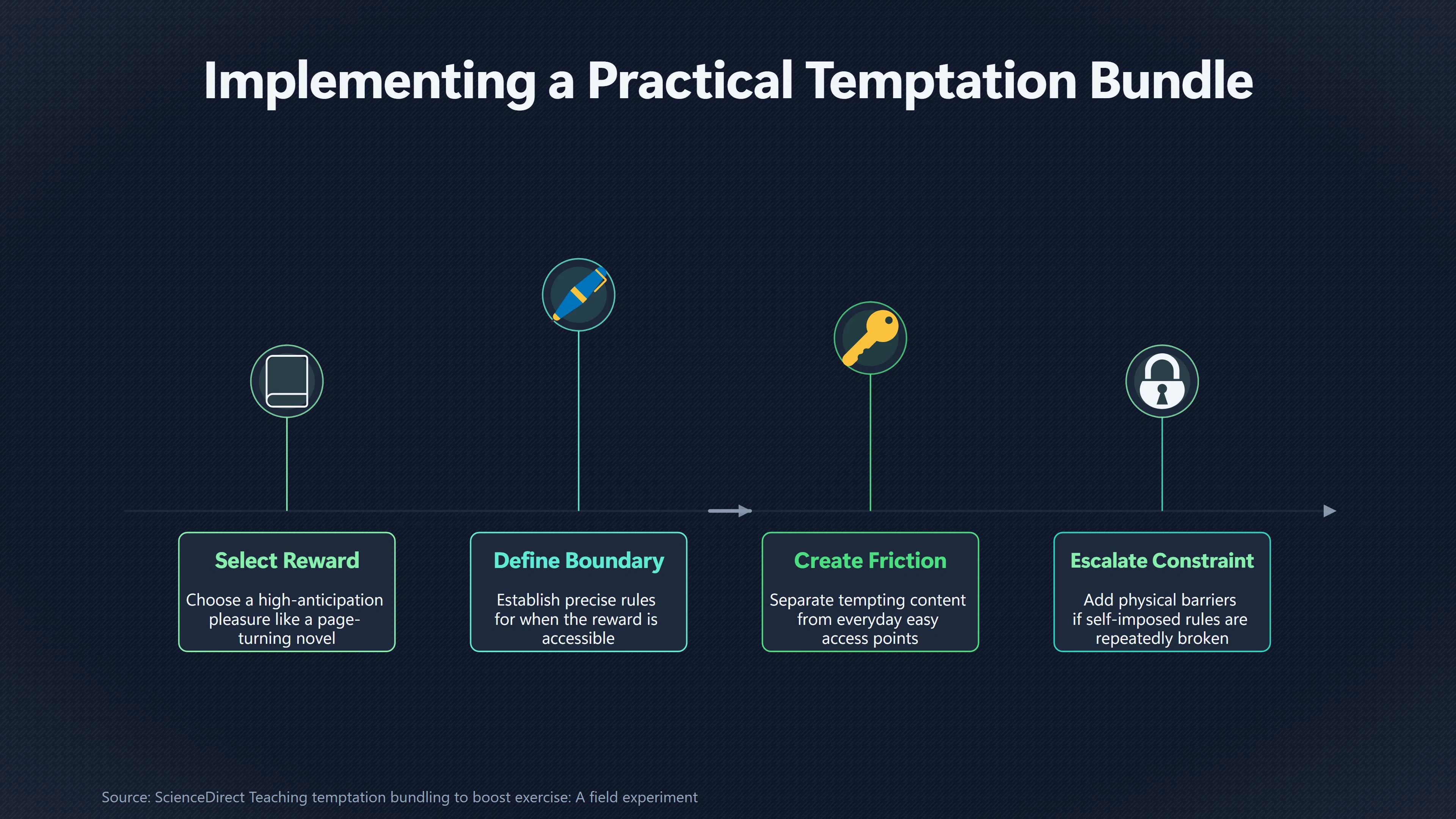
Choose something you genuinely anticipate. A merely pleasant reward provides little pull. The original experiment deliberately used pre-tested, page-turning novels and allowed participants to choose among them. Knowledge@Wharton
- Define the boundary precisely. “I will listen to this series only while exercising” is more useful than “I will try to listen while exercising”. The restriction should make clear what earns access.
- Separate the tempting content from everyday access. Keep a particular audiobook, podcast series or programme for the target activity rather than using all entertainment this way. A dedicated playlist, separate downloaded content or another access barrier can create useful friction without making ordinary leisure unnecessarily restrictive.
- Escalate only when the self-rule repeatedly fails. Moving from an intention to an environmental constraint makes sense when unrestricted access keeps defeating the bundle. The original experiment suggests that enforced restriction can outperform a rule that participants must police themselves, particularly at first. PubMed Central (PMC)
Amazon book picks
Further Reading
Books and field guides related to Should You Lock Your Temptation to the Habit?. Use these as the next step if you want deeper reading beyond the article.
Atomic Habits
Rating: 3.5/5 from 7 Google Books ratings
The #1 New York Times bestseller. Over 25 million copies sold! Translated into 60+ languages! Tiny Changes, Remarkable Results No matter...
How to Change
Wall Street Journal bestseller “A welcome revelation.” --The Financial Times Award-winning Wharton Professor and Choiceology podcast host...
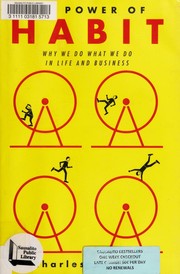
The Power of Habit
Rating: 4.0/5 from 145 Google Books ratings
Duhigg takes us to the edge of scientific discoveries that explain why habits exist and how they can be changed. Distilling information i...
Tiny Habits
Improving your life is much easier than you think. Whether it’s losing weight, sleeping more, or restoring your work/life balance – the s...
eBay marketplace picks
Marketplace Samples
Example marketplace items related to this page. Use the search link to explore similar finds on eBay.
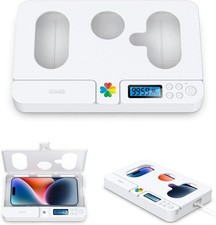
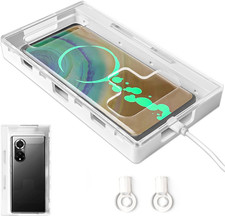
Selected fromphone lock box oneBay.co.uk.
Endnotes
1.
Source: sciencedirect.com
Title: ScienceDirect Teaching temptation bundling to boost exercise: A field experiment
Link:https://www.sciencedirect.com/science/article/pii/S074959782030385X
Source snippet
Teaching temptation bundling to boost exercise: A field experiment - ScienceDirect...
2.
Source: sciencedirect.com
Link:https://www.sciencedirect.com/science/article/pii/S0167268123000197
3.
Source: sciencedirect.com
Link:https://www.sciencedirect.com/journal/organizational-behavior-and-human-decision-processes/vol/161/suppl/S
4.
Source: sciencedirect.com
Link:https://www.sciencedirect.com/science/article/pii/S0167487007001079
5.
Source: sciencedirect.com
Link:https://www.sciencedirect.com/author/11138779200/angela-lee-duckworth
6.
Source: sciencedirect.com
Title: Behavior change
Link:https://www.sciencedirect.com/science/article/pii/S0749597820303848
7.
Source: sciencedirect.com
Title: Teaching temptation bundling to boost exercise: A field experiment
Link:https://www.sciencedirect.com/science/article/pii/S074959782030385X?c=METABOLISM
8.
Source: sciencedirect.com
Link:https://www.sciencedirect.com/author/20433982500/katherine-l-milkman
10.
Source: pubmed.ncbi.nlm.nih.gov
Link:https://pubmed.ncbi.nlm.nih.gov/25843979/
Source snippet
Holding the Hunger Games Hostage at the Gym: An Evaluation of Temptation Bundling - PubMed...
11.
Source: annualreviews.org
Title: Annual Reviews Commitment Devices | Annual Reviews
Link:https://www.annualreviews.org/doi/10.1146/annurev.economics.102308.124324
Source snippet
Annual ReviewsCommitment Devices | Annual ReviewsSeptember 4, 2010...
Published: September 4, 2010
12.
Source: ncbi.nlm.nih.gov
Title: NCBIThe Behavioral Economics Toolkit: Policy Levers and Intervention Strategies
Link:https://www.ncbi.nlm.nih.gov/sites/books/NBK593511/
Source snippet
Behavioral Economics - NCBI Bookshelf...
14.
Source: faculty.wharton.upenn.edu
Link:https://faculty.wharton.upenn.edu/wp-content/uploads/2017/07/TemptationBundling.pdf
15.
Source: chibe.upenn.edu
Title: the 5 day brain health challenge
Link:https://chibe.upenn.edu/news/the-5-day-brain-health-challenge/
16.
Source: ncbi.nlm.nih.gov
Link:https://www.ncbi.nlm.nih.gov/books/NBK593511/?report=printable
17.
Source: chibe.upenn.edu
Title: how chibe researchers use behavioral economics with their kids and family
Link:https://chibe.upenn.edu/blog/how-chibe-researchers-use-behavioral-economics-with-their-kids-and-family/
18.
Source: GOV.UK
Link:https://www.gov.uk/government/publications/online-choice-architecture-how-digital-design-can-harm-competition-and-consumers/evidence-review-of-online-choice-architecture-and-consumer-and-competition-harm
19.
Source: chibe.upenn.edu
Title: knowledge at wharton get it done two techniques to fast track your goals
Link:https://chibe.upenn.edu/news/knowledge-at-wharton-get-it-done-two-techniques-to-fast-track-your-goals/
20.
Source: pubmed.ncbi.nlm.nih.gov
Link:https://pubmed.ncbi.nlm.nih.gov/35217529/
21.
Source: pmc.ncbi.nlm.nih.gov
Link:https://pmc.ncbi.nlm.nih.gov/articles/PMC8740589/
22.
Source: chibe.upenn.edu
Title: psychology today 3 techniques to use if motivation is a barrier to exercise
Link:https://chibe.upenn.edu/news/psychology-today-3-techniques-to-use-if-motivation-is-a-barrier-to-exercise/
23.
Source: chibe.upenn.edu
Title: npr fresh starts guilty pleasures and other pro tips for sticking to good habits
Link:https://chibe.upenn.edu/news/npr-fresh-starts-guilty-pleasures-and-other-pro-tips-for-sticking-to-good-habits/
24.
Source: chibe.upenn.edu
Title: medium use temptation bundling to create better habits
Link:https://chibe.upenn.edu/news/medium-use-temptation-bundling-to-create-better-habits/
25.
Source: chibe.upenn.edu
Title: qa with katherine milkman keeping your resolutions
Link:https://chibe.upenn.edu/blog/qa-with-katherine-milkman-keeping-your-resolutions/
26.
Source: chibe.upenn.edu
Title: nejm catalyst event tackles patient behavior change
Link:https://chibe.upenn.edu/blog/nejm-catalyst-event-tackles-patient-behavior-change/
27.
Source: chibe.upenn.edu
Title: using temptation bundling to build better habits
Link:https://chibe.upenn.edu/news/using-temptation-bundling-to-build-better-habits/
28.
Source: penntoday.upenn.edu
Title: guilty pleasures and obtaining goals
Link:https://penntoday.upenn.edu/2014-01-16/research/guilty-pleasures-and-obtaining-goals
29.
Source: chibe.upenn.edu
Title: keeping new year s resolutions
Link:https://chibe.upenn.edu/news/keeping-new-year-s-resolutions/
30.
Source: chibe.upenn.edu
Title: using the hunger games to encourage healthier choices
Link:https://chibe.upenn.edu/news/using-the-hunger-games-to-encourage-healthier-choices/
31.
Source: chibe.upenn.edu
Title: holding the hunger games hostage at the gym an evaluation of temptation bundling
Link:https://chibe.upenn.edu/publications/holding-the-hunger-games-hostage-at-the-gym-an-evaluation-of-temptation-bundling/
32.
Source: annualreviews.org
Title: Commitment Devices | Annual Reviews
Link:https://www.annualreviews.org/doi/pdf/10.1146/annurev.economics.102308.124324
33.
Source: annualreviews.org
Title: Commitment Devices | Annual Reviews
Link:https://www.annualreviews.org/content/journals/10.1146/annurev.economics.102308.124324
34.
Source: bcfg.wharton.upenn.edu
Title: journal articles
Link:https://bcfg.wharton.upenn.edu/journal_articles/
35.
Source: jglobal.jst.go.jp
Link:https://jglobal.jst.go.jp/en/detail?JGLOBAL_ID=202102217679614117
Additional References
36.
Source: papers.ssrn.com
Link:https://papers.ssrn.com/sol3/papers.cfm?abstract_id=2183859
Source snippet
Holding the Hunger Games Hostage at the Gym: an Evaluation of Temptation Bundling by Katherine L. Milkman, Julia A. Minson, Kevin Vol...
37.
Source: youtube.com
Title: Every Way To Trick Your Brain Into Loving Hard Work
Link:https://www.youtube.com/watch?v=Ft_8vh5I7mI
Source snippet
This video by Katherine Milkman on Changing Behavior With 'Temptation Bundling' explains the original research and behavioral mechanics b...
38.
Source: youtube.com
Link:https://www.youtube.com/watch?v=EgAuOlx8n1Q
Source snippet
Every Way To Trick Your Brain Into Loving Hard Work...
39.
Source: youtube.com
Title: The Science of Change with Katy Milkman
Link:https://www.youtube.com/watch?v=AVPYEbPUIBk
Source snippet
The Science of Resolutions: Why is it So Hard to Set Goals & Actually Achieve Them?...
40.
Source: researchgate.net
Link:https://www.researchgate.net/publication/256040779_Holding_the_Hunger_Games_Hostage_at_the_Gym_An_Evaluation_of_Temptation_Bundling
41.
Source: besci.org
Link:https://besci.org/papers/milkman-2013
42.
Source: nationalacademies.org
Link:https://www.nationalacademies.org/read/26874/chapter/7
43.
Source: researchgate.net
Link:https://www.researchgate.net/publication/354038462_Temptation_Bundling
44.
Source: dialnet.unirioja.es
Link:https://dialnet.unirioja.es/servlet/articulo?codigo=4593460
45.
Source: researchgate.net
Link:https://www.researchgate.net/publication/346246007_Teaching_temptation_bundling_to_boost_exercise_A_field_experiment