Within Better Habits
Make Better Meals Easier Before Hunger Hits
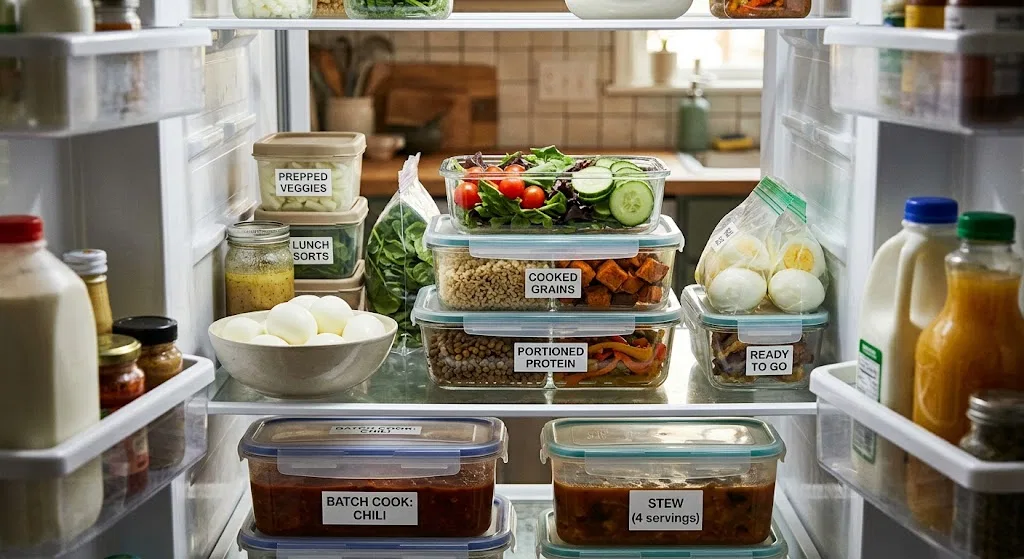
Preparing ingredients or meals ahead can prevent healthy eating plans from collapsing when hunger meets an empty kitchen.
On this page
- Where food routines commonly break down
- Preparing ingredients and portions
- Keeping meal preparation realistic
Page outline Jump by section
Introduction
Meal preparation works as a self-improvement tool when it moves an important food decision away from the moment when that decision is hardest. Instead of arriving home hungry and asking, “What shall I eat?”, you arrange in advance for a reasonable option to be the easiest option: ingredients are ready, portions are available, or a complete meal only needs heating. The point is not culinary perfection. It is to reduce the number of choices, steps and delays standing between hunger and eating well.
That principle fits the evidence better than the stronger claim that everyone must cook extensively from scratch. Meal planning is associated with better diet quality and greater food variety, while more home food preparation is often associated with healthier eating. But much of this evidence is observational, so it cannot prove that preparation itself causes the improvement. British data also show that people can achieve a high-quality diet without consuming large amounts of home-prepared food.[PubMed Central (PMC)]pmc.ncbi.nlm.nih.govOpen source on nih.gov.
The practical lesson is narrower and more useful: make tomorrow’s acceptable meal easier before tomorrow’s hunger arrives.

Where food routines commonly break down
Healthy-eating intentions often fail at a predictable handover point. The problem is not necessarily deciding that vegetables, pulses, wholegrains or balanced meals are desirable. It is converting that intention into food at 7 pm when someone is hungry, tired, short of time and looking at an unprepared kitchen.
Time pressure is a well-established part of this problem. Research on food choice has linked perceived time scarcity with less home preparation and greater reliance on fast food, restaurant meals and convenience foods. A population study of 1,319 US adults likewise found that people spending the least time on food preparation tended to be working adults who placed a high priority on convenience; those spending more time preparing food reported more frequent consumption of foods such as vegetables and fruit. These are associations rather than proof of cause, but they identify a realistic constraint: any eating system that repeatedly requires substantial effort at the end of a busy day is vulnerable to failure.[ScienceDirect]sciencedirect.comScienceDirect Time scarcity and food choices: An overviewTime scarcity and food choices: An overview - ScienceDirect…
Meal preparation addresses that constraint by changing when the work happens. Washing vegetables while energy is available, cooking several portions together or choosing tomorrow’s lunch tonight does not eliminate effort. It shifts effort from a high-friction moment to a planned one. In behavioural terms, the evening meal becomes less of an open decision and more of an execution step.
There is a useful parallel with implementation intentions: plans that connect a situation with a predetermined response. A meta-analysis of 23 studies found that such plans had a moderate effect on increasing healthier foods and a smaller effect on reducing unhealthy eating. That asymmetry matters. It may be easier to ensure that a useful food is ready to be eaten than to rely on a rule forbidding every competing choice.[PubMed]pubmed.ncbi.nlm.nih.govOpen source on nih.gov.
For meal preparation, that could mean replacing “I should eat better this week” with something operational: weekday lunches will be taken from the portions prepared on Sunday, or when I come home late, I will use one of the two freezer meals rather than decide from scratch. The improvement is not greater enthusiasm. It is clearer governance of the vulnerable moment.
Preparing ingredients and portions
Meal preparation does not have to mean producing seven identical boxed dinners. The useful intervention is whatever removes enough work from the next meal to make the intended choice competitive with the easiest alternative.
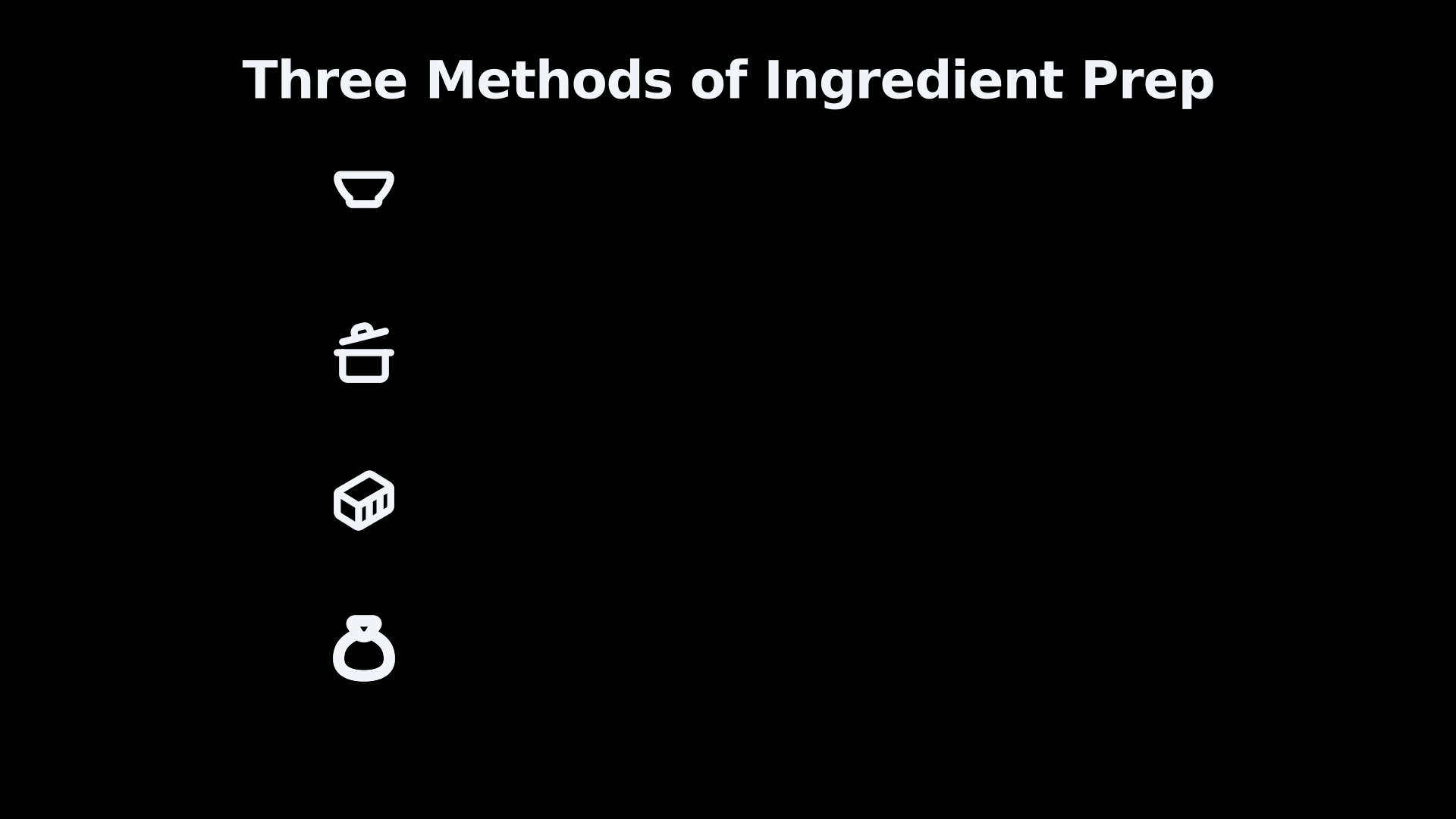
One approach is ingredient preparation. Vegetables can be washed or chopped, a grain or pulse can be cooked in advance, and a protein source can be portioned so that several different meals can be assembled quickly. This preserves more day-to-day variety than complete batch cooking while still removing much of the preparation barrier.
A second approach is component preparation. One cooking session might produce rice, roasted vegetables, lentils and a sauce that can appear in different combinations during the week. The decision becomes “which prepared combination?” rather than “what meal can I invent, shop for and cook now?” This is especially useful when eating the same finished meal repeatedly would become tedious.
A third approach is complete portions. Soups, stews, curries, pasta sauces and similar foods can be prepared in several servings, divided and refrigerated or frozen. The portion itself can then act as the default. NHS material explicitly recommends batch cooking, portioning meals and freezing them for later as a practical way of making home-prepared food easier to use.[West London NHS Trust]westlondon.nhs.ukWest London NHS Trust Food preparation and portions:: West London NHS TrustWest London NHS Trust Food preparation and portions:: West London NHS Trust
Portioning also changes the structure of the decision. Instead of facing a large container and deciding how much to serve while hungry, the serving decision has already been made. Experimental evidence illustrates why this can matter, although it should not be overgeneralised. In a 12-week randomised weight-loss trial involving 183 adults with overweight or obesity, participants receiving portion-controlled pre-packaged lunch and dinner meals alongside behavioural counselling lost more weight on average than those selecting their own foods. That study tested commercial pre-portioned meals within a weight-loss programme, not ordinary household meal prep, so it does not prove that home portioning produces the same result. It does show that controlling the meal before the eating moment can materially alter behaviour.[PubMed Central (PMC)]pmc.ncbi.nlm.nih.govOpen source on nih.gov.
The nutritional target does not need to be redesigned meal by meal either. The UK Eatwell Guide is intended to describe the balance of food across a day or even a week, rather than requiring every individual plate to reproduce its proportions exactly. That makes it well suited to advance planning: a small set of repeatable breakfasts, lunches and dinners can collectively cover fruit and vegetables, starchy carbohydrates, protein foods, dairy or alternatives and appropriate fats without demanding a fresh nutritional calculation every evening.[GOV.UK]GOV.UKThe Eatwell GuideThe Eatwell Guide
Keeping meal preparation realistic
The easiest way to make meal prep fail is to turn it into a second self-improvement project. Elaborate weekly menus, large Sunday cooking sessions and perfectly measured containers can work for some people, but they also create a new burden. The better test is whether preparation reduces total friction across the week.
That qualification is supported by the wider evidence on cooking. A systematic review of 38 observational studies found that home cooking is shaped by much more than cooking skill, including time availability, employment, relationships and cultural factors. The authors concluded that the evidence connecting home cooking itself with improved diet and health remained uncertain, in part because much of the literature was cross-sectional. Reviews of cooking interventions have similarly noted weaknesses in study design and limited evidence about long-term effects.[sciencedirect.com]sciencedirect.comOpen source on sciencedirect.com.
So “cook everything yourself” is a poor universal rule. UK National Diet and Nutrition Survey research offers a useful counterexample. Among 1,063 adults who already had high-quality diets, researchers found no adjusted difference in overall dietary quality or obesity prevalence between those consuming relatively high and low amounts of home-prepared food. The low-preparation group achieved its diet differently. The researchers therefore cautioned against presenting home preparation as a prerequisite for healthy eating.[PubMed Central (PMC)]pmc.ncbi.nlm.nih.govPubMed Central (PMC)Comparison of individuals with low versus high consumption of home-prepared food in a group with universally high die…
For self-improvement, this shifts the objective from maximum cooking to minimum necessary preparation. A realistic system might use frozen vegetables, tinned pulses, pre-cooked grains, supermarket salad, yoghurt, fruit, wholegrain bread and a few genuinely cooked dishes. Convenience is not automatically the enemy; it can be deliberately recruited to make a sound choice easier.
A sustainable preparation policy can therefore be very small:
- Prepare the meals that repeatedly fail. If breakfast already works, leave it alone. If weekday lunches collapse into whatever is nearest, prepare lunches.
- Keep one emergency option. A freezer meal, simple store-cupboard combination or other acceptable fallback prevents a disrupted schedule from turning into an entirely open decision.
- Repeat more than you reinvent. A short rotation of reliable meals reduces planning effort while allowing enough variation to avoid boredom.
- Prepare only as far ahead as you will actually use. Throwing away neglected containers is not evidence that more discipline is needed; it is evidence that the batch was too large or the menu too ambitious.
- Put prepared food where it will win the competition for attention. Ready-to-eat or ready-to-heat food is most useful when it is visible and genuinely quicker than the alternatives.
Food safety places sensible limits on the “prepare once, eat all week” idea. The UK Food Standards Agency advises cooling cooked leftovers and refrigerating them within two hours, eating refrigerated leftovers within 48 hours or freezing them, and reheating leftovers only once. Reheated food should be steaming hot throughout. For longer preparation cycles, freezing portions is therefore safer than treating the refrigerator as week-long storage.[GOV.UK]food.gov.ukUK Cooking your food | Food Standards AgencyUK Cooking your food | Food Standards Agency
The useful rule is to decide earlier
Meal preparation earns its place in effective self-improvement because it changes the architecture of an ordinary repeated decision. Hunger no longer has to trigger a negotiation among nutrition goals, available ingredients, cooking effort, delivery options and immediate cravings. Some of those questions have already been answered.
The evidence does not justify claiming that batch cooking is a guaranteed route to weight loss, that home cooking is inherently healthy, or that everyone needs a rigid weekly menu. Meal planning and home preparation are associated with better dietary patterns, but causal evidence is more limited, and healthy diets can be constructed with relatively little home cooking.[nih.gov]pmc.ncbi.nlm.nih.govOpen source on nih.gov.
What survives those qualifications is a robust behavioural principle: prepare enough in advance that the intended meal does not have to defeat convenience at the moment of greatest hunger. Sometimes that means cooking four portions on Sunday. Sometimes it means chopping tomorrow’s vegetables tonight. Sometimes it means keeping a deliberately chosen ready meal or freezer portion available for late days.
The successful system is the one in which eating reasonably well becomes the path requiring fewer decisions, not more willpower.
Amazon book picks
Further Reading
Books and field guides related to Make Better Meals Easier Before Hunger Hits. Use these as the next step if you want deeper reading beyond the article.
Cook Once, Eat All Week
Cook Once, Eat All Week is a revolutionary way to get a delicious, healthy, and affordable dinner on the table FAST. Author Cassy Joy Gar...

The Power of Habit
Rating: 4.0/5 from 145 Google Books ratings
In The Power of Habit, award-winning business reporter Charles Duhigg takes us to the thrilling edge of scientific discoveries that expla...
Good and Cheap
By showing that kitchen skill, and not budget, is the key to great food, Good and Cheap will help you eat well—really well—on the stricte...
The Food Lab
A New York Times Bestseller Winner of the James Beard Award for General Cooking Winner of the IACP Cookbook of the Year Award "The one bo...
eBay marketplace picks
Marketplace Samples
Live-tested eBay searches with available results related to this page.
Selected fromself improvement wall art oneBay.co.uk.



Endnotes
1.
Source: sciencedirect.com
Title: ScienceDirect Time scarcity and food choices: An overview
Link:https://www.sciencedirect.com/science/article/pii/S0195666306003813
Source snippet
Time scarcity and food choices: An overview - ScienceDirect...
2.
Source: sciencedirect.com
Link:https://www.sciencedirect.com/science/article/pii/S0195666310005325
3.
Source: westlondon.nhs.uk
Title: West London NHS Trust Food preparation and portions:: West London NHS Trust
Link:https://www.westlondon.nhs.uk/ealing-talking-therapies/move-4-mood/eat-well-feel-well/food-preparation-and-portions
4.
Source: GOV.UK
Title: The Eatwell Guide
Link:https://www.gov.uk/government/publications/the-eatwell-guide
5.
Source: GOV.UK
Title: Healthy eating: applying All Our Health
Link:https://www.gov.uk/government/publications/healthy-eating-applying-all-our-health/healthy-eating-applying-all-our-health
6.
Source: sciencedirect.com
Link:https://www.sciencedirect.com/science/article/pii/S0195666316309576
7.
Source: sciencedirect.com
Link:https://www.sciencedirect.com/science/article/pii/S149940461730828X
8.
Source: food.gov.uk
Title: UK Cooking your food | Food Standards Agency
Link:https://www.food.gov.uk/safety-hygiene/cooking-your-food?ContensisTextOnly=true
9.
Source: food.gov.uk
Title: UK F&Y2 Wave 9, Chapter 6: Eating at home | Food Standards Agency
Link:https://www.food.gov.uk/research/fy2-wave-9-chapter-6-eating-at-home
10.
Source: GOV.UK
Title: www.gov.uk Student guide to food safety and hygiene
Link:https://www.gov.uk/government/publications/student-guide-to-food-safety-and-hygiene/student-guide-to-food-safety-and-hygiene
11.
Source: GOV.UK
Title: www.gov.uk Food supplements guidance
Link:https://www.gov.uk/government/publications/food-supplements-guidance/food-supplements-guidance
12.
Source: foodstandards.gov.scot
Title: Food and You 2 Survey: Scotland Wave 11 Key Findings | Food Standards Scotland
Link:https://www.foodstandards.gov.scot/science-and-evidence/food-and-you-2-survey-scotland-wave-11-key-findings1
13.
Source: uclh.nhs.uk
Title: Eating Well for Less: University College London Hospitals NHS Foundation Trust
Link:https://www.uclh.nhs.uk/patients-and-visitors/patient-information-pages/eating-well-less
14.
Source: cntw.nhs.uk
Link:https://www.cntw.nhs.uk/resources/healthy-eating-on-a-budget
15.
Source: food.gov.uk
Title: F&Y2 Wave 8: Chapter 6 Eating at home | Food Standards Agency
Link:https://www.food.gov.uk/research/fy2-wave-8-chapter-6-eating-at-home?navref=quicklink
16.
Source: food.gov.uk
Title: F&Y2 Wave 8: Chapter 6 Eating at home | Food Standards Agency
Link:https://www.food.gov.uk/research/fy2-wave-8-chapter-6-eating-at-home
17.
Source: food.gov.uk
Title: F&Y2 Wave 10 Chapter 5: Eating at home | Food Standards Agency
Link:https://www.food.gov.uk/research/fy2-wave-10-chapter-5-eating-at-home
18.
Source: foodstandards.gov.scot
Title: Food and You 2 Survey: Scotland Wave 10 Key Findings | Food Standards Scotland
Link:https://www.foodstandards.gov.scot/science-and-evidence/food-and-you-2-survey-scotland-wave-10-key-findings-overview
19.
Source: GOV.UK
Title: www.gov.uk Chapter 10: healthier eating
Link:https://www.gov.uk/government/publications/delivering-better-oral-health-an-evidence-based-toolkit-for-prevention/chapter-10-healthier-eating
20.
Source: food.gov.uk
Title: F&Y2 Wave 9, Chapter 6: Eating at home | Food Standards Agency
Link:https://www.food.gov.uk/research/fy2-wave-9-chapter-6-eating-at-home?navref=quicklink
21.
Source: food.gov.uk
Title: Botulism (Clostridium botulinum) | Food Standards Agency
Link:https://www.food.gov.uk/safety-hygiene/botulism-clostridium-botulinum
22.
Source: food.gov.uk
Title: Food and You 2: Wave 9 Key Findings | Food Standards Agency
Link:https://www.food.gov.uk/research/food-and-you-2/food-and-you-2-wave-9-key-findings?print=1
23.
Source: food.gov.uk
Title: Food & You 2 trends: Chapter 6: Eating at Home | Food Standards Agency
Link:https://www.food.gov.uk/research/food-you-2-trends-chapter-6-eating-at-home
24.
Source: food.gov.uk
Title: F&Y2 Wave 7-8 NI: Chapter 6: Eating at home | Food Standards Agency
Link:https://www.food.gov.uk/research/fy2-wave-7-8-ni-chapter-6-eating-at-home?navref=quicklink
25.
Source: bedslutonchildrenshealth.nhs.uk
Title: Healthy eating
Link:https://www.bedslutonchildrenshealth.nhs.uk/feeding-and-eating/healthy-eating/
27.
Source: cambspborochildrenshealth.nhs.uk
Title: Healthy eating
Link:https://www.cambspborochildrenshealth.nhs.uk/feeding-and-eating/healthy-eating/
28.
Source: food.gov.uk
Title: Food and You 2: Wave 8 Key Findings | Food Standards Agency
Link:https://www.food.gov.uk/research/behaviour-and-perception/food-and-you-2-wave-8-key-findings?print=1
29.
Source: campaignresources.dhsc.gov.uk
Link:https://campaignresources.dhsc.gov.uk/campaigns/school-zone/healthy-eating/eatwell-guide/
30.
Source: sciencedirect.com
Link:https://www.sciencedirect.com/science/article/pii/S0195666324000564
31.
Source: food.gov.uk
Title: F&Y2 Wave 7: Chapter 3 Food security | Food Standards Agency
Link:https://www.food.gov.uk/research/fy2-wave-7-chapter-3-food-security
32.
Source: help-for-early-years-providers.education.gov.uk
Link:https://help-for-early-years-providers.education.gov.uk/health-and-wellbeing/nutrition/children-aged-one-to-five-guidance
33.
Source: GOV.UK
Title: www.gov.uk The Eatwell Guide: how to use in promotional material
Link:https://www.gov.uk/government/publications/the-eatwell-guide/the-eatwell-guide-how-to-use-in-promotional-material
34.
Source: food.gov.uk
Title: F&Y2 trends: Chapter 5: Eating at home | Food Standards Agency
Link:https://www.food.gov.uk/research/fy2-trends-chapter-5-eating-at-home?navref=quicklink
35.
Source: food.gov.uk
Title: Not reheating leftovers until steaming hot throughout | Food Standards Agency
Link:https://www.food.gov.uk/research/behaviour-and-perception/not-reheating-leftovers-until-steaming-hot-throughout
36.
Source: food.gov.uk
Title: Not reheating leftovers until steaming hot throughout | Food Standards Agency
Link:https://www.food.gov.uk/research/behaviour-and-perception/not-reheating-leftovers-until-steaming-hot-throughout?navref=quicklink
37.
Source: food.gov.uk
Title: Storing chilled foods at incorrect temperatures | Food Standards Agency
Link:https://www.food.gov.uk/research/behaviour-and-perception/storing-chilled-foods-at-incorrect-temperatures
38.
Source: food.gov.uk
Link:https://www.food.gov.uk/research/behaviour-and-perception/not-checking-use-by-dates-and-consuming-foods-past-the-use-by-dates?navref=quicklink
39.
Source: food.gov.uk
Title: F&Y2 Wave 6: Chapter 6 Eating at home | Food Standards Agency
Link:https://www.food.gov.uk/research/fy2-wave-6-chapter-6-eating-at-home
40.
Source: advances.nutrition.org
Link:https://advances.nutrition.org/article/S2161-8313%2823%2900311-3/fulltext
41.
Source: nhs.uk
Title: www.nhs.uk Healthy eating when trying to lose weight
Link:https://www.nhs.uk/better-health/lose-weight/healthy-eating-when-trying-to-lose-weight/
42.
Source: nhs.uk
Title: www.nhs.uk Calories and weight loss
Link:https://www.nhs.uk/better-health/lose-weight/calorie-counting/
43.
Source: nhs.uk
Title: www.nhs.uk8 tips for healthy eating
Link:https://www.nhs.uk/live-well/eat-well/how-to-eat-a-balanced-diet/eight-tips-for-healthy-eating/
44.
Source: nhs.uk
Title: www.nhs.uk Recipes
Link:https://www.nhs.uk/healthier-families/recipes/
45.
Source: food.gov.uk
Title: Chapter 6: Eating at home | Food Standards Agency
Link:https://www.food.gov.uk/research/chapter-6-eating-at-home?navref=quicklink
46.
Source: food.gov.uk
Title: Food and You 2: Wave 4 Key findings | Food Standards Agency
Link:https://www.food.gov.uk/research/food-and-you-2/food-and-you-2-wave-4-key-findings?print=1
47.
Source: food.gov.uk
Title: Reduce food waste and stay safe this Christmas | Food Standards Agency
Link:https://www.food.gov.uk/news-alerts/news/reduce-food-waste-and-stay-safe-this-christmas
48.
Source: nhs.uk
Title: www.nhs.uk Healthy lunch ideas
Link:https://www.nhs.uk/healthier-families/recipes/lunch/
49.
Source: nhs.uk
Title: www.nhs.uk Easy dinner ideas
Link:https://www.nhs.uk/healthier-families/recipes/dinner/
50.
Source: food.blog.gov.uk
Title: blog.gov.uk Top 10 kitchen hygiene hacks for students – Food Standards Agency
Link:https://food.blog.gov.uk/2021/12/08/top-10-kitchen-hygiene-hacks-for-students/
51.
Source: advances.nutrition.org
Link:https://advances.nutrition.org/article/S2161-8313%2822%2900144-2/fulltext
52.
Source: sciencedirect.com
Link:https://www.sciencedirect.com/science/article/pii/S1499404620303559
53.
Source: sciencedirect.com
Link:https://www.sciencedirect.com/science/article/pii/S0195666318314363
54.
Source: sciencedirect.com
Link:https://www.sciencedirect.com/science/article/pii/S0140673618328708
55.
Source: sciencedirect.com
Link:https://www.sciencedirect.com/science/article/abs/pii/S149940461730828X
56.
Source: GOV.UK
Title: www.gov.uk The Eatwell Guide and Resources
Link:https://www.gov.uk/government/publications/the-eatwell-guide-and-resources
57.
Source: GOV.UK
Title: www.gov.uk[Withdrawn] New Eatwell Guide illustrates a healthy, balanced diet
Link:https://www.gov.uk/government/news/new-eatwell-guide-illustrates-a-healthy-balanced-diet
58.
Source: sciencedirect.com
Link:https://www.sciencedirect.com/science/article/abs/pii/S0195666315003244
59.
Source: nidirect.gov.uk
Title: Healthier lunch options | nidirect
Link:https://www.nidirect.gov.uk/articles/healthier-lunch-options
60.
Source: nidirect.gov.uk
Title: Healthy balanced diet | nidirect
Link:https://www.nidirect.gov.uk/articles/healthy-balanced-diet
61.
Source: food.gov.uk
Link:https://www.food.gov.uk/research/foodborne-disease/controlling-campylobacter-during-the-manufacture-of-chicken-liver-pate
62.
Source: sciencedirect.com
Title: Time Spent on Home Food Preparation and Indicators of Healthy Eating
Link:https://www.sciencedirect.com/science/article/pii/S0749379714004000
63.
Source: sciencedirect.com
Link:https://www.sciencedirect.com/science/article/pii/S1499404612005726
64.
Source: sciencedirect.com
Title: Time-scarcity, ready-meals, ill-health and the obesity epidemic
Link:https://www.sciencedirect.com/science/article/abs/pii/S0924224412001173
65.
Source: sciencedirect.com
Link:https://www.sciencedirect.com/science/article/abs/pii/S0002822311014970
66.
Source: sciencedirect.com
Title: Food Preparation by Young Adults Is Associated with Better Diet Quality
Link:https://www.sciencedirect.com/science/article/abs/pii/S0002822306020906
67.
Source: sciencedirect.com
Link:https://www.sciencedirect.com/science/article/abs/pii/S0195666310005192
68.
Source: sciencedirect.com
Link:https://www.sciencedirect.com/science/article/pii/S2475299123115186
69.
Source: sciencedirect.com
Link:https://www.sciencedirect.com/science/article/pii/S1499404621000014
70.
Source: sciencedirect.com
Title: Time scarcity and food choices: An overview
Link:https://www.sciencedirect.com/science/article/abs/pii/S0195666306003813
71.
Source: sciencedirect.com
Link:https://www.sciencedirect.com/science/article/abs/pii/S149940461400058X
72.
Source: sciencedirect.com
Link:https://www.sciencedirect.com/science/article/pii/S2475299123093502
73.
Source: sciencedirect.com
Link:https://www.sciencedirect.com/science/article/pii/S2211335523002735
74.
Source: science.food.gov.uk
Link:https://science.food.gov.uk/article/161540-interventions-applied-at-retail-consumer-restaurant-and-catering-settings-to-reduce-the-levels-of-_campylobacter_-spp
75.
Source: food.gov.uk
Link:https://www.food.gov.uk/food-hygiene
76.
Source: food.gov.uk
Link:https://www.food.gov.uk/food-safety-and-hygiene/food-poisoning?navref=quicklink
77.
Source: myhealthlondon.nhs.uk
Link:https://www.myhealthlondon.nhs.uk/be-healthier/healthy-lifestyle/eat/
78.
Source: myhealthlondon.nhs.uk
Link:https://www.myhealthlondon.nhs.uk/be-healthier/nutrition-hub/ready-steady-cook/main-meals/
79.
Source: myhealthlondon.nhs.uk
Link:https://www.myhealthlondon.nhs.uk/be-healthier/nutrition-hub/ready-steady-cook/lovely-lunches/
80.
Source: harrow.gov.uk
Link:https://www.harrow.gov.uk/health-leisure/healthy-eating/1
81.
Source: marineavenuemc-whitleybay.nhs.uk
Title: Marine Avenue Medical Centre
Link:https://www.marineavenuemc-whitleybay.nhs.uk/healthy-eating-week-2025-small-changes-big-impact
82.
Source: uhbristol.nhs.uk
Link:https://www.uhbristol.nhs.uk/patients-and-visitors/your-hospitals/bristol-royal-infirmary/what-we-do/hepatology-department/helpful-information/liver-disease-and-diet/
83.
Source: justonenorfolk.nhs.uk
Link:https://www.justonenorfolk.nhs.uk/healthy-lifestyles/eat-better/eating-on-a-budget/
84.
Source: pmc.ncbi.nlm.nih.gov
Link:https://pmc.ncbi.nlm.nih.gov/articles/PMC5288891/
85.
Source: pmc.ncbi.nlm.nih.gov
Link:https://pmc.ncbi.nlm.nih.gov/articles/PMC6729029/
Source snippet
PubMed Central (PMC)Home-prepared food, dietary quality and socio-demographic factors: a cross-sectional analysis of the UK National Diet...
86.
Source: pmc.ncbi.nlm.nih.gov
Link:https://pmc.ncbi.nlm.nih.gov/articles/PMC6337812/
Source snippet
PubMed Central (PMC)Comparison of individuals with low versus high consumption of home-prepared food in a group with universally high die...
87.
Source: pmc.ncbi.nlm.nih.gov
Link:https://pmc.ncbi.nlm.nih.gov/articles/PMC4254327/
88.
Source: pubmed.ncbi.nlm.nih.gov
Link:https://pubmed.ncbi.nlm.nih.gov/21056605/
89.
Source: pmc.ncbi.nlm.nih.gov
Link:https://pmc.ncbi.nlm.nih.gov/articles/PMC5312668/
90.
Source: pmc.ncbi.nlm.nih.gov
Link:https://pmc.ncbi.nlm.nih.gov/articles/PMC4063875/
91.
Source: pubmed.ncbi.nlm.nih.gov
Link:https://pubmed.ncbi.nlm.nih.gov/42142215/
92.
Source: pubmed.ncbi.nlm.nih.gov
Link:https://pubmed.ncbi.nlm.nih.gov/41840718/
93.
Source: pmc.ncbi.nlm.nih.gov
Link:https://pmc.ncbi.nlm.nih.gov/articles/PMC12610451/
94.
Source: pubmed.ncbi.nlm.nih.gov
Link:https://pubmed.ncbi.nlm.nih.gov/40910965/
95.
Source: pmc.ncbi.nlm.nih.gov
Link:https://pmc.ncbi.nlm.nih.gov/articles/PMC12146092/
96.
Source: pmc.ncbi.nlm.nih.gov
Link:https://pmc.ncbi.nlm.nih.gov/articles/PMC11221142/
97.
Source: pubmed.ncbi.nlm.nih.gov
Link:https://pubmed.ncbi.nlm.nih.gov/38367913/
98.
Source: pubmed.ncbi.nlm.nih.gov
Link:https://pubmed.ncbi.nlm.nih.gov/38103793/
99.
Source: pubmed.ncbi.nlm.nih.gov
Link:https://pubmed.ncbi.nlm.nih.gov/37744739/
100.
Source: pmc.ncbi.nlm.nih.gov
Link:https://pmc.ncbi.nlm.nih.gov/articles/PMC10511804/
101.
Source: pmc.ncbi.nlm.nih.gov
Link:https://pmc.ncbi.nlm.nih.gov/articles/PMC10346164/
102.
Source: pmc.ncbi.nlm.nih.gov
Link:https://pmc.ncbi.nlm.nih.gov/articles/PMC10055649/
103.
Source: pubmed.ncbi.nlm.nih.gov
Link:https://pubmed.ncbi.nlm.nih.gov/36653939/
104.
Source: pubmed.ncbi.nlm.nih.gov
Link:https://pubmed.ncbi.nlm.nih.gov/36456831/
105.
Source: pmc.ncbi.nlm.nih.gov
Link:https://pmc.ncbi.nlm.nih.gov/articles/PMC9502289/
106.
Source: pmc.ncbi.nlm.nih.gov
Link:https://pmc.ncbi.nlm.nih.gov/articles/PMC9412361/
107.
Source: pubmed.ncbi.nlm.nih.gov
Link:https://pubmed.ncbi.nlm.nih.gov/33541769/
108.
Source: pubmed.ncbi.nlm.nih.gov
Link:https://pubmed.ncbi.nlm.nih.gov/33938062/
109.
Source: pmc.ncbi.nlm.nih.gov
Link:https://pmc.ncbi.nlm.nih.gov/articles/PMC7915304/
110.
Source: pmc.ncbi.nlm.nih.gov
Link:https://pmc.ncbi.nlm.nih.gov/articles/PMC7305980/
111.
Source: pmc.ncbi.nlm.nih.gov
Link:https://pmc.ncbi.nlm.nih.gov/articles/PMC7469020/
112.
Source: pubmed.ncbi.nlm.nih.gov
Link:https://pubmed.ncbi.nlm.nih.gov/31492141/
113.
Source: pmc.ncbi.nlm.nih.gov
Link:https://pmc.ncbi.nlm.nih.gov/articles/PMC10260640/
114.
Source: pmc.ncbi.nlm.nih.gov
Link:https://pmc.ncbi.nlm.nih.gov/articles/PMC7050805/
115.
Source: pubmed.ncbi.nlm.nih.gov
Link:https://pubmed.ncbi.nlm.nih.gov/30654805/
116.
Source: pubmed.ncbi.nlm.nih.gov
Link:https://pubmed.ncbi.nlm.nih.gov/30578213/
117.
Source: pubmed.ncbi.nlm.nih.gov
Link:https://pubmed.ncbi.nlm.nih.gov/29895188/
118.
Source: pubmed.ncbi.nlm.nih.gov
Link:https://pubmed.ncbi.nlm.nih.gov/28958671/
119.
Source: pmc.ncbi.nlm.nih.gov
Link:https://pmc.ncbi.nlm.nih.gov/articles/PMC5561571/
120.
Source: pmc.ncbi.nlm.nih.gov
Link:https://pmc.ncbi.nlm.nih.gov/articles/PMC5442685/
121.
Source: pubmed.ncbi.nlm.nih.gov
Link:https://pubmed.ncbi.nlm.nih.gov/28535769/
122.
Source: pubmed.ncbi.nlm.nih.gov
Link:https://pubmed.ncbi.nlm.nih.gov/28244173/
123.
Source: pubmed.ncbi.nlm.nih.gov
Link:https://pubmed.ncbi.nlm.nih.gov/28153017/
124.
Source: pmc.ncbi.nlm.nih.gov
Link:https://pmc.ncbi.nlm.nih.gov/articles/PMC5132243/
125.
Source: pubmed.ncbi.nlm.nih.gov
Link:https://pubmed.ncbi.nlm.nih.gov/27899807/
126.
Source: pubmed.ncbi.nlm.nih.gov
Link:https://pubmed.ncbi.nlm.nih.gov/27839899/
127.
Source: pmc.ncbi.nlm.nih.gov
Link:https://pmc.ncbi.nlm.nih.gov/articles/PMC4524366/
128.
Source: pubmed.ncbi.nlm.nih.gov
Link:https://pubmed.ncbi.nlm.nih.gov/26164120/
129.
Source: pmc.ncbi.nlm.nih.gov
Link:https://pmc.ncbi.nlm.nih.gov/articles/PMC4377200/
130.
Source: pubmed.ncbi.nlm.nih.gov
Link:https://pubmed.ncbi.nlm.nih.gov/25875767/
131.
Source: pubmed.ncbi.nlm.nih.gov
Link:https://pubmed.ncbi.nlm.nih.gov/25245799/
132.
Source: pubmed.ncbi.nlm.nih.gov
Link:https://pubmed.ncbi.nlm.nih.gov/23092741/
133.
Source: pubmed.ncbi.nlm.nih.gov
Link:https://pubmed.ncbi.nlm.nih.gov/22717177/
134.
Source: pubmed.ncbi.nlm.nih.gov
Link:https://pubmed.ncbi.nlm.nih.gov/20883734/
135.
Source: pubmed.ncbi.nlm.nih.gov
Link:https://pubmed.ncbi.nlm.nih.gov/17592101/
136.
Source: pubmed.ncbi.nlm.nih.gov
Link:https://pubmed.ncbi.nlm.nih.gov/16698116/
137.
Source: pubmed.ncbi.nlm.nih.gov
Link:https://pubmed.ncbi.nlm.nih.gov/30265560/
138.
Source: pmc.ncbi.nlm.nih.gov
Link:https://pmc.ncbi.nlm.nih.gov/articles/PMC5340595/
139.
Source: pubmed.ncbi.nlm.nih.gov
Link:https://pubmed.ncbi.nlm.nih.gov/29995649/
140.
Source: pubmed.ncbi.nlm.nih.gov
Link:https://pubmed.ncbi.nlm.nih.gov/16448518/
141.
Source: pubmed.ncbi.nlm.nih.gov
Link:https://pubmed.ncbi.nlm.nih.gov/17126631/
Additional References
142.
Source: youtube.com
Title: The Truth About Meal Prep: How to Eat Clean Without Losing Your Weekend
Link:https://www.youtube.com/watch?v=5dletfh3gf4
Source snippet
For practical guidance on restructuring your kitchen workflow to eliminate [decision fatigue]({{ 'decision-fatigue/' | relative_url }}), watch the Meal Prep System Guide, which dire...
143.
Source: youtube.com
Title: How to Lose Fat on a Busy Schedule (Without Relying on Motivation)
Link:https://www.youtube.com/watch?v=IXGUlAJ0x8Q
Source snippet
The Truth About Meal Prep: How to Eat Clean Without Losing Your Weekend...
144.
Source: nature.com
Link:https://www.nature.com/articles/ijo2016217
145.
Source: nature.com
Link:https://www.nature.com/articles/s41591-022-02077-7
146.
Source: mdpi.com
Link:https://www.mdpi.com/2304-8158/14/21/3625
147.
Source: jamanetwork.com
Link:https://jamanetwork.com/journals/jamainternalmedicine/fullarticle/485403
148.
Source: cambridge.org
Link:https://www.cambridge.org/core/journals/public-health-nutrition/article/barriers-and-facilitators-to-participant-adherence-of-dietary-recommendations-within-comprehensive-cardiac-rehabilitation-programmes-a-systematic-review/7D5EDAB5ED239FF7AB4882D45301D66C
149.
Source: doaj.org
Link:https://doaj.org/article/ba2daa5c5e604f839a637c980d3c2765
150.
Source: frontiersin.org
Link:https://www.frontiersin.org/journals/nutrition/articles/10.3389/fnut.2026.1797836/full
151.
Source: doi.org
Link:https://doi.org/10.1080%2F21642850.2016.1256211