Within Habit Timelines
Does Science Really Say Habits Take 66 Days?
The 66-day figure was a midpoint in a study where estimated habit formation ranged from 18 to 254 days.
On this page
- How the 12 week study measured automaticity
- Why 66 days was never a universal deadline
- What the 18 to 254 day range changes
Page outline Jump by section
Introduction
The famous claim that it takes 66 days to form a habit comes from a real and influential study, but “66 days” was never a universal deadline. Phillippa Lally and colleagues followed people attempting new everyday health behaviours for 12 weeks and modelled how their sense of automaticity changed with repetition. Among participants whose habit-growth curves could be modelled well, the estimated time to reach 95% of their eventual automaticity ranged from 18 to 254 days, with a median of 66 days.[Wiley Online Library]onlinelibrary.wiley.comWiley Online LibraryHow are habits formed: Modelling habit formation in the real world - Lally - 2010 - European Journal of Social Psycho…
That distinction changes the lesson considerably. The study did not discover a new magic number to replace the 21-day myth. It found that habit formation is a gradual, highly variable learning process: automaticity generally rises quickly at first, then improves by progressively smaller amounts as it approaches a plateau. The range, the shape of that curve and the study’s modelling limitations are at least as important as its much-repeated midpoint.[Wiley Online Library]onlinelibrary.wiley.comWiley Online LibraryHow are habits formed: Modelling habit formation in the real world - Lally - 2010 - European Journal of Social Psycho…
How the 12-week study measured automaticity
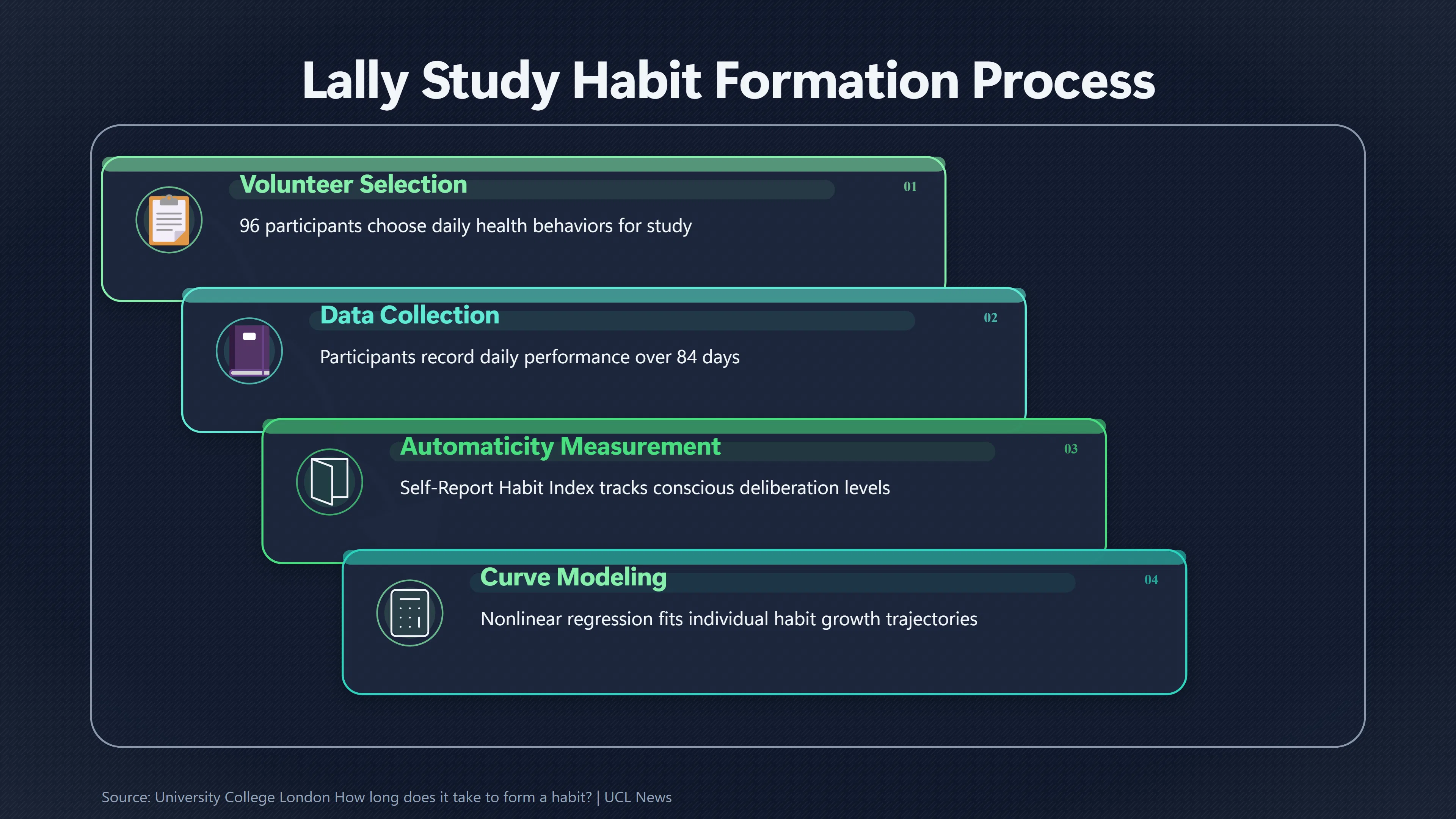
Lally and colleagues recruited 96 volunteers and asked each to choose a new eating, drinking or physical-activity behaviour that they wanted to perform once a day in a consistent situation. An example of such a context was doing the behaviour “after breakfast”. Participants then attempted their chosen behaviour for 12 weeks, or 84 days, recording both whether they had performed it and how automatic it felt.[Wiley Online Library]onlinelibrary.wiley.comWiley Online LibraryHow are habits formed: Modelling habit formation in the real world - Lally - 2010 - European Journal of Social Psycho…
This matters because the researchers were not simply counting consecutive successful days. Their central outcome was automaticity: the extent to which performing the behaviour came to feel less dependent on conscious deliberation or remembering. They calculated this using selected items from the Self-Report Habit Index (SRHI), a questionnaire designed to measure characteristics associated with habitual behaviour.[Wiley Online Library]onlinelibrary.wiley.comWiley Online LibraryHow are habits formed: Modelling habit formation in the real world - Lally - 2010 - European Journal of Social Psycho…
The researchers expected automaticity to follow an asymptotic curve. In plain English, that means repetition produces substantial gains early on, but each additional repetition tends to add less than the previous one. Eventually the curve approaches a personal plateau. There is therefore no obvious scientific moment when a behaviour flips overnight from “not a habit” to “habit”.[Wiley Online Library]onlinelibrary.wiley.comWiley Online LibraryHow are habits formed: Modelling habit formation in the real world - Lally - 2010 - European Journal of Social Psycho…
To put a number on the process, the researchers estimated when each person’s curve reached 95% of its predicted plateau, rather than waiting for some categorical “habit formed” event. Later research using the same approach has explicitly distinguished these two quantities: the time required to approach stable automaticity and the eventual level of automaticity reached. Someone can therefore develop automaticity relatively quickly without necessarily ending up with the same habit strength as somebody else.[BPS PsycHub]bpspsychub.onlinelibrary.wiley.comBPS PsycHubHabit formation following routine‐based versus time‐based cue planning: A randomized controlled trial - Keller - 2021 - Britis…
There is another important detail hidden by the simple “96 people, 66 days” retelling. Of the 96 volunteers, 82 provided sufficient data for analysis. The nonlinear model could be fitted for 62 of those people, and the researchers judged it a good fit for 39. More consistent performance was associated with better model fit. In other words, the famous timing estimate emerged from individual trajectories that behaved sufficiently like the hypothesised learning curve; the study did not observe every one of its 96 participants smoothly becoming habitual after roughly two months.[Wiley Online Library]onlinelibrary.wiley.comWiley Online LibraryHow are habits formed: Modelling habit formation in the real world - Lally - 2010 - European Journal of Social Psycho…
Why 66 days was never a universal deadline
For the well-fitting trajectories, the median estimated time to reach 95% of the automaticity plateau was 66 days. A median is the middle observation in an ordered set, not a prescription for every person. More revealingly, the individual estimates stretched from 18 days at the low end to 254 days at the high end.[PubMed Central (PMC)]pmc.ncbi.nlm.nih.govOpen source on nih.gov.
That spread is the central finding obscured when “median of 66 days” becomes “habits take 66 days”. The slow end was more than fourteen times the fast end. Lally herself has subsequently stressed that the real message of the research was the large variability in how long habit formation took, rather than a universal 66-day rule.[University of Surrey]surrey.ac.ukOpen source on surrey.ac.uk.
There is also a methodological reason to interpret the longest estimates carefully. The experiment lasted only 84 days, yet the fitted curves produced estimates extending as far as 254 days. The researchers were fitting mathematical learning curves to the observed automaticity scores and estimating when those curves would reach 95% of their asymptotes. Consequently, values beyond the 84-day observation period were model-based projections, not three, six or eight months of directly observed daily data. The study’s abstract itself describes the procedure as nonlinear regression fitted to each participant’s scores over the 84 days.[Wiley Online Library]onlinelibrary.wiley.comWiley Online LibraryHow are habits formed: Modelling habit formation in the real world - Lally - 2010 - European Journal of Social Psycho…
This does not make the 254-day result meaningless. It means the correct interpretation is narrower: some participants’ observed trajectories were consistent with habit development taking substantially longer than the study itself lasted. The evidence supports large variation far better than it supports treating either 66 or 254 as a precise personal forecast.
The 66-day figure is also specific to what this experiment studied: self-selected eating, drinking and physical-activity behaviours performed daily in a repeated context. It did not establish the formation time for every behaviour people casually call a habit, from studying and saving money to complex workplace routines. A 2024 systematic review found that even within health behaviours, relatively few studies had directly estimated time to habit formation, reinforcing the need for caution about universal numbers.[PubMed Central (PMC)]pmc.ncbi.nlm.nih.govOpen source on nih.gov.
What the 18-to-254-day range changes
The range changes the practical interpretation from “persist for 66 days” to “expect your own learning curve”. At day 30, one behaviour might already be close to its eventual automaticity while another may still require substantial conscious effort. Neither outcome contradicts the original study.
The study also produced a useful finding about imperfect consistency. Missing one opportunity to perform the target behaviour did not materially disrupt the habit-formation process. That is different from saying consistency does not matter: participants who were very inconsistent were less successful, and more consistent performance was associated with better-fitting habit-growth curves. The evidence therefore distinguishes an occasional lapse from chronic non-performance.[Wiley Online Library]onlinelibrary.wiley.comWiley Online LibraryHow are habits formed: Modelling habit formation in the real world - Lally - 2010 - European Journal of Social Psycho…
That is especially relevant to self-improvement advice built around perfect streaks. Lally’s data do not support the idea that one missed day sends habit formation back to zero. The more defensible goal is repeated performance in a stable context over enough opportunities for the behaviour-context association to strengthen. UCL’s contemporary explanation of the research similarly advised specifying clearly what behaviour will be performed and in what situation, then repeating it consistently until it begins to require less effort.[University College London]ucl.ac.ukUniversity College London How long does it take to form a habit? | UCL NewsUniversity College LondonHow long does it take to form a habit? | UCL News - UCL – University College London…
Later evidence has made the original variability look less like an anomaly. A 2021 study that also modelled individual automaticity trajectories found a median of 59 days among people who successfully formed the targeted nutrition habit, but again found markedly different trajectories, including unsuccessful and discontinuous formation.[DOI]doi.orgHabit formation following routine‐based versus time‐based cue planning: A randomized controlled trial - Keller - 2021 - British Journa… A 2024 systematic review identified only four studies that directly reported formation times; across the relevant studies, individual estimates extended from 4 to 335 days. The review concluded that the duration varies substantially between people and behaviours.[PubMed Central (PMC)]pmc.ncbi.nlm.nih.govOpen source on nih.gov.
Those later findings should not be used to turn 66 into a different universal number. They strengthen the more important point first made visible by Lally’s dataset: between-person and between-behaviour variation is fundamental to the question.
What the study really lets you conclude
The safest reading of the 66-day study is both more modest and more useful than the popular slogan. Repeating a behaviour in a consistent context can make it progressively more automatic, but the process is gradual rather than governed by a fixed calendar threshold. In the best-fitting individual trajectories in Lally and colleagues’ study, reaching 95% of the predicted automaticity plateau took a median of 66 days but ranged from 18 to 254 days.[Wiley Online Library]onlinelibrary.wiley.comWiley Online LibraryHow are habits formed: Modelling habit formation in the real world - Lally - 2010 - European Journal of Social Psycho…
The study therefore supports three conclusions that the “66-day rule” tends to erase: people can progress at very different speeds; automaticity develops along a curve rather than appearing suddenly on a particular day; and an occasional missed opportunity does not automatically destroy the process.[Wiley Online Library]onlinelibrary.wiley.comWiley Online LibraryHow are habits formed: Modelling habit formation in the real world - Lally - 2010 - European Journal of Social Psycho…
For self-improvement that works, the most defensible use of the research is not to circle day 66 on a calendar. It is to judge progress by whether a well-defined behaviour is becoming easier to initiate and more automatic in its intended context, while allowing enough time for a trajectory that may be considerably shorter or longer than the famous midpoint. The enduring finding of the study is not that habits take 66 days. It is that there was no single formation time in the data.

Amazon book picks
Further Reading
Books and field guides related to Does Science Really Say Habits Take 66 Days?. Use these as the next step if you want deeper reading beyond the article.
Good Habits, Bad Habits
'The world's leading expert on habits' - Matthew Syed, bestselling author of Black Box Thinking and Rebel IdeasWhat if you could harness...
Atomic Habits
Rating: 3.5/5 from 7 Google Books ratings
The #1 New York Times bestseller. Over 25 million copies sold! Translated into 60+ languages! Tiny Changes, Remarkable Results No matter...
Tiny Habits
Improving your life is much easier than you think. Whether it’s losing weight, sleeping more, or restoring your work/life balance – the s...

The Power of Habit
Rating: 4.0/5 from 145 Google Books ratings
Duhigg takes us to the edge of scientific discoveries that explain why habits exist and how they can be changed. Distilling information i...
eBay marketplace picks
Marketplace Samples
Live-tested eBay searches with available results related to this page.
Selected frommotivational poster oneBay.co.uk.



Endnotes
1.
Source: onlinelibrary.wiley.com
Link:https://onlinelibrary.wiley.com/doi/10.1002/ejsp.674
Source snippet
Wiley Online LibraryHow are habits formed: Modelling habit formation in the real world - Lally - 2010 - European Journal of Social Psycho...
2.
Source: bpspsychub.onlinelibrary.wiley.com
Link:https://bpspsychub.onlinelibrary.wiley.com/doi/abs/10.1111/bjhp.12504
Source snippet
BPS PsycHubHabit formation following routine‐based versus time‐based cue planning: A randomized controlled trial - Keller - 2021 - Britis...
3.
Source: bpspsychub.onlinelibrary.wiley.com
Link:https://bpspsychub.onlinelibrary.wiley.com/share/SFKV2IDZIZUZFJF4X9N2?target=10.1111%2Fbjhp.12504
4.
Source: onlinelibrary.wiley.com
Link:https://onlinelibrary.wiley.com/doi/abs/10.1002/ejsp.674?aff_id=24772
Source snippet
Wiley Online LibraryHow are habits formed: Modelling habit formation in the real world - Lally - 2010 - European Journal of Social Psycho...
5.
Source: doi.org
Link:https://doi.org/10.1111/bjhp.12504
Source snippet
Habit formation following routine‐based versus time‐based cue planning: A randomized controlled trial - Keller - 2021 - British Journa...
6.
Source: doi.org
Link:https://doi.org/10.3390/healthcare12232488
7.
Source: bpspsychub.onlinelibrary.wiley.com
Link:https://bpspsychub.onlinelibrary.wiley.com/doi/10.1111/bjhp.12637
8.
Source: doi.org
Link:https://doi.org/10.1111/bjhp.12637
9.
Source: doi.org
Link:https://doi.org/10.1080/23311908.2022.2041277?urlappend=%3Futm_source%3Dresearchgate.net%26utm_medium%3Darticle
10.
Source: onlinelibrary.wiley.com
Link:https://onlinelibrary.wiley.com/doi/abs/10.1002/ejsp.674
11.
Source: onlinelibrary.wiley.com
Link:https://onlinelibrary.wiley.com/doi/abs/10.1002/ejsp.674?msockid=038ed114f43667dd0790c4bef5146634
12.
Source: onlinelibrary.wiley.com
Link:https://onlinelibrary.wiley.com/doi/abs/10.1002/ejsp.674?source=content_type%3Areact%7Cfirst_level_url%3Aarticle%7Csection%3Amain_content%7Cbutton%3Abody_link
13.
Source: onlinelibrary.wiley.com
Link:https://onlinelibrary.wiley.com/doi/abs/10.1002/ejsp.674?MixPanelId=15e3fe314440-0468d8411-64220f54-100000-15e3fe314460
14.
Source: onlinelibrary.wiley.com
Link:https://onlinelibrary.wiley.com/doi/abs/10.1002/ejsp.674?cf_chl_jschl_tk=pmd_EwcJDaCFBR9OVEL1O_0qjioww0Gc86ZzpBvCBFhrDcE-1635261061-0-gqNtZGzNAjujcnBszQi9
15.
Source: onlinelibrary.wiley.com
Link:https://onlinelibrary.wiley.com/doi/abs/10.1002/ejsp.674?538fcd4b_page=6&947f74f7_page=5
16.
Source: onlinelibrary.wiley.com
Link:https://onlinelibrary.wiley.com/doi/10.1002/ejsp.674?538fcd4b_page=1&947f74f7page=3&=%2Fen-gt%2Four-commitment%23kI3HdLdDj7HLFW4BJlUYoy23RoHF9sl3JcIXrw%3D%3D
17.
Source: onlinelibrary.wiley.com
Link:https://onlinelibrary.wiley.com/doi/10.1002/ejsp.674?2d235898_page=2&538fcd4b_page=6&d2101103_page=8&d73ad837_page=2
18.
Source: surrey.ac.uk
Link:https://www.surrey.ac.uk/news/does-it-really-take-66-days-form-habit-we-asked-expert-dr-pippa-lally
19.
Source: pmc.ncbi.nlm.nih.gov
Link:https://pmc.ncbi.nlm.nih.gov/articles/PMC11641623/
20.
Source: pubmed.ncbi.nlm.nih.gov
Link:https://pubmed.ncbi.nlm.nih.gov/39685110/
Source snippet
Time to Form a Habit: A Systematic Review and Meta-Analysis of Health Behaviour Habit Formation and Its Determinants - PubMed...
21.
Source: ucl.ac.uk
Title: University College London How long does it take to form a habit? | UCL News
Link:https://www.ucl.ac.uk/news/2009/aug/how-long-does-it-take-form-habit%20
Source snippet
University College LondonHow long does it take to form a habit? | UCL News - UCL – University College London...
22.
Source: pubmed.ncbi.nlm.nih.gov
Link:https://pubmed.ncbi.nlm.nih.gov/39489712/
23.
Source: pmc.ncbi.nlm.nih.gov
Link:https://pmc.ncbi.nlm.nih.gov/articles/PMC12318445/
24.
Source: pmc.ncbi.nlm.nih.gov
Link:https://pmc.ncbi.nlm.nih.gov/articles/PMC7969808/
25.
Source: pmc.ncbi.nlm.nih.gov
Link:https://pmc.ncbi.nlm.nih.gov/articles/PMC7135855/
26.
Source: pmc.ncbi.nlm.nih.gov
Link:https://pmc.ncbi.nlm.nih.gov/articles/PMC7020232/
27.
Source: pmc.ncbi.nlm.nih.gov
Link:https://pmc.ncbi.nlm.nih.gov/articles/PMC4566897/
28.
Source: pmc.ncbi.nlm.nih.gov
Link:https://pmc.ncbi.nlm.nih.gov/articles/PMC3439603/
29.
Source: pmc.ncbi.nlm.nih.gov
Link:https://pmc.ncbi.nlm.nih.gov/articles/PMC6033090/
30.
Source: researchgate.net
Link:https://www.researchgate.net/profile/Phillippa-Lally-2
31.
Source: surrey.ac.uk
Link:https://www.surrey.ac.uk/people/phillippa-lally
Additional References
32.
Source: youtube.com
Title: The 2 Biggest Misconceptions About Building Habits
Link:https://www.youtube.com/watch?v=WxDStOiWUDc
Source snippet
For direct insight into the study's findings on automaticity curves and formation timelines, watch this interview on Making and Breaking...
33.
Source: youtube.com
Title: Making and Breaking Habits | Dr. Pippa Lally
Link:https://www.youtube.com/watch?v=w6bDPS3IrM8
Source snippet
How Long Does It Take to Build a Habit? HINT: It's NOT 21 Days...
34.
Source: researchgate.net
Link:https://www.researchgate.net/publication/349767578_A_Systematic_Review_Examining_the_Relationship_Between_Habit_and_Physical_Activity_Behavior_in_Longitudinal_Studies
35.
Source: researchgate.net
Link:https://www.researchgate.net/publication/348328187_Habit_formation_following_routine-based_versus_time-based_cue_planning_A_randomized_controlled_trial
36.
Source: researchgate.net
Link:https://www.researchgate.net/publication/250924756_What_Predicts_Intention-Behavior_Discordance_A_Review_of_the_Action_Control_Framework
37.
Source: tandfonline.com
Link:https://www.tandfonline.com/doi/abs/10.1080/08870446.2024.2422828
38.
Source: frontiersin.org
Link:https://www.frontiersin.org/journals/psychology/articles/10.3389/fpsyg.2021.626750/full
39.
Source: frontiersin.org
Link:https://www.frontiersin.org/journals/psychology/articles/10.3389/fpsyg.2020.00560/full
40.
Source: 26pushups.com
Link:https://www.26pushups.com/tools/habit-formation
41.
Source: scribd.com
Link:https://www.scribd.com/document/955119400/Keller-Et-Al-2021-Habit-Formation-Following-Routine-Based-Versus-Time-Based-Cue-Planning-A