Within Work Prep
What Should Tomorrow's First Action Look Like?
A concrete restart note can turn an unfinished project into an action you can begin without reconstructing yesterday's thinking.
On this page
- Turning broad tasks into visible actions
- Examples for writing, analysis, coding and administration
- How much detail a restart note actually needs
Page outline Jump by section
Introduction
A useful end-of-day restart note should make tomorrow’s first move executable, not merely remind you that a project exists. “Continue report” preserves the project name; “Open the survey workbook, filter to July respondents, and check whether the age totals match Table 3” preserves an action. The second version matters because it reduces the amount of project reconstruction required before useful work can resume.
Several strands of research support this approach, although there is not a large research literature testing “restart notes” as a named productivity technique. Experiments on interrupted work show that preparing for resumption and preserving useful contextual cues can shorten the disruption caused by a break. Research on implementation intentions finds that specifying what action will happen in response to a future cue improves goal initiation. Studies of external reminders likewise show that remembering improves when an intention is stored in the environment rather than left entirely to memory.[sciencedirect.com]sciencedirect.comPreparing to resume an interrupted task: effects of prospective goal encoding and retrospective rehearsal - ScienceDirect…
The practical policy is therefore simple: before stopping unfinished work, leave one visible instruction describing the first physical or digital action you expect to perform when you return.
Turning broad tasks into visible actions
The crucial distinction is between a project description and a restart instruction. “Finish budget”, “work on presentation” and “deal with supplier problem” describe desired outcomes. They still force tomorrow’s worker to determine where to begin. A restart instruction moves that decision to today, while the project’s state is still readily available in memory.
Research on implementation intentions provides the clearest general model. Peter Gollwitzer and Paschal Sheeran’s meta-analysis examined 94 independent tests of plans that connect a specified future situation with a specified response — essentially deciding in advance, “when this happens, I will do that”. Across the studies, implementation intentions had a medium-to-large overall effect on goal attainment and specifically helped with initiating goal-directed behaviour.[ScienceDirect]sciencedirect.comImplementation Intentions and Goal Achievement: A Meta‐analysis of Effects and Processes - ScienceDirect…
A restart note need not be a formal if–then statement, but it can exploit the same principle. Compare:
Tomorrow: work on quarterly analysis.
with:
When I reopen this workbook: check the three missing March values against the raw export.
The latter has already settled the first behavioural choice. It identifies both the cue — reopening the workbook — and the response. Importantly, this does not mean planning tomorrow’s entire session. The intervention is deliberately smaller: decide the first action while the information needed to make that decision is still fresh.
Interruption research makes this especially relevant to unfinished knowledge work. In an experiment by J. Gregory Trafton and colleagues, participants who received a short warning before an interruption used that interval to prepare and subsequently resumed the suspended task more quickly than participants interrupted immediately. The researchers distinguished between remembering the state of the task and encoding what should be done when work resumed.[ScienceDirect]sciencedirect.comPreparing to resume an interrupted task: effects of prospective goal encoding and retrospective rehearsal - ScienceDirect…
Helen Hodgetts and Dylan Jones found a related effect: preparation before interruption reduced resumption costs, while contextual cues helped people retrieve suspended goals. Altering those cues after the interruption made recovery harder.[PubMed]pubmed.ncbi.nlm.nih.govContextual cues aid recovery from interruption: the role of associative activation - PubMed… These were laboratory tasks rather than overnight office projects, so the findings should not be treated as a direct trial of end-of-day notes. They do, however, support the underlying design principle: preserve the information tomorrow will need to recover the suspended goal.
What should tomorrow’s first action look like?
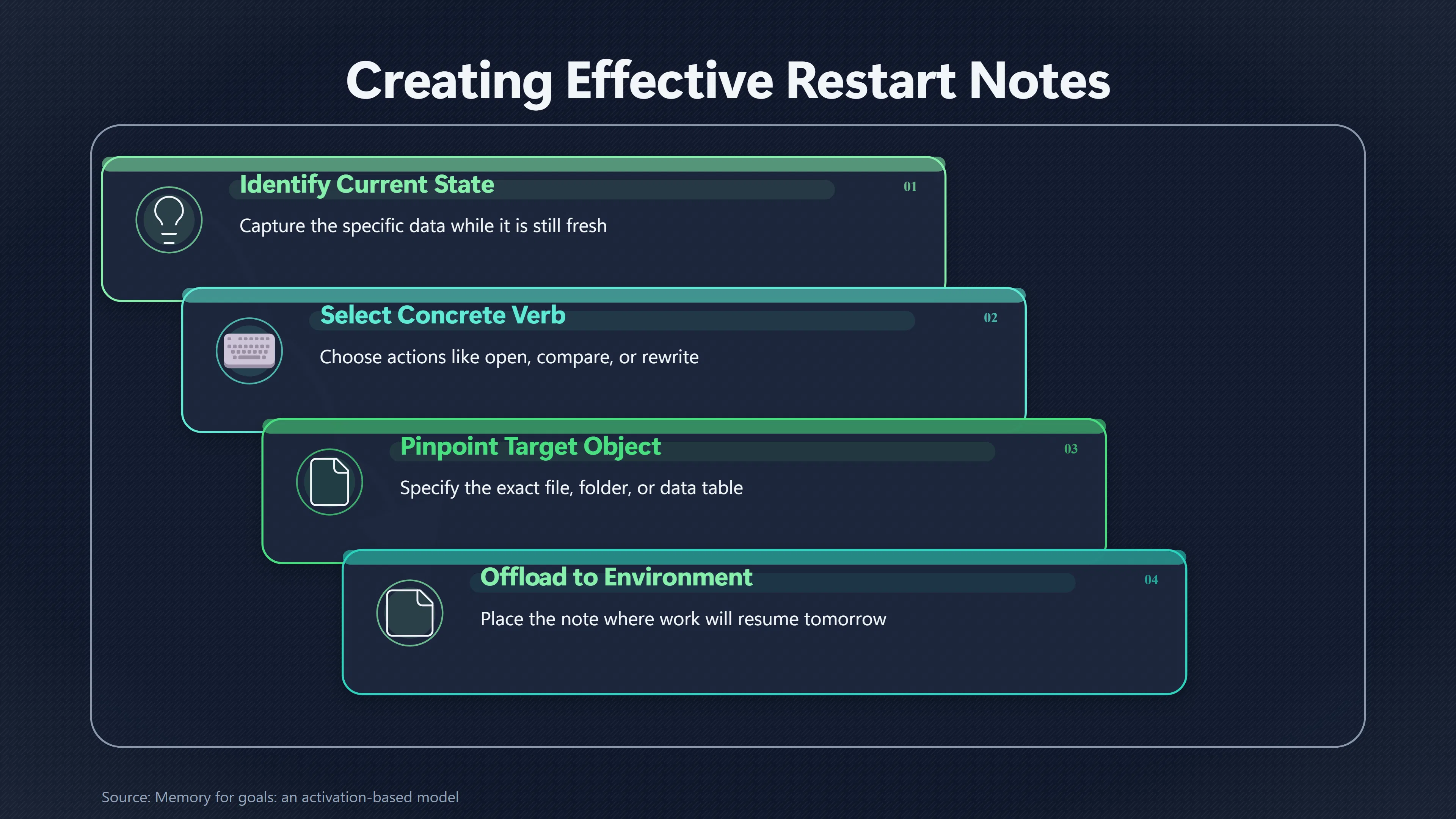
A strong next action has three characteristics: it is observable, it points to the relevant object or location, and it is small enough to start without another round of planning. “Think about the problem” usually fails this test because the worker must still decide what thinking consists of. “List the three explanations that could account for the discrepancy” passes it.
The action should normally begin with a concrete verb: open, compare, rewrite, test, call, check, extract, insert, send, reconcile or review. The point is not linguistic neatness. A concrete verb forces the note writer to decide what tomorrow’s behaviour actually is.
There is useful evidence that the content of reminders matters. In experiments on prospective memory — remembering to perform an intended future action — researchers compared reminders containing different information. Reminders that specified both the target cue and the associated action improved prospective-memory performance, whereas target-only or action-only reminders did not produce the same benefit in one experiment. The benefits of reminders were also greater under heavier memory loads.[PubMed]pubmed.ncbi.nlm.nih.govBenefits from prospective memory offloading depend on memory load and reminder type - PubMedOctober 6, 2022…
That finding maps neatly onto restart notes. “Table 3” identifies a target but not what to do with it. “Check totals” identifies an action but not where. “Table 3: check its totals against the July export” carries both pieces.
A practical test is to imagine encountering the note tomorrow after having forgotten most of today’s working context. Could you obey it immediately? If the answer is “I would first need to work out what I meant”, the note is not finished.
Examples across everyday knowledge work
The right level of specificity depends on the work, but the underlying transformation is consistent: replace a broad intention with the first manipulable object and action.
- Writing: Instead of “continue methods section”, leave “Rewrite the sampling paragraph using the three figures highlighted in Smith; then add the citation.”
- Analysis: Instead of “investigate conversion decline”, leave “Filter the weekly conversion table to mobile traffic and compare weeks 27–30 with the same weeks last year.”
- Coding: Instead of “fix login bug”, leave “Run the failing
expired_tokentest, inspect the refresh-token branch, and confirm whether the exception occurs before the retry.” - Administration: Instead of “sort invoices”, leave “Open the August invoice folder and match the five unassigned payments against the bank export.”
- Presentation work: Instead of “finish slides”, leave “Replace the placeholder chart on slide 8 with the regional revenue chart and check that its date range ends in July.”
- Research: Instead of “read papers on retention”, leave “Read the results section of the saved retention paper and record its sample size, outcome measure and effect estimate in the evidence table.”
These instructions are intentionally modest. They do not attempt to specify every subsequent action. Once work is moving, the next decision can often be made with the project open and its context restored. The restart note is aimed at the unusually fragile transition between not working on the project and working on it again.
That distinction also prevents a restart note from turning into elaborate daily planning. Research on workplace planning suggests that planning can support daily performance, but its effects depend on the work environment and interruptions. A two-week experience-sampling study, for example, distinguished ordinary time-management planning from contingent planning for anticipated interruptions and found different relationships with engagement and performance.[PubMed]pubmed.ncbi.nlm.nih.govWhen daily planning improves employee performance: The importance of planning type, engagement, and interruptions - PubMedNovember… The narrower restart-note practice does not require predicting tomorrow’s whole day; it merely pre-decides the opening move.

Make the instruction visible where work resumes
Writing a good action is only half the intervention. It should appear where it can actually trigger behaviour.
Prospective-memory researchers call the use of external reminders intention offloading: instead of depending entirely on internal memory, people put information into the environment. Sam Gilbert’s experiments involving 1,196 participants found that setting external reminders improved performance. People also used reminders more when memory demands were greater or interruptions were expected.[Sage Journals]journals.sagepub.comSage JournalsStrategic offloading of delayed intentions into the external environment - Sam J. Gilbert, 2015May 1, 2015… A later review concluded that intention offloading is highly effective and that decisions about using reminders are strongly influenced by people’s judgements about their own memory.[PubMed Central (PMC)]pmc.ncbi.nlm.nih.govPubMed Central (PMC)Outsourcing Memory to External Tools: A Review of ‘Intention Offloading’ - PMC…
For work, visibility can be extremely literal. Put the instruction at the top of the draft, in a comment beside the unfinished code, on a sticky note attached to the relevant papers, in the task that will be opened first, or in a text file sitting beside the dataset. The best location is usually inside or immediately beside the object on which the action will be performed.
That matters because a generic reminder such as “remember project X” may successfully remind you that something requires attention while still failing to restore what you intended to do. Experimental work on reminders reinforces this distinction: reminders carrying both the relevant cue and intended response can outperform incomplete reminders.[PubMed]pubmed.ncbi.nlm.nih.govBenefits from prospective memory offloading depend on memory load and reminder type - PubMedOctober 6, 2022…
Visibility should therefore be judged functionally, not aesthetically. A beautifully organised note buried three folders deep is a poor cue. An inelegant comment at the exact point where tomorrow’s work begins may be much better.
How much detail does a restart note actually need?
The ideal note is not the shortest possible note. It is the shortest note that prevents reconstruction.
For straightforward work, one sentence may be enough:
Next: compare the revised forecast with the finance version and investigate any difference above £5,000.
For a cognitively dense task, preserving one or two pieces of state may be worthwhile:
Next: test whether excluding the two late responses removes the significance. Current model is column H; do not use column G because it still contains the old weighting.
The second sentence is useful because it records information that would otherwise have to be rediscovered. But a miniature project diary would go too far. If the note contains the whole history of the problem, several alternative plans and a long explanation of why each matters, tomorrow begins with reading rather than doing.
A good rule is to record only information needed to cross the restart boundary:
- Where: the file, section, record, function, person or physical material involved.
- What: the first observable action.
- Critical state, if necessary: one fact that prevents a likely mistake or repeated investigation.
Research on memory for interrupted goals helps explain this economy. Models of task resumption emphasise that suspended goals compete with other information and that contextual cues can assist retrieval. Longer or more cognitively demanding interruptions have also been associated experimentally with longer resumption times.[DOI]doi.orgMemory for goals: an activation‐based modelMemory for goals: an activation‐based model - Altmann - 2002 - Cognitive Science - Wiley Online LibraryJanuary 1, 2002… Overnight, the intervening “interruption” includes everything from commuting and dinner to sleep and the next morning’s messages. Expecting tomorrow’s mind to preserve every detail unaided is an unnecessary gamble when a few words can carry the crucial state forward.
Stop while the next move is still obvious
The best time to create the note is immediately before leaving the work, not later in the evening. At that moment, you still know why a number looks suspicious, which paragraph is weak, which test failed and what you intended to try next. That transient knowledge is exactly what tomorrow may otherwise have to reconstruct.
Laboratory interruption studies provide a useful analogue. Giving people a brief opportunity to prepare before switching away from a task improved subsequent resumption, and experiments on contextual cues likewise found benefits from encoding useful retrieval information before the break.[ScienceDirect]sciencedirect.comPreparing to resume an interrupted task: effects of prospective goal encoding and retrospective rehearsal - ScienceDirect… The implication is not that every workday should end with a formal shutdown ritual. It is that the few seconds before disengagement are unusually valuable for preserving the project’s next state.
There may also be an after-hours benefit to making the plan concrete. E. J. Masicampo and Roy Baumeister found across several studies that unfinished goals could produce intrusive thoughts and interfere with unrelated activity, while forming specific plans for those goals eliminated the observed cognitive interference effects. Their experiments do not establish that a one-line restart note will reliably stop work-related rumination, but they do suggest that an unfinished goal and an unfinished goal with a credible plan are psychologically different states.[PubMed]pubmed.ncbi.nlm.nih.govOpen source on nih.gov.
The useful stopping question is therefore not “What do I need to remember about this project?” It is narrower: “If I returned with only this note, what instruction would let me make the first correct move?”
Write that instruction, put it where the work will resume, and stop. Tomorrow can begin with execution rather than reconstruction.
Amazon book picks
Further Reading
Books and field guides related to What Should Tomorrow's First Action Look Like?. Use these as the next step if you want deeper reading beyond the article.
Getting Things Done
The personal productivity guru (Fast Company) delivers powerful methods that vastly increase your efficiency and creative results-at work...
Atomic Habits
Rating: 3.5/5 from 7 Google Books ratings
The #1 New York Times bestseller. Over 25 million copies sold! Translated into 60+ languages! Tiny Changes, Remarkable Results No matter...
The Checklist Manifesto
THE GAME-CHANGING BOOK FROM THE BESTSELLING AUTHOR OF BEING MORTAL Today we find ourselves in possession of stupendous know-how, which we...
Deep Work
Trade paperback. Professor and popular blogger Cal Newport reveals the new key to achieving success and true meaning in professional life...
eBay marketplace picks
Marketplace Samples
Live-tested eBay searches with available results related to this page.
Selected fromoffice desk organizer oneBay.co.uk.


Endnotes
1.
Source: sciencedirect.com
Link:https://www.sciencedirect.com/science/article/pii/S1071581903000235
Source snippet
Preparing to resume an interrupted task: effects of prospective goal encoding and retrospective rehearsal - ScienceDirect...
2.
Source: sciencedirect.com
Link:https://www.sciencedirect.com/science/chapter/bookseries/abs/pii/S0065260106380021
Source snippet
Implementation Intentions and Goal Achievement: A Meta‐analysis of Effects and Processes - ScienceDirect...
3.
Source: doi.org
Title: Memory for goals: an activation‐based model
Link:https://doi.org/10.1207/s15516709cog2601_2
Source snippet
Memory for goals: an activation‐based model - Altmann - 2002 - Cognitive Science - Wiley Online LibraryJanuary 1, 2002...
Published: January 1, 2002
4.
Source: doi.org
Link:https://doi.org/10.3758/s13423-022-02139-4
5.
Source: sciencedirect.com
Link:https://www.sciencedirect.com/science/article/pii/S0885201417302241
6.
Source: sciencedirect.com
Link:https://www.sciencedirect.com/science/article/abs/pii/S1053810015000070
7.
Source: sciencedirect.com
Link:https://www.sciencedirect.com/science/article/pii/S1053811914008453
8.
Source: sciencedirect.com
Link:https://www.sciencedirect.com/science/article/pii/S0001691812001461
9.
Source: sciencedirect.com
Title: Unfulfilled goals interfere with tasks that require executive functions
Link:https://www.sciencedirect.com/science/article/pii/S0022103110002283
10.
Source: sciencedirect.com
Title: Memory for goals: an activation-based model
Link:https://www.sciencedirect.com/science/article/pii/S0364021301000581
11.
Source: sciencedirect.com
Link:https://www.sciencedirect.com/science/article/abs/pii/S0065260106380021
12.
Source: sciencedirect.com
Link:https://www.sciencedirect.com/science/article/pii/S0028393217300544
13.
Source: sciencedirect.com
Title: Unfulfilled goals interfere with tasks that require executive functions
Link:https://www.sciencedirect.com/science/article/abs/pii/S0022103110002283
14.
Source: sciencedirect.com
Link:https://www.sciencedirect.com/science/article/abs/pii/S002210310600028X
15.
Source: sciencedirect.com
Title: Interfered by unaccomplished academic tasks: The role of success expectations
Link:https://www.sciencedirect.com/science/article/abs/pii/S0023969021000576
16.
Source: sciencedirect.com
Link:https://www.sciencedirect.com/science/article/pii/S1071581915000221
17.
Source: sciencedirect.com
Link:https://www.sciencedirect.com/science/article/pii/S0028393206003897
18.
Source: sciencedirect.com
Link:https://www.sciencedirect.com/science/article/abs/pii/S1071581903000235
19.
Source: doi.org
Link:https://doi.org/10.1007/978
20.
Source: pubmed.ncbi.nlm.nih.gov
Link:https://pubmed.ncbi.nlm.nih.gov/16938050/
Source snippet
Contextual cues aid recovery from interruption: the role of associative activation - PubMed...
21.
Source: pmc.ncbi.nlm.nih.gov
Link:https://pmc.ncbi.nlm.nih.gov/articles/PMC9971128/
Source snippet
PubMed Central (PMC)Outsourcing Memory to External Tools: A Review of ‘Intention Offloading’ - PMC...
22.
Source: pubmed.ncbi.nlm.nih.gov
Link:https://pubmed.ncbi.nlm.nih.gov/36201804/
Source snippet
Benefits from prospective memory offloading depend on memory load and reminder type - PubMedOctober 6, 2022...
Published: October 6, 2022
23.
Source: pubmed.ncbi.nlm.nih.gov
Link:https://pubmed.ncbi.nlm.nih.gov/29154579/
Source snippet
When daily planning improves employee performance: The importance of planning type, engagement, and interruptions - PubMedNovember...
24.
Source: journals.sagepub.com
Link:https://journals.sagepub.com/doi/10.1080/17470218.2014.972963
Source snippet
Sage JournalsStrategic offloading of delayed intentions into the external environment - Sam J. Gilbert, 2015May 1, 2015...
Published: May 1, 2015
25.
Source: pubmed.ncbi.nlm.nih.gov
Title: Pub Med Strategic offloading of delayed intentions into the external environment
Link:https://pubmed.ncbi.nlm.nih.gov/25404057/
Source snippet
Strategic offloading of delayed intentions into the external environment - PubMed...
26.
Source: pubmed.ncbi.nlm.nih.gov
Link:https://pubmed.ncbi.nlm.nih.gov/19102614/
27.
Source: pubmed.ncbi.nlm.nih.gov
Link:https://pubmed.ncbi.nlm.nih.gov/21688924/
28.
Source: pmc.ncbi.nlm.nih.gov
Link:https://pmc.ncbi.nlm.nih.gov/articles/PMC13296345/
29.
Source: pmc.ncbi.nlm.nih.gov
Link:https://pmc.ncbi.nlm.nih.gov/articles/PMC13092134/
30.
Source: pmc.ncbi.nlm.nih.gov
Link:https://pmc.ncbi.nlm.nih.gov/articles/PMC13195971/
31.
Source: pmc.ncbi.nlm.nih.gov
Link:https://pmc.ncbi.nlm.nih.gov/articles/PMC12750492/
32.
Source: pmc.ncbi.nlm.nih.gov
Link:https://pmc.ncbi.nlm.nih.gov/articles/PMC12466827/
33.
Source: pmc.ncbi.nlm.nih.gov
Link:https://pmc.ncbi.nlm.nih.gov/articles/PMC12305806/
34.
Source: pmc.ncbi.nlm.nih.gov
Link:https://pmc.ncbi.nlm.nih.gov/articles/11781985/
35.
Source: pmc.ncbi.nlm.nih.gov
Link:https://pmc.ncbi.nlm.nih.gov/articles/PMC11103908/
36.
Source: pubmed.ncbi.nlm.nih.gov
Link:https://pubmed.ncbi.nlm.nih.gov/37642279/
37.
Source: pmc.ncbi.nlm.nih.gov
Link:https://pmc.ncbi.nlm.nih.gov/articles/PMC10896823/
38.
Source: pubmed.ncbi.nlm.nih.gov
Link:https://pubmed.ncbi.nlm.nih.gov/37289516/
39.
Source: pubmed.ncbi.nlm.nih.gov
Link:https://pubmed.ncbi.nlm.nih.gov/38515981/
40.
Source: pmc.ncbi.nlm.nih.gov
Link:https://pmc.ncbi.nlm.nih.gov/articles/PMC10952538/
41.
Source: pubmed.ncbi.nlm.nih.gov
Link:https://pubmed.ncbi.nlm.nih.gov/36201839/
42.
Source: pmc.ncbi.nlm.nih.gov
Link:https://pmc.ncbi.nlm.nih.gov/articles/PMC10087331/
43.
Source: pmc.ncbi.nlm.nih.gov
Link:https://pmc.ncbi.nlm.nih.gov/articles/PMC10305802/
44.
Source: pmc.ncbi.nlm.nih.gov
Link:https://pmc.ncbi.nlm.nih.gov/articles/PMC8247645/
45.
Source: pmc.ncbi.nlm.nih.gov
Link:https://pmc.ncbi.nlm.nih.gov/articles/PMC8149892/
46.
Source: pubmed.ncbi.nlm.nih.gov
Link:https://pubmed.ncbi.nlm.nih.gov/33428644/
47.
Source: pmc.ncbi.nlm.nih.gov
Link:https://pmc.ncbi.nlm.nih.gov/articles/PMC7799745/
48.
Source: pmc.ncbi.nlm.nih.gov
Link:https://pmc.ncbi.nlm.nih.gov/articles/PMC7946166/
49.
Source: pmc.ncbi.nlm.nih.gov
Link:https://pmc.ncbi.nlm.nih.gov/articles/PMC7732645/
50.
Source: pubmed.ncbi.nlm.nih.gov
Link:https://pubmed.ncbi.nlm.nih.gov/32400318/
51.
Source: pubmed.ncbi.nlm.nih.gov
Link:https://pubmed.ncbi.nlm.nih.gov/31448938/
52.
Source: pmc.ncbi.nlm.nih.gov
Link:https://pmc.ncbi.nlm.nih.gov/articles/PMC6370699/
53.
Source: pmc.ncbi.nlm.nih.gov
Link:https://pmc.ncbi.nlm.nih.gov/articles/PMC5340749/
54.
Source: pmc.ncbi.nlm.nih.gov
Link:https://pmc.ncbi.nlm.nih.gov/articles/PMC5123225/
55.
Source: pmc.ncbi.nlm.nih.gov
Link:https://pmc.ncbi.nlm.nih.gov/articles/PMC4500900/
56.
Source: journals.sagepub.com
Link:https://journals.sagepub.com/doi/abs/10.1080/17470218.2014.972963
57.
Source: pubmed.ncbi.nlm.nih.gov
Link:https://pubmed.ncbi.nlm.nih.gov/25451474/
58.
Source: pmc.ncbi.nlm.nih.gov
Link:https://pmc.ncbi.nlm.nih.gov/articles/PMC4448673/
59.
Source: pubmed.ncbi.nlm.nih.gov
Link:https://pubmed.ncbi.nlm.nih.gov/23261418/
60.
Source: pubmed.ncbi.nlm.nih.gov
Link:https://pubmed.ncbi.nlm.nih.gov/22489707/
61.
Source: onlinelibrary.wiley.com
Title: s15516709cog2601 2
Link:https://onlinelibrary.wiley.com/doi/10.1207/s15516709cog2601_2
62.
Source: onlinelibrary.wiley.com
Title: s15516709cog2601 2
Link:https://onlinelibrary.wiley.com/doi/abs/10.1207/s15516709cog2601_2
63.
Source: bishtref.com
Title: s15516709cog2601 2
Link:https://bishtref.com/articles/10.1207/s15516709cog2601_2
64.
Source: pubmed.ncbi.nlm.nih.gov
Link:https://pubmed.ncbi.nlm.nih.gov/25666463/
65.
Source: pubmed.ncbi.nlm.nih.gov
Link:https://pubmed.ncbi.nlm.nih.gov/7796305/
66.
Source: pubmed.ncbi.nlm.nih.gov
Link:https://pubmed.ncbi.nlm.nih.gov/9584436/
67.
Source: pmc.ncbi.nlm.nih.gov
Link:https://pmc.ncbi.nlm.nih.gov/articles/PMC11246708/
68.
Source: journals.sagepub.com
Link:https://journals.sagepub.com/doi/10.1177/154193120304700810
Additional References
69.
Source: youtube.com
Title: Tired of Taking Work Home? You Need this Routine
Link:https://www.youtube.com/watch?v=BPnoJQ_dG7Y
Source snippet
In Procrastinating on Important Work | 10 Tips to Get You Started, the presenter details concrete strategies to eliminate startup frictio...
70.
Source: youtube.com
Title: Procrastinating on Important Work | 10 Tips to Get You Started
Link:https://www.youtube.com/watch?v=OMpcCu5v_fs
Source snippet
The 'If-Then' Trick: How To Start Working When You Have Zero Energy...
71.
Source: youtube.com
Title: The ‘If-Then’ Trick: How To Start Working When You Have Zero Energy
Link:https://www.youtube.com/watch?v=6jk2AQ-SxOA
Source snippet
ClickUp Shutdown Routine: Close Your Day in 10 Minutes...
72.
Source: youtube.com
Title: Click Up Shutdown Routine: Close Your Day in 10 Minutes
Link:https://www.youtube.com/watch?v=JaEAm8u4XF4
Source snippet
You WANT IT SO BAD, but do NOTHING: how to break the cycle...
73.
Source: youtube.com
Title: You WANT IT SO BAD, but do NOTHING: how to break the cycle
Link:https://www.youtube.com/watch?v=9iP2iRx274w
Source snippet
Tired of Taking Work Home? You Need this Routine...
74.
Source: researchgate.net
Link:https://www.researchgate.net/publication/271801402_Everyday_Planning_An_Analysis_of_Daily_Time_Management
75.
Source: researchgate.net
Link:https://www.researchgate.net/publication/37367696_Implementation_Intentions_and_Goal_Achievement_A_Meta-Analysis_of_Effects_and_Processes
76.
Source: researchgate.net
Link:https://www.researchgate.net/publication/51234294_Consider_It_Done_Plan_Making_Can_Eliminate_the_Cognitive_Effects_of_Unfulfilled_Goals
77.
Source: guilfordjournals.com
Link:https://guilfordjournals.com/doi/10.1521/soco.2012.30.1.37
78.
Source: apa.org
Link:https://www.apa.org/gradpsych/2013/09/matters