Within Precommitment
Do Self Imposed Deadlines Really Stop Procrastination?
Deadlines are more credible commitment devices when they create an external consequence, while recent replication evidence weakens claims about arbitrary
On this page
- Why deadlines can function as precommitment
- What changed after the 2026 replication
- Turning vague intentions into real delivery points
Page outline Jump by section
Introduction
A deadline can be a precommitment, but simply putting a date in your diary is not necessarily one. The distinction is whether missing the date changes anything. A deadline tied to a client, submission system, appointment, financial loss or other consequence changes the future choice; an arbitrary private target can often be moved the moment it becomes inconvenient.
That distinction matters because a famous 2002 study is often treated as evidence that self-imposed dates beat procrastination. In fact, its self-imposed deadlines were binding and costly to miss. More importantly, a preregistered replication published in Psychological Science in July 2026 failed to reproduce the study’s central result: different deadline arrangements had negligible effects on the measured outcomes.[upenn.edu]faculty.wharton.upenn.eduAriely Wertenbroch 2002Wharton Faculty Platform1333…
The useful lesson is therefore narrower than “set yourself deadlines”. A credible delivery point can still remove room for repeated postponement, but current evidence gives much less reason to believe that inventing intermediate dates — even neatly spaced ones — is a reliable anti-procrastination technique by itself.
Why deadlines can function as precommitment
A genuine deadline changes what happens after a particular date. Before the deadline arrives, waiting remains possible; afterwards, waiting carries a cost. That cost need not be money. A missed university submission may lose marks, a late client deliverable may damage a relationship, and failing to send something before a scheduled meeting may mean arriving without the promised work. The common feature is that the consequence cannot simply be wished away when motivation falls.
This is what made the classic experiments by Dan Ariely and Klaus Wertenbroch more interesting than ordinary goal-setting. In their first field study, 99 professionals taking an MIT executive-education course had three papers to complete. One section received evenly spaced deadlines. The other could choose its own dates — but had to declare them near the beginning of the course, could not subsequently change them, and lost 1 per cent of a paper’s grade for every day it was late. Students nevertheless selected dates substantially earlier than the last possible submission date.[Wharton Faculty Platform]faculty.wharton.upenn.eduAriely Wertenbroch 2002Wharton Faculty Platform1333…
That behaviour was evidence of demand for commitment: people were voluntarily surrendering flexibility and accepting a potential penalty. It was not evidence about writing “finish report: Friday” in a private calendar and retaining complete freedom to change Friday to Monday.
The original paper’s second experiment made the same point still more clearly. Sixty participants proofread three roughly ten-page texts over three weeks. They earned money for finding errors but lost $1 for each day a task was submitted after its deadline. Participants were randomly assigned to an end deadline, externally imposed weekly deadlines, or deadlines they chose themselves. Again, the self-chosen dates were not imaginary milestones: once selected, lateness cost money.[Wharton Faculty Platform]faculty.wharton.upenn.eduAriely Wertenbroch 2002Wharton Faculty Platform1333…
In the 2002 results, performance followed an appealing pattern. Participants with externally imposed, evenly spaced deadlines found the most errors, incurred the least delay and earned the most; self-imposed deadlines came next; leaving everything until the final deadline performed worst. The authors concluded that people recognised their tendency to procrastinate and could partially control it by precommitting, but did not choose their deadlines optimally.[Association for Psychological Science]psychologicalscience.orgAssociation for Psychological ScienceProcrastination, Deadlines, and Performance: Self-Control by Precommitment - Psychological Science…
For years, that finding supplied an unusually tidy prescription: divide a long project into smaller pieces and give each one an advance deadline. The evidence accumulated since then makes that prescription considerably less tidy.
What changed after the 2026 replication
The most direct challenge arrived in 2026. Kyle Hyndman and Alberto Bisin replicated the proofreading experiment underlying Study 2 of Ariely and Wertenbroch. Their design again compared three conditions: no intermediate deadlines, externally imposed evenly spaced deadlines, and self-imposed deadlines. The preregistration specified the original study’s central outcome measures — errors detected, days late and overall payment — and planned 40 participants per treatment, with random assignment at the individual level.[ASPREDICTED]aspredicted.orgq6vf 824taspredicted.org…
The result did not reproduce the original deadline advantage. Hyndman and Bisin reported that changing the deadline regime had a negligible effect on the three performance measures and on several survey measures. In particular, externally imposed, evenly spaced deadlines no longer stood out as an effective way of reducing procrastination. The replication was published online by Psychological Science on 15 July 2026.[Association for Psychological Science]psychologicalscience.orgAssociation for Psychological ScienceReplication of “Procrastination, Deadlines, and Performance: Self-Control by Precommitment” - Psycho…
That is an important correction because it targets the experiment most directly associated with the idea that carefully spaced deadlines improve performance. It does not prove that deadlines never work, nor does one failed replication erase every observation in the original research. But the specific causal claim is now much less secure. The sensible reading in 2026 is that evenly spaced deadlines should not be treated as a generally established solution to procrastination.
Nor did this doubt appear from nowhere. Hyndman and Bisin had already conducted a separate field experiment, published in 2020, in which students showed substantial demand for self-imposed deadlines but those deadlines did not increase completion rates. Depending on the treatment, sizeable minorities or majorities voluntarily chose deadlines — yet wanting commitment and benefiting from it were clearly different things.[ScienceDirect]sciencedirect.comScienceDirect Present-bias, procrastination and deadlines in a field experimentPresent-bias, procrastination and deadlines in a field experiment - ScienceDirectJanuary 1, 2020…
That study also exposed a potential downside. Deadlines can encourage people to begin close to the cut-off, leaving little room to recover when a task proves harder than expected. The authors identified three competing effects: a deadline may create useful commitment, but it also removes the option of waiting for a better moment and can magnify mistakes caused by overconfidence or failure to persevere after an unsuccessful attempt.[ScienceDirect]sciencedirect.comScienceDirect Present-bias, procrastination and deadlines in a field experimentPresent-bias, procrastination and deadlines in a field experiment - ScienceDirectJanuary 1, 2020…
Other field evidence is similarly mixed. Burger, Charness and Lynham found in a 2011 experiment that evenly spaced interim deadlines actually reduced completion of a lengthy task.[UCSB Economics Faculty]faculty.econ.ucsb.eduUCSB Economics FacultyJournal of Economic Behavior & Organization 77 (2011) 393–404November 8, 2025… A much larger study involving vocational colleges in Israel introduced deadlines for students’ final projects, with missing the date producing delay and uncertainty over rescheduling. It found no effect on either project defence or graduation rates.[ScienceDirect]sciencedirect.comDo Deadlines Affect Project Completion? Experimental Evidence from Israeli Vocational Colleges - ScienceDirect…
So the historical comparison has shifted:
ClaimEarlier readingBetter reading after the 2026 replicationPeople voluntarily seek deadlinesSupported in several studiesStill reasonably supportedSelf-imposed deadlines reliably improve completionSuggested by influential early evidenceMixed evidence; not a dependable general ruleEvenly spaced external deadlines outperform other schedulesStrong result in the 2002 proofreading experimentDirect 2026 replication did not reproduce itA private target date is itself a commitment deviceEasy popular inferenceNot established by the classic experimentA deadline with consequences can alter future incentivesBuilt into the experimental designsMechanistically plausible, but effectiveness remains context-dependent
The distinction between the first two rows is especially useful for self-improvement. People can correctly recognise that they procrastinate while being poor designers of the mechanism intended to stop it. Demand for a commitment device is not evidence that the chosen device works.
Real deadlines versus dates you can renegotiate
The practical dividing line is therefore not simply “external deadline good, self-imposed deadline bad”. Ariely and Wertenbroch’s participants created their own dates, yet those dates became real because they were declared to somebody else, fixed in advance and costly to miss. Conversely, an externally announced deadline may accomplish little if missing it has few consequences: the Israeli vocational-college experiment is a useful reminder that externality alone is not enough.[Wharton Faculty Platform]faculty.wharton.upenn.eduAriely Wertenbroch 2002Wharton Faculty Platform1333…
A more useful question is: what changes if the date passes?
Consider two versions of the same intention. “I will finish my portfolio by 30 September” is principally a forecast or goal while 1 October leaves all options unchanged. “I have booked a portfolio review with another person for 30 September” creates a delivery point. The second arrangement does not guarantee better work, but postponement now requires cancelling, explaining, rearranging or turning up without the promised material. The future decision is different from the one available today.
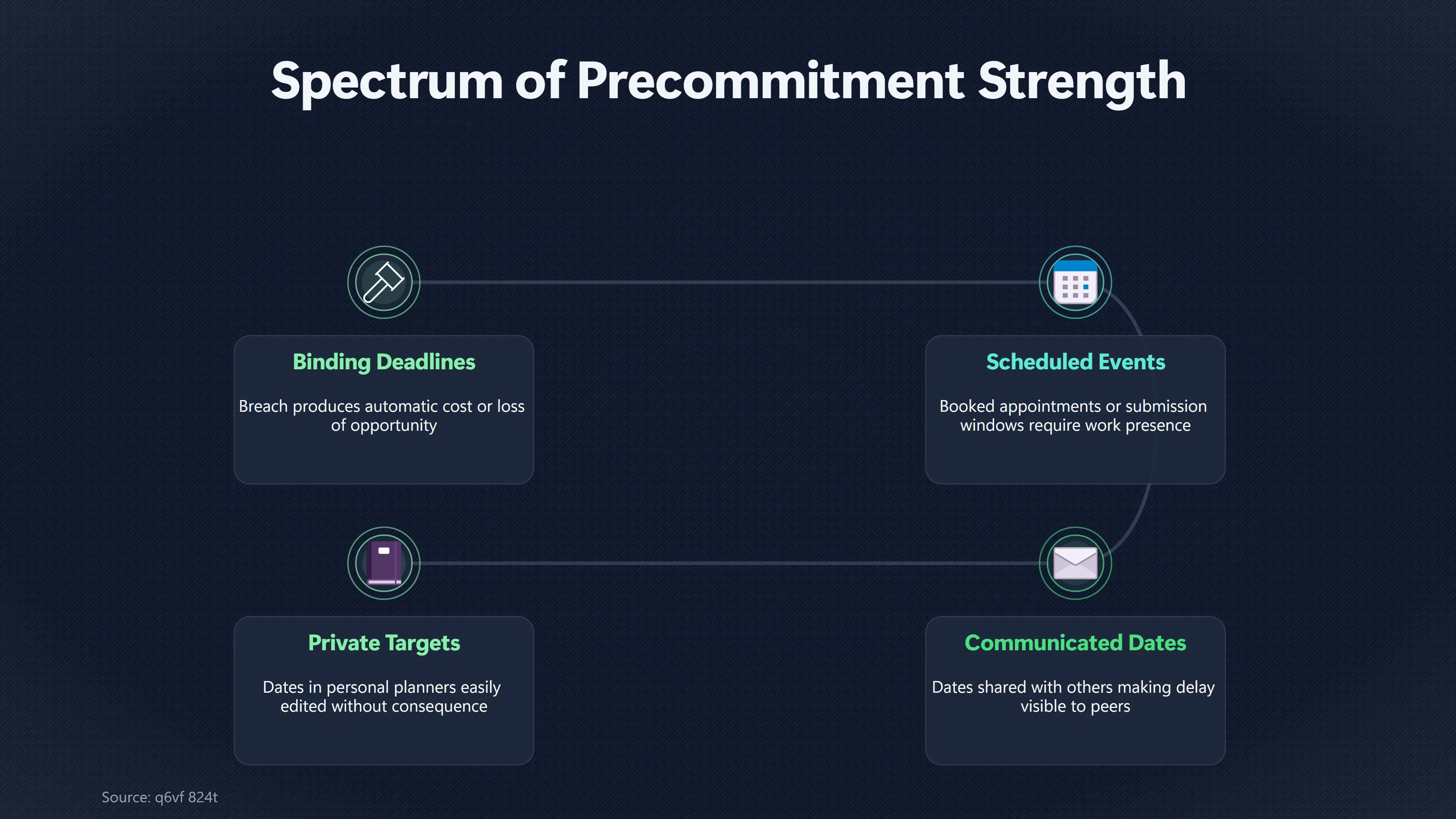
That produces a practical spectrum rather than a binary distinction:
- Weak: a date written privately in a planner that can be edited without consequence.
- Stronger: a date communicated to another person, making delay visible.
- Stronger still: a scheduled event, submission window or dependency that requires the work to exist at that time.
- Binding: a date whose breach automatically produces a meaningful cost or loss of opportunity.
These categories describe the strength of precommitment, not guaranteed effectiveness. The 2026 replication and other null findings are good reasons not to promise that moving further down the spectrum will automatically improve performance. What becomes stronger is the constraint on later renegotiation.
This is also why multiplying arbitrary deadlines may be the wrong response to procrastination. Three invented milestones are not necessarily three commitment devices. If every date can be shifted whenever it is missed, the person still faces essentially the same decision repeatedly: do the uncomfortable task now, or revise the plan again?
Turning vague intentions into real delivery points
For self-improvement, the most defensible use of deadline research is to design delivery points rather than decorative dates. Start with something that must exist — a draft, application, training session, booked appointment or completed piece of work — and identify the earliest sensible point at which another part of reality can depend upon it.
The emphasis on “sensible” matters. The original 2002 research suggested that people did not set deadlines optimally, while later experiments show that deadlines can be ineffective or even harmful. A deadline set unnecessarily early sacrifices flexibility. If illness, unexpected work or a difficult task intervenes, the commitment may punish circumstances rather than procrastination. Bisin and Hyndman’s field evidence explicitly highlights the lost option value of waiting and the risk that an early deadline leaves insufficient time to recover from mistakes.[ScienceDirect]sciencedirect.comScienceDirect Present-bias, procrastination and deadlines in a field experimentPresent-bias, procrastination and deadlines in a field experiment - ScienceDirectJanuary 1, 2020…
The aim, then, is not maximum rigidity. It is minimum necessary rigidity: enough external structure that postponement is no longer frictionless, without creating artificial constraints that make successful completion harder.
This interpretation also fits evidence beyond strict deadline experiments. A 2019 field experiment in higher education found that offering students a non-binding commitment agreement improved exam participation and passing, while reminders alone did not change behaviour. That does not establish that soft commitments always work, but it reinforces the broader point that commitment can involve more than merely making a future date salient.[American Economic Association]aeaweb.orgOpen source on aeaweb.org.
The strongest conclusion from the deadline literature is therefore more modest — and more useful — than the old productivity slogan. Do not assume that an arbitrary date will manufacture urgency. If repeated postponement is predictable, look for a real delivery point that changes the future choice: somebody expects the output, an appointment has been booked, a submission becomes due, or another action genuinely depends on completion.
And do not overstate even that. The 2026 replication means the familiar claim that evenly spaced deadlines reliably defeat procrastination should now be treated with substantial caution. What survives more comfortably is the underlying logic of precommitment: a deadline becomes meaningful when deciding to delay later is no longer equivalent to simply changing your mind.[Association for Psychological Science]psychologicalscience.orgAssociation for Psychological ScienceReplication of “Procrastination, Deadlines, and Performance: Self-Control by Precommitment” - Psycho…
Amazon book picks
Further Reading
Books and field guides related to Do Self Imposed Deadlines Really Stop Procrastination?. Use these as the next step if you want deeper reading beyond the article.
Nudge
Rating: 3.5/5 from 29 Google Books ratings
Thaler and Sunstein offer a groundbreaking discussion of how to apply the science of choice to nudge people toward decisions that can imp...
The Now Habit: A Strategic Program for Overcoming Procrastina...
Learn how to overcome procrastination and enjoy guilt-free play! One of the most effective programs to combat procrastination, THE NOW HA...
Solving the Procrastination Puzzle: A Concise Guide to Strate...
The revised edition of the self-published hit, offering powerful strategies to end procrastination. Why do we sabotage our own best inten...
The ONE Thing: The Surprisingly Simple Truth Behind Extraordi...
YOU WANT LESS. You want fewer distractions and less on your plate. The daily barrage of e-mails, texts, tweets, messages, and meetings di...
eBay marketplace picks
Marketplace Samples
Live-tested eBay searches with available results related to this page.
Selected fromself improvement wall art oneBay.co.uk.



Endnotes
1.
Source: aspredicted.org
Title: q6vf 824t
Link:https://aspredicted.org/q6vf-824t.pdf
Source snippet
aspredicted.org...
2.
Source: sciencedirect.com
Title: ScienceDirect Present-bias, procrastination and deadlines in a field experiment
Link:https://www.sciencedirect.com/science/article/pii/S0899825619301757
Source snippet
Present-bias, procrastination and deadlines in a field experiment - ScienceDirectJanuary 1, 2020...
Published: January 1, 2020
3.
Source: faculty.econ.ucsb.edu
Link:https://faculty.econ.ucsb.edu/~charness/papers/procrastination.pdf
Source snippet
UCSB Economics FacultyJournal of Economic Behavior & Organization 77 (2011) 393–404November 8, 2025...
Published: November 8, 2025
4.
Source: sciencedirect.com
Link:https://www.sciencedirect.com/science/article/pii/S0167268122003924
Source snippet
Do Deadlines Affect Project Completion? Experimental Evidence from Israeli Vocational Colleges - ScienceDirect...
5.
Source: sciencedirect.com
Link:https://www.sciencedirect.com/science/article/pii/S0277953623006883
6.
Source: sciencedirect.com
Link:https://www.sciencedirect.com/science/article/abs/pii/S0277953623006883
7.
Source: sciencedirect.com
Link:https://www.sciencedirect.com/science/article/abs/pii/S0167268122003924
8.
Source: sciencedirect.com
Title: Field and online experiments on [self-control]({{ ‘self-control/’ | relative_url }})
Link:https://www.sciencedirect.com/science/article/pii/S0167268110002337
9.
Source: sciencedirect.com
Link:https://www.sciencedirect.com/science/article/abs/pii/S0191886915001610
10.
Source: sciencedirect.com
Title: Present-bias, procrastination and deadlines in a field experiment
Link:https://www.sciencedirect.com/science/article/abs/pii/S0899825619301757
11.
Source: sciencedirect.com
Link:https://www.sciencedirect.com/science/article/pii/S004727271500033X
12.
Source: faculty.wharton.upenn.edu
Title: Ariely Wertenbroch 2002
Link:https://faculty.wharton.upenn.edu/wp-content/uploads/2012/05/Ariely—Wertenbroch-2002.pdf
Source snippet
Wharton Faculty Platform1333...
13.
Source: psychologicalscience.org
Link:https://www.psychologicalscience.org/journals/psychological-science/09567976261460772/
Source snippet
Association for Psychological ScienceReplication of “Procrastination, Deadlines, and Performance: Self-Control by Precommitment” - Psycho...
14.
Source: psychologicalscience.org
Link:https://www.psychologicalscience.org/journals/psychological-science/1467-9280.00441/
Source snippet
Association for Psychological ScienceProcrastination, Deadlines, and Performance: Self-Control by Precommitment - Psychological Science...
15.
Source: aeaweb.org
Link:https://www.aeaweb.org/articles?id=10.1257%2Fapp.20170288
16.
Source: aeaweb.org
Link:https://www.aeaweb.org/articles?id=10.1257%2Fpol.20130351
17.
Source: aeaweb.org
Title: Bargaining with Deadlines and Private Information
Link:https://www.aeaweb.org/articles?id=10.1257%2Fmic.5.4.219
18.
Source: aeaweb.org
Title: Microcommitments: The Effect of Small Commitments on Student Success
Link:https://www.aeaweb.org/articles?id=10.1257%2Fpandp.20211043
19.
Source: pubs.aeaweb.org
Link:https://pubs.aeaweb.org/doi/10.1257/aer.20151181
20.
Source: aeaweb.org
Title: Teamwork as a Self-Disciplining Device
Link:https://www.aeaweb.org/articles?id=10.1257%2Fmic.20160217
21.
Source: aeaweb.org
Link:https://www.aeaweb.org/articles?id=10.1257%2Faer.20151181
22.
Source: pubs.aeaweb.org
Link:https://pubs.aeaweb.org/doi/10.1257/aer.20200212
23.
Source: aeaweb.org
Title: Delay and Deadlines: Freeriding and Information Revelation in Partnerships
Link:https://www.aeaweb.org/articles?id=10.1257%2Fmic.6.2.163
24.
Source: aeaweb.org
Title: Why Don’t Present-Biased Agents Make Commitments?
Link:https://www.aeaweb.org/articles?id=10.1257%2Faer.p20151084
25.
Source: aeaweb.org
Link:https://www.aeaweb.org/articles?id=10.1257%2Faer.101.2.632
26.
Source: aeaweb.org
Link:https://www.aeaweb.org/articles?id=10.1257%2Fjep.28.3.169
Additional References
27.
Source: pubmed.ncbi.nlm.nih.gov
Link:https://pubmed.ncbi.nlm.nih.gov/42456006/
Source snippet
Replication of "Procrastination, Deadlines, and Performance: Self-Control by Precommitment" - PubMed...
28.
Source: youtube.com
Title: The Secret to Kicking Procrastination: Reward Yourself | Dan Ariely | Big Think
Link:https://www.youtube.com/watch?v=zbEa1P4sqd8
Source snippet
Inside the Mind of a Master Procrastinator | Tim Urban | TED...
29.
Source: youtube.com
Title: Parkinson’s Law
Link:https://www.youtube.com/watch?v=tlddeUri3GM
Source snippet
Dan Ariely self imposed deadlines procrastination The Specialness Trap: Why We Procrastinate Happiness...
30.
Source: youtube.com
Title: How to Stop Procrastination & Increase Motivation | Dr. Andrew Huberman
Link:https://www.youtube.com/watch?v=48jlHaxZnig
Source snippet
Parkinson's Law - Manage Your Time More Effectively...
31.
Source: youtube.com
Title: Why you procrastinate even when it feels bad
Link:https://www.youtube.com/watch?v=FWTNMzK9vG4
Source snippet
How to Stop Procrastination & Increase Motivation | Dr. Andrew Huberman...
32.
Source: youtube.com
Title: Inside the Mind of a Master Procrastinator | Tim Urban | TED
Link:https://www.youtube.com/watch?v=arj7oStGLkU
Source snippet
Why you procrastinate even when it feels bad...
33.
Source: gwern.net
Link:https://gwern.net/doc/statistics/bias/index
34.
Source: researchgate.net
Link:https://www.researchgate.net/publication/365898059_Do_Deadlines_Affect_Project_Completion_Experimental_Evidence_from_Israeli_Vocational_Colleges
35.
Source: metatoc.com
Link:https://metatoc.com/papers/193758-replication-of-procrastination-deadlines-and-performance-self-control-by-precommitment
36.
Source: visualize.jove.com
Link:https://visualize.jove.com/42456006-replication-of-procrastination-deadlines-and-performance-self-control-by-precommitment