Within Simple Metrics
Measure the Question That Could Change Your Plan
A metric earns its place when a different result would lead you to continue, adjust or simplify what you are doing.
On this page
- Linking each metric to a specific decision
- Testing whether different results would trigger different actions
- Replacing interesting trivia with decision relevant information
Page outline Jump by section
Introduction
A measurement earns its place in a self-improvement plan when a different result could lead to a different next action. The practical question is not “What can I track?” but “What am I uncertain about that could make me continue, adjust or simplify this plan?” If every plausible result would leave the plan unchanged, collecting the number adds information without resolving a decision.
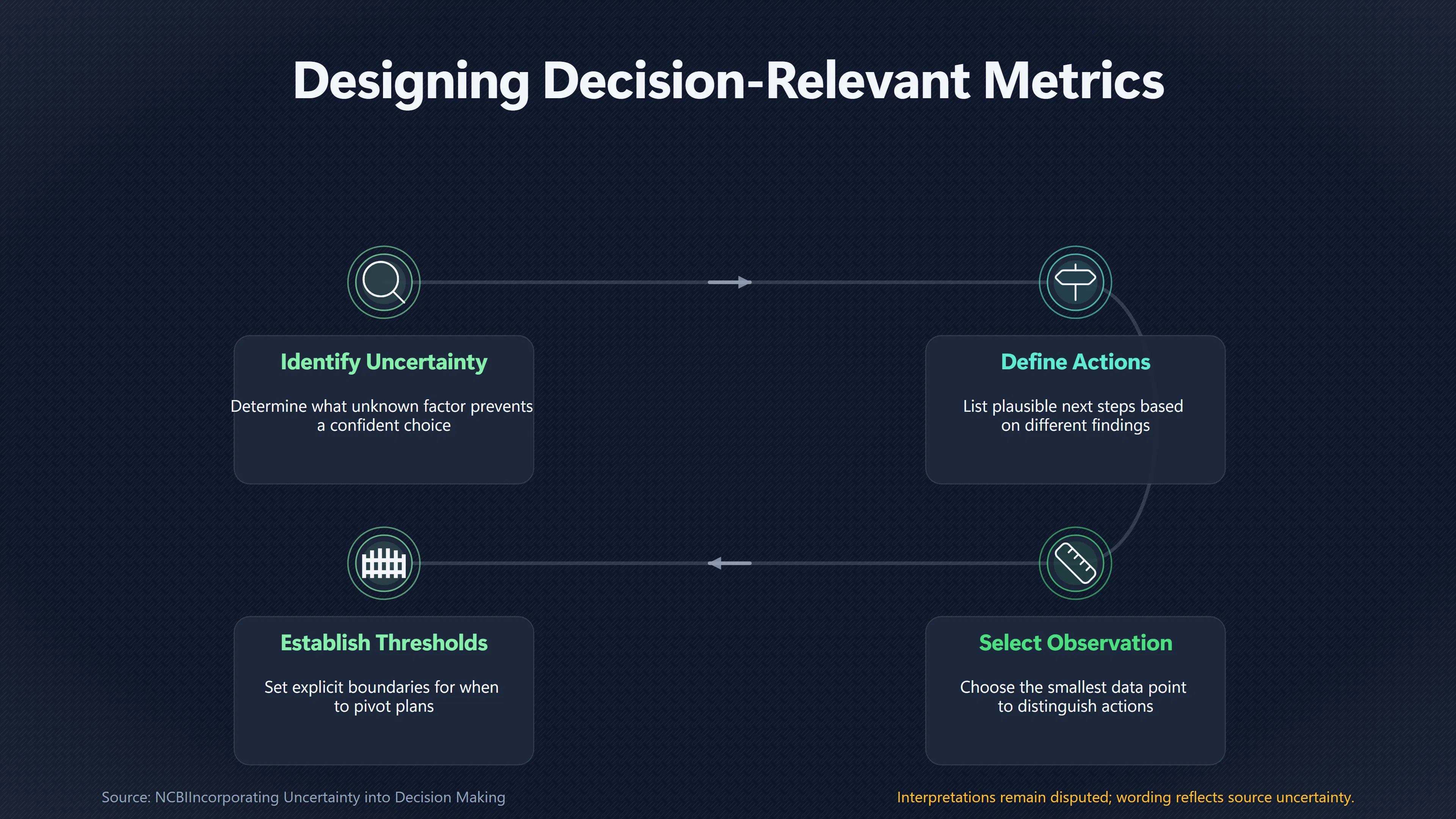
Decision science gives this principle a formal name: the value of information. Information is valuable when reducing uncertainty can improve a choice; if no possible finding would change the preferred action, its decision value is effectively zero.[PubMed Central (PMC)]pmc.ncbi.nlm.nih.govOpen source on nih.gov. Applied to self-improvement, this suggests a deliberately narrow measurement strategy: identify the live uncertainty, decide in advance what different findings would imply, and collect only enough evidence to distinguish between the actions you are genuinely considering.
Link each metric to a specific decision
The same goal can require different measurements depending on what is currently uncertain. Suppose you intend to study four evenings a week but feel that progress is poor. One possibility is that the routine rarely happens; another is that you study consistently but the method produces weak learning. Those are different uncertainties, and they call for different metrics.
If the first question is “Am I following the plan often enough to give it a fair test?”, the most useful measure may simply be planned sessions completed. If four sessions are scheduled and only one regularly happens, a recall score or sophisticated concentration measure is unlikely to change the immediate decision. The plan first needs to become more feasible. If four sessions are reliably happening, however, adherence is no longer the main uncertainty. A delayed recall test, practice problem or other outcome measure may now help answer whether the method itself should change.
NICE’s behaviour-change guidance makes a related distinction between monitoring a behaviour and monitoring its outcome. It recommends reviewing progress and tailoring subsequent plans accordingly rather than treating measurement as an end in itself.[Nice]nice.org.ukRecommendations | Behaviour change: individual approaches | Guidance | NICEJanuary 2, 2014… That distinction matters because a metric can be perfectly accurate while answering the wrong question. Knowing precisely how many minutes you studied does not tell you whether poor retention is caused by an ineffective study method if the real problem is that most planned sessions never happened.
A useful way to design a metric is therefore to work backwards from the decision:
- What are the plausible next actions? For example, continue unchanged, alter the schedule, or simplify the routine.
- What uncertainty prevents you choosing confidently between them?
- What is the smallest observation that could reduce that uncertainty enough to choose?
This makes measurement conditional rather than permanent. “Sessions completed” might be crucial for three weeks and almost irrelevant a month later. A metric should follow the question, not become part of the furniture simply because it was once useful.
Test whether different results would trigger different actions
Before collecting a metric, imagine several plausible results. If you cannot say how they would lead to materially different actions, the measurement is probably not ready to earn your attention.
Consider a person experimenting with a morning writing routine. They are unsure whether the schedule is sustainable. Before tracking anything, they could define three broad cases:
Finding after a suitable trialDecision implicationMost planned sessions happenKeep the scheduleAbout half happenAdjust timing or frequencyVery few happenSimplify the plan substantially
The thresholds need not pretend to be universal scientific cut-offs. Their purpose is to make the decision logic explicit. Without that step, it is easy to accumulate numbers and decide afterwards that whatever happened somehow supports the plan you already preferred.
This is closely related to the logic behind formal value-of-information analysis. Such methods compare what can be achieved with current information against what could be achieved if some uncertainty were reduced. Crucially, when no possible information outcome would alter the decision, gathering more information has no expected decision value.[PubMed Central (PMC)]pmc.ncbi.nlm.nih.govOpen source on nih.gov. The everyday implication is powerful: a metric does not become useful merely because its value varies. The variation must cross a boundary that matters for action.
This also reveals a common failure in personal experiments: collecting evidence before defining what evidence would count. Suppose someone tracks mood after meditation but has no idea what improvement would make them continue, what lack of improvement would make them change the practice, or how long they need to observe before judging. Almost any pattern can then be rationalised. By contrast, deciding beforehand that “after four weeks, I will keep this routine if it is feasible and there is a noticeable improvement in the outcome I care about; otherwise I will alter one element” gives the measurement an actual job.
Pre-specifying the decision does not eliminate judgement. Personal data are often noisy, and rigid responses to single observations can be counterproductive. The point is to decide the kind of evidence that could change the plan and the observation window over which you will judge it, rather than reacting to every daily fluctuation.
The useful metric sits at the current bottleneck
Measurement becomes especially efficient when it targets the part of the plan that is currently most uncertain rather than attempting to describe the whole system.
Imagine someone trying to exercise three times a week. There are several possible bottlenecks:
- the sessions are rarely started;
- sessions happen but are routinely cut short;
- the programme is followed but performance does not improve;
- the programme works but is so inconvenient that it is unlikely to last.
Tracking every relevant variable at once — workouts, sets, repetitions, heart rate, sleep, soreness, motivation, steps and body weight — may produce a detailed picture without revealing which of those bottlenecks deserves action.
A smaller approach works sequentially. First ask whether planned sessions happen. If not, the next experiment concerns feasibility. Once adherence is dependable, ask whether the programme produces the intended outcome. If it does, the remaining uncertainty may be whether the routine is sustainable. Each stage calls for different evidence.
This does not mean self-monitoring itself is unhelpful. A large meta-analysis covering 138 experimental studies and 19,951 participants found that interventions designed to increase goal-progress monitoring also improved goal attainment on average, with an effect size of d = 0.40. Effects were larger when progress was physically recorded or made public.[PubMed]pubmed.ncbi.nlm.nih.govDoes monitoring goal progress promote goal attainment? A meta-analysis of the experimental evidence - PubMedFebruary 1, 2016… What that evidence supports is the usefulness of progress monitoring as a self-regulation technique. It does not establish that collecting more variables, monitoring them more often or keeping them indefinitely produces better decisions.
A broader meta-review of 66 meta-analyses reinforces the need for caution. It found support for techniques including self-monitoring, goal setting and personalised feedback, but none was consistently effective for every behaviour and population, and the authors identified substantial limitations in the evidence base.[PubMed]pubmed.ncbi.nlm.nih.govSelf-regulation mechanisms in health behavior change: a systematic meta-review of meta-analyses, 2006-2017 - PubMed… The useful question is therefore not whether tracking is good in the abstract. It is whether this particular measurement is resolving the uncertainty that presently blocks the next decision.
Why more precision can still leave the decision unchanged
People often respond to uncertainty by making measurement more precise. Yet precision has value only if the remaining uncertainty lies close enough to a decision boundary for better measurement to alter the choice.
Suppose you have completed two study sessions each week for a month despite planning five. Whether your true average concentration during those sessions was 6.2 or 7.1 out of 10 is unlikely to change the obvious next question: why is the five-session plan not happening? Additional precision about concentration can be real information while having almost no relevance to the immediate decision.
The opposite case is different. Suppose you complete every session and are deciding whether to continue one learning method or switch to another because performance appears flat. Now a more reliable measure of retention may matter because several plausible results could genuinely support different actions. Measurement precision becomes valuable because the decision is sensitive to it, not because precision is inherently desirable.
That distinction is central to value-of-information reasoning. The benefit of resolving uncertainty depends on whether better knowledge can change what is chosen and improve the consequence of that choice.[PubMed Central (PMC)]pmc.ncbi.nlm.nih.govOpen source on nih.gov. There is therefore no general rule that a richer dataset is better. Ten loosely relevant metrics can have less decision value than one crude measure located exactly at the uncertainty separating two actions.
For personal improvement, this makes “good enough to decide” a useful standard. You generally do not need to estimate a psychological state, performance trend or habit frequency with research-grade precision. You need enough confidence to decide whether the sensible response is to keep going, change something specific or reduce the demands of the plan.

Replace interesting trivia with decision-relevant information
Modern trackers make it easy to collect information because it is available, not because it is useful. Step counts, streaks, minutes, scores, readiness estimates, completed tasks and weekly averages can all become part of a personal dashboard without ever being tied to a choice.
The simplest test is counterfactual: imagine the metric came out substantially better or worse than expected. What would you do differently?
Take reading. “Books completed this year” may be satisfying to know. But if the current uncertainty is whether your way of reading technical material produces durable understanding, the annual total cannot distinguish between keeping the method and changing it. A small test of delayed recall or the ability to apply the material may have far greater decision value.
Or take focused work. Total working hours can tell you how long you were occupied. If you are testing whether blocking messaging applications during a defined two-hour period helps you complete an important task, however, the useful information concerns that decision. Did the planned focus period happen? Was the intended output completed more reliably? Tracking seven other productivity indicators may tell an interesting story about the day while adding little to the choice you are actually trying to make.
Even automated data are not automatically free. Self-tracking research documents practical burdens, discontinuation and situations in which people stop because tracking becomes frustrating, time-consuming or no longer useful. In one study of former users of personal-informatics tools, researchers found that abandonment sometimes occurred because the tool had already served its purpose; stopping could represent a successful endpoint rather than failure.[PubMed Central (PMC)]pmc.ncbi.nlm.nih.govPubMed Central (PMC)Beyond Abandonment to Next Steps: Understanding and Designing for Life after Personal Informatics Tool Use - PMCMay 1… A systematic review of 67 empirical self-tracking studies likewise identified discontinuance and longer-term use as substantial themes and highlighted unresolved questions about adverse psychosocial effects.[PubMed Central (PMC)]pmc.ncbi.nlm.nih.govPubMed Central (PMC)How Self-tracking and the Quantified Self Promote Health and Well-being: Systematic Review - PMCSeptember 21, 2021…
That makes “interesting but unused” data more costly than they first appear. Even where collection is automatic, the information competes for attention when it is reviewed and interpreted. A minimal system asks each metric to justify why it deserves that attention now.
Measurement can change the thing being measured
There is another reason to track selectively: observation is not always passive. Asking people to repeatedly record behaviour, symptoms or experiences can alter how they notice and respond to them.
Studies of intensive digital measurement illustrate the issue. Research involving people using daily digital measurements has reported that repeated self-monitoring can influence participants’ behaviour, make some people more worried about their health and impose meaningful reporting burden.[PubMed]pubmed.ncbi.nlm.nih.govOpen source on nih.gov. More broadly, a recent systematic review and meta-analysis of remote measurement-based mental-health interventions reported an average adherence rate of 74.5% across tracking items and found that more prompts per day were associated with lower adherence; reported adverse effects, though uncommon, included technical problems and psychological distress.[PubMed]pubmed.ncbi.nlm.nih.govOpen source on nih.gov.
Those clinical contexts should not be casually generalised to ordinary habit tracking, but they make the mechanism clear: measurements have costs, and repeated prompts can themselves become part of the intervention. The right response is not to avoid self-monitoring. It is to recognise that a measurement whose result cannot affect your decision may still consume effort or influence behaviour.
This strengthens the case for asking about decision relevance before adding a metric. A daily mood score may be worthwhile if you are genuinely deciding between two routines on the basis of their effect on mood. It is harder to justify if you intend to follow the same routine whatever the numbers say.
Sometimes the right measurement is a temporary diagnostic
A common mistake is assuming that useful metrics must become permanent habits. In reality, some of the most decision-relevant measurements are temporary.
Suppose a planned evening walk keeps failing. You suspect the problem is not motivation generally but unpredictable finishing times at work. For two weeks, you might record only two things: whether the walk happened and whether work finished later than the time at which walking remained practical. If most missed walks coincide with late finishes, that may be enough to move the activity elsewhere in the day.
Once the uncertainty is resolved and the plan changes, continuing to log finishing time indefinitely may serve no purpose. The metric has completed its job.
This interpretation fits what researchers have observed in personal informatics: people lapse, resume and stop tracking for many reasons, and stopping can occur after a person has learnt enough from the data or established a behaviour that no longer requires constant measurement.[PubMed Central (PMC)]pmc.ncbi.nlm.nih.govPubMed Central (PMC)Beyond Abandonment to Next Steps: Understanding and Designing for Life after Personal Informatics Tool Use - PMCMay 1… Minimal measurement therefore treats metrics more like diagnostic tools than possessions. You deploy one because there is a specific uncertainty worth resolving, then retire it when that question no longer governs the next action.
NICE guidance similarly frames monitoring within cycles of assessment, review and adaptation rather than as detached record-keeping. It recommends planning points at which progress will be reviewed and support or intervention subsequently tailored.[Nice]nice.org.ukRecommendations | Behaviour change: individual approaches | Guidance | NICEJanuary 2, 2014… For everyday self-improvement, the corresponding principle is straightforward: do not keep measuring a solved question simply because you have historical data for it.
When the result should not change the plan yet
Decision relevance does not mean acting on every measurement immediately. Sometimes a metric is appropriate, but the observation is too noisy or the time period too short to support a change.
A single bad run, low-output writing session or distracted study evening may be completely consistent with a good plan. If you redesign the routine after every disappointing result, measurement creates instability rather than useful feedback. The relevant unit may therefore be a week, several repetitions or another observation window long enough to separate persistent problems from normal variation.
The test remains the same, but it applies to patterns, not necessarily individual data points. Before collecting, specify roughly what pattern would make you reconsider the plan. For example: “If I miss at least half the sessions over three weeks, I will reduce the schedule.” This protects against two opposite errors: changing too quickly because of noise and gathering data indefinitely because no decision point was ever defined.
It also exposes situations in which you already have enough information. If you know that a five-day routine is impossible within your current commitments and intend to reduce it regardless of another week’s observations, further tracking has little immediate value. Information gathering is justified by unresolved uncertainty, not by discomfort with making a decision.
A metric earns its place by separating plausible next actions
The most useful way to think about minimal measurement is as a small decision experiment. Start not with the available metrics but with the choice you may have to make.
Ask:
- What am I genuinely unsure about?
- Which plausible answers would make me act differently?
- What is the simplest reasonably reliable observation that distinguishes those answers?
- How much evidence do I need before changing course?
- When can I stop collecting it?
Those questions create a direct chain from uncertainty to evidence to action. They also make it much harder for convenient metrics to survive merely because they are easy to count.
The result is a lighter but more demanding form of self-tracking. It may record fewer numbers, yet every number has a reason to exist. “Did the planned behaviour happen?” is useful when feasibility is uncertain. An outcome measure becomes useful when adherence is established but effectiveness remains uncertain. A temporary contextual measure is useful when a specific obstacle might explain repeated failures. Once that uncertainty is settled, the measurement can disappear.
The central rule is therefore not measure less at all costs. It is measure only what could presently change the plan. That is what turns personal data from an accumulating record into information for the next decision.
Amazon book picks
Further Reading
Books and field guides related to Measure the Question That Could Change Your Plan. Use these as the next step if you want deeper reading beyond the article.
Atomic Habits
Rating: 3.5/5 from 7 Google Books ratings
The #1 New York Times bestseller. Over 25 million copies sold! Translated into 60+ languages! Tiny Changes, Remarkable Results No matter...
How to Measure Anything
Now updated with new research and even more intuitive explanations, a demystifying explanation of how managers can inform themselves to m...
Thinking in Bets
Wall Street Journal bestseller! Poker champion turned business consultant Annie Duke teaches you how to get comfortable with uncertainty...
Decisive
The New York Times-bestselling authors of Switch and Made to Stick offer a fascinating tour through the workings of our minds to reveal h...
eBay marketplace picks
Marketplace Samples
Live-tested eBay searches with available results related to this page.
Selected fromproductivity poster oneBay.co.uk.




Endnotes
1.
Source: pmc.ncbi.nlm.nih.gov
Link:https://pmc.ncbi.nlm.nih.gov/articles/PMC7373630/
2.
Source: ncbi.nlm.nih.gov
Title: NCBIIncorporating Uncertainty into Decision Making
Link:https://www.ncbi.nlm.nih.gov/books/NBK200840/
Source snippet
Environmental Decisions in the Face of Uncertainty - NCBI Bookshelf...
3.
Source: nice.org.uk
Link:https://www.nice.org.uk/Guidance/PH49/chapter/recommendations
Source snippet
Recommendations | Behaviour change: individual approaches | Guidance | NICEJanuary 2, 2014...
Published: January 2, 2014
4.
Source: pubmed.ncbi.nlm.nih.gov
Link:https://pubmed.ncbi.nlm.nih.gov/26479070/
Source snippet
Does monitoring goal progress promote goal attainment? A meta-analysis of the experimental evidence - PubMedFebruary 1, 2016...
Published: February 1, 2016
5.
Source: pubmed.ncbi.nlm.nih.gov
Link:https://pubmed.ncbi.nlm.nih.gov/31662031/
Source snippet
Self-regulation mechanisms in health behavior change: a systematic meta-review of meta-analyses, 2006-2017 - PubMed...
6.
Source: pmc.ncbi.nlm.nih.gov
Link:https://pmc.ncbi.nlm.nih.gov/articles/PMC5428074/
Source snippet
PubMed Central (PMC)Beyond Abandonment to [Next Steps]({{ 'next-steps/' | relative_url }}): Understanding and Designing for Life after Personal Informatics Tool Use - PMCMay 1...
7.
Source: pmc.ncbi.nlm.nih.gov
Link:https://pmc.ncbi.nlm.nih.gov/articles/PMC8493454/
Source snippet
PubMed Central (PMC)How Self-tracking and the Quantified Self Promote Health and Well-being: Systematic Review - PMCSeptember 21, 2021...
Published: September 21, 2021
8.
Source: pubmed.ncbi.nlm.nih.gov
Link:https://pubmed.ncbi.nlm.nih.gov/35173979/
9.
Source: pubmed.ncbi.nlm.nih.gov
Link:https://pubmed.ncbi.nlm.nih.gov/41603797/
10.
Source: pmc.ncbi.nlm.nih.gov
Link:https://pmc.ncbi.nlm.nih.gov/articles/PMC13376127/
11.
Source: pmc.ncbi.nlm.nih.gov
Link:https://pmc.ncbi.nlm.nih.gov/articles/PMC13360716/
12.
Source: GOV.UK
Title: www.gov.uk HMR C Evaluation Framework
Link:https://www.gov.uk/government/publications/hmrc-evaluation-framework/hmrc-evaluation-framework
13.
Source: GOV.UK
Title: www.gov.uk Magenta Book: Central Government guidance on evaluation (HTML)
Link:https://www.gov.uk/government/publications/the-magenta-book/magenta-book-central-government-guidance-on-evaluation-html
14.
Source: GOV.UK
Title: www.gov.uk Test and Learn (HTML)
Link:https://www.gov.uk/government/publications/the-magenta-book/test-and-learn-html
15.
Source: GOV.UK
Link:https://www.gov.uk/government/publications/the-magenta-book/transparency-in-government-evaluation-research-t-i-g-e-r-html
16.
Source: GOV.UK
Title: www.gov.uk Government analytical evaluation capabilities framework (HTML)
Link:https://www.gov.uk/government/publications/the-magenta-book/government-analytical-evaluation-capabilities-framework-html
17.
Source: GOV.UK
Title: www.gov.uk Guidance on the Impact Evaluation of AI Interventions (HTML)
Link:https://www.gov.uk/government/publications/the-magenta-book/guidance-on-the-impact-evaluation-of-ai-interventions-html
18.
Source: GOV.UK
Title: the green book 2026
Link:https://www.gov.uk/government/publications/the-green-book-appraisal-and-evaluation-in-central-government/the-green-book-2026
19.
Source: pubmed.ncbi.nlm.nih.gov
Link:https://pubmed.ncbi.nlm.nih.gov/41602944/
20.
Source: ncbi.nlm.nih.gov
Link:https://www.ncbi.nlm.nih.gov/books/NBK621597/
21.
Source: pubmed.ncbi.nlm.nih.gov
Link:https://pubmed.ncbi.nlm.nih.gov/41270280/
22.
Source: pmc.ncbi.nlm.nih.gov
Link:https://pmc.ncbi.nlm.nih.gov/articles/PMC12580184/
23.
Source: pmc.ncbi.nlm.nih.gov
Link:https://pmc.ncbi.nlm.nih.gov/articles/PMC12533563/
24.
Source: pmc.ncbi.nlm.nih.gov
Link:https://pmc.ncbi.nlm.nih.gov/articles/PMC12475346/
25.
Source: pmc.ncbi.nlm.nih.gov
Link:https://pmc.ncbi.nlm.nih.gov/articles/PMC12489404/
26.
Source: pmc.ncbi.nlm.nih.gov
Link:https://pmc.ncbi.nlm.nih.gov/articles/PMC13045739/
27.
Source: pmc.ncbi.nlm.nih.gov
Link:https://pmc.ncbi.nlm.nih.gov/articles/PMC11526767/
28.
Source: GOV.UK
Title: www.gov.uk UKSP F: intervention-level evaluation feasibility report
Link:https://www.gov.uk/government/publications/uk-shared-prosperity-fund-intervention-level-evaluation/ukspf-intervention-level-evaluation-feasibility-report-executive-summary
29.
Source: pubmed.ncbi.nlm.nih.gov
Link:https://pubmed.ncbi.nlm.nih.gov/39316431/
30.
Source: pubmed.ncbi.nlm.nih.gov
Link:https://pubmed.ncbi.nlm.nih.gov/39033723/
31.
Source: GOV.UK
Title: www.gov.uk Evaluation Registry FAQs
Link:https://www.gov.uk/government/publications/evaluation-registry-faqs
32.
Source: pubmed.ncbi.nlm.nih.gov
Link:https://pubmed.ncbi.nlm.nih.gov/38717433/
33.
Source: pubmed.ncbi.nlm.nih.gov
Link:https://pubmed.ncbi.nlm.nih.gov/38648090/
34.
Source: pmc.ncbi.nlm.nih.gov
Link:https://pmc.ncbi.nlm.nih.gov/articles/PMC11319831/
35.
Source: pmc.ncbi.nlm.nih.gov
Link:https://pmc.ncbi.nlm.nih.gov/articles/PMC10589825/
36.
Source: pmc.ncbi.nlm.nih.gov
Link:https://pmc.ncbi.nlm.nih.gov/articles/PMC11041077/
37.
Source: GOV.UK
Title: www.gov.uk DHS C: evaluation strategy
Link:https://www.gov.uk/government/publications/dhsc-evaluation-strategy/dhsc-evaluation-strategy
38.
Source: pmc.ncbi.nlm.nih.gov
Link:https://pmc.ncbi.nlm.nih.gov/articles/PMC7612603/
39.
Source: pmc.ncbi.nlm.nih.gov
Link:https://pmc.ncbi.nlm.nih.gov/articles/PMC8900900/
40.
Source: pmc.ncbi.nlm.nih.gov
Link:https://pmc.ncbi.nlm.nih.gov/articles/PMC8717289/
41.
Source: pmc.ncbi.nlm.nih.gov
Link:https://pmc.ncbi.nlm.nih.gov/articles/PMC8842387/
42.
Source: pmc.ncbi.nlm.nih.gov
Link:https://pmc.ncbi.nlm.nih.gov/articles/PMC7612319/
43.
Source: pmc.ncbi.nlm.nih.gov
Link:https://pmc.ncbi.nlm.nih.gov/articles/PMC7613968/
44.
Source: pmc.ncbi.nlm.nih.gov
Link:https://pmc.ncbi.nlm.nih.gov/articles/PMC7995618/
45.
Source: pmc.ncbi.nlm.nih.gov
Link:https://pmc.ncbi.nlm.nih.gov/articles/PMC8299712/
46.
Source: pubmed.ncbi.nlm.nih.gov
Link:https://pubmed.ncbi.nlm.nih.gov/33656451/
47.
Source: pmc.ncbi.nlm.nih.gov
Link:https://pmc.ncbi.nlm.nih.gov/articles/PMC7764987/
48.
Source: nice.org.uk
Link:https://www.nice.org.uk/guidance/ng183/chapter/recommendations
49.
Source: pubmed.ncbi.nlm.nih.gov
Link:https://pubmed.ncbi.nlm.nih.gov/32788152/
50.
Source: pmc.ncbi.nlm.nih.gov
Link:https://pmc.ncbi.nlm.nih.gov/articles/PMC8160067/
51.
Source: pmc.ncbi.nlm.nih.gov
Link:https://pmc.ncbi.nlm.nih.gov/articles/PMC7351123/
52.
Source: pubmed.ncbi.nlm.nih.gov
Link:https://pubmed.ncbi.nlm.nih.gov/31662031/?dopt=Abstract
53.
Source: pmc.ncbi.nlm.nih.gov
Link:https://pmc.ncbi.nlm.nih.gov/articles/PMC7063266/
54.
Source: pubmed.ncbi.nlm.nih.gov
Link:https://pubmed.ncbi.nlm.nih.gov/31687937/
55.
Source: pubmed.ncbi.nlm.nih.gov
Link:https://pubmed.ncbi.nlm.nih.gov/31890630/
56.
Source: pubmed.ncbi.nlm.nih.gov
Link:https://pubmed.ncbi.nlm.nih.gov/31409357/
57.
Source: pmc.ncbi.nlm.nih.gov
Link:https://pmc.ncbi.nlm.nih.gov/articles/PMC7034331/
58.
Source: pubmed.ncbi.nlm.nih.gov
Link:https://pubmed.ncbi.nlm.nih.gov/30425028/
59.
Source: pmc.ncbi.nlm.nih.gov
Link:https://pmc.ncbi.nlm.nih.gov/articles/PMC6231850/
60.
Source: pubmed.ncbi.nlm.nih.gov
Link:https://pubmed.ncbi.nlm.nih.gov/29385950/
61.
Source: pmc.ncbi.nlm.nih.gov
Link:https://pmc.ncbi.nlm.nih.gov/articles/PMC6062090/
62.
Source: pmc.ncbi.nlm.nih.gov
Link:https://pmc.ncbi.nlm.nih.gov/articles/PMC6001204/
63.
Source: pmc.ncbi.nlm.nih.gov
Link:https://pmc.ncbi.nlm.nih.gov/articles/PMC5956159/
64.
Source: pubmed.ncbi.nlm.nih.gov
Link:https://pubmed.ncbi.nlm.nih.gov/29529158/
65.
Source: pmc.ncbi.nlm.nih.gov
Link:https://pmc.ncbi.nlm.nih.gov/articles/PMC11774256
66.
Source: pmc.ncbi.nlm.nih.gov
Link:https://pmc.ncbi.nlm.nih.gov/articles/PMC5701635/
67.
Source: pubmed.ncbi.nlm.nih.gov
Link:https://pubmed.ncbi.nlm.nih.gov/28800736/
68.
Source: pmc.ncbi.nlm.nih.gov
Link:https://pmc.ncbi.nlm.nih.gov/articles/PMC5600512/
69.
Source: pubmed.ncbi.nlm.nih.gov
Link:https://pubmed.ncbi.nlm.nih.gov/28392775/
70.
Source: pmc.ncbi.nlm.nih.gov
Link:https://pmc.ncbi.nlm.nih.gov/articles/PMC6001256/
71.
Source: pmc.ncbi.nlm.nih.gov
Link:https://pmc.ncbi.nlm.nih.gov/articles/PMC5161799/
72.
Source: pmc.ncbi.nlm.nih.gov
Link:https://pmc.ncbi.nlm.nih.gov/articles/PMC5432203/
73.
Source: pmc.ncbi.nlm.nih.gov
Link:https://pmc.ncbi.nlm.nih.gov/articles/PMC5432205/
74.
Source: pmc.ncbi.nlm.nih.gov
Link:https://pmc.ncbi.nlm.nih.gov/articles/PMC12435389/
75.
Source: pmc.ncbi.nlm.nih.gov
Link:https://pmc.ncbi.nlm.nih.gov/articles/PMC4954630/
76.
Source: pmc.ncbi.nlm.nih.gov
Link:https://pmc.ncbi.nlm.nih.gov/articles/PMC4642375/
77.
Source: pmc.ncbi.nlm.nih.gov
Link:https://pmc.ncbi.nlm.nih.gov/articles/PMC4492926/
78.
Source: pubmed.ncbi.nlm.nih.gov
Link:https://pubmed.ncbi.nlm.nih.gov/25965276/
79.
Source: pmc.ncbi.nlm.nih.gov
Link:https://pmc.ncbi.nlm.nih.gov/articles/PMC4948652/
80.
Source: nice.org.uk
Link:https://www.nice.org.uk/Guidance/PH49
81.
Source: nice.org.uk
Link:https://www.nice.org.uk/guidance/ph49/evidence
82.
Source: nice.org.uk
Link:https://www.nice.org.uk/guidance/ph49/chapter/context
83.
Source: ncbi.nlm.nih.gov
Link:https://www.ncbi.nlm.nih.gov/books/NBK200840/?report=printable
84.
Source: pmc.ncbi.nlm.nih.gov
Link:https://pmc.ncbi.nlm.nih.gov/articles/PMC3364356/
85.
Source: pmc.ncbi.nlm.nih.gov
Link:https://pmc.ncbi.nlm.nih.gov/articles/PMC3126717/
86.
Source: GOV.UK
Title: www.gov.uk The Magenta Book
Link:https://www.gov.uk/government/publications/the-magenta-book
87.
Source: pmc.ncbi.nlm.nih.gov
Link:https://pmc.ncbi.nlm.nih.gov/articles/PMC2386626/
88.
Source: nice.org.uk
Link:https://www.nice.org.uk/guidance/ph6/chapter/Recommendations
89.
Source: nice.org.uk
Link:https://www.nice.org.uk/guidance/ph6/chapter/Considerations
90.
Source: nice.org.uk
Link:https://www.nice.org.uk/guidance/ph6/evidence
91.
Source: nice.org.uk
Link:https://www.nice.org.uk/guidance/ph6/chapter/introduction
92.
Source: nice.org.uk
Link:https://www.nice.org.uk/about/what-we-do/research-and-development/research-recommendations/ph49/3
93.
Source: ncbi.nlm.nih.gov
Link:https://www.ncbi.nlm.nih.gov/books/NBK608018/
94.
Source: ncbi.nlm.nih.gov
Link:https://www.ncbi.nlm.nih.gov/books/NBK225344/
95.
Source: pubmed.ncbi.nlm.nih.gov
Link:https://pubmed.ncbi.nlm.nih.gov/29189034/
96.
Source: pubmed.ncbi.nlm.nih.gov
Link:https://pubmed.ncbi.nlm.nih.gov/21401218/
97.
Source: pmc.ncbi.nlm.nih.gov
Link:https://pmc.ncbi.nlm.nih.gov/articles/PMC1071430/
98.
Source: ncbi.nlm.nih.gov
Link:https://www.ncbi.nlm.nih.gov/books/NBK63641/
99.
Source: ncbi.nlm.nih.gov
Link:https://www.ncbi.nlm.nih.gov/books/NBK235178/
100.
Source: GOV.UK
Title: www.gov.uk About us
Link:https://www.gov.uk/government/organisations/evaluation-task-force/about
Additional References
101.
Source: youtube.com
Title: Thinking in Bets by Annie Duke
Link:https://www.youtube.com/watch?v=H49lFODYp7g
Source snippet
Value of Information decision analysis Decision Analysis 4 (Tree): EVSI - Expected Value of Sample Information...
102.
Source: youtube.com
Title: Decision Analysis: Expected Value of Sample Information
Link:https://www.youtube.com/watch?v=FUY07dvaUuE
Source snippet
How to Measure Anything with Doug Hubbard...
103.
Source: osf.io
Link:https://osf.io/yzjp3/
104.
Source: osf.io
Link:https://osf.io/vu8xt/
105.
Source: osf.io
Link:https://osf.io/8ntva/
106.
Source: osf.io
Link:https://osf.io/gf7kr/
107.
Source: osf.io
Link:https://osf.io/fuba8/
108.
Source: osf.io
Link:https://osf.io/fmuh9/
109.
Source: osf.io
Link:https://osf.io/3p2h8/
110.
Source: osf.io
Link:https://osf.io/ysqu6/