Within Work Prep
When Tomorrow Prep Becomes Today's Procrastination
A useful shutdown setup ends once the first task, next action, materials and memory cues are ready, rather than becoming another project.
On this page
- How preparation expands beyond its useful purpose
- The minimum setup needed for an easier restart
- A practical stopping rule for end of day preparation
Page outline Jump by section
Introduction
End-of-day preparation is useful only while it makes tomorrow easier to start. Once the first task, first concrete action, necessary materials and a reliable memory cue are ready, further organising can become a disguised form of procrastination: work that feels responsible but no longer meaningfully reduces tomorrow’s starting friction.
That distinction matters because planning genuinely can help. Specific implementation plans improve goal initiation, and concrete plans for unfinished work can reduce intrusive thoughts about it. But the research does not imply that more planning is always better. Reviews of procrastination explicitly identify excessive planning as one way action regulation can go wrong, while research on external reminders shows that reminders themselves have costs and should be used selectively.[sciencedirect.com]sciencedirect.comImplementation Intentions and Goal Achievement: A Meta‐analysis of Effects and Processes - ScienceDirect…
The practical policy is therefore simple: prepare for resumption, not for certainty. End the shutdown routine when tomorrow’s first useful action can begin without another planning session.
How preparation expands beyond its useful purpose
Preparation has an unusually convincing disguise. Renaming folders, improving a task system, rearranging tomorrow’s calendar and researching a better workflow all look more productive than obvious avoidance. The problem is not that these activities are inherently useless. It is that their value depends on whether they remove a real obstacle to subsequent action.
Research on procrastination provides a useful warning here. A scoping review of work-related procrastination describes procrastination partly as impaired action regulation: difficulties can occur in evaluating, planning, carrying out or completing work. Crucially, this can involve excessive planning, with planning becoming more important than doing the task itself.[PubMed Central (PMC)]pmc.ncbi.nlm.nih.govOpen source on nih.gov.
That makes “I am preparing” an unreliable test of whether preparation is worthwhile. A better question is: what decision or obstacle will this preparation remove tomorrow? Opening the correct spreadsheet and writing “Next: reconcile the three unmatched invoices” has an identifiable payoff. Spending another 20 minutes redesigning the project dashboard may not.
The risk becomes greater when preparation promises relief from an uncomfortable task. Procrastination research increasingly treats delay not simply as poor time management but as a form of short-term mood regulation: when a task feels difficult, frustrating or aversive, avoiding it can provide immediate emotional relief while shifting the cost to the future self.[DOI]doi.orgProcrastination and the Priority of Short‐Term Mood Regulation: Consequences for Future Self - Sirois - 2013 - Social and Personality… An elaborate preparation ritual can fit that pattern without looking like avoidance. Instead of confronting the uncertain draft, difficult analysis or awkward decision, a person can continue working on the safer problem of how work should be organised.
Perfectionistic concerns can reinforce the same tendency. A meta-analysis involving roughly 10,000 participants found a positive association between procrastination and perfectionistic concerns, while a seven-day diary study found that perceived discrepancies between actual and ideal performance helped explain the relationship.[Wiley Online Library]onlinelibrary.wiley.comWiley Online LibraryA Meta‐analytic and Conceptual Update on the Associations Between Procrastination and Multidimensional Perfectionism… Applied cautiously to end-of-day setup, this suggests a recognisable failure mode: “ready enough to restart” quietly becomes “everything must be perfectly arranged before I can stop”.
That is setup creep. Its defining feature is not how long the routine takes but whether additional effort is still reducing a genuine initiation barrier.
The minimum setup needed for an easier restart
The strongest evidence for preparation supports specificity, not elaborateness. Gollwitzer and Sheeran’s meta-analysis of 94 independent tests found that implementation intentions — plans specifying when, where and how an intended behaviour will occur — produced a medium-to-large overall improvement in goal attainment and helped with initiating action. The mechanism involves making the relevant cue more accessible and strengthening the connection between that cue and the intended response.[ScienceDirect]sciencedirect.comImplementation Intentions and Goal Achievement: A Meta‐analysis of Effects and Processes - ScienceDirect…
For end-of-day preparation, that points towards a deliberately small package:
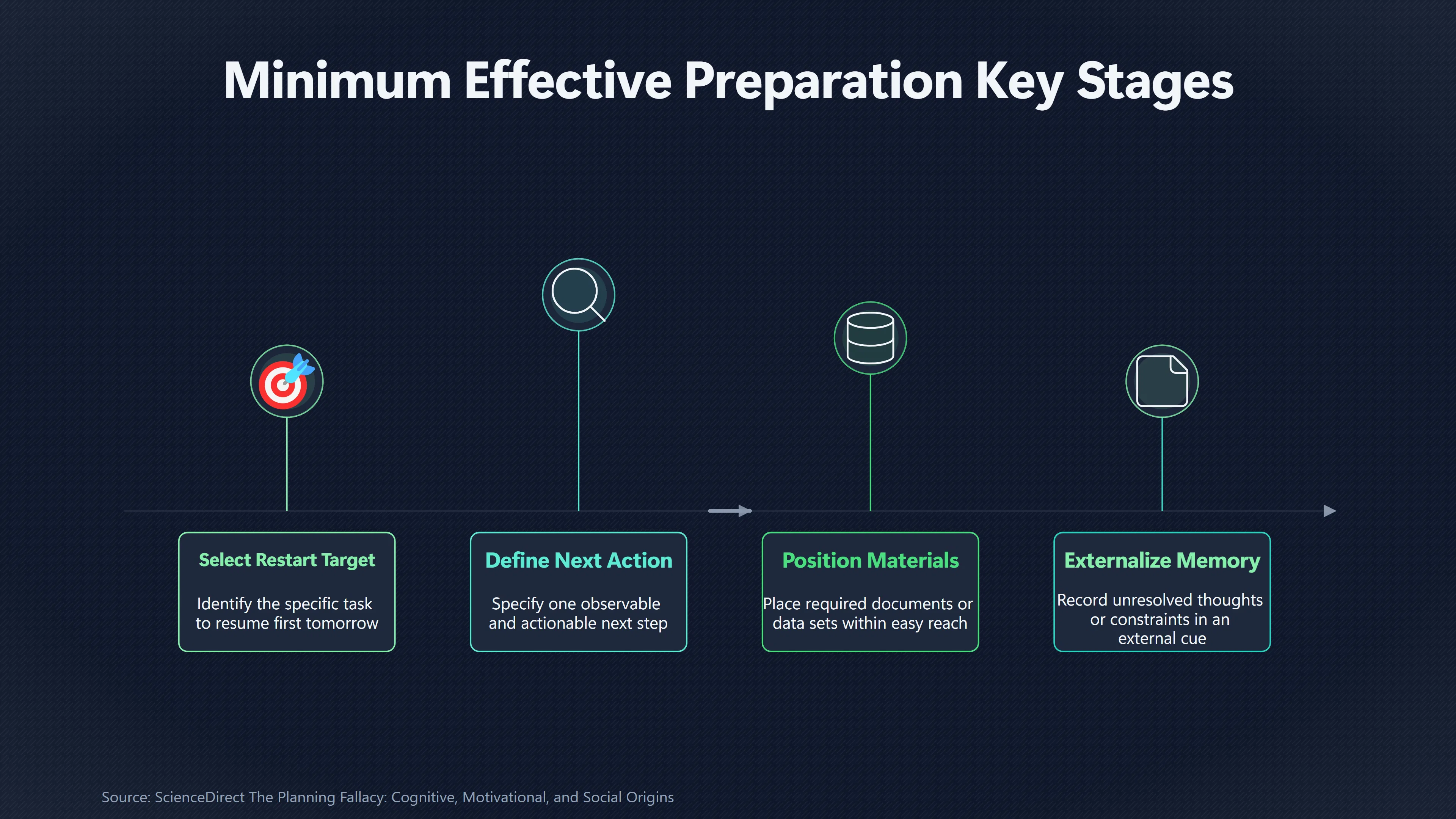
- Choose the restart target. Identify the task you intend to resume first rather than reprioritising your entire workload.
- Specify one observable next action. “Continue budget” is vague; “open the August forecast and check the three flagged assumptions” is actionable.
- Put the required material within reach. Leave the correct document, dataset, notebook or physical material easy to locate.
- Externalise anything you genuinely need to remember. Record the unresolved thought, constraint or question rather than expecting tomorrow’s memory to reconstruct it.
- Stop. Do not treat successful setup as permission to start optimising the rest of tomorrow.
The memory step can be extremely small. Research on “intention offloading” — using external aids to carry future intentions — finds that reminders such as calendars, notes, alerts and strategically positioned objects can substantially improve fulfilment of delayed intentions. Importantly, the same review frames reminder-setting as a cost-benefit decision: reminders consume time and effort too, and setting them for everything would create unacceptable overhead.[PubMed Central (PMC)]pmc.ncbi.nlm.nih.govPubMed Central (PMC)Outsourcing Memory to External Tools: A Review of ‘Intention Offloading’ - PMC…
That is a useful model for the whole shutdown routine. A cue earns its place when it saves more future effort than it costs to create. A note reading “Next: verify whether the 4.2% figure includes refunds” may save tomorrow’s self several minutes of reconstruction. Copying every possible future action into three different productivity systems probably does not.
The same principle applies to materials. “Materials ready” does not require an immaculate desk or inbox zero. It means that whatever blocks the first action has been removed. If tomorrow starts with editing a presentation, having the current presentation and source figures identifiable is enough. Sorting unrelated downloads or choosing new folder icons does nothing for that restart.
Why a small plan can be enough
There is a particularly relevant finding in research on unfinished goals. Masicampo and Baumeister found that unfinished goals could produce intrusive thoughts and interfere with unrelated tasks, but having participants make specific plans for completing those goals eliminated those cognitive effects in their experiments. Participants did not have to finish the underlying goal first; a credible plan for later action was enough to reduce interference.[PubMed]pubmed.ncbi.nlm.nih.govConsider it done! Plan making can eliminate the cognitive effects of unfulfilled goals - PubMed…
This is important for shutdown routines because it challenges the intuition that peace of mind requires comprehensive closure. Often the work itself cannot be completed today. The useful substitute is not exhaustive replanning but sufficient closure about how work will resume.
Workplace evidence points in the same direction. Unfinished tasks are associated with poorer psychological detachment from work, and research on incomplete work goals suggests that concrete plans for when, where and how they will be resolved can help people disengage.[PubMed]pubmed.ncbi.nlm.nih.govOpen source on nih.gov. Psychological detachment matters because off-job recovery depends partly on being able to stop engaging mentally and behaviourally with work demands rather than continually extending the workday into leisure time.[Springer]link.springer.comOpen source on springer.com.
This creates an important boundary. End-of-day planning can help you stop thinking about work; end-of-day planning that itself refuses to stop defeats part of the purpose.
More generally, time-management research supports planning without establishing a case for endless planning. A meta-analysis found moderate associations between time management and job performance, academic achievement and wellbeing, as well as a negative association with distress. A two-week workplace study likewise found benefits from daily planning, while showing that the usefulness of particular planning approaches depends on circumstances such as interruptions.[PubMed Central (PMC)]pmc.ncbi.nlm.nih.govPub Med Central (PMC)Does time management work? A meta-analysisPub Med Central (PMC)Does time management work? A meta-analysis The sensible conclusion is not “plan as much as possible”, but “use planning to make execution easier”.
A practical stopping rule for end-of-day preparation
A shutdown routine needs a stopping rule because preparation otherwise has no natural finish line. There is always another task that could be clarified, another contingency that could be anticipated and another system that could be tidied.
A robust stopping rule is:
Stop preparing when you can name tomorrow’s first task, perform its first physical or digital action without replanning, access the materials required for that action, and recover any essential unfinished thought from an external cue.
That rule deliberately ignores whether the whole day is optimised.
Suppose you finish work midway through a difficult report. You decide that tomorrow’s restart is the results section. You leave a note saying, “Next: compare the regional conversion rates with Table 3; explain the North–South gap.” The current report and Table 3 are saved where you can immediately reach them. At that point the setup has accomplished its purpose. Rearranging the bibliography, cleaning the downloads folder, colour-coding the remaining tasks and rebuilding tomorrow’s calendar may create a stronger feeling of readiness, but they do not materially improve the first restart.
A useful diagnostic is to test every additional preparation action against three questions:
- What specific friction will this remove tomorrow?
- Does that friction affect the first meaningful action, or merely make the system look more complete?
- Would stopping now leave enough information to restart confidently?
If the third answer is yes and the first two reveal no concrete benefit, stopping is the productive action.
This also guards against the planning fallacy in a small but useful way. Research on task-duration prediction shows that people tend to construct optimistic future scenarios while underusing evidence from their previous experience.[ScienceDirect]sciencedirect.comScienceDirect The Planning Fallacy: Cognitive, Motivational, and Social OriginsScienceDirect The Planning Fallacy: Cognitive, Motivational, and Social Origins Elaborate evening schedules can therefore create false precision: a carefully packed calendar may imply that tomorrow is more controllable than it really is. Preparing the first action asks much less of forecasting. You do not need to know exactly how the entire day will unfold to know what file to open first.
When setup creep is already happening
The clearest sign of setup creep is repeated work on the representation of work while execution remains unchanged. The task list is being rewritten, the calendar adjusted and the workspace improved, yet the same difficult project is still waiting.
At that point, adding a more sophisticated planning method is usually the wrong intervention. Reduce the routine instead. Preserve only the elements that carry information across the overnight boundary: the restart target, next action, essential materials and memory cue. Everything else must justify itself by removing a demonstrated source of friction.
This distinction also prevents an unhelpful swing to the opposite extreme. The answer to overplanning is not zero preparation. Specific plans can improve initiation; reminders can reliably support future intentions; and credible plans for unfinished work can make it easier to disengage.[sciencedirect.com]sciencedirect.comImplementation Intentions and Goal Achievement: A Meta‐analysis of Effects and Processes - ScienceDirect… The target is minimum effective preparation.
That is the larger self-improvement principle at work here. A useful system should make the desired behaviour easier to perform, not become a substitute behaviour that demands continuous maintenance. End-of-day setup has succeeded when tomorrow’s starting point is obvious enough that you no longer need to think about preparing for it today.
Amazon book picks
Further Reading
Books and field guides related to When Tomorrow Prep Becomes Today's Procrastination. Use these as the next step if you want deeper reading beyond the article.
Getting Things Done
The personal productivity guru (Fast Company) delivers powerful methods that vastly increase your efficiency and creative results-at work...
Four Thousand Weeks
A life-changing gift of a book: What if you tried to stop doing everything, so you could finally get round to what counts? **The instant...
Atomic Habits
Rating: 3.5/5 from 7 Google Books ratings
The #1 New York Times bestseller. Over 25 million copies sold! Translated into 60+ languages! Tiny Changes, Remarkable Results No matter...
Essentialism
Have you ever found yourself struggling with information overload? Have you ever felt both overworked and underutilised? Do you ever feel...
eBay marketplace picks
Marketplace Samples
Live-tested eBay searches with available results related to this page.
Selected frommotivational poster oneBay.co.uk.



Current eBay listing
Motivational Quotes Framed Wall Art Poster Canvas Print Picture

Current eBay listing
Gym Motivational Posters Work Out Insperational Quotes Wall Art
Endnotes
1.
Source: sciencedirect.com
Link:https://www.sciencedirect.com/science/chapter/bookseries/abs/pii/S0065260106380021
Source snippet
Implementation Intentions and Goal Achievement: A Meta‐analysis of Effects and Processes - ScienceDirect...
2.
Source: doi.org
Link:https://doi.org/10.3389/fpsyt.2021.736776
Source snippet
Frontiers | Procrastination, Perfectionism, and Other Work-Related Mental Problems: Prevalence, Types, Assessment, and Treatment—A Sco...
3.
Source: doi.org
Link:https://doi.org/10.1111/spc3.12011
Source snippet
Procrastination and the Priority of Short‐Term Mood Regulation: Consequences for Future Self - Sirois - 2013 - Social and Personality...
4.
Source: onlinelibrary.wiley.com
Link:https://onlinelibrary.wiley.com/doi/abs/10.1002/per.2098
Source snippet
Wiley Online LibraryA Meta‐analytic and Conceptual Update on the Associations Between Procrastination and Multidimensional Perfectionism...
5.
Source: sciencedirect.com
Link:https://www.sciencedirect.com/science/article/pii/S0191886917301484
Source snippet
Clarifying the perfectionism-procrastination relationship using a 7-day, 14-occasion daily diary study - ScienceDirect...
6.
Source: sciencedirect.com
Link:https://www.sciencedirect.com/science/article/abs/pii/S002210310600028X
7.
Source: doi.org
Link:https://doi.org/10.3758/s13423-022-02139-4
8.
Source: link.springer.com
Link:https://link.springer.com/article/10.1186/s12889-020-09691-5
9.
Source: sciencedirect.com
Title: ScienceDirect The Planning Fallacy: Cognitive, Motivational, and Social Origins
Link:https://www.sciencedirect.com/science/article/abs/pii/S0065260110430014%23%21
10.
Source: sciencedirect.com
Link:https://www.sciencedirect.com/science/article/pii/S0001691826007158
11.
Source: sciencedirect.com
Link:https://www.sciencedirect.com/science/article/abs/pii/S2589979125000320
12.
Source: doi.org
Link:https://doi.org/10.1111/peps.12685
13.
Source: onlinelibrary.wiley.com
Link:https://onlinelibrary.wiley.com/doi/pdf/10.1111/peps.12685
14.
Source: bpspsychub.onlinelibrary.wiley.com
Link:https://bpspsychub.onlinelibrary.wiley.com/doi/full/10.1111/joop.12526
15.
Source: doi.org
Link:https://doi.org/10.1002/job.2792
16.
Source: link.springer.com
Link:https://link.springer.com/article/10.3758/s13421-024-01529-4
17.
Source: sciencedirect.com
Link:https://www.sciencedirect.com/science/article/pii/S1470160X22009682
18.
Source: link.springer.com
Link:https://link.springer.com/article/10.3758/s13423-022-02139-4
19.
Source: doi.org
Link:https://doi.org/10.1177/09637214211070814
20.
Source: link.springer.com
Link:https://link.springer.com/article/10.1007/s10869-021-09781-0
21.
Source: doi.org
Link:https://doi.org/10.1186/s12889-020-09691-5
22.
Source: onlinelibrary.wiley.com
Link:https://onlinelibrary.wiley.com/doi/10.1111/jasp.12646
23.
Source: doi.org
Link:https://doi.org/10.1002/jcad.12243
24.
Source: onlinelibrary.wiley.com
Link:https://onlinelibrary.wiley.com/doi/full/10.1002/jcad.12243
25.
Source: onlinelibrary.wiley.com
Link:https://onlinelibrary.wiley.com/doi/abs/10.1002/jcad.12243
26.
Source: sciencedirect.com
Link:https://www.sciencedirect.com/science/article/pii/S0191886918304732
27.
Source: doi.org
Link:https://doi.org/10.1111/bjso.12243
28.
Source: doi.org
Link:https://doi.org/doi%3A10.3390/ijerph14121606
29.
Source: bpspsychub.onlinelibrary.wiley.com
Link:https://bpspsychub.onlinelibrary.wiley.com/doi/pdf/10.1111/joop.12137
30.
Source: sciencedirect.com
Title: Influencing the occurrence of mind wandering while reading
Link:https://www.sciencedirect.com/science/article/abs/pii/S1053810015000525
31.
Source: onlinelibrary.wiley.com
Link:https://onlinelibrary.wiley.com/doi/abs/10.1002/per.1985
32.
Source: doi.org
Link:https://doi.org/10.1080/03055698.2014.899487
33.
Source: compass.onlinelibrary.wiley.com
Link:https://compass.onlinelibrary.wiley.com/doi/abs/10.1111/spc3.12011
34.
Source: compass.onlinelibrary.wiley.com
Link:https://compass.onlinelibrary.wiley.com/doi/pdf/10.1111/spc3.12011
35.
Source: compass.onlinelibrary.wiley.com
Link:https://compass.onlinelibrary.wiley.com/doi/abs/10.1111/spc3.12011?mod=article_inline
36.
Source: sciencedirect.com
Title: Unfulfilled goals interfere with tasks that require executive functions
Link:https://www.sciencedirect.com/science/article/pii/S0022103110002283
37.
Source: sciencedirect.com
Title: Finishing on time: When do predictions influence completion times?
Link:https://www.sciencedirect.com/science/article/pii/S0749597809000715
38.
Source: doi.org
Link:https://doi.org/10.1002/1099-0992%28200011/12%2930%3A6%3C873%3A%3AAID-EJSP22%3E3.0.CO%3B2-U
39.
Source: onlinelibrary.wiley.com
Link:https://onlinelibrary.wiley.com/doi/10.1002/1099-0992%28200011/12%2930%3A6%3C873%3A%3AAID-EJSP22%3E3.0.CO%3B2-U
40.
Source: onlinelibrary.wiley.com
Title: 1469 8986.3750614
Link:https://onlinelibrary.wiley.com/doi/10.1111/1469-8986.3750614
41.
Source: sciencedirect.com
Title: Urban parks: green spaces or green walls?
Link:https://www.sciencedirect.com/science/article/pii/0169204694001937
42.
Source: sciencedirect.com
Title: Urban parks: green spaces or green walls?
Link:https://www.sciencedirect.com/science/article/abs/pii/0169204694001937
43.
Source: doi.org
Link:https://doi.org/10.1007/978
44.
Source: sciencedirect.com
Link:https://www.sciencedirect.com/science/article/abs/pii/S0065260106380021
45.
Source: sciencedirect.com
Title: Unfulfilled goals interfere with tasks that require executive functions
Link:https://www.sciencedirect.com/science/article/abs/pii/S0022103110002283
46.
Source: sciencedirect.com
Link:https://www.sciencedirect.com/science/article/pii/S0191886924000771
47.
Source: sciencedirect.com
Link:https://www.sciencedirect.com/science/article/pii/S0001879104001149
48.
Source: sciencedirect.com
Title: Interfered by unaccomplished academic tasks: The role of success expectations
Link:https://www.sciencedirect.com/science/article/abs/pii/S0023969021000576
49.
Source: sciencedirect.com
Link:https://www.sciencedirect.com/science/article/pii/S0007681318301538
50.
Source: sciencedirect.com
Title: Bedtime Procrastination
Link:https://www.sciencedirect.com/topics/psychology/bedtime-procrastination
51.
Source: sciencedirect.com
Link:https://www.sciencedirect.com/science/article/abs/pii/S0749597811001191
52.
Source: sciencedirect.com
Link:https://www.sciencedirect.com/science/article/pii/S0749597805000348
53.
Source: sciencedirect.com
Title: Overcoming procrastination? A meta-analysis of intervention studies
Link:https://www.sciencedirect.com/science/article/pii/S1747938X18300472
54.
Source: sciencedirect.com
Title: The age-[prospective memory]({{ ‘remembering/’ | relative_url }})-paradox: an exploration of possible mechanisms
Link:https://www.sciencedirect.com/science/article/pii/S1041610224029089
55.
Source: sciencedirect.com
Link:https://www.sciencedirect.com/science/article/pii/S0263786315001489
56.
Source: pubmed.ncbi.nlm.nih.gov
Link:https://pubmed.ncbi.nlm.nih.gov/21688924/
Source snippet
Consider it done! Plan making can eliminate the cognitive effects of unfulfilled goals - PubMed...
57.
Source: pmc.ncbi.nlm.nih.gov
Link:https://pmc.ncbi.nlm.nih.gov/articles/PMC9971128/
Source snippet
PubMed Central (PMC)Outsourcing Memory to External Tools: A Review of ‘Intention Offloading’ - PMC...
58.
Source: pmc.ncbi.nlm.nih.gov
Link:https://pmc.ncbi.nlm.nih.gov/articles/PMC8542725/
59.
Source: pubmed.ncbi.nlm.nih.gov
Link:https://pubmed.ncbi.nlm.nih.gov/29261139/
60.
Source: pmc.ncbi.nlm.nih.gov
Title: Pub Med Central (PMC)Does time management work? A meta-analysis
Link:https://pmc.ncbi.nlm.nih.gov/articles/PMC7799745/
61.
Source: pubmed.ncbi.nlm.nih.gov
Link:https://pubmed.ncbi.nlm.nih.gov/29154579/
62.
Source: pubmed.ncbi.nlm.nih.gov
Title: Pub Med Outsourcing Memory to External Tools: A Review of ‘Intention Offloading’
Link:https://pubmed.ncbi.nlm.nih.gov/35789477/
63.
Source: pubmed.ncbi.nlm.nih.gov
Link:https://pubmed.ncbi.nlm.nih.gov/42025615/
64.
Source: pubmed.ncbi.nlm.nih.gov
Link:https://pubmed.ncbi.nlm.nih.gov/41554526/
65.
Source: pmc.ncbi.nlm.nih.gov
Link:https://pmc.ncbi.nlm.nih.gov/articles/PMC12615544/
66.
Source: pubmed.ncbi.nlm.nih.gov
Link:https://pubmed.ncbi.nlm.nih.gov/40723655/
67.
Source: pmc.ncbi.nlm.nih.gov
Link:https://pmc.ncbi.nlm.nih.gov/articles/PMC12292320/
68.
Source: pubmed.ncbi.nlm.nih.gov
Link:https://pubmed.ncbi.nlm.nih.gov/38466711/
69.
Source: pubmed.ncbi.nlm.nih.gov
Link:https://pubmed.ncbi.nlm.nih.gov/36579835/
70.
Source: pmc.ncbi.nlm.nih.gov
Link:https://pmc.ncbi.nlm.nih.gov/articles/PMC10036153/
71.
Source: pubmed.ncbi.nlm.nih.gov
Link:https://pubmed.ncbi.nlm.nih.gov/38515981/
72.
Source: pmc.ncbi.nlm.nih.gov
Link:https://pmc.ncbi.nlm.nih.gov/articles/PMC10952538/
73.
Source: pubmed.ncbi.nlm.nih.gov
Link:https://pubmed.ncbi.nlm.nih.gov/34707522/
74.
Source: pmc.ncbi.nlm.nih.gov
Link:https://pmc.ncbi.nlm.nih.gov/articles/PMC8149892/
75.
Source: pubmed.ncbi.nlm.nih.gov
Link:https://pubmed.ncbi.nlm.nih.gov/33428644/
76.
Source: journals.plos.org
Link:https://journals.plos.org/plosone/article/related?id=10.1371%2Fjournal.pone.0245066
77.
Source: pmc.ncbi.nlm.nih.gov
Link:https://pmc.ncbi.nlm.nih.gov/articles/PMC7596587/
78.
Source: pubmed.ncbi.nlm.nih.gov
Link:https://pubmed.ncbi.nlm.nih.gov/33178068/
79.
Source: pubmed.ncbi.nlm.nih.gov
Link:https://pubmed.ncbi.nlm.nih.gov/33032027/
80.
Source: pmc.ncbi.nlm.nih.gov
Link:https://pmc.ncbi.nlm.nih.gov/articles/PMC7400384/
81.
Source: pubmed.ncbi.nlm.nih.gov
Link:https://pubmed.ncbi.nlm.nih.gov/32679730/
82.
Source: pubmed.ncbi.nlm.nih.gov
Link:https://pubmed.ncbi.nlm.nih.gov/31576790/
83.
Source: pmc.ncbi.nlm.nih.gov
Link:https://pmc.ncbi.nlm.nih.gov/articles/PMC6125391/
84.
Source: pmc.ncbi.nlm.nih.gov
Link:https://pmc.ncbi.nlm.nih.gov/articles/PMC5340749/
85.
Source: journals.sagepub.com
Link:https://journals.sagepub.com/doi/10.1002/per.2098
86.
Source: pubmed.ncbi.nlm.nih.gov
Link:https://pubmed.ncbi.nlm.nih.gov/28206790/
87.
Source: pubmed.ncbi.nlm.nih.gov
Link:https://pubmed.ncbi.nlm.nih.gov/11728059/
88.
Source: journals.plos.org
Link:https://journals.plos.org/plosone/article/figures?id=10.1371%2Fjournal.pone.0245066
Additional References
89.
Source: youtube.com
Title: How I Rest Effectively for Productivity
Link:https://www.youtube.com/watch?v=EyMVBSQxiDQ
Source snippet
For insight into how excessive organizing can turn into avoidance, What is Procrastivity? Productive Procrastination and the ADHD Brain d...
90.
Source: youtube.com
Link:https://www.youtube.com/watch?v=-rdvORFEF9w
Source snippet
How to Fix Procrastination with Neuroscience (And Why You do it)...
91.
Source: youtube.com
Title: What is Procrastivity? Productive Procrastination and the ADHD Brain
Link:https://www.youtube.com/watch?v=Sb3BLC0-t5Y
Source snippet
ADHD Productive Procrastination: Why You're Busy but Still Avoiding the Big Thing...
92.
Source: youtube.com
Title: How to Fix Procrastination with Neuroscience (And Why You do it)
Link:https://www.youtube.com/watch?v=eifyuvGgJRc
Source snippet
Ambitious But Lazy? Here's What's Actually Happening...
93.
Source: researchgate.net
Link:https://www.researchgate.net/publication/232558487_Exploring_the_Planning_Fallacy_Why_People_Underestimate_Their_Task_Completion_Times
94.
Source: researchgate.net
Link:https://www.researchgate.net/publication/37367696_Implementation_Intentions_and_Goal_Achievement_A_Meta-Analysis_of_Effects_and_Processes
95.
Source: researchgate.net
Link:https://www.researchgate.net/publication/321959086_Ovsiankina%27s_Great_Relief_How_Supplemental_Work_during_the_Weekend_May_Contribute_to_Recovery_in_the_Face_of_Unfinished_Tasks
96.
Source: researchgate.net
Link:https://www.researchgate.net/publication/284132125_Successfully_leaving_work_at_work_The_self-regulatory_underpinnings_of_psychological_detachment
97.
Source: researchgate.net
Link:https://www.researchgate.net/publication/346416527_Too_proactive_to_switch_off_When_taking_charge_drains_resources_and_impairs_detachment
98.
Source: researchgate.net
Link:https://www.researchgate.net/publication/393287322_Unfinished_Tasks_and_Unsettled_Minds_A_Diary_Study_on_Personal_Smartphone_Interruptions_Frustration_and_Rumination