Within Sleep and Focus
Interrupted Sleep Can Hurt Attention Too
Repeated awakenings can impair sustained attention even when total time in bed is not dramatically reduced.
On this page
- What repeated nighttime awakenings do to vigilance
- How fragmented sleep compares with shortened sleep
- Why uninterrupted sleep opportunity matters
Page outline Jump by section
Introduction
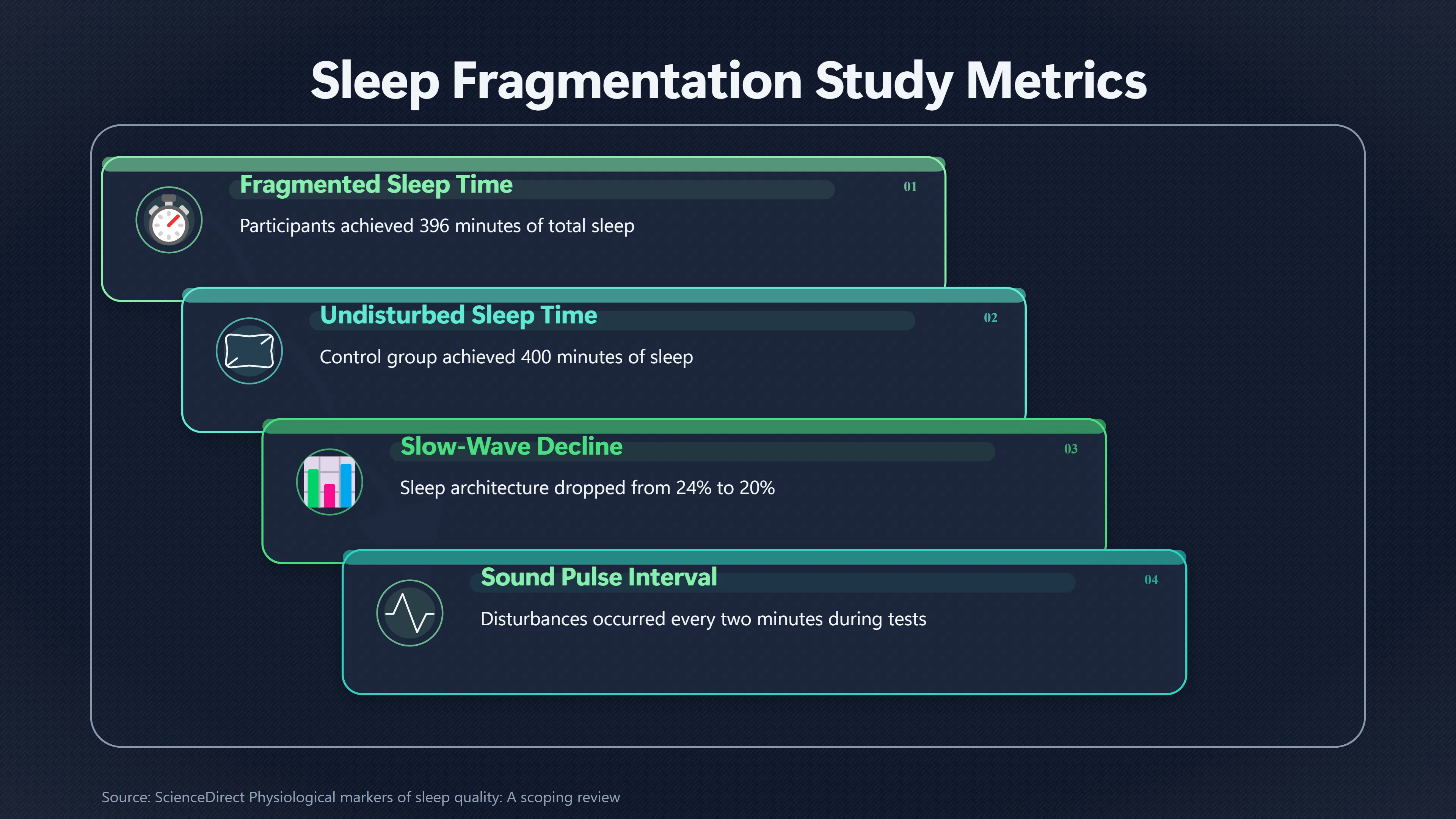
Sleep can be long enough on the clock and still leave attention less reliable the next day. Sleep fragmentation means repeated arousals or awakenings that break otherwise continuous sleep. Experimental studies show that these interruptions can increase daytime sleepiness and impair sustained attention even when total sleep time changes little or, in some protocols, is deliberately preserved. In one controlled experiment, participants obtained about 396 minutes of sleep during a fragmented night versus 400 minutes during undisturbed sleep, yet fragmentation made it harder to remain awake and worsened measures that included sustained attention.[OUP Academic]academic.oup.comOUP AcademicEffect of Sleep Fragmentation on Daytime Function | American Journal of Respiratory and Critical Care Medicine | Oxford Acade…
That distinction matters for self-improvement. Counting hours is useful, but it does not capture whether those hours were consolidated. A nominally adequate sleep window can therefore coexist with poorer next-day vigilance if sleep is repeatedly interrupted. The practical target is not merely enough opportunity to sleep, but enough uninterrupted sleep opportunity for sleep to remain restorative.
What repeated awakenings do to vigilance
The strongest evidence for an effect independent of substantially shorter sleep comes from experiments that deliberately fragment sleep while keeping total sleep time similar.
A particularly clear example involved 16 healthy participants whose sleep was disturbed with sound pulses approximately every two minutes. The sounds were adjusted to produce brief electroencephalographic, or EEG, arousals. Despite this intensive disruption, total sleep time was essentially unchanged: 396 ± 24 minutes after fragmentation versus 400 ± 20 minutes after undisturbed sleep, a statistically non-significant difference. The next day, however, participants became sleepy more quickly on the Multiple Sleep Latency Test and were less able to maintain wakefulness on the Maintenance of Wakefulness Test. Performance measures also indicated poorer mental flexibility and sustained attention.[OUP Academic]academic.oup.comOUP AcademicEffect of Sleep Fragmentation on Daytime Function | American Journal of Respiratory and Critical Care Medicine | Oxford Acade…
An even subtler experiment suggests that disruption need not always become an obvious awakening. Twelve healthy participants were exposed to sounds approximately every minute, most of which produced autonomic responses — such as transient changes in heart rate or blood pressure — without a conventionally visible EEG arousal. Total sleep time again barely changed: 414 ± 32 minutes during fragmentation versus 419 ± 27 minutes during undisturbed sleep. Nevertheless, slow-wave sleep fell and participants were objectively sleepier the following day on both sleep-latency and wakefulness-maintenance tests.[PubMed]pubmed.ncbi.nlm.nih.govPub Med The effect of nonvisible sleep fragmentation on daytime functionThe effect of nonvisible sleep fragmentation on daytime function - PubMed…
Other laboratory work has found electrophysiological signs of impaired attention after fragmentation without reduced total sleep time. Measurements of waking EEG activity and auditory event-related potentials — brain responses to stimuli — indicated reduced arousal and impaired information processing after experimentally fragmented sleep. The investigators concluded that this relatively subtle disruption produced sustained impairment of alertness and attention despite no reduction in total sleep time.[PubMed]pubmed.ncbi.nlm.nih.govOpen source on nih.gov.
These experiments expose the weakness of treating nightly duration as a complete measure of restorative sleep. Two nights can contain roughly the same number of scored minutes asleep while differing considerably in how those minutes are organised.
Why the same number of hours can work differently
Sleep is not simply an accumulation of interchangeable unconscious minutes. During a normal night, the brain moves through stages of non-rapid-eye-movement and rapid-eye-movement sleep in an organised pattern. Repeated arousals can force transitions towards lighter sleep, interrupt deeper stages and alter the continuity of that architecture.
In the experiment involving autonomic fragmentation, for example, slow-wave sleep declined from 24% to 20% even though total sleep time remained virtually unchanged.[PubMed]pubmed.ncbi.nlm.nih.govPub Med The effect of nonvisible sleep fragmentation on daytime functionThe effect of nonvisible sleep fragmentation on daytime function - PubMed… A broader review of physiological markers of sleep quality found that greater fragmentation generally tracked poorer perceived sleep quality, while slow-wave sleep showed moderate associations with better performance on vigilance, motor-speed and executive-function tasks. The review also emphasised that these relationships are inconsistent across studies, so no single sleep stage should be treated as a simple explanation for next-day performance.[ScienceDirect]sciencedirect.comScienceDirect Physiological markers of sleep quality: A scoping reviewPhysiological markers of sleep quality: A scoping review - ScienceDirectAugust 1, 2022…
Frequent arousals also repeatedly shift the sleeping brain towards wakefulness. An older physiological experiment found that brief, frequent arousals increased overnight metabolism and reduced morning performance, mood and alertness even though total sleep time was only minimally reduced. The authors did not claim that the metabolic changes themselves caused the impairment, but the findings illustrate that apparently small interruptions are physiologically active events rather than neutral gaps in an otherwise restorative night.[PubMed]pubmed.ncbi.nlm.nih.govPub Med Metabolism during normal, fragmented, and recovery sleepMetabolism during normal, fragmented, and recovery sleep - PubMed…
This helps explain the basic mechanism without overstating it. Fragmentation can reduce the restorative value of a given quantity of scored sleep by changing its continuity and composition. The downstream expression may be greater sleep pressure during the day, reduced alertness and less dependable information processing.
There is, however, an important scientific qualification. Researchers have debated whether “continuity” is truly an independent restorative property or whether fragmentation simply reduces the amount of effective restorative sleep. A review and reanalysis argued that some apparent continuity effects could be explained by fragmentation increasing stage 1, or very light, sleep: conventional total-sleep-time calculations count those minutes as sleep even though they may contribute relatively little to recuperation.[PubMed]pubmed.ncbi.nlm.nih.govPub Med Does sleep fragmentation impact recuperation? A review and reanalysisDoes sleep fragmentation impact recuperation? A review and reanalysis - PubMed…
For everyday purposes, the distinction does not overturn the practical finding. Whether interruptions damage attention because continuity itself is necessary, because they replace deeper sleep with less restorative light sleep, or through a mixture of these processes, hours alone can conceal a meaningful loss of sleep quality.
Fragmented sleep versus shortened sleep
Fragmentation and sleep restriction are different manipulations. Restriction reduces the opportunity to sleep; fragmentation repeatedly interrupts sleep within an available sleep window. Both can impair next-day function, but they should not automatically be treated as physiologically identical.
A useful head-to-head experiment studied 61 healthy adults aged 20–29. One group experienced a four-hour sleep opportunity; another had an eight-hour opportunity interrupted by four awakenings lasting roughly 15 minutes each. Compared with their normal nights, both conditions increased omission and commission errors on a sustained-attention task. Both also increased fatigue and confusion and reduced vigour. The researchers detected no significant difference between the two experimental conditions on these consequences.[ScienceDirect]sciencedirect.comEffects of one night of induced night-wakings versus sleep restriction on sustained attention and mood: a pilot study - Scie…
That result is striking because the fragmented condition retained an eight-hour sleep window, but it should be interpreted carefully. The awakenings themselves consumed part of that window, so this experiment does not isolate continuity while holding actual sleep duration perfectly constant. Its value is different: it shows that a realistic pattern of repeated night waking can produce next-day attention failures comparable, in that small study, with a substantially restricted sleep opportunity.[PubMed]pubmed.ncbi.nlm.nih.govOpen source on nih.gov.
Not every comparison finds fragmentation equally damaging. In another small within-person study of 20 healthy men, a five-hour restriction night produced a stronger overall disturbance than a night fragmented by hourly light exposure, and the psychomotor vigilance test did not detect significant changes from either manipulation.[PubMed]pubmed.ncbi.nlm.nih.govOpen source on nih.gov. That null result is useful: fragmentation does not inevitably cause a measurable vigilance deficit after every protocol or every single night.
A 2003 review comparing sleep fragmentation with sleep deprivation reached a suitably restrained conclusion. Both can increase objective sleepiness and degrade reaction time, vigilance, short-term-memory performance and mood, while the severity of impairment depends heavily on the degree of disruption rather than simply on which label is applied to it.[PubMed]pubmed.ncbi.nlm.nih.govPub Med Clinical effects of sleep fragmentation versus sleep deprivationPub Med Clinical effects of sleep fragmentation versus sleep deprivation
The evidence therefore does not support the simplistic claim that fragmented sleep is always “as bad as” sleeping fewer hours. It supports something narrower and more useful: preserving time in bed does not guarantee preserved vigilance when that sleep is repeatedly broken.
Attention can fail even when the night looks adequate
The practical problem with fragmentation is that it can be poorly represented by a simple bedtime-to-wake-time calculation. Someone can spend eight hours in bed and conclude that sleep quantity cannot explain next-day lapses, while repeated awakenings have substantially altered what happened within those eight hours.
Recent experimental work strengthens this point. In a 2024 study of 20 premenopausal women, researchers deliberately fragmented sleep for three nights but extended the sleep opportunity so that sleep duration would not be shortened. Vigilance was assessed with the ten-minute psychomotor vigilance task (PVT), which measures reaction time and counts unusually slow responses as attentional lapses. Fragmentation adversely affected neurobehavioural performance under one of the study’s hormonal conditions, including slower reactions, and increased subjective sleepiness. The investigators concluded that adequate sleep duration did not eliminate the adverse effects associated with disrupted continuity.[PubMed Central (PMC)]pmc.ncbi.nlm.nih.govOpen source on nih.gov.
That study is particularly relevant because it addresses a weakness of many earlier fragmentation experiments: if awakenings simply remove an hour of sleep, poorer performance might be attributed to that lost hour rather than fragmentation. Extending the sleep opportunity makes it possible to preserve duration more closely while disturbing continuity.[PubMed Central (PMC)]pmc.ncbi.nlm.nih.govOpen source on nih.gov.
At the same time, cognitive effects are not uniform. Another experiment used non-awakening auditory stimulation to fragment sleep across three consecutive nights while maintaining similar total sleep time. Fragmentation altered sleep architecture and increased subjective fatigue, but the researchers did not find broad deterioration across all of their vigilance, memory and cognitive-fatigue measures; inhibition was the behavioural measure that clearly worsened.[PubMed]pubmed.ncbi.nlm.nih.govPub Med Impact of Sleep Fragmentation on Cognition and FatiguePub Med Impact of Sleep Fragmentation on Cognition and Fatigue
That variability is important. Broken sleep raises the risk of impaired alertness and attention; it does not mean that every person will perform worse on every cognitive test after every interrupted night.
Why uninterrupted sleep opportunity matters
For self-improvement, the evidence changes what counts as a useful sleep goal. “I was in bed for eight hours” answers a question about sleep opportunity, not necessarily about restorative sleep. Even measured total sleep time cannot completely describe continuity, because conventional scoring can count a night containing frequent arousals and stage transitions as nearly as long as an undisturbed one.
The relevant distinction is therefore between three quantities: time in bed, total time scored as asleep, and how continuously that sleep occurred. Fragmentation studies demonstrate why the third deserves attention alongside the first two. Researchers have even developed fragmentation indices based on awakenings and sleep-stage shifts because total sleep time and sleep efficiency do not fully capture the disruption represented by repeated arousals.[PubMed]pubmed.ncbi.nlm.nih.govOpen source on nih.gov.
This does not mean occasional normal awakenings should be treated as evidence of a problem. Arousals occur naturally, and their frequency varies with factors including age.[PubMed]pubmed.ncbi.nlm.nih.govOpen source on nih.gov. The experimentally induced disruptions that reliably impair daytime function are generally more frequent or more systematic than an isolated remembered awakening.
The useful lesson is narrower: when next-day sustained attention remains poor despite apparently adequate sleep duration, sleep continuity is a legitimate variable to consider rather than assuming that duration tells the whole story. Repeated awakenings can leave enough sleep on the clock while making vigilance less stable the following day.
For a self-improvement strategy built around reliable attention, that makes protecting an uninterrupted sleep opportunity more meaningful than chasing a duration number in isolation. Sleep quantity remains important, but the experimental evidence shows why continuous sleep and sufficient sleep are complementary goals rather than interchangeable ones.
Amazon book picks
Further Reading
Books and field guides related to Interrupted Sleep Can Hurt Attention Too. Use these as the next step if you want deeper reading beyond the article.
Why We Sleep
"Sleep is one of the most important but least understood aspects of our life, wellness, and longevity ... An explosion of scientific disc...
The Sleep Solution
With cutting-edge sleep science and time-tested techniques, The Sleep Solution will help anyone achieve healthy sleep and eliminate pills...
The Promise of Sleep
Sleep better, live longer with the groundbreaking information and step-by-step program in this revolutionary book. Healthful sleep has be...
Say Good Night to Insomnia
Emphasis on changing sleep thoughts and behaviors, and managing insomnia by managing stress.
eBay marketplace picks
Marketplace Samples
Live-tested eBay searches with available results related to this page.
Selected fromsleep accessories oneBay.co.uk.


Endnotes
1.
Source: academic.oup.com
Link:https://academic.oup.com/ajrccm/article-abstract/153/4/1328/8552642
Source snippet
OUP AcademicEffect of Sleep Fragmentation on Daytime Function | American Journal of Respiratory and Critical Care Medicine | Oxford Acade...
2.
Source: sciencedirect.com
Title: ScienceDirect Physiological markers of sleep quality: A scoping review
Link:https://www.sciencedirect.com/science/article/pii/S1087079222000703
Source snippet
Physiological markers of sleep quality: A scoping review - ScienceDirectAugust 1, 2022...
Published: August 1, 2022
3.
Source: sciencedirect.com
Link:https://www.sciencedirect.com/science/article/pii/S1389945714001579
Source snippet
Effects of one night of induced night-wakings versus sleep restriction on sustained attention and mood: a pilot study - Scie...
4.
Source: sciencedirect.com
Link:https://www.sciencedirect.com/science/article/pii/S0031938419311394
5.
Source: academic.oup.com
Link:https://academic.oup.com/sleep/article/45/7/zsac046/6537622
6.
Source: academic.oup.com
Link:https://academic.oup.com/sleep/article-abstract/43/Supplement_1/A75/5846998
7.
Source: academic.oup.com
Link:https://academic.oup.com/sleep/article/42/Supplement_1/A49/5451074
8.
Source: sciencedirect.com
Title: The neurocognitive consequences of sleep restriction: A meta-analytic review
Link:https://www.sciencedirect.com/science/article/abs/pii/S0149763417301641
9.
Source: sciencedirect.com
Title: Idiopathic hypersomnia
Link:https://www.sciencedirect.com/science/article/pii/S1087079215001112
10.
Source: sciencedirect.com
Link:https://www.sciencedirect.com/science/article/pii/S1389945704001157
11.
Source: academic.oup.com
Link:https://academic.oup.com/ajrccm/article-abstract/155/5/1596/8551995
12.
Source: academic.oup.com
Link:https://academic.oup.com/sleep/article-abstract/17/5/438/2749503
13.
Source: sciencedirect.com
Title: Infrequent periodic sleep disruption: Effects on sleep, performance and mood
Link:https://www.sciencedirect.com/science/article/abs/pii/0031938489902369
14.
Source: academic.oup.com
Link:https://academic.oup.com/sleep/article/8/1/11/2750302
15.
Source: sciencedirect.com
Title: The effect of experimental sleep fragmentation on error monitoring
Link:https://www.sciencedirect.com/science/article/abs/pii/S0301051114002658
16.
Source: sciencedirect.com
Link:https://www.sciencedirect.com/science/article/pii/S2110582025015225
17.
Source: sciencedirect.com
Title: The neurocognitive consequences of sleep restriction: A meta-analytic review
Link:https://www.sciencedirect.com/science/article/pii/S0149763417301641
18.
Source: sciencedirect.com
Title: Influencing dreams through sensory stimulation: A systematic review
Link:https://www.sciencedirect.com/science/article/pii/S1087079224000121
19.
Source: sciencedirect.com
Link:https://www.sciencedirect.com/author/7005084907/avi-sadeh
20.
Source: pubmed.ncbi.nlm.nih.gov
Title: Pub Med The effect of sleep fragmentation on daytime function
Link:https://pubmed.ncbi.nlm.nih.gov/8616562/
Source snippet
The effect of sleep fragmentation on daytime function - PubMed...
21.
Source: pubmed.ncbi.nlm.nih.gov
Title: Pub Med The effect of nonvisible sleep fragmentation on daytime function
Link:https://pubmed.ncbi.nlm.nih.gov/9154863/
Source snippet
The effect of nonvisible sleep fragmentation on daytime function - PubMed...
22.
Source: pubmed.ncbi.nlm.nih.gov
Link:https://pubmed.ncbi.nlm.nih.gov/14572121/
23.
Source: pubmed.ncbi.nlm.nih.gov
Title: Pub Med Metabolism during normal, fragmented, and recovery sleep
Link:https://pubmed.ncbi.nlm.nih.gov/1757306/
Source snippet
Metabolism during normal, fragmented, and recovery sleep - PubMed...
24.
Source: pubmed.ncbi.nlm.nih.gov
Title: Pub Med Does sleep fragmentation impact recuperation? A review and reanalysis
Link:https://pubmed.ncbi.nlm.nih.gov/10646163/
Source snippet
Does sleep fragmentation impact recuperation? A review and reanalysis - PubMed...
25.
Source: pubmed.ncbi.nlm.nih.gov
Link:https://pubmed.ncbi.nlm.nih.gov/24891081/
26.
Source: pubmed.ncbi.nlm.nih.gov
Link:https://pubmed.ncbi.nlm.nih.gov/31874181/
27.
Source: pubmed.ncbi.nlm.nih.gov
Title: Pub Med Clinical effects of sleep fragmentation versus sleep deprivation
Link:https://pubmed.ncbi.nlm.nih.gov/14505597/
28.
Source: pmc.ncbi.nlm.nih.gov
Link:https://pmc.ncbi.nlm.nih.gov/articles/PMC11321839/
29.
Source: pubmed.ncbi.nlm.nih.gov
Link:https://pubmed.ncbi.nlm.nih.gov/38874415/
30.
Source: pubmed.ncbi.nlm.nih.gov
Title: Pub Med Impact of Sleep Fragmentation on Cognition and Fatigue
Link:https://pubmed.ncbi.nlm.nih.gov/36497559/
31.
Source: pubmed.ncbi.nlm.nih.gov
Link:https://pubmed.ncbi.nlm.nih.gov/15511704/
32.
Source: pubmed.ncbi.nlm.nih.gov
Title: Pub Med A state transition-based method for quantifying EEG sleep fragmentation
Link:https://pubmed.ncbi.nlm.nih.gov/19705179/
33.
Source: pubmed.ncbi.nlm.nih.gov
Link:https://pubmed.ncbi.nlm.nih.gov/25471634/
34.
Source: pmc.ncbi.nlm.nih.gov
Link:https://pmc.ncbi.nlm.nih.gov/articles/PMC12990338/
35.
Source: pubmed.ncbi.nlm.nih.gov
Link:https://pubmed.ncbi.nlm.nih.gov/41745406/
36.
Source: pubmed.ncbi.nlm.nih.gov
Link:https://pubmed.ncbi.nlm.nih.gov/41878708/
37.
Source: pmc.ncbi.nlm.nih.gov
Link:https://pmc.ncbi.nlm.nih.gov/articles/PMC12713949/
38.
Source: pmc.ncbi.nlm.nih.gov
Link:https://pmc.ncbi.nlm.nih.gov/articles/PMC12354256/
39.
Source: pubmed.ncbi.nlm.nih.gov
Link:https://pubmed.ncbi.nlm.nih.gov/39078935/
40.
Source: pubmed.ncbi.nlm.nih.gov
Link:https://pubmed.ncbi.nlm.nih.gov/38038673/
41.
Source: pubmed.ncbi.nlm.nih.gov
Link:https://pubmed.ncbi.nlm.nih.gov/38353411/
42.
Source: pubmed.ncbi.nlm.nih.gov
Link:https://pubmed.ncbi.nlm.nih.gov/37743582/
43.
Source: pmc.ncbi.nlm.nih.gov
Link:https://pmc.ncbi.nlm.nih.gov/articles/PMC10529275/
44.
Source: pubmed.ncbi.nlm.nih.gov
Link:https://pubmed.ncbi.nlm.nih.gov/35578403/
45.
Source: pmc.ncbi.nlm.nih.gov
Link:https://pmc.ncbi.nlm.nih.gov/articles/PMC10900040/
46.
Source: pmc.ncbi.nlm.nih.gov
Link:https://pmc.ncbi.nlm.nih.gov/articles/PMC9740245/
47.
Source: pmc.ncbi.nlm.nih.gov
Link:https://pmc.ncbi.nlm.nih.gov/articles/PMC9272266/
48.
Source: pmc.ncbi.nlm.nih.gov
Link:https://pmc.ncbi.nlm.nih.gov/articles/PMC8177706/
49.
Source: pmc.ncbi.nlm.nih.gov
Link:https://pmc.ncbi.nlm.nih.gov/articles/PMC8637582/
50.
Source: pmc.ncbi.nlm.nih.gov
Link:https://pmc.ncbi.nlm.nih.gov/articles/8193556/
51.
Source: pubmed.ncbi.nlm.nih.gov
Link:https://pubmed.ncbi.nlm.nih.gov/32031019/
52.
Source: pmc.ncbi.nlm.nih.gov
Link:https://pmc.ncbi.nlm.nih.gov/articles/PMC6265542/
53.
Source: pmc.ncbi.nlm.nih.gov
Link:https://pmc.ncbi.nlm.nih.gov/articles/PMC5386280/
54.
Source: pubmed.ncbi.nlm.nih.gov
Link:https://pubmed.ncbi.nlm.nih.gov/28364467/?duplicate_of=27634802
55.
Source: pubmed.ncbi.nlm.nih.gov
Link:https://pubmed.ncbi.nlm.nih.gov/27250816/
56.
Source: pmc.ncbi.nlm.nih.gov
Link:https://pmc.ncbi.nlm.nih.gov/articles/PMC4813351/
57.
Source: pmc.ncbi.nlm.nih.gov
Link:https://pmc.ncbi.nlm.nih.gov/articles/PMC4246141/
58.
Source: pubmed.ncbi.nlm.nih.gov
Link:https://pubmed.ncbi.nlm.nih.gov/22913604/
59.
Source: pmc.ncbi.nlm.nih.gov
Link:https://pmc.ncbi.nlm.nih.gov/articles/PMC3545009/
60.
Source: pubmed.ncbi.nlm.nih.gov
Link:https://pubmed.ncbi.nlm.nih.gov/22470524/
61.
Source: pmc.ncbi.nlm.nih.gov
Link:https://pmc.ncbi.nlm.nih.gov/articles/PMC2851141/
62.
Source: pubmed.ncbi.nlm.nih.gov
Link:https://pubmed.ncbi.nlm.nih.gov/19742409/
63.
Source: pmc.ncbi.nlm.nih.gov
Link:https://pmc.ncbi.nlm.nih.gov/articles/PMC2865224/
64.
Source: pubmed.ncbi.nlm.nih.gov
Link:https://pubmed.ncbi.nlm.nih.gov/2274618/
65.
Source: pubmed.ncbi.nlm.nih.gov
Link:https://pubmed.ncbi.nlm.nih.gov/7991955/
66.
Source: pubmed.ncbi.nlm.nih.gov
Link:https://pubmed.ncbi.nlm.nih.gov/3596950/
67.
Source: pmc.ncbi.nlm.nih.gov
Link:https://pmc.ncbi.nlm.nih.gov/articles/PMC8764943/
68.
Source: pubmed.ncbi.nlm.nih.gov
Link:https://pubmed.ncbi.nlm.nih.gov/10646171/
69.
Source: pubmed.ncbi.nlm.nih.gov
Link:https://pubmed.ncbi.nlm.nih.gov/21075235/
70.
Source: pubmed.ncbi.nlm.nih.gov
Link:https://pubmed.ncbi.nlm.nih.gov/11386203/
71.
Source: pubmed.ncbi.nlm.nih.gov
Link:https://pubmed.ncbi.nlm.nih.gov/12531154/
72.
Source: science.gov
Link:https://www.science.gov/topicpages/n/night%2Bblindness
73.
Source: science.gov
Link:https://www.science.gov/topicpages/n/night%2Beating%2Bsyndrome
74.
Source: science.gov
Link:https://www.science.gov/topicpages/r/rdecom%2Bcerdec%2Bnight
75.
Source: science.gov
Link:https://www.science.gov/topicpages/z/zolpidem-induced%2Bsleepwalking%2Bsleep
Additional References
76.
Source: research.ed.ac.uk
Link:https://www.research.ed.ac.uk/en/publications/the-effect-of-nonvisible-sleep-fragmentation-on-daytime-function
Source snippet
inburgh ResearchThe effect of nonvisible sleep fragmentation on daytime function - University of Edinburgh Research Explorer...
77.
Source: research.ed.ac.uk
Title: Edinburgh Research The effect of sleep fragmentation on daytime function
Link:https://www.research.ed.ac.uk/en/publications/the-effect-of-sleep-fragmentation-on-daytime-function/
Source snippet
inburgh ResearchThe effect of sleep fragmentation on daytime function - University of Edinburgh Research Explorer...
78.
Source: youtube.com
Link:https://www.youtube.com/watch?v=4hqtpO_zL9k
Source snippet
Why You Wake Up Tired Even After 8 Hours: Fix These Morning Killers Fast...
79.
Source: youtube.com
Title: Why You Wake Up Tired Even After 8 Hours: Fix These Morning Killers Fast
Link:https://www.youtube.com/watch?v=G7ZPN2kCksI
Source snippet
ADHD + Restless Legs + Bad Sleep: The Dopamine–Iron Link Nobody Explains...
80.
Source: youtube.com
Title: Improving Sleep to Slow the Progression of Alzheimer’s Disease
Link:https://www.youtube.com/watch?v=Nfmjd1SduR8
Source snippet
Even in midlife, disrupted sleep tied to memory, thinking problems later on...
81.
Source: youtube.com
Title: Tossing & Turning? The Physiology of Sleep Fragmentation in Insomnia
Link:https://www.youtube.com/watch?v=Jotr6AQFPkY
Source snippet
Improving Sleep to Slow the Progression of Alzheimer's Disease...
82.
Source: researchgate.net
Link:https://www.researchgate.net/publication/352142837_The_CHD8CHD7Kismet_family_links_blood-brain_barrier_glia_and_serotonin_to_ASD-associated_sleep_defects
83.
Source: researchgate.net
Link:https://www.researchgate.net/publication/261999314_Effects_of_one_night_of_induced_night-wakings_versus_sleep_restriction_on_sustained_attention_and_mood_A_pilot_study
84.
Source: pou3f3.org
Link:https://pou3f3.org/family-resources/
85.
Source: frontiersin.org
Link:https://www.frontiersin.org/journals/psychology/articles/10.3389/fpsyg.2018.02089/full