Within Exercise
Why Starting Exercise Matters More Than Repeating Every Detail
A repeatable pre-workout ritual can make starting exercise more automatic even when the workout itself changes from day to day.
On this page
- Exercise instigation versus workout execution
- Building a stable pre workout sequence
- Keeping the start consistent while varying the session
Page outline Jump by section
Introduction
A workout does not have to become identical from day to day for exercise to become easier to start. The more useful target for repetition may be the beginning of the session: encountering a familiar cue, carrying out the same short preparation sequence and reaching an exercise-ready state. Research distinguishes this process — exercise instigation or preparation — from execution, meaning the workout itself. Instigation habit has predicted exercise frequency more strongly than habitual execution in observational work, while intervention studies increasingly suggest that practising preparation can help people exercise more often.[PubMed]pubmed.ncbi.nlm.nih.govHabitual exercise instigation (vs. execution) predicts healthy adults' exercise frequency - PubMedJanuary 1, 2016…
That makes a starting ritual a practical form of self-improvement: standardise the few minutes before exercise, not necessarily the next 30 or 60. Trainers can go on after the same daily transition; a bottle can be filled; a mat can be unfolded; then the actual session can remain flexible.
Starting matters differently from doing
Exercise looks like one behaviour in a diary — “went to the gym” or “ran for 30 minutes” — but psychologically it can contain distinct phases. Instigation concerns selecting and initiating exercise. Execution concerns progressing through the actions that make up the workout once it has begun. Habit researchers have argued that these phases need not become automatic to the same degree.[BPS Psych Hub]bpspsychub.onlinelibrary.wiley.comBPS Psych HubHabitual instigation and habitual execution: Definition, measurement, and effects on behaviour frequency - Gardner - 2016…
A particularly relevant study by L. Alison Phillips and Benjamin Gardner followed 123 healthy adults using surveys and a month of electronic daily diaries. Instigation-habit strength was the only unique habit measure that predicted exercise frequency: execution-habit strength and simply performing the same exercise pattern from session to session did not uniquely predict frequency. Changes in exercise frequency were also associated with changes in instigation habit rather than execution habit.[PubMed]pubmed.ncbi.nlm.nih.govHabitual exercise instigation (vs. execution) predicts healthy adults' exercise frequency - PubMedJanuary 1, 2016…
That finding changes what “consistent exercise” can mean. Someone need not run the same route, perform the same lifts or follow the same video every Tuesday. The repeatable unit can instead be something like:
finish work → change clothes → fill water bottle → put on trainers → begin
Once that sequence reaches the point where exercise has started, the person might run, cycle, lift weights or take an online class. The ritual provides consistency where consistency has particular behavioural value — at the transition from not exercising to exercising.
A second study sharpened this distinction by separating preparation from performance. Among 181 adults recruited from nine gyms and recreation centres, both intention and preparatory-habit strength predicted exercise over six weeks, whereas performance habit did not. Temporal consistency was the strongest predictor among the proposed habit antecedents in both phases. The authors concluded that focusing on a consistent preparatory routine could help establish exercise habit.[PubMed]pubmed.ncbi.nlm.nih.govPub Med The role of habit in different phases of exerciseThe role of habit in different phases of exercise - PubMed…
These studies are important but should not be overread. Much of the foundational evidence is observational and uses self-reported habit measures, so it cannot prove that making a ritual automatic will by itself cause long-term exercise adherence. A systematic review of longitudinal physical-activity research found the instigation/preparation literature promising but still too small to confirm the proposed advantage conclusively.[PubMed Central (PMC)]pmc.ncbi.nlm.nih.govOpen source on nih.gov.
Build a stable pre-workout sequence
A useful starting ritual has two jobs. First, it makes the beginning recognisable: there is a clear situation in which preparation starts. Second, it makes the route from that situation to exercise short and repeatable.
This fits the broader mechanism of habit formation. Habits are learned associations in which recurring contexts increasingly prompt a behavioural response with less deliberation. For exercise, the ritual can supply a compact sequence of cues and actions even when the eventual workout is complex.[BPS Psych Hub]bpspsychub.onlinelibrary.wiley.comBPS Psych HubHabitual instigation and habitual execution: Definition, measurement, and effects on behaviour frequency - Gardner - 2016…
The practical design is therefore deliberately modest:
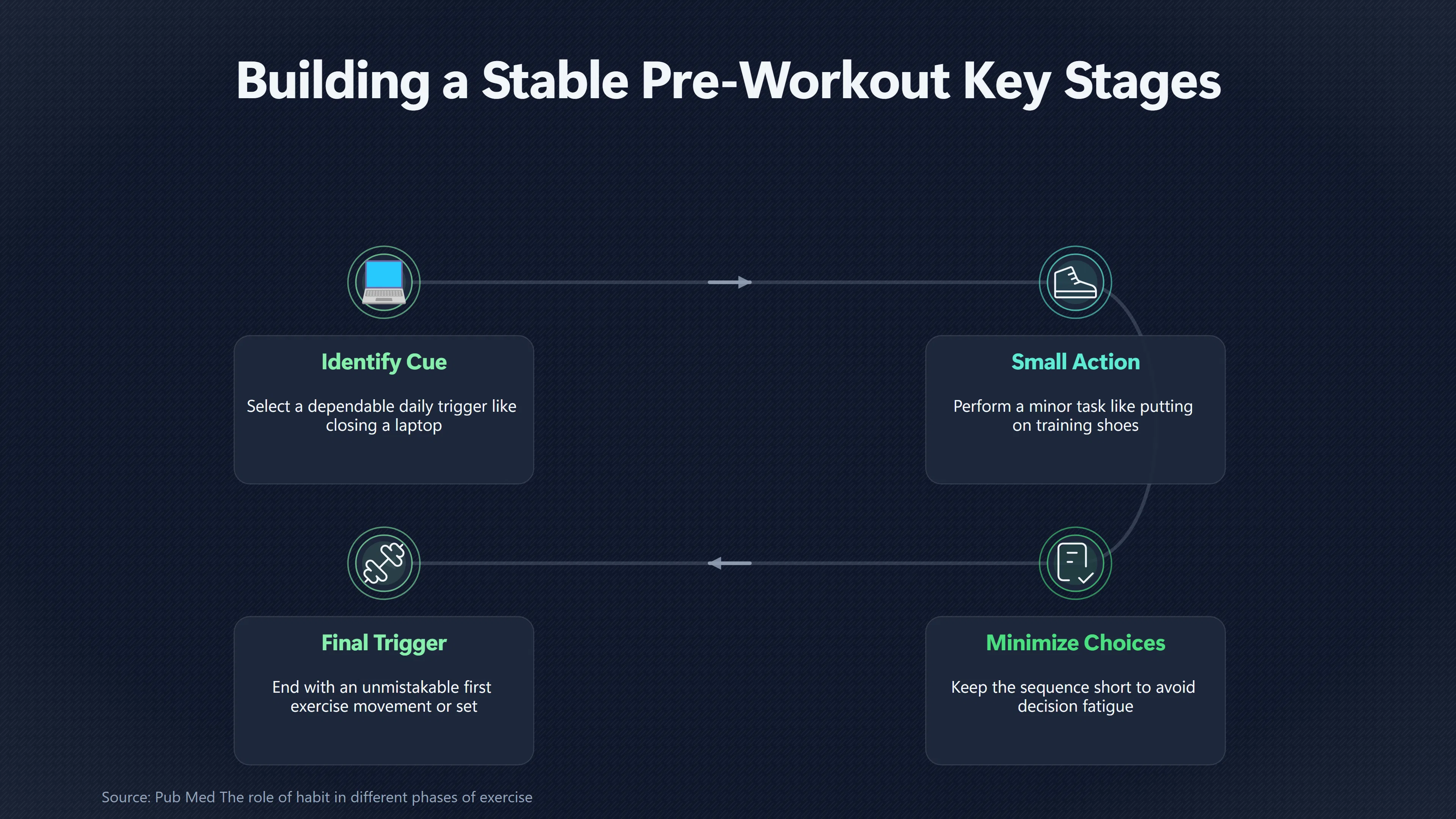
- Choose a dependable starting cue. Prefer something that already occurs reliably: finishing breakfast, closing a work laptop, arriving home or returning from the school run.
- Attach a small preparation action. Change into exercise clothes, put on trainers, unfold the mat or open the exercise programme.
- Keep the sequence short. Each additional choice creates another point at which the transition can stall. Decide equipment and basic logistics beforehand where practical.
- End the ritual with an unmistakable first exercise action. Walk outside, start the warm-up, begin the first set or press play on the class. Preparation should lead into exercise rather than becoming an elaborate routine of its own.
- Repeat the cue-to-start sequence even when the workout varies. The stable behaviour is the transition into exercise.
Planning can reinforce this structure. Implementation intentions specify the situation and intended response — essentially, “when X happens, I will do Y”. A meta-analysis of 26 physical-activity studies found small-to-moderate positive effects at both post-intervention and follow-up. A later review of 13 randomised trials found a more qualified picture: the overall pooled effect was not statistically significant, but studies that reinforced implementation intentions showed a significant benefit, and planning for barriers also appeared useful.[Taylor & Francis Online]tandfonline.comOpen source on tandfonline.com.
A ritual therefore works better as a concrete response to a cue than as a motivational slogan. “Exercise after work” still leaves room for negotiation. “When I shut my laptop on Monday, Wednesday and Friday, I change into the clothes beside my desk and start my five-minute warm-up” specifies what the transition actually looks like.

Keep the start consistent while the session changes
One of the most useful consequences of the instigation-versus-execution distinction is that variety inside the workout need not destroy the starting habit. Phillips and Gardner explicitly distinguished patterned exercise — repeatedly doing the same exercise actions — from habitual instigation. Patterned exercise itself did not uniquely predict exercise frequency in their study.[PubMed]pubmed.ncbi.nlm.nih.govHabitual exercise instigation (vs. execution) predicts healthy adults' exercise frequency - PubMedJanuary 1, 2016…
This matters because rigid workout repetition can clash with ordinary exercise needs. Strength programmes progress, runners change routes, weather alters outdoor plans, people sometimes have only 15 minutes rather than an hour, and enjoyment may depend on variety. A starting ritual can absorb those changes by putting stability one level earlier in the behavioural sequence.
Consider three days that all begin after the same end-of-work cue:
- On Monday, changing clothes and putting on trainers leads to a 30-minute run.
- On Wednesday, the same preparation leads to a short home strength session.
- On Friday, it leads to a walk because time or energy is limited.
The exercise content differs, but the behavioural transition remains recognisable. That is closer to what the instigation evidence implies than insisting that every detail of every workout occur in exactly the same way. It also preserves a useful distinction between making exercise easier to begin and optimising exercise programming, which is a separate problem.
There is some experimental support for concentrating on cues and consistency. In a randomised trial of 94 new gym members who intended to exercise but were initially below physical-activity guidelines, a habit-focused intervention taught participants to use cues and practise consistently. After eight weeks, the intervention group increased moderate-to-vigorous physical activity relative to controls on both accelerometer and self-report measures, while also reporting greater cue use and practice consistency. The authors described the findings as initial evidence rather than definitive proof and called for longer follow-up.[PubMed]pubmed.ncbi.nlm.nih.govIncreasing Physical Activity Through Principles of Habit Formation in New Gym Members: a Randomized Controlled Trial - PubMed…
The newest substantial intervention evidence points in a similar direction. A year-long factorial experiment involving 751 new users of an online exercise-class platform separately tested components aimed at intrinsic motivation and identity, exercise preparation habit and exercise instigation habit. The preparation-habit component produced the clearest evidence of benefit: it increased preparation- and instigation-habit strength and showed some positive effects on exercise participation, particularly online class frequency. Other expected intervention effects were not significant, so the result supports preparation as promising rather than establishing it as a universal solution.[wiley.com]iaap-journals.onlinelibrary.wiley.comOpen source on wiley.com.
Consistency should serve the cue, not become a constraint
Habit theory often emphasises stable contexts, but “stable” should not automatically be translated into “exercise at precisely 18:00 in precisely the same room”. Context can include time, location, preceding behaviour, social surroundings and other cues, and evidence about which form of stability matters most for physical activity is not completely settled.
For example, an ecological momentary assessment study followed 104 older adults for ten days and combined repeated reports of context with accelerometer monitoring. More stable physical contexts were associated with more moderate-to-vigorous physical activity, but the measured context-stability variables did not predict physical-activity habit strength.[PubMed]pubmed.ncbi.nlm.nih.govOpen source on nih.gov. A newer year-long study of 202 older adults found that context stability was more consistently related to changes in habit strength than to behaviour itself, while the cue that mattered could differ between individuals.[PubMed]pubmed.ncbi.nlm.nih.govOpen source on nih.gov.
The practical implication is to seek enough stability for the start to become recognisable, rather than constructing a brittle ritual that fails whenever life changes. “After breakfast, I put on my walking shoes” may survive a change in breakfast time better than “at exactly 07:15 I exercise”. “When I arrive home from work, I change straight into training clothes” may remain useful even when the planned workout changes.
This also explains why an extremely elaborate ritual can defeat its purpose. The mechanism is supposed to reduce the amount of deliberation between cue and action. If starting requires choosing a playlist, mixing a particular drink, finding several pieces of equipment, selecting among ten workouts and waiting for the perfect mood, the preparation phase has accumulated decisions instead of becoming easier to reproduce.

What a good starting ritual actually achieves
The strongest interpretation of the evidence is narrower — and more useful — than saying motivation no longer matters. Starting rituals do not guarantee that someone will exercise, and implementation intentions appear to work better under some conditions than others. A systematic review found that factors including intention, self-efficacy and perceived behavioural control could influence how well implementation intentions translate into physical activity.[PubMed]pubmed.ncbi.nlm.nih.govOpen source on nih.gov.
What the ritual can do is relocate some of the behavioural work. Instead of solving the entire question “Will I exercise, and what exactly will I do?” at the moment when the session is due, the person repeatedly encounters a familiar cue and performs a prepared opening sequence. Repetition gives that beginning an opportunity to become increasingly automatic.
That makes the most useful test of a ritual surprisingly simple. It does not need to make every workout identical, eliminate conscious choice or produce an effortless hour of training. It needs to make the transition into exercise more dependable. The evidence on instigation, preparation and cue-based interventions suggests that repeating how a session begins may be more important for exercise frequency than repeating every detail of what happens after it has begun.[PubMed]pubmed.ncbi.nlm.nih.govHabitual exercise instigation (vs. execution) predicts healthy adults' exercise frequency - PubMedJanuary 1, 2016…
Amazon book picks
Further Reading
Books and field guides related to Why Starting Exercise Matters More Than Repeating Every Detail. Use these as the next step if you want deeper reading beyond the article.
Atomic Habits
Rating: 3.5/5 from 7 Google Books ratings
The #1 New York Times bestseller. Over 25 million copies sold! Translated into 60+ languages! Tiny Changes, Remarkable Results No matter...
No Sweat
Do you secretly hate exercising? Struggle to stick with a program? Millions of people try and fail to stay fit. But what if "exercising"...
Tiny Habits
Improving your life is much easier than you think. Whether it’s losing weight, sleeping more, or restoring your work/life balance – the s...
The Joy of Movement
The bestselling author of The Willpower Instinct introduces a surprising science-based book that doesn't tell us why we should exercise b...
eBay marketplace picks
Marketplace Samples
Live-tested eBay searches with available results related to this page.
Selected fromfitness poster oneBay.co.uk.
Endnotes
1.
Source: pubmed.ncbi.nlm.nih.gov
Link:https://pubmed.ncbi.nlm.nih.gov/26148187/
Source snippet
Habitual exercise instigation (vs. execution) predicts healthy adults' exercise frequency - PubMedJanuary 1, 2016...
Published: January 1, 2016
2.
Source: pubmed.ncbi.nlm.nih.gov
Title: Pub Med The role of habit in different phases of exercise
Link:https://pubmed.ncbi.nlm.nih.gov/28374463/
Source snippet
The role of habit in different phases of exercise - PubMed...
3.
Source: pubmed.ncbi.nlm.nih.gov
Link:https://pubmed.ncbi.nlm.nih.gov/39354798/
Source snippet
A full-factorial test of motivational and volitional intervention strategies for promoting exercise habit formation and exercise ma...
4.
Source: bpspsychub.onlinelibrary.wiley.com
Link:https://bpspsychub.onlinelibrary.wiley.com/doi/abs/10.1111/bjhp.12189
Source snippet
BPS Psych HubHabitual instigation and habitual execution: Definition, measurement, and effects on behaviour frequency - Gardner - 2016...
5.
Source: pmc.ncbi.nlm.nih.gov
Link:https://pmc.ncbi.nlm.nih.gov/articles/PMC7969808/
6.
Source: bpspsychub.onlinelibrary.wiley.com
Title: BPS Psych Hub The role of habit in different phases of exercise
Link:https://bpspsychub.onlinelibrary.wiley.com/doi/abs/10.1111/bjhp.12237
Source snippet
BPS Psych HubThe role of habit in different phases of exercise - Kaushal - 2017 - British Journal of Health Psychology - Wiley Online Lib...
7.
Source: pubmed.ncbi.nlm.nih.gov
Link:https://pubmed.ncbi.nlm.nih.gov/28188586/
Source snippet
Increasing Physical Activity Through Principles of Habit Formation in New Gym Members: a Randomized Controlled Trial - PubMed...
8.
Source: tandfonline.com
Link:https://www.tandfonline.com/doi/full/10.1080/17437199.2011.560095
9.
Source: pmc.ncbi.nlm.nih.gov
Link:https://pmc.ncbi.nlm.nih.gov/articles/PMC6235272/
Source snippet
PubMed Central (PMC)Impact of implementation intentions on physical activity practice in adults: A systematic review and meta-analysis of...
10.
Source: pubmed.ncbi.nlm.nih.gov
Link:https://pubmed.ncbi.nlm.nih.gov/29945470/
11.
Source: iaap-journals.onlinelibrary.wiley.com
Link:https://iaap-journals.onlinelibrary.wiley.com/doi/10.1111/aphw.12597
12.
Source: pmc.ncbi.nlm.nih.gov
Link:https://pmc.ncbi.nlm.nih.gov/articles/PMC11652125/
13.
Source: pubmed.ncbi.nlm.nih.gov
Link:https://pubmed.ncbi.nlm.nih.gov/33502088/
14.
Source: bpspsychub.onlinelibrary.wiley.com
Link:https://bpspsychub.onlinelibrary.wiley.com/doi/10.1111/bjhp.12509
15.
Source: pubmed.ncbi.nlm.nih.gov
Link:https://pubmed.ncbi.nlm.nih.gov/41664442/
16.
Source: pubmed.ncbi.nlm.nih.gov
Link:https://pubmed.ncbi.nlm.nih.gov/31923898/
17.
Source: pmc.ncbi.nlm.nih.gov
Link:https://pmc.ncbi.nlm.nih.gov/articles/PMC13114073/
18.
Source: tandfonline.com
Link:https://www.tandfonline.com/doi/abs/10.1080/08870446.2025.2528925
19.
Source: pmc.ncbi.nlm.nih.gov
Link:https://pmc.ncbi.nlm.nih.gov/articles/PMC12379489/
20.
Source: bpspsychub.onlinelibrary.wiley.com
Link:https://bpspsychub.onlinelibrary.wiley.com/doi/abs/10.1111/bjhp.12795
21.
Source: bpspsychub.onlinelibrary.wiley.com
Link:https://bpspsychub.onlinelibrary.wiley.com/doi/full/10.1111/bjhp.12795
22.
Source: iaap-journals.onlinelibrary.wiley.com
Link:https://iaap-journals.onlinelibrary.wiley.com/toc/17580854/2025/17/1
23.
Source: iaap-journals.onlinelibrary.wiley.com
Link:https://iaap-journals.onlinelibrary.wiley.com/doi/toc/10.1111/%28ISSN%291758-0854.psychology-of-habit
24.
Source: pmc.ncbi.nlm.nih.gov
Link:https://pmc.ncbi.nlm.nih.gov/articles/PMC11659695/
25.
Source: pmc.ncbi.nlm.nih.gov
Link:https://pmc.ncbi.nlm.nih.gov/articles/PMC11635918/
26.
Source: pmc.ncbi.nlm.nih.gov
Link:https://pmc.ncbi.nlm.nih.gov/articles/PMC11178247/
27.
Source: pmc.ncbi.nlm.nih.gov
Link:https://pmc.ncbi.nlm.nih.gov/articles/PMC10669490/
28.
Source: pmc.ncbi.nlm.nih.gov
Link:https://pmc.ncbi.nlm.nih.gov/articles/PMC7617183/
29.
Source: pmc.ncbi.nlm.nih.gov
Link:https://pmc.ncbi.nlm.nih.gov/articles/PMC10151500/
30.
Source: pmc.ncbi.nlm.nih.gov
Link:https://pmc.ncbi.nlm.nih.gov/articles/PMC9540191/
31.
Source: pmc.ncbi.nlm.nih.gov
Link:https://pmc.ncbi.nlm.nih.gov/articles/PMC9372943/
32.
Source: pmc.ncbi.nlm.nih.gov
Link:https://pmc.ncbi.nlm.nih.gov/articles/PMC9374066/
33.
Source: pmc.ncbi.nlm.nih.gov
Link:https://pmc.ncbi.nlm.nih.gov/articles/PMC9223740/
34.
Source: pubmed.ncbi.nlm.nih.gov
Link:https://pubmed.ncbi.nlm.nih.gov/35742582/
35.
Source: pmc.ncbi.nlm.nih.gov
Link:https://pmc.ncbi.nlm.nih.gov/articles/PMC9226889/
36.
Source: pubmed.ncbi.nlm.nih.gov
Link:https://pubmed.ncbi.nlm.nih.gov/35756236/
37.
Source: pmc.ncbi.nlm.nih.gov
Link:https://pmc.ncbi.nlm.nih.gov/articles/PMC8961486/
38.
Source: pmc.ncbi.nlm.nih.gov
Link:https://pmc.ncbi.nlm.nih.gov/articles/PMC8783455/
39.
Source: pmc.ncbi.nlm.nih.gov
Link:https://pmc.ncbi.nlm.nih.gov/articles/PMC8296287/
40.
Source: pubmed.ncbi.nlm.nih.gov
Link:https://pubmed.ncbi.nlm.nih.gov/34198658/
41.
Source: pmc.ncbi.nlm.nih.gov
Link:https://pmc.ncbi.nlm.nih.gov/articles/PMC8250330/
42.
Source: ncbi.nlm.nih.gov
Title: research news
Link:https://www.ncbi.nlm.nih.gov/search/research-news/12815/
43.
Source: bpspsychub.onlinelibrary.wiley.com
Link:https://bpspsychub.onlinelibrary.wiley.com/doi/pdfdirect/10.1111/bjhp.12509
44.
Source: pmc.ncbi.nlm.nih.gov
Link:https://pmc.ncbi.nlm.nih.gov/articles/PMC7645026/
45.
Source: onlinelibrary.wiley.com
Link:https://onlinelibrary.wiley.com/doi/10.1002/9781119568124.ch48
46.
Source: onlinelibrary.wiley.com
Link:https://onlinelibrary.wiley.com/doi/full/10.1002/oby.22535
47.
Source: onlinelibrary.wiley.com
Link:https://onlinelibrary.wiley.com/doi/abs/10.1002/oby.22535
48.
Source: pubmed.ncbi.nlm.nih.gov
Link:https://pubmed.ncbi.nlm.nih.gov/30427874/
49.
Source: pmc.ncbi.nlm.nih.gov
Link:https://pmc.ncbi.nlm.nih.gov/articles/PMC5932761/
50.
Source: pubmed.ncbi.nlm.nih.gov
Link:https://pubmed.ncbi.nlm.nih.gov/29720097/
51.
Source: bpspsychub.onlinelibrary.wiley.com
Link:https://bpspsychub.onlinelibrary.wiley.com/doi/10.1111/bjhp.12237
52.
Source: pmc.ncbi.nlm.nih.gov
Link:https://pmc.ncbi.nlm.nih.gov/articles/PMC6144778/
53.
Source: tandfonline.com
Link:https://www.tandfonline.com/doi/full/10.1080/21642850.2014.896743
54.
Source: pmc.ncbi.nlm.nih.gov
Link:https://pmc.ncbi.nlm.nih.gov/articles/PMC4346081/
55.
Source: pubmed.ncbi.nlm.nih.gov
Link:https://pubmed.ncbi.nlm.nih.gov/22468716/
56.
Source: pubmed.ncbi.nlm.nih.gov
Link:https://pubmed.ncbi.nlm.nih.gov/41949147/
57.
Source: iaap-journals.onlinelibrary.wiley.com
Link:https://iaap-journals.onlinelibrary.wiley.com/doi/epdf/10.1111/aphw.12597
58.
Source: doi.org
Link:https://doi.org/10.1016/j.actpsy.2026.106690
Additional References
59.
Source: youtube.com
Title: Exercise: How to (Re)Start the Habit
Link:https://www.youtube.com/watch?v=lWI-2y-kyXw
Source snippet
For a practical breakdown on lowering friction and establishing automated starting rituals to make beginning workouts easier, see How to...
60.
Source: youtube.com
Title: How to Start Exercise Habit Using The 2min Rule From The Book “Atomic Habits”
Link:https://www.youtube.com/watch?v=QGU5tc3u7ks
Source snippet
How to use behavior change techniques for exercise (plus 3 of my favorites)...
61.
Source: youtube.com
Title: How to use behavior change techniques for exercise (plus 3 of my favorites)
Link:https://www.youtube.com/watch?v=Z1rhbNT9Zp8
Source snippet
Master the 4-Step Habit Loop to Build Lasting Exercise Routines...
62.
Source: youtube.com
Title: Master the 4-Step Habit Loop to Build Lasting Exercise Routines
Link:https://www.youtube.com/watch?v=DJWGL6qtlDU
Source snippet
How Busy Parents Stay Consistent With Exercise by Removing Friction...
63.
Source: researchgate.net
Link:https://www.researchgate.net/publication/384564278_A_full-factorial_test_of_motivational_and_volitional_intervention_strategies_for_promoting_exercise_habit_formation_and_exercise_maintenance_among_new_users_of_an_online_exercise_class_platform
64.
Source: researchgate.net
Link:https://www.researchgate.net/publication/233472164_A_meta-analytic_review_of_the_effect_of_implementation_intentions_on_physical_activity
65.
Source: researchgate.net
Link:https://www.researchgate.net/publication/279807291_Habitual_Exercise_Instigation_vs_Execution_Predicts_Healthy_Adults%27_Exercise_Frequency
66.
Source: visualize.jove.com
Link:https://visualize.jove.com/39354798-a-full-factorial-test-of-motivational-and-volitional-intervention-strategies-for-promoting-exercise-habit-formation-and-exercise-maintenance-among-new-users-of-an-online-exercise-class-platform
67.
Source: mendeley.com
Link:https://www.mendeley.com/catalogue/2585407b-c5ec-3725-a58a-0d836471bfa5/
68.
Source: healthevidence.org
Link:https://www.healthevidence.org/view-article.aspx?a=meta-analytic-review-effect-implementation-intentions-physical-activity-25322