Within Motivation Limits
When Habit Advice Promises Too Much
Stable routines can help habits form, but changing environments and complex behaviours prevent automaticity from becoming a universal substitute for motivation.
On this page
- Why repetition does not guarantee effortless action
- Evidence that context effects are not uniform
- Which behaviours remain vulnerable to disruption
Page outline Jump by section
Introduction
Habit formation can make self-improvement less dependent on moment-to-moment motivation, but it does not make motivation obsolete. The important qualification is context. Psychological habits are learned links between cues and responses: repetition can make a behaviour easier to initiate when familiar cues recur, but that automaticity is not necessarily portable to a different schedule, place, social setting or version of the task.[Association for Psychological Science]psychologicalscience.orgAssociation for Psychological ScienceHabits, Goals, and Effective Behavior Change - Current Directions in Psychological Science - APS…
That distinction matters because real life is not perfectly repetitive. Work patterns change, people travel or move house, family responsibilities shift, and behaviours such as exercising or studying require many variable decisions. Research supports using stable contexts to build habits, while also showing substantial variation in automaticity, in which cues matter, and in whether automaticity translates into maintained behaviour. Habit is therefore best understood as a way to reduce some recurring motivational demands, not as a mechanism that eventually makes any important behaviour effortless everywhere.[PubMed Central (PMC)]pmc.ncbi.nlm.nih.govOpen source on nih.gov.
Why repetition does not guarantee effortless action
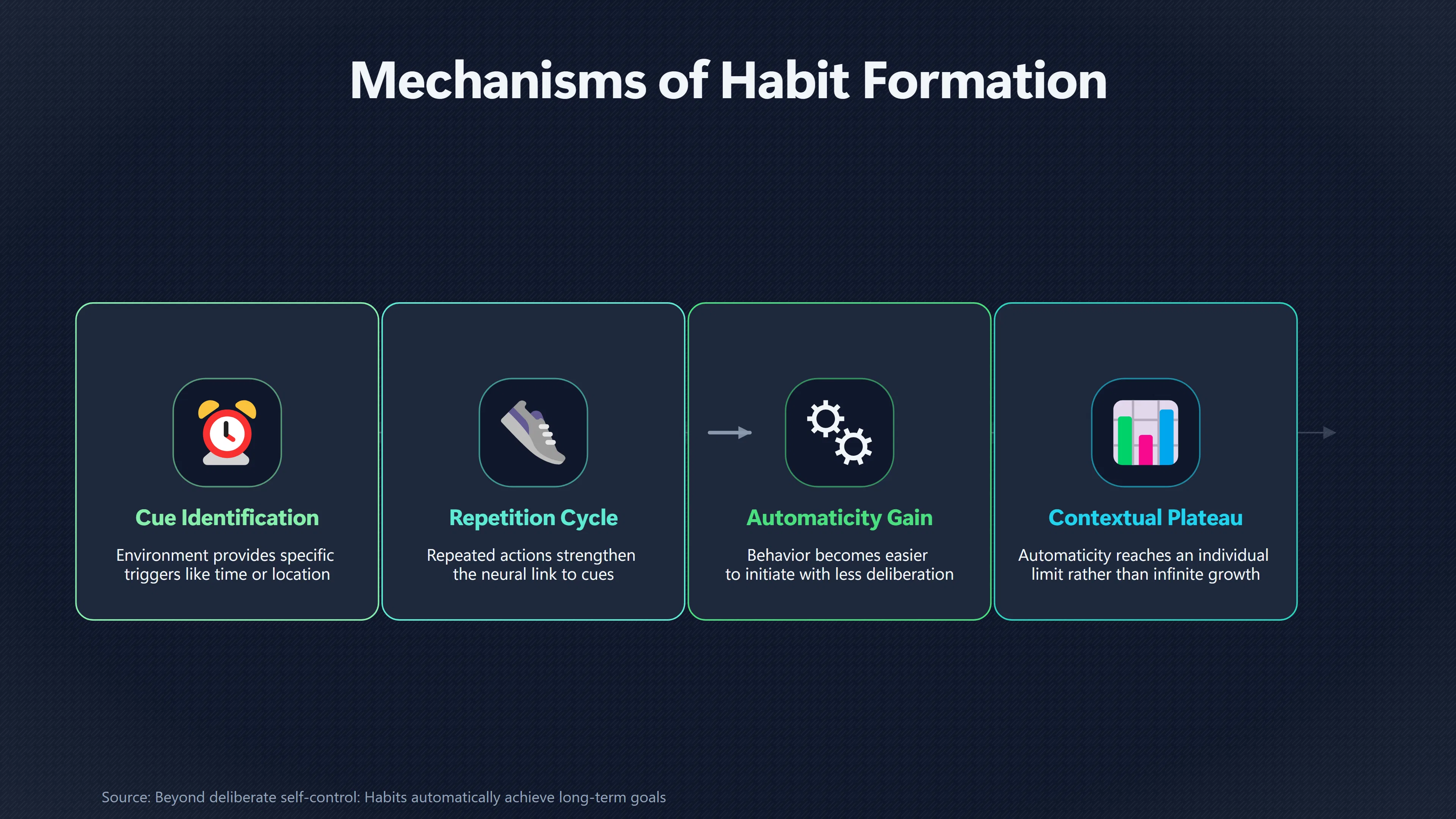
The familiar advice to “repeat something until it becomes automatic” leaves out a crucial condition. Repetition is most useful for habit formation when the behaviour and its cues recur together. Habit researchers commonly describe the resulting mechanism as a learned cue–response association: encountering a familiar context can generate an impulse towards the previously repeated action without requiring a fresh decision about what to do.[PubMed Central (PMC)]pmc.ncbi.nlm.nih.govPubMed Central (PMC)A review and analysis of the use of ‘habit’ in understanding, predicting and influencing health-related behaviour - P…
This means automaticity is not simply a property acquired by a behaviour after enough repetitions. It is partly a relationship between a behaviour and the circumstances in which it has been learned. Fifty repetitions scattered unpredictably across different situations need not produce the same learning as fifty repetitions reliably following a particular cue.
A six-week study of 95 university students illustrates the point. Students assigned to build study habits at consistent times and places were compared with students told to vary their times and rooms. Across this experiment and a second dataset drawn from a habit-building app, greater context stability predicted greater automaticity and better attainment of repetition goals. In the experimental study, the relationship between fluctuations in context stability and automaticity appeared only in the group whose overall context had been kept relatively stable.[PubMed Central (PMC)]pmc.ncbi.nlm.nih.govPubMed Central (PMC)Context Stability in Habit Building Increases Automaticity and Goal Attainment - PMCJune 10, 2022…
More recent experimental evidence comes from walking. In a randomised study of 127 insufficiently active working adults, both consistent-context and varied-context planning increased walking during the four-week intervention, but only the consistent-context planners developed and retained greater walking automaticity. Having a more routine daily schedule also helped some participants develop automaticity.[PubMed]pubmed.ncbi.nlm.nih.govConfirming the Causal Role of Consistent Contexts in Developing a Walking Habit: A Randomized Comparison With Varied Contexts - PubMed…
These findings support stable routines, but they do not support the stronger promise that sufficient repetition eventually makes behaviour universally effortless. Even under favourable conditions, habit formation varies markedly between people and behaviours. In the influential real-world study by Phillippa Lally and colleagues, the estimated time to reach 95% of an individual’s eventual automaticity ranged from 18 to 254 days among participants whose data fitted the model. Automaticity also approached an individual plateau rather than increasing indefinitely.[Wiley Online Library]onlinelibrary.wiley.comWiley Online LibraryHow are habits formed: Modelling habit formation in the real world - Lally - 2010 - European Journal of Social Psycho…
A 2024 systematic review and meta-analysis reinforces that variability. Across 20 health-habit studies involving 2,601 participants, the few studies reporting formation times produced median estimates of roughly 59–66 days and mean estimates of 106–154 days, with individual values spanning 4–335 days. Eleven of the 20 studies were rated at high risk of bias, so even these figures should not be treated as a universal timetable.[PubMed Central (PMC)]pmc.ncbi.nlm.nih.govOpen source on nih.gov.
The practical lesson is more useful than a “21-day” or “66-day” rule: repetition can progressively reduce the amount of deliberate initiation a behaviour requires, but there is no research-supported point at which an arbitrary behaviour becomes permanently motivation-free.
Context effects are not uniform
“Keep the context consistent” sounds straightforward until context has to be defined. A cue could be a clock time, location, person, mood, preceding activity or recurring event. Different behaviours may become linked to different combinations of these cues.
That complication appears clearly in physical-activity research. In a study of 1,244 Australian adults, greater consistency in routine and mood was associated with greater physical-activity automaticity, whereas greater consistency in time and people present was associated with physical-activity behaviour itself. Location was not the universal master cue that simple habit advice might lead someone to expect.[PubMed]pubmed.ncbi.nlm.nih.govCue Consistency Associated with Physical Activity Automaticity and Behavior - PubMedApril 11, 2015…
A smaller 2024 prospective study produced another mixed pattern. Habit more strongly mediated the relationship between previous and later physical activity when participants reported consistency in time of day, type of activity and mood. Consistency in place, people present and position within a routine did not show the same moderating effect. The sample contained only 68 university students, so these particular cue rankings should not be generalised broadly; their importance is that they challenge the assumption that every form of contextual consistency operates identically.[PubMed Central (PMC)]pmc.ncbi.nlm.nih.govOpen source on nih.gov.
There are also findings that do not neatly support a context-stability-to-habit pathway. An ecological momentary assessment study followed 104 older adults for ten days while continuously measuring their movement. Stable physical contexts were associated with more moderate-to-vigorous physical activity, and aspects of context stability also related to sedentary behaviour. Yet none of the measured context-stability scores predicted participants’ reported habit strength for physical activity or sedentary behaviour.[PubMed]pubmed.ncbi.nlm.nih.govOpen source on nih.gov.
More recent longitudinal research likewise suggests that the relevant cue can be individual rather than universal. A study following 202 older adults across three data-collection periods found context stability was more consistently related to changes in habit strength than to changes in actual movement behaviour, while associations depended on whether people were adopting or maintaining behaviour and on which cue was most stable for the individual.[PubMed]pubmed.ncbi.nlm.nih.govOpen source on nih.gov.
So “use a consistent cue” remains sensible advice, but the evidence does not justify turning it into “always do the behaviour at exactly the same time and place”. For some behaviours, a functional cue such as “after breakfast” may be more useful than 7.30 am; for others, the preceding routine, social situation or internal state may be more predictive. The broader theoretical literature accordingly recognises that useful habit cues can include internal and functional contexts rather than only fixed external locations and clock times.[ScienceDirect]sciencedirect.comOpen source on sciencedirect.com.
What happens when life changes the cues?
The context-dependence that helps habits form also creates a vulnerability: change the context and the old cue may no longer reliably trigger the response. Habit memory does not necessarily vanish, but its opportunity to control behaviour can weaken when the environment that normally activates it disappears. Contemporary habit theory therefore treats disruption of context cues as one route through which established behaviour can be changed.[Association for Psychological Science]psychologicalscience.orgAssociation for Psychological ScienceHabits, Goals, and Effective Behavior Change - Current Directions in Psychological Science - APS…
Moving home provides unusually useful real-world evidence because it alters many everyday cues at once. Research on the “habit discontinuity” hypothesis has found that relocation can temporarily loosen established behavioural patterns. In a study of university employees, stronger environmental concern was associated with less car commuting among people who had recently moved home, consistent with the idea that disrupted travel routines gave deliberate preferences more opportunity to influence behaviour.[ScienceDirect]sciencedirect.comOpen source on sciencedirect.com.
A much larger analysis used data from 18,053 people in the UK Understanding Society survey. Again, stronger environmental attitudes predicted lower car use among recent movers, with evidence that the effect diminished as time since moving increased. The finding is particularly revealing for self-improvement: context disruption can expose the deliberate decision-making that a stable routine had previously reduced.[PubMed Central (PMC)]pmc.ncbi.nlm.nih.govOpen source on nih.gov.
A field experiment involving 800 households reached a related conclusion. An intervention encouraging sustainable behaviours was more effective among people who had recently relocated than among matched non-movers, and the researchers estimated that this post-move “window of opportunity” lasted roughly three months.[ScienceDirect]sciencedirect.comOpen source on sciencedirect.com.
That mechanism cuts both ways. Context change can help break an unwanted habit, but it can also interrupt a useful one. A person who reliably exercises after commuting home may discover that the routine stops firing after switching to remote work. Someone who studies automatically at a particular library may need substantially more deliberate effort while travelling. A meal-preparation routine built around a predictable Sunday afternoon becomes less protective when shift work makes Sundays unpredictable.
This is one reason apparently successful habits sometimes fail precisely when they are most needed. What has become easy may be performing behaviour X in context Y, rather than performing X under arbitrary conditions.
Complex behaviours retain motivational work
The limits become more important as behaviour becomes more complicated. Taking a vitamin after breakfast is relatively discrete. “Exercise regularly”, “study every evening” or “eat healthily” can describe sequences containing many separate actions and decisions.
A major review of health-behaviour research cautioned against assuming that evidence about automatising simple actions transfers wholesale to complex behaviour. Complex activities may contain multiple components, and the evidence reviewed did not establish that everyday health behaviours typically become rigid action sequences carried through without conscious input. The useful distinction is between habitual initiation and automatic execution of the whole activity. A cue might automatically get someone to start exercising without automatically selecting the workout, adjusting its intensity, finding equipment, dealing with an injury or persisting through every difficult part.[PubMed Central (PMC)]pmc.ncbi.nlm.nih.govPubMed Central (PMC)A review and analysis of the use of ‘habit’ in understanding, predicting and influencing health-related behaviour - P…
A later conceptual review developed this complexity problem further. Complex habits can contain separable or substitutable components rather than one fixed response. Their rewards may also need to operate differently from those supporting simpler behaviours. In other words, treating “going for a run” and “maintaining an exercise programme” as psychologically equivalent habits risks hiding much of the work involved in the latter.[PubMed]pubmed.ncbi.nlm.nih.govOpen source on nih.gov.
Empirical evidence points in the same direction, although it should not be overinterpreted. In a survey in which 459 participants assessed 25 behaviours, including exercise, handwashing, smoking and medication adherence, perceived complexity was negatively associated with automaticity. Frequency, contextual stability and reward were positively associated with automaticity, while complexity altered some of those relationships.[PubMed Central (PMC)]pmc.ncbi.nlm.nih.govOpen source on nih.gov.
This suggests a more realistic target for self-improvement: automate the recurring gateway where possible, rather than expecting the entire goal to become unconscious. Automatically putting on running shoes after arriving home can reduce the motivational burden of starting. It does not remove decisions about route, pace, weather or whether pain warrants stopping. Automatically opening study materials after dinner can eliminate one daily negotiation without making difficult intellectual work effortless.
That narrower version of habit formation is less spectacular than promises to “put success on autopilot”, but it fits the evidence better.

Automaticity is not the same as reliable behaviour
A final distinction prevents habit advice from being oversold: researchers usually measure habit strength or automaticity separately from whether a person actually performs the target behaviour. The two are related, but they are not interchangeable.
Gardner’s review defines habit as a learned process through which a stimulus generates an impulse towards an action. Crucially, that impulse can combine or compete with other influences and need not produce the behaviour. Conscious decisions, competing actions and inhibitions can still win.[PubMed Central (PMC)]pmc.ncbi.nlm.nih.govPubMed Central (PMC)A review and analysis of the use of ‘habit’ in understanding, predicting and influencing health-related behaviour - P…
The 2024 walking experiment offers a concrete example. Consistent-context planners developed greater automaticity, but contrary to the researchers’ expectation, that experimental condition did not itself show superior maintenance of walking after the intervention. Across participants, people who had developed greater automaticity did maintain walking better, but automaticity was not a guarantee of continued performance.[PubMed]pubmed.ncbi.nlm.nih.govConfirming the Causal Role of Consistent Contexts in Developing a Walking Habit: A Randomized Comparison With Varied Contexts - PubMed…
This matters whenever circumstances introduce barriers that an automatic impulse cannot solve. A habitual intention to cycle to work does not repair a puncture. A study cue cannot create two uninterrupted hours in an unexpectedly busy evening. An exercise routine may trigger the impulse to train while illness, childcare or travel prevents execution. The automatic process can reduce one source of friction — deciding or remembering to begin — while practical constraints still determine whether action is possible.
For long-term behaviour change, then, habit and motivation should not be treated as rival explanations where one eventually replaces the other. Stable cue–response learning can shift some repeated actions away from continual deliberation, making behaviour less sensitive to everyday fluctuations in enthusiasm.[PubMed]pubmed.ncbi.nlm.nih.govPub Med Psychology of HabitPsychology of Habit - PubMed… But when contexts change, behaviours are complex or competing demands become stronger, deliberate regulation can become important again.
A more durable interpretation of habit advice
The evidence supports a bounded version of the habit strategy. Repeating a manageable action in a recognisable context can strengthen automatic initiation, and stable contexts often help that process. The mistake is extending that finding into a promise that enough repetition makes a complex self-improvement goal effortless under all conditions.[PubMed]pubmed.ncbi.nlm.nih.govOpen source on nih.gov.
For goals that must survive real-world variation, four distinctions are especially useful:
- Automatic initiation is not automatic completion. A habit can make starting easier while the difficult or variable parts of the activity still require conscious regulation.[PubMed Central (PMC)]pmc.ncbi.nlm.nih.govPubMed Central (PMC)A review and analysis of the use of ‘habit’ in understanding, predicting and influencing health-related behaviour - P…
- A strong habit in one context is not necessarily a portable habit. Travel, relocation, remote working and schedule changes can remove or weaken the cues that previously did motivational work.[ScienceDirect]sciencedirect.comOpen source on sciencedirect.com.
- Context is multidimensional. Time and place can matter, but so can preceding routines, people, mood and other cues; studies do not find that the same contextual dimension predicts automaticity for everyone or every behaviour.[PubMed]pubmed.ncbi.nlm.nih.govOpen source on nih.gov.
- Automaticity is an influence on behaviour, not a guarantee of it. Competing responses and real-world constraints remain capable of overriding a habitual impulse.[PubMed]pubmed.ncbi.nlm.nih.govOpen source on nih.gov.
The strongest self-improvement systems therefore do not require habit to carry more weight than it can. Habits are particularly valuable for stable, recurring pieces of behaviour: beginning a morning walk, preparing medication after breakfast, opening a study session after a dependable cue, or initiating another repeated action. When life changes, however, some deliberate planning and motivation may have to return while new cue–response relationships are established. Habit formation can lower the recurring motivational cost of action; it cannot make changing circumstances irrelevant.
Amazon book picks
Further Reading
Books and field guides related to When Habit Advice Promises Too Much. Use these as the next step if you want deeper reading beyond the article.
Good Habits, Bad Habits
'The world's leading expert on habits' - Matthew Syed, bestselling author of Black Box Thinking and Rebel IdeasWhat if you could harness...
Atomic Habits
Rating: 3.5/5 from 7 Google Books ratings
The #1 New York Times bestseller. Over 25 million copies sold! Translated into 60+ languages! Tiny Changes, Remarkable Results No matter...
The Power of Habit
Rating: 4.0/5 from 145 Google Books ratings
Duhigg takes us to the edge of scientific discoveries that explain why habits exist and how they can be changed. Distilling information i...
How to Change
Wall Street Journal bestseller “A welcome revelation.” --The Financial Times Award-winning Wharton Professor and Choiceology podcast host...
eBay marketplace picks
Marketplace Samples
Live-tested eBay searches with available results related to this page.
Selected frommotivational wall art oneBay.co.uk.



Endnotes
1.
Source: sciencedirect.com
Link:https://www.sciencedirect.com/science/article/pii/S002210311100254X
Source snippet
How do habits guide behavior? Perceived and actual triggers of habits in daily life - ScienceDirect...
2.
Source: onlinelibrary.wiley.com
Link:https://onlinelibrary.wiley.com/doi/10.1002/ejsp.674
Source snippet
Wiley Online LibraryHow are habits formed: Modelling habit formation in the real world - Lally - 2010 - European Journal of Social Psycho...
3.
Source: sciencedirect.com
Link:https://www.sciencedirect.com/science/article/pii/S146902921930130X
4.
Source: compass.onlinelibrary.wiley.com
Link:https://compass.onlinelibrary.wiley.com/doi/full/10.1111/spc3.12975
5.
Source: sciencedirect.com
Link:https://www.sciencedirect.com/science/article/pii/S0272494407000898
6.
Source: sciencedirect.com
Link:https://www.sciencedirect.com/science/article/pii/S0272494415300487
7.
Source: sciencedirect.com
Title: Beyond deliberate [self-control]({{ ‘self-control/’ | relative_url }}): Habits automatically achieve long-term goals
Link:https://www.sciencedirect.com/science/article/pii/S2352250X24000939
8.
Source: compass.onlinelibrary.wiley.com
Link:https://compass.onlinelibrary.wiley.com/doi/10.1111/spc3.12975?af=R
9.
Source: compass.onlinelibrary.wiley.com
Link:https://compass.onlinelibrary.wiley.com/doi/abs/10.1111/spc3.12975
10.
Source: compass.onlinelibrary.wiley.com
Link:https://compass.onlinelibrary.wiley.com/doi/epdf/10.1111/spc3.12975
11.
Source: bpspsychub.onlinelibrary.wiley.com
Link:https://bpspsychub.onlinelibrary.wiley.com/doi/10.1111/bjhp.12637
12.
Source: bpspsychub.onlinelibrary.wiley.com
Link:https://bpspsychub.onlinelibrary.wiley.com/doi/10.1111/bjhp.12509
13.
Source: bpspsychub.onlinelibrary.wiley.com
Link:https://bpspsychub.onlinelibrary.wiley.com/doi/abs/10.1111/bjhp.12504
14.
Source: sciencedirect.com
Link:https://www.sciencedirect.com/science/article/abs/pii/S146902921930130X
15.
Source: sciencedirect.com
Title: Habit discontinuity and student travel mode choice
Link:https://www.sciencedirect.com/science/article/pii/S1369847818305874
16.
Source: onlinelibrary.wiley.com
Link:https://onlinelibrary.wiley.com/doi/abs/10.1002/ejsp.674
17.
Source: onlinelibrary.wiley.com
Link:https://onlinelibrary.wiley.com/doi/abs/10.1002/ejsp.674?MixPanelId=15e3fe314440-0468d8411-64220f54-100000-15e3fe314460
18.
Source: onlinelibrary.wiley.com
Link:https://onlinelibrary.wiley.com/doi/abs/10.1002/ejsp.674?source=content_type%3Areact%7Cfirst_level_url%3Aarticle%7Csection%3Amain_content%7Cbutton%3Abody_link
19.
Source: onlinelibrary.wiley.com
Link:https://onlinelibrary.wiley.com/doi/abs/10.1002/ejsp.674?msockid=038ed114f43667dd0790c4bef5146634
20.
Source: onlinelibrary.wiley.com
Link:https://onlinelibrary.wiley.com/doi/abs/10.1002/ejsp.674?cf_chl_jschl_tk=pmd_EwcJDaCFBR9OVEL1O_0qjioww0Gc86ZzpBvCBFhrDcE-1635261061-0-gqNtZGzNAjujcnBszQi9
21.
Source: onlinelibrary.wiley.com
Link:https://onlinelibrary.wiley.com/doi/abs/10.1002/ejsp.674?msockid=17570258034862e732eb114c02616368
22.
Source: onlinelibrary.wiley.com
Title: j.1559 1816.1998.tb01681.x
Link:https://onlinelibrary.wiley.com/doi/10.1111/j.1559-1816.1998.tb01681.x
23.
Source: sciencedirect.com
Link:https://www.sciencedirect.com/author/7004701242/bas-verplanken
24.
Source: sciencedirect.com
Title: Beyond deliberate self-control: Habits automatically achieve long-term goals
Link:https://www.sciencedirect.com/science/article/abs/pii/S2352250X24000939
25.
Source: psychologicalscience.org
Link:https://www.psychologicalscience.org/journals/current-directions/09637214241246480/
Source snippet
Association for Psychological ScienceHabits, Goals, and Effective Behavior Change - Current Directions in Psychological Science - APS...
26.
Source: pubmed.ncbi.nlm.nih.gov
Title: Pub Med Psychology of Habit
Link:https://pubmed.ncbi.nlm.nih.gov/26361052/?dopt=Abstract
Source snippet
Psychology of Habit - PubMed...
27.
Source: pmc.ncbi.nlm.nih.gov
Link:https://pmc.ncbi.nlm.nih.gov/articles/PMC11641623/
28.
Source: pubmed.ncbi.nlm.nih.gov
Link:https://pubmed.ncbi.nlm.nih.gov/39225981/
Source snippet
Confirming the Causal Role of Consistent Contexts in Developing a Walking Habit: A Randomized Comparison With Varied Contexts - PubMed...
29.
Source: pmc.ncbi.nlm.nih.gov
Link:https://pmc.ncbi.nlm.nih.gov/articles/PMC4566897/
Source snippet
PubMed Central (PMC)A review and analysis of the use of ‘habit’ in understanding, predicting and influencing health-related behaviour - P...
30.
Source: pmc.ncbi.nlm.nih.gov
Link:https://pmc.ncbi.nlm.nih.gov/articles/PMC9226889/
Source snippet
PubMed Central (PMC)Context Stability in Habit Building Increases Automaticity and Goal Attainment - PMCJune 10, 2022...
Published: June 10, 2022
31.
Source: pubmed.ncbi.nlm.nih.gov
Link:https://pubmed.ncbi.nlm.nih.gov/25864705/
Source snippet
Cue Consistency Associated with Physical Activity Automaticity and Behavior - PubMedApril 11, 2015...
Published: April 11, 2015
32.
Source: pmc.ncbi.nlm.nih.gov
Link:https://pmc.ncbi.nlm.nih.gov/articles/PMC11201238/
33.
Source: pubmed.ncbi.nlm.nih.gov
Link:https://pubmed.ncbi.nlm.nih.gov/38920777/
34.
Source: pubmed.ncbi.nlm.nih.gov
Link:https://pubmed.ncbi.nlm.nih.gov/33502088/
35.
Source: pubmed.ncbi.nlm.nih.gov
Link:https://pubmed.ncbi.nlm.nih.gov/41664442/
36.
Source: pmc.ncbi.nlm.nih.gov
Link:https://pmc.ncbi.nlm.nih.gov/articles/PMC4847906/
37.
Source: pubmed.ncbi.nlm.nih.gov
Link:https://pubmed.ncbi.nlm.nih.gov/35382707/
38.
Source: pmc.ncbi.nlm.nih.gov
Link:https://pmc.ncbi.nlm.nih.gov/articles/PMC6667662/
39.
Source: pubmed.ncbi.nlm.nih.gov
Link:https://pubmed.ncbi.nlm.nih.gov/31396122/
40.
Source: pubmed.ncbi.nlm.nih.gov
Link:https://pubmed.ncbi.nlm.nih.gov/25207647/
41.
Source: pubmed.ncbi.nlm.nih.gov
Link:https://pubmed.ncbi.nlm.nih.gov/35756236/
42.
Source: pmc.ncbi.nlm.nih.gov
Link:https://pmc.ncbi.nlm.nih.gov/articles/PMC13059544/
43.
Source: pmc.ncbi.nlm.nih.gov
Link:https://pmc.ncbi.nlm.nih.gov/articles/PMC13114073/
44.
Source: pubmed.ncbi.nlm.nih.gov
Link:https://pubmed.ncbi.nlm.nih.gov/39685110/
45.
Source: doi.org
Link:https://doi.org/10.3390/healthcare12232488
46.
Source: pmc.ncbi.nlm.nih.gov
Link:https://pmc.ncbi.nlm.nih.gov/articles/PMC11635905/
47.
Source: pubmed.ncbi.nlm.nih.gov
Link:https://pubmed.ncbi.nlm.nih.gov/36749452/
48.
Source: pmc.ncbi.nlm.nih.gov
Link:https://pmc.ncbi.nlm.nih.gov/articles/PMC9392502/
49.
Source: pmc.ncbi.nlm.nih.gov
Link:https://pmc.ncbi.nlm.nih.gov/articles/PMC8137900/
50.
Source: pmc.ncbi.nlm.nih.gov
Link:https://pmc.ncbi.nlm.nih.gov/articles/PMC6960169/
51.
Source: pmc.ncbi.nlm.nih.gov
Link:https://pmc.ncbi.nlm.nih.gov/articles/PMC6302524/
52.
Source: pubmed.ncbi.nlm.nih.gov
Link:https://pubmed.ncbi.nlm.nih.gov/27120333/
53.
Source: pubmed.ncbi.nlm.nih.gov
Link:https://pubmed.ncbi.nlm.nih.gov/26361052/
54.
Source: pmc.ncbi.nlm.nih.gov
Link:https://pmc.ncbi.nlm.nih.gov/articles/PMC4731333/
55.
Source: pmc.ncbi.nlm.nih.gov
Link:https://pmc.ncbi.nlm.nih.gov/articles/PMC4296343/
56.
Source: pmc.ncbi.nlm.nih.gov
Link:https://pmc.ncbi.nlm.nih.gov/articles/PMC3489688/
57.
Source: doi.org
Link:https://doi.org/10.1080/17437199.2011.603640%C2%A0
58.
Source: doi.org
Title: Beyond frequency: Habit as mental construct
Link:https://doi.org/10.1348/014466605X49122
59.
Source: pubmed.ncbi.nlm.nih.gov
Link:https://pubmed.ncbi.nlm.nih.gov/17678574/
60.
Source: doi.org
Title: Interventions to Break and Create Consumer Habits
Link:https://doi.org/10.1509%2Fjppm.25.1.90
Additional References
61.
Source: youtube.com
Link:https://www.youtube.com/watch?v=0aZwqnn9qbQ
Source snippet
Habit Expert, Wendy Wood, breaks down the three bases of habit formation! (Behavioral Science)...
62.
Source: youtube.com
Link:https://www.youtube.com/watch?v=8tqy9VPd8DQ
Source snippet
"Wendy Wood" "habits" The secret habits that control your life | Wendy Wood...
63.
Source: youtube.com
Link:https://www.youtube.com/watch?v=SihwUFcKAwk
Source snippet
The Science of Making & Breaking Habits | Huberman Lab Essentials...
64.
Source: youtube.com
Title: The Science of Making & Breaking Habits | Huberman Lab Essentials
Link:https://www.youtube.com/watch?v=HXuj7wAt7u8
Source snippet
Behavioral economics: making behavior change stick in the long term (Katherine Milkman)...
65.
Source: youtube.com
Title: The secret habits that control your life | Wendy Wood
Link:https://www.youtube.com/watch?v=Ywec1MbeQDk
Source snippet
How habits can help us keep New Year’s resolutions, with Wendy Wood, PhD | Speaking of Psychology...
66.
Source: youtu.be
Title: The Self Elevation
Link:https://youtu.be/sUlhSnQ3NzE
Source snippet
"Katy Milkman" "How to Change" habit context How to Change - Katy Milkman: Surprising Science Behind Lasting Habits & Personal Transforma...
67.
Source: researchgate.net
Link:https://www.researchgate.net/publication/223364167_Context_change_and_travel_mode_choice_Combining_the_habit_discontinuity_and_self-activation_hypotheses
68.
Source: researchgate.net
Link:https://www.researchgate.net/publication/286903493_Empowering_interventions_to_promote_sustainable_lifestyles_Testing_the_habit_discontinuity_hypothesis_in_a_field_experiment
69.
Source: researchgate.net
Link:https://www.researchgate.net/publication/298342235_Empowering_interventions_to_promote_sustainable_lifestyles_Testing_the_habit_discontinuity_hypothesis_in_a_field_experiment
70.
Source: researchgate.net
Link:https://www.researchgate.net/publication/386593213_Time_to_Form_a_Habit_A_Systematic_Review_and_Meta-Analysis_of_Health_Behaviour_Habit_Formation_and_Its_Determinants