Within If Then Plans
Why Can If Then Plans Start Action So Quickly?
Linking a clear cue to a response can make the cue easier to notice and the intended action quicker to initiate.
On this page
- Making the critical cue more mentally accessible
- Strengthening the cue response link
- What strategic automaticity does and does not mean
Page outline Jump by section
Introduction
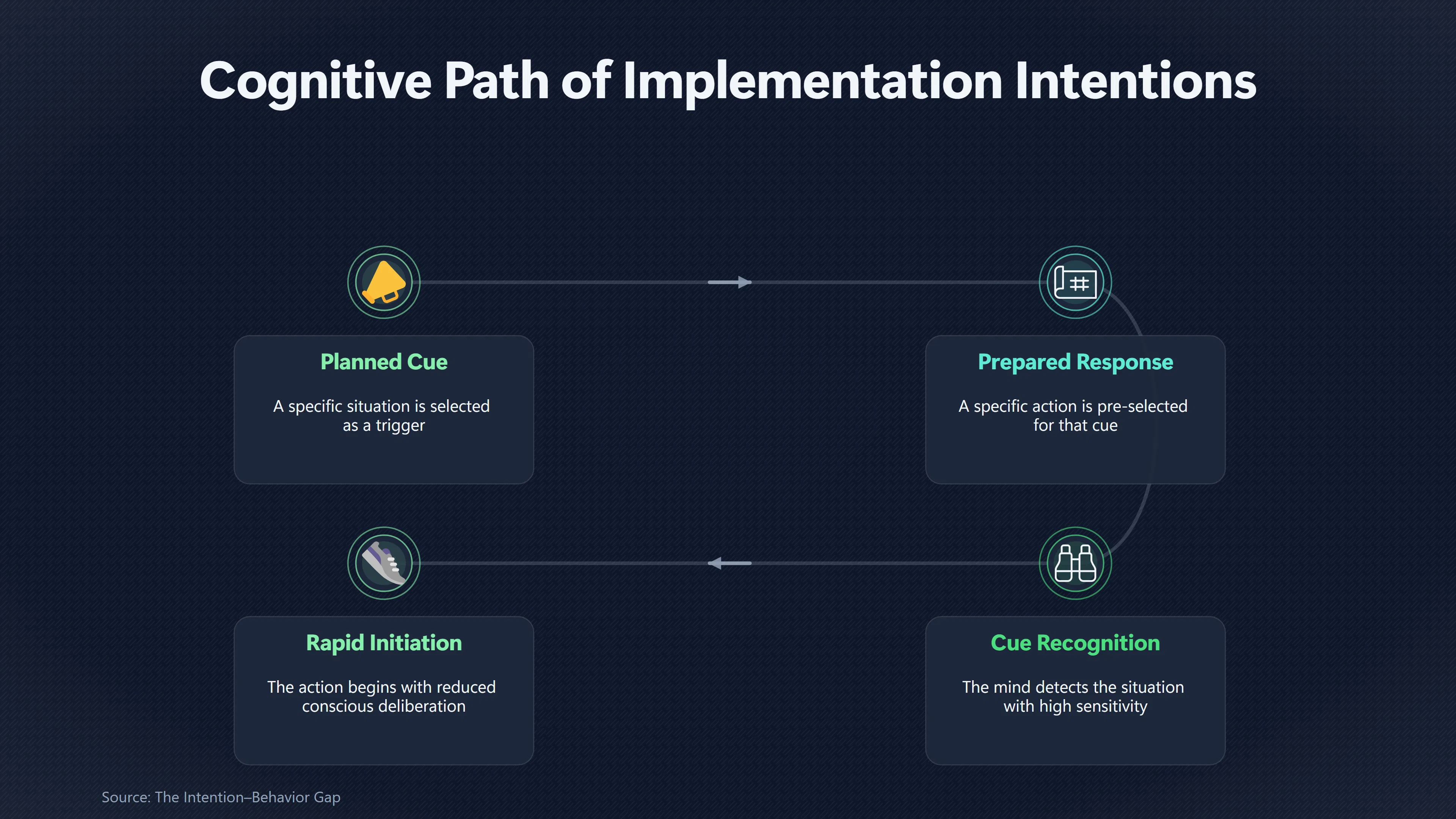
An if-then plan can make action feel unusually quick because it changes what has to happen at the critical moment. Instead of noticing a situation, remembering a goal, deciding whether to act and choosing what to do, you have already linked one recognisable cue to one response: “If X happens, then I will do Y.” Psychologists call this an implementation intention.
Research points to two closely connected mechanisms. First, specifying the “if” makes the critical cue more mentally accessible and easier to detect. Second, explicitly pairing that cue with the “then” response strengthens their mental association, so encountering the cue can bring the intended action to mind rapidly. Experiments find characteristics associated with automatic action initiation: faster responding, relative efficiency under competing mental demands and, in some settings, less need for a fresh conscious decision at the moment of action.[sciencedirect.com]sciencedirect.comHow do implementation intentions promote goal attainment? A test of component processes - ScienceDirect…
The important phrase is strategic automaticity. The plan does not remove choice. It uses a deliberate choice made earlier to reduce the amount of choice required later.
Making the critical cue easier to notice
Ordinary intentions can fail before a decision about action is even reached. You might genuinely intend to do something but fail to recognise the particular moment when doing it would make sense. An implementation intention tackles this recognition problem by giving one future situation special psychological importance.
Suppose your aim is to practise a language regularly. “I will practise tonight” leaves you responsible for remembering that intention amid everything else happening that evening. “If I put my dinner plate in the dishwasher, then I will open my language exercise” singles out a particular event. The dishwasher is no longer merely part of clearing up; it has become the signal for the next action.
Experimental evidence supports this cue-accessibility account. Webb and Sheeran found that implementation intentions increased the accessibility of the situation specified in the plan, and that this increase helped explain subsequent improvements in goal-directed performance. In other words, the cue did not merely appear in the wording of the plan: its mental representation became more ready for activation.[ScienceDirect]sciencedirect.comHow do implementation intentions promote goal attainment? A test of component processes - ScienceDirect…
Earlier experiments by Webb and Sheeran examined whether this heightened sensitivity might have an obvious downside — perhaps people would become so primed for the planned cue that they would mistake irrelevant or ambiguous stimuli for it. Their studies instead found more accurate or faster discrimination of the specified cues without evidence of impaired responses to irrelevant or ambiguous stimuli. That fits a more useful interpretation of cue accessibility: the plan can help the right situation stand out rather than simply making the person indiscriminately trigger-happy.[White Rose Research Online]eprints.whiterose.ac.ukWhite Rose Research OnlineIdentifying good opportunities to act: implementation intentions and cue discrimination - White Rose Research O…
This is one reason the wording of an if-then plan matters. A vague cue such as “if I have some spare time” provides the mind with a poorly defined event to detect. A concrete transition — “when I close my laptop after my last meeting” — gives the plan a much more identifiable trigger. The mechanism depends not simply on having made a plan, but on having specified something that can actually be recognised when it occurs.
Strengthening the cue-response link
Noticing the opportunity is only half of the mechanism. After recognising a cue, a person could still reopen the question of what to do: Should I start now? What should I start with? Perhaps later would be better.
The “then” half of an implementation intention pre-selects the response. Webb and Sheeran experimentally tested both sides of this mechanism and found that improved performance was mediated not only by greater cue accessibility but also by a stronger association between the specified cue and response. Their conclusion was that implementation intentions partly delegate behavioural control to the chosen situational cue.[ScienceDirect]sciencedirect.comHow do implementation intentions promote goal attainment? A test of component processes - ScienceDirect…
Later prospective-memory research provides a useful illustration. In an experiment comparing implementation intentions with rehearsal and other forms of preparation, holding the relevant cue and response constant, the if-then planning condition produced a stronger cue-response link and better performance. This suggests that the benefit cannot always be reduced to simply thinking about the intended behaviour more often; explicitly encoding the contingency between this situation and this response can matter.[Taylor & Francis Online]tandfonline.comTaylor & Francis OnlineImplementation intentions forge a strong cue–response link and boost prospective memory performance: Journal of Co…
The practical difference is subtle but important. Consider:
Intention: “When I get home, I should go for a run.”
If-then plan: “If I put my keys on the hall table, then I will put on my running shoes.”
Both refer to essentially the same goal. But the second statement builds a direct bridge between a perceptible event and a specific first action. When the keys hit the table, there is less behavioural territory left to negotiate.
That helps explain why implementation intentions can affect the speed of initiation, not merely whether an action eventually happens. Classic experiments found that people with implementation intentions initiated planned responses more immediately when the relevant situations occurred. The US National Cancer Institute’s behavioural-research summary describes this as helping people both “see” and “seize” opportunities to act: cue processing improves, while the planned response becomes more readily triggered.[Cancer Control]cancercontrol.cancer.govCancer ControlImplementation Intentions | Division of Cancer Control and Population Sciences (DCCPS)…
Why the response can feel automatic
Psychologists use automaticity more carefully than everyday speech sometimes does. It does not necessarily mean a completely involuntary reflex. Processes can show particular features of automaticity, such as occurring quickly, requiring relatively few cognitive resources or proceeding without a new conscious intention immediately beforehand.
Implementation intentions have shown several of these features. Brandstätter, Lengfelder and Gollwitzer tested action initiation in four studies, including experiments in which university students had to cope with experimentally imposed cognitive load. The benefits of implementation intentions persisted despite competing mental demands. The researchers interpreted this as evidence that the planned action could be initiated both immediately and efficiently when its cue appeared.[PubMed]pubmed.ncbi.nlm.nih.govPub Med Implementation intentions and efficient action initiationImplementation intentions and efficient action initiation - PubMed…
Other experiments pushed the idea further. Bayer and colleagues presented critical cues outside participants’ conscious awareness and found evidence of stronger action preparation or faster initiation among participants who had previously formed the corresponding implementation intention. Such findings support the proposition that, once the association has been deliberately established, its later activation need not always involve consciously rehearsing the complete plan.[Guilford Journals]guilfordjournals.comOpen source on guilfordjournals.com.
Research on prospective memory — remembering to carry out an intended action later — points in a similar direction, although with important qualifications. One study found that implementation intentions improved prospective-memory performance under demanding attentional conditions and proposed that robust cue-action associations could support relatively reflexive triggering when the target appeared. Another found evidence that implementation-intention encoding increased spontaneous retrieval of intentions when relevant cues occurred.[PubMed]pubmed.ncbi.nlm.nih.govOpen source on nih.gov.
This produces the seemingly paradoxical idea of strategic automaticity: automatic-looking action can originate in deliberate planning. Gollwitzer and Schaal used the term to distinguish this process from automatic behaviour that simply develops unintentionally. You consciously decide in advance which situation should control which response; later, that decision can reduce the need for conscious deliberation in the situation itself.[PubMed]pubmed.ncbi.nlm.nih.govPub Med Metacognition in action: the importance of implementation intentionsMetacognition in action: the importance of implementation intentions - PubMed…
For self-improvement, that distinction matters. The purpose is not to become less thoughtful overall. It is to spend thought before a predictable decision point so that you need less of it during that decision point.
What strategic automaticity does — and does not — mean
The evidence does not justify the stronger claim that an if-then sentence turns an entire behaviour into a fully automatic habit. Implementation intentions can automate or facilitate aspects of action initiation while the subsequent behaviour still requires attention, effort and control.
A useful challenge to an overly strong automaticity account comes from experiments by McDaniel and Scullin. Implementation-intention encoding improved prospective memory in their studies, but it did not prevent performance from deteriorating under sufficiently high cognitive demands. They concluded that implementation intentions could create strong associative encoding without supporting a completely automated prospective-memory response.[DOI]doi.orgOpen source on doi.org.
A review of behavioural and physiological research reaches a similarly nuanced picture. Studies support efficient and immediate initiation, and effects on early attention and perception, but prospective-memory experiments also indicate that executing the intended behaviour can still consume controlled cognitive resources. In other words, triggering an action and carrying it through are not necessarily the same cognitive process.[PubMed Central (PMC)]pmc.ncbi.nlm.nih.govPubMed Central (PMC)Promoting the translation of intentions into action by implementation intentions: behavioral effects and physiologica…
Nor does a cue-response association operate entirely independently of the person’s goal. Sheeran, Webb and Gollwitzer found that implementation intentions improved attainment when the underlying goal intention was strong, but not when it was weak; in another experiment, their effect depended on the relevant higher-level goal being activated. The mechanism therefore should not be understood as an unconditional behavioural switch that fires regardless of what the person wants.[Sage Journals]journals.sagepub.comOpen source on sagepub.com.
The most defensible interpretation is narrower and more useful. An if-then plan can prepare the gateway into action. It makes a chosen opportunity easier to recognise and binds that opportunity to a response selected in advance. When the cue arrives, those changes can shorten the route from perception to action.
The decision has moved, not disappeared
The everyday experience of an effective if-then plan can therefore be deceptively simple. The cue occurs and the next action seems obvious. But what feels effortless in that moment reflects cognitive work performed earlier.
Without a plan, the sequence might be:
situation → remember goal → consider options → choose response → initiate
With a well-established if-then link, it can move closer to:
planned cue → prepared response
That compression is the central mechanism. The person has not surrendered control to the environment indiscriminately. They have deliberately selected which part of the environment should prompt which action. Research on cue accessibility, cue discrimination and cue-response linkage explains why the planned moment can subsequently be recognised and acted upon with unusual speed.[sciencedirect.com]sciencedirect.comHow do implementation intentions promote goal attainment? A test of component processes - ScienceDirect…
This also clarifies why if-then plans are especially well matched to a particular self-improvement problem: already knowing what you want to do, yet repeatedly failing to start when the opportunity arrives. Their distinctive advantage is not that they create unlimited motivation or make difficult work effortless. It is that they can remove a small but consequential piece of friction between seeing the moment and starting the action.
Amazon book picks
Further Reading
Books and field guides related to Why Can If Then Plans Start Action So Quickly?. Use these as the next step if you want deeper reading beyond the article.
The Power of Habit
Rating: 4.0/5 from 145 Google Books ratings
In The Power of Habit, award-winning business reporter Charles Duhigg takes us to the thrilling edge of scientific discoveries that expla...
Atomic Habits
Rating: 3.5/5 from 7 Google Books ratings
The #1 New York Times bestseller. Over 25 million copies sold! Translated into 60+ languages! Tiny Changes, Remarkable Results No matter...

TINY HABITS: The Small Changes That Change Everything
Rating: 3.6/5 from 8 Google Books ratings
First published 2019. Subjects: Habit, Change (psychology), SELF-HELP / Motivational & Inspirational, SELF-HELP / Personal Growth / Happi...
Good Habits, Bad Habits: The Science of Making Positive Chang...
'The world's leading expert on habits' - Matthew Syed, bestselling author of Black Box Thinking and Rebel IdeasWhat if you could harness...
eBay marketplace picks
Marketplace Samples
Live-tested eBay searches with available results related to this page.
Selected fromself improvement wall art oneBay.co.uk.




Endnotes
1.
Source: sciencedirect.com
Link:https://www.sciencedirect.com/science/article/abs/pii/S002210310600028X
Source snippet
How do implementation intentions promote goal attainment? A test of component processes - ScienceDirect...
2.
Source: cancercontrol.cancer.gov
Link:https://cancercontrol.cancer.gov/brp/research/constructs/implementation-intentions
Source snippet
Cancer ControlImplementation Intentions | Division of Cancer Control and Population Sciences (DCCPS)...
3.
Source: doi.org
Link:https://doi.org/10.3758/MC.38.2.221
4.
Source: doi.org
Link:https://doi.org/10.1521/SOCO.2007.25.2.248
5.
Source: sciencedirect.com
Link:https://www.sciencedirect.com/science/article/abs/pii/S0195666318314363
6.
Source: sciencedirect.com
Link:https://www.sciencedirect.com/science/article/pii/S0195666318314363
7.
Source: doi.org
Title: The Intention–Behavior Gap
Link:https://doi.org/10.1111/spc3.12265
8.
Source: sciencedirect.com
Link:https://www.sciencedirect.com/science/article/abs/pii/S0165178115000360
9.
Source: sciencedirect.com
Link:https://www.sciencedirect.com/science/article/pii/S0165178115000360
10.
Source: sciencedirect.com
Link:https://www.sciencedirect.com/science/article/abs/pii/S1053810012000645
11.
Source: doi.org
Link:https://doi.org/10.1002/EJSP.205
12.
Source: sciencedirect.com
Title: More than planned: Implementation intention effects in non-planned situations
Link:https://www.sciencedirect.com/science/article/pii/S0001691816304048
13.
Source: sciencedirect.com
Link:https://www.sciencedirect.com/science/article/pii/S002210311630186X
14.
Source: sciencedirect.com
Link:https://www.sciencedirect.com/topics/social-sciences/intention
15.
Source: sciencedirect.com
Link:https://www.sciencedirect.com/science/article/abs/pii/S0065260106380021
16.
Source: sciencedirect.com
Link:https://www.sciencedirect.com/science/chapter/bookseries/abs/pii/S0065260106380021
17.
Source: sciencedirect.com
Title: Can implementation intentions help to overcome [ego-depletion]({{ ‘ego-depletion/’ | relative_url }})?
Link:https://www.sciencedirect.com/science/article/pii/S0022103102005279
18.
Source: pubmed.ncbi.nlm.nih.gov
Title: Pub Med Implementation intentions and efficient action initiation
Link:https://pubmed.ncbi.nlm.nih.gov/11708569/
Source snippet
Implementation intentions and efficient action initiation - PubMed...
19.
Source: pubmed.ncbi.nlm.nih.gov
Title: Pub Med Metacognition in action: the importance of implementation intentions
Link:https://pubmed.ncbi.nlm.nih.gov/15647140/
Source snippet
Metacognition in action: the importance of implementation intentions - PubMed...
20.
Source: eprints.whiterose.ac.uk
Link:https://eprints.whiterose.ac.uk/id/eprint/10753/
Source snippet
White Rose Research OnlineHow do implementation intentions promote goal attainment? A test of component processes - White Rose Research O...
21.
Source: eprints.whiterose.ac.uk
Link:https://eprints.whiterose.ac.uk/id/eprint/10774/
Source snippet
White Rose Research OnlineIdentifying good opportunities to act: implementation intentions and cue discrimination - White Rose Research O...
22.
Source: tandfonline.com
Link:https://www.tandfonline.com/doi/abs/10.1080/20445911.2014.975816
Source snippet
Taylor & Francis OnlineImplementation intentions forge a strong cue–response link and boost prospective memory performance: Journal of Co...
23.
Source: pmc.ncbi.nlm.nih.gov
Link:https://pmc.ncbi.nlm.nih.gov/articles/PMC4500900/
Source snippet
PubMed Central (PMC)Promoting the translation of intentions into action by implementation intentions: behavioral effects and physiologica...
24.
Source: guilfordjournals.com
Link:https://guilfordjournals.com/doi/full/10.1521/soco.2009.27.2.183
25.
Source: pubmed.ncbi.nlm.nih.gov
Link:https://pubmed.ncbi.nlm.nih.gov/18604955/
26.
Source: pubmed.ncbi.nlm.nih.gov
Link:https://pubmed.ncbi.nlm.nih.gov/22897132/
27.
Source: pubmed.ncbi.nlm.nih.gov
Link:https://pubmed.ncbi.nlm.nih.gov/20173194/
28.
Source: journals.sagepub.com
Link:https://journals.sagepub.com/doi/10.1177/0146167204271308
29.
Source: pubmed.ncbi.nlm.nih.gov
Title: Pub Med The interplay between goal intentions and implementation intentions
Link:https://pubmed.ncbi.nlm.nih.gov/15574664/
30.
Source: pubmed.ncbi.nlm.nih.gov
Link:https://pubmed.ncbi.nlm.nih.gov/31125588/
31.
Source: pubmed.ncbi.nlm.nih.gov
Link:https://pubmed.ncbi.nlm.nih.gov/31414843/
32.
Source: pmc.ncbi.nlm.nih.gov
Link:https://pmc.ncbi.nlm.nih.gov/articles/PMC4113409/
33.
Source: pubmed.ncbi.nlm.nih.gov
Link:https://pubmed.ncbi.nlm.nih.gov/24929276/
34.
Source: pubmed.ncbi.nlm.nih.gov
Link:https://pubmed.ncbi.nlm.nih.gov/22032198/
35.
Source: pubmed.ncbi.nlm.nih.gov
Link:https://pubmed.ncbi.nlm.nih.gov/18096108/
36.
Source: journals.sagepub.com
Link:https://journals.sagepub.com/doi/pdf/10.1177/0146167204271308
37.
Source: journals.sagepub.com
Link:https://journals.sagepub.com/doi/abs/10.1177/0146167204271308
38.
Source: journals.sagepub.com
Title: s15327957pspr0202 5
Link:https://journals.sagepub.com/doi/10.1207/s15327957pspr0202_5
39.
Source: pubmed.ncbi.nlm.nih.gov
Link:https://pubmed.ncbi.nlm.nih.gov/17425900/
40.
Source: guilfordjournals.com
Link:https://guilfordjournals.com/doi/10.1521/soco.2007.25.2.248
41.
Source: guilfordjournals.com
Link:https://guilfordjournals.com/doi/10.1521/soco.2009.27.2.183
Additional References
42.
Source: research.manchester.ac.uk
Link:https://research.manchester.ac.uk/en/publications/how-do-implementation-intentions-promote-goal-attainment-a-test-o/
Source snippet
Research ExplorerHow do implementation intentions promote goal attainment? A test of component processes - Research Explorer The Universi...
43.
Source: research.manchester.ac.uk
Link:https://research.manchester.ac.uk/en/publications/identifying-good-opportunities-to-act-implementation-intentions-a/
Source snippet
Research ExplorerIdentifying good opportunities to act: Implementation intentions and cue discrimination - Research Explorer The Universi...
44.
Source: youtube.com
Title: Why You Never Follow Through (And the 1-Sentence Fix That Works)
Link:https://www.youtube.com/watch?v=cZD05av0b5E
Source snippet
Peter Gollwitzer implementation intentions automaticity The If-Then Planning Technique That Actually Works...
45.
Source: youtube.com
Title: How to Actually Stick to Your Goals: The Psychology of Implementation Intentions
Link:https://www.youtube.com/watch?v=v2T0d2NE9q0
Source snippet
The "If-Then" Plan - Implementation Intentions...
46.
Source: youtube.com
Title: Implementation Intentions — The If-Then Rule That Doubles Follow-Through
Link:https://www.youtube.com/watch?v=wgeApk_f3JE
Source snippet
Stop procrastinating by using implementation intentions...
47.
Source: youtube.com
Title: The If-Then Planning Technique That Actually Works
Link:https://www.youtube.com/watch?v=eYIk3Uiwtd4
Source snippet
How to Actually Stick to Your Goals: The Psychology of Implementation Intentions...
48.
Source: youtube.com
Title: Stop procrastinating by using implementation intentions
Link:https://www.youtube.com/watch?v=RWvUl-aovqE
Source snippet
Why You Never Follow Through (And the 1-Sentence Fix That Works)...
49.
Source: youtube.com
Title: The “If-Then” Plan
Link:https://www.youtube.com/watch?v=Ck0Nk8W-eww
Source snippet
Implementation Intentions — The If-Then Rule That Doubles Follow-Through...
50.
Source: researchgate.net
Link:https://www.researchgate.net/publication/11645682_Implementation_Intentions_and_Efficient_Action_Initiation
51.
Source: researchgate.net
Link:https://www.researchgate.net/publication/37367696_Implementation_Intentions_and_Goal_Achievement_A_Meta-Analysis_of_Effects_and_Processes