Within Study Systems
Does Studying in the Same Context Build Momentum?
Studying in the same reliable context can make starting before social media more automatic over repeated sessions.
On this page
- Why repeated time and place cues can strengthen automaticity
- How to choose a study context you will actually encounter
- When an inconsistent schedule makes context stability harder
Page outline Jump by section
Introduction
Studying in the same reliable context can make a morning study routine easier to start repeatedly. The clearest evidence comes from a six-week study of 95 university students: those asked to keep the time and place of a new study habit stable developed stronger automaticity and did better at meeting their repetition goals than students asked to keep changing those contexts. Across 2,482 logged study-habit repetitions, greater context stability was associated with the behaviour feeling progressively more automatic.[PubMed Central (PMC)]pmc.ncbi.nlm.nih.govPubMed Central (PMC)Context Stability in Habit Building Increases Automaticity and Goal Attainment - PMCJune 10, 2022…
For a routine designed to begin before social media, the practical point is not that every morning must look identical. It is that a recurring, recognisable situation can become associated with starting study. “After breakfast, at my desk” gives the behaviour a more consistent setting than “whenever I find time this morning”. Repetition in stable contexts is a central mechanism in habit theory because recurring cues can gradually become associated with the action that follows them.[Taylor & Francis Online]tandfonline.comTaylor & Francis OnlinePromoting habit formation: Health Psychology Review: Vol 7, No sup1 - Get AccessOctober 11, 2011…
The evidence is promising rather than definitive. The main university experiment was relatively small, heavily weighted towards psychology students and deliberately contrasted stable contexts with unusually variable ones. It therefore supports context consistency as a useful design principle, not a guarantee that a fixed morning schedule will automatically produce a lasting study habit.[PubMed Central (PMC)]pmc.ncbi.nlm.nih.govPubMed Central (PMC)Context Stability in Habit Building Increases Automaticity and Goal Attainment - PMCJune 10, 2022…
Why repeated time-and-place cues can strengthen automaticity
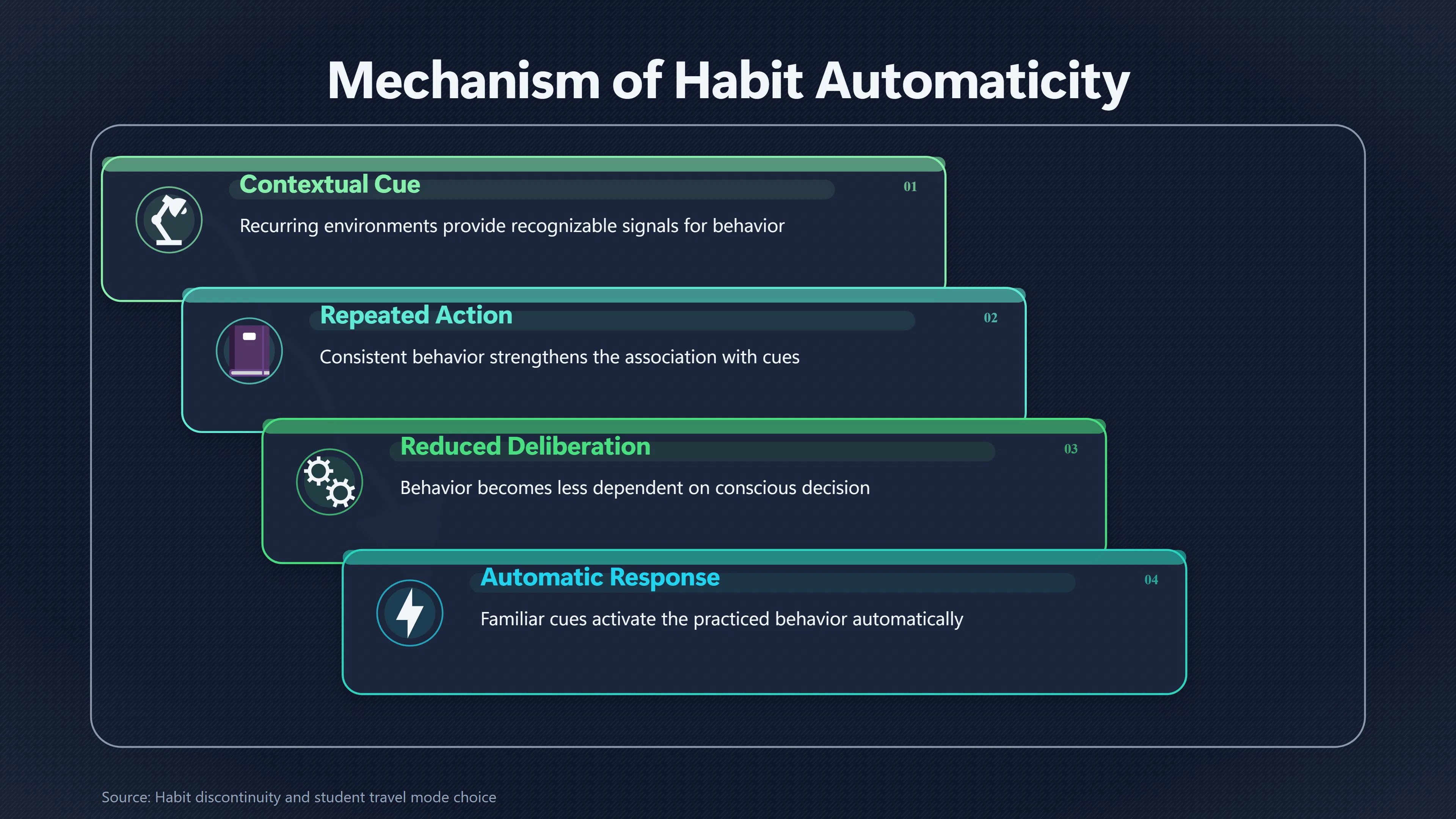
The important distinction is between repetition and context-dependent repetition. Simply studying frequently gives you practice at studying. Repeatedly beginning under recognisable circumstances can additionally strengthen an association between those circumstances and the act of starting. Habit research describes automaticity as behaviour becoming less dependent on fresh deliberation because familiar cues increasingly activate the response.[PubMed Central (PMC)]pmc.ncbi.nlm.nih.govPubMed Central (PMC)A review and analysis of the use of ‘habit’ in understanding, predicting and influencing health-related behaviour - P…
That distinction was tested unusually directly by Marco Stojanovic, Axel Grund and Stefan Fries. Their 2022 study randomly assigned university students building new study habits to different context instructions. The stable-context group was told to perform its habit in the same place and at the same point in the course of the day. The variable-context group was told to change both, including using different places and different times rather than repeatedly returning to recent ones. Participants then logged their repetitions over six weeks.[PubMed Central (PMC)]pmc.ncbi.nlm.nih.govPubMed Central (PMC)Context Stability in Habit Building Increases Automaticity and Goal Attainment - PMCJune 10, 2022…
The final dataset contained 95 students and 2,482 repetitions, averaging 26.13 logged repetitions per participant. The manipulation produced a large difference in reported context stability between the two groups, confirming that students had meaningfully altered the consistency of their settings.[Frontiers]frontiersin.orgFrontiersFrontiers | Context Stability in Habit Building Increases Automaticity and Goal AttainmentJune 10, 2022…
Greater context stability predicted greater automaticity. It also predicted higher habit repetition goal attainment — essentially, how well participants were achieving the repetition targets they had set. Automaticity partially mediated the relationship between context stability and goal attainment, meaning that part, but not all, of the advantage associated with stable contexts could statistically be accounted for by the behaviour becoming more automatic.[PubMed]pubmed.ncbi.nlm.nih.govContext Stability in Habit Building Increases Automaticity and Goal Attainment - PubMed…
A second dataset provided a useful check. The researchers analysed 2,368 repetitions of 308 self-selected habits recorded by 218 users of a habit-building app. Context was measured rather than experimentally assigned, so this part cannot establish causality as cleanly. Nevertheless, the same broad pattern appeared: greater context stability predicted both greater automaticity and better repetition-goal attainment.[PubMed Central (PMC)]pmc.ncbi.nlm.nih.govPubMed Central (PMC)Context Stability in Habit Building Increases Automaticity and Goal Attainment - PMCJune 10, 2022…
That convergence makes the study especially relevant to morning consistency. A reliable morning context does more than reserve a convenient slot in a diary. Repeated encounters with the same cues may reduce the amount of initiation that has to be reconstructed each day. Instead of waking up and repeatedly deciding whether, where and when to study, the learner increasingly encounters a familiar situation in which studying is the practised response.
This interpretation also fits the wider habit literature. Reviews describe habits as responses acquired through repeated behaviour in stable contexts, with context–behaviour associations strengthening as the pairing recurs. Once those associations are established, encountering the relevant context can help activate the behaviour with less dependence on conscious deliberation.[Taylor & Francis Online]tandfonline.comTaylor & Francis OnlinePromoting habit formation: Health Psychology Review: Vol 7, No sup1 - Get AccessOctober 11, 2011… A 2026 preregistered reanalysis of a separate six-month longitudinal dataset also found context stability among the factors associated with habit strength, although that research covered behaviours more broadly rather than specifically morning study.[Sage Journals]journals.sagepub.comOpen source on sagepub.com.
For studying before social media, this suggests a useful change of emphasis. The aim is not merely to exercise enough willpower to ignore feeds each morning. It is to make starting study the repeatedly practised response to the opening context of the day.
How to choose a study context you will actually encounter
The strongest context is not necessarily the most perfectly controlled one. It is one that recurs often enough to provide repeated opportunities for the same behaviour.
For a student with predictable mornings, that might mean studying at the same desk shortly after breakfast. The relevant context then contains several overlapping cues: the stage of the morning, the location, the preceding activity and perhaps the prepared study materials. A workable routine might therefore be: finish breakfast, sit at the usual desk, open the prepared question set and begin before opening social media.
There is a reason to think beyond clock time alone. Habit researchers have argued that stable contexts need not be defined exclusively by an exact physical location and exact minute; functional cues such as a preceding action can also provide continuity.[ScienceDirect]sciencedirect.comOpen source on sciencedirect.com. For someone whose breakfast finishes anywhere between 7.15 and 7.45, “after breakfast” may therefore be a more dependable cue than “at exactly 7.30”.
This matters because an idealised context that rarely occurs produces few opportunities for context-dependent repetition. A student who chooses “8.00 at the library” but reaches campus at 8.00 only twice a week has created a precise context without creating a frequent one. By contrast, “after I arrive on campus, before checking social media” may preserve a recognisable behavioural sequence across more days.
The practical target is recognisability rather than perfection. A useful context generally has three properties:
- Frequent: it occurs on enough study days to accumulate repetitions.
- Distinctive: it clearly signals the start of the study period rather than blending into an unstructured morning.
- Controllable: the learner can usually enter or recognise it without relying on circumstances that change constantly.
The study by Stojanovic and colleagues should not be interpreted as showing that every physical detail must remain frozen. Its experimental contrast was deliberately strong: participants in the variable condition were instructed to keep changing places and points in the day. The useful real-world inference is therefore narrower — unnecessary variability can remove recurring cues that might otherwise help the routine become automatic.[PubMed Central (PMC)]pmc.ncbi.nlm.nih.govPubMed Central (PMC)Context Stability in Habit Building Increases Automaticity and Goal Attainment - PMCJune 10, 2022…
A morning study context can consequently have a stable core with flexible edges. “After breakfast, at my desk” may be stable enough even when breakfast ends at 7.20 on Monday and 7.40 on Tuesday. Likewise, “when I reach the library before my first lecture” can remain functionally recognisable despite modest differences in arrival time.
For a study-before-social-media routine, consistency in the sequence can be particularly useful: morning cue → study start → social media later. The research did not directly test social-media abstinence, so it would overstate the evidence to claim that stable contexts specifically prevent feed checking. What the evidence supports is the more modest mechanism: a recurring context can strengthen automatic initiation of the intended behaviour.[Frontiers]frontiersin.orgFrontiersFrontiers | Context Stability in Habit Building Increases Automaticity and Goal AttainmentJune 10, 2022…

When an inconsistent schedule makes context stability harder
The obvious difficulty is that many student mornings are not stable. A timetable might begin at 9.00 on Monday, noon on Tuesday and 8.00 on Wednesday; commuting, shift work, caring responsibilities or changing study spaces can introduce further variation. Under those conditions, insisting on one exact combination of clock time and physical location may make the routine unnecessarily brittle.
This is where “same context” needs careful interpretation. Researchers have challenged the assumption that useful habit cues must always be an invariant external place and time. A stable functional context — such as completing one recurring action and then starting another — may remain meaningful even as clock time or location varies.[ScienceDirect]sciencedirect.comOpen source on sciencedirect.com. That provides a sensible alternative for irregular mornings: preserve the sequence when the schedule cannot preserve the hour.
For example, compare two rules:
Rigid context: “I study at my bedroom desk at 7.30 every morning.”
Functional context: “After my first meal and before opening social media, I start my prepared study task.”
The first gives stronger physical and temporal consistency when life permits it. The second may provide more repetition when mornings vary. Current evidence does not establish which rule is superior for students with irregular timetables, so the choice should be based on which cue is genuinely encountered most reliably rather than assuming maximum rigidity is always best.
There is another reason for caution. The six-week experiment included 95 participants, 82% were female and 90% studied psychology. Participants also received course credit, with an additional lottery incentive available for sufficient repetitions. The authors explicitly warn against assuming that the results generalise unchanged to other populations and types of habits.[PubMed Central (PMC)]pmc.ncbi.nlm.nih.govPubMed Central (PMC)Context Stability in Habit Building Increases Automaticity and Goal Attainment - PMCJune 10, 2022…
Nor is context stability universally associated with stronger habits in every behavioural domain. An ecological momentary assessment study of physical activity and sedentary behaviour found that its measures of context stability did not predict habit, illustrating that the relationship can depend on the behaviour and on how “context” is defined and measured.[PubMed]pubmed.ncbi.nlm.nih.govOpen source on nih.gov. A longitudinal nutrition study likewise found context stability associated with habit strength between people, but did not find the expected next-day within-person effects.[PubMed]pubmed.ncbi.nlm.nih.govOpen source on nih.gov.
Those qualifications sharpen rather than erase the practical lesson. The evidence does not justify reorganising an entire life around an inviolable 7.30 study appointment. It supports reducing avoidable variation while a new routine is being established.
Does studying in the same context build momentum?
The best answer is probably, particularly during habit formation, but the effect should be understood as behavioural automaticity rather than motivational momentum. In the strongest directly relevant dataset, students repeatedly studying in more stable contexts developed greater automaticity and achieved more of their repetition goals over six weeks. The accompanying app dataset reproduced the overall relationship, while broader habit research gives the finding a plausible mechanism through learned context–behaviour associations.[PubMed Central (PMC)]pmc.ncbi.nlm.nih.govPubMed Central (PMC)Context Stability in Habit Building Increases Automaticity and Goal Attainment - PMCJune 10, 2022…
For a morning routine, that translates into a simple principle: choose a cue you are actually likely to encounter and let the opening study action follow it repeatedly. If mornings are predictable, keeping both place and part of the day consistent is reasonable. If mornings vary, preserve a dependable event or sequence — such as “after breakfast” or “after arriving at the library” — instead of continually inventing a new study occasion.
The goal is not a perfectly identical morning. It is enough consistency for the beginning of study to stop being a completely new decision each day. Within a routine that starts before social media, that is the particular value of stable context: repeated mornings can gradually make “this is where I begin studying” a more practised response than “what should I do first?”[PubMed Central (PMC)]pmc.ncbi.nlm.nih.govPubMed Central (PMC)Context Stability in Habit Building Increases Automaticity and Goal Attainment - PMCJune 10, 2022…
Amazon book picks
Further Reading
Books and field guides related to Does Studying in the Same Context Build Momentum?. Use these as the next step if you want deeper reading beyond the article.
Atomic Habits
Rating: 3.5/5 from 7 Google Books ratings
The #1 New York Times bestseller. Over 25 million copies sold! Translated into 60+ languages! Tiny Changes, Remarkable Results No matter...
Good Habits, Bad Habits
'The world's leading expert on habits' - Matthew Syed, bestselling author of Black Box Thinking and Rebel IdeasWhat if you could harness...
Tiny Habits
Improving your life is much easier than you think. Whether it’s losing weight, sleeping more, or restoring your work/life balance – the s...

The Power of Habit
Rating: 4.0/5 from 145 Google Books ratings
Duhigg takes us to the edge of scientific discoveries that explain why habits exist and how they can be changed. Distilling information i...
eBay marketplace picks
Marketplace Samples
Live-tested eBay searches with available results related to this page.
Selected fromdesk organizer oneBay.co.uk.



Endnotes
1.
Source: sciencedirect.com
Link:https://www.sciencedirect.com/science/article/pii/S146902921930130X
2.
Source: sciencedirect.com
Link:https://www.sciencedirect.com/science/article/abs/pii/S146902921930130X
3.
Source: sciencedirect.com
Link:https://www.sciencedirect.com/science/article/pii/S0361476X25000876
4.
Source: sciencedirect.com
Title: Habit discontinuity and student travel mode choice
Link:https://www.sciencedirect.com/science/article/pii/S1369847818305874
5.
Source: sciencedirect.com
Title: Habit predicts in-the-moment alcohol consumption
Link:https://www.sciencedirect.com/science/article/abs/pii/S0306460314003165
6.
Source: sciencedirect.com
Link:https://www.sciencedirect.com/science/article/abs/pii/S0022096516300285
7.
Source: pmc.ncbi.nlm.nih.gov
Link:https://pmc.ncbi.nlm.nih.gov/articles/PMC9226889/
Source snippet
PubMed Central (PMC)Context Stability in Habit Building Increases Automaticity and Goal Attainment - PMCJune 10, 2022...
Published: June 10, 2022
8.
Source: pubmed.ncbi.nlm.nih.gov
Link:https://pubmed.ncbi.nlm.nih.gov/35756236/
Source snippet
Context Stability in Habit Building Increases Automaticity and Goal Attainment - PubMed...
9.
Source: tandfonline.com
Link:https://www.tandfonline.com/doi/full/10.1080/17437199.2011.603640
Source snippet
Taylor & Francis OnlinePromoting habit formation: Health Psychology Review: Vol 7, No sup1 - Get AccessOctober 11, 2011...
Published: October 11, 2011
10.
Source: pmc.ncbi.nlm.nih.gov
Link:https://pmc.ncbi.nlm.nih.gov/articles/PMC3505409/
Source snippet
PubMed Central (PMC)Making health habitual: the psychology of ‘habit-formation’ and general practice - PMC...
11.
Source: pmc.ncbi.nlm.nih.gov
Link:https://pmc.ncbi.nlm.nih.gov/articles/PMC4566897/
Source snippet
PubMed Central (PMC)A review and analysis of the use of ‘habit’ in understanding, predicting and influencing health-related behaviour - P...
12.
Source: frontiersin.org
Link:https://www.frontiersin.org/journals/psychology/articles/10.3389/fpsyg.2019.02642/full
13.
Source: frontiersin.org
Link:https://www.frontiersin.org/journals/psychology/articles/10.3389/fpsyg.2022.883795/full
Source snippet
FrontiersFrontiers | Context Stability in Habit Building Increases Automaticity and Goal AttainmentJune 10, 2022...
Published: June 10, 2022
14.
Source: frontiersin.org
Link:https://www.frontiersin.org/journals/psychology/articles/10.3389/fpsyg.2022.883795/full?infclid=98ed75048fad41069048c53e63b2394c
15.
Source: journals.sagepub.com
Link:https://journals.sagepub.com/doi/full/10.1177/01461672261440446
16.
Source: pubmed.ncbi.nlm.nih.gov
Link:https://pubmed.ncbi.nlm.nih.gov/42053513/
17.
Source: pubmed.ncbi.nlm.nih.gov
Link:https://pubmed.ncbi.nlm.nih.gov/33502088/
18.
Source: pubmed.ncbi.nlm.nih.gov
Link:https://pubmed.ncbi.nlm.nih.gov/35962435/
19.
Source: journals.sagepub.com
Link:https://journals.sagepub.com/doi/pdf/10.1177/14697874261437063?download=true
20.
Source: journals.sagepub.com
Link:https://journals.sagepub.com/doi/abs/10.1177/14697874261437063
21.
Source: pmc.ncbi.nlm.nih.gov
Link:https://pmc.ncbi.nlm.nih.gov/articles/PMC11201238/
22.
Source: frontiersin.org
Link:https://www.frontiersin.org/journals/cognition/articles/10.3389/fcogn.2024.1352656/full
23.
Source: tandfonline.com
Link:https://www.tandfonline.com/doi/full/10.1080/00050067.2023.2210759
24.
Source: pubmed.ncbi.nlm.nih.gov
Link:https://pubmed.ncbi.nlm.nih.gov/36749452/
25.
Source: pmc.ncbi.nlm.nih.gov
Link:https://pmc.ncbi.nlm.nih.gov/articles/PMC9372943/
26.
Source: frontiersin.org
Title: Frontiers | Development and Validation of a Daily Habit Scale
Link:https://www.frontiersin.org/journals/neuroscience/articles/10.3389/fnins.2022.880023/full
27.
Source: pmc.ncbi.nlm.nih.gov
Link:https://pmc.ncbi.nlm.nih.gov/articles/PMC9274250/
28.
Source: pmc.ncbi.nlm.nih.gov
Link:https://pmc.ncbi.nlm.nih.gov/articles/PMC12318445/
29.
Source: tandfonline.com
Link:https://www.tandfonline.com/doi/abs/10.1080/08870446.2021.2003362
30.
Source: tandfonline.com
Link:https://www.tandfonline.com/doi/full/10.1080/08870446.2021.2003362
31.
Source: pubmed.ncbi.nlm.nih.gov
Link:https://pubmed.ncbi.nlm.nih.gov/33966668/
32.
Source: pmc.ncbi.nlm.nih.gov
Link:https://pmc.ncbi.nlm.nih.gov/articles/PMC8137900/
33.
Source: pubmed.ncbi.nlm.nih.gov
Link:https://pubmed.ncbi.nlm.nih.gov/31396122/
34.
Source: pmc.ncbi.nlm.nih.gov
Link:https://pmc.ncbi.nlm.nih.gov/articles/PMC4731333/
35.
Source: pmc.ncbi.nlm.nih.gov
Link:https://pmc.ncbi.nlm.nih.gov/articles/PMC4216661/
36.
Source: pubmed.ncbi.nlm.nih.gov
Link:https://pubmed.ncbi.nlm.nih.gov/23864536/
37.
Source: doi.org
Link:https://doi.org/10.1080/17437199.2011.603640%C2%A0
38.
Source: tandfonline.com
Link:https://www.tandfonline.com/doi/abs/10.1080/17437199.2011.603640
39.
Source: pubmed.ncbi.nlm.nih.gov
Link:https://pubmed.ncbi.nlm.nih.gov/17678574/
40.
Source: pubmed.ncbi.nlm.nih.gov
Link:https://pubmed.ncbi.nlm.nih.gov/33444109/
41.
Source: pubmed.ncbi.nlm.nih.gov
Link:https://pubmed.ncbi.nlm.nih.gov/21299328/
42.
Source: db.cngb.org
Link:https://db.cngb.org/data_resources/literature/35756236
43.
Source: ouci.dntb.gov.ua
Link:https://ouci.dntb.gov.ua/en/works/7XJjALMl/
Additional References
44.
Source: orbilu.uni.lu
Link:https://orbilu.uni.lu/handle/10993/51220
Source snippet
ORBilu: Context Stability in Habit Building Increases Automaticity and Goal Attainment - 2022...
45.
Source: youtube.com
Title: The PERFECT Daily Routine for Students | 4 Systems That Actually Work
Link:https://www.youtube.com/watch?v=QrcHFA_8EWk
Source snippet
For further insights into how [environmental cues]({{ 'useful-cues/' | relative_url }}) and consistent settings drive automaticity in daily habits, you can watch Achieve Your G...
46.
Source: youtube.com
Title: Achieve Your Goals Through the Power of Habits
Link:https://www.youtube.com/watch?v=qopZaJsUhkc
Source snippet
The PERFECT Daily Routine for Students | 4 Systems That Actually Work...
47.
Source: researchgate.net
Link:https://www.researchgate.net/publication/356209185_Developing_habit-based_health_behaviour_change_interventions_twenty-one_questions_to_guide_future_research
48.
Source: apa.org
Link:https://www.apa.org/gradpsych/2015/11/bad-study-habits
49.
Source: mendeley.com
Link:https://www.mendeley.com/catalogue/e7b06926-1f59-3250-8601-aa3375f68ebe/
50.
Source: researchgate.net
Link:https://www.researchgate.net/figure/Multilevel-mediation-analysis-of-the-effect-of-context-stability-on-HRGA-habit_fig2_361222550
51.
Source: researchgate.net
Link:https://www.researchgate.net/figure/Multilevel-mediation-analysis-with-unstandardized-regression-coefficients-of-the-effect_fig1_361222550
52.
Source: researchgate.net
Link:https://www.researchgate.net/figure/Multilevel-regressions-of-automaticity-on-context-stability-based-on-controlled-study_tbl1_361222550
53.
Source: preprints.org
Link:https://www.preprints.org/manuscript/202404.1402