Within Spending Systems
Why a Ten Minute Shopping Pause May Not Work
A brief delay may do little if the shopper keeps browsing, because the tempting context remains active throughout the pause.
On this page
- What the ten minute delay experiment found
- How continued browsing undermines the pause
- Better ways to change both time and context
Page outline Jump by section
Introduction
A ten-minute shopping pause sounds sensible: interrupt the checkout, wait for the urge to weaken, then decide with a clearer head. But the best direct experiment on this specific tactic found that a ten-minute delay did not significantly reduce either the number of impulse products bought or the amount spent impulsively. The revealing detail was what happened during the pause: every participant in the delayed group continued shopping for at least part of it.[Deep Blue]deepblue.lib.umich.eduDeep Blue Impulse Buying: Designing for Self-Control with E-commerceDeep Blue Impulse Buying: Designing for Self-Control with E-commerce
That makes the experiment useful for self-improvement precisely because the intervention failed. A pause is not automatically a cooling-off period. If ten extra minutes are spent comparing alternatives, seeing recommendations and adding products to a basket, the shopper remains inside the environment stimulating the urge. The more useful rule is therefore not simply wait before buying, but wait away from shopping. For short delays, changing what occupies attention may matter as much as adding minutes.
What the ten-minute experiment found
Carol Moser’s 2020 University of Michigan doctoral research examined several interventions intended to help people control online impulse buying. The programme included an approximately 25-hour postponement experiment, a ten-minute in-laboratory delay involving Amazon purchases, and experiments involving reflection and distraction. The underlying question was practical: what kind of friction actually helps once somebody already wants to make an impulsive purchase?[Deep Blue]deepblue.lib.umich.eduDeep Blue Impulse Buying: Designing for Self-Control with E-commerceDeep Blue Impulse Buying: Designing for Self-Control with E-commerce
The ten-minute study provides an unusually direct test of the familiar advice to impose a short waiting period. Participants in the delay condition could shop, but completion of their Amazon purchases was held up for ten minutes. Researchers compared outcomes including the number of impulsive purchases, dollars spent impulsively and the proportion of basket additions ultimately purchased. The delay produced no statistically significant reduction in the number of impulse products purchased or in impulsive spending.[School of Information]si.umich.eduSchool of Information Virtual dissertation defense: Carol Moser | umsiSchool of InformationVirtual dissertation defense: Carol Moser | umsiMarch 17, 2020…
This result should not be read as proof that waiting never works. Within the same research programme, an approximately 25-hour postponement reduced both the reported urge to buy impulsively and purchase intention. The experiments differed in more than duration, so they do not establish a universal threshold somewhere between ten minutes and 25 hours. They instead expose a weakness in treating elapsed time as the active ingredient by itself.[School of Information]si.umich.eduSchool of Information Virtual dissertation defense: Carol Moser | umsiSchool of InformationVirtual dissertation defense: Carol Moser | umsiMarch 17, 2020…
Moser also cautioned that the laboratory setting may have influenced behaviour. Participants were relatively captive and might have felt expected to remain engaged with the task; somebody encountering the same barrier at home could simply put down the device. Ten minutes also leaves fewer opportunities than 25 hours for ordinary life — a meal, sleep, work or a conversation — to draw attention away from the desired product.[Deep Blue]deepblue.lib.umich.eduDeep Blue Impulse Buying: Designing for Self-ControlDeep BlueImpulse Buying: Designing for Self-ControlOctober 18, 2025…
The appropriate conclusion is therefore narrower than “ten minutes is useless”. It is that an unguided ten-minute delay, while shopping remains available, is weak evidence of meaningful friction. The intervention stopped payment temporarily without reliably stopping the shopping process that preceded it.
How continued browsing undermines the pause
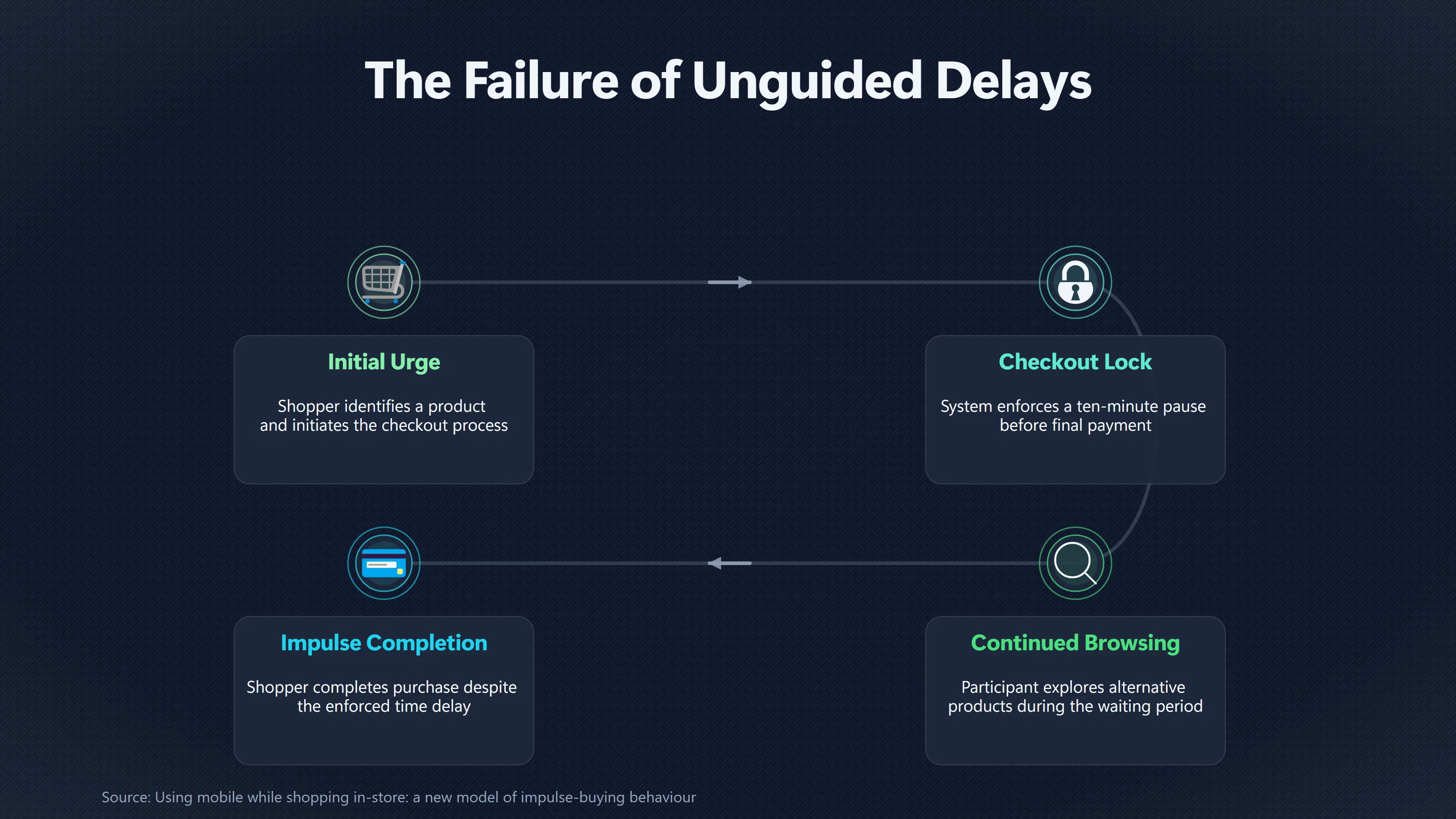
The striking finding was that 100% of participants exposed to the ten-minute delay continued to browse alternative products for at least some of the waiting period. Some participants said the extra time enabled them to look at other items or options; one reported that it allowed them to add more to their basket. Moser consequently described a case against “unguided postponement”: merely preventing checkout can create additional shopping time rather than genuine psychological distance from the purchase.[Deep Blue]deepblue.lib.umich.eduDeep Blue Impulse Buying: Designing for Self-ControlDeep BlueImpulse Buying: Designing for Self-ControlOctober 18, 2025…
That interpretation is consistent with a wider body of research linking browsing and exploratory shopping to impulsive outcomes. Research in the Journal of Consumer Research, using laboratory and field experiments, found that broader visual attention can produce a more exploratory shopping mindset, increasing exploration and ultimately affecting unplanned purchasing; people with greater impulsive-buying tendencies were especially susceptible.[OUP Academic]academic.oup.comOUP AcademicExploratory Shopping: Attention Affects In-Store Exploration and Unplanned Purchasing | Journal of Consumer Research | Oxford… Other mobile-commerce research has found that hedonic browsing — browsing for enjoyment rather than simply completing a practical task — positively influences the urge to buy impulsively.[ScienceDirect]sciencedirect.comUnderstanding impulse buying in mobile commerce: An investigation into hedonic and utilitarian browsing - ScienceDirect…
This distinction explains why ten minutes can be ten minutes in name but not ten minutes of cooling off. Imagine somebody wants a pair of trainers and activates a ten-minute checkout lock. They then spend those ten minutes looking at another colour, checking the “customers also bought” section, comparing a discounted model and reading enthusiastic reviews. The transaction has been delayed, but attention has never left the purchase. The shopper has also encountered several fresh opportunities to want something.
Research on online commerce has long identified exposure as part of this problem. An analysis in the Journal of Computer-Mediated Communication argued that browsing increases exposure to triggering shopping stimuli, while prolonged exposure can interfere with self-observation and restraint.[OUP Academic]academic.oup.comOUP AcademicOn the Negative Effects of E-Commerce: a Sociocognitive Exploration of Unregulated on-line Buying | Journal of Computer-Media… More recent research on social commerce similarly finds relationships between impulse buying and features such as visual appeal, ease of use, passing time and serendipitous discovery. Its survey-based design cannot prove that every extra minute of browsing causes another impulsive purchase, but it reinforces the point that a digital shopping environment is not psychologically neutral space in which to “cool down”.[Frontiers]frontiersin.orgFrontiersFrontiers | How technical and situational cues affect impulse buying behavior in social commerce? Evidence from bored consumersO…
When boredom becomes another shopping cue
There is a second failure mode. An enforced ten-minute wait can become boring, especially if it provides no alternative activity. Moser reported that some participants considered the delay too long or boring and noted the awkward implication: impulse shopping itself can be used as relief from boredom.[Deep Blue]deepblue.lib.umich.eduDeep Blue Impulse Buying: Designing for Self-ControlDeep BlueImpulse Buying: Designing for Self-ControlOctober 18, 2025…
That connection is supported beyond this experiment. A Swedish qualitative study of online fashion shopping found that young consumers described impulsive purchases as a response to boredom, with easy access, price and other shopping stimuli helping to break monotony.[ScienceDirect]sciencedirect.comClicking the boredom away – Exploring impulse fashion buying behavior online - ScienceDirectMarch 1, 2019… A 2024 study of 395 social-commerce users likewise found that situational cues associated with passing time and serendipity positively influenced impulse buying.[PubMed]pubmed.ncbi.nlm.nih.govOpen source on nih.gov.
A badly designed pause can therefore create an odd loop: stop checkout → become bored → keep browsing → encounter more appealing products → maintain or renew the urge to buy. Waiting has technically occurred, but the behavioural system has not achieved what the wait was supposed to accomplish.
There was even evidence of a more counter-intuitive problem. A small number of participants interpreted the delay as creating time pressure. One thought a decision had to be made within the ten minutes even though participants were actually allowed to keep shopping afterwards. In other words, friction intended to slow a decision was sometimes perceived like a deadline — a familiar form of retail urgency.[Deep Blue]deepblue.lib.umich.eduDeep Blue Impulse Buying: Designing for Self-ControlDeep BlueImpulse Buying: Designing for Self-ControlOctober 18, 2025…
Better ways to change both time and context
The practical lesson is not to search for a magical number of minutes. A stronger interruption changes time, attention and environment together. Moser’s broader research found that approximately 3½ minutes spent either listing reasons for and against buying or completing a distracting task reduced reported impulsive urge and purchase intention. That result is especially instructive because these interventions could be shorter than the unsuccessful ten-minute pause while giving the interval a different purpose.[School of Information]si.umich.eduSchool of Information Virtual dissertation defense: Carol Moser | umsiSchool of InformationVirtual dissertation defense: Carol Moser | umsiMarch 17, 2020…
The experiments are not directly interchangeable: they used different designs and outcomes, so it would be too strong to conclude that 3½ minutes of reflection is universally “better” than ten minutes of waiting. What they support is a design principle. Structured interruption can prevent the pause itself from becoming more shopping. Later research examining interventions against online shopping “dark patterns” has likewise treated postponement, reflection and distraction as distinct approaches rather than assuming that delay alone is sufficient.[Cambridge University Press]cambridge.orgOpen source on cambridge.org.
For a personal spending system, that principle can be translated into a few concrete rules:
- Leave the shopping environment. When the waiting period begins, close the retailer’s tab or app rather than continuing to browse.
- Give a short pause a job. Write down why you want the item, why you might not need it, what you already own that serves the same purpose, or what else the money is meant for. This resembles the structured reflection tested in Moser’s research.[Deep Blue]deepblue.lib.umich.eduDeep Blue Impulse Buying: Designing for Self-Control with E-commerceDeep Blue Impulse Buying: Designing for Self-Control with E-commerce
- Use genuine distraction when reflection becomes shopping research. Move to an unrelated activity rather than opening reviews, comparison sites or social-media content about the product.
- Use a longer delay for recurring trouble spots. A next-day decision has more opportunity for ordinary life to break the attentional hold of the purchase than an uninterrupted ten minutes. Moser’s 25-hour finding supports this direction, although it should not be treated as proof that precisely 25 hours is optimal.[School of Information]si.umich.eduSchool of Information Virtual dissertation defense: Carol Moser | umsiSchool of InformationVirtual dissertation defense: Carol Moser | umsiMarch 17, 2020…
- Do not turn the pause into a countdown. A timer saying “you can buy in 09:59” may keep the purchase mentally foregrounded. A better system records the item for later review and lets the shopper leave.
This also clarifies what successful self-improvement looks like in this narrow setting. The objective is not to demonstrate enough willpower to stare at tempting products for ten minutes without buying them. It is to redesign the moment so that the temptation stops receiving continuous attention.
A ten-minute delay can still be useful when it creates a real break: close the shop, put down the phone, do something unrelated and reconsider afterwards. What the failed experiment warns against is the weaker version — delaying the payment while leaving the shopper immersed in the same stream of products, recommendations and stimulation. In that situation, the clock is running, but the impulse may never have had a chance to cool.

Amazon book picks
Further Reading
Books and field guides related to Why a Ten Minute Shopping Pause May Not Work. Use these as the next step if you want deeper reading beyond the article.
The Year of Less
The Year of Less In her late twenties, Cait Flanders found herself stuck in the consumerism cycle that grips so many of us: earn more, bu...
Dopamine Nation
'Her stories have the power to transform your life' Lori Gottlieb, bestselling author of Maybe You Should Talk to Someone 'Radically chan...
Nudge
Rating: 3.5/5 from 29 Google Books ratings
Thaler and Sunstein offer a groundbreaking discussion of how to apply the science of choice to nudge people toward decisions that can imp...
Thinking, Fast and Slow
Why is there more chance we'll believe something if it's in a bold type face? Why are judges more likely to deny parole before lunch? Why...
eBay marketplace picks
Marketplace Samples
Live-tested eBay searches with available results related to this page.
Selected fromself improvement wall art oneBay.co.uk.


Endnotes
1.
Source: academic.oup.com
Link:https://academic.oup.com/jcr/article-abstract/48/1/51/5959957
Source snippet
OUP AcademicExploratory Shopping: Attention Affects In-Store Exploration and Unplanned Purchasing | Journal of Consumer Research | Oxford...
2.
Source: sciencedirect.com
Link:https://www.sciencedirect.com/science/article/pii/S0268401218310776
Source snippet
Understanding impulse buying in mobile commerce: An investigation into hedonic and utilitarian browsing - ScienceDirect...
3.
Source: academic.oup.com
Link:https://academic.oup.com/jcmc/article/6/3/JCMC631/4584222
Source snippet
OUP AcademicOn the Negative Effects of E-Commerce: a Sociocognitive Exploration of Unregulated on-line Buying | Journal of Computer-Media...
4.
Source: sciencedirect.com
Link:https://www.sciencedirect.com/science/article/pii/S096969891830167X
Source snippet
Clicking the boredom away – Exploring impulse fashion buying behavior online - ScienceDirectMarch 1, 2019...
Published: March 1, 2019
5.
Source: cambridge.org
Link:https://www.cambridge.org/core/journals/behavioural-public-policy/article/dark-patterns-in-online-shopping-do-they-work-and-can-nudges-help-mitigate-impulse-buying/996B92402604A7E3D417ECBAE2C38362
6.
Source: academic.oup.com
Link:https://academic.oup.com/ntr/article/27/7/1274/8005025
7.
Source: sciencedirect.com
Title: Using mobile while shopping in-store: a new model of impulse-buying behaviour
Link:https://www.sciencedirect.com/org/science/article/pii/S0736376122000453
8.
Source: academic.oup.com
Link:https://academic.oup.com/jcr/article/48/3/374/6189049
9.
Source: academic.oup.com
Link:https://academic.oup.com/edited-volume/34263/chapter-abstract/290484206
10.
Source: sciencedirect.com
Link:https://www.sciencedirect.com/science/article/pii/S0747563217305599
11.
Source: academic.oup.com
Link:https://academic.oup.com/jcmc/article/10/1/JCMC10112/4614485
12.
Source: academic.oup.com
Link:https://academic.oup.com/ntr/article/18/5/1357/2511093
13.
Source: academic.oup.com
Link:https://academic.oup.com/mit-press-scholarship-online/book/20161/chapter-abstract/179172033
14.
Source: academic.oup.com
Link:https://academic.oup.com/edited-volume/34532/chapter-abstract/292952096
15.
Source: academic.oup.com
Link:https://academic.oup.com/jcr/article-abstract/33/4/537/1790385
16.
Source: academic.oup.com
Link:https://academic.oup.com/jcr/article-abstract/33/4/537/1790385?login=true
17.
Source: academic.oup.com
Link:https://academic.oup.com/jcr/article-abstract/14/2/189/1830380
18.
Source: sciencedirect.com
Link:https://www.sciencedirect.com/science/article/abs/pii/S0747563217305599
19.
Source: sciencedirect.com
Title: The role of atmospheric cues in online impulse-buying behavior
Link:https://www.sciencedirect.com/science/article/pii/S1567422313000410
20.
Source: sciencedirect.com
Link:https://www.sciencedirect.com/science/article/pii/S0148296312001816
21.
Source: sciencedirect.com
Title: The influence of pre-existing negative affect on store purchase intentions
Link:https://www.sciencedirect.com/science/article/abs/pii/S0022435999000020
22.
Source: sciencedirect.com
Title: Model-based evaluation of cooling-off policies
Link:https://www.sciencedirect.com/science/article/pii/S0899825621000695
23.
Source: sciencedirect.com
Title: Model-based evaluation of cooling-off policies
Link:https://www.sciencedirect.com/science/article/abs/pii/S0899825621000695
24.
Source: deepblue.lib.umich.edu
Title: Deep Blue Impulse Buying: Designing for [Self-Control]({{ ‘self-control/’ | relative_url }}) with E-commerce
Link:https://deepblue.lib.umich.edu/items/b4da4889-a5bd-4fd5-a8c6-5b940df3b972
25.
Source: deepblue.lib.umich.edu
Link:https://deepblue.lib.umich.edu/data/concern/data_sets/m039k5047?locale=en
Source snippet
Deep BlueData Set | Impulse Buying: Designing for Self-Control with E-commerce | ID: m039k5047 | Deep Blue Data...
26.
Source: si.umich.edu
Title: School of Information Virtual dissertation defense: Carol Moser | umsi
Link:https://www.si.umich.edu/about-umsi/events/virtual-dissertation-defense-carol-moser
Source snippet
School of InformationVirtual dissertation defense: Carol Moser | umsiMarch 17, 2020...
Published: March 17, 2020
27.
Source: deepblue.lib.umich.edu
Title: Deep Blue Impulse Buying: Designing for Self-Control
Link:https://deepblue.lib.umich.edu/bitstream/handle/2027.42/155212/moserc_1.pdf
Source snippet
Deep BlueImpulse Buying: Designing for Self-ControlOctober 18, 2025...
Published: October 18, 2025
28.
Source: frontiersin.org
Link:https://www.frontiersin.org/journals/psychology/articles/10.3389/fpsyg.2024.1405189/full
Source snippet
FrontiersFrontiers | How technical and situational cues affect impulse buying behavior in social commerce? Evidence from bored consumersO...
29.
Source: pmc.ncbi.nlm.nih.gov
Link:https://pmc.ncbi.nlm.nih.gov/articles/PMC11481336/
30.
Source: pubmed.ncbi.nlm.nih.gov
Link:https://pubmed.ncbi.nlm.nih.gov/39417023/
31.
Source: pmc.ncbi.nlm.nih.gov
Link:https://pmc.ncbi.nlm.nih.gov/articles/PMC11340200/
32.
Source: pmc.ncbi.nlm.nih.gov
Link:https://pmc.ncbi.nlm.nih.gov/articles/PMC8352567/
33.
Source: frontiersin.org
Link:https://www.frontiersin.org/journals/psychology/articles/10.3389/fpsyg.2020.567784/full
34.
Source: pmc.ncbi.nlm.nih.gov
Link:https://pmc.ncbi.nlm.nih.gov/articles/PMC5747326/
35.
Source: pmc.ncbi.nlm.nih.gov
Link:https://pmc.ncbi.nlm.nih.gov/articles/PMC4718626/
36.
Source: pmc.ncbi.nlm.nih.gov
Link:https://pmc.ncbi.nlm.nih.gov/articles/PMC4565702/
37.
Source: pmc.ncbi.nlm.nih.gov
Link:https://pmc.ncbi.nlm.nih.gov/articles/PMC3937447/
38.
Source: pmc.ncbi.nlm.nih.gov
Link:https://pmc.ncbi.nlm.nih.gov/articles/PMC3543695/
39.
Source: pubmed.ncbi.nlm.nih.gov
Link:https://pubmed.ncbi.nlm.nih.gov/16780394/
Additional References
40.
Source: youtube.com
Title: STOP IMPULSE BUYING! 10 Simple Tricks to Control Your Spending & Save Money
Link:https://www.youtube.com/watch?v=uya3sNW2R-A
Source snippet
The 24-Hour Rule That Silently Kills Impulse Spending...
41.
Source: youtube.com
Title: How to Stop IMPULSE BUYING and the Power of Delaying Shopping Decisions
Link:https://www.youtube.com/watch?v=iFZXgHBavFA
Source snippet
The 24-Hour Rule: Stop Impulse Buying & Save Money...
42.
Source: bts.gov
Link:https://www.bts.gov/archive/publications/federal_register/2002/bts_20021125
43.
Source: youtube.com
Title: The 24-Hour Rule That Silently Kills Impulse Spending
Link:https://www.youtube.com/watch?v=A4IUKw9L-Uc
Source snippet
How to Stop IMPULSE BUYING and the Power of Delaying Shopping Decisions...
44.
Source: youtube.com
Title: The 24-Hour Rule: Stop Impulse Buying & Save Money
Link:https://www.youtube.com/watch?v=RJbP6zbOl30
Source snippet
How to Stop Buying Things You Don't Need (24-Hour Rule)...
45.
Source: researchgate.net
Link:https://www.researchgate.net/publication/360474910_Dark_patterns_in_online_shopping_do_they_work_and_can_nudges_help_mitigate_impulse_buying
46.
Source: researchgate.net
Link:https://www.researchgate.net/publication/392874472_Designing_For_Instant_Gratification_in_Urban_Fashion_A_UX_Research_Paper_on_In-Minutes_Delivery_Platforms
47.
Source: researchgate.net
Link:https://www.researchgate.net/publication/398942353_How_Does_Self-Control_Moderate_Shopping_Enjoyment_and_Impulse_Buying_Among_Generation_Z_Online_Gamers
48.
Source: researchgate.net
Link:https://www.researchgate.net/publication/23519398_Point-Of-Purchase_Signs_Impulse_Purchases_And_Individual_Differences_In_The_Desire_To_Touch
49.
Source: researchgate.net
Link:https://www.researchgate.net/publication/291328096_Positive_Affect_and_Cognitive_Restoration_Investigating_the_Role_of_Valence_and_Arousal