Within Useful Feedback
Why More Feedback Is Not Always Better
More messages, detail or visual complexity do not reliably improve outcomes, and extra feedback can help adherence without changing the main goal.
On this page
- Daily versus weekly feedback
- Simple displays versus richer contextual feedback
- When adherence improves but outcomes do not
Page outline Jump by section
Introduction
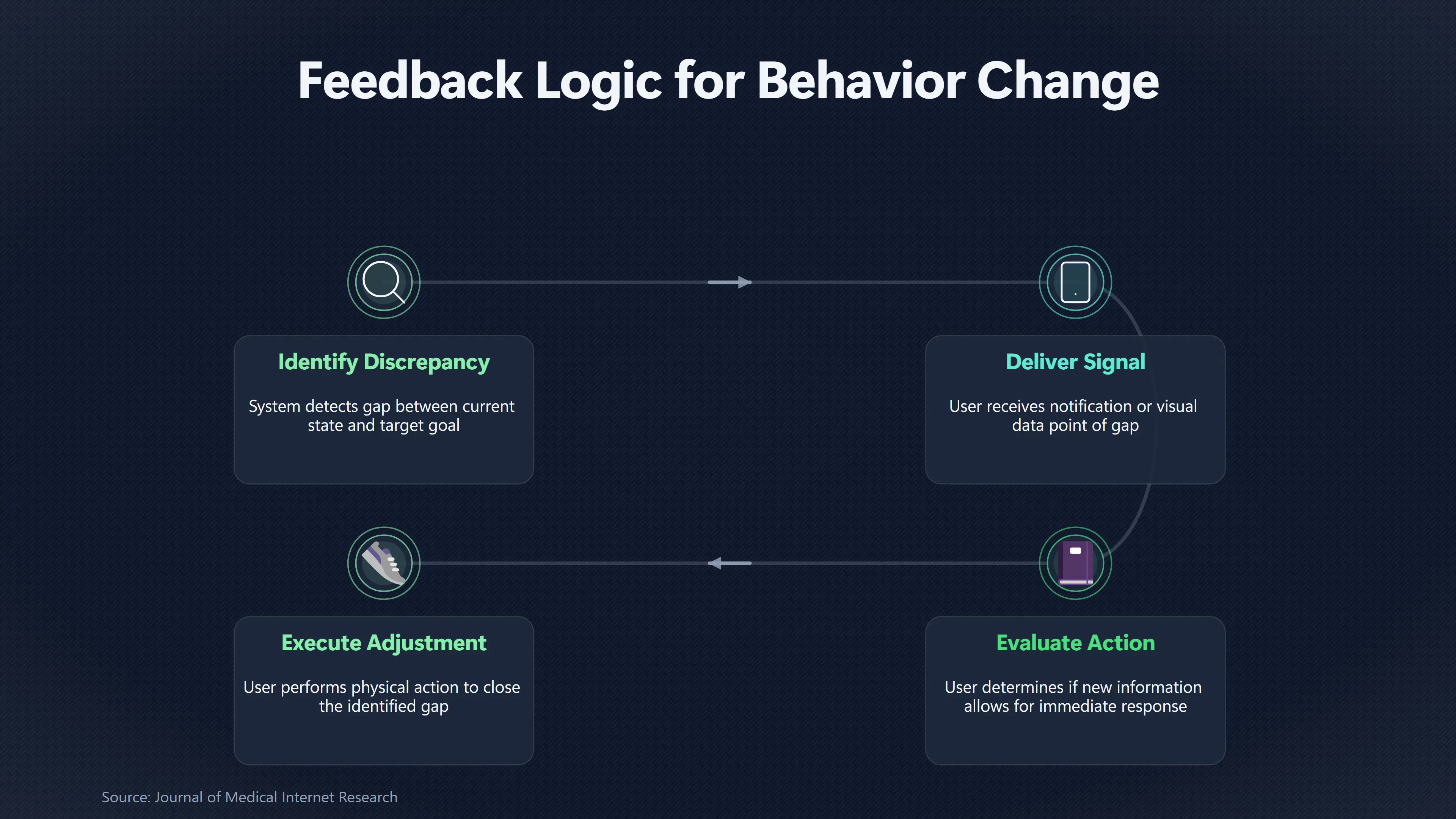
More feedback is not automatically better feedback. Making a self-monitoring system more frequent, detailed or visually sophisticated can improve awareness and sometimes keep people recording their behaviour, but those gains do not reliably translate into better performance on the underlying goal. Randomised studies of physical activity and weight management show a recurring pattern: daily feedback can beat weekly feedback in some settings, yet additional messages can reach diminishing returns; richer visual and contextual displays can fail to outperform simple information; and extra reminders can substantially increase tracking without producing significantly greater weight loss.[PubMed Central (PMC)]pmc.ncbi.nlm.nih.govPubMed Central (PMC)Impact of feedback generation and presentation on self-monitoring behaviors, dietary intake, physical activity, and w…
That distinction matters for self-improvement. The purpose of feedback is not to maximise the amount of information a person receives. It is to make the next useful adjustment easier. Once feedback already provides a clear comparison with a meaningful target, adding frequency or complexity may contribute little — and sometimes improves the monitoring process more than the behaviour being monitored.
Daily feedback does not have a simple advantage
The case for frequent feedback is intuitive. If someone learns today that they are falling behind on walking, studying or another repeated behaviour, they still have time to respond. Waiting until the end of the week may turn feedback into a retrospective report rather than a useful prompt.
There is experimental support for that logic. In Project Step, a small randomised trial involving insufficiently active adults with overweight or obesity, participants received adaptive walking goals and either daily or weekly feedback. Those receiving daily feedback increased their steps more than those receiving weekly feedback. The result shows that frequency can matter when the feedback concerns a behaviour that can be adjusted repeatedly and quickly.[PubMed]pubmed.ncbi.nlm.nih.govProject Step: A Randomized Controlled Trial Investigating the Effects of Frequent Feedback and Contingent Incentives on Physical Ac…
But the wider evidence does not establish a rule that daily is superior to weekly. A 2024 systematic review and meta-analysis covering 19 self-monitoring and feedback studies found only two studies that directly investigated feedback frequency. It concluded that results on the best way to generate and present feedback were mixed, with substantial heterogeneity preventing a pooled comparison of different frequencies and formats. In other words, the evidence base is much thinner than the ubiquity of daily app notifications might suggest.[PubMed Central (PMC)]pmc.ncbi.nlm.nih.govPubMed Central (PMC)Impact of feedback generation and presentation on self-monitoring behaviors, dietary intake, physical activity, and w…
The long-running SMART weight-management trial illustrates why the answer depends on what outcome is measured. Participants using a personal digital assistant could receive short, tailored daily messages in addition to the feedback built into a broader behavioural programme. Across related analyses, daily feedback was associated with better self-monitoring and larger reductions in reported energy intake, yet the primary 24-month comparison found no significant difference in percentage weight change between the paper diary, electronic diary and electronic diary-plus-feedback groups.[PubMed Central (PMC)]pmc.ncbi.nlm.nih.govPubMed Central (PMC)Using mHealth Technology to Enhance Self-Monitoring for Weight Loss A Randomized Trial - PMCJuly 1, 2012…
There can also be a saturation point. In a three-month smartwatch experiment, insufficiently active young adults received between zero and six randomly timed prompts per day. Step counts rose with the number of prompts to self-monitor up to roughly three per day, after which extra prompts produced minimal or reduced benefit. The number of behavioural-feedback prompts, meanwhile, was not associated with daily step counts. More opportunities to intervene therefore did not create a linear dose-response relationship.[PubMed Central (PMC)]pmc.ncbi.nlm.nih.govOpen source on nih.gov.
The practical question is consequently not “How often can feedback be delivered?” but “How often does new information create a useful opportunity to act?” A daily signal can be valuable for daily walking because the person can still take another walk. Repeating essentially the same message several more times that day may add no new decision value.
Richer displays can inform without changing behaviour
Digital self-monitoring makes it easy to assume that more dimensions, graphs and contextual information will produce better decisions. The Feedback, Awareness and Behaviour (FAB) study in Cambridgeshire put that assumption to a particularly clear test.
The trial randomised 466 adults to no immediate feedback or one of three progressively richer versions of personalised physical-activity feedback. “Simple” feedback gave participants their average physical activity level alongside reference categories and information about activity guidelines. “Visual” feedback added graphs of heart rate and movement across the day. “Contextualised” feedback added estimates showing how familiar activities such as walking, cycling and housework could increase activity, together with material intended to support goal setting. The design deliberately made each successive condition more information-rich.[PubMed Central (PMC)]pmc.ncbi.nlm.nih.govOpen source on nih.gov.
Yet personalised feedback did not significantly change objectively measured physical activity, self-reported activity or intention to become more active. It did improve participants’ awareness of their activity level, but the simple, visual and contextualised versions did not differ significantly in their behavioural effects.[PubMed Central (PMC)]pmc.ncbi.nlm.nih.govOpen source on nih.gov.
That is an important failure mode for self-monitoring: better understanding is an intermediate outcome, not necessarily the goal itself. A graph may correct a mistaken belief about how active someone is. Additional context may explain what the graph means. Neither necessarily removes the practical barrier that prevents that person from exercising tomorrow.
A later UK intervention pushed sophistication considerably further. MIPACT provided primary-care patients at risk of cardiovascular disease or type 2 diabetes with personalised, multidimensional physical-activity feedback through a digital system and web app, supported by health-trainer sessions. Feedback covered several dimensions rather than relying on a single activity number. At 12 months, however, the trial found no meaningful improvement in moderate-to-vigorous activity, overall physical activity level or sedentary time compared with usual care; for the principal outcomes, the groups were effectively equivalent.[PubMed]pubmed.ncbi.nlm.nih.govOpen source on nih.gov.
There is an instructive design detail behind that study. During development, interviews with patients and health professionals found that patients generally preferred simple messages to more complex or abstract visualisations. The eventual platform therefore offered accessible graphical formats and additional guidance rather than assuming that information richness was inherently desirable.[Springer]link.springer.comOpen source on springer.com.
These findings do not show that visualisation is useless. A richer display may be valuable when it exposes a pattern that a single number hides — for example, distinguishing long sedentary periods from insufficient vigorous exercise. But richness earns its place only when the extra dimension changes interpretation or suggests a different action. Complexity added for its own sake can turn a feedback tool into a better description of the problem without making the solution easier.
Adherence can improve while the main outcome does not
One of the most useful distinctions in this research is between engagement with self-monitoring and success on the ultimate goal. They can move separately.
A 12-week randomised trial of a commercial web-based weight-loss programme provides a striking example. The basic programme already offered food and exercise diaries, a weekly weigh-in log, automated feedback and reminders. The enhanced version added individualised weekly reports based on participants’ records plus extra reminders by text, email or telephone.[JMIR]jmir.orgJournal of Medical Internet ResearchJournal of Medical Internet Research - Enhancement of Self-Monitoring in a Web-Based Weight Loss Program by Extra Individualized Feed…
The additions clearly changed monitoring behaviour. Participants in the enhanced group recorded food consistently for a median of eight weeks, compared with three weeks in the basic group. For exercise the figures were 2.5 versus one week, and for weigh-ins 11 versus eight weeks. Those were statistically significant differences.[JMIR]jmir.orgJournal of Medical Internet ResearchJournal of Medical Internet Research - Enhancement of Self-Monitoring in a Web-Based Weight Loss Program by Extra Individualized Feed…
But the headline outcome did not follow in parallel. Mean weight loss was 3.3 kg in the enhanced programme and 2.7 kg in the basic programme, a difference that was not statistically significant. Nor was there a significant difference in the proportion achieving at least 5% weight loss. Extra feedback and reminders had therefore succeeded at one thing — getting people to monitor more consistently — without demonstrating a corresponding improvement in the main outcome.[JMIR]jmir.orgJournal of Medical Internet ResearchJournal of Medical Internet Research - Enhancement of Self-Monitoring in a Web-Based Weight Loss Program by Extra Individualized Feed…
This result is especially revealing because, within the same study, more consistent monitoring was associated with greater weight loss. That observational association did not mean that experimentally adding features which increased monitoring would necessarily cause a detectable additional loss of weight. People who monitor consistently may differ in motivation, behaviour or circumstances; and an intervention that generates more records does not guarantee that those records will lead to more effective behavioural adjustments.[JMIR]jmir.orgJournal of Medical Internet ResearchJournal of Medical Internet Research - Enhancement of Self-Monitoring in a Web-Based Weight Loss Program by Extra Individualized Feed…
The SMART trial offers a related caution. Electronic monitoring helped sustain adherence compared with paper recording, but adding daily feedback to the electronic diary did not significantly improve adherence over the electronic diary alone in the main 24-month analysis, and the three groups did not differ significantly in mean percentage weight loss at 24 months. The method could make monitoring easier without producing a proportionate long-term advantage in the outcome that ultimately mattered.[ScienceDirect]sciencedirect.comOpen source on sciencedirect.com.
Why the extra feedback stops adding value
These studies point to several mechanisms rather than a single explanation. First, feedback can encounter diminishing informational returns. If yesterday’s message already established that someone is below a target and today’s circumstances have not materially changed, another message may contain little actionable information. The smartwatch prompt experiment, in which benefits levelled off after roughly three self-monitoring prompts per day, is consistent with such a ceiling.[PubMed Central (PMC)]pmc.ncbi.nlm.nih.govOpen source on nih.gov.
Second, measurement can be easier to change than the behaviour being measured. A reminder can cause someone to open an app or enter their weight within seconds. Losing weight, increasing physical activity or changing eating patterns requires changes outside the monitoring system. The web-based weight-loss trial demonstrates the resulting gap particularly well: enhanced feedback strongly affected logging consistency without significantly improving weight loss.[PubMed Central (PMC)]pmc.ncbi.nlm.nih.govOpen source on nih.gov.
Third, information may identify a discrepancy without resolving its cause. FAB participants became more accurate in judging their activity but did not become more active. MIPACT delivered far more detailed characterisation of physical activity and still did not increase mean activity. Knowing that a gap exists is different from having the time, opportunity, confidence or workable strategy required to close it.[PubMed Central (PMC)]pmc.ncbi.nlm.nih.govOpen source on nih.gov.
Finally, extra sophistication may add information that is technically relevant but behaviourally redundant. In FAB, adding visual patterns and then contextualised examples did not outperform simpler feedback. The 2024 systematic review consequently concluded that the available comparisons of feedback frequency, richness and other presentation characteristics give mixed results rather than identifying a universally superior format.[Springer]link.springer.comImpact of feedback generation and presentation on self-monitoring behaviors, dietary intake, physical activity, and weight: a sys…
The useful target is decision value, not feedback volume
The evidence does not support stripping self-monitoring down to the bare minimum in every case. Daily feedback sometimes does outperform weekly feedback, and detailed information can be valuable when it reveals a genuinely actionable pattern. The stronger conclusion is narrower: frequency and richness are design choices, not benefits in themselves.
A useful feedback system therefore needs enough information to answer a practical question. If a daily step message arrives while there is still time to walk, higher frequency may have real value. If several measurements reveal that inactivity is concentrated after work, richer contextual feedback may identify a better intervention than a total step count. But once another message, metric or graph stops changing what the person can sensibly do next, its marginal value is small.
This is also why adherence should not be mistaken for success. More app openings, weigh-ins, diary entries or dashboard views can show that feedback has made monitoring more engaging. They are meaningful intermediate outcomes, but they are not substitutes for the behaviour or result the monitoring system exists to improve. Trials in weight management and physical activity repeatedly show that the two can diverge.[jmir.org]jmir.orgJournal of Medical Internet ResearchJournal of Medical Internet Research - Enhancement of Self-Monitoring in a Web-Based Weight Loss Program by Extra Individualized Feed…
For self-improvement, the better optimisation question is therefore not how to obtain the most feedback. It is how to obtain the least feedback that reliably reveals a meaningful discrepancy and supports a useful response. The current evidence cannot specify one ideal frequency or display for every goal, but it gives good reason to resist the assumption that a busier dashboard, a longer report or another notification necessarily makes self-monitoring more effective.
Amazon book picks
Further Reading
Books and field guides related to Why More Feedback Is Not Always Better. Use these as the next step if you want deeper reading beyond the article.
Thanks for the Feedback
We get feedback every day of our lives, from friends and family, colleagues, customers, and bosses, teachers, doctors, and strangers. We...
The Paradox of Choice
Rating: 3.5/5 from 13 Google Books ratings
Whether we’re buying a pair of jeans, ordering a cup of coffee, purchasing shampoo from the drug store, selecting a long-distance carrier...
Atomic Habits
Rating: 3.5/5 from 7 Google Books ratings
The #1 New York Times bestseller. Over 25 million copies sold! Translated into 60+ languages! Tiny Changes, Remarkable Results No matter...
The Power of Habit
Rating: 4.0/5 from 145 Google Books ratings
Duhigg takes us to the edge of scientific discoveries that explain why habits exist and how they can be changed. Distilling information i...
eBay marketplace picks
Marketplace Samples
Live-tested eBay searches with available results related to this page.
Selected fromminimalist poster oneBay.co.uk.



Endnotes
1.
Source: jmir.org
Title: Journal of Medical Internet Research
Link:https://www.jmir.org/2016/4/e82/
Source snippet
Journal of Medical Internet Research - Enhancement of Self-Monitoring in a Web-Based Weight Loss Program by Extra Individualized Feed...
2.
Source: link.springer.com
Link:https://link.springer.com/article/10.1186/s12966-023-01555-6
Source snippet
Impact of feedback generation and presentation on self-monitoring behaviors, dietary intake, physical activity, and weight: a sys...
3.
Source: link.springer.com
Link:https://link.springer.com/article/10.1186/s13063-015-0892-x
4.
Source: sciencedirect.com
Link:https://www.sciencedirect.com/science/article/pii/S0749379712002425
5.
Source: humanfactors.jmir.org
Link:https://humanfactors.jmir.org/2026/1/e87692
6.
Source: mhealth.jmir.org
Link:https://mhealth.jmir.org/2026/1/e76991/
7.
Source: aging.jmir.org
Link:https://aging.jmir.org/2026/1/e91873
8.
Source: pediatrics.jmir.org
Link:https://pediatrics.jmir.org/2026/1/e86139
9.
Source: mental.jmir.org
Link:https://mental.jmir.org/2026/1/e84754/
10.
Source: sciencedirect.com
Link:https://www.sciencedirect.com/science/article/abs/pii/S0093934X25001385
11.
Source: jmir.org
Title: Journal of Medical Internet Research
Link:https://www.jmir.org/2025/1/e60703
13.
Source: medinform.jmir.org
Link:https://medinform.jmir.org/2024/1/e59828
14.
Source: mhealth.jmir.org
Link:https://mhealth.jmir.org/2024/1/e51216/
15.
Source: link.springer.com
Link:https://link.springer.com/article/10.1007/s12553-024-00888-x
16.
Source: sciencedirect.com
Link:https://www.sciencedirect.com/org/science/article/pii/S2561326X23002184
17.
Source: sciencedirect.com
Link:https://www.sciencedirect.com/org/science/article/pii/S2561326X22003006
18.
Source: formative.jmir.org
Link:https://formative.jmir.org/2022/3/e26525
19.
Source: jmir.org
Title: Journal of Medical Internet Research
Link:https://www.jmir.org/2021/2/e22694/
20.
Source: link.springer.com
Link:https://link.springer.com/article/10.1186/s12966-020-00998-5
21.
Source: sciencedirect.com
Link:https://www.sciencedirect.com/science/article/pii/S0953620519303061
22.
Source: link.springer.com
Link:https://link.springer.com/article/10.1186/s11556
23.
Source: link.springer.com
Link:https://link.springer.com/article/10.1186/s13012
24.
Source: link.springer.com
Link:https://link.springer.com/article/10.1186/s13012
25.
Source: sciencedirect.com
Link:https://www.sciencedirect.com/org/science/article/pii/S2291522219001712
26.
Source: mhealth.jmir.org
Link:https://mhealth.jmir.org/2019/2/e12209/
27.
Source: link.springer.com
Link:https://link.springer.com/article/10.1186/s13643
28.
Source: link.springer.com
Link:https://link.springer.com/article/10.1186/s12889-016-3256-x
29.
Source: sciencedirect.com
Link:https://www.sciencedirect.com/org/science/article/pii/S1438887116000741
30.
Source: jmir.org
Title: Journal of Medical Internet Research
Link:https://www.jmir.org/2015/10/e231/
31.
Source: mhealth.jmir.org
Link:https://mhealth.jmir.org/2015/2/e42/
32.
Source: mhealth.jmir.org
Link:https://mhealth.jmir.org/2015/2/e42/citations
33.
Source: link.springer.com
Link:https://link.springer.com/article/10.1007/s11606-014-2913-y
34.
Source: jmir.org
Title: Journal of Medical Internet Research
Link:https://www.jmir.org/2013/7/e140
35.
Source: sciencedirect.com
Link:https://www.sciencedirect.com/science/article/abs/pii/S0749379712002425
36.
Source: link.springer.com
Link:https://link.springer.com/article/10.1186/1471
37.
Source: link.springer.com
Link:https://link.springer.com/article/10.1186/1471
38.
Source: sciencedirect.com
Link:https://www.sciencedirect.com/science/article/abs/pii/S0002822303014482
39.
Source: sciencedirect.com
Title: Descriptive dynamic models for goal-directed arm movements
Link:https://www.sciencedirect.com/science/article/abs/pii/0167945784900101
40.
Source: sciencedirect.com
Link:https://www.sciencedirect.com/science/article/pii/S1499404615004728
41.
Source: sciencedirect.com
Link:https://www.sciencedirect.com/science/article/pii/S036013151930082X
42.
Source: sciencedirect.com
Link:https://www.sciencedirect.com/science/article/pii/S0747563215302946
43.
Source: sciencedirect.com
Title: Information Richness
Link:https://www.sciencedirect.com/topics/computer-science/information-richness
44.
Source: pmc.ncbi.nlm.nih.gov
Link:https://pmc.ncbi.nlm.nih.gov/articles/PMC10765525/
Source snippet
PubMed Central (PMC)Impact of feedback generation and presentation on self-monitoring behaviors, dietary intake, physical activity, and w...
45.
Source: pubmed.ncbi.nlm.nih.gov
Link:https://pubmed.ncbi.nlm.nih.gov/33601334/
Source snippet
Project Step: A Randomized Controlled Trial Investigating the Effects of Frequent Feedback and Contingent Incentives on Physical Ac...
46.
Source: pmc.ncbi.nlm.nih.gov
Link:https://pmc.ncbi.nlm.nih.gov/articles/PMC3563396/
Source snippet
PubMed Central (PMC)Using mHealth Technology to Enhance Self-Monitoring for Weight Loss A Randomized Trial - PMCJuly 1, 2012...
Published: July 1, 2012
47.
Source: pmc.ncbi.nlm.nih.gov
Link:https://pmc.ncbi.nlm.nih.gov/articles/PMC5027143/
Source snippet
PubMed Central (PMC)The use of mHealth to deliver tailored messages reduces reported energy and fat intake - PMC...
48.
Source: pmc.ncbi.nlm.nih.gov
Link:https://pmc.ncbi.nlm.nih.gov/articles/PMC10015600/
49.
Source: pmc.ncbi.nlm.nih.gov
Link:https://pmc.ncbi.nlm.nih.gov/articles/PMC3774634/
50.
Source: pubmed.ncbi.nlm.nih.gov
Link:https://pubmed.ncbi.nlm.nih.gov/24066178/
Source snippet
Impact of personalised feedback about physical activity on change in objectively measured physical activity (the FAB study): a rand...
51.
Source: pubmed.ncbi.nlm.nih.gov
Link:https://pubmed.ncbi.nlm.nih.gov/32771018/
52.
Source: pmc.ncbi.nlm.nih.gov
Link:https://pmc.ncbi.nlm.nih.gov/articles/PMC7414690/
53.
Source: pmc.ncbi.nlm.nih.gov
Link:https://pmc.ncbi.nlm.nih.gov/articles/PMC4846785/
54.
Source: pubmed.ncbi.nlm.nih.gov
Link:https://pubmed.ncbi.nlm.nih.gov/42378437/
55.
Source: pmc.ncbi.nlm.nih.gov
Link:https://pmc.ncbi.nlm.nih.gov/articles/PMC12868584/
56.
Source: pubmed.ncbi.nlm.nih.gov
Link:https://pubmed.ncbi.nlm.nih.gov/41262705/
57.
Source: pmc.ncbi.nlm.nih.gov
Link:https://pmc.ncbi.nlm.nih.gov/articles/PMC12454610/
58.
Source: pmc.ncbi.nlm.nih.gov
Link:https://pmc.ncbi.nlm.nih.gov/articles/PMC11282379/
59.
Source: pubmed.ncbi.nlm.nih.gov
Link:https://pubmed.ncbi.nlm.nih.gov/38807219/
60.
Source: pmc.ncbi.nlm.nih.gov
Link:https://pmc.ncbi.nlm.nih.gov/articles/PMC11161714/
61.
Source: pubmed.ncbi.nlm.nih.gov
Link:https://pubmed.ncbi.nlm.nih.gov/38451990/
62.
Source: pubmed.ncbi.nlm.nih.gov
Link:https://pubmed.ncbi.nlm.nih.gov/38178230/
63.
Source: pmc.ncbi.nlm.nih.gov
Link:https://pmc.ncbi.nlm.nih.gov/articles/PMC10145832/
64.
Source: pmc.ncbi.nlm.nih.gov
Link:https://pmc.ncbi.nlm.nih.gov/articles/PMC9841671/
65.
Source: pubmed.ncbi.nlm.nih.gov
Link:https://pubmed.ncbi.nlm.nih.gov/36160596/
66.
Source: pmc.ncbi.nlm.nih.gov
Link:https://pmc.ncbi.nlm.nih.gov/articles/PMC9158426/
67.
Source: pubmed.ncbi.nlm.nih.gov
Link:https://pubmed.ncbi.nlm.nih.gov/35234658/
68.
Source: pmc.ncbi.nlm.nih.gov
Link:https://pmc.ncbi.nlm.nih.gov/articles/PMC8928046/
69.
Source: pmc.ncbi.nlm.nih.gov
Link:https://pmc.ncbi.nlm.nih.gov/articles/PMC8791066/
70.
Source: pmc.ncbi.nlm.nih.gov
Link:https://pmc.ncbi.nlm.nih.gov/articles/PMC8726568/
71.
Source: pmc.ncbi.nlm.nih.gov
Link:https://pmc.ncbi.nlm.nih.gov/articles/PMC8467510/
72.
Source: pmc.ncbi.nlm.nih.gov
Link:https://pmc.ncbi.nlm.nih.gov/articles/PMC8158169/
73.
Source: pmc.ncbi.nlm.nih.gov
Link:https://pmc.ncbi.nlm.nih.gov/articles/PMC7407266/?uid=cd56dee81ef03s16
74.
Source: pmc.ncbi.nlm.nih.gov
Link:https://pmc.ncbi.nlm.nih.gov/articles/PMC6926211/
75.
Source: pubmed.ncbi.nlm.nih.gov
Link:https://pubmed.ncbi.nlm.nih.gov/31494019/
76.
Source: pmc.ncbi.nlm.nih.gov
Link:https://pmc.ncbi.nlm.nih.gov/articles/PMC6500067/
77.
Source: pmc.ncbi.nlm.nih.gov
Link:https://pmc.ncbi.nlm.nih.gov/articles/PMC6416539/
78.
Source: pubmed.ncbi.nlm.nih.gov
Link:https://pubmed.ncbi.nlm.nih.gov/30816851/
79.
Source: pmc.ncbi.nlm.nih.gov
Link:https://pmc.ncbi.nlm.nih.gov/articles/PMC6409509/
80.
Source: pmc.ncbi.nlm.nih.gov
Link:https://pmc.ncbi.nlm.nih.gov/articles/PMC6371423/
81.
Source: pubmed.ncbi.nlm.nih.gov
Link:https://pubmed.ncbi.nlm.nih.gov/29529158/
82.
Source: pmc.ncbi.nlm.nih.gov
Link:https://pmc.ncbi.nlm.nih.gov/articles/PMC7518411/
83.
Source: pmc.ncbi.nlm.nih.gov
Link:https://pmc.ncbi.nlm.nih.gov/articles/PMC5746685/
84.
Source: pubmed.ncbi.nlm.nih.gov
Link:https://pubmed.ncbi.nlm.nih.gov/29259794/
85.
Source: pmc.ncbi.nlm.nih.gov
Link:https://pmc.ncbi.nlm.nih.gov/articles/PMC5729493/
86.
Source: pubmed.ncbi.nlm.nih.gov
Link:https://pubmed.ncbi.nlm.nih.gov/28494799/
87.
Source: pmc.ncbi.nlm.nih.gov
Link:https://pmc.ncbi.nlm.nih.gov/articles/PMC5127499/
88.
Source: pubmed.ncbi.nlm.nih.gov
Link:https://pubmed.ncbi.nlm.nih.gov/27072817/
89.
Source: pmc.ncbi.nlm.nih.gov
Link:https://pmc.ncbi.nlm.nih.gov/articles/PMC4552151/
90.
Source: pmc.ncbi.nlm.nih.gov
Link:https://pmc.ncbi.nlm.nih.gov/articles/PMC4483716/
91.
Source: pubmed.ncbi.nlm.nih.gov
Link:https://pubmed.ncbi.nlm.nih.gov/24434827/
92.
Source: pmc.ncbi.nlm.nih.gov
Link:https://pmc.ncbi.nlm.nih.gov/articles/PMC4266405/
93.
Source: pmc.ncbi.nlm.nih.gov
Link:https://pmc.ncbi.nlm.nih.gov/articles/PMC4195875/
94.
Source: pmc.ncbi.nlm.nih.gov
Link:https://pmc.ncbi.nlm.nih.gov/articles/PMC4238192/
95.
Source: pmc.ncbi.nlm.nih.gov
Link:https://pmc.ncbi.nlm.nih.gov/articles/PMC3529986/
96.
Source: pubmed.ncbi.nlm.nih.gov
Link:https://pubmed.ncbi.nlm.nih.gov/23512320/
97.
Source: pmc.ncbi.nlm.nih.gov
Link:https://pmc.ncbi.nlm.nih.gov/articles/PMC3786000/
98.
Source: pmc.ncbi.nlm.nih.gov
Link:https://pmc.ncbi.nlm.nih.gov/articles/PMC3996838/
99.
Source: pubmed.ncbi.nlm.nih.gov
Link:https://pubmed.ncbi.nlm.nih.gov/21200337/
100.
Source: pmc.ncbi.nlm.nih.gov
Link:https://pmc.ncbi.nlm.nih.gov/articles/PMC3268702/
101.
Source: pmc.ncbi.nlm.nih.gov
Link:https://pmc.ncbi.nlm.nih.gov/articles/PMC2859395/
102.
Source: pmc.ncbi.nlm.nih.gov
Link:https://pmc.ncbi.nlm.nih.gov/articles/PMC4170834/
103.
Source: pubmed.ncbi.nlm.nih.gov
Link:https://pubmed.ncbi.nlm.nih.gov/36862471/
104.
Source: pubmed.ncbi.nlm.nih.gov
Link:https://pubmed.ncbi.nlm.nih.gov/22936524/?dopt=Abstract
105.
Source: pubmed.ncbi.nlm.nih.gov
Link:https://pubmed.ncbi.nlm.nih.gov/22936524/
106.
Source: pubmed.ncbi.nlm.nih.gov
Link:https://pubmed.ncbi.nlm.nih.gov/22704741/
107.
Source: pubmed.ncbi.nlm.nih.gov
Link:https://pubmed.ncbi.nlm.nih.gov/19194332/
108.
Source: pubmed.ncbi.nlm.nih.gov
Link:https://pubmed.ncbi.nlm.nih.gov/24965281/
109.
Source: science.gov
Link:https://www.science.gov/topicpages/t/trials%2Bregistry%2Banzctr.html
110.
Source: science.gov
Link:https://www.science.gov/topicpages/p/physical%2Bactivity%2Bmeasures
111.
Source: ouci.dntb.gov.ua
Link:https://ouci.dntb.gov.ua/en/works/lD8nAqGl/
Additional References
112.
Source: youtube.com
Title: How to Give & Get Constructive Feedback | Dr. Adam Grant & Dr. Andrew Huberman
Link:https://www.youtube.com/watch?v=sPWRjjj2iok
Source snippet
Why Feedback Is Making You Worse (And What to Do Instead) | Adam Grant...
113.
Source: youtube.com
Title: Why Feedback Is Making You Worse (And What to Do Instead) | Adam Grant
Link:https://www.youtube.com/watch?v=rwSg2uXIqBM
Source snippet
Thanks for the Feedback | Doug Stone & Sheila Heen | Talks at Google...
114.
Source: youtube.com
Title: Thanks for the Feedback | Doug Stone & Sheila Heen | Talks at Google
Link:https://www.youtube.com/watch?v=SggjK0Gm3I4
Source snippet
How Feedback Affects Performance - Andrew Huberman - [Growth Mindset]({{ 'growth-mindset/' | relative_url }})...
115.
Source: cdc.gov
Link:https://www.cdc.gov/pcd/issues/2016/16_0231.htm
116.
Source: youtube.com
Title: How Feedback Affects Performance
Link:https://www.youtube.com/watch?v=V9ewjjzAlRs
Source snippet
Why Feedback Fails with Dr Mark Scullard...
117.
Source: researchgate.net
Link:https://www.researchgate.net/publication/347163077_Decolonising_the_Teaching_of_Mathematics_in_Rural_Learning_Ecologies_by_Using_Indigenous_Games
118.
Source: researchgate.net
Link:https://www.researchgate.net/publication/291335719_Does_Monitoring_Goal_Progress_Promote_Goal_Attainment_A_Meta-Analysis_of_the_Experimental_Evidence
119.
Source: researchgate.net
Link:https://www.researchgate.net/publication/343531197Effect_of_novel_technology-enabled_multidimensional_physical_activity_feedback_in_primary_care_patients_at_risk_of_chronic_disease-_the_MIPACT_study_a_randomised_controlled_trial
120.
Source: researchgate.net
Link:https://www.researchgate.net/publication/301246849_Enhancement_of_Self-Monitoring_in_a_Web-Based_Weight_Loss_Program_by_Extra_Individualized_Feedback_and_Reminders_Randomized_Trial
121.
Source: researchgate.net
Link:https://www.researchgate.net/publication/331059650_Feedback_from_physical_activity_monitors_to_enhance_amount_of_physical_activity_in_adults-a_protocol_for_a_systematic_review_and_meta-analysis/download