Within Evidence Limits
Why Visible Progress Tracking Can Improve Goal Follow Through
Tracking goals tends to help more when progress is physically recorded or shared, showing that monitoring design matters as much as monitoring itself.
On this page
- What randomized studies found about self monitoring
- Why recording and public reporting may strengthen effects
- Where tracking can become excessive or misleading
Page outline Jump by section
Introduction
Self-monitoring is one of the better-supported ideas in the self-improvement toolkit, but the evidence points to a more specific lesson than simply “track your goals”. Monitoring tends to work better when progress leaves a visible trace: a written log, recorded measurement, step count or other record that can be reviewed. Effects have also been larger when progress is reported to somebody else rather than kept entirely private.

The strongest broad evidence comes from a meta-analysis of 138 randomised studies involving 19,951 participants. Interventions designed to increase progress monitoring produced a moderate improvement in goal attainment, with an average effect of d = 0.40. Crucially, the benefit was larger when monitoring information was physically recorded and when outcomes were reported or made public.[PubMed]pubmed.ncbi.nlm.nih.govDoes monitoring goal progress promote goal attainment? A meta-analysis of the experimental evidence - PubMedFebruary 1, 2016…
That makes visible tracking a useful example of why implementation matters in evidence-based self-improvement. The intervention is not merely “pay attention to your goal”. A record can make discrepancies difficult to forget, while reporting can add accountability. Neither mechanism, however, means that more tracking is always better.
What randomised studies found about self-monitoring
Benjamin Harkin and colleagues’ 2016 Psychological Bulletin meta-analysis provides unusually broad experimental evidence because it restricted its main analysis to studies in which participants were randomly allocated to an intervention promoting progress monitoring or to a control condition. The 138 studies covered nearly 20,000 participants and a variety of goals, although health-related goals were particularly prominent.[PubMed]pubmed.ncbi.nlm.nih.govDoes monitoring goal progress promote goal attainment? A meta-analysis of the experimental evidence - PubMedFebruary 1, 2016…
The interventions had a very large effect on how frequently people monitored progress (d = 1.98, 95% confidence interval 1.71 to 2.24), but the effect on actually attaining goals was substantially smaller: d = 0.40 (95% CI 0.32 to 0.48). Changes in monitoring frequency statistically mediated the improvement in goal attainment. In plain terms, interventions successfully got people to check their progress much more often, and this increased monitoring was associated with a meaningful but considerably more modest improvement in achieving the goal.[PubMed]pubmed.ncbi.nlm.nih.govDoes monitoring goal progress promote goal attainment? A meta-analysis of the experimental evidence - PubMedFebruary 1, 2016…
That distinction matters. A tracking system can be extremely successful at generating entries, check-ins or measurements without producing an equally dramatic change in the outcome that ultimately matters. The evidence supports monitoring as an aid to goal pursuit, not as a guarantee of success.
The meta-analysis also produced a particularly useful implementation finding. Monitoring in private had an estimated effect of d = 0.19 on goal attainment, whereas monitoring in public was associated with d = 0.55 and reporting monitoring information with d = 0.47. Physically recording the information was associated with an effect of d = 0.43, compared with d = 0.29 when information was not recorded. When goal attainment itself was measured objectively, the corresponding recorded-versus-unrecorded estimates were d = 0.57 versus d = 0.23.[Library]1library.netDoes Monitoring Goal Progress Promote Goal Attainment? A Meta-Analysis of the Experimental Evidence…
These are moderator findings across sets of studies, rather than clean estimates from one enormous experiment independently randomising people to “visible” and “invisible” tracking. They should therefore be interpreted more cautiously than the overall randomised comparison between monitoring interventions and controls. The authors themselves called for direct experiments comparing reported with unreported monitoring to establish the mechanisms more firmly.[White Rose Research Online]eprints.whiterose.ac.ukOpen source on whiterose.ac.uk.
Why a visible record may be more useful than a mental check
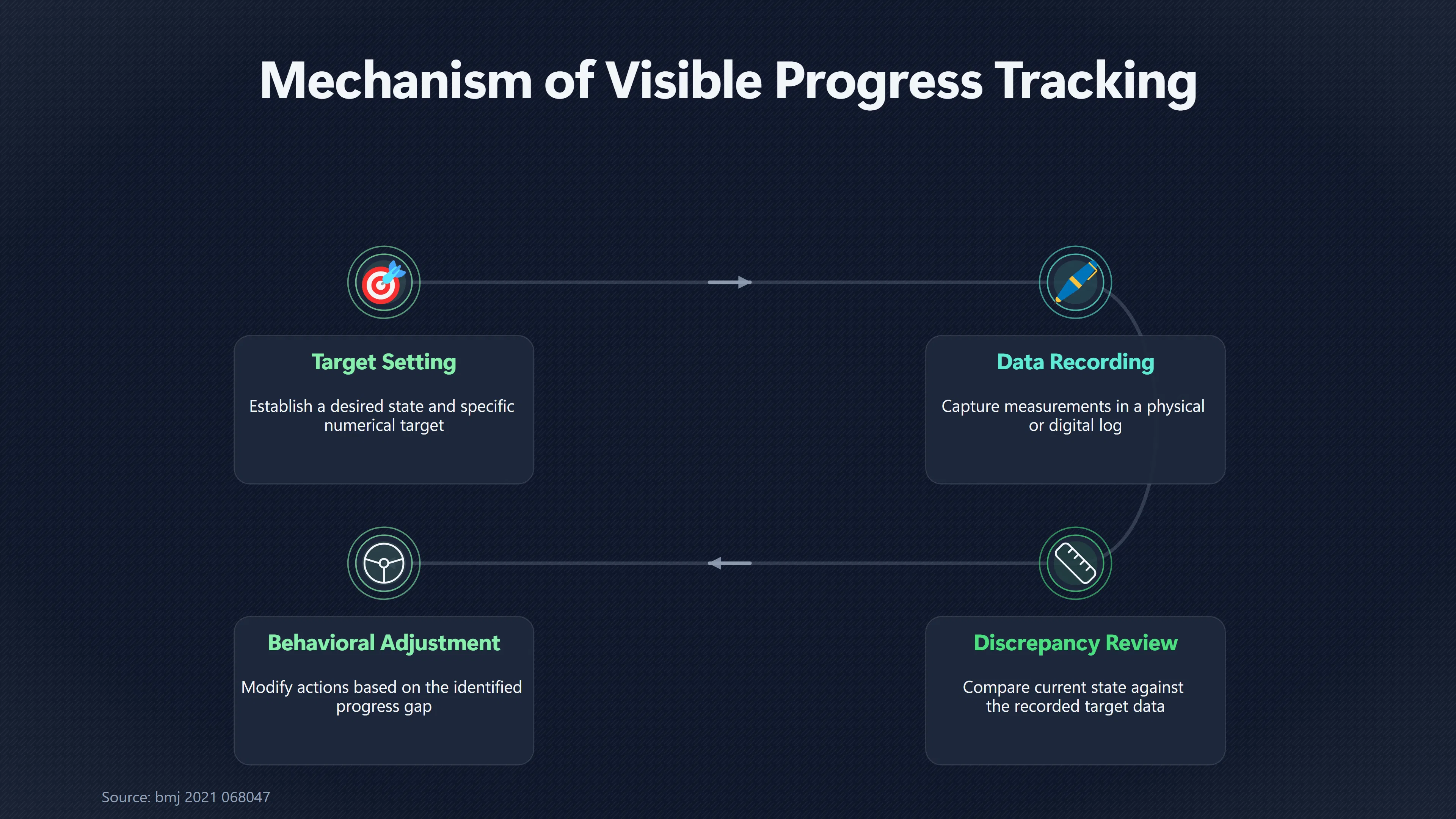
The basic self-regulation logic is straightforward. Monitoring supplies information about the difference between the present state and a desired state. If the target is 8,000 steps and the display says 4,300 late in the afternoon, the discrepancy can prompt an adjustment. Without sufficiently frequent feedback, people may simply fail to notice that behaviour is drifting away from the target. The Harkin meta-analysis supports this feedback-loop account because interventions that changed monitoring frequency subsequently improved goal attainment.[PubMed]pubmed.ncbi.nlm.nih.govDoes monitoring goal progress promote goal attainment? A meta-analysis of the experimental evidence - PubMedFebruary 1, 2016…
Recording adds something beyond noticing the number in the moment. Harkin and colleagues proposed that a physical record may strengthen the encoding and later retrieval of progress information. A diary, spreadsheet, calendar mark or stored digital reading also gives the person something that can be examined across time. It becomes harder for yesterday’s shortfall—or improvement—to disappear from memory.[White Rose Research Online]eprints.whiterose.ac.ukOpen source on whiterose.ac.uk.
A record can therefore turn an impression such as “I have been exercising quite regularly” into a sequence that can be inspected. The useful feature is not necessarily paper rather than pixels: the relevant distinction is between transient awareness and information that is actually recorded and available for review. Indeed, physical-activity monitors provide a particularly concrete modern version of this feedback loop.
A 2022 BMJ systematic review of 121 randomised controlled trials involving 16,743 participants found that physical-activity-monitor interventions that provided feedback increased overall physical activity by a standardised mean difference of 0.42, equivalent in the authors’ analysis to roughly 1,235 additional steps per day. The certainty of evidence differed by outcome, and the authors cautioned that publication bias might mean the physical-activity effect was overestimated.[BMJ]bmj.combmj 2021 068047bmj 2021 068047
A separate review of step-count monitoring found 70 randomised trials and reported increases of about 1,126 steps per day at four months or less and 464 at one year in its preferred change-from-baseline analysis. The estimated effect was much less certain at two years, illustrating a recurring problem with tracking interventions: an immediately visible number can change behaviour without establishing that the same benefit will persist indefinitely.[PubMed]pubmed.ncbi.nlm.nih.govOpen source on nih.gov.
Public reporting adds accountability, but the mechanism is not settled
Making progress visible to somebody else changes the intervention again. A private spreadsheet primarily supplies information to the person pursuing the goal. A weekly report to a coach, group or other observer adds a social audience.
Harkin and colleagues proposed several possible reasons why public or reported monitoring might strengthen goal pursuit: greater public commitment, accountability, concern about how one’s performance is presented to others, and—in experiments—the possibility of demand effects, where participants alter behaviour because they infer what researchers expect. Their meta-analysis established the moderator pattern, but it did not establish which of these explanations causes the stronger effect.[White Rose Research Online]eprints.whiterose.ac.ukOpen source on whiterose.ac.uk.
This distinction guards against turning “public tracking works better” into another oversized self-help rule. Posting every goal on social media is not what the evidence demonstrates. Reporting can be as simple as submitting step counts, recording symptoms for review, or having measurements reviewed within a structured programme.[College Sidekick]collegesidekick.comstudy docsstudy docs
More recent evidence reinforces the broader idea that feedback surrounding self-monitoring can matter while also showing how uncertain the optimal design remains. A 2024 systematic review examined 19 randomised studies with 3,261 participants comparing forms of feedback around self-monitoring of diet, physical activity or weight. For physical activity, feedback produced a small additional benefit over self-monitoring without feedback (d = 0.29, 95% CI 0.16 to 0.43). But results for other outcomes and feedback formats were mixed, and 10 of the 19 studies were judged at high overall risk of bias. The reviewers concluded that there was not yet enough evidence to say which forms of feedback or presentation are best.[DOI]doi.orgOpen source on doi.org.
The practical distinction is therefore between making progress inspectable and assuming that any extra social or technological layer will improve it. The first has broad experimental support; the best way to engineer the second remains much less certain.
Track the measure that corresponds to the goal
Visibility is useful only if the visible number represents something worth changing. One of the more practical findings in the Harkin review was that monitoring behaviour and monitoring outcomes did not produce interchangeable effects.
Across the relevant comparisons, monitoring behaviour had a reliable effect on behavioural performance (d = 0.45) but no reliable effect on outcomes (d = 0.14). Monitoring outcomes showed the reverse pattern: a medium-to-large effect on outcomes (d = 0.62), but no reliable effect on behaviour (d = 0.17).[Library]1library.netDoes Monitoring Goal Progress Promote Goal Attainment? A Meta-Analysis of the Experimental Evidence…
This gives visible tracking an important design rule. If the objective is to establish a behaviour, record the behaviour: sessions completed, pages written, minutes practised or another direct measure. If the objective is an outcome, an outcome measure may be informative, although outcomes can often be influenced by factors beyond the person’s immediate control.
The American Psychological Association’s summary of the research gives the health example succinctly: monitoring food intake is more directly aligned with changing diet, whereas monitoring body weight is aligned with a weight outcome.[American Psychological Association]apa.orgOpen source on apa.org. The same logic generalises beyond health. Counting hours at a desk is a poor progress indicator if the real goal is completed work; recording books purchased says little about reading; and maintaining a long habit streak can become misleading if the underlying behaviour has become perfunctory.
The point is not to find the most impressive metric. It is to make the relevant progress—or lack of it—visible enough to guide the next action.
Where tracking becomes excessive or misleading
The evidence does not support the stronger claim that adding ever more dashboards, devices and measurements will keep improving results. Self-monitoring is an intervention component, and more elaborate monitoring can fail to outperform a simpler system.
The IDEA randomised clinical trial provides a useful counterexample to technological enthusiasm. It enrolled 471 young adults in a behavioural weight-loss programme. After six months, one group used a study website to self-monitor diet and physical activity, while another received a wearable device and web interface. At 24 months, estimated weight loss was 5.9 kg in the standard group but only 3.5 kg in the wearable-technology group, a statistically significant difference favouring the simpler standard intervention. Both groups improved physical activity, fitness and diet, without significant between-group differences on those measures.[JAMA Network]jamanetwork.comOpen source on jamanetwork.com.
That trial does not show that wearables generally make people worse at achieving goals; large reviews of physical-activity monitors find benefits on average.[BMJ]bmj.combmj 2021 068047bmj 2021 068047 It shows something narrower and more useful: a more sophisticated visible-tracking device is not automatically an improvement over an existing self-monitoring system.
There is also a human cost to consider. People sometimes avoid progress information precisely because they expect it to be unpleasant, demotivating or to demand an unwanted response. Research on avoidance of goal-progress information has identified perceived effort, anticipated negative emotions, doubts about the value or accuracy of information and concern about what the information will require them to do as reasons people stop checking.[PubMed Central (PMC)]pmc.ncbi.nlm.nih.govOpen source on nih.gov. A systematic review of 67 empirical studies on health-related self-tracking similarly identified discontinuation and rejection as significant themes and highlighted adverse psychosocial consequences as an area needing more research.[PubMed Central (PMC)]pmc.ncbi.nlm.nih.govOpen source on nih.gov.
The risks also depend on what is being tracked and by whom. A meta-analysis of self-weighing found no overall association with affect, body-related attitudes or disordered eating, although it found a small negative association with broader psychological functioning and evidence that effects differed according to participant and study characteristics.[PubMed Central (PMC)]pmc.ncbi.nlm.nih.govOpen source on nih.gov. That is another reason not to universalise a tracking prescription from average effects.
The strongest practical version of the claim
The evidence supports a restrained version of “what gets measured gets managed”. Deliberately increasing progress monitoring improves goal attainment on average, and the largest broad randomised evidence base suggests that monitoring works better when information is recorded and when progress is reported or made public.[PubMed]pubmed.ncbi.nlm.nih.govDoes monitoring goal progress promote goal attainment? A meta-analysis of the experimental evidence - PubMedFebruary 1, 2016…
For self-improvement, that translates into a fairly simple implementation pattern:
- Choose a measure closely matched to the goal. Track the behaviour when changing the behaviour is the objective, rather than an attractive but weakly related proxy.
- Leave a record. A written tick, logged session, stored measurement or automatically recorded step count creates information that can be revisited rather than merely noticed and forgotten.
- Make the record easy to compare with a target. Visibility is most useful when it reveals whether action is on course and makes adjustment possible.
- Use reporting selectively. A coach, training partner, group or other appropriate observer can add accountability, but the evidence does not require broadcasting goals widely.
- Keep the system lighter than the behaviour it serves. A tracking ritual that consumes excessive time, produces distress or becomes the goal in its own right has stopped functioning as useful feedback.
Visible progress tracking is therefore best understood as feedback infrastructure, not motivation theatre. Its value lies in repeatedly confronting intention with evidence: what was actually done, what changed, and how far that leaves the person from the target. Randomised research gives that principle credible support. It also puts a sensible ceiling on the claim: recording and reporting can improve the odds of follow-through, but a streak, graph, wearable or public commitment is only useful insofar as it helps produce the behaviour or outcome the goal was meant to achieve.[White Rose Research Online]eprints.whiterose.ac.ukOpen source on whiterose.ac.uk.
Amazon book picks
Further Reading
Books and field guides related to Why Visible Progress Tracking Can Improve Goal Follow Through. Use these as the next step if you want deeper reading beyond the article.
Atomic Habits
Rating: 3.5/5 from 7 Google Books ratings
The #1 New York Times bestseller. Over 25 million copies sold! Translated into 60+ languages! Tiny Changes, Remarkable Results No matter...
The Progress Principle
Explains how to foster progress, shows how to remove obstacles, including meaningless tasks and toxic relationships that disrupt employee...
Measure What Matters
#1 New York Times Bestseller Legendary venture capitalist John Doerr reveals how the goal-setting system of Objectives and Key Results (O...
Your Best Year Ever
"New York Times bestselling author shares a powerful, proven, research-driven system for setting and achieving your goals. If you're tire...
eBay marketplace picks
Marketplace Samples
Live-tested eBay searches with available results related to this page.
Selected fromhabit tracker board oneBay.co.uk.


Endnotes
1.
Source: 1library.net
Link:https://1library.net/document/rz3x7o7z-does-monitoring-progress-promote-attainment-analysis-experimental-evidence.html
Source snippet
Does Monitoring Goal Progress Promote Goal Attainment? A Meta-Analysis of the Experimental Evidence...
2.
Source: bmj.com
Title: bmj 2021 068047
Link:https://www.bmj.com/content/376/bmj-2021-068047
3.
Source: doi.org
Link:https://doi.org/10.1186/s12966-023-01555-6
4.
Source: doi.org
Link:https://doi.org/10.1177/01461672251382271
5.
Source: bmj.com
Link:https://www.bmj.com/content/376/bmj-2021-068047.abstract
6.
Source: doi.org
Link:https://doi.org/10.1111/obr.13306
7.
Source: doi.org
Title: An experimental test of control theory‐based interventions for physical activity
Link:https://doi.org/10.1111/BJHP.12198
8.
Source: bmj.com
Link:https://www.bmj.com/content/354/bmj.i5204
9.
Source: bjsm.bmj.com
Link:https://bjsm.bmj.com/content/56/23/1366
10.
Source: bjsm.bmj.com
Link:https://bjsm.bmj.com/content/55/8/422
11.
Source: pubmed.ncbi.nlm.nih.gov
Link:https://pubmed.ncbi.nlm.nih.gov/26479070/
Source snippet
Does monitoring goal progress promote goal attainment? A meta-analysis of the experimental evidence - PubMedFebruary 1, 2016...
Published: February 1, 2016
12.
Source: eprints.whiterose.ac.uk
Link:https://eprints.whiterose.ac.uk/id/eprint/87431/1/bul%20harkin%20raw%20final.pdf
13.
Source: eprints.whiterose.ac.uk
Link:https://eprints.whiterose.ac.uk/id/eprint/91437/
Source snippet
White Rose Research OnlineDoes Monitoring Goal Progress Promote Goal Attainment? A Meta-Analysis of the Experimental Evidence - White Ros...
14.
Source: pubmed.ncbi.nlm.nih.gov
Link:https://pubmed.ncbi.nlm.nih.gov/33036635/
15.
Source: collegesidekick.com
Title: study docs
Link:https://www.collegesidekick.com/study-docs/28285561
16.
Source: pmc.ncbi.nlm.nih.gov
Link:https://pmc.ncbi.nlm.nih.gov/articles/PMC10765525/
17.
Source: apa.org
Link:https://www.apa.org/news/press/releases/2015/10/progress-goals?AreaStudy=COMM&Program=CSTC&abtestactive=true
18.
Source: jamanetwork.com
Link:https://jamanetwork.com/journals/jama/fullarticle/2553448
19.
Source: pubmed.ncbi.nlm.nih.gov
Link:https://pubmed.ncbi.nlm.nih.gov/27654602/
20.
Source: pmc.ncbi.nlm.nih.gov
Link:https://pmc.ncbi.nlm.nih.gov/articles/PMC5297323/
21.
Source: pmc.ncbi.nlm.nih.gov
Link:https://pmc.ncbi.nlm.nih.gov/articles/PMC8493454/
22.
Source: pmc.ncbi.nlm.nih.gov
Link:https://pmc.ncbi.nlm.nih.gov/articles/PMC4917920/
23.
Source: pubmed.ncbi.nlm.nih.gov
Title: Pub Med What is the psychological impact of self-weighing? A meta-analysis
Link:https://pubmed.ncbi.nlm.nih.gov/26742706/
24.
Source: jamanetwork.com
Link:https://jamanetwork.com/journals/jama/fullarticle/2840703
25.
Source: GOV.UK
Title: www.gov.uk Appendix A: Sustainability reporting for the UK public sector
Link:https://www.gov.uk/government/publications/sustainability-reporting-guidance-2025-26/appendix-a-sustainability-reporting-for-the-uk-public-sector-concepts-principles-and-foundations
26.
Source: pubmed.ncbi.nlm.nih.gov
Link:https://pubmed.ncbi.nlm.nih.gov/40667816/
27.
Source: pubmed.ncbi.nlm.nih.gov
Link:https://pubmed.ncbi.nlm.nih.gov/39069082/
28.
Source: pubmed.ncbi.nlm.nih.gov
Link:https://pubmed.ncbi.nlm.nih.gov/38996332/
29.
Source: jamanetwork.com
Link:https://jamanetwork.com/journals/jama/fullarticle/2818967
30.
Source: pubmed.ncbi.nlm.nih.gov
Link:https://pubmed.ncbi.nlm.nih.gov/38178230/
31.
Source: pmc.ncbi.nlm.nih.gov
Link:https://pmc.ncbi.nlm.nih.gov/articles/PMC11960220/
32.
Source: pubmed.ncbi.nlm.nih.gov
Link:https://pubmed.ncbi.nlm.nih.gov/36396151/
33.
Source: pmc.ncbi.nlm.nih.gov
Link:https://pmc.ncbi.nlm.nih.gov/articles/PMC9685716/
34.
Source: pmc.ncbi.nlm.nih.gov
Link:https://pmc.ncbi.nlm.nih.gov/articles/PMC8791066/
35.
Source: pubmed.ncbi.nlm.nih.gov
Link:https://pubmed.ncbi.nlm.nih.gov/34546176/
36.
Source: pubmed.ncbi.nlm.nih.gov
Link:https://pubmed.ncbi.nlm.nih.gov/34192411/
37.
Source: pmc.ncbi.nlm.nih.gov
Link:https://pmc.ncbi.nlm.nih.gov/articles/PMC7545847/
38.
Source: pmc.ncbi.nlm.nih.gov
Link:https://pmc.ncbi.nlm.nih.gov/articles/PMC6802237/
39.
Source: pubmed.ncbi.nlm.nih.gov
Link:https://pubmed.ncbi.nlm.nih.gov/30843082/
40.
Source: biolincc.nhlbi.nih.gov
Link:https://biolincc.nhlbi.nih.gov/studies/idea/
41.
Source: pubmed.ncbi.nlm.nih.gov
Link:https://pubmed.ncbi.nlm.nih.gov/29567638/
42.
Source: pmc.ncbi.nlm.nih.gov
Link:https://pmc.ncbi.nlm.nih.gov/articles/PMC5875102/
43.
Source: pubmed.ncbi.nlm.nih.gov
Link:https://pubmed.ncbi.nlm.nih.gov/29529158/
44.
Source: pmc.ncbi.nlm.nih.gov
Link:https://pmc.ncbi.nlm.nih.gov/articles/PMC5370453/
45.
Source: pmc.ncbi.nlm.nih.gov
Link:https://pmc.ncbi.nlm.nih.gov/articles/PMC5364185/
46.
Source: pubmed.ncbi.nlm.nih.gov
Link:https://pubmed.ncbi.nlm.nih.gov/28392775/
47.
Source: pubmed.ncbi.nlm.nih.gov
Link:https://pubmed.ncbi.nlm.nih.gov/28228740/
48.
Source: pubmed.ncbi.nlm.nih.gov
Link:https://pubmed.ncbi.nlm.nih.gov/28114460/
49.
Source: jamanetwork.com
Title: Wearable Technology and Long-term Weight Loss | JAMA | JAMA Network
Link:https://jamanetwork.com/journals/jama/article-abstract/2598256
50.
Source: pmc.ncbi.nlm.nih.gov
Link:https://pmc.ncbi.nlm.nih.gov/articles/PMC5480209/
51.
Source: jamanetwork.com
Link:https://jamanetwork.com/journals/jama/fullarticle/2553448?gsid=b94d7748-41f5-4134-a6db-1ca346af035a
52.
Source: pmc.ncbi.nlm.nih.gov
Link:https://pmc.ncbi.nlm.nih.gov/articles/PMC4909388/
53.
Source: pubmed.ncbi.nlm.nih.gov
Link:https://pubmed.ncbi.nlm.nih.gov/27234343/
54.
Source: pmc.ncbi.nlm.nih.gov
Link:https://pmc.ncbi.nlm.nih.gov/articles/PMC4846785/
55.
Source: pubmed.ncbi.nlm.nih.gov
Link:https://pubmed.ncbi.nlm.nih.gov/26896865/
56.
Source: eprints.whiterose.ac.uk
Link:https://eprints.whiterose.ac.uk/id/eprint/94001/
57.
Source: eprints.whiterose.ac.uk
Link:https://eprints.whiterose.ac.uk/id/eprint/87431/
58.
Source: pmc.ncbi.nlm.nih.gov
Link:https://pmc.ncbi.nlm.nih.gov/articles/PMC4546162/
59.
Source: pmc.ncbi.nlm.nih.gov
Link:https://pmc.ncbi.nlm.nih.gov/articles/PMC4729441/
60.
Source: pubmed.ncbi.nlm.nih.gov
Link:https://pubmed.ncbi.nlm.nih.gov/26627092/
61.
Source: pubmed.ncbi.nlm.nih.gov
Link:https://pubmed.ncbi.nlm.nih.gov/25521523/
62.
Source: pmc.ncbi.nlm.nih.gov
Link:https://pmc.ncbi.nlm.nih.gov/articles/PMC4266405/
63.
Source: pmc.ncbi.nlm.nih.gov
Link:https://pmc.ncbi.nlm.nih.gov/articles/PMC4157390/
64.
Source: pmc.ncbi.nlm.nih.gov
Link:https://pmc.ncbi.nlm.nih.gov/articles/PMC3563396/
65.
Source: pubmed.ncbi.nlm.nih.gov
Link:https://pubmed.ncbi.nlm.nih.gov/21592351/
66.
Source: pubmed.ncbi.nlm.nih.gov
Link:https://pubmed.ncbi.nlm.nih.gov/18663122/
67.
Source: pubmed.ncbi.nlm.nih.gov
Link:https://pubmed.ncbi.nlm.nih.gov/27169809/
68.
Source: pubmed.ncbi.nlm.nih.gov
Link:https://pubmed.ncbi.nlm.nih.gov/39962997/
69.
Source: pubmed.ncbi.nlm.nih.gov
Link:https://pubmed.ncbi.nlm.nih.gov/24355668/
70.
Source: pubmed.ncbi.nlm.nih.gov
Link:https://pubmed.ncbi.nlm.nih.gov/18763898/
Additional References
71.
Source: youtube.com
Title: The Science of Habit Tracking: Why Visible Progress Doubles Follow-Through
Link:https://www.youtube.com/watch?v=qOycEsN-4Z4
Source snippet
The Tools for Setting & Achieving Goals with Dr. Emily Balcetis provides direct behavioral science insights into how visual perception, v...
72.
Source: blog.smu.edu
Link:https://blog.smu.edu/healthbehaviorlab/2016/02/08/17/
Source snippet
SMU BlogDoes Monitoring Goal Progress Promote Goal Attainment? – Health Behavior Lab...
73.
Source: youtube.com
Link:https://www.youtube.com/watch?v=aIEpt827_yg
Source snippet
The Science of Habit Tracking: Why Visible Progress Doubles Follow-Through...
74.
Source: youtube.com
Title: Every [Self Control]({{ ‘self-control/’ | relative_url }}) Method Explained in 10 Minutes
Link:https://www.youtube.com/watch?v=giTVDyL9OvA
Source snippet
People who ACTUALLY achieve their GOALS do this Science-Based Strategies from a Psychologist...
75.
Source: youtube.com
Title: Tools for Setting & Achieving Goals | Dr. Emily Balcetis
Link:https://www.youtube.com/watch?v=7YGZZcXqKxE
Source snippet
Why We See Things Differently | Emily Balcetis | TEDxCambridge...
76.
Source: youtube.com
Title: Why We See Things Differently | Emily Balcetis | TEDx Cambridge
Link:https://www.youtube.com/watch?v=Tu2rryXVXLY
Source snippet
Every Self Control Method Explained in 10 Minutes...
77.
Source: youtube.com
Title: Jordan B Peterson Clips
Link:https://www.youtube.com/watch?v=Bf9Wen-j5Zw
Source snippet
Run for your life! At a comfortable pace, and not too far: James O'Keefe at TEDxUMKC TEDx Talks...
78.
Source: researchgate.net
Link:https://www.researchgate.net/publication/291335719_Does_Monitoring_Goal_Progress_Promote_Goal_Attainment_A_Meta-Analysis_of_the_Experimental_Evidence
79.
Source: researchgate.net
Link:https://www.researchgate.net/publication/332387106_Goal_measures_for_psychotherapy_A_systematic_review_of_self-report_idiographic_instruments
80.
Source: researchgate.net
Link:https://www.researchgate.net/publication/376609411_Goal-Setting_Interventions_in_Sports_Public_Goal_Monitoring_Improves_Swimmers%27_Motivation_and_Performance