Within Goals vs Actions
Why Process Goals Help When It Is Time to Perform
Process goals direct attention to the next controllable action, which can be more useful during execution than thinking about the final result.
On this page
- How process goals differ from outcome goals
- What sport research suggests about performance
- How process cues transfer to study, work and training
Page outline Jump by section
Introduction
Process goals are useful during performance because they direct attention towards what can still be done now. An outcome goal such as winning a race, earning a high mark or delivering the best presentation in the room may provide motivation beforehand, but once execution begins, thinking repeatedly about that result does not tell you what action to take next. A process goal does: maintain the chosen rhythm, complete the next step of the calculation, listen fully before responding, or use the rehearsed opening.
Sport psychology has developed this distinction particularly clearly. Research generally supports process goals as a useful way to organise attention and action, and a 2022 systematic review and meta-analysis found substantially larger performance effects for process goals than for performance or outcome goals. The important qualification is that process goals must fit the performer and task: too much conscious attention to technique can interfere with an already well-learned skill.[Taylor & Francis Online]tandfonline.comTaylor & Francis OnlineFull article: The performance and psychological effects of goal setting in sport: A systematic review and meta-ana…
How process goals differ from outcome goals
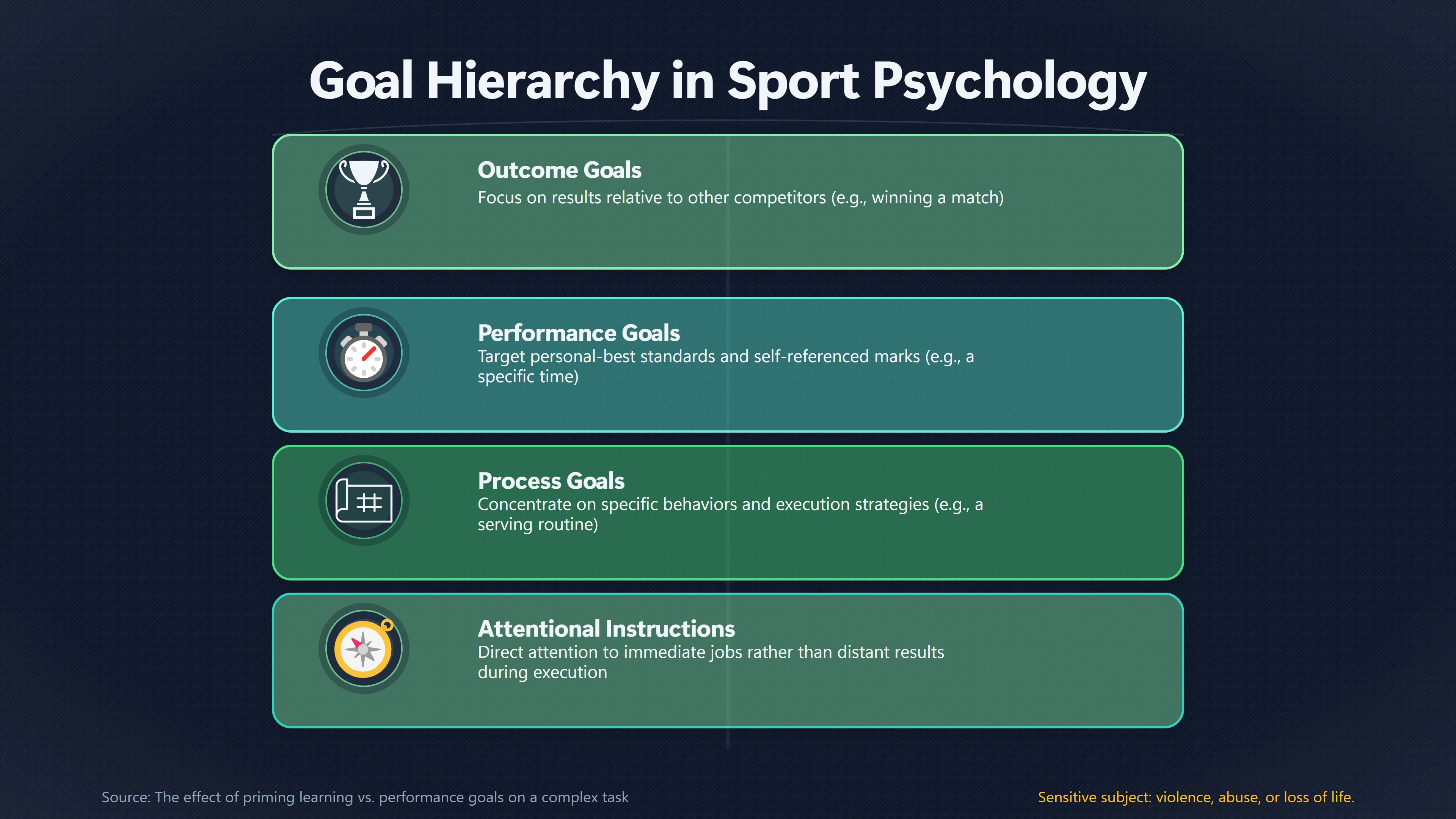
Sport research commonly distinguishes three kinds of goals. An outcome goal concerns the result relative to somebody else, such as winning a match. A performance goal uses a self-referenced standard, such as achieving a personal-best time. A process goal concerns the behaviours, strategies or thought processes involved in executing the task. The categories are not necessarily competitors; an athlete can want to win, target a particular time and still concentrate on a process cue while performing.[Taylor & Francis Online]tandfonline.comOpen source on tandfonline.com.
The distinction becomes especially useful at the moment of execution because the goals sit at different distances from action. A tennis player cannot directly execute “win this set”. Winning depends partly on the opponent and emerges from many individual points. The player can, however, execute a chosen serving routine, recover position after a shot or commit to the intended target. Process goals therefore reduce a distant result to an immediate job.
This is more than the familiar distinction between controllable and uncontrollable outcomes. Process goals can function as attentional instructions. Instead of asking the performer to keep evaluating whether success is approaching, they specify where attention should go. A golfer might use a cue associated with the intended movement; a runner might attend to rhythm; a speaker might concentrate on delivering the next idea clearly rather than monitoring the audience for evidence of success.
That distinction helps explain why outcome goals can remain valuable without being the best thing to think about continuously. “Finish in the top three” can determine what months of preparation are for. At the starting line, however, attention has a different job. The question changes from What result do I want? to What do I need to execute now?
What sport research suggests about performance
The evidence is encouraging, although it is not strong enough to justify the simple slogan that process goals always outperform every alternative. A 2022 systematic review and meta-analysis synthesised 27 studies and reported the largest performance effect for process goals, with an effect size of d = 1.36, compared with d = 0.44 for performance goals and d = 0.09 for outcome goals. Process goals also showed a large positive effect on self-efficacy, the belief that one can successfully perform the required task.[Taylor & Francis Online]tandfonline.comTaylor & Francis OnlineFull article: The performance and psychological effects of goal setting in sport: A systematic review and meta-ana…
Evidence specifically concerning attention fits the proposed mechanism. In the studies reviewed by Williamson and colleagues, process and performance goals both showed potential attentional benefits. One particularly relevant earlier study by Kingston and Hardy found that golfers receiving a process-oriented intervention significantly improved their concentration, whereas the performance-goal group did not show a comparable improvement.[Taylor & Francis Online]tandfonline.comTaylor & Francis OnlineFull article: The performance and psychological effects of goal setting in sport: A systematic review and meta-ana…
Research on learning motor skills supplies another clue. Zimmerman and Kitsantas studied goal setting during dart-throwing practice and found advantages when learners initially concentrated on process before subsequently shifting towards outcome. Later work in physical education did not reproduce a straightforward advantage of one goal type over another, but it did find that self-recording improved performance and that goal-setting groups made more technique-related and adaptive judgements than controls. In other words, the evidence points towards a self-regulation cycle — set an actionable target, execute it, observe what happened and adjust — rather than suggesting that merely attaching the label “process goal” guarantees improvement.[ERIC]eric.ed.govEJ543828 - Developmental Phases in Self-Regulation: Shifting from Process Goals to Outcome Goals., Journal of Educational Psychology, 1997…
There are good reasons to keep the size of the claimed benefit in perspective. A systematic review of applied sport interventions found only 27 eligible studies, with 63% containing fewer than 30 participants. Researchers also noted inconsistent implementation of goal-setting theory and relatively few direct comparisons between process, performance and outcome goals. The later meta-analysis likewise warned that including only published studies could inflate estimated effects because statistically significant findings are more likely to appear in the published literature.[Taylor & Francis Online]tandfonline.comOpen source on tandfonline.com.
The defensible conclusion is therefore narrower than “process goals are proven to be best”. They are a promising and practically coherent way of directing attention towards execution, supported by experimental and applied evidence, but the precise advantage depends on the task, performer and way the goal is constructed.
When focusing on the process becomes too much
There is an important complication: concentrating on a process is not automatically helpful merely because it is controllable.
Consider an experienced golfer. During early learning, deliberately thinking about grip, alignment or another component of the movement may be useful. After thousands of repetitions, however, much of the movement has become automatic. Under pressure, consciously trying to control each component can interfere with that automatic coordination. This tension became known in the literature as the process-goal paradox: process goals are supposed to help performers focus, yet a highly detailed process instruction can sometimes make a skilled performer focus on mechanics that normally run without conscious supervision.[ScienceDirect]sciencedirect.comEvidence for the effectiveness of holistic process goals for learning and performance under pressure - ScienceDirect…
Researchers consequently distinguished part process goals from holistic process goals. A part goal directs attention towards a particular technical component. A holistic goal uses a broader cue representing the movement as a whole — for example, the word “smooth” for the overall feel of a golf putt. The latter aims to direct attention without forcing the performer to consciously reconstruct an automated skill piece by piece.[ScienceDirect]sciencedirect.comOpen source on sciencedirect.com.
Experiments by Mullen and colleagues provide support for this distinction. Across three experiments involving motor tasks under increased anxiety, performers using a holistic movement focus outperformed those using part-oriented process goals. A later race-driving experiment similarly found that the holistic-process group performed better than the part-process group in a competitive condition. Another study found advantages for holistic cues in retention and transfer after learning a simulated driving task.[nih.gov]pubmed.ncbi.nlm.nih.govPub Med Conscious processing and the process goal paradoxConscious processing and the process goal paradox - PubMed…
A 2026 position statement on performance under pressure from Exercise and Sports Science Australia consequently highlights goal setting as one psychological strategy for task-focused attention and notes evidence favouring holistic rather than part process cues under pressure.[Springer Link]link.springer.comSpringer LinkPerformance Under Pressure in Sport: A Position Statement from Exercise and Sports Science Australia (ESSA) | Sports Medicin…
This produces a more useful rule than “focus on technique”: the process cue should contain only as much conscious instruction as the performer needs. A learner correcting a specific error may need a concrete technical instruction. A skilled performer in competition may need a short cue that evokes the entire rehearsed action without inviting mechanical over-control.
How process cues transfer to study, work and training
The sporting mechanism transfers most plausibly to other settings when the same problem exists: a meaningful outcome is distracting attention from an action that can still affect it.
In studying, “get a first” or “score 80%” is an outcome or performance target, not an instruction for the next hour. During a revision session, a process target could instead be “retrieve the answer before checking the notes” or “complete each problem without looking at the worked solution first”. Educational research on self-regulated learning describes process goals as proximal regulators of more distant outcomes: they turn a remote objective into standards that can guide and monitor the current task.[Springer Link]link.springer.comOpen source on springer.com.
The same principle appears in research outside conventional sport. A study of medical students compared process- and outcome-oriented goal setting while students practised suturing, explicitly treating processes as the actions producing performance outcomes. More broadly, research on learning versus performance goals argues that when somebody still needs to discover effective strategies, directing attention towards learning the method can be preferable to demanding a particular final performance level.[PubMed]pubmed.ncbi.nlm.nih.govOpen source on nih.gov.
At work, the equivalent depends on the task. “Make this presentation a success” gives direction but little attentional guidance while speaking. “State the claim, show the evidence, then explain the implication” provides an executable sequence. During a difficult conversation, “convince them” depends partly on another person; “listen to the full objection before answering” remains available to the speaker.
In training, process cues can become even smaller. A runner whose target race time matters enormously may nevertheless perform the current interval by concentrating on the intended pace and rhythm. A lifter can focus on the rehearsed execution cue rather than repeatedly estimating whether today’s session proves that a future personal best is possible. The outcome remains useful for planning and evaluation; the process cue governs the repetition taking place now.
This suggests three practical tests for a useful performance cue:
- Is it actionable now? “Win” fails this test; “commit to the planned target” can pass it.
- Does it direct attention towards task-relevant information? A cue should simplify the next action rather than add another target to worry about.
- Does its level of detail match the performer’s skill? Someone learning a technique may benefit from a specific component, whereas an expert may perform better with a familiar holistic cue.
The distinction between process and learning goals is also worth preserving. Recent research argues that a process goal can mean executing an existing strategy correctly, whereas a learning goal concerns acquiring or discovering the strategy itself. If you already know how to perform the task, “use the rehearsed three-step check” is a process cue. If you do not yet know which method works, the better immediate goal may be to test and learn an effective strategy rather than pretending execution has already been solved.[ScienceDirect]sciencedirect.comOpen source on sciencedirect.com.

The useful sequence is outcome, process, feedback
Process goals work best as part of a hierarchy rather than as a rejection of ambition. The distant outcome answers where am I trying to get? The process goal answers what deserves my attention while I perform? Feedback afterwards answers did that process work, and what should change?
That separation matters because constant outcome monitoring can consume attention without creating a new action. During execution, the scoreboard, grade, sales result or finishing time may be important, but it is usually information rather than behaviour. A process cue converts that concern back into something the performer can do.
Sport provides the clearest historical testing ground for this idea, but it also supplies the main warning against oversimplifying it. Process goals are not magic words, and more detailed control is not necessarily better. The strongest cue is one that returns attention to the next useful, controllable action without interfering with skills that already work automatically. That is the practical value of process goals within self-improvement: outcomes can set direction, while performance itself is organised around what remains changeable in the present moment.[Taylor & Francis Online]tandfonline.comTaylor & Francis OnlineFull article: The performance and psychological effects of goal setting in sport: A systematic review and meta-ana…
Amazon book picks
Further Reading
Books and field guides related to Why Process Goals Help When It Is Time to Perform. Use these as the next step if you want deeper reading beyond the article.
Atomic Habits
Rating: 3.5/5 from 7 Google Books ratings
The #1 New York Times bestseller. Over 25 million copies sold! Translated into 60+ languages! Tiny Changes, Remarkable Results No matter...
Peak
For the first time in decades of groundbreaking research, the inventor of the 10,000-hour rule explains his techniques for developing mas...
The Inner Game of Tennis
"The Inner Game of Tennis" is a revolutionary program for overcoming the self-doubt, nervousness, and lapses of concentration that can ke...
The Practicing Mind
Examines the process of practice as it relates to learning, and shows that it can build discipline and clarity, and be a fulfilling proce...
eBay marketplace picks
Marketplace Samples
Live-tested eBay searches with available results related to this page.
Selected fromself improvement wall art oneBay.co.uk.




Endnotes
1.
Source: link.springer.com
Link:https://link.springer.com/article/10.1007/s40279-026-02472-x
Source snippet
Springer LinkPerformance Under Pressure in Sport: A Position Statement from Exercise and Sports Science Australia (ESSA) | Sports Medicin...
2.
Source: sciencedirect.com
Link:https://www.sciencedirect.com/science/article/pii/S0959475210000411
Source snippet
The effect of different goals and self-recording on self-regulation of learning a motor skill in a physical education settin...
3.
Source: sciencedirect.com
Link:https://www.sciencedirect.com/science/article/pii/S1469029214001800
Source snippet
Evidence for the effectiveness of holistic process goals for learning and performance under pressure - ScienceDirect...
4.
Source: sciencedirect.com
Link:https://www.sciencedirect.com/science/article/abs/pii/S1469029214001800
5.
Source: sciencedirect.com
Link:https://www.sciencedirect.com/science/article/pii/S1469029216301133
6.
Source: link.springer.com
Link:https://link.springer.com/article/10.1007/s11409-007-9012-y
7.
Source: sciencedirect.com
Link:https://www.sciencedirect.com/science/article/pii/S1469029225002055
8.
Source: sciencedirect.com
Link:https://www.sciencedirect.com/science/article/pii/S1352759222000112
9.
Source: sciencedirect.com
Title: The effect of priming learning vs. performance goals on a complex task
Link:https://www.sciencedirect.com/science/article/abs/pii/S0749597814000508
10.
Source: sciencedirect.com
Link:https://www.sciencedirect.com/science/article/abs/pii/S0959475210000411
11.
Source: sciencedirect.com
Link:https://www.sciencedirect.com/science/article/pii/S1469029202000365
12.
Source: sciencedirect.com
Link:https://www.sciencedirect.com/science/article/abs/pii/S1469029202000365
13.
Source: sciencedirect.com
Link:https://www.sciencedirect.com/science/article/abs/pii/S0360131510002940
14.
Source: sciencedirect.com
Link:https://www.sciencedirect.com/science/article/pii/S0749597813000423
15.
Source: tandfonline.com
Link:https://www.tandfonline.com/doi/full/10.1080/1750984X.2022.2116723
Source snippet
Taylor & Francis OnlineFull article: The performance and psychological effects of goal setting in sport: A systematic review and meta-ana...
16.
Source: tandfonline.com
Link:https://www.tandfonline.com/doi/full/10.1080/1750984X.2021.1901298
17.
Source: tandfonline.com
Link:https://www.tandfonline.com/doi/abs/10.1080/1750984X.2022.2116723?scroll=top&tab=permissions
Source snippet
Taylor & Francis OnlineFull article: The performance and psychological effects of goal setting in sport: A systematic review and meta-ana...
18.
Source: eric.ed.gov
Link:https://eric.ed.gov/?id=EJ543828
Source snippet
EJ543828 - Developmental Phases in Self-Regulation: Shifting from Process Goals to Outcome Goals., Journal of Educational Psychology, 1997...
19.
Source: tandfonline.com
Link:https://www.tandfonline.com/doi/pdf/10.1080/1750984X.2022.2116723
20.
Source: pubmed.ncbi.nlm.nih.gov
Title: Pub Med Conscious processing and the process goal paradox
Link:https://pubmed.ncbi.nlm.nih.gov/20587818/
Source snippet
Conscious processing and the process goal paradox - PubMed...
21.
Source: doi.org
Link:https://doi.org/10.1155/2012/735790
22.
Source: pubmed.ncbi.nlm.nih.gov
Link:https://pubmed.ncbi.nlm.nih.gov/30990131/
23.
Source: pmc.ncbi.nlm.nih.gov
Link:https://pmc.ncbi.nlm.nih.gov/articles/PMC13018065/
24.
Source: pmc.ncbi.nlm.nih.gov
Link:https://pmc.ncbi.nlm.nih.gov/articles/PMC12737111/
25.
Source: doi.org
Link:https://doi.org/10.1080%2F17437199.2025.2467695
26.
Source: pmc.ncbi.nlm.nih.gov
Link:https://pmc.ncbi.nlm.nih.gov/articles/PMC10769023/
27.
Source: pmc.ncbi.nlm.nih.gov
Link:https://pmc.ncbi.nlm.nih.gov/articles/PMC9713087/
28.
Source: tandfonline.com
Link:https://www.tandfonline.com/doi/abs/10.1080/1750984X.2022.2116723
29.
Source: tandfonline.com
Link:https://www.tandfonline.com/doi/full/10.1080/1750984X.2022.2116723?scroll=top&tab=permissions
30.
Source: pubmed.ncbi.nlm.nih.gov
Link:https://pubmed.ncbi.nlm.nih.gov/35572269/
31.
Source: doi.org
Link:https://doi.org/10.3389/frym.2022.684422
32.
Source: tandfonline.com
Link:https://www.tandfonline.com/doi/abs/10.1080/1750984X.2021.1901298
33.
Source: doi.org
Link:https://doi.org/10.1080/1750984X.2021.1901298
34.
Source: pmc.ncbi.nlm.nih.gov
Link:https://pmc.ncbi.nlm.nih.gov/articles/PMC6694986/
35.
Source: tandfonline.com
Link:https://www.tandfonline.com/doi/full/10.1080/10401334.2019.1600520
36.
Source: tandfonline.com
Link:https://www.tandfonline.com/doi/abs/10.1080/10401334.2019.1600520
37.
Source: tandfonline.com
Link:https://www.tandfonline.com/doi/abs/10.1080/10413209908404202
38.
Source: coachsci.sdsu.edu
Link:https://coachsci.sdsu.edu/csa/vol63/hardy.htm
39.
Source: pubmed.ncbi.nlm.nih.gov
Link:https://pubmed.ncbi.nlm.nih.gov/8201904/
Additional References
40.
Source: youtube.com
Title: Process-Oriented Learning: The Way To Reach Excellence
Link:https://www.youtube.com/watch?v=yS2gCgjSq3U
Source snippet
"Process goals" vs outcome goals sport psychology performance SVSP Psychology Tips - Process and Outcome Goal Setting...
41.
Source: youtube.com
Title: Process Goals VS Outcome Goals: How to Set Goals You Can Actually Achieve
Link:https://www.youtube.com/watch?v=tfQftLaQQ7Y
Source snippet
Mediocre People Focus on the Outcome. Exceptional People Focus On the Process...
42.
Source: youtube.com
Title: Mediocre People Focus on the Outcome. Exceptional People Focus On the Process
Link:https://www.youtube.com/watch?v=gq8-9jSCJr8
Source snippet
Goal Setting in Sport - How to Reach Any Goal! (Sport Psychology)...
43.
Source: youtube.com
Title: Goal Setting in Sport
Link:https://www.youtube.com/watch?v=Q8dcGBK4aT0
Source snippet
Product Goals or Process Goals? Which One Is Right For You?...
44.
Source: youtube.com
Title: Product Goals or Process Goals? Which One Is Right For You?
Link:https://www.youtube.com/watch?v=Gm04s3wWWnM
Source snippet
Process-Oriented Learning: The Way To Reach Excellence...
45.
Source: scispace.com
Link:https://scispace.com/papers/anxiety-and-motor-performance-more-evidence-for-the-2pv4o3vvdy
46.
Source: researchgate.net
Link:https://www.researchgate.net/publication/237363267_Attentional_Focus_Dispositional_Reinvestment_and_Skilled_Motor_Performance_Under_Pressure
47.
Source: researchgate.net
Link:https://www.researchgate.net/publication/232582156_Developmental_Phases_in_Self-Regulation_Shifting_From_Process_Goals_to_Outcome_Goals
48.
Source: researchgate.net
Link:https://www.researchgate.net/publication/320609499_Goal_Setting_and_Goal_Orientation_An_Integration_of_Two_Different_yet_Related_Literatures
49.
Source: researchgate.net
Link:https://www.researchgate.net/publication/284621413_Learning_versus_performance_goals_When_should_each_be_used