Within Sleep and Mood
Why Tired Tasks Feel Harder to Start
After too little sleep, demanding tasks can feel less worth the effort even when the intended reward has not changed.
On this page
- Effort discounting after sleep loss
- Cognitive effort versus physical effort
- What this means for demanding habits
Page outline Jump by section
Introduction
After too little sleep, a demanding task can become less attractive even when its reward has not changed. The useful concept here is effort discounting: as the effort required to obtain a reward rises, the reward becomes less valuable in practical terms. Controlled experiments suggest that sleep loss can steepen this discounting, particularly for cognitive effort. A tired person may still value passing an exam, finishing a report or keeping a learning habit, yet become less willing to pay the immediate mental cost required to get there.[PubMed]pubmed.ncbi.nlm.nih.govSleep deprivation alters effort discounting but not delay discounting of monetary rewards - PubMedJune 1, 2013…
That distinction matters for behaviour change. Sleep loss does not simply remove goals or make every reward less appealing. Instead, it can alter the calculation between what an action is worth and what it seems to cost to perform. This helps explain the familiar experience of knowing that a planned behaviour matters while finding its first demanding step unusually difficult to start.
Effort discounting after sleep loss
Effort discounting describes a simple trade-off. Suppose one option pays £5 for an easy task while another pays £10 for a substantially harder one. The £10 remains £10, but the work needed to obtain it reduces its subjective value. Increase the required effort far enough and a person will eventually prefer the smaller, easier reward.
Sleep deprivation appears capable of shifting that crossover point. In a 2013 laboratory study involving 77 healthy young adults across three experiments, Camilo Libedinsky and colleagues compared choices made after normal sleep with choices made after a night without sleep. Their effort task offered monetary rewards in return for differing amounts of work, such as typing different numbers of letter strings backwards. After sleep deprivation, participants discounted rewards more strongly as required effort increased.[PubMed]pubmed.ncbi.nlm.nih.govSleep deprivation alters effort discounting but not delay discounting of monetary rewards - PubMedJune 1, 2013…
The comparison with delay discounting made the result especially informative. The researchers also examined whether tired participants became more inclined to take smaller rewards immediately rather than wait for larger ones. Sleep deprivation did not significantly change that preference, even though it increased effort discounting. In other words, the result was not simply that tired people valued future rewards less or became uniformly impatient. The cost attached specifically to working for the reward had changed.[PubMed]pubmed.ncbi.nlm.nih.govSleep deprivation alters effort discounting but not delay discounting of monetary rewards - PubMedJune 1, 2013…
A 2025 systematic review of human effort-discounting research places these experiments within a wider literature showing that effort and delay are meaningfully different costs. It notes both the sleep-deprivation result and subsequent evidence that fatigue manipulations can change cognitive effort discounting. At the same time, effort-discounting measures show appreciable within-person variability, so they should not be treated as perfectly stable measurements of motivation.[Cambridge University Press]cambridge.orgCambridge University PressA systematic review of effort discounting research in humans: Current knowledge, recommendations, and future di…
Duration becomes part of the price
A later experiment made the mechanism more concrete by asking participants how much sustained attention they were prepared to provide for money. Participants first completed a vigilance task after normal sleep and after sleep deprivation, with different monetary incentives for fast responses. They were then offered rewards for maintaining attention for periods ranging from one to 30 minutes.[PubMed]pubmed.ncbi.nlm.nih.govSleep deprivation increases the costs of attentional effort: Performance, preference and pupil size - PubMed…
Longer attention already reduced the attractiveness of the reward when people were rested. Sleep deprivation made that duration-related discounting steeper. Put simply, 30 minutes of concentration carried a larger subjective price when participants had not slept. Pupil measurements also tracked variations in arousal and performance, supporting the interpretation that effort allocation under sleep deprivation reflects an interaction between physiological state, incentives and task demands rather than a simple decision to stop caring.[PubMed]pubmed.ncbi.nlm.nih.govSleep deprivation increases the costs of attentional effort: Performance, preference and pupil size - PubMed…
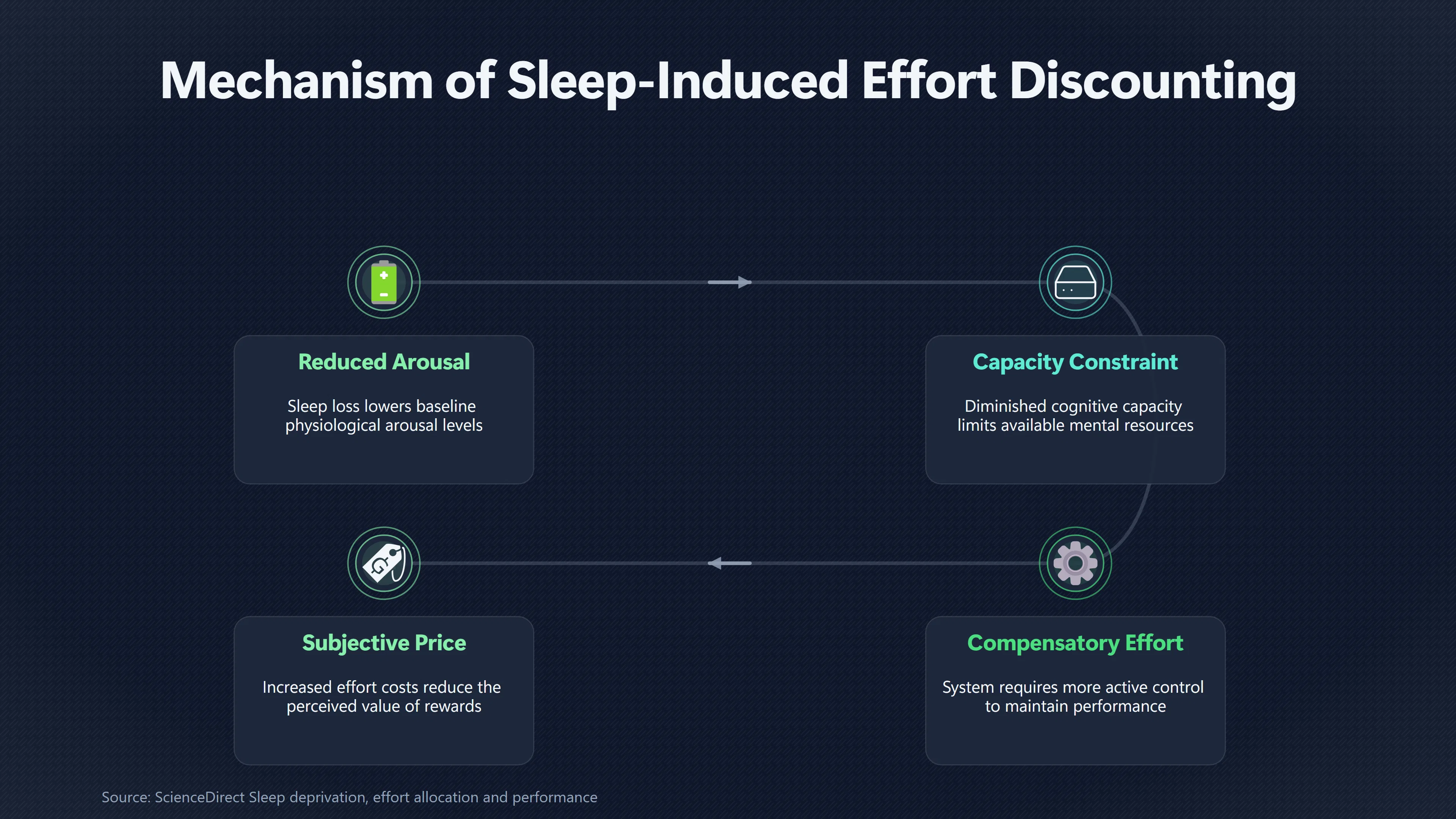
This fits a broader review of sleep deprivation, effort allocation and performance. Sleep loss reduces arousal and increases lapses and other constraints on cognitive performance; maintaining performance can therefore require greater compensatory effort. At the same time, willingness to provide that effort can decline. Performance after sleep loss can consequently reflect two interacting problems: reduced capacity and a higher subjective cost of mobilising the remaining capacity.[ScienceDirect]sciencedirect.comScienceDirect Sleep deprivation, effort allocation and performanceSleep deprivation, effort allocation and performance - ScienceDirect…
That is an important correction to everyday interpretations of tired behaviour. Choosing the easy task does not necessarily mean that the underlying goal suddenly matters less. If concentration has become more costly, the same reward may simply no longer clear the person’s threshold for investing the required effort.
Cognitive effort is especially vulnerable
The evidence does not support the stronger claim that insufficient sleep makes all effort equally unattractive. One particularly revealing experiment directly compared willingness to invest cognitive and physical effort in the same people.
Twenty-four healthy young adults completed laboratory sessions after either three consecutive nights with only a three-hour sleep opportunity or three nights with a nine-hour opportunity. Before making their choices, participants were trained on six difficulty levels of separate cognitive and physical tasks. This mattered because the researchers wanted to distinguish genuine reluctance to expend effort from a rational belief that a tired participant would simply fail the harder task.[PubMed Central (PMC)]pmc.ncbi.nlm.nih.govPubMed Central (PMC)Sleep Restriction Reduces Cognitive but Not Physical Motivation - PMC…
Sleep restriction reduced willingness to choose high-cognitive-effort, high-reward options, particularly at the greatest effort levels. Yet it did not significantly reduce willingness to select physically effortful options for reward. Participants had also demonstrated that they could perform the cognitive effort levels successfully, making reduced ability alone an inadequate explanation for the choices.[PubMed Central (PMC)]pmc.ncbi.nlm.nih.govPubMed Central (PMC)Sleep Restriction Reduces Cognitive but Not Physical Motivation - PMC…
The result argues against treating motivation as one tank that simply empties when someone sleeps badly. Cognitive and physical effort have partly distinct motivational properties even in rested people, and research using parallel effort tasks finds only a moderate relationship between willingness to expend the two kinds of effort.[PubMed]pubmed.ncbi.nlm.nih.govOpen source on nih.gov.
There is also an important distinction between willingness to choose physical effort and how physically strenuous exercise feels once underway. A 2025 systematic review and meta-analysis covering 45 studies found that sleep deprivation impaired several measures of sporting performance and, across 12 studies assessing ratings of perceived exertion, increased subjective exertion overall. The effect varied by population and form of sleep deprivation, so this does not mean every workout will feel harder after every short night. It does show why the finding that cognitive motivation can be selectively reduced should not be misread as evidence that sleep is irrelevant to perceived physical effort.[PubMed]pubmed.ncbi.nlm.nih.govOpen source on nih.gov.
For self-improvement, the most defensible conclusion is therefore narrower and more useful: sleep loss has particularly direct experimental evidence for reducing willingness to buy rewards with cognitive effort. Physical performance and perceived exertion can also suffer, but the motivational effects are not necessarily identical.
Why effort rises without the goal changing
The mechanism is best understood as a changing cost-benefit calculation rather than a disappearance of intention.
Consider someone who intends to spend an hour studying after work. The long-term benefit — gaining a qualification — is the same on Tuesday as it was on Monday. After insufficient sleep, however, maintaining attention is less reliable. The person may need more active control to resist distraction, recover from lapses and keep relevant information in mind. Research reviews describe sleep-deprived cognition as operating under reduced arousal and capacity constraints while requiring greater compensatory effort to maintain performance.[PubMed]pubmed.ncbi.nlm.nih.govPub Med Sleep deprivation, effort allocation and performanceSleep deprivation, effort allocation and performance - PubMed…
That creates an important feedback loop. A cognitively demanding action becomes harder to sustain; sustaining it therefore requires more effort; and effort itself is a cost that the decision system weighs against the expected reward. The behaviour can consequently lose subjective value without the nominal reward becoming smaller. Experimental findings showing greater effort discounting alongside unchanged delay discounting are consistent with this interpretation.[PubMed Central (PMC)]pmc.ncbi.nlm.nih.govPubMed Central (PMC)Sleep Deprivation Alters Effort Discounting but not Delay Discounting of Monetary Rewards - PMC…
Incentives can sometimes shift the balance back. In the sustained-attention experiment, larger rewards improved sleep-deprived performance, and broader reviews find that feedback, incentives, interest and engaging task characteristics can sometimes mobilise additional effort after sleep loss. But compensation has limits: stronger motivation does not reliably restore every component of performance to its rested level, particularly as deprivation becomes severe or prolonged.[nih.gov]pubmed.ncbi.nlm.nih.govSleep deprivation increases the costs of attentional effort: Performance, preference and pupil size - PubMed…
This is why “I really want this” and “I can readily make myself do this tonight” are not equivalent statements. Motivation is partly expressed through a willingness to incur immediate costs. Sleep loss can change those costs.
What this means for demanding habits
The mechanism has a straightforward consequence for self-improvement: a tired-day decision is not necessarily a reliable referendum on whether a goal is worthwhile. It is being made under a temporarily altered effort landscape.
Habits with substantial cognitive start-up costs are obvious candidates: studying difficult material, writing, practising a language intensively, completing complicated administrative work, planning meals, learning technical skills or doing concentrated professional development. The research does not directly test all of these behaviours, so it would be too strong to claim that sleep deprivation necessarily causes each one to be abandoned. What the laboratory evidence supports is the underlying mechanism: when cognitive effort rises, tired people can become more likely to prefer lower-effort alternatives.[PubMed]pubmed.ncbi.nlm.nih.govSleep deprivation alters effort discounting but not delay discounting of monetary rewards - PubMedJune 1, 2013…
This suggests a useful design principle for behaviour change: when sleep is poor, reduce unnecessary effort costs before questioning the goal. That can mean shrinking the cognitively demanding portion of a habit, removing decisions from its starting sequence or switching to a lower-complexity version that preserves continuity. Reading previously prepared notes may be a more realistic tired-day learning behaviour than tackling unfamiliar technical material; following a predetermined meal plan requires less cognitive work than inventing one while exhausted.
The distinction also explains why simply increasing the promised reward is an imperfect solution. Incentives can mobilise additional effort, but they are asking an already impaired system to compensate. For repeated self-improvement behaviours, reducing avoidable cognitive load may be more sustainable than repeatedly trying to overpower sleep-related changes in effort valuation with urgency, guilt or ever-larger rewards.[PubMed]pubmed.ncbi.nlm.nih.govPub Med Sleep deprivation, effort allocation and performanceSleep deprivation, effort allocation and performance - PubMed…
How certain is the mechanism?
The evidence is suggestive rather than complete. Some of the most direct experiments are small laboratory studies involving healthy young adults, and total sleep deprivation is more extreme than the ordinary short nights encountered during everyday behaviour change. A 2025 review of sleep loss and decision-making also cautions that conventional behavioural measures can hide different underlying processes: apparently similar choices can arise from changes in value sensitivity, decision noise or strategy.[PubMed]pubmed.ncbi.nlm.nih.govOpen source on nih.gov.
Evidence outside total-deprivation laboratories nevertheless points in a compatible direction. In a study of 325 young adults, poorer self-reported sleep quality over the preceding month was associated with reduced effort expenditure for monetary rewards, while neither sleep quality nor sleep duration was significantly associated with temporal discounting. Shorter reported sleep duration itself was not significantly associated with effort expenditure, however, and the authors emphasised that observational data cannot establish that poor sleep caused the motivational difference.[PubMed Central (PMC)]pmc.ncbi.nlm.nih.govOpen source on nih.gov.
That qualification matters. “Sleep loss increases effort cost” is a useful description of a supported behavioural mechanism, not a universal law governing every person after every poor night. Effects depend on the kind and severity of sleep loss, the task, incentives, individual differences and how effort is measured.
The strongest practical conclusion is therefore also the simplest. Insufficient sleep can change the price of action before it changes the goal. For cognitively demanding habits in particular, the planned reward may remain intact while the effort required to reach it weighs more heavily in the choice. Recognising that distinction turns a tired failure to start from evidence that “I must not want this enough” into a more precise problem: today, this version of the behaviour may simply be unusually expensive.
Amazon book picks
Further Reading
Books and field guides related to Why Tired Tasks Feel Harder to Start. Use these as the next step if you want deeper reading beyond the article.
Why We Sleep
"Sleep is one of the most important but least understood aspects of our life, wellness, and longevity ... An explosion of scientific disc...
The Sleep Solution
With cutting-edge sleep science and time-tested techniques, The Sleep Solution will help anyone achieve healthy sleep and eliminate pills...
The Willpower Instinct
Based on Stanford University psychologist Kelly McGonigal's wildly popular course "The Science of Willpower," The Willpower Instinct is t...
Indistractable
*As heard on Steven Bartlett's Diary of a CEO* 'A must-read' Mark Manson We are living through a crisis of distraction. Plans get sidetra...
eBay marketplace picks
Marketplace Samples
Live-tested eBay searches with available results related to this page.
Selected frommotivational poster oneBay.co.uk.



Endnotes
1.
Source: cambridge.org
Link:https://www.cambridge.org/core/journals/judgment-and-decision-making/article/systematic-review-of-effort-discounting-research-in-humans-current-knowledge-recommendations-and-future-directions/F2E2339CB6115F92558ED543012932F2
Source snippet
Cambridge University PressA systematic review of effort discounting research in humans: Current knowledge, recommendations, and future di...
2.
Source: sciencedirect.com
Link:https://www.sciencedirect.com/science/article/pii/S0028393218301258
Source snippet
Sleep deprivation increases the costs of attentional effort: Performance, preference and pupil size - ScienceDirect...
3.
Source: sciencedirect.com
Title: ScienceDirect Sleep deprivation, effort allocation and performance
Link:https://www.sciencedirect.com/science/chapter/bookseries/pii/S0079612319300378
Source snippet
Sleep deprivation, effort allocation and performance - ScienceDirect...
4.
Source: sciencedirect.com
Link:https://www.sciencedirect.com/science/article/pii/S0149763424003981
5.
Source: sciencedirect.com
Title: Neural correlates of effort-based valuation with prospective choices
Link:https://www.sciencedirect.com/science/article/pii/S1053811918320238
6.
Source: sciencedirect.com
Link:https://www.sciencedirect.com/science/article/abs/pii/S092549271530069X
7.
Source: sciencedirect.com
Title: Do cognitive and physical effort costs affect choice behavior similarly?
Link:https://www.sciencedirect.com/science/article/pii/S0022249622000657
8.
Source: sciencedirect.com
Link:https://www.sciencedirect.com/science/article/pii/S016787602400165X
9.
Source: sciencedirect.com
Title: The impact of sleep loss on decision making: Opening the cognitive black box
Link:https://www.sciencedirect.com/science/article/pii/S108707922500067X
10.
Source: sciencedirect.com
Title: The effects of sleep loss on capacity and effort
Link:https://www.sciencedirect.com/science/article/pii/S1984006314000583
11.
Source: sciencedirect.com
Title: Auditory Vigilance Test
Link:https://www.sciencedirect.com/topics/medicine-and-dentistry/auditory-vigilance-test
12.
Source: pubmed.ncbi.nlm.nih.gov
Link:https://pubmed.ncbi.nlm.nih.gov/23729933/
Source snippet
Sleep deprivation alters effort discounting but not delay discounting of monetary rewards - PubMedJune 1, 2013...
Published: June 1, 2013
13.
Source: pubmed.ncbi.nlm.nih.gov
Link:https://pubmed.ncbi.nlm.nih.gov/29601889/
Source snippet
Sleep deprivation increases the costs of attentional effort: Performance, preference and pupil size - PubMed...
14.
Source: pmc.ncbi.nlm.nih.gov
Link:https://pmc.ncbi.nlm.nih.gov/articles/PMC9642807/
Source snippet
PubMed Central (PMC)Sleep Restriction Reduces Cognitive but Not Physical Motivation - PMC...
15.
Source: pmc.ncbi.nlm.nih.gov
Link:https://pmc.ncbi.nlm.nih.gov/articles/PMC3649832/
Source snippet
PubMed Central (PMC)Sleep Deprivation Alters Effort Discounting but not Delay Discounting of Monetary Rewards - PMC...
16.
Source: pubmed.ncbi.nlm.nih.gov
Title: Pub Med Sleep deprivation, effort allocation and performance
Link:https://pubmed.ncbi.nlm.nih.gov/31072557/
Source snippet
Sleep deprivation, effort allocation and performance - PubMed...
17.
Source: pubmed.ncbi.nlm.nih.gov
Title: Pub Med Sleep Restriction Reduces Cognitive but Not Physical Motivation
Link:https://pubmed.ncbi.nlm.nih.gov/36394069/
Source snippet
Sleep Restriction Reduces Cognitive but Not Physical Motivation - PubMed...
18.
Source: pubmed.ncbi.nlm.nih.gov
Link:https://pubmed.ncbi.nlm.nih.gov/29620381/
19.
Source: pubmed.ncbi.nlm.nih.gov
Link:https://pubmed.ncbi.nlm.nih.gov/40236824/
20.
Source: pmc.ncbi.nlm.nih.gov
Link:https://pmc.ncbi.nlm.nih.gov/articles/PMC11996801/
21.
Source: pmc.ncbi.nlm.nih.gov
Title: Pub Med Central (PMC)The effects of sleep loss on capacity and effort
Link:https://pmc.ncbi.nlm.nih.gov/articles/PMC4608917/
22.
Source: pmc.ncbi.nlm.nih.gov
Link:https://pmc.ncbi.nlm.nih.gov/articles/PMC2865224/
23.
Source: pubmed.ncbi.nlm.nih.gov
Link:https://pubmed.ncbi.nlm.nih.gov/40505175/
24.
Source: pmc.ncbi.nlm.nih.gov
Link:https://pmc.ncbi.nlm.nih.gov/articles/PMC12189852/
25.
Source: pmc.ncbi.nlm.nih.gov
Link:https://pmc.ncbi.nlm.nih.gov/articles/PMC10358359/
26.
Source: pmc.ncbi.nlm.nih.gov
Link:https://pmc.ncbi.nlm.nih.gov/articles/PMC13017762/
27.
Source: pmc.ncbi.nlm.nih.gov
Link:https://pmc.ncbi.nlm.nih.gov/articles/PMC12884900/
28.
Source: pubmed.ncbi.nlm.nih.gov
Link:https://pubmed.ncbi.nlm.nih.gov/39488298/
29.
Source: pubmed.ncbi.nlm.nih.gov
Link:https://pubmed.ncbi.nlm.nih.gov/35708888/
30.
Source: pmc.ncbi.nlm.nih.gov
Link:https://pmc.ncbi.nlm.nih.gov/articles/PMC9584849/
31.
Source: pubmed.ncbi.nlm.nih.gov
Link:https://pubmed.ncbi.nlm.nih.gov/37476692/
32.
Source: pmc.ncbi.nlm.nih.gov
Link:https://pmc.ncbi.nlm.nih.gov/articles/PMC8664577/
33.
Source: pmc.ncbi.nlm.nih.gov
Link:https://pmc.ncbi.nlm.nih.gov/articles/PMC8286723/
34.
Source: pubmed.ncbi.nlm.nih.gov
Link:https://pubmed.ncbi.nlm.nih.gov/34285617/
35.
Source: pmc.ncbi.nlm.nih.gov
Link:https://pmc.ncbi.nlm.nih.gov/articles/PMC7294403/
36.
Source: pmc.ncbi.nlm.nih.gov
Link:https://pmc.ncbi.nlm.nih.gov/articles/PMC6143346/
37.
Source: pmc.ncbi.nlm.nih.gov
Link:https://pmc.ncbi.nlm.nih.gov/articles/PMC4651827/
38.
Source: pubmed.ncbi.nlm.nih.gov
Link:https://pubmed.ncbi.nlm.nih.gov/26358975/
39.
Source: pmc.ncbi.nlm.nih.gov
Link:https://pmc.ncbi.nlm.nih.gov/articles/PMC4593856/
40.
Source: pmc.ncbi.nlm.nih.gov
Link:https://pmc.ncbi.nlm.nih.gov/articles/PMC4589447/
41.
Source: pmc.ncbi.nlm.nih.gov
Link:https://pmc.ncbi.nlm.nih.gov/articles/PMC3742668/
42.
Source: pmc.ncbi.nlm.nih.gov
Link:https://pmc.ncbi.nlm.nih.gov/articles/PMC2849789/
43.
Source: pubmed.ncbi.nlm.nih.gov
Link:https://pubmed.ncbi.nlm.nih.gov/8480005/
44.
Source: pubmed.ncbi.nlm.nih.gov
Link:https://pubmed.ncbi.nlm.nih.gov/12753348/
45.
Source: pmc.ncbi.nlm.nih.gov
Link:https://pmc.ncbi.nlm.nih.gov/articles/PMC2656292/
46.
Source: pubmed.ncbi.nlm.nih.gov
Link:https://pubmed.ncbi.nlm.nih.gov/4068965/
47.
Source: pubmed.ncbi.nlm.nih.gov
Link:https://pubmed.ncbi.nlm.nih.gov/11014055/
Additional References
48.
Source: academic.oup.com
Link:https://academic.oup.com/sleep/article-abstract/36/6/899/2559049
Source snippet
OUP AcademicSleep Deprivation Alters Effort Discounting but not Delay Discounting of Monetary Rewards | SLEEP | Oxford Academic...
49.
Source: youtube.com
Title: Sleep Deprivation, Impulsivity and the Prefrontal Cortex | Dr. Matt Walker
Link:https://www.youtube.com/watch?v=ajM6FMY0_MY
Source snippet
The Real Reason You Feel Lazy: How the Brain Computes Effort Discounting...
50.
Source: youtube.com
Title: Breaking Bad Habits: Neuro-computational Mechanisms of Effort Discounting
Link:https://www.youtube.com/watch?v=8g131xLJdiE
Source snippet
Laziness Isn't a Flaw: Effort Discounting and the Cost of Effort...
51.
Source: youtube.com
Title: Laziness Isn’t a Flaw: Effort Discounting and the Cost of Effort
Link:https://www.youtube.com/watch?v=3fZQKiHsA48
Source snippet
Sleep Deprivation, Impulsivity and the Prefrontal Cortex | Dr. Matt Walker...
52.
Source: youtube.com
Title: The Real Reason You Feel Lazy: How the Brain Computes Effort Discounting
Link:https://www.youtube.com/watch?v=Ee4dROuJb6I
Source snippet
Sleep Is Your Superpower | Matt Walker | TED...
53.
Source: researchgate.net
Link:https://www.researchgate.net/publication/237014240_Sleep_Deprivation_Alters_Effort_Discounting_but_not_Delay_Discounting_of_Monetary_Rewards
54.
Source: researchgate.net
Link:https://www.researchgate.net/publication/358005412_Poor_sleep_quality_is_significantly_associated_with_effort_but_not_temporal_discounting_of_monetary_rewards
55.
Source: doi.org
Link:https://doi.org/10.1007/s40279-022-01706-y
56.
Source: doaj.org
Link:https://doaj.org/article/a705cc015e02486db05f9d0b1f646518
57.
Source: eprints.soton.ac.uk
Link:https://eprints.soton.ac.uk/467942/