Within Accountability
When Does an Accountability Partner Actually Help?
Accountability is more likely to stay useful when expectations are agreed together and the person receiving reports is trusted rather than feared.
On this page
- Trust and legitimacy in supportive accountability
- Agreeing expectations without creating surveillance
- Responding to missed commitments with problem solving
Page outline Jump by section
Introduction
An accountability partner helps when they make progress visible without turning visibility into surveillance. The best choice is usually someone you trust to want your goal to succeed, who respects that the goal remains yours, and who can respond to an imperfect week with curiosity rather than judgement. Research on “supportive accountability” describes much the same combination: clear expectations work best when the person receiving reports is regarded as trustworthy, benevolent and legitimate, and when monitoring has been agreed rather than imposed.[JMIR]jmir.orgJournal of Medical Internet ResearchJournal of Medical Internet Research - Supportive Accountability: A Model for Providing Human Support to Enhance Adherence to eHealth…
That distinction matters because accountability and control are not the same intervention. Research on goal support finds that autonomy-supportive behaviour — listening, understanding the goal-holder’s perspective and preserving choice — is associated with better goal progress than more directive approaches, while controlling interpersonal styles are associated with poorer personal and relationship outcomes.[PubMed]pubmed.ncbi.nlm.nih.govDistinguishing autonomous and directive forms of goal support: their effects on goal progress, relationship quality, and subjective… The useful partner therefore creates a reason to report honestly, not a reason to hide a bad result.
Trust matters more than toughness
A common intuition is that the ideal accountability partner is the person least likely to “let you off the hook”. That can be useful only up to a point. Accountability depends on the expectation that somebody will notice whether an agreed action happened; it does not require that person to punish, shame or interrogate you when it did not.
The supportive-accountability model developed by David Mohr, Pim Cuijpers and Kenneth Lehman is particularly useful here. It argues that the person holding someone accountable needs legitimacy. Part of that legitimacy is instrumental: they should have enough knowledge or experience to make their involvement credible when expertise matters. But another part is relational: the person should appear trustworthy, benevolent and genuinely concerned with the goal-holder’s interests. Demands from somebody perceived as illegitimate can backfire, particularly when they are experienced as attempts to control behaviour.[JMIR]jmir.orgJournal of Medical Internet ResearchJMIRJournal of Medical Internet Research - Supportive Accountability: A Model for Providing Human Support to Enhance Adherence to eHealth…
For everyday self-improvement, this suggests that the most impressive or disciplined person in your circle is not automatically the best partner. Someone can know a great deal about training, studying or business and still be a poor choice if admitting “I did none of it this week” feels unsafe. Conversely, a supportive friend does not need professional expertise when the job is simply to receive an agreed progress report and help you think through obstacles.
Research on close relationships points in the same direction. Across three studies following personal goals for three months, Richard Koestner and colleagues distinguished autonomy support, characterised by empathic perspective-taking, from directive support, which involved giving positive guidance. Autonomy support consistently predicted greater goal progress and was also associated with better relationship quality and wellbeing. Its association with progress was explained in part by stronger autonomous motivation — pursuing the goal because it felt personally chosen rather than externally imposed. Directive support showed only a marginal association with progress overall.[PubMed]pubmed.ncbi.nlm.nih.govDistinguishing autonomous and directive forms of goal support: their effects on goal progress, relationship quality, and subjective…
A later study of 710 people in romantic relationships made the distinction even clearer. Autonomy-supportive, directive-supportive and controlling behaviour emerged as distinguishable styles. Autonomy support predicted favourable outcomes including cooperation and perceived goal progress, whereas controlling behaviour predicted more goal-related conflict and poorer relationship quality and wellbeing.[ScienceDirect]sciencedirect.comEmpirically distinguishing interpersonal styles within romantic relationships: What is helpful or harmful when having a goal…
So a useful screening question is not simply, “Will this person challenge me?” It is “Can I tell this person the unvarnished truth about my progress?” If the relationship makes failure embarrassing enough to conceal, the reporting mechanism starts losing the information it needs to work.
Agree expectations without creating surveillance
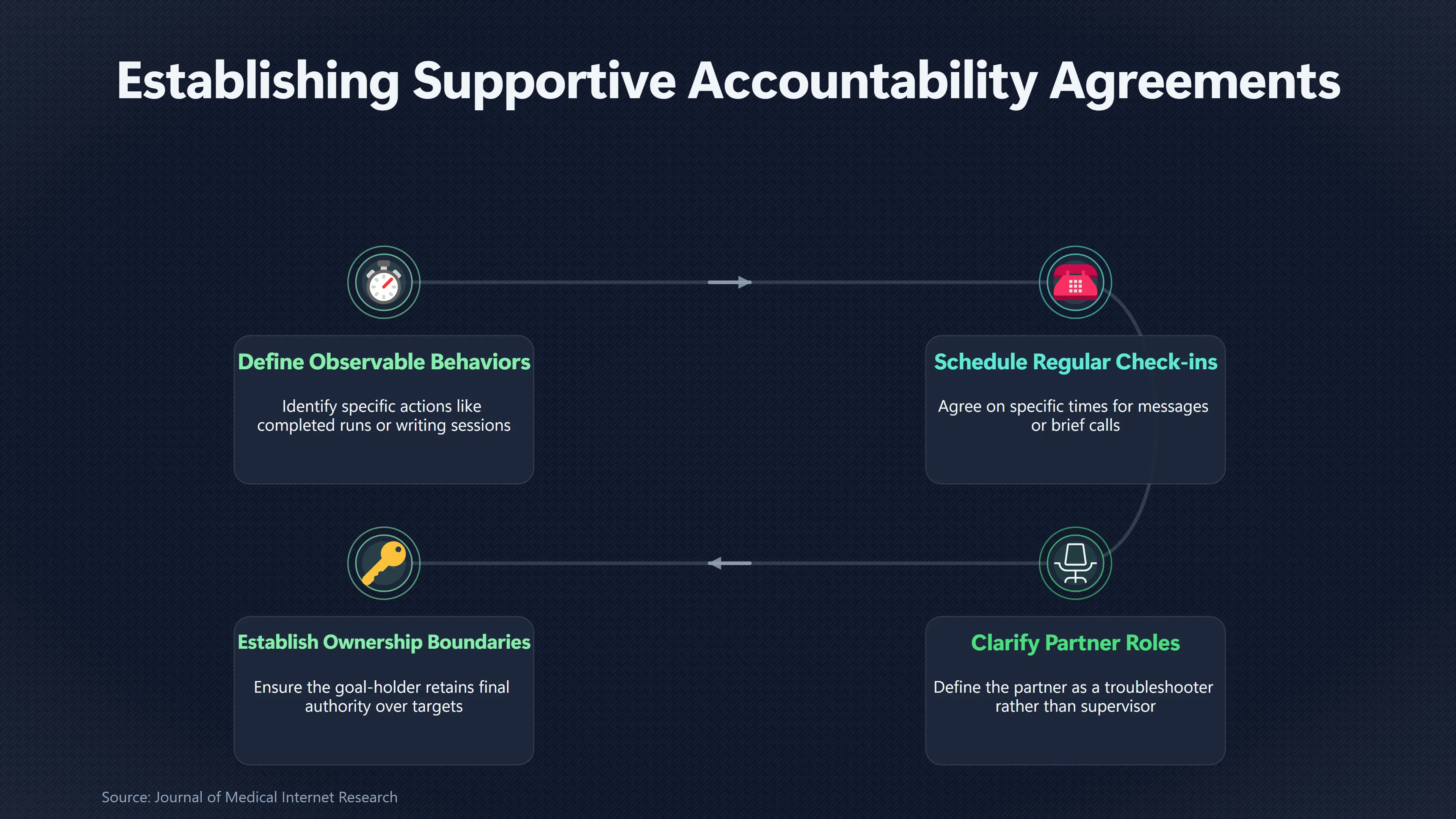
Good accountability begins with a small agreement rather than an open-ended licence to monitor somebody’s life. The supportive-accountability literature recommends establishing expectations early, making them specific and process-oriented, involving the person being supported in setting them, and explaining why any monitoring is useful. Monitoring should have the person’s agreement and should not carry an implied threat of negative consequences.[PubMed Central (PMC)]pmc.ncbi.nlm.nih.govPubMed Central (PMC)Supportive Accountability: A Model for Providing Human Support to Enhance Adherence to eHealth Interventions - PMC…
In practice, the agreement can be remarkably modest:
- What gets reported: an observable behaviour, such as “three runs completed”, “four writing sessions done” or “applications sent”.
- When: perhaps a Friday message or a ten-minute Sunday call, rather than unpredictable checking.
- What the partner does: acknowledge the report, ask one or two useful questions and help troubleshoot when requested.
- What the partner does not do: demand evidence, chase repeatedly between check-ins, contact other people about the goal or independently expand what is being monitored.
- Who owns changes: the goal-holder can revise an unrealistic target; the partner can question the reasoning, but does not unilaterally raise the standard.
This structure preserves the valuable part of social accountability — another person will know what happened — while putting boundaries around that person’s authority. The partner is receiving information under an agreed arrangement, not becoming a supervisor.
There is evidence that meaningful visibility can work without damaging rapport when it is embedded in a supportive relationship. In a 12-week randomised behavioural weight-loss study, coaches either could or could not see participants’ digitally recorded weight, eating and physical-activity data. When coaches had access, participants reported greater supportive accountability and recorded eating and physical activity more consistently; average weight loss was 6.2% versus 5.3%. Importantly, the groups did not significantly differ in working alliance, treatment satisfaction or attendance.[DOI]doi.orgOpen source on doi.org.
That study involved trained coaches in a structured programme, so it should not be treated as proof that giving a friend access to every metric is beneficial. Its more useful lesson is narrower: visibility itself need not feel hostile when people understand the arrangement and the person seeing the information is there to help. In ordinary accountability partnerships, sharing less information may be enough. A weekly total can create social visibility without exposing an entire diary, fitness dashboard or productivity log.
The communication method should also fit the person rather than maximise contact for its own sake. A 2024 qualitative study of young people receiving adherence support found that phone coaching could build a stronger personal connection but was also more disruptive, while texts were easier and more flexible; participants’ preferences varied considerably.[PubMed Central (PMC)]pmc.ncbi.nlm.nih.govOpen source on nih.gov. A partner who insists on daily calls because they feel “more accountable” may therefore be increasing friction without increasing useful support.
Missed commitments are the real test
Almost anyone can be encouraging after a successful week. The quality of an accountability partnership becomes clearer after a failure.
Suppose the agreement was four study sessions and the report says: “I did one.” A policing response concentrates on compliance: Why didn’t you do what you said? What will make you actually do it next week? A permissive response simply waves the failure away. Supportive accountability sits between them. The missed commitment remains visible, but the conversation turns towards diagnosis: What got in the way? Was the target unrealistic, was the cue ineffective, or did another priority repeatedly win? What should change before the next attempt?
That approach is consistent with supportive-accountability theory’s emphasis on process expectations, jointly determined goals and reciprocity: the person reporting progress accepts the obligation to report successes and failures, while the supporter contributes attention and help with problems.[PubMed Central (PMC)]pmc.ncbi.nlm.nih.govOpen source on nih.gov. Accountability is therefore two-sided. “You owe me an honest report” is reasonable only when paired with something like “I owe you a useful, respectful response.”
This distinction also prevents a missed commitment from silently changing the relationship. If every failure triggers more messages, more questions or closer monitoring, accountability can progressively become surveillance. The better default is to treat increased support as something to offer and agree: “Would a midweek check-in help?” rather than “From now on I’m checking every Wednesday as well.”
There is also reason not to assume that more conspicuous support is always better. In research involving 61 couples discussing personal goals, visible emotional support was helpful during discussions for recipients experiencing high distress but was associated with poorer discussion outcomes for people who were not distressed. More subtle “invisible” emotional support, meanwhile, predicted greater goal achievement over the following year.[PubMed]pubmed.ncbi.nlm.nih.govOpen source on nih.gov. The study concerns romantic partners rather than formal accountability relationships, but it reinforces a useful implementation principle: support should respond to need rather than continually announce itself.
How to recognise the right partner
The strongest candidate is someone who can combine warmth with clarity. Warmth without clarity can dissolve accountability into occasional encouragement; clarity without warmth can make reporting feel like inspection. A good partner is comfortable saying, “You planned three and did one — what happened?” without communicating, “You have disappointed me as a person.”
Several practical signs follow from the research. The person is more promising if they listen before prescribing solutions, accept that you determine the underlying goal, can keep reports private, reliably remember agreed check-ins, and distinguish a missed behaviour from a character judgement. Some relevant knowledge helps when feedback is part of the arrangement, but trust and benevolence are not optional extras: they are central to why accountability from that person carries legitimate weight.[PubMed Central (PMC)]pmc.ncbi.nlm.nih.govPubMed Central (PMC)Supportive Accountability: A Model for Providing Human Support to Enhance Adherence to eHealth Interventions - PMC…
Be more cautious when someone repeatedly enlarges their role: asking for information you never agreed to share, checking between scheduled reports, using guilt or ridicule, treating explanations as excuses before hearing them, competing with you, or making their approval conditional on performance. Controlling support can include overt pressure but also subtler forms such as guilt and conditional regard, and research distinguishes these behaviours from autonomy-supportive help.[ScienceDirect]sciencedirect.comEmpirically distinguishing interpersonal styles within romantic relationships: What is helpful or harmful when having a goal…
The distinction can be reduced to three questions:
- Would I report a failure to this person as readily as a success?
- Have we agreed what they are entitled to ask about, rather than leaving that boundary undefined?
- When I miss the target, will their first aim be to understand and improve the process rather than make me feel bad enough to comply?
Three yeses do not guarantee that the partnership will work, but a no — particularly to the first question — is consequential. Accountability relies on accurate reporting. Fear of the person receiving the report undermines that foundation.
Support should strengthen ownership, not replace it
The deeper purpose of an accountability partner is not to become the external source of discipline forever. Their presence should make your own commitments harder to ignore while leaving the reasons for pursuing them intact.
That is why autonomy support is such an important counterweight to social pressure. Experimental research in another domain — emotion regulation — found that people given autonomy-supportive rather than controlling instructions were more likely subsequently to pursue the target behaviour when they were free to choose for themselves.[The Hebrew University of Jerusalem]cris.huji.ac.ilOpen source on huji.ac.il. It would be too strong to claim that this experiment proves the same effect for accountability partnerships, but it illustrates the relevant motivational risk: compliance while another person is watching is not necessarily the same thing as durable self-directed action.
The evidence base also deserves some restraint. The supportive-accountability model originated in digital health and was explicitly proposed as a theoretical framework whose components required empirical testing. A 2025 scoping review of 36 empirical studies found substantial variation in how supportive accountability had subsequently been implemented. Of the studies explicitly using the model, accountability was commonly incorporated, but other elements such as bond and legitimacy received less consistent attention and were not always directly measured.[PubMed]pubmed.ncbi.nlm.nih.govOpen source on nih.gov. There is therefore no well-established scientific formula proving that a particular personality type makes the ideal everyday accountability partner.
What the evidence supports more convincingly is a design principle. Social visibility can help, but the relationship carrying that visibility matters. Choose someone whose attention makes honesty easier, agree the boundaries before difficulties arise, and make a missed commitment the beginning of a useful conversation rather than the trigger for tighter control. That preserves what accountability is supposed to add to self-improvement: a commitment that another person can see, without handing that person ownership of the goal.
Amazon book picks
Further Reading
Books and field guides related to When Does an Accountability Partner Actually Help?. Use these as the next step if you want deeper reading beyond the article.
The Coaching Habit
Coaching is an essential skill for leaders. But for most busy, overworked managers, coaching employees is done badly, or not at all. They...
The Four Tendencies
NEW YORK TIMES BESTSELLER • Are you an Upholder, a Questioner, an Obliger, or a Rebel? From the author of Better Than Before and The Happ...
Atomic Habits
Rating: 3.5/5 from 7 Google Books ratings
The #1 New York Times bestseller. Over 25 million copies sold! Translated into 60+ languages! Tiny Changes, Remarkable Results No matter...
Nonviolent Communication
Psychologist Marshall Rosenberg lays out a communication and conflict-resolution process focusing on inspiring empathy and listening empa...
eBay marketplace picks
Marketplace Samples
Live-tested eBay searches with available results related to this page.
Selected fromfriendship keyring oneBay.co.uk.



Endnotes
1.
Source: jmir.org
Title: Journal of Medical Internet Research
Link:https://www.jmir.org/2011/1/E30/
Source snippet
Journal of Medical Internet Research - Supportive Accountability: A Model for Providing Human Support to Enhance Adherence to eHealth...
2.
Source: sciencedirect.com
Link:https://www.sciencedirect.com/science/article/pii/S1162908822000317
Source snippet
Empirically distinguishing interpersonal styles within romantic relationships: What is helpful or harmful when having a goal...
4.
Source: sciencedirect.com
Link:https://www.sciencedirect.com/science/article/abs/pii/S1162908822000317
Source snippet
Empirically distinguishing interpersonal styles within romantic relationships: What is helpful or harmful when having a goal...
5.
Source: sciencedirect.com
Link:https://www.sciencedirect.com/science/article/pii/S2214782921000397
Source snippet
The Supportive Accountability Inventory: Psychometric properties of a measure of supportive accountability in coached digita...
6.
Source: doi.org
Link:https://doi.org/10.1002/oby.24138
7.
Source: sciencedirect.com
Link:https://www.sciencedirect.com/science/article/pii/S0738399123004603
8.
Source: jmir.org
Title: Journal of Medical Internet Research
Link:https://www.jmir.org/2025/1/e72639
10.
Source: doi.org
Link:https://doi.org/10.1177/01461672251382271
11.
Source: sciencedirect.com
Link:https://www.sciencedirect.com/org/science/article/pii/S1438887125013159
12.
Source: sciencedirect.com
Link:https://www.sciencedirect.com/org/science/article/pii/S1438887120006068
13.
Source: jmir.org
Title: Journal of Medical Internet Research
Link:https://www.jmir.org/2020/7/e17967
15.
Source: jmir.org
Title: Journal of Medical Internet Research
Link:https://www.jmir.org/2014/3/e95/
16.
Source: sciencedirect.com
Link:https://www.sciencedirect.com/science/article/pii/S0361476X13000489
17.
Source: sciencedirect.com
Link:https://www.sciencedirect.com/org/science/article/pii/S1438887111000513
18.
Source: sciencedirect.com
Link:https://www.sciencedirect.com/science/article/pii/S0191886924000771
19.
Source: sciencedirect.com
Link:https://www.sciencedirect.com/science/article/pii/S1469029218304424
20.
Source: sciencedirect.com
Link:https://www.sciencedirect.com/science/article/pii/S1469029215000096
21.
Source: pmc.ncbi.nlm.nih.gov
Link:https://pmc.ncbi.nlm.nih.gov/articles/PMC3221353/
Source snippet
PubMed Central (PMC)Supportive Accountability: A Model for Providing Human Support to Enhance Adherence to eHealth Interventions - PMC...
22.
Source: pubmed.ncbi.nlm.nih.gov
Link:https://pubmed.ncbi.nlm.nih.gov/22930370/
Source snippet
Distinguishing autonomous and directive forms of goal support: their effects on goal progress, relationship quality, and subjective...
23.
Source: pubmed.ncbi.nlm.nih.gov
Link:https://pubmed.ncbi.nlm.nih.gov/21393123/
Source snippet
Supportive accountability: a model for providing human support to enhance adherence to eHealth interventions - PubMed...
24.
Source: pubmed.ncbi.nlm.nih.gov
Link:https://pubmed.ncbi.nlm.nih.gov/39358838/
25.
Source: pmc.ncbi.nlm.nih.gov
Link:https://pmc.ncbi.nlm.nih.gov/articles/PMC10842772/
26.
Source: pmc.ncbi.nlm.nih.gov
Link:https://pmc.ncbi.nlm.nih.gov/articles/PMC3749146/
27.
Source: pubmed.ncbi.nlm.nih.gov
Link:https://pubmed.ncbi.nlm.nih.gov/23885036/
28.
Source: cris.huji.ac.il
Link:https://cris.huji.ac.il/en/publications/choosing-to-regulate-emotions-pursuing-emotion-goals-in-autonomy/
29.
Source: pubmed.ncbi.nlm.nih.gov
Link:https://pubmed.ncbi.nlm.nih.gov/41004801/
30.
Source: pmc.ncbi.nlm.nih.gov
Link:https://pmc.ncbi.nlm.nih.gov/articles/PMC12514419/
31.
Source: pmc.ncbi.nlm.nih.gov
Link:https://pmc.ncbi.nlm.nih.gov/articles/PMC11537830/
32.
Source: onlinelibrary.wiley.com
Link:https://onlinelibrary.wiley.com/doi/abs/10.1002/oby.24138
33.
Source: pmc.ncbi.nlm.nih.gov
Link:https://pmc.ncbi.nlm.nih.gov/articles/PMC12754025/
34.
Source: pmc.ncbi.nlm.nih.gov
Link:https://pmc.ncbi.nlm.nih.gov/articles/PMC13352420/
35.
Source: pmc.ncbi.nlm.nih.gov
Link:https://pmc.ncbi.nlm.nih.gov/articles/PMC8122167/
36.
Source: pubmed.ncbi.nlm.nih.gov
Link:https://pubmed.ncbi.nlm.nih.gov/34026568/
37.
Source: pubmed.ncbi.nlm.nih.gov
Link:https://pubmed.ncbi.nlm.nih.gov/35502309/
38.
Source: pubmed.ncbi.nlm.nih.gov
Link:https://pubmed.ncbi.nlm.nih.gov/33098278/
39.
Source: pmc.ncbi.nlm.nih.gov
Link:https://pmc.ncbi.nlm.nih.gov/articles/PMC7420735/
40.
Source: pmc.ncbi.nlm.nih.gov
Link:https://pmc.ncbi.nlm.nih.gov/articles/PMC7071958/
41.
Source: pmc.ncbi.nlm.nih.gov
Link:https://pmc.ncbi.nlm.nih.gov/articles/PMC6994384/
42.
Source: pubmed.ncbi.nlm.nih.gov
Link:https://pubmed.ncbi.nlm.nih.gov/31368741/
43.
Source: pmc.ncbi.nlm.nih.gov
Link:https://pmc.ncbi.nlm.nih.gov/articles/PMC8323847/
44.
Source: pubmed.ncbi.nlm.nih.gov
Link:https://pubmed.ncbi.nlm.nih.gov/29742998/
45.
Source: pubmed.ncbi.nlm.nih.gov
Link:https://pubmed.ncbi.nlm.nih.gov/30211571/
46.
Source: pmc.ncbi.nlm.nih.gov
Link:https://pmc.ncbi.nlm.nih.gov/articles/PMC6205907/
47.
Source: pubmed.ncbi.nlm.nih.gov
Link:https://pubmed.ncbi.nlm.nih.gov/28903654/
48.
Source: pmc.ncbi.nlm.nih.gov
Link:https://pmc.ncbi.nlm.nih.gov/articles/PMC5704777/
49.
Source: pmc.ncbi.nlm.nih.gov
Link:https://pmc.ncbi.nlm.nih.gov/articles/PMC5000864/
50.
Source: pmc.ncbi.nlm.nih.gov
Link:https://pmc.ncbi.nlm.nih.gov/articles/PMC4667812/
51.
Source: pmc.ncbi.nlm.nih.gov
Link:https://pmc.ncbi.nlm.nih.gov/articles/PMC4795838/
52.
Source: pubmed.ncbi.nlm.nih.gov
Link:https://pubmed.ncbi.nlm.nih.gov/24854480/
53.
Source: pmc.ncbi.nlm.nih.gov
Link:https://pmc.ncbi.nlm.nih.gov/articles/PMC4004138/
54.
Source: pmc.ncbi.nlm.nih.gov
Link:https://pmc.ncbi.nlm.nih.gov/articles/PMC2891543/
55.
Source: pubmed.ncbi.nlm.nih.gov
Link:https://pubmed.ncbi.nlm.nih.gov/16737377/
56.
Source: pubmed.ncbi.nlm.nih.gov
Link:https://pubmed.ncbi.nlm.nih.gov/17030894/
57.
Source: pubmed.ncbi.nlm.nih.gov
Link:https://pubmed.ncbi.nlm.nih.gov/20565187/
58.
Source: pubmed.ncbi.nlm.nih.gov
Link:https://pubmed.ncbi.nlm.nih.gov/9665793/
59.
Source: pubmed.ncbi.nlm.nih.gov
Link:https://pubmed.ncbi.nlm.nih.gov/17484608/
60.
Source: selfdeterminationtheory.org
Link:https://selfdeterminationtheory.org/research/sport-[exercise
61.
Source: selfdeterminationtheory.org
Link:https://selfdeterminationtheory.org/research/autonomy-supportive-practices/communication/
62.
Source: selfdeterminationtheory.org
Link:https://selfdeterminationtheory.org/research/autonomy-supportive-practices/structure/
63.
Source: selfdeterminationtheory.org
Link:https://selfdeterminationtheory.org/research/motivation/
Additional References
64.
Source: journals.sagepub.com
Title: Sage Journals Distinguishing Autonomous and Directive Forms of Goal Support
Link:https://journals.sagepub.com/doi/10.1177/0146167212457075
Source snippet
Sage JournalsDistinguishing Autonomous and Directive Forms of Goal Support - Richard Koestner, Theodore A. Powers, Noémie Carbonneau, Mar...
65.
Source: youtube.com
Title: How to choose the right accountability partner
Link:https://www.youtube.com/watch?v=bGRzV2NIxzs
Source snippet
How to choose an accountability partner How to Choose an Accountability Partner | Mary Morrissey...
66.
Source: youtube.com
Title: How to Choose an Accountability Partner
Link:https://www.youtube.com/watch?v=2MgKjUVg-J0
Source snippet
How to choose the right accountability partner - the person who can truly help you make change...
67.
Source: youtube.com
Title: People With These Traits Make Great Accountability Partners
Link:https://www.youtube.com/watch?v=RWgSuctcVu4
Source snippet
How to Find Your Ideal Accountability Partner...
68.
Source: youtube.com
Title: How to Find Your Ideal Accountability Partner
Link:https://www.youtube.com/watch?v=3NRrBhXQuPQ
Source snippet
Simon Sinek on How Accountability Partners Keep You Committed...
69.
Source: researchgate.net
Link:https://www.researchgate.net/publication/251878600_When_Visibility_Matters_Short-Term_Versus_Long-Term_Costs_and_Benefits_of_Visible_and_Invisible_Support
70.
Source: jamanetwork.com
Link:https://jamanetwork.com/journals/jamanetworkopen/fullarticle/2819706
71.
Source: selfdeterminationtheory.org
Link:https://selfdeterminationtheory.org/research/autonomy-supportive-practices/
72.
Source: selfdeterminationtheory.org
Link:https://selfdeterminationtheory.org/coaches-controlling-interpersonal-style/
73.
Source: selfdeterminationtheory.org
Link:https://selfdeterminationtheory.org/general-causality-orientations-scale/