Within Adapt the Plan
When Repeated Failures Mean Your Routine Needs Redesign
A routine deserves redesign when the same situation repeatedly predicts failure, not simply because one attempt went badly.
On this page
- How to separate one off lapses from recurring failure windows
- Which recurring conditions are informative enough to act on
- Why local diagnosis is more useful than global self judgment
Page outline Jump by section
Introduction
A routine deserves redesign when failure becomes predictable. One missed workout, abandoned study session or disrupted morning routine may be noise: illness, travel, an unusual deadline or chance can defeat an otherwise workable plan. But when the same behaviour repeatedly fails in the same kind of window — after late meetings, on low-sleep mornings, during the hour before dinner, or whenever the usual location is unavailable — the repetition is evidence about the routine itself.
That distinction matters because behaviour is strongly shaped by context. Research on habits shows that recurring contextual cues can support automatic behaviour, while changes in those cues can disrupt it. Research on goal monitoring likewise finds that recording progress can improve goal attainment. The useful move is therefore not to count failures indiscriminately, but to ask whether they cluster under identifiable conditions. A cluster points towards a local design weakness that can be tested and changed.[PubMed]pubmed.ncbi.nlm.nih.govPub Med Changing circumstances, disrupting habitsChanging circumstances, disrupting habits - PubMed…
How to separate a one-off lapse from a recurring failure window
A failure window is best understood as a recurring combination of circumstances in which a planned behaviour becomes substantially less reliable. The important feature is not merely repetition. It is conditional repetition: the failures keep appearing when particular conditions recur.
Suppose someone intends to exercise four times a week and misses three sessions in a month. Those three misses alone reveal relatively little. If one happened during illness, another during travel and another because the gym unexpectedly closed, there may be no common mechanism to redesign. But if all three were Wednesday evening sessions following a late day at work, that clustering carries much more information. “I sometimes miss exercise” has become “this routine repeatedly breaks in this particular situation”.
This is why monitoring can be more useful when it records circumstances rather than simply producing a streak or success percentage. A major meta-analysis covering 138 studies and 19,951 participants found that interventions designed to increase progress monitoring increased goal attainment, with a mean effect of d = 0.40; effects were larger when progress was physically recorded. The study did not establish a universal rule for how many repeated failures constitute a broken routine, but it supports the broader value of making performance visible rather than relying on impressions.[PubMed]pubmed.ncbi.nlm.nih.govDoes monitoring goal progress promote goal attainment? A meta-analysis of the experimental evidence - PubMed…
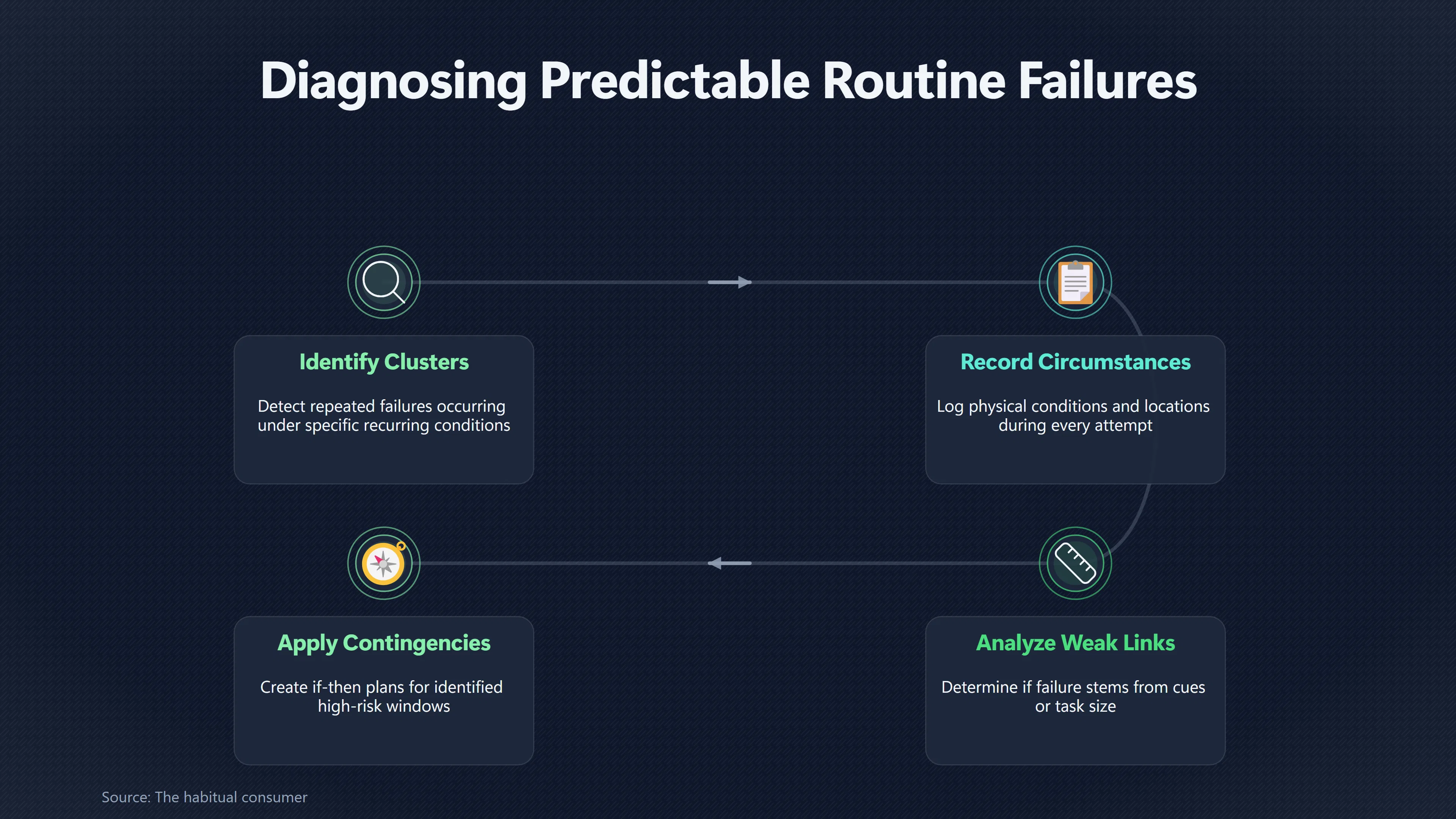
For diagnosing failure windows, a compact record can capture four things: what was planned, whether it happened, what conditions were present, and where the routine broke down. After several comparable opportunities, the question becomes whether failures disproportionately coincide with one condition.
That approach also protects against a common reasoning error: treating any repetition as proof of a universal personal limitation. Even time of day is more complicated than familiar claims about “running out of willpower”. A large naturalistic study following two student samples of 8,867 and 8,754 people found evidence of fatigue during prolonged work on a specific task, but negligible evidence that ability generally deteriorated across the day. A recurring evening failure may therefore be real without proving that people simply possess less self-control at night. The relevant mechanism could instead be sleep-related fatigue, competing obligations, hunger, environmental cues or the particular task itself.[PubMed Central (PMC)]pmc.ncbi.nlm.nih.govPubMed Central (PMC)A pre-registered naturalistic observation of within domain mental fatigue and domain-general depletion of self-contro…
Which recurring conditions are informative enough to act on?
The strongest signal is a condition that is specific, repeated and plausibly connected to the behaviour. “I have been inconsistent lately” is too broad to diagnose. “I have skipped the planned study session on four of the last five evenings when I arrived home after 19:30” identifies a situation that can actually be redesigned.
Several kinds of recurring condition are particularly informative:
- Time and sequence: the behaviour repeatedly fails at a particular time or after another activity, such as studying after dinner or exercising after a long commute.
- Place: success is reliable in one location but deteriorates elsewhere.
- Competing events: late meetings, childcare, social plans or other predictable commitments repeatedly consume the same window.
- Missing cues: the behaviour works when attached to a stable event but disappears when the cue varies.
- Task size: starting is reasonably reliable, but completion repeatedly fails when the planned session requires more time or effort than the available window permits.
- Disruption and recovery: an interruption is unavoidable, but the routine repeatedly fails to restart afterwards.
Context deserves particular attention because habits are not simply behaviours that have been repeated many times. They involve learned associations between contexts and responses. Research examining students who moved to a new university found that habitual exercising, newspaper reading and television watching were disrupted when relevant features of their usual performance contexts changed. A later UK study of 18,053 people similarly found evidence consistent with the “habit discontinuity” hypothesis: changing context can weaken established behavioural patterns and create an opportunity for more intentional control.[PubMed]pubmed.ncbi.nlm.nih.govPub Med Changing circumstances, disrupting habitsChanging circumstances, disrupting habits - PubMed…
The reverse is also important. In a 2022 study of intentional habit building, researchers examined 95 students completing 2,482 study-habit repetitions and a separate dataset containing 308 habits and 2,368 repetitions. Greater context stability predicted stronger automaticity and better repetition-goal attainment in both datasets. That does not mean every useful routine must happen at exactly the same time and place. It does mean that repeatedly failing whenever the usual context disappears is diagnostically meaningful: the routine may depend more heavily on that context than its designer realised.[PubMed]pubmed.ncbi.nlm.nih.govContext Stability in Habit Building Increases Automaticity and Goal Attainment - PubMed…
Recent work reinforces the point that context should be treated as part of the behavioural system rather than as scenery around it. Experimental research has found that practice strengthens cue-response associations, while reviews of habitual physical activity identify changed circumstances and competing responsibilities as routes through which established patterns can be disrupted.[PubMed]pubmed.ncbi.nlm.nih.govPub Med Measuring context-response associations that drive habitsMeasuring context-response associations that drive habits - PubMedDecember 4, 2023…
The pattern should identify the weak link
Once a failure window is visible, the next question is not simply “How do I try harder there?” It is what exactly becomes unreliable inside that window?
Consider three people who all fail to complete an evening study routine. The surface outcome is identical, but the diagnostic patterns could be completely different. One never begins because “study sometime after dinner” provides an unreliable cue. Another begins consistently but plans a 90-minute session when only 30 minutes are normally available. A third studies successfully unless work finishes late, at which point the transition from work to study disappears. Treating all three as a motivation problem would hide the evidence needed for redesign.
This is where implementation-intention research is useful. Implementation intentions specify a response to a defined situation in an “if–then” form rather than relying on a general intention. A landmark meta-analysis of 94 independent tests reported a medium-to-large overall effect on goal attainment (d = 0.65). A much larger 2024 synthesis of 642 tests found positive effects across cognitive, emotional and behavioural outcomes, with stronger effects when plans genuinely used a contingent if–then structure, when motivation was high and when plans were rehearsed.[ScienceDirect]sciencedirect.comOpen source on sciencedirect.com.
For a failure-window diagnosis, the significance is straightforward. Once the recurring situation is known, it can become the condition in a contingency: if the meeting runs beyond 18:00, then the workout becomes a 20-minute home session, for example. The value lies less in the wording than in pre-deciding what happens when the known weak point arrives.
That is also consistent with NICE behaviour-change guidance. NICE recommends combining goals and action planning with feedback and monitoring, coping plans and regular review. Its definition of action planning explicitly includes what will happen in a particular situation or at a particular time, and it says behaviour goals should be reviewed in light of experience, with further plans informed by previous progress.[NICE]nice.org.ukOpen source on nice.org.uk.
A repeated failure window therefore turns vague disappointment into a testable proposition. If late workdays are the problem, change what happens on late workdays. If the cue is unreliable, replace the cue. If the session is consistently too large for the available window, change its size. The redesigned element should correspond to the observed failure rather than becoming an unrelated overhaul of the entire routine.
Why local diagnosis beats global self-judgement
Repeated failure can easily produce a global explanation: I am lazy, I have no discipline, I always give up. Such conclusions feel explanatory because they cover every failure at once. They are also poor guides to system adjustment because they erase precisely the variation that could reveal what is going wrong.
Evidence from relapse research illustrates the danger particularly clearly. The classic cognitive-behavioural relapse model focuses on identifiable “high-risk situations” and the person’s ability to respond to them. In that literature, attributing a lapse to stable, global and internal deficiencies can contribute to guilt, reduced confidence and abandonment of the attempt, whereas interpreting it as a failure to cope with a particular high-risk situation leaves room for learning a better response.[PubMed Central (PMC)]pmc.ncbi.nlm.nih.govOpen source on nih.gov.
That literature concerns addictive behaviours, so its clinical findings should not be casually transferred to missed gym sessions or unfinished reading plans. But its diagnostic distinction is highly relevant: specific situations contain more actionable information than global character judgements. Even within smoking research, the relationship is more complicated than a simple rule that self-blame always causes further failure. An ecological study following 203 smokers across 1,001 smoking episodes found that reactions to recurrent lapses were more informative than reactions to the first lapse, while some predictions about guilt and self-blame were not supported in the expected direction.[PubMed Central (PMC)]pmc.ncbi.nlm.nih.govOpen source on nih.gov.
That nuance strengthens rather than weakens the case for examining repeated events. A single lapse is a poor foundation for a sweeping causal story. Repeated observations allow the person to ask a narrower and more useful question: what reliably distinguishes the situations in which this routine works from those in which it fails?
When the evidence is strong enough to redesign
There is no research-backed universal threshold such as “three misses means redesign”. Different behaviours occur at different frequencies, and rare but important disruptions cannot sensibly be judged by the same numerical rule as a daily routine. The threshold should therefore be evidential rather than arbitrary.
A redesign becomes increasingly justified when three features coincide: the condition has recurred, failures cluster within it, and there is a plausible part of the routine that the condition disrupts. Confidence rises further when the same behaviour still works reasonably well outside that window. That contrast acts as a useful internal comparison.
Imagine a person who completes six of seven planned morning runs but only one of five runs scheduled after work. The interesting evidence is not an overall completion rate of seven out of twelve. It is the large difference between two recurring contexts. Before concluding that the exercise goal itself is unrealistic, the evening window deserves investigation.
This kind of local comparison also prevents unnecessary system churn. Behaviour-change evidence does not imply that every disappointing week demands a new productivity method. NICE explicitly frames monitoring alongside review and tailoring, while habit research shows that stable contexts can support repetition. Constantly replacing a routine after isolated failures could destroy useful consistency rather than improve it.[NICE]nice.org.ukOpen source on nice.org.uk.
The practical standard is therefore predictability before overhaul. A bad day is an event. Several unrelated bad days may still be noise. But when a recognisable situation repeatedly forecasts the same breakdown, the failures have become diagnostic data.
Redesign the window, not your identity
The most useful interpretation of a recurring failure window is modest: this version of the routine does not cope well with this condition. It does not establish that the entire goal is wrong, that every part of the routine is defective or that the person lacks discipline.
That narrower diagnosis is what makes adaptive self-improvement possible. Monitoring identifies the recurring condition; comparison shows whether it genuinely predicts poorer performance; and the resulting redesign targets the part of the routine exposed by the pattern. Evidence on implementation intentions suggests that explicitly linking anticipated situations to responses can improve goal attainment, while research on context stability shows why routines can become either supported or disrupted by their surrounding cues.[DOI]doi.orgOpen source on doi.org.
The crucial shift is from asking “How often did I fail?” to “When does failure become predictable?” Once failure has an address — a time, transition, place, cue or recurring obstacle — it stops being merely a verdict on past performance. It becomes evidence about where the routine needs redesign.
Amazon book picks
Further Reading
Books and field guides related to When Repeated Failures Mean Your Routine Needs Redesign. Use these as the next step if you want deeper reading beyond the article.
Good Habits, Bad Habits
'The world's leading expert on habits' - Matthew Syed, bestselling author of Black Box Thinking and Rebel IdeasWhat if you could harness...
Atomic Habits
Rating: 3.5/5 from 7 Google Books ratings
The #1 New York Times bestseller. Over 25 million copies sold! Translated into 60+ languages! Tiny Changes, Remarkable Results No matter...
The Power of Habit
NEW YORK TIMES BESTSELLER • MORE THAN 3 MILLION COPIES SOLD • This instant classic explores how we can change our lives by changing our h...
How to Change
Wall Street Journal bestseller “A welcome revelation.” --The Financial Times Award-winning Wharton Professor and Choiceology podcast host...
eBay marketplace picks
Marketplace Samples
Live-tested eBay searches with available results related to this page.
Selected frommotivational poster oneBay.co.uk.



Current eBay listing
Gym Motivational Posters Work Out Insperational Quotes Wall Art

Current eBay listing
Motivational Quotes Framed Wall Art Poster Canvas Print Picture
Endnotes
1.
Source: sciencedirect.com
Link:https://www.sciencedirect.com/science/article/abs/pii/S0065260106380021
2.
Source: doi.org
Link:https://doi.org/10.1080/10463283.2024.2334563
3.
Source: nice.org.uk
Link:https://www.nice.org.uk/Guidance/PH49/chapter/recommendations
4.
Source: sciencedirect.com
Link:https://www.sciencedirect.com/science/article/pii/S0191886919304258
5.
Source: doi.org
Link:https://doi.org/10.1016/j.paid.2017.04.024
6.
Source: sciencedirect.com
Title: The habitual consumer
Link:https://www.sciencedirect.com/science/article/pii/S1057740809001065
7.
Source: sciencedirect.com
Link:https://www.sciencedirect.com/science/chapter/bookseries/abs/pii/S0065260106380021
8.
Source: sciencedirect.com
Title: More than planned: Implementation intention effects in non-planned situations
Link:https://www.sciencedirect.com/science/article/abs/pii/S0001691816304048
9.
Source: sciencedirect.com
Title: Self-regulatory failure: A review with clinical implications
Link:https://www.sciencedirect.com/science/article/abs/pii/0272735887900055
10.
Source: sciencedirect.com
Title: Self-Regulation Failure
Link:https://www.sciencedirect.com/topics/psychology/self-regulation-failure
11.
Source: doi.org
Link:https://doi.org/10.1007/978
12.
Source: pubmed.ncbi.nlm.nih.gov
Title: Pub Med Changing circumstances, disrupting habits
Link:https://pubmed.ncbi.nlm.nih.gov/15982113/
Source snippet
Changing circumstances, disrupting habits - PubMed...
13.
Source: pubmed.ncbi.nlm.nih.gov
Link:https://pubmed.ncbi.nlm.nih.gov/35756236/
Source snippet
Context Stability in Habit Building Increases Automaticity and Goal Attainment - PubMed...
14.
Source: pubmed.ncbi.nlm.nih.gov
Link:https://pubmed.ncbi.nlm.nih.gov/26479070/
Source snippet
Does monitoring goal progress promote goal attainment? A meta-analysis of the experimental evidence - PubMed...
15.
Source: pmc.ncbi.nlm.nih.gov
Link:https://pmc.ncbi.nlm.nih.gov/articles/PMC5607124/
Source snippet
PubMed Central (PMC)A pre-registered naturalistic observation of within domain mental fatigue and domain-general depletion of self-contro...
16.
Source: pubmed.ncbi.nlm.nih.gov
Title: Pub Med Clocking self-regulation: why [time of day]({{ ‘time-of-day/’ | relative_url }}) matters for health psychology
Link:https://pubmed.ncbi.nlm.nih.gov/28385063/
Source snippet
Clocking self-regulation: why time of day matters for health psychology - PubMed...
17.
Source: pubmed.ncbi.nlm.nih.gov
Link:https://pubmed.ncbi.nlm.nih.gov/27120333/
Source snippet
Habit Discontinuity, Self-Activation, and the Diminishing Influence of Context Change: Evidence from the UK Understanding Society S...
18.
Source: pmc.ncbi.nlm.nih.gov
Link:https://pmc.ncbi.nlm.nih.gov/articles/PMC9226889/
Source snippet
PubMed Central (PMC)Context Stability in Habit Building Increases Automaticity and Goal Attainment - PMC...
19.
Source: pubmed.ncbi.nlm.nih.gov
Title: Pub Med Measuring context-response associations that drive habits
Link:https://pubmed.ncbi.nlm.nih.gov/38047612/
Source snippet
Measuring context-response associations that drive habits - PubMedDecember 4, 2023...
Published: December 4, 2023
20.
Source: pubmed.ncbi.nlm.nih.gov
Link:https://pubmed.ncbi.nlm.nih.gov/39702740/
Source snippet
Maintaining habitual physical activity by overcoming disruptive competing actions: mechanisms and interventions - PubMed...
21.
Source: pmc.ncbi.nlm.nih.gov
Link:https://pmc.ncbi.nlm.nih.gov/articles/PMC6760427/
22.
Source: pmc.ncbi.nlm.nih.gov
Title: Pub Med Central (PMC)Relapse prevention for addictive behaviors
Link:https://pmc.ncbi.nlm.nih.gov/articles/PMC3163190/
23.
Source: pmc.ncbi.nlm.nih.gov
Link:https://pmc.ncbi.nlm.nih.gov/articles/PMC3296289/
24.
Source: pubmed.ncbi.nlm.nih.gov
Link:https://pubmed.ncbi.nlm.nih.gov/42053513/
25.
Source: pubmed.ncbi.nlm.nih.gov
Link:https://pubmed.ncbi.nlm.nih.gov/41784001/
26.
Source: pubmed.ncbi.nlm.nih.gov
Link:https://pubmed.ncbi.nlm.nih.gov/41664442/
27.
Source: pmc.ncbi.nlm.nih.gov
Link:https://pmc.ncbi.nlm.nih.gov/articles/PMC12653320/
28.
Source: pubmed.ncbi.nlm.nih.gov
Link:https://pubmed.ncbi.nlm.nih.gov/39676132/
29.
Source: pmc.ncbi.nlm.nih.gov
Link:https://pmc.ncbi.nlm.nih.gov/articles/PMC11538878/
30.
Source: pmc.ncbi.nlm.nih.gov
Link:https://pmc.ncbi.nlm.nih.gov/articles/PMC11161714/
31.
Source: pubmed.ncbi.nlm.nih.gov
Link:https://pubmed.ncbi.nlm.nih.gov/35791507/
32.
Source: pmc.ncbi.nlm.nih.gov
Link:https://pmc.ncbi.nlm.nih.gov/articles/PMC10765525/
33.
Source: pmc.ncbi.nlm.nih.gov
Link:https://pmc.ncbi.nlm.nih.gov/articles/PMC10952786/
34.
Source: pmc.ncbi.nlm.nih.gov
Link:https://pmc.ncbi.nlm.nih.gov/articles/PMC10015600/
35.
Source: pmc.ncbi.nlm.nih.gov
Link:https://pmc.ncbi.nlm.nih.gov/articles/PMC12318445/
36.
Source: pubmed.ncbi.nlm.nih.gov
Link:https://pubmed.ncbi.nlm.nih.gov/34283681/
37.
Source: pmc.ncbi.nlm.nih.gov
Link:https://pmc.ncbi.nlm.nih.gov/articles/PMC9999286/
38.
Source: pmc.ncbi.nlm.nih.gov
Link:https://pmc.ncbi.nlm.nih.gov/articles/PMC8747167/
39.
Source: pubmed.ncbi.nlm.nih.gov
Link:https://pubmed.ncbi.nlm.nih.gov/34713424/
40.
Source: pmc.ncbi.nlm.nih.gov
Link:https://pmc.ncbi.nlm.nih.gov/articles/PMC9291624/
41.
Source: pmc.ncbi.nlm.nih.gov
Link:https://pmc.ncbi.nlm.nih.gov/articles/PMC8149892/
42.
Source: pmc.ncbi.nlm.nih.gov
Link:https://pmc.ncbi.nlm.nih.gov/articles/PMC8365685/
43.
Source: pubmed.ncbi.nlm.nih.gov
Link:https://pubmed.ncbi.nlm.nih.gov/33822454/
44.
Source: pubmed.ncbi.nlm.nih.gov
Link:https://pubmed.ncbi.nlm.nih.gov/33405284/
45.
Source: pmc.ncbi.nlm.nih.gov
Link:https://pmc.ncbi.nlm.nih.gov/articles/PMC7778403/
46.
Source: pmc.ncbi.nlm.nih.gov
Link:https://pmc.ncbi.nlm.nih.gov/articles/PMC9135175/
47.
Source: pubmed.ncbi.nlm.nih.gov
Link:https://pubmed.ncbi.nlm.nih.gov/32228721/
48.
Source: pmc.ncbi.nlm.nih.gov
Link:https://pmc.ncbi.nlm.nih.gov/articles/PMC7571594/
49.
Source: pmc.ncbi.nlm.nih.gov
Link:https://pmc.ncbi.nlm.nih.gov/articles/PMC7429262/
50.
Source: pmc.ncbi.nlm.nih.gov
Link:https://pmc.ncbi.nlm.nih.gov/articles/PMC6693254/
51.
Source: pubmed.ncbi.nlm.nih.gov
Link:https://pubmed.ncbi.nlm.nih.gov/31217762/
52.
Source: pmc.ncbi.nlm.nih.gov
Link:https://pmc.ncbi.nlm.nih.gov/articles/PMC5591758/
53.
Source: pmc.ncbi.nlm.nih.gov
Link:https://pmc.ncbi.nlm.nih.gov/articles/PMC13055932/
54.
Source: pmc.ncbi.nlm.nih.gov
Link:https://pmc.ncbi.nlm.nih.gov/articles/PMC5916047/
55.
Source: pmc.ncbi.nlm.nih.gov
Link:https://pmc.ncbi.nlm.nih.gov/articles/PMC5875102/
56.
Source: pmc.ncbi.nlm.nih.gov
Link:https://pmc.ncbi.nlm.nih.gov/articles/PMC5844157/
57.
Source: pmc.ncbi.nlm.nih.gov
Link:https://pmc.ncbi.nlm.nih.gov/articles/PMC5703565/
58.
Source: pubmed.ncbi.nlm.nih.gov
Link:https://pubmed.ncbi.nlm.nih.gov/28650196/
59.
Source: pmc.ncbi.nlm.nih.gov
Link:https://pmc.ncbi.nlm.nih.gov/articles/PMC5794240/
60.
Source: pubmed.ncbi.nlm.nih.gov
Link:https://pubmed.ncbi.nlm.nih.gov/28931013/
61.
Source: pmc.ncbi.nlm.nih.gov
Link:https://pmc.ncbi.nlm.nih.gov/articles/PMC6317726/
62.
Source: pmc.ncbi.nlm.nih.gov
Link:https://pmc.ncbi.nlm.nih.gov/articles/PMC5800587/
63.
Source: pmc.ncbi.nlm.nih.gov
Link:https://pmc.ncbi.nlm.nih.gov/articles/PMC5370453/
64.
Source: pmc.ncbi.nlm.nih.gov
Link:https://pmc.ncbi.nlm.nih.gov/articles/PMC5364185/
65.
Source: pmc.ncbi.nlm.nih.gov
Link:https://pmc.ncbi.nlm.nih.gov/articles/PMC5371716/
66.
Source: pmc.ncbi.nlm.nih.gov
Link:https://pmc.ncbi.nlm.nih.gov/articles/4975085/
67.
Source: pmc.ncbi.nlm.nih.gov
Link:https://pmc.ncbi.nlm.nih.gov/articles/PMC4975085/
68.
Source: pubmed.ncbi.nlm.nih.gov
Link:https://pubmed.ncbi.nlm.nih.gov/25965276/
69.
Source: pubmed.ncbi.nlm.nih.gov
Link:https://pubmed.ncbi.nlm.nih.gov/25706547/
70.
Source: pmc.ncbi.nlm.nih.gov
Link:https://pmc.ncbi.nlm.nih.gov/articles/PMC4997809/
71.
Source: pmc.ncbi.nlm.nih.gov
Link:https://pmc.ncbi.nlm.nih.gov/articles/PMC4566897/
72.
Source: nice.org.uk
Link:https://www.nice.org.uk/Guidance/PH49
73.
Source: pmc.ncbi.nlm.nih.gov
Link:https://pmc.ncbi.nlm.nih.gov/articles/PMC3505409/
74.
Source: pmc.ncbi.nlm.nih.gov
Link:https://pmc.ncbi.nlm.nih.gov/articles/PMC3179802/
75.
Source: pubmed.ncbi.nlm.nih.gov
Link:https://pubmed.ncbi.nlm.nih.gov/21787035/
76.
Source: pmc.ncbi.nlm.nih.gov
Link:https://pmc.ncbi.nlm.nih.gov/articles/PMC3062191/
77.
Source: pmc.ncbi.nlm.nih.gov
Link:https://pmc.ncbi.nlm.nih.gov/articles/PMC4636196/
78.
Source: pmc.ncbi.nlm.nih.gov
Link:https://pmc.ncbi.nlm.nih.gov/articles/PMC2846437/
79.
Source: pmc.ncbi.nlm.nih.gov
Link:https://pmc.ncbi.nlm.nih.gov/articles/PMC3829471/
80.
Source: nice.org.uk
Link:https://www.nice.org.uk/guidance/ph6/chapter/recommendations
81.
Source: pubmed.ncbi.nlm.nih.gov
Link:https://pubmed.ncbi.nlm.nih.gov/16871450/
82.
Source: pubmed.ncbi.nlm.nih.gov
Link:https://pubmed.ncbi.nlm.nih.gov/10890810/
83.
Source: pmc.ncbi.nlm.nih.gov
Link:https://pmc.ncbi.nlm.nih.gov/articles/PMC5844158/
84.
Source: pubmed.ncbi.nlm.nih.gov
Link:https://pubmed.ncbi.nlm.nih.gov/8916628/
85.
Source: pubmed.ncbi.nlm.nih.gov
Link:https://pubmed.ncbi.nlm.nih.gov/30760176/
86.
Source: pubmed.ncbi.nlm.nih.gov
Link:https://pubmed.ncbi.nlm.nih.gov/12237978/
87.
Source: pubmed.ncbi.nlm.nih.gov
Link:https://pubmed.ncbi.nlm.nih.gov/20363904/
88.
Source: pmc.ncbi.nlm.nih.gov
Link:https://pmc.ncbi.nlm.nih.gov/articles/PMC6876446/
89.
Source: pubmed.ncbi.nlm.nih.gov
Link:https://pubmed.ncbi.nlm.nih.gov/11595257/
Additional References
90.
Source: eprints.whiterose.ac.uk
Link:https://eprints.whiterose.ac.uk/id/eprint/91437/
Source snippet
White Rose Research OnlineDoes Monitoring Goal Progress Promote Goal Attainment? A Meta-Analysis of the Experimental Evidence - White Ros...
91.
Source: youtube.com
Title: The Science of Good and Bad Habits with Dr. Wendy Wood
Link:https://www.youtube.com/watch?v=h71_r9ocI3A
Source snippet
For an in-depth behavioral perspective on why routines break down under recurring context shifts, check out this discussion on The Scienc...
92.
Source: researchgate.net
Link:https://www.researchgate.net/publication/319947298_A_pre-registered_naturalistic_observation_of_within_domain_mental_fatigue_and_domain-general_depletion_of_self-control
93.
Source: researchgate.net
Link:https://www.researchgate.net/publication/291335719_Does_Monitoring_Goal_Progress_Promote_Goal_Attainment_A_Meta-Analysis_of_the_Experimental_Evidence
94.
Source: researchgate.net
Link:https://www.researchgate.net/publication/37367696_Implementation_Intentions_and_Goal_Achievement_A_Meta-Analysis_of_Effects_and_Processes
95.
Source: tandfonline.com
Link:https://www.tandfonline.com/doi/full/10.1080/17437199.2017.1316673
96.
Source: eurekamag.com
Link:https://eurekamag.com/research/057/653/057653112.php
97.
Source: apa.org
Link:https://www.apa.org/pubs/highlights/spotlight/issue-275
98.
Source: frontiersin.org
Link:https://www.frontiersin.org/journals/psychology/articles/10.3389/fpsyg.2022.883795/full
99.
Source: tandfonline.com
Link:https://www.tandfonline.com/doi/full/10.1080/08870440802642924