Within Missed Days
Your Streak Reset, but Did Your Habit?
A streak can fall to zero after one miss even while the learned cue-response association remains substantially intact.
On this page
- What streaks measure and what habits measure
- Why a zero day streak can misrepresent progress
- Better ways to interpret consistency after a lapse
Page outline Jump by section
Introduction
A streak can reset to zero after one missed day while the habit itself remains substantially intact. That is because the two measures describe different things. A streak records uninterrupted performance; habit research is concerned with how strongly a recurring context comes to trigger a response automatically. One is a sequence in a log. The other is a learned behavioural association.
This distinction matters most immediately after a miss. In the classic 12-week habit-formation study by Phillippa Lally and colleagues, missing one opportunity did not materially disrupt the growth of automaticity. Yet newer research on streak tracking shows that displaying a streak as “broken” can reduce subsequent engagement even when people’s underlying recent behaviour is held constant.[Wiley Online Library]onlinelibrary.wiley.comWiley Online LibraryHow are habits formed: Modelling habit formation in the real world - Lally - 2010 - European Journal of Social Psycho…
So a zero-day streak can be psychologically powerful without being a scientifically meaningful claim that habit progress has returned to zero. The useful question after a lapse is not simply “How many consecutive days have I done this?” but “How much evidence is there that this behaviour is becoming the normal response to its cue?”
What streaks measure and what habits measure
A consecutive-day streak is deliberately simple. If you perform an activity every day for 40 days and miss day 41, the old streak is over. Your new streak is zero. Mathematically, that is correct: the tracker is measuring an uninterrupted run.
Habit strength is different. In behavioural science, habits are generally understood as responses that become automatically activated by recurring contextual cues through repeated experience. Wendy Wood and Dennis Rünger’s major review describes habits as developing when people repeatedly perform the same responses in particular contexts; once established, these context-response associations can efficiently guide behaviour without requiring the same degree of deliberate decision-making each time.[Annual Reviews]annualreviews.orgAnnual Reviews Psychology of Habit | Annual ReviewsAnnual ReviewsPsychology of Habit | Annual ReviewsJanuary 4, 2016…
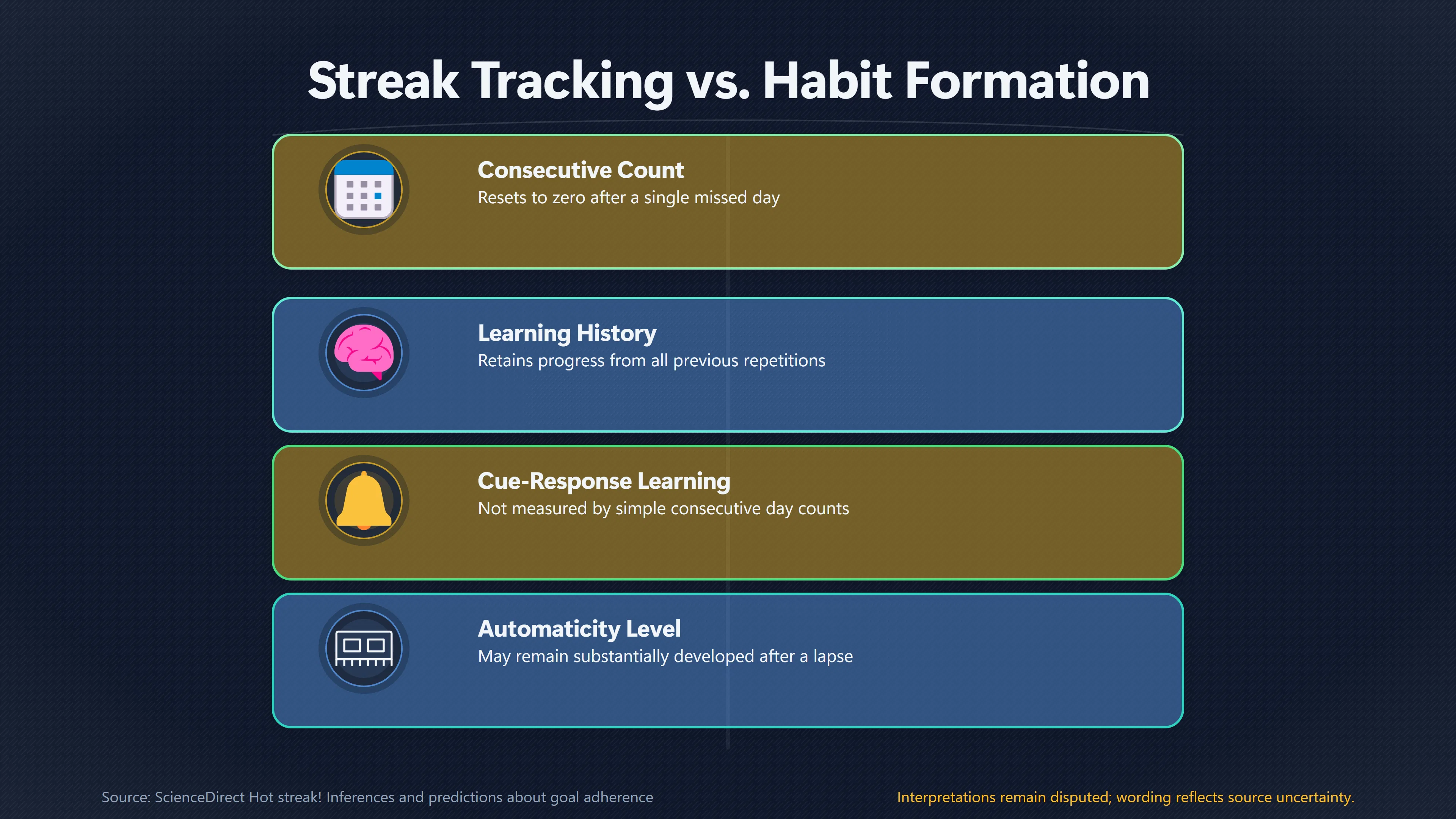
That gives streak length and habit strength very different properties after a lapse:
After one missed dayStreak measureHabit-progress interpretationConsecutive countResetsDoes not imply a resetPrevious repetitionsNo longer part of the current streakStill part of the learning historyCue-response learningNot measuredCentral to what researchers mean by habitAutomaticityNot measured directlyMay remain substantially developedNext repetitionStarts a new streakCan continue reinforcing the existing association
The difference is visible in Lally and colleagues’ influential longitudinal study. Ninety-six participants selected a daily eating, drinking or activity behaviour and performed it in a recurring context, such as after breakfast. Automaticity generally increased rapidly at first and then more slowly towards a plateau. Crucially, missing one opportunity did not materially affect the habit-formation process.[Wiley Online Library]onlinelibrary.wiley.comWiley Online LibraryHow are habits formed: Modelling habit formation in the real world - Lally - 2010 - European Journal of Social Psycho…
UCL’s explanation of the research makes the qualification equally important: one missed opportunity was not significant, but people who were very inconsistent generally failed to form habits successfully. The researchers could not specify one universal level of consistency that everyone must achieve.[University College London]ucl.ac.ukUniversity College London How long does it take to form a habit? | UCL NewsUniversity College LondonHow long does it take to form a habit? | UCL News - UCL – University College LondonAugust 4, 2009…
That means “a miss does not reset your habit” should not be converted into “consistency does not matter”. Repetition matters enormously. What the evidence challenges is the much narrower assumption that consecutiveness itself is the underlying psychological quantity being accumulated.
Why zero can misrepresent your progress
The most revealing evidence comes from putting streak research beside habit research. Streak researchers Jackie Silverman and Alixandra Barasch found across seven studies that people were more likely to continue a behaviour when their behavioural log displayed an intact rather than a broken streak. Strikingly, this effect could occur independently of actual past behaviour: changing how the same behavioural history appeared in the log could change what participants did next.[DOI]doi.orgOn or Off Track: How (Broken) Streaks Affect Consumer Decisions | Journal of Consumer Research | Oxford AcademicJune 30, 2022…
In one experiment involving exercise, participants had actually completed the same four consecutive strength exercises. Yet when the behavioural log represented those exercises as an intact streak, 66.23% chose another strength exercise, compared with 57.86% when the log represented the sequence as broken. The researchers designed the comparison specifically to separate the effect of the displayed streak from differences in participants’ actual behavioural histories.[Oxford Academic]academic.oup.comOxford AcademicOn or Off Track: How (Broken) Streaks Affect Consumer Decisions | Journal of Consumer Research | Oxford AcademicJune 30, 2022…
This exposes an important paradox. The streak display can influence future behaviour even though it is not itself a measure of the underlying habit.
Why? Silverman and Barasch found evidence that maintaining the streak becomes a secondary goal. People do not necessarily see the number merely as a record of exercising, studying or practising a language; keeping the sequence alive can acquire value of its own. An intact streak can therefore increase accomplishment and motivation, while a broken one can make progress feel smaller than the behavioural record warrants.[Oxford Academic]academic.oup.comOpen source on oup.com.
Related research strengthens the point that people assign extra meaning to consecutive patterns. Across nine preregistered studies, Silverman, Barasch and Deborah Small found that observers predicted greater future goal adherence when recent successes formed a streak than when adherence rates were otherwise comparable. The streak was interpreted as evidence of greater commitment.[ScienceDirect]sciencedirect.comScienceDirect Hot streak! Inferences and predictions about goal adherenceScienceDirect Hot streak! Inferences and predictions about goal adherence
That inference can sometimes be useful: a streak really can reflect sustained effort. But it is not uniquely diagnostic of habit strength. Two people could both have completed 29 of the previous 30 planned repetitions. If one missed yesterday and the other missed two weeks ago, their displayed streaks might be 0 versus 13 despite almost identical overall adherence. The streak statistic magnifies the position of the miss; it does not directly tell us how automatic either person’s behaviour has become.
The habit does not live in the counter
Habit research gives a better explanation for why earlier repetitions do not simply disappear after one missed opportunity. Repeatedly performing a response in a particular situation strengthens the association between that context and the behaviour. A substantial research literature therefore treats cue-contingent automaticity, rather than mere behavioural frequency, as central to habit.[PubMed]pubmed.ncbi.nlm.nih.govOpen source on nih.gov.
Context stability is especially relevant. In research combining a six-week study of university students with data from users of a habit-building app, performing behaviours in more stable contexts predicted greater automaticity as well as better attainment of repetition goals. The two datasets covered thousands of habit repetitions.[PubMed]pubmed.ncbi.nlm.nih.govOpen source on nih.gov.
A 2024 systematic review and meta-analysis covering 20 studies and 2,601 participants similarly found considerable variation in habit formation while identifying repetition and stable contexts as important determinants. It also emphasised that researchers still do not know precisely how consistent repetition must be for successful habit formation.[PubMed Central (PMC)]pmc.ncbi.nlm.nih.govOpen source on nih.gov.
The resulting picture is gradual rather than binary. Imagine someone who has spent three months putting on walking shoes after lunch and taking a short walk. Yesterday they missed the walk. Their tracker may correctly say that their current daily streak is zero. But yesterday’s omission does not erase months in which “lunch finished” repeatedly preceded “shoes on, go walking”. The next lunchtime can still encounter a well-practised response.
This is also why an established habit and a perfect record should not be treated as synonyms. Wood and Rünger describe habit memory in terms of learned context-response associations, while related work characterises habitual responses as relatively slow to modify. Nothing in that model resembles a digital counter whose accumulated learning is deleted by one failure to perform.[MySCP]myscp.onlinelibrary.wiley.comMy SCPThe habitual consumerMy SCPThe habitual consumer
A broken streak can create its own setback
There is an irony here: although a missed day need not erase habit learning, believing that the broken streak represents erased progress may make returning harder.
Silverman and Barasch’s experiments found that highlighting broken streaks reduced subsequent engagement relative to highlighting intact ones. The effect became stronger when participants attributed the break to themselves rather than an external cause. This makes sense if maintaining the streak has become a goal in its own right: once that goal appears irretrievably failed, some of the incentive generated by protecting it disappears.[DOI]doi.orgOn or Off Track: How (Broken) Streaks Affect Consumer Decisions | Journal of Consumer Research | Oxford AcademicJune 30, 2022…
Their “streak repair” experiment makes the mechanism unusually concrete. Participants whose streak remained intact chose to continue the target activity 93.14% of the time. Among those shown an ordinary broken streak, continuation fell to 68.66%. But when participants were told that doing the activity again could repair the streak, continuation rose to 85.20%. The behavioural history behind the broken-streak conditions was the same; changing whether the display could be repaired changed subsequent behaviour.[Oxford Academic]academic.oup.comOxford AcademicOn or Off Track: How (Broken) Streaks Affect Consumer Decisions | Journal of Consumer Research | Oxford AcademicJune 30, 2022…
This does not mean streaks are bad. Their motivational power is precisely why they are attractive. An intact streak can turn today’s repetition into something worth protecting, adding an immediate incentive to a goal whose real benefits may be distant. Research on logged streaks consistently finds that they can increase engagement while intact.[Oxford Academic]academic.oup.comOpen source on oup.com.
The weakness appears at the boundary between motivation tool and progress measure. If “37 days” means “I have another reason to do this today”, the streak is doing useful work. If the transition from 37 to zero is interpreted as “I have lost everything I built”, the display has begun supplying information that the habit science does not justify.

Better ways to interpret consistency after a lapse
After a miss, it is useful to keep the streak but put it beside measures that degrade gradually rather than catastrophically. No single replacement perfectly measures habit strength outside a research setting, but several views answer more useful questions than “How long since my last mistake?”
Recent completion rate. Instead of seeing only a zero-day current streak, look at how many intended repetitions occurred in a rolling period. Completing 27 of the past 30 opportunities describes something that “current streak: 0” hides. It should not be mistaken for a direct laboratory measure of automaticity, but it represents behavioural consistency more faithfully.
Cue consistency. Ask whether successful repetitions are still happening in roughly the intended situation: after breakfast, on arriving home, before the first meeting, or whatever cue was chosen. That aligns tracking more closely with the context-response learning at the heart of habit theory. Research linking stable contexts with greater automaticity gives this measure particular relevance.[PubMed]pubmed.ncbi.nlm.nih.govOpen source on nih.gov.
Automaticity. Notice whether the behaviour increasingly comes to mind or begins with less deliberate prompting when the cue occurs. Formal habit research often measures automaticity using validated self-report instruments rather than inferring it simply from the number of completed days.[Wiley Online Library]onlinelibrary.wiley.comWiley Online LibraryHow are habits formed: Modelling habit formation in the real world - Lally - 2010 - European Journal of Social Psycho…
Recovery after a miss. A useful practical indicator is whether one lapse remains one lapse. This is not a substitute for a validated habit-strength measure, but it avoids the streak counter’s all-or-nothing logic. Returning at the next intended opportunity preserves the broader pattern of repetition that the evidence associates with habit formation.
The aim is not to abolish streaks but to read them literally. A streak answers: “How many times have I done this consecutively?” It does not answer: “How much habit learning have I accumulated?”
Keep the motivation, discard the false reset
Streak tracking and habit formation overlap because both reward repeated behaviour, but they are not interchangeable. Streaks make continuity visible and can create a powerful extra reason to act. Habit formation is a slower learning process in which repeated responses become linked to recurring contexts and increasingly automatic.[Annual Reviews]annualreviews.orgAnnual Reviews Psychology of Habit | Annual ReviewsAnnual ReviewsPsychology of Habit | Annual ReviewsJanuary 4, 2016…
That distinction changes the meaning of the first day after a lapse. On the streak counter, it really is day one again. In the person’s learning history, it usually is not.
The strongest evidence does not support complacency about repeated misses: inconsistent performance can obstruct habit development, and repetition remains fundamental. But neither does it support treating a single lapse as psychological bankruptcy. Lally’s original study found that one missed opportunity did not materially derail habit formation, while subsequent streak research shows something different and complementary: the way a lapse is displayed can itself change motivation independently of the behaviour that came before it.[University College London]ucl.ac.ukUniversity College London How long does it take to form a habit? | UCL NewsUniversity College LondonHow long does it take to form a habit? | UCL News - UCL – University College LondonAugust 4, 2009…
For self-improvement that lasts, that is the useful separation to preserve. Let a streak be a motivational game if it helps. When it breaks, allow the number to reset without assuming that the habit did too.
Amazon book picks
Further Reading
Books and field guides related to Your Streak Reset, but Did Your Habit?. Use these as the next step if you want deeper reading beyond the article.
Atomic Habits
Rating: 3.5/5 from 7 Google Books ratings
The #1 New York Times bestseller. Over 25 million copies sold! Translated into 60+ languages! Tiny Changes, Remarkable Results No matter...
Good Habits, Bad Habits
'The world's leading expert on habits' - Matthew Syed, bestselling author of Black Box Thinking and Rebel IdeasWhat if you could harness...
How to Change
Wall Street Journal bestseller “A welcome revelation.” --The Financial Times Award-winning Wharton Professor and Choiceology podcast host...
The Power of Habit
Rating: 4.0/5 from 145 Google Books ratings
Duhigg takes us to the edge of scientific discoveries that explain why habits exist and how they can be changed. Distilling information i...
eBay marketplace picks
Marketplace Samples
Live-tested eBay searches with available results related to this page.
Selected frommotivational poster oneBay.co.uk.



Endnotes
1.
Source: onlinelibrary.wiley.com
Link:https://onlinelibrary.wiley.com/doi/10.1002/ejsp.674?538fcd4b_page=1&947f74f7page=3&=%2Fen-gt%2Four-commitment%23kI3HdLdDj7HLFW4BJlUYoy23RoHF9sl3JcIXrw%3D%3D
Source snippet
Wiley Online LibraryHow are habits formed: Modelling habit formation in the real world - Lally - 2010 - European Journal of Social Psycho...
2.
Source: onlinelibrary.wiley.com
Link:https://onlinelibrary.wiley.com/doi/10.1002/ejsp.674
Source snippet
Wiley Online LibraryHow are habits formed: Modelling habit formation in the real world - Lally - 2010 - European Journal of Social Psycho...
3.
Source: onlinelibrary.wiley.com
Link:https://onlinelibrary.wiley.com/doi/abs/10.1002/ejsp.674
Source snippet
Wiley Online LibraryHow are habits formed: Modelling habit formation in the real world - Lally - 2010 - European Journal of Social Psycho...
4.
Source: doi.org
Link:https://doi.org/10.1093/jcr/ucac029
Source snippet
On or Off Track: How (Broken) Streaks Affect Consumer Decisions | Journal of Consumer Research | Oxford AcademicJune 30, 2022...
Published: June 30, 2022
5.
Source: sciencedirect.com
Title: ScienceDirect Hot streak! Inferences and predictions about goal adherence
Link:https://www.sciencedirect.com/science/article/pii/S0749597823000572
6.
Source: sciencedirect.com
Title: ScienceDirect Hot streak! Inferences and predictions about goal adherence
Link:https://www.sciencedirect.com/science/article/abs/pii/S0749597823000572
7.
Source: myscp.onlinelibrary.wiley.com
Title: My SCPThe habitual consumer
Link:https://myscp.onlinelibrary.wiley.com/doi/10.1016/j.jcps.2009.08.003
8.
Source: sciencedirect.com
Title: The Effect of Social Support Features via Buddies in App-Based Habit Building
Link:https://www.sciencedirect.com/org/science/article/pii/S194186472300001X
9.
Source: doi.org
Link:https://doi.org/10.1080%2F17437199.2022.2034516
10.
Source: onlinelibrary.wiley.com
Link:https://onlinelibrary.wiley.com/doi/abs/10.1002/ejsp.674?MixPanelId=15e3fe314440-0468d8411-64220f54-100000-15e3fe314460
11.
Source: onlinelibrary.wiley.com
Link:https://onlinelibrary.wiley.com/doi/abs/10.1002/ejsp.674?msockid=2489864bf52b6612230d95d6f48167ef
12.
Source: onlinelibrary.wiley.com
Link:https://onlinelibrary.wiley.com/doi/abs/10.1002/ejsp.674?msockid=17570258034862e732eb114c02616368
13.
Source: onlinelibrary.wiley.com
Link:https://onlinelibrary.wiley.com/doi/abs/10.1002/ejsp.674?cf_chl_jschl_tk=pmd_EwcJDaCFBR9OVEL1O_0qjioww0Gc86ZzpBvCBFhrDcE-1635261061-0-gqNtZGzNAjujcnBszQi9
14.
Source: onlinelibrary.wiley.com
Link:https://onlinelibrary.wiley.com/doi/abs/10.1002/ejsp.674?msockid=038ed114f43667dd0790c4bef5146634
15.
Source: onlinelibrary.wiley.com
Link:https://onlinelibrary.wiley.com/doi/abs/10.1002/ejsp.674?aff_id=24772
16.
Source: onlinelibrary.wiley.com
Link:https://onlinelibrary.wiley.com/doi/10.1002/ejsp.674?2d235898_page=2&538fcd4b_page=6&d2101103_page=8&d73ad837_page=2
17.
Source: onlinelibrary.wiley.com
Link:https://onlinelibrary.wiley.com/doi/abs/10.1002/ejsp.674?538fcd4b_page=6&947f74f7_page=5
18.
Source: sciencedirect.com
Title: The motivating power of streaks: Increasing persistence is as easy as 1, 2, 3
Link:https://www.sciencedirect.com/science/article/pii/S0749597825000032
19.
Source: academic.oup.com
Link:https://academic.oup.com/jcr/article/49/6/1095/6623414?guestAccessKey=1bb91501-7f0d-4dcc-806d-8124e533be13
20.
Source: annualreviews.org
Title: Annual Reviews Psychology of Habit | Annual Reviews
Link:https://www.annualreviews.org/docserver/fulltext/psych/67/1/annurev-psych-122414-033417.pdf
Source snippet
Annual ReviewsPsychology of Habit | Annual ReviewsJanuary 4, 2016...
Published: January 4, 2016
21.
Source: pubmed.ncbi.nlm.nih.gov
Title: Pub Med Psychology of Habit
Link:https://pubmed.ncbi.nlm.nih.gov/26361052/
Source snippet
Psychology of Habit - PubMed...
22.
Source: ucl.ac.uk
Title: University College London How long does it take to form a habit? | UCL News
Link:https://www.ucl.ac.uk/news/2009/aug/how-long-does-it-take-form-habit%20
Source snippet
University College LondonHow long does it take to form a habit? | UCL News - UCL – University College LondonAugust 4, 2009...
Published: August 4, 2009
23.
Source: academic.oup.com
Link:https://academic.oup.com/jcr/article/49/6/1095/6623414?guestAccessKey=1bb91501-7f0d-4dcc-806d-8124e533be13&login=false
Source snippet
Oxford AcademicOn or Off Track: How (Broken) Streaks Affect Consumer Decisions | Journal of Consumer Research | Oxford AcademicJune 30, 2022...
Published: June 30, 2022
24.
Source: pubmed.ncbi.nlm.nih.gov
Link:https://pubmed.ncbi.nlm.nih.gov/20658824/
25.
Source: pmc.ncbi.nlm.nih.gov
Link:https://pmc.ncbi.nlm.nih.gov/articles/PMC4566897/
26.
Source: pubmed.ncbi.nlm.nih.gov
Link:https://pubmed.ncbi.nlm.nih.gov/35756236/
27.
Source: pmc.ncbi.nlm.nih.gov
Link:https://pmc.ncbi.nlm.nih.gov/articles/PMC9226889/
28.
Source: pmc.ncbi.nlm.nih.gov
Link:https://pmc.ncbi.nlm.nih.gov/articles/PMC11641623/
29.
Source: annualreviews.org
Title: Annual Reviews ANNUAL
Link:https://www.annualreviews.org/doi/pdf/10.1146/annurev-psych-122414-033417
Source snippet
REVIEWS Further Click here to view this...
30.
Source: academic.oup.com
Link:https://academic.oup.com/abm/article-abstract/doi/10.1093/abm/kaag015/8675907
31.
Source: pmc.ncbi.nlm.nih.gov
Link:https://pmc.ncbi.nlm.nih.gov/articles/PMC13114073/
32.
Source: ucl.ac.uk
Title: How the brain forms habits with dual learning system | UCL News
Link:https://www.ucl.ac.uk/news/2025/may/how-brain-forms-habits-dual-learning-system
33.
Source: pmc.ncbi.nlm.nih.gov
Link:https://pmc.ncbi.nlm.nih.gov/articles/PMC11574773/
34.
Source: pmc.ncbi.nlm.nih.gov
Link:https://pmc.ncbi.nlm.nih.gov/articles/PMC11494719/
35.
Source: pubmed.ncbi.nlm.nih.gov
Link:https://pubmed.ncbi.nlm.nih.gov/39225981/
36.
Source: pmc.ncbi.nlm.nih.gov
Link:https://pmc.ncbi.nlm.nih.gov/articles/PMC11635918/
37.
Source: pmc.ncbi.nlm.nih.gov
Link:https://pmc.ncbi.nlm.nih.gov/articles/PMC11652125/
38.
Source: pmc.ncbi.nlm.nih.gov
Link:https://pmc.ncbi.nlm.nih.gov/articles/PMC11161714/
39.
Source: pmc.ncbi.nlm.nih.gov
Link:https://pmc.ncbi.nlm.nih.gov/articles/PMC10842266/
40.
Source: pmc.ncbi.nlm.nih.gov
Link:https://pmc.ncbi.nlm.nih.gov/articles/PMC10578412/
41.
Source: pmc.ncbi.nlm.nih.gov
Link:https://pmc.ncbi.nlm.nih.gov/articles/PMC10151500/
42.
Source: academic.oup.com
Link:https://academic.oup.com/jcr/article-abstract/49/6/1095/6623414
43.
Source: pmc.ncbi.nlm.nih.gov
Link:https://pmc.ncbi.nlm.nih.gov/articles/PMC12318445/
44.
Source: ucl.ac.uk
Title: Brits quit new sustainable habits after just 13 days | UCL News
Link:https://www.ucl.ac.uk/news/headlines/2022/jan/brits-quit-new-sustainable-habits-after-just-13-days
45.
Source: ucl.ac.uk
Link:https://www.ucl.ac.uk/epidemiology-health-care/news/2021/nov/how-cope-work-if-your-colleagues-start-leaving
46.
Source: ucl.ac.uk
Title: How to cope at work if your colleagues start leaving | UCL News
Link:https://www.ucl.ac.uk/news/headlines/2021/nov/how-cope-work-if-your-colleagues-start-leaving
47.
Source: pubmed.ncbi.nlm.nih.gov
Link:https://pubmed.ncbi.nlm.nih.gov/32116961/
48.
Source: pmc.ncbi.nlm.nih.gov
Link:https://pmc.ncbi.nlm.nih.gov/articles/PMC7020232/
49.
Source: ucl.ac.uk
Title: How to break bad habits | UCL News
Link:https://www.ucl.ac.uk/news/headlines/2020/jan/how-break-bad-habits
50.
Source: pmc.ncbi.nlm.nih.gov
Link:https://pmc.ncbi.nlm.nih.gov/articles/PMC6895142/
51.
Source: ucl.ac.uk
Title: Five ways to form a good habit | UCL News
Link:https://www.ucl.ac.uk/news/headlines/2019/aug/five-ways-form-good-habit
52.
Source: ucl.ac.uk
Title: Latest news | UCL News
Link:https://www.ucl.ac.uk/news/latest-news?collection=drupal-push-news-news&meta_UclAudience_not=staff&meta_UclAudience_not=students&meta_UclOrgUnit=%22UCL+News%22&start_rank=7711
53.
Source: ucl.ac.uk
Title: Forming a new habit | UCL News
Link:https://www.ucl.ac.uk/news/headlines/2019/jan/forming-new-habit
54.
Source: ucl.ac.uk
Title: Five steps for an attainable New Year resolution | UCL News
Link:https://www.ucl.ac.uk/news/headlines/2018/jan/five-steps-attainable-new-year-resolution
55.
Source: annualreviews.org
Title: Psychology of Habit | Annual Reviews
Link:https://www.annualreviews.org/docserver/fulltext/psych/67/1/annurev-psych-122414-033417.pdf?accname=guest&checksum=AF3B3EEFD1B16EB6822F73787ED682D5&expires=1767193310&id=id
56.
Source: annualreviews.org
Title: Psychology of Habit | Annual Reviews
Link:https://www.annualreviews.org/docserver/fulltext/psych/67/1/annurev-psych-122414-033417.pdf?accname=guest&checksum=073AC838243715A79C3D4DD2CDE4C47E&expires=1763333131&id=id
57.
Source: pubmed.ncbi.nlm.nih.gov
Link:https://pubmed.ncbi.nlm.nih.gov/26361052/?dopt=Abstract
58.
Source: pubmed.ncbi.nlm.nih.gov
Link:https://pubmed.ncbi.nlm.nih.gov/21749245/
59.
Source: ucl.ac.uk
Title: UC L in the News: How to give up bad habits forever | UCL News
Link:https://www.ucl.ac.uk/news/2008/feb/ucl-news-how-give-bad-habits-forever
60.
Source: pmc.ncbi.nlm.nih.gov
Link:https://pmc.ncbi.nlm.nih.gov/articles/PMC13193246/
61.
Source: annualreviews.org
Link:https://www.annualreviews.org/content/journals/psych/67/1
62.
Source: annualreviews.org
Link:https://www.annualreviews.org/content/journals/psych/67/1?page=1&pageSize=100
63.
Source: ucl.ac.uk
Link:https://www.ucl.ac.uk/population-health-sciences/health-informatics/research/publications-archive
64.
Source: openurl.ebsco.com
Link:https://openurl.ebsco.com/contentitem/doi%3A10.1093/jcr/ucac029?id=ebsco%3Adoi%3A10.1093%2Fjcr%2Fucac029&sid=ebsco%3Aplink%3Acrawler
Additional References
65.
Source: youtube.com
Title: Why Habit Streaks Secretly Make You Quit
Link:https://www.youtube.com/watch?v=zZfbro_NkCM
Source snippet
Streak tracking habit formation psychology missed day Building Your 365 Legacy: The Power of Daily Streaks, Habit Psychology, and Consist...
66.
Source: youtube.com
Title: The Problem with Habit Trackers (And What to Do Instead)
Link:https://www.youtube.com/watch?v=nfRZPf_6a1c
Source snippet
The Habit Tracker Trap: Stop Feeling Guilty and Build Real Routines...
67.
Source: youtube.com
Title: The Habit Tracker Trap: Stop Feeling Guilty and Build Real Routines
Link:https://www.youtube.com/watch?v=_KDZSd3wZ8w
Source snippet
Why Habit Streaks Secretly Make You Quit...
68.
Source: youtube.com
Title: Streak Psychology: Why Breaking One Feels So Bad
Link:https://www.youtube.com/watch?v=FtEEvGGmSqs
Source snippet
The Problem with Habit Trackers (And What to Do Instead)...
69.
Source: habitdex.com
Link:https://habitdex.com/methods/dont-break-the-chain
70.
Source: researchgate.net
Link:https://www.researchgate.net/publication/32898894_How_are_habits_formed_Modeling_habit_formation_in_the_real_world
71.
Source: zendy.io
Link:https://zendy.io/title/10.1002/ejsp.674
72.
Source: knowledge.insead.edu
Link:https://knowledge.insead.edu/marketing/consumer-streaks-are-motivating-key-keeping-them-alive
73.
Source: colorado.edu
Link:https://www.colorado.edu/business/faculty-research/2023/04/19/or-track-how-broken-streaks-affect-consumer-decisions
74.
Source: jackiesilverman.com
Link:https://www.jackiesilverman.com/research