Within Habit Timelines
Where Did the 21 Day Habit Rule Come From?
The famous 21-day rule grew from Maxwell Maltz's observations about adjustment, not experiments on everyday habit formation.
On this page
- What Maxwell Maltz actually wrote
- How a minimum became a universal rule
- Why modern habit research rejects a fixed deadline
Page outline Jump by section
Introduction
The famous claim that “it takes 21 days to form a habit” did not begin as the result of a habit experiment. Its most traceable source is Psycho-Cybernetics, a 1960 self-help book by plastic surgeon Maxwell Maltz. Maltz described patients adapting to altered appearances after surgery, phantom-limb experiences after amputation, and people becoming accustomed to a new home. From these observations, he proposed that perceptible change in a person’s mental image generally required “a minimum of about 21 days”.[Penguin Random House Canada]penguinrandomhouse.caOpen source on penguinrandomhouse.ca.
That is substantially different from saying that repeating any behaviour for exactly three weeks makes it automatic. Maltz was discussing adjustment and self-image, not reporting a controlled study of everyday habit formation. As the idea travelled through popular self-help, crucial qualifications disappeared: “a minimum of about 21 days” became simply “21 days”, and psychological adjustment became “forming a habit”. Modern habit research measures something different and finds no universal three-week deadline.[Scientific American]scientificamerican.comScientific AmericanHow Long Does It Really Take to Form a Habit? | Scientific AmericanJanuary 24, 2024…
What Maxwell Maltz actually wrote
Maltz’s original passage is revealing because it contains both the seed of the modern claim and the qualifications that later versions largely discarded. In Psycho-Cybernetics, he advised readers trying his self-image exercises to reserve judgement for at least three weeks. He then offered several observations to explain why. According to Maltz, the average plastic-surgery patient took about 21 days to become accustomed to a changed face; a phantom limb persisted for roughly that period after amputation; and a new house took around three weeks to begin feeling like home.[Penguin Random House Canada]penguinrandomhouse.caOpen source on penguinrandomhouse.ca.
His conclusion concerned a change in a “mental image”, not the acquisition of an automatically cued behaviour. The wording was cautious even by the standards of his own argument: he referred to a minimum, said about 21 days, and described “commonly observed phenomena”. The passage presented no randomly assigned groups, systematic comparison of different behaviours or statistical estimate showing that habits reliably emerge after three weeks. Scientific American’s account of the history likewise notes that no formal experiment was conducted to verify Maltz’s 21-day observation.[Scientific American]scientificamerican.comScientific AmericanHow Long Does It Really Take to Form a Habit? | Scientific AmericanJanuary 24, 2024…
The distinction matters because Maltz’s examples were not actually equivalent phenomena. Becoming familiar with one’s appearance after surgery, experiencing a phantom limb, feeling at home in a new house and learning a repeated behaviour involve different processes. Maltz grouped them together because he believed they illustrated changes in self-image and psychological adjustment. The later 21-day rule went further by treating the common number as evidence of a general law governing behavioural habits.[Penguin Random House Canada]penguinrandomhouse.caOpen source on penguinrandomhouse.ca.
There is also an important linguistic distinction. Researchers at University College London have suggested that part of the confusion may involve habituation versus habit formation. Habituation can mean becoming accustomed to something; behavioural habit formation concerns developing a response that becomes automatically elicited by an associated situation. Maltz’s examples largely concerned the former sort of “getting used to” experience, yet the popular rule came to be understood as a claim about the latter.[UCL Blogs]blogs.ucl.ac.ukUCL BlogsJune | 2012 | UCL ‘Health Chatter’: Research Department of Behavioural Science and Health Blog…
How a minimum became a universal rule
The mutation can be understood as a series of small but consequential simplifications:
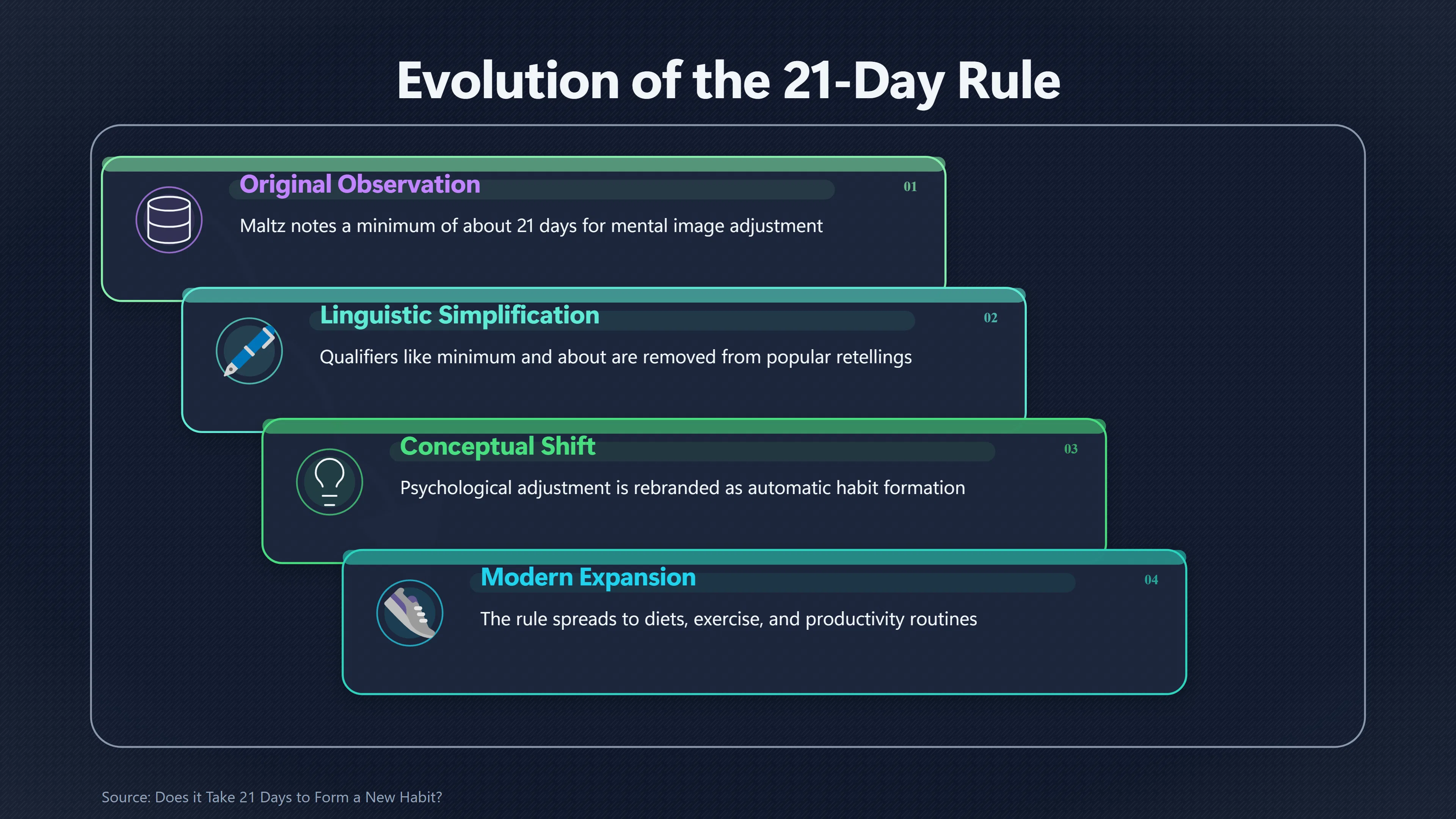
First, the lower bound disappeared. “A minimum of about 21 days” does not predict completion on day 21. Even on Maltz’s own terms, it means meaningful adjustment might require three weeks or longer. Removing “minimum” converts a proposed floor into something resembling a finish line.[Penguin Random House Canada]penguinrandomhouse.caOpen source on penguinrandomhouse.ca.
Second, “about” disappeared. Maltz’s wording acknowledged approximation. The popular version supplies a precise integer, giving an anecdotal observation the appearance of a measured scientific threshold. That precision is not present in the underlying evidence.[Penguin Random House Canada]penguinrandomhouse.caOpen source on penguinrandomhouse.ca.
Third, the outcome changed. Maltz wrote about perceptible changes in mental image and adapting to altered circumstances. Popular retellings transformed this into a statement about habit formation: repeat an action for 21 days and it becomes habitual. UCL researchers explicitly describe the broad generalisation from Maltz’s plastic-surgery observations as unclear and distinguish his examples from the automatic responses studied by habit researchers.[UCL Blogs]blogs.ucl.ac.ukUCL BlogsJune | 2012 | UCL ‘Health Chatter’: Research Department of Behavioural Science and Health Blog…
Finally, the scope expanded. A handful of observations became advice supposedly applicable to exercise, diets, productivity routines and other behaviour changes. By 2009, The Guardian was already describing the 21-day idea as pop-psychology wisdom while reporting research that contradicted it; university and scientific explainers have subsequently continued to trace the claim back to Maltz.[theguardian.com]theguardian.comThe GuardianThis column will change your life: How long does it really take to change a habit? | Life and style | The GuardianOctober 9…
There is no well-documented single moment at which one identifiable writer definitively changed Maltz’s wording into the modern rule. Claims that a particular self-help author or decade alone caused the transformation should therefore be treated cautiously. What the sources establish more securely is the direction of the distortion: an observation about adjustment entered popular self-improvement culture and circulated in a much broader, more definite form.[UCL Blogs]blogs.ucl.ac.ukUCL BlogsJune | 2012 | UCL ‘Health Chatter’: Research Department of Behavioural Science and Health Blog…
The simplified version also has an obvious psychological advantage as advice. Twenty-one days feels substantial without seeming forbidding. Behavioural economist Colin Camerer told Scientific American that three days would sound implausibly short whereas a year would seem daunting; three weeks occupies an appealing middle ground. That does not demonstrate exactly why the myth historically spread, but it helps explain why the simplified claim has proved so durable once established.[Scientific American]scientificamerican.comScientific AmericanHow Long Does It Really Take to Form a Habit? | Scientific AmericanJanuary 24, 2024…

Why modern habit research rejects a fixed deadline
Modern studies ask a more precise question than Maltz did. In behavioural research, forming a habit is generally associated with a behaviour becoming increasingly automatic in response to a recurring context. The relevant question is therefore not simply “How many consecutive days did someone perform this action?” but how repetition changes automaticity over time.[Wiley Online Library]onlinelibrary.wiley.comWiley Online LibraryHow are habits formed: Modelling habit formation in the real world - Lally - 2010 - European Journal of Social Psycho…
A landmark study by Phillippa Lally and colleagues illustrates why the 21-day rule fails this test. Ninety-six volunteers selected an eating, drinking or activity behaviour and attempted to perform it each day in the same context for 12 weeks. Researchers repeatedly measured automaticity and modelled its development over time. For participants whose data could be modelled, automaticity increased along a curve towards a plateau rather than suddenly switching on after a predetermined number of repetitions. Estimated times to reach 95 per cent of the eventual automaticity plateau ranged from 18 to 254 days.[Wiley Online Library]onlinelibrary.wiley.comWiley Online LibraryHow are habits formed: Modelling habit formation in the real world - Lally - 2010 - European Journal of Social Psycho…
The significance of that finding is not that “66 days” — the study’s much-publicised central estimate — should replace 21 as a new magic number. It is that people and behaviours varied enormously. UCL’s own explanation stresses that assigning one number to the process is unwise: relatively simple behaviours could develop automaticity faster than more demanding ones, and individuals differed in both the speed and eventual strength of their habits.[UCL Blogs]blogs.ucl.ac.ukJune 29, 2012…
More recent evidence strengthens that objection. A 2024 systematic review and meta-analysis covering 20 studies and 2,601 participants found that only four included studies directly reported the time required to develop health habits — itself an important warning against overly confident universal claims. Across the available evidence, reported median acquisition times were around 59–66 days, while individual estimates extended from 4 to 335 days. The authors concluded that the evidence clearly contradicts the popular idea that habits generally form in approximately 21 days.[PubMed Central (PMC)]pmc.ncbi.nlm.nih.govOpen source on nih.gov.
The comparison with Maltz is therefore not merely 21 days versus a larger number. The two traditions were measuring different things:
The popular 21-day ruleModern habit researchOriginates in Maltz’s observations about adjustment and mental imageStudies repeated behaviours and their developing automaticityBegan as “a minimum of about 21 days”Finds large differences between people and behavioursBecame a fixed three-week deadlineModels habit strength as developing progressivelyImplies a clear finishing pointFinds no universal day on which a behaviour becomes a habit
[penguinrandomhouse.ca]penguinrandomhouse.caOpen source on penguinrandomhouse.ca.
The useful lesson hidden by the myth
The historical mistake matters because a fixed deadline changes how people interpret their own progress. If someone expects a morning walk, reading routine or other behaviour to feel automatic after exactly three weeks, continued effort on day 22 can look like evidence that the attempt has failed. The research provides no basis for that conclusion. Habit strength can still be developing even when deliberate effort remains necessary after three weeks.[UCL Blogs]blogs.ucl.ac.ukJune 29, 2012…
Nor does the evidence support treating an uninterrupted 21-day streak as a special threshold. Lally and colleagues found that missing one opportunity to perform the chosen behaviour did not materially derail the habit-formation process. What mattered was repeated performance in a consistent context over time, not crossing an arbitrary calendar boundary without a blemish.[Wiley Online Library]onlinelibrary.wiley.comWiley Online LibraryHow are habits formed: Modelling habit formation in the real world - Lally - 2010 - European Journal of Social Psycho…
That makes the history of the 21-day rule unusually instructive for self-improvement. The original statement was already an informal generalisation, but the enduring myth required additional transformations: approximation became precision, a minimum became a deadline, adjustment became habit formation, and observations became something resembling a scientific law. Modern evidence reverses each of those simplifications. Habit formation is gradual, variable and behaviour-dependent rather than governed by a universal three-week clock.[Scientific American]scientificamerican.comScientific AmericanHow Long Does It Really Take to Form a Habit? | Scientific AmericanJanuary 24, 2024…

Amazon book picks
Further Reading
Books and field guides related to Where Did the 21 Day Habit Rule Come From?. Use these as the next step if you want deeper reading beyond the article.
Psycho-Cybernetics
Rating: 4.0/5 from 5 Google Books ratings
Previously published Wiltshire, 1967. Guide to personal health and success
Atomic Habits
Rating: 3.5/5 from 7 Google Books ratings
The #1 New York Times bestseller. Over 25 million copies sold! Translated into 60+ languages! Tiny Changes, Remarkable Results No matter...
Good Habits, Bad Habits
'The world's leading expert on habits' - Matthew Syed, bestselling author of Black Box Thinking and Rebel IdeasWhat if you could harness...
The Power of Habit
Rating: 4.0/5 from 145 Google Books ratings
Duhigg takes us to the edge of scientific discoveries that explain why habits exist and how they can be changed. Distilling information i...
eBay marketplace picks
Marketplace Samples
Live-tested eBay searches with available results related to this page.
Selected fromhabit tracker board oneBay.co.uk.

Endnotes
1.
Source: onlinelibrary.wiley.com
Link:https://onlinelibrary.wiley.com/doi/abs/10.1002/ejsp.674?msockid=038ed114f43667dd0790c4bef5146634
Source snippet
Wiley Online LibraryHow are habits formed: Modelling habit formation in the real world - Lally - 2010 - European Journal of Social Psycho...
2.
Source: compass.onlinelibrary.wiley.com
Link:https://compass.onlinelibrary.wiley.com/doi/full/10.1111/spc3.12975
3.
Source: bpspsychub.onlinelibrary.wiley.com
Link:https://bpspsychub.onlinelibrary.wiley.com/doi/10.1111/bjhp.12637
4.
Source: bpspsychub.onlinelibrary.wiley.com
Link:https://bpspsychub.onlinelibrary.wiley.com/doi/abs/10.1111/bjhp.12504
5.
Source: onlinelibrary.wiley.com
Link:https://onlinelibrary.wiley.com/doi/abs/10.1002/ejsp.674?msockid=17570258034862e732eb114c02616368
6.
Source: penguinrandomhouse.ca
Link:https://www.penguinrandomhouse.ca/books/318795/psycho-cybernetics-by-maxwell-maltz-md-fics/9780399176135/excerpt
7.
Source: blogs.ucl.ac.uk
Link:https://blogs.ucl.ac.uk/bsh/2012/06/
Source snippet
UCL BlogsJune | 2012 | UCL ‘Health Chatter’: Research Department of Behavioural Science and Health Blog...
8.
Source: scientificamerican.com
Link:https://www.scientificamerican.com/article/how-long-does-it-really-take-to-form-a-habit/
Source snippet
Scientific AmericanHow Long Does It Really Take to Form a Habit? | Scientific AmericanJanuary 24, 2024...
Published: January 24, 2024
9.
Source: pmc.ncbi.nlm.nih.gov
Link:https://pmc.ncbi.nlm.nih.gov/articles/PMC11641623/
10.
Source: theguardian.com
Link:https://www.theguardian.com/lifeandstyle/2009/oct/10/change-your-life-habit-28-day-rule
Source snippet
The GuardianThis column will change your life: How long does it really take to change a habit? | Life and style | The GuardianOctober 9...
11.
Source: womenshealth.obgyn.msu.edu
Link:https://womenshealth.obgyn.msu.edu/blog/debunking-21-day-myth-about-bad-habits
12.
Source: blogs.ucl.ac.uk
Link:https://blogs.ucl.ac.uk/bsh/tag/21-days/
Source snippet
June 29, 2012...
Published: June 29, 2012
13.
Source: pmc.ncbi.nlm.nih.gov
Link:https://pmc.ncbi.nlm.nih.gov/articles/3505409/
14.
Source: blogs.ucl.ac.uk
Link:https://blogs.ucl.ac.uk/bsh/tag/66-days/
15.
Source: blogs.ucl.ac.uk
Link:https://blogs.ucl.ac.uk/bsh/page/10/
Additional References
16.
Source: youtube.com
Title: Does it Take 21 Days to Form a New Habit?
Link:https://www.youtube.com/watch?v=9MDFlNci2xY
Source snippet
For a direct breakdown of how Dr. Maxwell Maltz's original clinical observations on self-image were misunderstood and morphed into the mo...
17.
Source: youtube.com
Title: How Long Does It Take to Build a Habit? HINT: It’s NOT 21 Days
Link:https://www.youtube.com/watch?v=cJ2gxIsScmk
Source snippet
The 21-Day Habit is Killing Your Growth w/B.J Fogg...
18.
Source: youtube.com
Title: The 21-Day Habit Myth. Maxwell Maltz Started a 70-Year Lie
Link:https://www.youtube.com/watch?v=yY0qRqxGcSE
Source snippet
The 21-Day Habit Myth: What Science Really Says...
19.
Source: youtube.com
Title: The 21-Day Habit is Killing Your Growth w/B.J Fogg
Link:https://www.youtube.com/watch?v=lXPy6IqrqQ0
Source snippet
How Long It Takes to Form a New Habit - And Break Bad Ones...
20.
Source: youtube.com
Title: The 21-Day Habit Myth: What Science Really Says
Link:https://www.youtube.com/watch?v=jTJ7a9j7POw
Source snippet
How Long Does It Take to Build a Habit? HINT: It's NOT 21 Days...
21.
Source: youtube.com
Title: How Long It Takes to Form a New Habit
Link:https://www.youtube.com/watch?v=HXH6_2AAVMw
Source snippet
Does it Take 21 Days to Form a New Habit?...
22.
Source: researchgate.net
Link:https://www.researchgate.net/publication/386593213_Time_to_Form_a_Habit_A_Systematic_Review_and_Meta-Analysis_of_Health_Behaviour_Habit_Formation_and_Its_Determinants
23.
Source: keepmewise.com
Link:https://keepmewise.com/blog/how-long-to-build-a-habit/
24.
Source: researchgate.net
Link:https://www.researchgate.net/publication/32898894_How_are_habits_formed_Modeling_habit_formation_in_the_real_world
25.
Source: studylib.net
Link:https://studylib.net/doc/27184734/psycho-cybernetics-maxwell-maltz