Within Stable Contexts
Why Existing Routines Make Powerful Habit Anchors
A behaviour that already happens reliably can provide a stronger anchor for a new habit than a vague intention to act later.
On this page
- Why established actions create dependable cues
- What the flossing after brushing study suggests
- How to choose the right position in a routine
Page outline Jump by section
Introduction
An existing routine can make a powerful anchor for a new habit because it supplies something a vague intention such as “I’ll do it later” does not: a concrete event that already happens reliably. Instead of repeatedly deciding when to act, you link the new behaviour to a recognisable point in something you already do — for example, flossing after brushing your teeth, taking a supplement after breakfast, or doing a brief stretch after shutting down your computer.
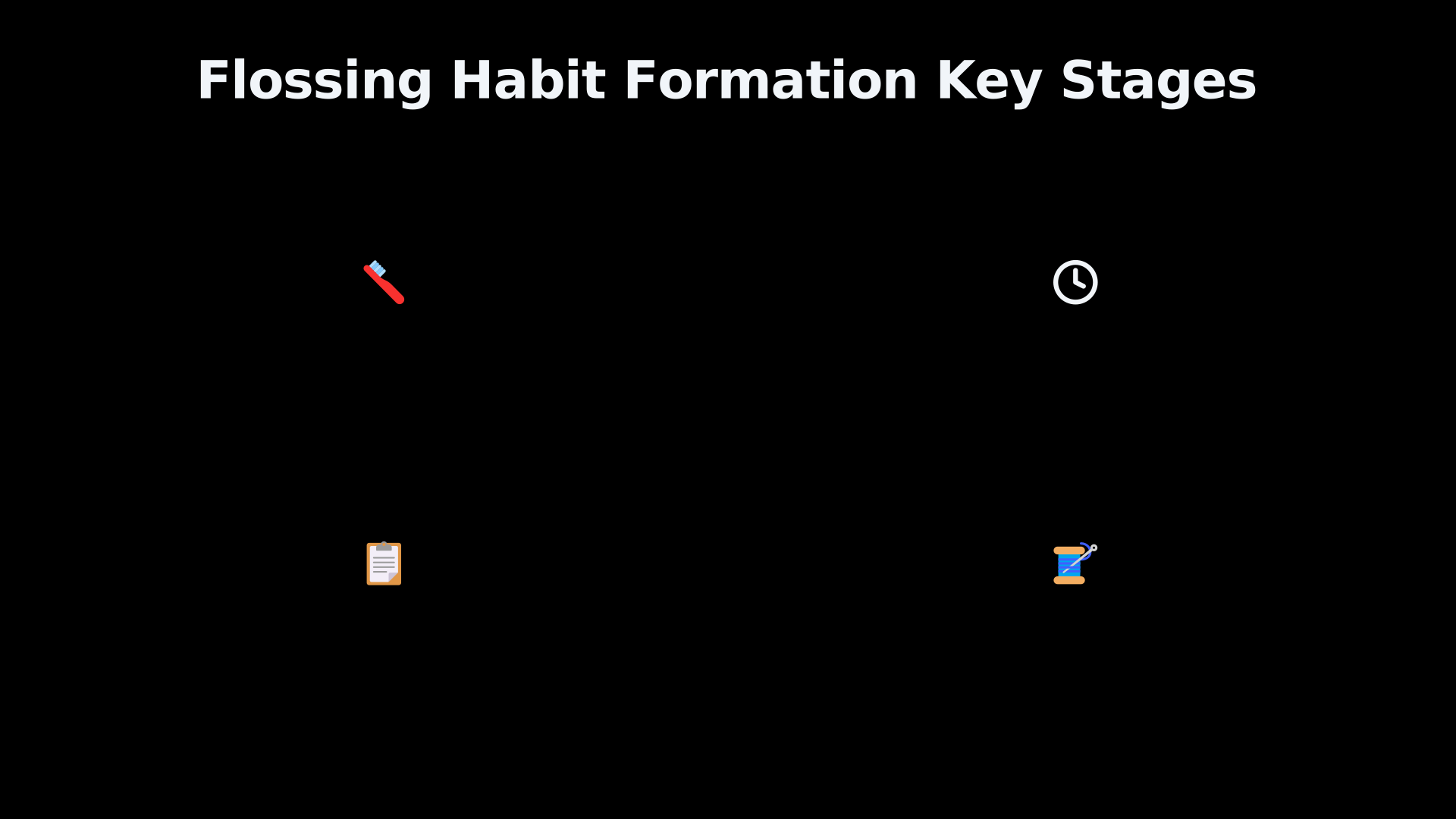
The mechanism is straightforward. Repeatedly encountering the established action and then performing the new one gives the brain a stable cue–response pairing to learn. Over time, the preceding routine can become a prompt for the added behaviour. Research supports this general approach, although it also adds an important qualification: routines are useful anchors because they can make repetition dependable, not because attaching one action to another automatically guarantees a habit.[Compass]compass.onlinelibrary.wiley.comWhat is habit and how can it be used to change real‐world behaviour? Narrowing the theory‐reality gap - Gardner - 2024 - Social an…
Why established actions create dependable cues
A routine anchor turns an intention into a specific contingency: when this familiar event happens, I do that. Psychologists study closely related plans as “implementation intentions”. Research on their mechanisms suggests that specifying a cue can make that opportunity easier to notice and strengthen the association between the situation and the intended response. A recent meta-analysis covering 642 independent tests found implementation intentions beneficial across behavioural and other outcomes, with stronger effects when plans used an explicit contingent format and were rehearsed.[BPS Psych Hub]bpspsychub.onlinelibrary.wiley.comBPS Psych HubMechanisms of implementation intention effects: The role of goal intentions, self‐efficacy, and accessibility of plan compon…
An established routine has an additional practical advantage: the cue does not have to be created from scratch. If you reliably brush your teeth every evening, “after brushing” already occurs without needing another calendar entry or a fresh act of remembering. The new behaviour can effectively borrow the stability of the old one.
That distinction helps explain why “after I make my morning coffee, I will write for five minutes” is potentially more useful than “I will write more often”. The first plan identifies an observable event at which action should begin. It also creates repeated opportunities to practise the same relationship between cue and response. Contemporary habit theory describes habits precisely in terms of cue–behaviour associations acquired through context-consistent repetition.[Compass]compass.onlinelibrary.wiley.comWhat is habit and how can it be used to change real‐world behaviour? Narrowing the theory‐reality gap - Gardner - 2024 - Social an…
There is evidence that event-based cues can support this process. In a four-week study of technology-supported habit formation, researchers found that reminders helped participants repeat behaviours but reliance on reminders did not produce the same development of automaticity; event-based cues were associated with increased automaticity. That result should not be treated as proof that phone reminders are inherently bad, but it illustrates the difference between an external prompt that repeatedly tells you what to do and a recurring event that can itself become associated with the behaviour.[UCL Discovery]discovery.ucl.ac.ukUCL DiscoveryBeyond Self-Tracking and Reminders: Designing Smartphone Apps That Support Habit Formation - UCL DiscoveryApril 19, 2015…
The broader context-stability literature points in the same direction. In a 2022 study, 95 university students building study habits were assigned either to keep place and time stable or deliberately vary them; a second dataset covered 308 habits recorded by 218 habit-app users. Across both datasets, greater context stability predicted greater automaticity and better attainment of repetition goals. An established routine is therefore useful partly because it can provide one component of that stable context again and again.[PubMed Central (PMC)]pmc.ncbi.nlm.nih.govPubMed Central (PMC)Context Stability in Habit Building Increases Automaticity and Goal Attainment - PMCJune 10, 2022…
What the flossing-after-brushing study suggests
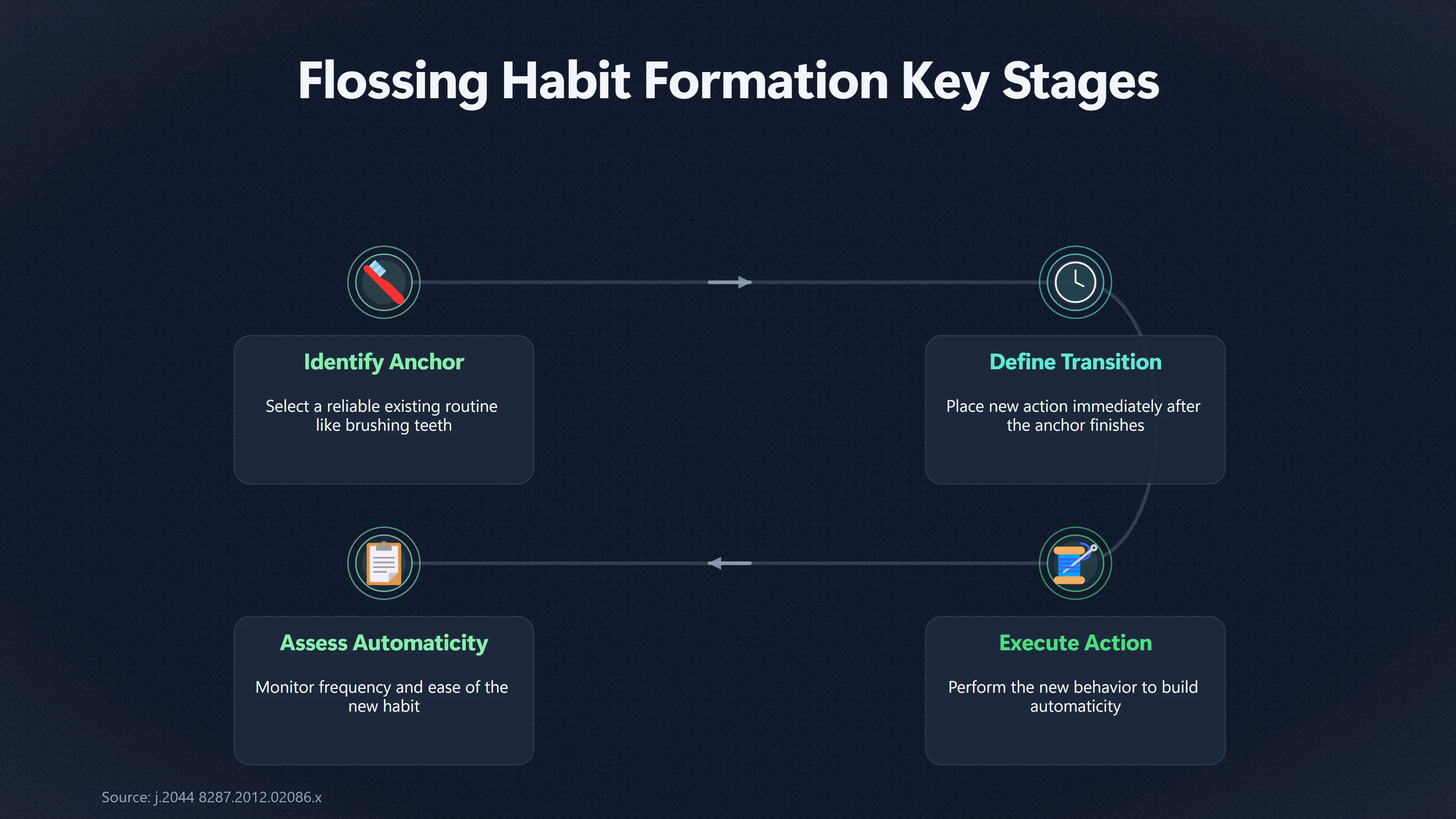
One unusually concrete experiment examined exactly where a new action should sit inside an established routine. Gaby Judah, Benjamin Gardner and Robert Aunger recruited 50 participants for a study of flossing habit formation. Everyone received an intervention intended to encourage flossing, but half were instructed to floss before brushing their teeth and half after brushing. Participants recorded their flossing for four weeks, and the researchers assessed automaticity after four weeks and again at an eight-month follow-up.[PubMed]pubmed.ncbi.nlm.nih.govForming a flossing habit: an exploratory study of the psychological determinants of habit formation - PubMed…
The after-brushing group tended to develop stronger flossing habits. At the eight-month follow-up they also reported stronger habits and more frequent flossing than those assigned to floss before brushing. Behavioural frequency mattered too, as did factors including previous flossing and positive attitudes, so the location of the new behaviour was not the only influence. And with only 50 participants, the study was exploratory rather than a definitive test of the best possible anchoring strategy. The authors themselves called for more rigorous research.[PubMed]pubmed.ncbi.nlm.nih.govForming a flossing habit: an exploratory study of the psychological determinants of habit formation - PubMed…
Nevertheless, the finding is revealing because “before brushing” and “after brushing” sound superficially equivalent. They are not necessarily equivalent psychologically.
Putting flossing after tooth-brushing gives the new action a clear preceding event: brushing finishes, then flossing begins. Asking someone to floss before brushing means the person must remember the new behaviour before starting the familiar action. The established routine cannot serve as the preceding trigger in quite the same way.
Researchers reviewing habit-based interventions have consequently highlighted the position of a new behaviour within an existing routine as an unresolved but potentially important design question. The flossing result suggests that routine structure matters, while the wider evidence is not yet strong enough to support a universal rule that “after” is always superior to “before”.[Taylor & Francis Online]tandfonline.comOpen source on tandfonline.com.
The practical lesson is narrower and more useful: choose a point where the old behaviour can clearly signal the beginning of the new one. “After I put my toothbrush down, I floss” has an identifiable transition. “Sometime during my bedtime routine, I floss” leaves more room for forgetting or postponement.
Routine anchors are useful, not uniquely superior
The appeal of anchoring can easily outrun the evidence. A daily routine is not necessarily a better cue than every alternative.
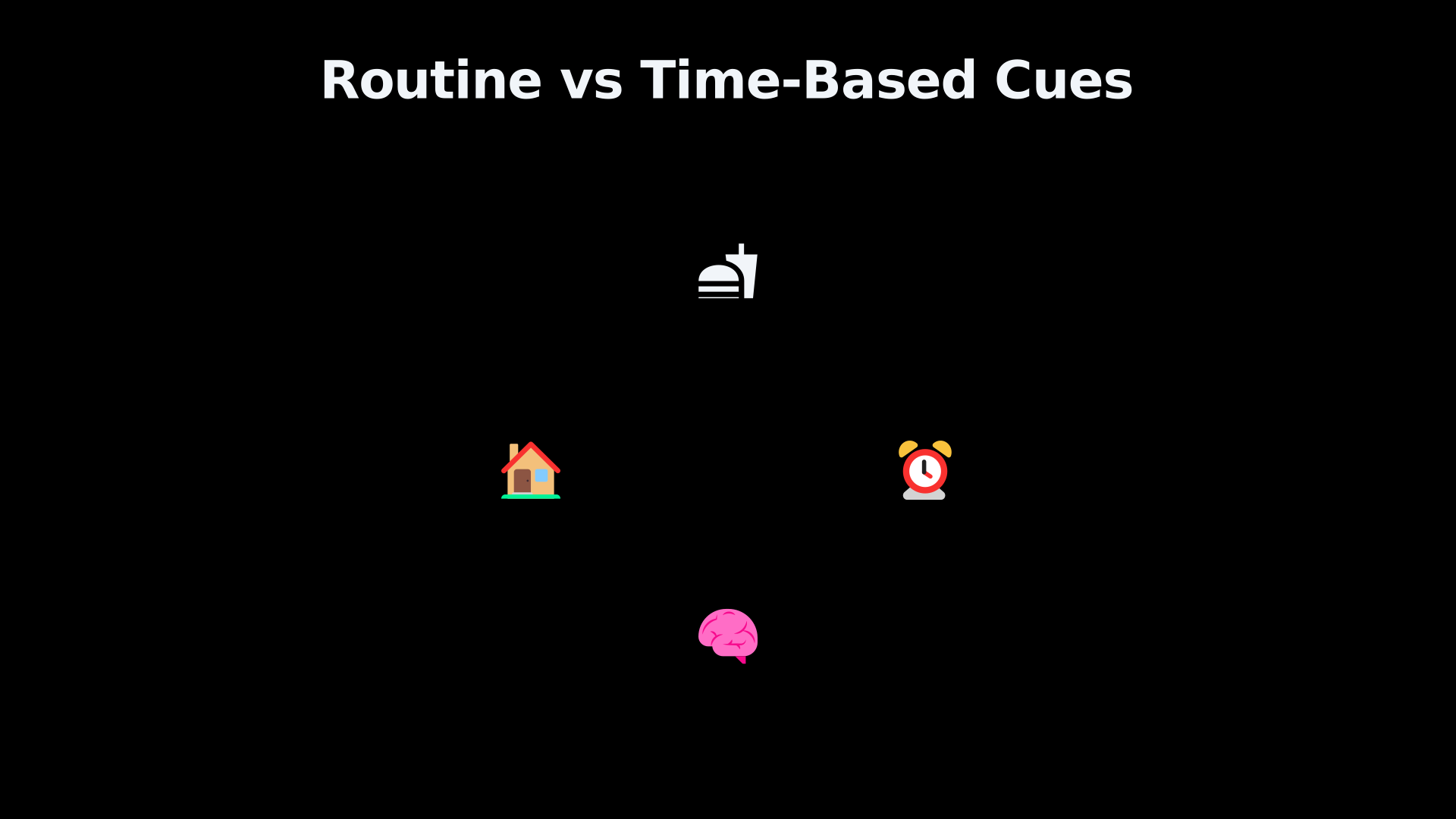
A randomised controlled trial led by Jan Keller tested routine-based against time-based cues directly. The researchers randomly assigned 192 adults to link a self-selected healthy eating behaviour either to a daily routine, such as after breakfast, or to a specific time, such as 9 am. Participants then completed daily assessments for 84 days. Among those who successfully developed habits, the estimated median time to peak automaticity was 59 days.[PubMed]pubmed.ncbi.nlm.nih.govHabit formation following routine-based versus time-based cue planning: A randomized controlled trial - PubMed…
Both groups increased their automaticity and enactment of their plans, but there was no significant overall advantage for routine-based cues over time-based cues. What strongly predicted automaticity was repeatedly carrying out the planned behaviour in response to the chosen cue.[PubMed]pubmed.ncbi.nlm.nih.govHabit formation following routine-based versus time-based cue planning: A randomized controlled trial - PubMed…
That finding sharpens the case for routine anchors rather than undermining it. The important question is not whether an existing routine possesses some special psychological power unavailable to a clock. It is whether the anchor gives you a clear, repeatable opportunity to enact the behaviour consistently.
For someone whose breakfast happens every morning but at different clock times, “after breakfast” may be the more robust cue. Someone who must perform an action at precisely 9 am may reasonably prefer a time cue. The anchor should serve the repetition rather than become a rule imposed for its own sake.
How to choose the right position in a routine
A useful routine anchor should pass three practical tests: it should happen reliably, be easy to recognise, and sit at a point where the new behaviour can realistically follow. The goal is to remove ambiguity from the transition between the established action and the new one.
Choose an anchor you already perform consistently. “After my first coffee” works only if that coffee reliably occurs. “After I go to the gym” is a weak daily anchor if gym visits happen sporadically. The cue does not have to occur at an identical minute, but repeated cue–response pairing depends on encountering it often enough to practise the relationship.[PubMed]pubmed.ncbi.nlm.nih.govHabit formation following routine-based versus time-based cue planning: A randomized controlled trial - PubMed…
Prefer an observable completion point. Finishing breakfast, putting the toothbrush down, arriving home or closing a laptop provides a more definite transition than broad states such as “when I have some free time”. An explicit boundary reduces the amount of interpretation required at the moment of action.
Put the behaviour where it fits operationally. The flossing study makes “after” attractive, but sequence should still make sense. If the new behaviour requires equipment in another room, takes 40 minutes when the anchor precedes an urgent commitment, or clashes with what normally happens next, the theoretical cue may be stable while the practical sequence is poor. Reviews of habit interventions explicitly identify the optimal position of a new behaviour within existing routines as an area where more research is needed.[Taylor & Francis Online]tandfonline.comOpen source on tandfonline.com.
Make the new action small enough to follow the cue consistently. An anchor cannot compensate for a behaviour that is routinely impractical. “After breakfast, I read one page” presents a very different repetition problem from “after breakfast, I study for two hours”. For habit formation, reliable enactment of the cue–behaviour plan is crucial; the Keller trial found repeated plan enactment to be a key predictor of automaticity.[PubMed]pubmed.ncbi.nlm.nih.govHabit formation following routine-based versus time-based cue planning: A randomized controlled trial - PubMed…
Judge the anchor by whether you actually use it. A randomised trial of app-based meditation provides a useful warning against assuming that a personalised anchor must be best. Participants were assigned to personalised anchors, fixed anchors or a control condition. The fixed-anchor group showed somewhat greater meditation persistence, while participants who actually adhered closely to their anchoring strategy showed the strongest persistence; almost all of those high adherers were using morning anchors. The study also experienced substantial attrition, so its results are suggestive rather than a universal prescription to anchor habits in the morning.[PubMed]pubmed.ncbi.nlm.nih.govOpen source on nih.gov.
In practice, this means testing the cue against ordinary life. If you repeatedly reach the end of the anchor and forget the intended behaviour, the cue may not be sufficiently noticeable. If you remember but repeatedly cannot act, the position may be inconvenient. If the anchor itself frequently disappears, it is not stable enough.

The anchor must survive real life
Routine anchoring works by exploiting regularity, which also reveals its main vulnerability: when the old routine disappears, the cue for the new behaviour may disappear with it.
This matters when working from home replaces commuting, weekends have different morning sequences, holidays remove the usual breakfast pattern, or a new job changes when the day begins. A behaviour that seems thoroughly established may partly depend on cues embedded in a particular routine. Habit researchers therefore emphasise that habitual responding is tied to the cues under which the cue–behaviour association was learned rather than representing a completely context-free ability to act automatically.[Compass]compass.onlinelibrary.wiley.comWhat is habit and how can it be used to change real‐world behaviour? Narrowing the theory‐reality gap - Gardner - 2024 - Social an…
The best anchor is consequently not always the most precise one. It is the most dependable cue that still fits the behaviour. “After I finish eating my first meal” may survive variations in schedule that “after breakfast at my kitchen table at 7.30 am” does not. Conversely, if greater specificity genuinely improves consistency without making the plan fragile, the narrower anchor may work better.
That is the central implementation principle behind routine anchoring. Do not merely place a desired behaviour somewhere near something you already do. Identify a reliable event, define the transition clearly, and repeatedly perform the new action when that event occurs. Existing routines are valuable because they give habit learning a dependable starting point; repetition is what turns that starting point into an increasingly automatic response.[PubMed]pubmed.ncbi.nlm.nih.govHabit formation following routine-based versus time-based cue planning: A randomized controlled trial - PubMed…
Amazon book picks
Further Reading
Books and field guides related to Why Existing Routines Make Powerful Habit Anchors. Use these as the next step if you want deeper reading beyond the article.
Tiny Habits
Improving your life is much easier than you think. Whether it’s losing weight, sleeping more, or restoring your work/life balance – the s...
Atomic Habits
Rating: 3.5/5 from 7 Google Books ratings
The #1 New York Times bestseller. Over 25 million copies sold! Translated into 60+ languages! Tiny Changes, Remarkable Results No matter...
The Power of Habit
Rating: 4.0/5 from 145 Google Books ratings
Duhigg takes us to the edge of scientific discoveries that explain why habits exist and how they can be changed. Distilling information i...
Good Habits, Bad Habits
'The world's leading expert on habits' - Matthew Syed, bestselling author of Black Box Thinking and Rebel IdeasWhat if you could harness...
eBay marketplace picks
Marketplace Samples
Live-tested eBay searches with available results related to this page.
Selected frommotivational desk sign oneBay.co.uk.
Current eBay listing
Motivational Desk Sitter gift shelf sign wooden handmade unique


Current eBay listing
Motivational Acrylic Desk Sign Positive Quote Gift Office Decor
Endnotes
1.
Source: compass.onlinelibrary.wiley.com
Link:https://compass.onlinelibrary.wiley.com/doi/full/10.1111/spc3.12975
Source snippet
What is habit and how can it be used to change real‐world behaviour? Narrowing the theory‐reality gap - Gardner - 2024 - Social an...
2.
Source: pubmed.ncbi.nlm.nih.gov
Link:https://pubmed.ncbi.nlm.nih.gov/33405284/
Source snippet
Habit formation following routine-based versus time-based cue planning: A randomized controlled trial - PubMed...
3.
Source: bpspsychub.onlinelibrary.wiley.com
Link:https://bpspsychub.onlinelibrary.wiley.com/doi/full/10.1348/014466607X267010
Source snippet
BPS Psych HubMechanisms of implementation intention effects: The role of goal intentions, self‐efficacy, and accessibility of plan compon...
4.
Source: doi.org
Link:https://doi.org/10.1080/10463283.2024.2334563
Source snippet
The when and how of planning: Meta-analysis of the scope and components of implementation intentions in 642 tests: European Review of...
5.
Source: discovery.ucl.ac.uk
Link:https://discovery.ucl.ac.uk/id/eprint/1468224/
Source snippet
UCL DiscoveryBeyond Self-Tracking and Reminders: Designing Smartphone Apps That Support Habit Formation - UCL DiscoveryApril 19, 2015...
Published: April 19, 2015
6.
Source: pmc.ncbi.nlm.nih.gov
Link:https://pmc.ncbi.nlm.nih.gov/articles/PMC9226889/
Source snippet
PubMed Central (PMC)Context Stability in Habit Building Increases Automaticity and Goal Attainment - PMCJune 10, 2022...
Published: June 10, 2022
7.
Source: pubmed.ncbi.nlm.nih.gov
Link:https://pubmed.ncbi.nlm.nih.gov/35756236/
Source snippet
Context Stability in Habit Building Increases Automaticity and Goal Attainment - PubMed...
8.
Source: pubmed.ncbi.nlm.nih.gov
Link:https://pubmed.ncbi.nlm.nih.gov/22989272/
Source snippet
Forming a flossing habit: an exploratory study of the psychological determinants of habit formation - PubMed...
9.
Source: bpspsychub.onlinelibrary.wiley.com
Link:https://bpspsychub.onlinelibrary.wiley.com/doi/10.1111/j.2044-8287.2012.02086.x
10.
Source: tandfonline.com
Link:https://www.tandfonline.com/doi/full/10.1080/08870446.2021.2003362
11.
Source: bpspsychub.onlinelibrary.wiley.com
Link:https://bpspsychub.onlinelibrary.wiley.com/doi/abs/10.1111/bjhp.12504
12.
Source: discovery.ucl.ac.uk
Link:https://discovery.ucl.ac.uk/id/eprint/10118622/
13.
Source: pubmed.ncbi.nlm.nih.gov
Link:https://pubmed.ncbi.nlm.nih.gov/34941558/
14.
Source: pmc.ncbi.nlm.nih.gov
Link:https://pmc.ncbi.nlm.nih.gov/articles/PMC13269919/
15.
Source: doi.org
Link:https://doi.org/10.1038/s42003-026-09994-0
16.
Source: bpspsychub.onlinelibrary.wiley.com
Link:https://bpspsychub.onlinelibrary.wiley.com/doi/10.1111/bjop.70065
17.
Source: tandfonline.com
Link:https://www.tandfonline.com/doi/full/10.1080/02699931.2025.2568555
18.
Source: pmc.ncbi.nlm.nih.gov
Link:https://pmc.ncbi.nlm.nih.gov/articles/PMC12586644/
19.
Source: pmc.ncbi.nlm.nih.gov
Link:https://pmc.ncbi.nlm.nih.gov/articles/PMC11920387/
20.
Source: pubmed.ncbi.nlm.nih.gov
Link:https://pubmed.ncbi.nlm.nih.gov/39702740/
21.
Source: pmc.ncbi.nlm.nih.gov
Link:https://pmc.ncbi.nlm.nih.gov/articles/PMC11641623/
22.
Source: pmc.ncbi.nlm.nih.gov
Link:https://pmc.ncbi.nlm.nih.gov/articles/PMC11297519/
23.
Source: pmc.ncbi.nlm.nih.gov
Link:https://pmc.ncbi.nlm.nih.gov/articles/PMC11243207/
24.
Source: compass.onlinelibrary.wiley.com
Link:https://compass.onlinelibrary.wiley.com/doi/abs/10.1111/spc3.12975
25.
Source: pmc.ncbi.nlm.nih.gov
Link:https://pmc.ncbi.nlm.nih.gov/articles/PMC11161714/
26.
Source: compass.onlinelibrary.wiley.com
Link:https://compass.onlinelibrary.wiley.com/doi/epdf/10.1111/spc3.12975
27.
Source: pubmed.ncbi.nlm.nih.gov
Link:https://pubmed.ncbi.nlm.nih.gov/38704776/
28.
Source: pubmed.ncbi.nlm.nih.gov
Link:https://pubmed.ncbi.nlm.nih.gov/37115610/
29.
Source: pmc.ncbi.nlm.nih.gov
Link:https://pmc.ncbi.nlm.nih.gov/articles/PMC10182474/
30.
Source: pmc.ncbi.nlm.nih.gov
Link:https://pmc.ncbi.nlm.nih.gov/articles/PMC9839633/
31.
Source: pmc.ncbi.nlm.nih.gov
Link:https://pmc.ncbi.nlm.nih.gov/articles/PMC9372943/
32.
Source: pubmed.ncbi.nlm.nih.gov
Link:https://pubmed.ncbi.nlm.nih.gov/35962435/
33.
Source: doi.org
Link:https://doi.org/10.1186/s12966-022-01343-8
34.
Source: pmc.ncbi.nlm.nih.gov
Link:https://pmc.ncbi.nlm.nih.gov/articles/PMC9274250/
35.
Source: pmc.ncbi.nlm.nih.gov
Link:https://pmc.ncbi.nlm.nih.gov/articles/PMC12318445/
36.
Source: tandfonline.com
Link:https://www.tandfonline.com/doi/full/10.1080/23311908.2022.2041277
37.
Source: doi.org
Link:https://doi.org/10.1080%2F17437199.2022.2034516
38.
Source: pmc.ncbi.nlm.nih.gov
Link:https://pmc.ncbi.nlm.nih.gov/articles/PMC8734923/
39.
Source: pubmed.ncbi.nlm.nih.gov
Link:https://pubmed.ncbi.nlm.nih.gov/34779335/
40.
Source: tandfonline.com
Link:https://www.tandfonline.com/doi/abs/10.1080/08870446.2021.2003362
41.
Source: pmc.ncbi.nlm.nih.gov
Link:https://pmc.ncbi.nlm.nih.gov/articles/PMC8800991/
42.
Source: pmc.ncbi.nlm.nih.gov
Link:https://pmc.ncbi.nlm.nih.gov/articles/PMC8388501/
43.
Source: pubmed.ncbi.nlm.nih.gov
Link:https://pubmed.ncbi.nlm.nih.gov/34438614/
44.
Source: pmc.ncbi.nlm.nih.gov
Link:https://pmc.ncbi.nlm.nih.gov/articles/PMC8149892/
45.
Source: pmc.ncbi.nlm.nih.gov
Link:https://pmc.ncbi.nlm.nih.gov/articles/PMC8250330/
46.
Source: doi.org
Link:https://doi.org/10.1111/bjhp.12504
47.
Source: pmc.ncbi.nlm.nih.gov
Link:https://pmc.ncbi.nlm.nih.gov/articles/PMC7106637/
48.
Source: pmc.ncbi.nlm.nih.gov
Link:https://pmc.ncbi.nlm.nih.gov/articles/PMC7042030/
49.
Source: pmc.ncbi.nlm.nih.gov
Link:https://pmc.ncbi.nlm.nih.gov/articles/PMC6591659/
50.
Source: pmc.ncbi.nlm.nih.gov
Link:https://pmc.ncbi.nlm.nih.gov/articles/PMC6302524/
51.
Source: ncbi.nlm.nih.gov
Link:https://www.ncbi.nlm.nih.gov/books/NBK512974/
52.
Source: pubmed.ncbi.nlm.nih.gov
Link:https://pubmed.ncbi.nlm.nih.gov/27120333/
53.
Source: pmc.ncbi.nlm.nih.gov
Link:https://pmc.ncbi.nlm.nih.gov/articles/PMC4847906/
54.
Source: bpspsychub.onlinelibrary.wiley.com
Link:https://bpspsychub.onlinelibrary.wiley.com/doi/10.1111/bjhp.12189
55.
Source: pmc.ncbi.nlm.nih.gov
Link:https://pmc.ncbi.nlm.nih.gov/articles/PMC4877177/
56.
Source: pmc.ncbi.nlm.nih.gov
Link:https://pmc.ncbi.nlm.nih.gov/articles/PMC4216661/
57.
Source: pmc.ncbi.nlm.nih.gov
Link:https://pmc.ncbi.nlm.nih.gov/articles/PMC4566897/
58.
Source: tandfonline.com
Link:https://www.tandfonline.com/doi/full/10.1080/17437199.2013.876238
59.
Source: bpspsychub.onlinelibrary.wiley.com
Title: j.2044 8287.2012.02086.x
Link:https://bpspsychub.onlinelibrary.wiley.com/doi/abs/10.1111/j.2044-8287.2012.02086.x
60.
Source: doi.org
Link:https://doi.org/10.1111/j.2044-8287.2012.02086.x
61.
Source: bpspsychub.onlinelibrary.wiley.com
Link:https://bpspsychub.onlinelibrary.wiley.com/doi/abs/10.1348/014466607X267010
62.
Source: pmc.ncbi.nlm.nih.gov
Link:https://pmc.ncbi.nlm.nih.gov/articles/PMC2821175/
63.
Source: ucl.ac.uk
Title: How long does it take to form a habit? | UCL News
Link:https://www.ucl.ac.uk/news/2009/aug/how-long-does-it-take-form-habit%20
64.
Source: bpspsychub.onlinelibrary.wiley.com
Link:https://bpspsychub.onlinelibrary.wiley.com/doi/10.1348/014466607X267010
65.
Source: pubmed.ncbi.nlm.nih.gov
Link:https://pubmed.ncbi.nlm.nih.gov/18096108/
66.
Source: pubmed.ncbi.nlm.nih.gov
Link:https://pubmed.ncbi.nlm.nih.gov/2280268/
67.
Source: pubmed.ncbi.nlm.nih.gov
Link:https://pubmed.ncbi.nlm.nih.gov/1942013/
68.
Source: doi.org
Link:https://doi.org/10.1136/bmjopen-2023-079401
69.
Source: discovery.ucl.ac.uk
Link:https://discovery.ucl.ac.uk/id/eprint/10144814/
70.
Source: discovery.ucl.ac.uk
Link:https://discovery.ucl.ac.uk/id/eprint/10094674/
71.
Source: discovery.ucl.ac.uk
Title: ucl.ac.uk Development and Validation of a Daily Habit Scale
Link:https://discovery.ucl.ac.uk/id/eprint/10153533
72.
Source: discovery.ucl.ac.uk
Link:https://discovery.ucl.ac.uk/id/eprint/1455696/
73.
Source: discovery.ucl.ac.uk
Link:https://discovery.ucl.ac.uk/id/eprint/10075586/
74.
Source: discovery.ucl.ac.uk
Link:https://discovery.ucl.ac.uk/1546254/
75.
Source: discovery.ucl.ac.uk
Title: ucl.ac.uk Habit and habitual behaviour
Link:https://discovery.ucl.ac.uk/id/eprint/10155780/
76.
Source: discovery.ucl.ac.uk
Link:https://discovery.ucl.ac.uk/id/eprint/10107821/
77.
Source: discovery.ucl.ac.uk
Link:https://discovery.ucl.ac.uk/id/eprint/10139326/
78.
Source: db.cngb.org
Link:https://db.cngb.org/data_resources/literature/35756236
79.
Source: surrey.ac.uk
Title: benjamin gardner
Link:https://www.surrey.ac.uk/people/benjamin-gardner
80.
Source: ouci.dntb.gov.ua
Link:https://ouci.dntb.gov.ua/en/works/7XJjALMl/
Additional References
81.
Source: nature.com
Link:https://www.nature.com/articles/s41598-025-94805-5
82.
Source: youtube.com
Title: TINY HABITS by B.J. Fogg – Animated Book
Link:https://www.youtube.com/watch?v=ijInaXZy0pU
Source snippet
"Habit stacking" habit cues anchor routines Habit Stacking: Bolt the New Onto the Sturdy...
83.
Source: youtube.com
Title: How To Actually Get Things Done (implementation intentions)
Link:https://www.youtube.com/watch?v=DUAB-BW-gZ8
Source snippet
The If Then Plan - implementation intentions...
84.
Source: researchgate.net
Link:https://www.researchgate.net/publication/356209185_Developing_habit-based_health_behaviour_change_interventions_twenty-one_questions_to_guide_future_research
85.
Source: researchgate.net
Link:https://www.researchgate.net/publication/348328187_Habit_formation_following_routine-based_versus_time-based_cue_planning_A_randomized_controlled_trial
86.
Source: researchgate.net
Link:https://www.researchgate.net/publication/355265703_Using_Personalized_Anchors_to_Establish_Routine_Meditation_Practice_with_a_Mobile_App_Randomized_Controlled_Trial_Preprint
87.
Source: researchgate.net
Link:https://www.researchgate.net/publication/381044449_What_is_habit_and_how_can_it_be_used_to_change_real-world_behaviour_Narrowing_the_theory-reality_gap
88.
Source: sciencedirect.com
Link:https://www.sciencedirect.com/science/article/abs/pii/S2352550925000260
89.
Source: sciencedirect.com
Link:https://www.sciencedirect.com/science/article/abs/pii/S0277953622008735
90.
Source: researchgate.net
Link:https://www.researchgate.net/publication/278405715_Beyond_Self-Tracking_and_Reminders_Designing_Smartphone_Apps_That_Support_Habit_Formation?_tp=eyJjb250ZXh0Ijp7InBhZ2UiOiJzY2llbnRpZmljQ29udHJpYnV0aW9ucyIsInByZXZpb3VzUGFnZSI6bnVsbCwic3ViUGFnZSI6bnVsbH19