Within Sleep and Mood
The Mood Loss You May Notice Least
Reduced enthusiasm, energy and attentiveness are among the most consistent emotional effects of insufficient sleep.
On this page
- Why positive affect falls reliably
- How reduced energy changes habit appeal
- Why negative mood is less consistent
Page outline Jump by section
Introduction
Insufficient sleep does not have to make you obviously miserable to alter your mood. One of its most reliable emotional effects is quieter: positive affect falls. Enthusiasm, interest, energy, attentiveness and the feeling of being ready to engage can all weaken, even when anger, sadness or other negative feelings change little.

That asymmetry is unusually well supported. A 2024 meta-analysis covering 154 experimental studies, 1,338 effect sizes and 5,717 participants found that total sleep deprivation, restricted sleep and fragmented sleep all reduced positive affect. Effects on negative affect and depressive symptoms were considerably more mixed.[PubMed]pubmed.ncbi.nlm.nih.govSleep loss and emotion: A systematic review and meta-analysis of over 50 years of experimental research - PubMedDecember 21, 2023… An earlier meta-analysis likewise estimated a large reduction in positive mood after sleep loss (Hedges’ g = −0.94), compared with a smaller increase in negative mood (g = 0.45).[PubMed]pubmed.ncbi.nlm.nih.govThe effect of sleep deprivation and restriction on mood, emotion, and emotion regulation: three meta-analyses in one - PubMedJune 1…
For behaviour change, that distinction matters. After poor sleep, the problem may not be “I feel terrible”. It may simply be that today’s workout, study session or other useful action has lost some of its pull.
Why positive affect falls so reliably
Researchers use positive affect more broadly than everyday words such as happiness. Common questionnaires capture states including being active, inspired, interested, excited, enthusiastic, energetic, alert, attentive, determined, confident and strong.[PubMed Central (PMC)]pmc.ncbi.nlm.nih.govOpen source on nih.gov. This makes the sleep-loss effect easier to recognise in ordinary life: it can look less like unhappiness and more like diminished psychological activation.
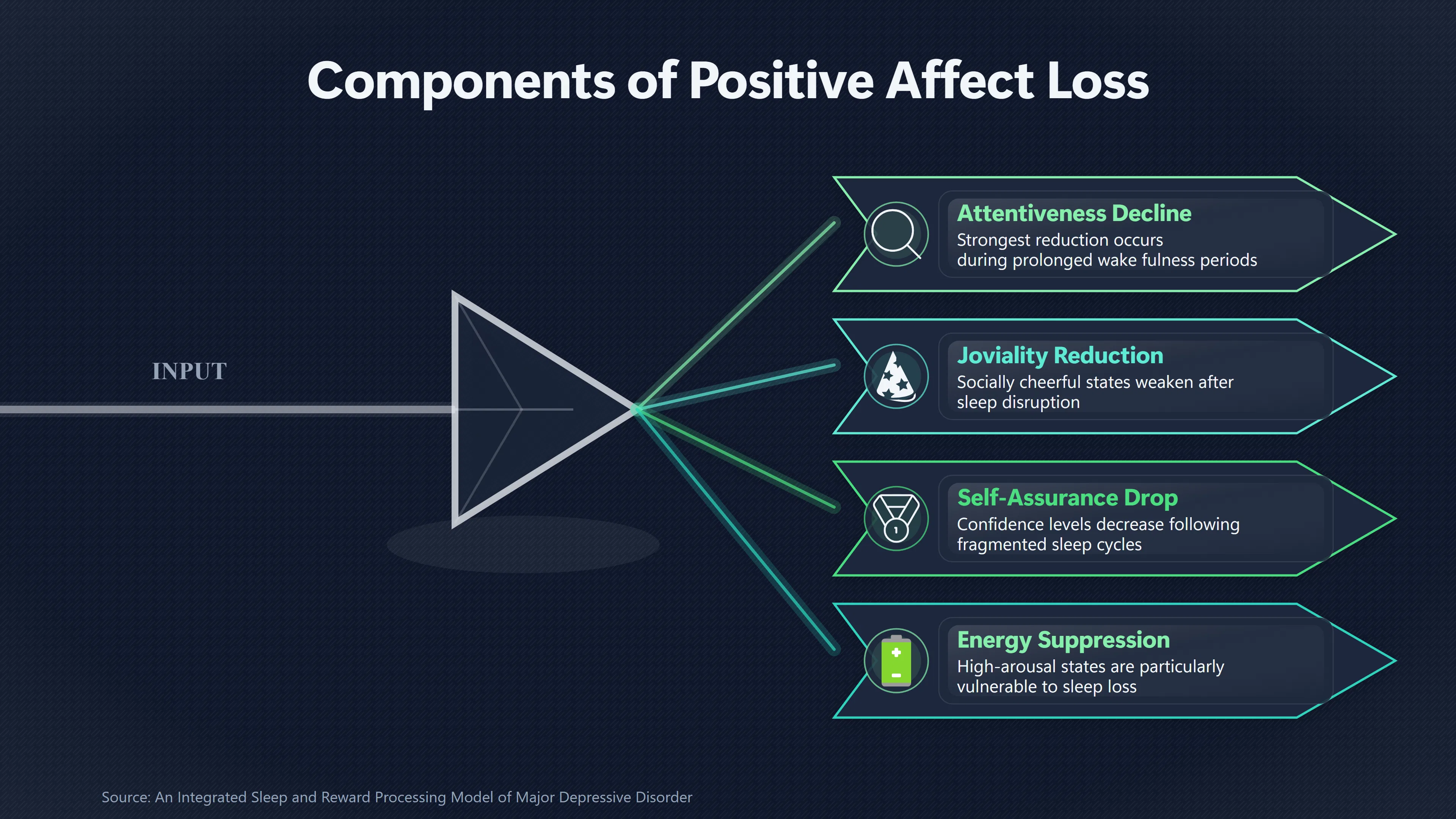
The strongest synthesis comes from the preregistered 2024 Psychological Bulletin review. Across experiments involving people aged 7 to 79, every major form of experimentally induced sleep loss reduced positive affect, with standardised mean differences ranging from −0.27 to −1.14. There was also evidence that high-arousal positive states were particularly vulnerable. In other words, insufficient sleep appears especially capable of suppressing the energetic end of feeling good rather than merely shifting people from happiness towards sadness.[PubMed]pubmed.ncbi.nlm.nih.govSleep loss and emotion: A systematic review and meta-analysis of over 50 years of experimental research - PubMedDecember 21, 2023…
The finding is not simply a consequence of combining many different mood outcomes into one score. Laboratory work that separated positive mood into more specific components found changes in attentiveness, general positive affect, joviality and self-assurance. During prolonged wakefulness, attentiveness showed a particularly strong decline with time awake. Chronic restriction to a six-hour nightly sleep opportunity also reduced attentiveness relative to a ten-hour opportunity.[PubMed]pubmed.ncbi.nlm.nih.govContrasting Effects of Sleep Restriction, Total Sleep Deprivation, and Sleep Timing on Positive and Negative Affect - PubMedAugust…
There is an important qualification. Effect sizes vary substantially between experiments, and different sleep manipulations are not interchangeable. The earlier 2021 meta-analysis found considerable heterogeneity in positive-mood effects and a methodological influence of study design. Its striking overall estimate of g = −0.94 should therefore not be read as a prediction of how much any particular person’s enthusiasm will decline after losing a particular number of hours.[OUP Academic]academic.oup.comOUP Academiceffect of sleep deprivation and restriction on mood, emotion, and emotion regulation: three meta-analyses in one | SLEEP | Ox… The robust conclusion is the direction of the effect, not a universal dose-response formula.
Broken sleep can drain positive mood
Total hours asleep are not the whole story. Experiments that repeatedly awaken participants provide an unusually clear demonstration of how disrupted sleep can selectively weaken positive feeling.
In one controlled study, healthy adults experienced a night of forced awakenings as well as a night of uninterrupted sleep. Positive-affect scores averaged 22.12 after the disrupted night compared with 26.44 after uninterrupted sleep, a medium-sized difference (d = −0.53). Negative affect, by contrast, did not differ significantly between conditions. The reduction extended across positive states including joviality, serenity, self-assurance and attentiveness.[OUP Academic]academic.oup.comOUP AcademicPartial Sleep Deprivation Attenuates the Positive Affective System: Effects Across Multiple Measurement Modalities | SLEEP |…
An earlier experiment compared several nights of forced awakenings with sleep loss produced by delaying bedtime. Although the groups experienced comparable reductions in total sleep time, people subjected to repeated awakenings showed a larger deterioration in positive mood. They also lost more slow-wave sleep, and the difference in slow-wave sleep statistically mediated the difference in positive mood.[PubMed]pubmed.ncbi.nlm.nih.govThe Effects of Sleep Continuity Disruption on Positive Mood and Sleep Architecture in Healthy Adults - PubMedNovember 1, 2015…
A subsequent crossover experiment strengthened the case that this is not merely a questionnaire effect. One night of disrupted sleep reduced self-reported positive affect, weakened the normal pain-inhibiting effect associated with positive emotion and altered attentional bias towards positive material, while corresponding negative-affect measures did not change significantly.[PubMed]pubmed.ncbi.nlm.nih.govOpen source on nih.gov.
These studies do not establish that loss of slow-wave sleep is the single mechanism behind every positive-mood effect of insufficient sleep. They do show something more practically useful: two nights containing a similar quantity of sleep need not have identical emotional consequences if their continuity and architecture differ.

How reduced energy changes habit appeal
The relevance to self-improvement becomes clearer when positive affect is treated as part of the motivational environment rather than simply as an emotional outcome. Many desirable behaviours have an immediate effort cost and a delayed payoff. Starting a difficult piece of work, practising a skill or preparing something rather than choosing the easiest alternative requires the action to feel sufficiently worth engaging with.
Experimental evidence suggests that sleep loss can change this calculation. In one study, 24 healthy young adults underwent three nights with either a three-hour or nine-hour sleep opportunity before making choices about how much effort to expend for rewards. Sleep restriction reduced willingness to invest cognitive effort, although motivation to invest physical effort was preserved. The researchers designed the task to distinguish this motivational change from participants simply being less capable of performing the task.[PubMed]pubmed.ncbi.nlm.nih.govPub Med Sleep Restriction Reduces Cognitive but Not Physical MotivationPub Med Sleep Restriction Reduces Cognitive but Not Physical Motivation
A smaller study following five nights with five hours in bed found meaningful individual differences too. Participants whose subjective motivation deteriorated more under sleep restriction also showed worse aspects of attentional performance.[PubMed Central (PMC)]pmc.ncbi.nlm.nih.govOpen source on nih.gov. These experiments caution against the sweeping claim that poor sleep destroys all motivation. Its effects can depend on the kind of effort involved and on the individual.
Positive mood may also matter for how rewards themselves are processed. In a crossover experiment of 42 healthy adults, forced awakenings did not produce a significant overall decline in reward learning. But the participants whose positive affect fell after disrupted sleep showed diminished reward learning, whereas those who preserved their positive affect showed the opposite pattern. Changes in negative affect did not explain this difference.[OUP Academic]academic.oup.comOpen source on oup.com. Because the groups were small and the finding concerned moderation rather than a universal effect, it should be regarded as suggestive rather than definitive.
Still, the pattern offers a useful explanation for an everyday experience: after insufficient sleep, an activity can remain objectively valuable while feeling subjectively less inviting. That is different from consciously deciding that the goal no longer matters.
The effect extends beyond solitary tasks
Positive-affect loss can also change the emotional rewards available from other people. In an experiment involving 53 young adults, participants were randomly assigned either four or eight hours in bed. After the restricted night, they reported less motivation to seek social connection and experienced less gratitude and connectedness when reflecting on somebody else’s generosity. Yet guilt and indebtedness — the negative social emotions measured — did not significantly increase.[OUP Academic]academic.oup.comOpen source on oup.com.
This is a particularly clear example of the positive-negative asymmetry. The social experience did not necessarily become unpleasant; it became less positively rewarding.
That distinction matters for behaviour change because many useful routines contain social reinforcement. Training with somebody, attending a class, studying with peers or simply receiving encouragement can make sustained effort more rewarding. The sleep-restriction study does not prove that sleep loss will make people abandon such habits, but it demonstrates a plausible pathway: inadequate sleep can reduce both the motivation to connect and some of the positive emotion generated when connection occurs.[OUP Academic]academic.oup.comOpen source on oup.com.
Why negative mood is less consistent
The familiar stereotype of sleep deprivation centres on irritability. Irritability certainly can occur, but experimental evidence does not support treating increased negative mood as the mirror image of reduced positive mood.
The 2021 meta-analysis found both effects, but they differed substantially in magnitude: g = −0.94 for positive mood versus g = 0.45 for negative mood. Moreover, total sleep deprivation produced larger negative-mood effects than partial sleep restriction, whereas the magnitude of positive-mood reduction did not significantly differ between those two categories in that analysis.[PubMed]pubmed.ncbi.nlm.nih.govThe effect of sleep deprivation and restriction on mood, emotion, and emotion regulation: three meta-analyses in one - PubMedJune 1…
The larger 2024 synthesis made the distinction even clearer. All three forms of sleep loss it examined — total deprivation, partial restriction and fragmentation — reliably reduced positive affect. Anxiety symptoms also increased, but results for general negative affect and depressive symptoms depended on the sleep manipulation and other study characteristics.[PubMed]pubmed.ncbi.nlm.nih.govSleep loss and emotion: A systematic review and meta-analysis of over 50 years of experimental research - PubMedDecember 21, 2023…
Individual experiments show why an average statement such as “poor sleep worsens mood” can obscure what actually happens. After one night of forced awakenings, positive affect fell substantially while negative affect was statistically unchanged.[OUP Academic]academic.oup.comOUP AcademicPartial Sleep Deprivation Attenuates the Positive Affective System: Effects Across Multiple Measurement Modalities | SLEEP |… In a week-long sleep-restriction experiment, attentiveness and aspects of general positive affect declined, whereas restricting sleep to six hours produced no overall effect on the negative mood dimensions examined.[PubMed Central (PMC)]pmc.ncbi.nlm.nih.govOpen source on nih.gov. And after a four-hour sleep opportunity, young adults showed less gratitude and connectedness without significantly greater guilt or indebtedness.[OUP Academic]academic.oup.comOpen source on oup.com.
This does not mean that insufficient sleep leaves negative emotions untouched. The 2024 synthesis found increased anxiety, while prolonged or more severe sleep deprivation can increase particular negative states.[PubMed]pubmed.ncbi.nlm.nih.govSleep loss and emotion: A systematic review and meta-analysis of over 50 years of experimental research - PubMedDecember 21, 2023… The more precise conclusion is that loss of positive feeling generalises across sleep-loss paradigms more consistently than a broad rise in negative feeling does.

The mood loss you may notice least
For someone attempting behaviour change, positive-affect loss is easy to misinterpret because it does not necessarily announce itself as distress. You can be neither particularly sad nor angry and still be less alert, interested, energetic or enthusiastic than you would have been after adequate sleep.
That creates a useful distinction between evaluating a goal and evaluating today’s feeling about the goal. If a valued activity suddenly seems unusually flat after restricted or fragmented sleep, experimental evidence gives good reason not to assume that the activity itself has become less worthwhile. Sleep loss may have altered the positive emotional state from which the choice is being made.[PubMed]pubmed.ncbi.nlm.nih.govSleep loss and emotion: A systematic review and meta-analysis of over 50 years of experimental research - PubMedDecember 21, 2023…
The evidence does not justify reducing every lapse in motivation to sleep, nor does it show that enthusiasm must fall after every poor night. Individual responses vary, sleep-loss protocols differ, and laboratory studies cannot reproduce the full emotional complexity of everyday life. A 2026 meta-analysis of 118 intensive longitudinal studies nevertheless adds real-world support to the experimental picture: within individuals, better subjective sleep quality and longer sleep duration predicted better next-day affect, although associations tended to be stronger for self-reported than objectively measured sleep.[ScienceDirect]sciencedirect.comOpen source on sciencedirect.com.
The practical lesson is therefore modest but important. During behaviour change, insufficient sleep can remove some of the positive emotional fuel that normally makes effort feel engaging. The absence of obvious bad mood is not evidence that sleep has had no emotional effect. Sometimes the clearest consequence is precisely what is missing: interest, attentiveness, energy and enthusiasm.
Amazon book picks
Further Reading
Books and field guides related to The Mood Loss You May Notice Least. Use these as the next step if you want deeper reading beyond the article.
Why We Sleep
"Sleep is one of the most important but least understood aspects of our life, wellness, and longevity ... An explosion of scientific disc...
The Sleep Solution
With cutting-edge sleep science and time-tested techniques, The Sleep Solution will help anyone achieve healthy sleep and eliminate pills...
The Sleep Revolution
JP Morgan’s Best Summer Read 2018 We are in the midst of a sleep deprivation crisis, and this has profound consequences – on our health,...
The Promise of Sleep
Sleep better, live longer with the groundbreaking information and step-by-step program in this revolutionary book. Healthful sleep has be...
eBay marketplace picks
Marketplace Samples
Live-tested eBay searches with available results related to this page.
Selected frommotivational poster oneBay.co.uk.



Endnotes
1.
Source: academic.oup.com
Link:https://academic.oup.com/sleep/article/47/Supplement_1/A79/7654101
Source snippet
OUP Academic0183 Sleep Loss and Emotion: A Systematic Review and Meta-Analysis of over Fifty Years of Experimental Research | SLEEP | Oxf...
2.
Source: academic.oup.com
Link:https://academic.oup.com/sleep/article/44/6/zsaa289/6053003?login=false
Source snippet
OUP Academiceffect of sleep deprivation and restriction on mood, emotion, and emotion regulation: three meta-analyses in one | SLEEP | Ox...
3.
Source: academic.oup.com
Link:https://academic.oup.com/sleep/article/40/1/zsw017/2739500
Source snippet
OUP AcademicPartial Sleep Deprivation Attenuates the Positive Affective System: Effects Across Multiple Measurement Modalities | SLEEP |...
4.
Source: academic.oup.com
Link:https://academic.oup.com/sleep/article/42/5/zsz026/5423962
5.
Source: academic.oup.com
Link:https://academic.oup.com/sleep/article/46/6/zsac265/6798913
6.
Source: sciencedirect.com
Link:https://www.sciencedirect.com/science/article/pii/S1087079226000043
7.
Source: sciencedirect.com
Link:https://www.sciencedirect.com/science/article/abs/pii/S1389945726003953
8.
Source: academic.oup.com
Link:https://academic.oup.com/abm/article/59/1/kaaf050/8173289
9.
Source: academic.oup.com
Link:https://academic.oup.com/sleep/article/44/12/zsab190/6330595
10.
Source: academic.oup.com
Link:https://academic.oup.com/sleep/article/44/12/zsab186/6329135
11.
Source: academic.oup.com
Link:https://academic.oup.com/sleep/article/44/6/zsaa289/6053003
12.
Source: sciencedirect.com
Title: An Integrated Sleep and Reward Processing Model of Major Depressive Disorder
Link:https://www.sciencedirect.com/science/article/pii/S0005789419301479
13.
Source: sciencedirect.com
Link:https://www.sciencedirect.com/science/article/pii/S0165032718306475
14.
Source: academic.oup.com
Link:https://academic.oup.com/sleep/article-abstract/40/suppl_1/A56/3781336
15.
Source: academic.oup.com
Link:https://academic.oup.com/abm/article/51/3/402/4564155
16.
Source: academic.oup.com
Link:https://academic.oup.com/sleep/article-abstract/38/11/1735/2662282
17.
Source: sciencedirect.com
Link:https://www.sciencedirect.com/science/article/abs/pii/S0925492714001772
18.
Source: sciencedirect.com
Link:https://www.sciencedirect.com/science/article/pii/S1389945714001579
19.
Source: sciencedirect.com
Link:https://www.sciencedirect.com/science/article/pii/S1054139X14000068
20.
Source: pubmed.ncbi.nlm.nih.gov
Link:https://pubmed.ncbi.nlm.nih.gov/38127505/
Source snippet
Sleep loss and emotion: A systematic review and meta-analysis of over 50 years of experimental research - PubMedDecember 21, 2023...
Published: December 21, 2023
21.
Source: pubmed.ncbi.nlm.nih.gov
Link:https://pubmed.ncbi.nlm.nih.gov/33367799/
Source snippet
The effect of sleep deprivation and restriction on mood, emotion, and emotion regulation: three meta-analyses in one - PubMedJune 1...
22.
Source: pmc.ncbi.nlm.nih.gov
Link:https://pmc.ncbi.nlm.nih.gov/articles/8193556/
23.
Source: pmc.ncbi.nlm.nih.gov
Link:https://pmc.ncbi.nlm.nih.gov/articles/PMC9433122/
24.
Source: pubmed.ncbi.nlm.nih.gov
Link:https://pubmed.ncbi.nlm.nih.gov/36062257/
Source snippet
Contrasting Effects of Sleep Restriction, Total Sleep Deprivation, and Sleep Timing on Positive and Negative Affect - PubMedAugust...
25.
Source: pubmed.ncbi.nlm.nih.gov
Link:https://pubmed.ncbi.nlm.nih.gov/26085289/
Source snippet
The Effects of Sleep Continuity Disruption on Positive Mood and Sleep Architecture in Healthy Adults - PubMedNovember 1, 2015...
Published: November 1, 2015
26.
Source: pmc.ncbi.nlm.nih.gov
Link:https://pmc.ncbi.nlm.nih.gov/articles/PMC4813351/
27.
Source: pubmed.ncbi.nlm.nih.gov
Link:https://pubmed.ncbi.nlm.nih.gov/28364467/
28.
Source: pmc.ncbi.nlm.nih.gov
Link:https://pmc.ncbi.nlm.nih.gov/articles/PMC6084750/
29.
Source: pubmed.ncbi.nlm.nih.gov
Title: Pub Med Sleep Restriction Reduces Cognitive but Not Physical Motivation
Link:https://pubmed.ncbi.nlm.nih.gov/36394069/
30.
Source: pmc.ncbi.nlm.nih.gov
Link:https://pmc.ncbi.nlm.nih.gov/articles/PMC9642807/
31.
Source: pmc.ncbi.nlm.nih.gov
Link:https://pmc.ncbi.nlm.nih.gov/articles/PMC8286723/
32.
Source: pubmed.ncbi.nlm.nih.gov
Link:https://pubmed.ncbi.nlm.nih.gov/34285617/
33.
Source: pubmed.ncbi.nlm.nih.gov
Link:https://pubmed.ncbi.nlm.nih.gov/30927744/
34.
Source: pubmed.ncbi.nlm.nih.gov
Link:https://pubmed.ncbi.nlm.nih.gov/41570755/
35.
Source: pmc.ncbi.nlm.nih.gov
Link:https://pmc.ncbi.nlm.nih.gov/articles/PMC12208346/
36.
Source: pmc.ncbi.nlm.nih.gov
Link:https://pmc.ncbi.nlm.nih.gov/articles/PMC11280943/
37.
Source: pmc.ncbi.nlm.nih.gov
Link:https://pmc.ncbi.nlm.nih.gov/articles/PMC10838359/
38.
Source: pubmed.ncbi.nlm.nih.gov
Link:https://pubmed.ncbi.nlm.nih.gov/36331805/
39.
Source: pmc.ncbi.nlm.nih.gov
Link:https://pmc.ncbi.nlm.nih.gov/articles/PMC9700806/
40.
Source: pubmed.ncbi.nlm.nih.gov
Link:https://pubmed.ncbi.nlm.nih.gov/34223608/
41.
Source: pmc.ncbi.nlm.nih.gov
Link:https://pmc.ncbi.nlm.nih.gov/articles/PMC8217716/
42.
Source: pmc.ncbi.nlm.nih.gov
Link:https://pmc.ncbi.nlm.nih.gov/articles/PMC8193556/
43.
Source: pubmed.ncbi.nlm.nih.gov
Link:https://pubmed.ncbi.nlm.nih.gov/32897097/
44.
Source: pmc.ncbi.nlm.nih.gov
Link:https://pmc.ncbi.nlm.nih.gov/articles/PMC7704897/
45.
Source: pubmed.ncbi.nlm.nih.gov
Link:https://pubmed.ncbi.nlm.nih.gov/31072557/
46.
Source: pmc.ncbi.nlm.nih.gov
Link:https://pmc.ncbi.nlm.nih.gov/articles/PMC6519913/
47.
Source: pmc.ncbi.nlm.nih.gov
Link:https://pmc.ncbi.nlm.nih.gov/articles/PMC6172954/
48.
Source: pmc.ncbi.nlm.nih.gov
Link:https://pmc.ncbi.nlm.nih.gov/articles/PMC5739917/
49.
Source: pmc.ncbi.nlm.nih.gov
Link:https://pmc.ncbi.nlm.nih.gov/articles/PMC4791211/
50.
Source: pubmed.ncbi.nlm.nih.gov
Link:https://pubmed.ncbi.nlm.nih.gov/28364467/?duplicate_of=27634802
51.
Source: pubmed.ncbi.nlm.nih.gov
Link:https://pubmed.ncbi.nlm.nih.gov/23729933/
52.
Source: pubmed.ncbi.nlm.nih.gov
Link:https://pubmed.ncbi.nlm.nih.gov/23331712/
53.
Source: pubmed.ncbi.nlm.nih.gov
Link:https://pubmed.ncbi.nlm.nih.gov/22188424/
54.
Source: pubmed.ncbi.nlm.nih.gov
Link:https://pubmed.ncbi.nlm.nih.gov/21058849/
55.
Source: pubmed.ncbi.nlm.nih.gov
Link:https://pubmed.ncbi.nlm.nih.gov/32468730/
Additional References
56.
Source: youtube.com
Link:https://www.youtube.com/watch?v=ZpUe3eWKeS4
Source snippet
Matthew Walker sleep emotional regulation mood Dr. Matt Walker: Improve Sleep to Boost Mood & Emotional Regulation | Huberman Lab Guest S...
57.
Source: youtube.com
Link:https://www.youtube.com/watch?v=ajM6FMY0_MY
Source snippet
How Light Impacts Your [Sleep and Mood]({{ 'sleep-and-mood/' | relative_url }}): Easy Daily Tactics from Dr. Andrew Huberman...
58.
Source: youtube.com
Link:https://www.youtube.com/watch?v=S_SrHS8FvMM
Source snippet
How sleep affects your emotions | Sleeping with Science, a TED series...
59.
Source: youtube.com
Title: How Better Sleep Changes Your Mood, Mind, and Ability to Feel Joy
Link:https://www.youtube.com/watch?v=PDndx5E4uPY
Source snippet
Sleep deprivation may be correlated with increased impulsivity and psychiatric disorders...
60.
Source: youtube.com
Title: How sleep affects your emotions | Sleeping with Science, a TED series
Link:https://www.youtube.com/watch?v=6F8wFkScnME
Source snippet
How Better Sleep Changes Your Mood, Mind, and Ability to Feel Joy...
61.
Source: researchgate.net
Link:https://www.researchgate.net/publication/306447674_Partial_Sleep_Deprivation_Attenuates_the_Positive_Affective_System_Effects_Across_Multiple_Measurement_Modalities
62.
Source: citedrive.com
Link:https://www.citedrive.com/en/discovery/0183-sleep-loss-and-emotion-a-systematic-review-and-meta-analysis-of-over-fifty-years-of-experimental-research/
63.
Source: researchgate.net
Link:https://www.researchgate.net/publication/379963516_0183_Sleep_Loss_and_Emotion_A_Systematic_Review_and_Meta-Analysis_of_over_Fifty_Years_of_Experimental_Research
64.
Source: doaj.org
Link:https://doaj.org/article/e7a831afd85b4122a769cdcaea049a08
65.
Source: diva-portal.org
Link:https://www.diva-portal.org/smash/record.jsf?pid=diva2%3A1520485