Within Consistency
Why Doing It in the Same Context Helps
Repeating a behavior in a similar setting can strengthen the link between the situation and the action.
On this page
- What context stability means in everyday habit building
- Evidence linking stable contexts with stronger automaticity
- How timing, location, and preceding events can anchor repetition
Page outline Jump by section
Introduction
Stable contexts make habits easier to repeat because they allow the same surroundings, moments or preceding events to become reliable signals for the same action. When a behaviour repeatedly follows a recognisable cue — brushing teeth after breakfast, reading after getting into bed, or walking after lunch — the brain can learn an association between that situation and the response. With enough repetition, encountering the cue can begin to prompt the behaviour with less deliberate remembering and decision-making. This cue–response learning is central to psychological accounts of habit.[PubMed]pubmed.ncbi.nlm.nih.govPub Med Psychology of HabitPsychology of Habit - PubMedSeptember 10, 2015…
That helps explain why consistency matters more than creating ideal conditions every time. The useful consistency is not simply an uninterrupted calendar streak. It is repeated pairing of a behaviour with a sufficiently recognisable context. Evidence from longitudinal habit-building research suggests that greater context stability is associated with stronger automaticity and better repetition, although the evidence base remains smaller and less definitive than popular habit advice sometimes implies.[PubMed Central (PMC)]pmc.ncbi.nlm.nih.govPubMed Central (PMC)Context Stability in Habit Building Increases Automaticity and Goal Attainment - PMCJune 10, 2022…
What a stable context actually means
In habit research, “context” is broader than physical location. It can include where you are, roughly when something happens, what you have just done, which objects are present and aspects of the social environment. A context is therefore better understood as the collection of cues surrounding an action rather than merely the room in which it occurs. Habit researchers have long argued that responses become associated with contextual features that repeatedly accompany their performance.[Sage Journals]journals.sagepub.comSage Journals Habits—A Repeat PerformanceSage JournalsHabits—A Repeat Performance - David T. Neal, Wendy Wood, Jeffrey M. Quinn, 2006…
Imagine someone trying to establish ten minutes of reading each day. “Read whenever I find time” allows the behaviour to occur in many different circumstances. Monday’s reading might happen on the train, Tuesday’s at a desk and Wednesday’s on the sofa at an unrelated time. The behaviour is repeated, but no single situation consistently predicts it.
“Read for ten minutes after getting into bed”, by contrast, repeatedly pairs reading with a recognisable event and place. Getting into bed can gradually become associated with picking up the book. The important difference is not that bedtime is intrinsically superior. It is that the cue is repeatedly available and connected to the same response.
This is why context stability should not be confused with rigid scheduling. A context can be stable even when the clock time varies. “After I finish breakfast” may occur at 7.15 on one day and 8.00 on another while retaining the same relationship between an existing routine and the new behaviour. Researchers commonly distinguish such event-based cues from purely time-based cues, although evidence is not yet strong enough to declare one cue type universally superior. A recent discussion of the literature notes that some physical-activity findings favour consistency in preceding events rather than time of day, while a dietary habit study found both event- and time-based approaches capable of supporting habit development.[UCL Discovery]discovery.ucl.ac.ukUCL Discovery Psychology & HealthUCL Discovery Psychology & Health
Why repetition in the same setting builds automaticity
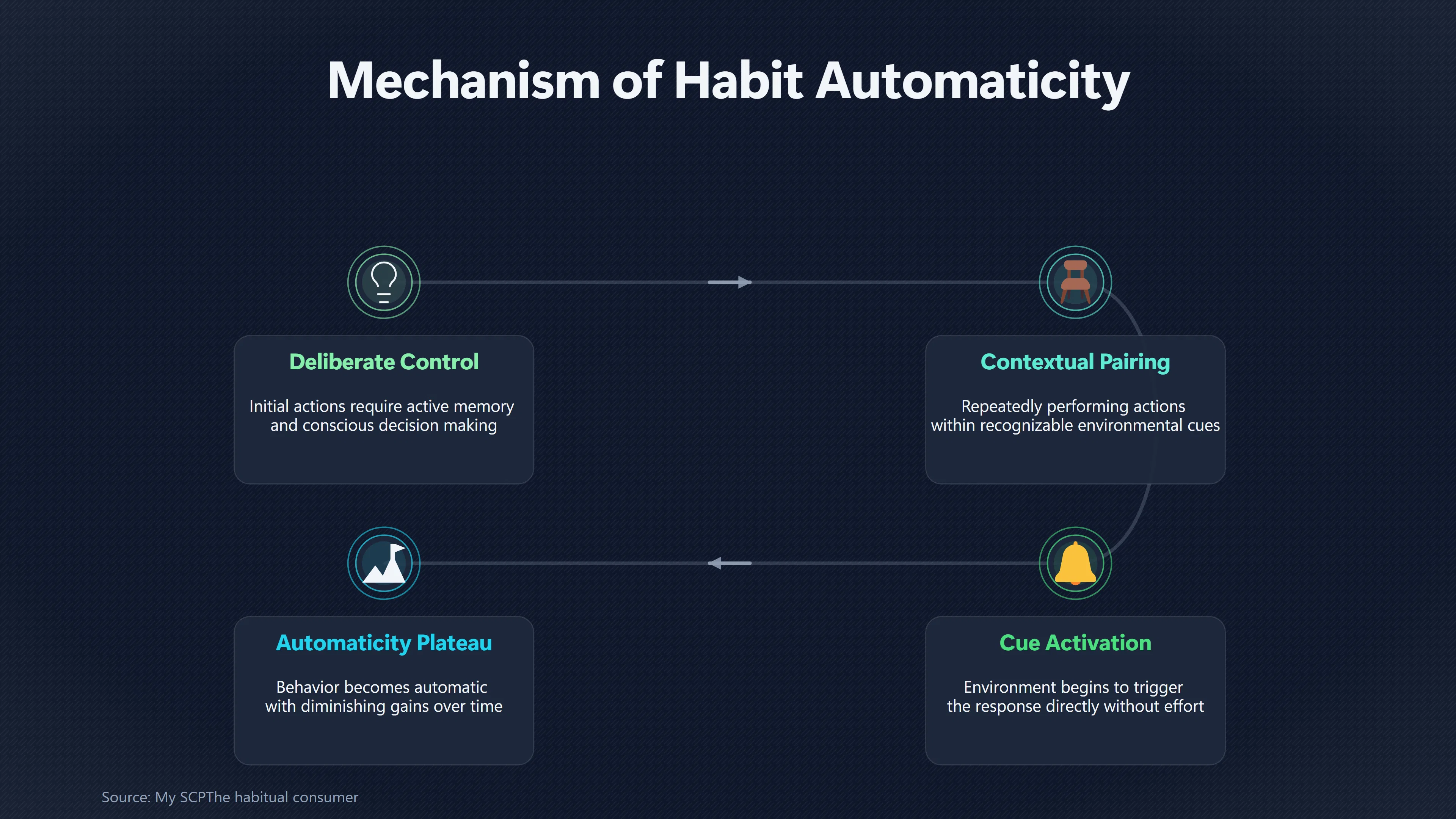
The key mechanism is cue–response association. Early in habit formation, carrying out an intended behaviour usually requires deliberate control: remembering the intention, recognising an opportunity and deciding to act. Repeating the action in connection with the same cues gives those cues predictive value. Psychological theories of habit propose that, through repeated experience, encountering the context can increasingly activate the associated response directly.[PubMed]pubmed.ncbi.nlm.nih.govPub Med Habits and Goals in Human Behavior: Separate but Interacting SystemsPub Med Habits and Goals in Human Behavior: Separate but Interacting Systems
This is different from merely becoming skilled at an activity. A person can become highly proficient at doing press-ups without automatically starting them each morning. Habit formation concerns, in part, the transition from “I need to remember to do this” towards the situation itself helping to bring the action to mind. Strong habits consequently reduce how much behavioural control has to come from an active decision on every occasion.[PubMed]pubmed.ncbi.nlm.nih.govPub Med Psychology of HabitPsychology of Habit - PubMedSeptember 10, 2015…
The classic real-world study by Phillippa Lally and colleagues illustrates the process. Ninety-six participants selected an eating, drinking or activity behaviour and were asked to perform it daily in the same context, such as after breakfast, for 12 weeks. Automaticity generally increased with repetition along a curved trajectory: early repetitions could produce substantial gains, while later gains became progressively smaller as automaticity approached a plateau. Among participants whose data fitted the model, the estimated time to reach 95% of their eventual automaticity ranged from 18 to 254 days.[Wiley Online Library]onlinelibrary.wiley.comOpen source on wiley.com.
The study cannot by itself tell us how the same behaviours would have developed in constantly changing contexts, because stable contextual repetition was built into its design. But it established an important real-world pattern: automaticity can develop gradually when a behaviour is repeatedly performed following a consistent cue.
More direct evidence arrived from Marco Stojanovic and colleagues in 2022. Their first study followed 95 university students over six weeks and covered 2,482 study-habit repetitions. Participants were assigned either to keep the place and time of their study habit stable or to vary those circumstances. A second study analysed 308 habits and 2,368 repetitions recorded by 218 users of a habit-building app. Across both datasets, greater context stability predicted greater automaticity and better attainment of repetition goals. The relationship between context stability and goal attainment was also partly mediated by automaticity.[PubMed Central (PMC)]pmc.ncbi.nlm.nih.govPubMed Central (PMC)Context Stability in Habit Building Increases Automaticity and Goal Attainment - PMCJune 10, 2022…
That last result is particularly useful for understanding the mechanism. A stable context did not merely provide a convenient diary slot. The findings were consistent with the idea that repeated contextual pairing helped behaviour become more automatic, which in turn contributed to continued performance. The authors also argued that context may support not only habit instigation — getting started — but smoother execution once the behaviour has begun.[Frontiers]frontiersin.orgOpen source on frontiersin.org.
Timing, location and preceding events can all become anchors
There is no requirement that every habit be tied to the same kind of cue. The practical question is which feature of everyday life can reliably precede the behaviour.
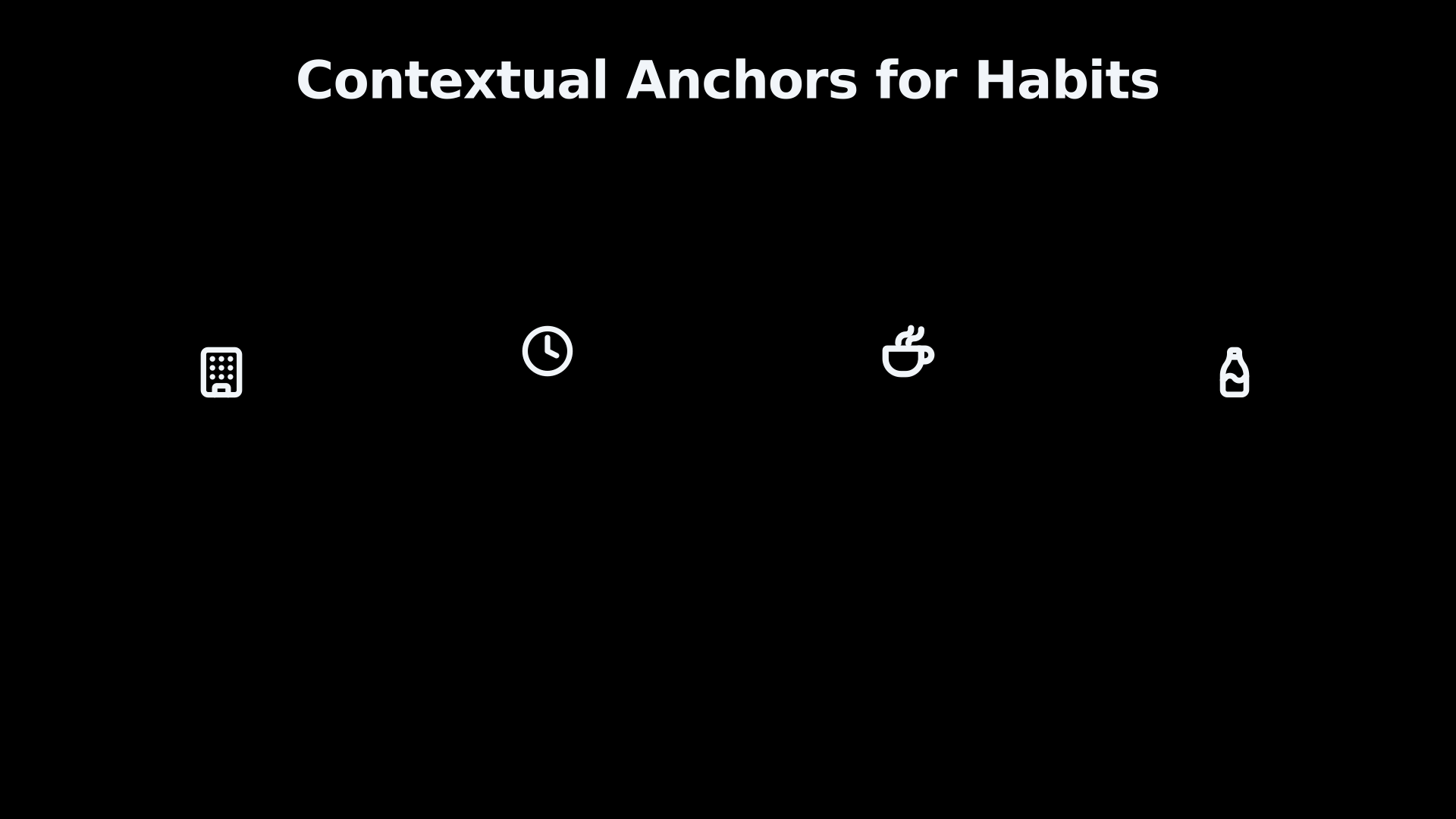
Location can work because returning to the same physical environment repeatedly restores many cues at once. Sitting at a particular desk may cue study; entering a kitchen after work may cue preparing a particular snack. Research on habitual behaviour has repeatedly identified location as one of the contextual features capable of triggering well-learned responses.[ScienceDirect]sciencedirect.comOpen source on sciencedirect.com.
Time or part of the day can also provide regularity, particularly when daily schedules are predictable. Yet “at 7.00 pm” requires noticing that it is 7.00 pm. This is one reason researchers have proposed that salient events may sometimes make better anchors than clock times: the event itself announces the opportunity. The empirical picture is mixed, however, so the sensible conclusion is not that time cues are ineffective but that recognisable events may be easier to encounter without active clock-monitoring.[PubMed Central (PMC)]pmc.ncbi.nlm.nih.govOpen source on nih.gov.
Preceding actions or routine events can create especially natural sequences. “Floss after brushing my teeth”, “take medication after breakfast” or “write three sentences after making morning coffee” attaches the new response to something that already happens. An exploratory study of people starting a vitamin-taking routine found participants using combinations of routine events, locations and objects as remembering cues; examples included taking a vitamin after morning coffee while preparing to leave home, or after brushing teeth in the bathroom.[PubMed Central (PMC)]pmc.ncbi.nlm.nih.govOpen source on nih.gov.
These cues can overlap. A useful context may be “after breakfast, at the kitchen table, with the vitamins beside the kettle”, not one isolated stimulus. Research distinguishes a specific cue from the broader context, which may contain numerous cues simultaneously. Exactly which elements of a complex real-world context become responsible for triggering a particular habit is still an open research question.[UCL Discovery]discovery.ucl.ac.ukUCL Discovery Psychology & HealthUCL Discovery Psychology & Health
Context changes reveal what stability was doing
One of the clearest ways to see the importance of context is to observe what happens when familiar circumstances disappear. If repetition alone controlled behaviour, moving house, changing workplace or altering a commute should make relatively little difference. Instead, substantial context changes can weaken established patterns and make behaviour more open to reconsideration — a phenomenon known as habit discontinuity.[ScienceDirect]sciencedirect.comContext change and travel mode choice: Combining the habit discontinuity and self-activation hypotheses - ScienceDirect…
A large UK analysis provides a useful real-world example. Researchers examined commuting behaviour in 18,053 participants from the Understanding Society survey. Environmental attitudes were associated with lower car use among people who had recently moved home, while that relationship became weaker as people remained longer at the same address. The researchers interpreted the pattern as evidence that relocation disrupts established contextual cues, temporarily reducing habitual control and allowing intentions and values more influence over behaviour.[PubMed]pubmed.ncbi.nlm.nih.govOpen source on nih.gov.
Other relocation research points in the same direction. A field experiment involving 800 households found that an intervention encouraging environmentally sustainable behaviours was more effective among recent movers than among comparable non-movers, with the reported “window of opportunity” lasting for roughly three months after relocation.[ScienceDirect]sciencedirect.comOpen source on sciencedirect.com.
These studies mostly concern disruption of existing habits rather than deliberate creation of new personal routines, so they should not be treated as direct tests of every habit-building claim. Their value here is mechanistic: when familiar contexts disappear, familiar responses can lose some of their automatic pull. That is what would be expected if stable contexts had previously been helping to retrieve those responses.
Stable does not have to mean perfect
Context stability is an advantage, not an all-or-nothing requirement. Real lives vary. Breakfast happens late, trains are cancelled, children wake early, offices change and holidays interrupt routines. Habit research does not establish that a behaviour must occur in an identical environment on every repetition for learning to take place.
The more defensible principle is recognisable consistency. The context needs enough recurring features for a dependable relationship between cue and action to develop. That could mean the same location, but it could instead mean the same preceding event or routine stage. Someone who walks “after lunch” may retain a useful anchor whether lunch occurs at home or at work.
Nor should context stability be mistaken for proof that a habit will form quickly. A 2024 systematic review and meta-analysis examined 20 health-habit studies involving 2,601 participants. It found improvement in habit strength across interventions, but the limited studies reporting formation time showed wide individual variation, and 11 of the 20 studies were rated at high risk of bias. The review identified repetition, timing, routines and context stability among factors associated with habit strength, while emphasising that the overall evidence base remains relatively small.[PubMed Central (PMC)]pmc.ncbi.nlm.nih.govOpen source on nih.gov.
That uncertainty is important. The evidence supports stable contextual repetition as a useful habit-building mechanism; it does not justify a formula promising that one particular cue, repeated for a predetermined number of days, will make any behaviour automatic.
Consistency works by making the next repetition easier to retrieve
Within long-term habit building, the strongest reason to value consistency is not that every day must look perfect. It is that repeated behaviour needs something dependable to attach itself to.
A useful habit cue therefore answers a concrete question: when this ordinary situation occurs again, what behaviour should follow it? “Exercise more” supplies no recurring trigger. “Do my short mobility routine after putting on my morning coffee” does. “Read every day” states a goal; “read after getting into bed” also supplies a context in which that goal can repeatedly become action.
The distinction matters because motivation can still fluctuate even when intentions remain good. Stable cues reduce the number of occasions on which the person has to invent the behaviour afresh — deciding when, noticing an opportunity and remembering what they meant to do. Reviews of habit research describe this as one of the central advantages of automaticity: repeated cue–response associations allow environmental circumstances to take over part of the work that initially depended on deliberate control.[PubMed]pubmed.ncbi.nlm.nih.govPub Med Psychology of HabitPsychology of Habit - PubMedSeptember 10, 2015…
For self-improvement that lasts, then, “be consistent” has a more precise meaning than maintaining an immaculate streak. Repeat the desired behaviour often enough, and in recognisable enough circumstances, that everyday life itself begins to provide the prompt. The stable context is not merely the backdrop to repetition. Over time, it can become part of the mechanism that makes the next repetition more likely.
Amazon book picks
Further Reading
Books and field guides related to Why Doing It in the Same Context Helps. Use these as the next step if you want deeper reading beyond the article.
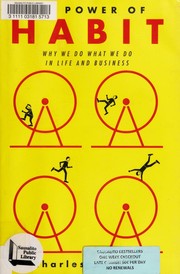
The Power of Habit
Rating: 4.0/5 from 145 Google Books ratings
Duhigg takes us to the edge of scientific discoveries that explain why habits exist and how they can be changed. Distilling information i...
Atomic Habits
Rating: 3.5/5 from 7 Google Books ratings
The #1 New York Times bestseller. Over 25 million copies sold! Translated into 60+ languages! Tiny Changes, Remarkable Results No matter...
Good Habits, Bad Habits
'The world's leading expert on habits' - Matthew Syed, bestselling author of Black Box Thinking and Rebel IdeasWhat if you could harness...
Tiny Habits
Improving your life is much easier than you think. Whether it’s losing weight, sleeping more, or restoring your work/life balance – the s...
eBay marketplace picks
Marketplace Samples
Live-tested eBay searches with available results related to this page.
Selected frommotivational poster oneBay.co.uk.

Current eBay listing
Motivational Quotes Framed Wall Art Poster Canvas Print Picture


Current eBay listing
Gym Motivational Posters Work Out Insperational Quotes Wall Art
Endnotes
1.
Source: sciencedirect.com
Link:https://www.sciencedirect.com/science/article/pii/S0272494407000898
Source snippet
Context change and travel mode choice: Combining the habit discontinuity and self-activation hypotheses - ScienceDirect...
2.
Source: sciencedirect.com
Link:https://www.sciencedirect.com/science/article/pii/S002210311100254X
3.
Source: sciencedirect.com
Link:https://www.sciencedirect.com/science/article/pii/S2352250X24000939
4.
Source: onlinelibrary.wiley.com
Link:https://onlinelibrary.wiley.com/doi/full/10.1002/ejsp.674
5.
Source: myscp.onlinelibrary.wiley.com
Title: My SCPThe habitual consumer
Link:https://myscp.onlinelibrary.wiley.com/doi/10.1016/j.jcps.2009.08.003
6.
Source: sciencedirect.com
Link:https://www.sciencedirect.com/science/article/pii/S0272494415300487
7.
Source: sciencedirect.com
Link:https://www.sciencedirect.com/science/article/abs/pii/S0167404826002336
8.
Source: sciencedirect.com
Link:https://www.sciencedirect.com/science/article/pii/S2589004226010874
9.
Source: bpspsychub.onlinelibrary.wiley.com
Link:https://bpspsychub.onlinelibrary.wiley.com/doi/10.1111/joop.12540
10.
Source: sciencedirect.com
Link:https://www.sciencedirect.com/org/science/article/pii/S1438887124002619
11.
Source: compass.onlinelibrary.wiley.com
Link:https://compass.onlinelibrary.wiley.com/doi/10.1111/spc3.12845
12.
Source: sciencedirect.com
Title: Habit discontinuity and student travel mode choice
Link:https://www.sciencedirect.com/science/article/pii/S1369847818305874
13.
Source: sciencedirect.com
Link:https://www.sciencedirect.com/science/article/pii/S0001691816303626
14.
Source: bpspsychub.onlinelibrary.wiley.com
Link:https://bpspsychub.onlinelibrary.wiley.com/doi/abs/10.1111/bjhp.12060
15.
Source: myscp.onlinelibrary.wiley.com
Link:https://myscp.onlinelibrary.wiley.com/doi/abs/10.1016/j.jcps.2009.08.003
16.
Source: onlinelibrary.wiley.com
Link:https://onlinelibrary.wiley.com/doi/10.1002/ejsp.674
17.
Source: onlinelibrary.wiley.com
Link:https://onlinelibrary.wiley.com/doi/abs/10.1002/ejsp.674?msockid=17570258034862e732eb114c02616368
18.
Source: onlinelibrary.wiley.com
Link:https://onlinelibrary.wiley.com/doi/abs/10.1002/ejsp.674?538fcd4b_page=6&947f74f7_page=5
19.
Source: sciencedirect.com
Link:https://www.sciencedirect.com/science/article/abs/pii/S0376635702000633
20.
Source: sciencedirect.com
Link:https://www.sciencedirect.com/science/article/pii/S0022103105001356
21.
Source: sciencedirect.com
Link:https://www.sciencedirect.com/science/article/abs/pii/S002210310600028X
22.
Source: sciencedirect.com
Link:https://www.sciencedirect.com/science/article/abs/pii/S0304422X1400031X
23.
Source: sciencedirect.com
Link:https://www.sciencedirect.com/science/article/abs/pii/S0022096516300285
24.
Source: sciencedirect.com
Title: Beyond deliberate [self-control]({{ ‘self-control/’ | relative_url }}): Habits automatically achieve long-term goals
Link:https://www.sciencedirect.com/science/article/abs/pii/S2352250X24000939
25.
Source: sciencedirect.com
Link:https://www.sciencedirect.com/science/article/pii/S0092656607001092
26.
Source: pubmed.ncbi.nlm.nih.gov
Title: Pub Med Psychology of Habit
Link:https://pubmed.ncbi.nlm.nih.gov/26361052/
Source snippet
Psychology of Habit - PubMedSeptember 10, 2015...
Published: September 10, 2015
27.
Source: journals.sagepub.com
Link:https://journals.sagepub.com/doi/full/10.1177/1745691621994226
Source snippet
Sage JournalsHabits and Goals in Human Behavior: Separate but Interacting Systems - Wendy Wood, Asaf Mazar, David T. Neal, 2022...
28.
Source: pmc.ncbi.nlm.nih.gov
Link:https://pmc.ncbi.nlm.nih.gov/articles/PMC9226889/
Source snippet
PubMed Central (PMC)Context Stability in Habit Building Increases Automaticity and Goal Attainment - PMCJune 10, 2022...
Published: June 10, 2022
29.
Source: pmc.ncbi.nlm.nih.gov
Link:https://pmc.ncbi.nlm.nih.gov/articles/PMC11641623/
30.
Source: journals.sagepub.com
Title: Sage Journals Habits—A Repeat Performance
Link:https://journals.sagepub.com/doi/10.1111/j.1467-8721.2006.00435.x
Source snippet
Sage JournalsHabits—A Repeat Performance - David T. Neal, Wendy Wood, Jeffrey M. Quinn, 2006...
31.
Source: discovery.ucl.ac.uk
Title: UCL Discovery Psychology & Health
Link:https://discovery.ucl.ac.uk/10139326/9/Lally_Developing%20habit%20based%20health%20behaviour%20change%20interventions%20twenty%20one%20questions%20to%20guide%20future%20research.pdf
32.
Source: pubmed.ncbi.nlm.nih.gov
Title: Pub Med Habits and Goals in Human Behavior: Separate but Interacting Systems
Link:https://pubmed.ncbi.nlm.nih.gov/34283681/
33.
Source: pubmed.ncbi.nlm.nih.gov
Link:https://pubmed.ncbi.nlm.nih.gov/35756236/
34.
Source: frontiersin.org
Link:https://www.frontiersin.org/journals/psychology/articles/10.3389/fpsyg.2022.883795/full
35.
Source: pmc.ncbi.nlm.nih.gov
Link:https://pmc.ncbi.nlm.nih.gov/articles/PMC4216661/
36.
Source: pmc.ncbi.nlm.nih.gov
Link:https://pmc.ncbi.nlm.nih.gov/articles/PMC7106637/
37.
Source: pubmed.ncbi.nlm.nih.gov
Link:https://pubmed.ncbi.nlm.nih.gov/27120333/
38.
Source: pmc.ncbi.nlm.nih.gov
Link:https://pmc.ncbi.nlm.nih.gov/articles/PMC4847906/
39.
Source: pubmed.ncbi.nlm.nih.gov
Link:https://pubmed.ncbi.nlm.nih.gov/39685110/
40.
Source: pubmed.ncbi.nlm.nih.gov
Link:https://pubmed.ncbi.nlm.nih.gov/42053513/
41.
Source: journals.sagepub.com
Link:https://journals.sagepub.com/doi/full/10.1177/01461672261440446
42.
Source: pubmed.ncbi.nlm.nih.gov
Link:https://pubmed.ncbi.nlm.nih.gov/41664442/
43.
Source: pmc.ncbi.nlm.nih.gov
Link:https://pmc.ncbi.nlm.nih.gov/articles/PMC12836306/
44.
Source: frontiersin.org
Link:https://www.frontiersin.org/journals/digital-health/articles/10.3389/fdgth.2025.1713334/full
45.
Source: doi.org
Link:https://doi.org/10.3389/fdgth.2025.1713334?urlappend=%3Futm_source%3Dresearchgate.net%26utm_medium%3Darticle
46.
Source: doi.org
Link:https://doi.org/10.1111/bjhp.12795
47.
Source: pmc.ncbi.nlm.nih.gov
Link:https://pmc.ncbi.nlm.nih.gov/articles/PMC11920387/
48.
Source: pmc.ncbi.nlm.nih.gov
Link:https://pmc.ncbi.nlm.nih.gov/articles/PMC11603321/
49.
Source: pubmed.ncbi.nlm.nih.gov
Link:https://pubmed.ncbi.nlm.nih.gov/39604487/
50.
Source: pmc.ncbi.nlm.nih.gov
Link:https://pmc.ncbi.nlm.nih.gov/articles/PMC11297519/
51.
Source: journals.sagepub.com
Link:https://journals.sagepub.com/doi/10.1177/20552076241265217
52.
Source: pmc.ncbi.nlm.nih.gov
Link:https://pmc.ncbi.nlm.nih.gov/articles/PMC11161714/
53.
Source: doi.org
Link:https://doi.org/10.3390/mti8020009
54.
Source: pmc.ncbi.nlm.nih.gov
Link:https://pmc.ncbi.nlm.nih.gov/articles/PMC10585941/
55.
Source: pubmed.ncbi.nlm.nih.gov
Link:https://pubmed.ncbi.nlm.nih.gov/35962435/
56.
Source: pmc.ncbi.nlm.nih.gov
Link:https://pmc.ncbi.nlm.nih.gov/articles/PMC9372943/
57.
Source: doi.org
Link:https://doi.org/10.1186/s12966-022-01343-8
58.
Source: frontiersin.org
Link:https://www.frontiersin.org/journals/psychology/articles/10.3389/fpsyg.2022.883795/full?infclid=98ed75048fad41069048c53e63b2394c
59.
Source: pmc.ncbi.nlm.nih.gov
Link:https://pmc.ncbi.nlm.nih.gov/articles/PMC12318445/
60.
Source: pubmed.ncbi.nlm.nih.gov
Link:https://pubmed.ncbi.nlm.nih.gov/34713424/
61.
Source: pubmed.ncbi.nlm.nih.gov
Link:https://pubmed.ncbi.nlm.nih.gov/33502088/
62.
Source: pubmed.ncbi.nlm.nih.gov
Link:https://pubmed.ncbi.nlm.nih.gov/29942574/
63.
Source: pmc.ncbi.nlm.nih.gov
Link:https://pmc.ncbi.nlm.nih.gov/articles/PMC6001179/
64.
Source: doi.org
Link:https://doi.org/10.1371/journal.pone.0153490
65.
Source: discovery.ucl.ac.uk
Link:https://discovery.ucl.ac.uk/id/eprint/1468224/
66.
Source: pmc.ncbi.nlm.nih.gov
Link:https://pmc.ncbi.nlm.nih.gov/articles/PMC4339261/
67.
Source: pmc.ncbi.nlm.nih.gov
Link:https://pmc.ncbi.nlm.nih.gov/articles/PMC4296343/
68.
Source: doi.org
Link:https://doi.org/10.1111/BJHP.12060
69.
Source: pmc.ncbi.nlm.nih.gov
Link:https://pmc.ncbi.nlm.nih.gov/articles/PMC3505409/
70.
Source: pubmed.ncbi.nlm.nih.gov
Link:https://pubmed.ncbi.nlm.nih.gov/17324087/
71.
Source: pubmed.ncbi.nlm.nih.gov
Link:https://pubmed.ncbi.nlm.nih.gov/12450091/
72.
Source: journals.sagepub.com
Title: j.1467 8721.2006.00435.x
Link:https://journals.sagepub.com/doi/abs/10.1111/j.1467-8721.2006.00435.x
73.
Source: journals.sagepub.com
Title: j.1467 8721.2006.00435.x
Link:https://journals.sagepub.com/doi/abs/10.1111/j.1467-8721.2006.00435.x?mod=article_inline
74.
Source: discovery.ucl.ac.uk
Link:https://discovery.ucl.ac.uk/1522125/
Additional References
75.
Source: youtube.com
Title: Hit Peak Performance with the Power of Habit | Wendy Wood
Link:https://www.youtube.com/watch?v=g-O1XDwhKIg
Source snippet
4 Steps to Building a Habit | James Clear & Dr. Andrew Huberman...
76.
Source: youtube.com
Title: 4 Steps to Building a Habit | James Clear & Dr. Andrew Huberman
Link:https://www.youtube.com/watch?v=n2SV81vh9vQ
Source snippet
Environment's Influence on Habits | Atomic Habits...
77.
Source: youtube.com
Link:https://www.youtube.com/watch?v=i4-CnaZllMo
Source snippet
Hit Peak Performance with the Power of Habit | Wendy Wood...
78.
Source: researchgate.net
Link:https://www.researchgate.net/publication/399739220_Achieving_clinically_meaningful_outcomes_in_digital_health_a_six-step_cyclical_precision_engagement_framework_ENGAGE
79.
Source: researchgate.net
Link:https://www.researchgate.net/publication/301683128_Habit_Discontinuity_Self-Activation_and_the_Diminishing_Influence_of_Context_Change_Evidence_from_the_UK_Understanding_Society_Survey
80.
Source: mdpi.com
Link:https://www.mdpi.com/2227-9032/12/23/2488
81.
Source: mdpi.com
Link:https://www.mdpi.com/2227-9032/12/23/2488?_bhlid=47dee3946db8c7e6d3a6e92da693cbc5a7439e28
82.
Source: doaj.org
Link:https://doaj.org/article/e295012ca8ba4b9a83d33d8bd5772933
83.
Source: researchportal.bath.ac.uk
Link:https://researchportal.bath.ac.uk/en/publications/context-change-and-travel-mode-choice-combining-the-habit-discont/
84.
Source: research.birmingham.ac.uk
Link:https://research.birmingham.ac.uk/en/publications/if-this-then-habit-exploring-context-aware-implementation-intenti/