Within Goals vs Actions
Does Writing Down Progress Make Goals Work Better?
Physically recording progress can make daily behaviour easier to evaluate and is associated with stronger goal attainment.
On this page
- What progress monitoring experiments found
- Why recorded behaviour gives faster feedback
- What to log without obsessing over results
Page outline Jump by section
Introduction
Writing down progress can make goals work better, but the strongest evidence supports a specific version of the idea: recording what you actually do, frequently enough to compare it with a target, can improve follow-through. It is not the act of handwriting a goal that appears important. The useful ingredient is creating a record of progress that makes behaviour visible and reviewable.
The clearest evidence comes from a 2016 meta-analysis of 138 randomised studies involving 19,951 participants. Interventions that encouraged people to monitor progress produced a moderate improvement in goal attainment, and the benefit was larger when monitoring information was physically recorded. Crucially for behaviour-based self-improvement, the analysis also found that monitoring behaviour was especially effective at changing behaviour itself.[PubMed]pubmed.ncbi.nlm.nih.govDoes monitoring goal progress promote goal attainment? A meta-analysis of the experimental evidence - PubMedFebruary 1, 2016…
That makes a progress log more than a motivational diary. Used carefully, it is a feedback system: Did I perform the action I said I would perform?
What progress-monitoring experiments found
Benjamin Harkin and colleagues’ meta-analysis in Psychological Bulletin provides the most directly relevant dataset. The researchers included experiments in which participants were randomly assigned to an intervention intended to increase monitoring of goal progress or to a control condition. Across the 138 studies, the monitoring interventions substantially increased monitoring itself (standardised effect size d = 1.98) and improved subsequent goal attainment (d = 0.40, 95% confidence interval 0.32 to 0.48). Changes in how frequently people monitored their progress statistically mediated the improvement in goal attainment.[PubMed]pubmed.ncbi.nlm.nih.govDoes monitoring goal progress promote goal attainment? A meta-analysis of the experimental evidence - PubMedFebruary 1, 2016…
The studies covered different kinds of goals, with much of the evidence coming from health-related behaviours such as physical activity, diet, weight management, smoking and management of medical conditions. That breadth is useful, but it also means the headline effect should not be interpreted as a guaranteed improvement of the same size for every personal goal. It is an average across varied interventions and populations.[American Psychological Association]apa.orgAmerican Psychological AssociationFrequently monitoring progress toward goals increases chance of successOctober 28, 2015…
For written progress logs, one moderator is particularly revealing. When participants physically recorded the information obtained through monitoring — for example, by entering it in a diary — the effect on goal attainment was larger (d = 0.43) than when the information was monitored but not recorded (d = 0.29). When researchers restricted the comparison to objectively measured goal attainment, the corresponding effects were d = 0.57 versus 0.23.[ResearchGate]researchgate.netResearchGate(PDF) Does Monitoring Goal Progress Promote Goal Attainment? A Meta-Analysis of the Experimental EvidenceOctober 19, 2015…
That finding needs careful wording. The meta-analysis does not establish that pen and paper possesses a special psychological advantage over every digital alternative. “Physically recorded” meant that monitoring information was recorded rather than merely observed; a structured digital log can serve the same basic self-monitoring function. The evidence therefore supports leaving a record, not a claim that handwriting is inherently superior.
There was another notable result. Monitoring that was reported to somebody else (d = 0.47) or conducted publicly (d = 0.55) was associated with larger effects on goal attainment than private monitoring (d = 0.19). A private log can still be useful, but the result suggests why coaching reports, training diaries shared with a coach or other forms of accountability can sometimes add leverage.[ResearchGate]researchgate.netResearchGate(PDF) Does Monitoring Goal Progress Promote Goal Attainment? A Meta-Analysis of the Experimental EvidenceOctober 19, 2015…
Why recorded behaviour gives faster feedback
A written log changes the information available to you. Without one, a statement such as “I have been studying quite consistently” depends heavily on memory and impression. With a simple record — “retrieval-practice session completed: yes/no” — the question becomes empirical.
Harkin and colleagues described self-recording as a way to examine progress over time and potentially identify actions that help or hinder it. More generally, monitoring works by allowing the present state to be compared with some reference point: a desired target or previous performance.[White Rose Research Online]eprints.whiterose.ac.ukWhite Rose Research OnlineDoes Monitoring Goal Progress Promote Goal Attainment? A Meta-Analysis of the Experimental Evidence.July 4, 2026…
This matters especially when an outcome goal has been translated into controllable behaviours. Suppose the outcome is to finish a 10K faster. Recording the race time tells you whether the outcome eventually improved. Recording completion of planned training sessions tells you much sooner whether the behaviour intended to produce that improvement is happening.
The meta-analysis found a striking “matching” pattern. Interventions that prompted people to monitor behaviour had a large reliable effect on behaviour (d = 0.79), but no reliable effect on outcomes in the smaller subset testing that relationship (d = 0.14). Conversely, monitoring outcomes affected outcomes (d = 0.62) but did not reliably change behaviour (d = 0.17).[ResearchGate]researchgate.netResearchGate(PDF) Does Monitoring Goal Progress Promote Goal Attainment? A Meta-Analysis of the Experimental EvidenceOctober 19, 2015…
That distinction is easy to overlook. A person trying to save £5,000 can repeatedly inspect the bank balance, just as somebody trying to improve fitness can repeatedly inspect body weight or a race time. Those measurements answer an important question — is the result changing? — but they do not necessarily answer the more immediately actionable question: am I consistently performing the behaviour intended to change it?
A behaviour log closes that information gap. “Transferred £100 on payday”, “completed the planned run”, “did 30 minutes of retrieval practice” and “wrote for 45 minutes” are observations about actions under comparatively direct control. They can therefore expose a breakdown in execution before the slower-moving outcome makes the problem obvious.
Research on people’s natural monitoring habits also suggests that this is not automatic. In three studies of personal goals, Chang and colleagues found that people reported finding progress easier to monitor when goals were represented in quantifiable terms. Monitoring was harder for some domains, including work and study, where progress may be less immediately measurable than something such as weight or exercise.[PubMed]pubmed.ncbi.nlm.nih.govPub Med Which Factors Are Associated with Monitoring Goal Progress?Which Factors Are Associated with Monitoring Goal Progress? - PubMedMarch 24, 2017…
The practical implication is not that everything needs a sophisticated metric. Often a deliberately crude measure makes an otherwise fuzzy behaviour observable: session completed or not; minutes practised; applications submitted; pages revised; planned transfer made.

What to log without obsessing over results
A useful progress log should make behaviour easier to evaluate, not turn self-improvement into continuous surveillance. The research supports monitoring as a behaviour-change technique, but it does not imply that more data, more elaborate dashboards or more frequent checking are always better.
Later evidence also argues against treating self-monitoring as a universally powerful ingredient in isolation. A large meta-review covering 30 previous meta-analyses and more than 400,000 participants found mixed results for self-regulatory behaviour-change techniques. For physical activity in particular, some reviews found benefits from self-monitoring while others did not. The authors also warned that many reviews were trying to isolate individual techniques from interventions containing several components, making causal attribution difficult.[PubMed Central (PMC)]pmc.ncbi.nlm.nih.govPubMed Central (PMC)Self-regulatory behavior change techniques in interventions to promote healthy eating, physical activity, or weight l…
At the same time, more focused evidence continues to find useful effects in particular settings. A systematic review and meta-analysis of 19 trials involving 2,800 adults found that interventions using self-monitoring reduced sedentary time in the short term, although study sizes were small and heterogeneity remained. A separate review of digital diet and physical-activity monitoring found improvements in weight, moderate physical activity and calorie intake among adults with overweight or obesity, while also indicating that intervention design mattered.[PubMed Central (PMC)]pmc.ncbi.nlm.nih.govOpen source on nih.gov.
For an ordinary personal goal, this evidence points towards a deliberately lean log:
- Record the behaviour closest to your control. For studying, that might be completed retrieval-practice sessions rather than the eventual examination grade. For writing, it might be planned writing sessions rather than publication or sales.
- Define the entry before the day begins. “Exercise: yes/no” is easier to interpret if “yes” already means completing the planned session rather than retrospectively deciding that walking around the shops counts.
- Use quantities only when they clarify behaviour. Minutes practised, kilometres run or pounds transferred can be useful; dozens of auxiliary metrics often add little to the central question of whether the intended action occurred.
- Keep an outcome measure at a slower cadence where useful. The behaviour log shows execution; an occasional outcome measurement shows whether those behaviours are producing the desired result. Harkin’s matching findings suggest that these measurements answer different questions rather than substituting perfectly for one another.[ResearchGate]researchgate.netResearchGate(PDF) Does Monitoring Goal Progress Promote Goal Attainment? A Meta-Analysis of the Experimental EvidenceOctober 19, 2015…
- Review patterns rather than judging individual misses. The value of having a record is that several days or weeks become inspectable. A missed session is one observation; repeated missed sessions at the same time or under the same conditions are information about the plan.
There is also a reason not to assume that people will naturally seek this feedback when it is most needed. Researchers have described an “ostrich problem”: people sometimes avoid information about goal progress precisely because it may reveal disappointing performance. Examples include avoiding scales, bank balances or records of consumption.[DOI]doi.orgOpen source on doi.org. A pre-decided, low-effort logging routine can reduce the opportunity to replace measurement with a favourable impression.
The useful distinction: log actions, check outcomes
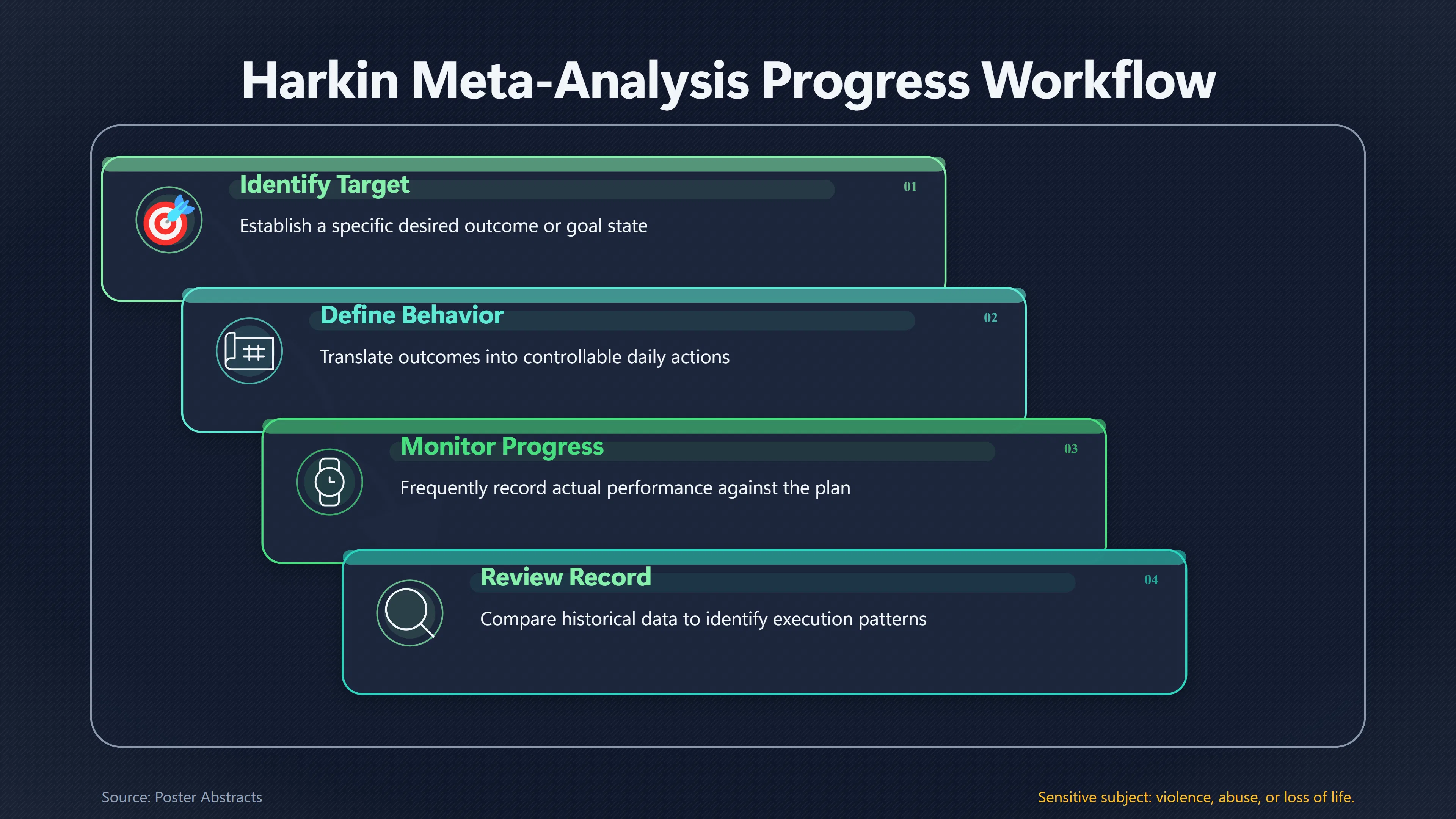
The most defensible conclusion from the experimental evidence is narrower — and more useful — than “write down your goals and you will achieve them”. The better-supported sequence is to establish a target, identify the behaviour expected to move you towards it, monitor that behaviour and leave a record that can be reviewed.
The 2016 meta-analysis gives this approach unusually direct support: prompting progress monitoring improved goal attainment overall; greater monitoring helped account for that improvement; physically recording monitoring information was associated with stronger effects; and monitoring behaviour produced its clearest effect on behaviour itself.[PubMed]pubmed.ncbi.nlm.nih.govDoes monitoring goal progress promote goal attainment? A meta-analysis of the experimental evidence - PubMedFebruary 1, 2016…
So if the outcome is “finish the qualification”, the daily log need not repeatedly say “finish the qualification”. It can record whether today’s planned study session happened. If the outcome is “build a £5,000 emergency fund”, the log can record whether the scheduled transfer was made. The eventual outcome still matters, but it can be checked less frequently to determine whether the behavioural strategy is working.
That is where written progress logs fit into self-improvement that works: the record turns an intention into something that can be inspected. Instead of repeatedly asking whether you want the outcome badly enough, it lets you ask the more actionable question — whether the behaviours intended to produce it are actually occurring.

Amazon book picks
Further Reading
Books and field guides related to Does Writing Down Progress Make Goals Work Better?. Use these as the next step if you want deeper reading beyond the article.
Atomic Habits
Rating: 3.5/5 from 7 Google Books ratings
The #1 New York Times bestseller. Over 25 million copies sold! Translated into 60+ languages! Tiny Changes, Remarkable Results No matter...
Tiny Habits
The world's leading expert on habit formation shows how you can have a happier, healthier life: by starting small. Myth: Change is hard....
The Progress Principle
Explains how to foster progress, shows how to remove obstacles, including meaningless tasks and toxic relationships that disrupt employee...
Measure What Matters
#1 New York Times Bestseller Legendary venture capitalist John Doerr reveals how the goal-setting system of Objectives and Key Results (O...
eBay marketplace picks
Marketplace Samples
Live-tested eBay searches with available results related to this page.
Selected fromself improvement wall art oneBay.co.uk.




Endnotes
1.
Source: researchgate.net
Link:https://www.researchgate.net/publication/291335719_Does_Monitoring_Goal_Progress_Promote_Goal_Attainment_A_Meta-Analysis_of_the_Experimental_Evidence
Source snippet
ResearchGate(PDF) Does Monitoring Goal Progress Promote Goal Attainment? A Meta-Analysis of the Experimental EvidenceOctober 19, 2015...
Published: October 19, 2015
2.
Source: doi.org
Link:https://doi.org/10.1111/spc3.12071
3.
Source: doi.org
Link:https://doi.org/10.1186/s12966-023-01555-6
4.
Source: doi.org
Title: Poster Abstracts
Link:https://doi.org/10.1002%2Foby.23626
5.
Source: researchgate.net
Link:https://www.researchgate.net/publication/361243507_Longitudinal_associations_between_executive_functions_and_metacognitive_monitoring_in_5-_to_8-year-olds
6.
Source: doi.org
Link:https://doi.org/10.1111/obr.13306
7.
Source: researchgate.net
Link:https://www.researchgate.net/publication/322745210_Behavior_Change_Techniques_Used_in_Digital_Behavior_Change_Interventions_to_Reduce_Excessive_Alcohol_Consumption_A_Meta-regression
8.
Source: researchgate.net
Link:https://www.researchgate.net/publication/315763981_Effective_behaviour_change_techniques_for_physical_activity_and_healthy_eating_in_overweight_and_obese_adults_systematic_review_and_meta-regression_analyses
9.
Source: researchgate.net
Link:https://www.researchgate.net/publication/282976277_Career_Development_Employment_and_Disability_in_Rehabilitation_From_Theory_to_Practice
10.
Source: researchgate.net
Link:https://www.researchgate.net/publication/38044624_Remediating_Number_Combination_and_Word_Problem_Deficits_Among_Students_With_Mathematics_Difficulties_A_Randomized_Control_Trial
11.
Source: researchgate.net
Link:https://www.researchgate.net/figure/Mediation-of-the-effect-of-interventions-on-goal-attainment-by-changes-in-the-frequency_fig4_291335719
12.
Source: researchgate.net
Link:https://www.researchgate.net/publication/367385774_Eye-tracking_Technology_and_Data-mining_Techniques_used_for_a_Behavioral_Analysis_of_Adults_engaged_in_Learning_Processes
13.
Source: researchgate.net
Link:https://www.researchgate.net/publication/264795887_A_Resource_Model_of_Change_Client_Factors_that_Influence_Problem_Gambling_Treatment_Outcomes
14.
Source: pubmed.ncbi.nlm.nih.gov
Link:https://pubmed.ncbi.nlm.nih.gov/26479070/
Source snippet
Does monitoring goal progress promote goal attainment? A meta-analysis of the experimental evidence - PubMedFebruary 1, 2016...
Published: February 1, 2016
15.
Source: eprints.whiterose.ac.uk
Link:https://eprints.whiterose.ac.uk/id/eprint/91437/
Source snippet
White Rose Research OnlineDoes Monitoring Goal Progress Promote Goal Attainment? A Meta-Analysis of the Experimental Evidence - White Ros...
16.
Source: eprints.whiterose.ac.uk
Link:https://eprints.whiterose.ac.uk/id/eprint/87431/
Source snippet
White Rose Research OnlineDoes Monitoring Goal Progress Promote Goal Attainment? A Meta-Analysis of the Experimental Evidence. - White Ro...
17.
Source: apa.org
Link:https://www.apa.org/news/press/releases/2015/10/progress-goals
Source snippet
American Psychological AssociationFrequently monitoring progress toward goals increases chance of successOctober 28, 2015...
Published: October 28, 2015
18.
Source: eprints.whiterose.ac.uk
Link:https://eprints.whiterose.ac.uk/id/eprint/87431/1/bul
Source snippet
White Rose Research OnlineDoes Monitoring Goal Progress Promote Goal Attainment? A Meta-Analysis of the Experimental Evidence.July 4, 2026...
Published: July 4, 2026
19.
Source: pmc.ncbi.nlm.nih.gov
Link:https://pmc.ncbi.nlm.nih.gov/articles/PMC7429262/
Source snippet
PubMed Central (PMC)Self-regulatory behavior change techniques in interventions to promote healthy eating, physical activity, or weight l...
20.
Source: pubmed.ncbi.nlm.nih.gov
Title: Pub Med Which Factors Are Associated with Monitoring Goal Progress?
Link:https://pubmed.ncbi.nlm.nih.gov/28392775/
Source snippet
Which Factors Are Associated with Monitoring Goal Progress? - PubMedMarch 24, 2017...
Published: March 24, 2017
21.
Source: pmc.ncbi.nlm.nih.gov
Link:https://pmc.ncbi.nlm.nih.gov/articles/PMC7571594/
Source snippet
PubMed Central (PMC)Self-Regulation Mechanisms in Health Behaviour Change: A Systematic Meta-Review of Meta-Analyses, 2006–2017 - PMC...
22.
Source: pmc.ncbi.nlm.nih.gov
Link:https://pmc.ncbi.nlm.nih.gov/articles/PMC6693254/
23.
Source: pubmed.ncbi.nlm.nih.gov
Link:https://pubmed.ncbi.nlm.nih.gov/34192411/
24.
Source: pubmed.ncbi.nlm.nih.gov
Link:https://pubmed.ncbi.nlm.nih.gov/38178230/
25.
Source: pmc.ncbi.nlm.nih.gov
Link:https://pmc.ncbi.nlm.nih.gov/articles/PMC10765525/
26.
Source: ncbi.nlm.nih.gov
Link:https://www.ncbi.nlm.nih.gov/books/NBK580337/
27.
Source: pubmed.ncbi.nlm.nih.gov
Link:https://pubmed.ncbi.nlm.nih.gov/34192411/?dopt=Abstract
28.
Source: pmc.ncbi.nlm.nih.gov
Link:https://pmc.ncbi.nlm.nih.gov/articles/PMC8365685/
29.
Source: GOV.UK
Title: www.gov.uk Behaviour change techniques review: descriptive studies
Link:https://www.gov.uk/guidance/behaviour-change-techniques-review-descriptive-studies
30.
Source: pmc.ncbi.nlm.nih.gov
Link:https://pmc.ncbi.nlm.nih.gov/articles/PMC7018570/
31.
Source: pubmed.ncbi.nlm.nih.gov
Link:https://pubmed.ncbi.nlm.nih.gov/29381786/
32.
Source: pmc.ncbi.nlm.nih.gov
Link:https://pmc.ncbi.nlm.nih.gov/articles/PMC5875102/
33.
Source: pmc.ncbi.nlm.nih.gov
Link:https://pmc.ncbi.nlm.nih.gov/articles/PMC6062857/
34.
Source: pmc.ncbi.nlm.nih.gov
Link:https://pmc.ncbi.nlm.nih.gov/articles/PMC5370453/
35.
Source: pmc.ncbi.nlm.nih.gov
Link:https://pmc.ncbi.nlm.nih.gov/articles/PMC5364185/
36.
Source: compass.onlinelibrary.wiley.com
Link:https://compass.onlinelibrary.wiley.com/doi/abs/10.1111/spc3.12071
37.
Source: pmc.ncbi.nlm.nih.gov
Link:https://pmc.ncbi.nlm.nih.gov/articles/PMC3268700/
38.
Source: pubmed.ncbi.nlm.nih.gov
Link:https://pubmed.ncbi.nlm.nih.gov/20739325/
39.
Source: pubmed.ncbi.nlm.nih.gov
Link:https://pubmed.ncbi.nlm.nih.gov/30335463/
40.
Source: pubmed.ncbi.nlm.nih.gov
Link:https://pubmed.ncbi.nlm.nih.gov/19916637/
41.
Source: pubmed.ncbi.nlm.nih.gov
Link:https://pubmed.ncbi.nlm.nih.gov/31973666/
Additional References
42.
Source: youtube.com
Title: The Power of Written Goals + Accountability
Link:https://www.youtube.com/watch?v=bmfhPvUECgE
Source snippet
Science of tracking progress goals Harkin monitoring The Science of Habit Tracking: Why Visible Progress Doubles Follow-Through...
43.
Source: youtube.com
Title: TEDx Atlanta
Link:https://www.youtube.com/watch?v=XD6N8bsjOEE
Source snippet
Tools for Setting & Achieving Goals | Dr. Emily Balcetis...
44.
Source: youtube.com
Title: Tools for Setting & Achieving Goals | Dr. Emily Balcetis
Link:https://www.youtube.com/watch?v=7YGZZcXqKxE
Source snippet
The Power of Written Goals + Accountability...
45.
Source: sciencedirect.com
Link:https://www.sciencedirect.com/org/science/article/pii/S2368795926000491
46.
Source: mdpi.com
Link:https://www.mdpi.com/2072-6643/14/1/209
47.
Source: 1library.net
Link:https://1library.net/document/rz3x7o7z-does-monitoring-progress-promote-attainment-analysis-experimental-evidence.html
48.
Source: eurekamag.com
Link:https://eurekamag.com/research/057/653/057653112.php
49.
Source: tandfonline.com
Link:https://www.tandfonline.com/doi/abs/10.1080/0144929X.2026.2666279
50.
Source: tandfonline.com
Link:https://www.tandfonline.com/doi/full/10.1080/0144929X.2026.2666279
51.
Source: tandfonline.com
Link:https://www.tandfonline.com/doi/full/10.1080/0144929X.2026.2666279?af=R