Within Precommitment
When Is Losing Money a Useful Commitment?
Putting personal money at risk can strengthen follow-through when softer promises have repeatedly failed, but demanding contracts may attract few users.
On this page
- How financial stakes change the cost of backing out
- What smoking and gym trials found
- When hard contracts become too costly or inflexible
Page outline Jump by section
Introduction
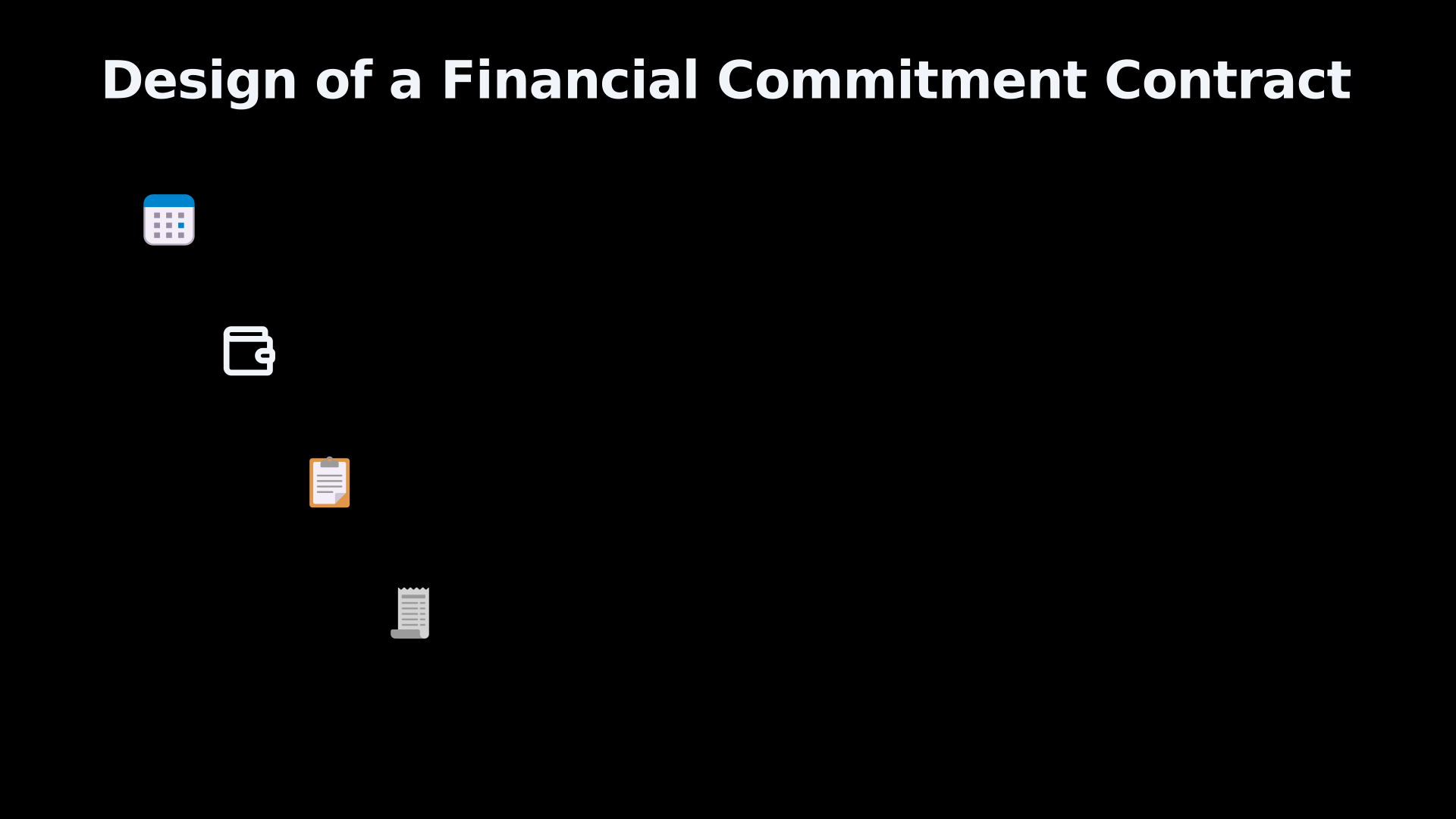
Putting your own money at risk can make a repeated behaviour failure expensive enough to change what happens when motivation weakens. A financial commitment contract typically lets you choose a target in advance — such as not smoking or visiting the gym — and requires you to forfeit some of your own money if you fail. Unlike a reward paid by somebody else, the incentive comes from avoiding a loss you deliberately created.
The strongest case for this approach is narrow. Money at stake can improve follow-through for some people who already want to change and have repeatedly failed with softer promises. Smoking and exercise trials show that such contracts can produce meaningful behavioural changes. But the same studies expose the central problem: many people decline hard commitments, while some who accept them subsequently lose their money. A stronger incentive is therefore not automatically a better self-improvement tool.[American Economic Association]aeaweb.orgAmerican Economic AssociationPut Your Money Where Your Butt Is: A Commitment Contract for Smoking Cessation - American Economic Association…
How financial stakes change the cost of backing out
A conventional intention leaves the immediate economics of a lapse largely unchanged. Suppose someone decides on Sunday that they will exercise on Tuesday evening. When Tuesday arrives, skipping the gym offers an immediate benefit — more free time and less effort — while much of exercise’s benefit remains distant. Repeating the intention does not alter that trade-off.
A money-at-stake contract does. If the person has already pledged £30 that will be lost unless an independently measurable target is met, skipping now carries an additional immediate cost. The contract does not need to make exercise more enjoyable or the long-term health benefit more vivid. Its distinctive function is to bring a consequence of failure forwards in time.
Economists therefore distinguish hard commitments, which impose genuine economic consequences, from softer devices such as promises or reminders. Hard commitments are particularly interesting because the person voluntarily creates a restriction that they may later wish did not exist. Reviews of commitment devices emphasise that effectiveness and demand are separate questions: a device can exert a strong influence once adopted while still being unattractive to many of the people who might theoretically benefit from it.[Annual Reviews]annualreviews.orgAnnual Reviews Commitment Devices | Annual ReviewsAnnual ReviewsCommitment Devices | Annual ReviewsSeptember 4, 2010…
That distinction matters for self-improvement. The relevant comparison is not simply “financial penalty versus doing nothing”. A useful contract must clear at least three hurdles: the target must represent something the person genuinely wants, failure must be measured fairly, and the stake must be large enough to matter without making an ordinary setback needlessly damaging.
What smoking and gym trials found
One of the clearest early field tests came from smokers in the Philippines. Xavier Giné, Dean Karlan and Jonathan Zinman tested a voluntary product called CARES. Smokers who accepted it deposited their own money into an account over six months. At the end they took a urine test for nicotine and cotinine: passing meant getting the deposited money back; failing meant forfeiting it to charity.[American Economic Association]aeaweb.orgAmerican Economic AssociationPut Your Money Where Your Butt Is: A Commitment Contract for Smoking Cessation - American Economic Association…
The result illustrates both the promise and the limitation of hard commitment. Only 11% of smokers offered CARES accepted it. Yet random assignment to being offered the contract increased the probability of passing the six-month test by about 3 percentage points relative to the control group. The researchers also found an effect in surprise testing at 12 months, after the original contractual period had finished, suggesting that the intervention did more than simply shift smoking until the day of the test.[American Economic Association]aeaweb.orgAmerican Economic AssociationPut Your Money Where Your Butt Is: A Commitment Contract for Smoking Cessation - American Economic Association…
The participants who used CARES did not merely make a token wager. Study material reports an average opening balance of 57 Philippine pesos, followed by further contributions from 80% of clients; by six months, the average balance had risen to 553 pesos. In other words, users progressively accumulated something worth protecting.[TIME]time.comPut Your Money Where Your Butt IsPut Your Money Where Your Butt Is:December 4, 2025…
The low uptake is nevertheless crucial. The experiment does not establish that imposing monetary penalties on all smokers would work, nor that everyone offered the contract benefited. It shows that making a voluntary hard commitment available changed cessation outcomes across the group offered it, despite relatively few people choosing to participate. The selection problem is part of the intervention rather than an incidental detail.
There is now strong evidence that financial incentives broadly construed can help smoking cessation, but this should not be mistaken for equally strong evidence specifically for self-funded contracts. A 2025 Cochrane review found high-certainty evidence that financial incentive programmes increased long-term quitting: across 39 studies and 18,303 participants, about 10 in 100 people receiving incentives quit for six months or longer, compared with about 7 in 100 controls. However, those studies encompassed cash and vouchers as well as self-deposits. The review found no clear evidence that programmes using redeemable self-deposits were more effective than other incentive designs.[Cochrane]cochrane.orgCan rewards help people quit smoking, and do they work in the long term? | CochraneJanuary 13, 2025…
Exercise shows the same tension
A workplace exercise experiment by Heather Royer, Mark Stehr and Justin Sydnor provides another instructive case. Employees first encountered a four-week financial incentive for using their company gym; some were subsequently offered the opportunity to create self-funded commitment contracts. The initial incentive produced strong short-term responses but only modest persistence by itself. The group offered commitment contracts subsequently showed longer-lasting changes in gym attendance.[American Economic Association]aeaweb.orgAmerican Economic AssociationIncentives, Commitments, and Habit Formation in Exercise: Evidence from a Field Experiment with Workers at a…
Again, however, demand for the hard device was limited. Among 346 people given the relevant commitment option, 12.4% took it up, putting about $58 on average at stake. Demand was considerably higher among people who were already gym members: 23% accepted. Among people who had not previously been members, overall uptake was only 6%, although it reached 21% among those who had visited at least once during the preceding incentive period.[IZA]iza.orgIncentives, Commitments and Habit Formation in ExerciseIncentives, Commitments and Habit Formation in Exercise:January 22, 2025…
That pattern suggests an important practical role for money-at-stake contracts: they may work better as an escalation after somebody has already begun changing a behaviour than as the first intervention offered to an entirely disengaged person. A financial contract cannot make somebody value a goal they do not really want. Its comparative advantage is making an already valued intention harder to abandon.
More recent evidence reinforces the point that genuine stakes can add something beyond merely writing down a promise. A 2024 randomised experiment involving 1,629 gym members in Stockholm compared non-incentivised “soft” contracts with “hard” contracts that allowed financial stakes. Being offered the hard contract increased monthly gym visits by 21% relative to the control group, while the soft-contract offer increased them by 8%.[PubMed]pubmed.ncbi.nlm.nih.govOpen source on nih.gov.
This study also obtained much greater engagement than some earlier trials: more than 82% of participants in the treatment groups accepted a contract, but only 41% of those offered the hard version chose to add financial stakes. Participants could choose deposits between 10 and 1,000 Swedish kronor. The difference between accepting a behavioural contract and actually wagering money is revealing: even among gym members volunteering for a study about their exercise goals, most of those offered the opportunity did not choose the monetary penalty.[LUSEM]lusem.lu.seOpen source on lu.se.
When hard contracts become too costly or inflexible
The intuitive argument for increasing the stake has a dangerous simplicity: if £10 is not enough to stop a lapse, perhaps £100 will be. But commitment devices are unusual because failure makes the intervention itself costly. A person who correctly anticipates a recurring self-control problem may benefit from creating consequences; someone who misjudges their future circumstances can simply manufacture an avoidable financial loss.
This is not merely theoretical. Research on hard commitments in other behavioural settings has found substantial default among people who voluntarily chose them. In one field experiment involving commitment savings, 55% of clients defaulted and suffered monetary losses. The study found evidence consistent with a difficult design problem: people can recognise that they need commitment yet choose a penalty too weak to change their behaviour, leaving them exposed to losses without receiving enough motivational benefit in return.[PubsOnLine]pubsonline.informs.orgOpen source on informs.org.
A recent analysis of healthcare commitment research makes the broader concern especially stark. Reviewing financial commitments tied to health behaviours, the authors report that in the average study 65% of people who made such commitments lost the money they had staked. Their argument is not that hard commitment never works, but that the possibility of commitment failure belongs in any assessment of its value.[PubMed Central (PMC)]pmc.ncbi.nlm.nih.govPub Med Central (PMC)Healthcare Appointments as Commitment DevicesPub Med Central (PMC)Healthcare Appointments as Commitment Devices
There is another problem: people are not always good at identifying when they need commitment. A 2022 Review of Economic Studies experiment with 1,248 participants examined commitment contracts for gym attendance and found that accepting them was influenced by noisy valuations and mistaken beliefs about one’s own future behaviour. Strikingly, roughly half of those willing to accept a contract designed to increase gym attendance were also willing to accept a contract designed to reduce attendance. The researchers’ modelling concluded that the contracts in their experimental setting reduced consumer surplus and were less socially efficient than exercise subsidies producing the same average behavioural change.[OUP Academic]academic.oup.comOpen source on oup.com.
That result challenges a tempting assumption: voluntary does not necessarily mean beneficial. Choosing a penalty is itself a decision subject to optimism, misunderstanding and inconsistent preferences. Someone may confidently stake money on exercising four times next week while underestimating workload, illness, caring responsibilities or simple fatigue. Once the contract is binding, it cannot necessarily distinguish procrastination from a genuinely sensible reason to change plans.
This is why flexibility has real value rather than being merely a loophole. A contract strict enough to defeat predictable excuses can also punish unpredictable shocks. Research on financial contracts finds that people may value commitment while simultaneously worrying about penalties for justifiable non-performance; different people prefer different combinations of hard commitment, reminders and flexibility.[OUP Academic]academic.oup.comOpen source on oup.com.
When is losing money a useful commitment?
For personal use, money at stake is best understood as a high-friction escalation, not a default motivational technique. It is most defensible when the evidence from your own behaviour is unusually clear: the goal remains important when considered calmly, the same avoidable lapse has happened repeatedly, softer arrangements have failed, success can be measured objectively, and the amount at risk would be uncomfortable rather than financially harmful.
The distinction between a behaviour target and an outcome target is particularly important. “Attend the gym eight times this month” is largely under the participant’s control and can be verified. “Lose four kilograms this month” depends on many additional factors. A hard contract becomes riskier as the outcome depends more heavily on circumstances outside the person’s control.
The evidence also argues against treating the largest affordable penalty as the optimal one. The 2025 Cochrane smoking review found no clear relationship between the total value of financial incentives and quitting outcomes across studies, although the authors caution that comparing nominal monetary values between different populations and settings is crude. More money is therefore not supported as a simple route to proportionally stronger effects.[Cochrane]cochrane.orgCan rewards help people quit smoking, and do they work in the long term? | CochraneJanuary 13, 2025…
For repeated behaviour failures, a sensible financial contract consequently has several safeguards built into its design:
- Use it for an established pattern, not a first attempt. A hard commitment is easier to justify after ordinary intentions and lower-cost arrangements have repeatedly failed.
- Stake only disposable money. The motivational mechanism requires the loss to matter; it does not require missed rent, debt or hardship.
- Choose an observable behaviour. Ambiguous targets create disputes and opportunities for convenient reinterpretation.
- Define legitimate exceptions in advance. Illness or other genuinely uncontrollable events should not have to be classified retrospectively in the heat of failure.
- Keep the commitment period bounded. A short contract allows the person to learn whether the penalty actually changes behaviour before renewing it.
- Judge success net of forfeitures. More gym visits accompanied by repeated painful financial losses may not represent an improvement in overall welfare.
The most useful lesson from the trials is therefore more precise than “bet on yourself”. Financial stakes can convert a distant aspiration into an immediate consequence, and experiments in smoking cessation and exercise show that this can change real behaviour.[American Economic Association]aeaweb.orgAmerican Economic AssociationPut Your Money Where Your Butt Is: A Commitment Contract for Smoking Cessation - American Economic Association… But hard commitments impose their greatest costs on exactly the occasions when they fail. Low uptake in some influential trials, frequent forfeiture in parts of the wider literature and evidence of mistaken contract choices all argue for selective rather than routine use.[iza.org]iza.orgIncentives, Commitments and Habit Formation in ExerciseIncentives, Commitments and Habit Formation in Exercise:January 22, 2025…
For self-improvement, that makes money-at-stake contracts most credible as a last-mile commitment device: a deliberately limited way to make backing out expensive when a person has good reason to believe that leaving the future decision cheap and flexible will simply reproduce a failure they have already seen many times.

Amazon book picks
Further Reading
Books and field guides related to When Is Losing Money a Useful Commitment?. Use these as the next step if you want deeper reading beyond the article.
Nudge: Improving Decisions About Health, Wealth, and Happiness
Rating: 3.5/5 from 29 Google Books ratings
Thaler and Sunstein offer a groundbreaking discussion of how to apply the science of choice to nudge people toward decisions that can imp...
Nudge
Rating: 3.5/5 from 29 Google Books ratings
Thaler and Sunstein offer a groundbreaking discussion of how to apply the science of choice to nudge people toward decisions that can imp...
Predictably Irrational: The Hidden Forces that Shape Our Deci...
Why do smart people make irrational decisions every day? The answers will surprise you. Predictably Irrational is an intriguing, witty an...
The Willpower Instinct
Based on Stanford University psychologist Kelly McGonigal's wildly popular course "The Science of Willpower," The Willpower Instinct is t...
eBay marketplace picks
Marketplace Samples
Live-tested eBay searches with available results related to this page.
Selected frommotivational desk sign oneBay.co.uk.




Endnotes
1.
Source: time.com
Title: Put Your Money Where Your Butt Is
Link:https://time.com/wp-content/uploads/2015/01/cares_dec08.pdf
Source snippet
Put Your Money Where Your Butt Is:December 4, 2025...
Published: December 4, 2025
2.
Source: cochrane.org
Link:https://www.cochrane.org/evidence/CD004307_can-rewards-help-people-quit-smoking-and-do-they-work-long-term
Source snippet
Can rewards help people quit smoking, and do they work in the long term? | CochraneJanuary 13, 2025...
Published: January 13, 2025
3.
Source: iza.org
Title: Incentives, Commitments and Habit Formation in Exercise
Link:https://www.iza.org/conference_files/wzb_fieldays_2013/royer_h9216.pdf
Source snippet
Incentives, Commitments and Habit Formation in Exercise:January 22, 2025...
Published: January 22, 2025
4.
Source: lusem.lu.se
Link:https://www.lusem.lu.se/node/2178
5.
Source: academic.oup.com
Link:https://academic.oup.com/restud/article-abstract/89/3/1205/6367787?itm_content=The_Review_of_Economic_Studies_0
6.
Source: academic.oup.com
Link:https://academic.oup.com/ej/article/134/664/3063/7692014
7.
Source: cochrane.org
Link:https://www.cochrane.org/evidence/CD004307_insenteifubaojianghajinyannocujinniyouxiaokamatazhangqidenaxiaoguohaarunoka
8.
Source: academic.oup.com
Link:https://academic.oup.com/restud/article-abstract/89/3/1205/6367787
9.
Source: cochrane.org
Title: Does behavioural support help people to stop smoking? | Cochrane
Link:https://www.cochrane.org/evidence/CD013229_does-behavioural-support-help-people-stop-smoking
10.
Source: cochrane.org
Link:https://www.cochrane.org/evidence/CD004305_do-interventions-reduce-cost-smoking-cessation-treatment-increase-quit-rates-quit-attempts-or-use
11.
Source: aeaweb.org
Link:https://www.aeaweb.org/articles?id=10.1257%2Fapp.2.4.213&page=558
Source snippet
American Economic AssociationPut Your Money Where Your Butt Is: A Commitment Contract for Smoking Cessation - American Economic Association...
12.
Source: aeaweb.org
Link:https://www.aeaweb.org/articles?id=10.1257%2Fapp.20130327
Source snippet
American Economic AssociationIncentives, Commitments, and Habit Formation in Exercise: Evidence from a Field Experiment with Workers at a...
13.
Source: annualreviews.org
Title: Annual Reviews Commitment Devices | Annual Reviews
Link:https://www.annualreviews.org/doi/10.1146/annurev.economics.102308.124324
Source snippet
Annual ReviewsCommitment Devices | Annual ReviewsSeptember 4, 2010...
Published: September 4, 2010
14.
Source: annualreviews.org
Title: Annual Reviews Commitment Devices | Annual Reviews
Link:https://www.annualreviews.org/doi/pdf/10.1146/annurev.economics.102308.124324
15.
Source: pubmed.ncbi.nlm.nih.gov
Title: Pub Med Incentives for smoking cessation
Link:https://pubmed.ncbi.nlm.nih.gov/39799985/
Source snippet
Incentives for smoking cessation - PubMed...
16.
Source: pubmed.ncbi.nlm.nih.gov
Link:https://pubmed.ncbi.nlm.nih.gov/39571470/
17.
Source: pubsonline.informs.org
Link:https://pubsonline.informs.org/doi/10.1287/mnsc.2018.3236
18.
Source: pmc.ncbi.nlm.nih.gov
Title: Pub Med Central (PMC)Healthcare Appointments as Commitment Devices
Link:https://pmc.ncbi.nlm.nih.gov/articles/PMC12687577/
19.
Source: pmc.ncbi.nlm.nih.gov
Link:https://pmc.ncbi.nlm.nih.gov/articles/PMC11725379/
20.
Source: pubmed.ncbi.nlm.nih.gov
Link:https://pubmed.ncbi.nlm.nih.gov/39491391/
21.
Source: pubmed.ncbi.nlm.nih.gov
Link:https://pubmed.ncbi.nlm.nih.gov/37678644/
22.
Source: ncbi.nlm.nih.gov
Link:https://www.ncbi.nlm.nih.gov/books/NBK593511/
23.
Source: pubmed.ncbi.nlm.nih.gov
Link:https://pubmed.ncbi.nlm.nih.gov/36367428/
24.
Source: pmc.ncbi.nlm.nih.gov
Link:https://pmc.ncbi.nlm.nih.gov/articles/PMC10094952/
25.
Source: pubmed.ncbi.nlm.nih.gov
Link:https://pubmed.ncbi.nlm.nih.gov/36201384/
26.
Source: pubmed.ncbi.nlm.nih.gov
Link:https://pubmed.ncbi.nlm.nih.gov/35217529/
27.
Source: pmc.ncbi.nlm.nih.gov
Link:https://pmc.ncbi.nlm.nih.gov/articles/PMC8279199/
28.
Source: pubmed.ncbi.nlm.nih.gov
Link:https://pubmed.ncbi.nlm.nih.gov/34306224/
29.
Source: pubmed.ncbi.nlm.nih.gov
Link:https://pubmed.ncbi.nlm.nih.gov/32939749/
30.
Source: pubmed.ncbi.nlm.nih.gov
Link:https://pubmed.ncbi.nlm.nih.gov/32672050/
31.
Source: pmc.ncbi.nlm.nih.gov
Link:https://pmc.ncbi.nlm.nih.gov/articles/PMC6635501/
32.
Source: pubmed.ncbi.nlm.nih.gov
Link:https://pubmed.ncbi.nlm.nih.gov/31313293/
33.
Source: pmc.ncbi.nlm.nih.gov
Link:https://pmc.ncbi.nlm.nih.gov/articles/PMC6591991/
34.
Source: pubmed.ncbi.nlm.nih.gov
Link:https://pubmed.ncbi.nlm.nih.gov/31234818/
35.
Source: pmc.ncbi.nlm.nih.gov
Link:https://pmc.ncbi.nlm.nih.gov/articles/PMC5899425/
36.
Source: pmc.ncbi.nlm.nih.gov
Link:https://pmc.ncbi.nlm.nih.gov/articles/PMC6061083/
37.
Source: pubmed.ncbi.nlm.nih.gov
Link:https://pubmed.ncbi.nlm.nih.gov/27064456/
38.
Source: aeaweb.org
Title: When do financial incentives lead to healthy habits?
Link:https://www.aeaweb.org/research/how-can-financial-incentives-healthy-habits
39.
Source: pubmed.ncbi.nlm.nih.gov
Link:https://pubmed.ncbi.nlm.nih.gov/26431076/
40.
Source: pubmed.ncbi.nlm.nih.gov
Link:https://pubmed.ncbi.nlm.nih.gov/25933128/
41.
Source: swlb1.aeaweb.org
Link:https://swlb1.aeaweb.org/articles?id=10.1257%2Fapp.20130327
42.
Source: pmc.ncbi.nlm.nih.gov
Link:https://pmc.ncbi.nlm.nih.gov/articles/PMC3806235/
43.
Source: pmc.ncbi.nlm.nih.gov
Link:https://pmc.ncbi.nlm.nih.gov/articles/PMC4707874/
44.
Source: pubmed.ncbi.nlm.nih.gov
Link:https://pubmed.ncbi.nlm.nih.gov/21491388/
45.
Source: annualreviews.org
Title: Commitment Devices | Annual Reviews
Link:https://www.annualreviews.org/content/journals/10.1146/annurev.economics.102308.124324
46.
Source: pubmed.ncbi.nlm.nih.gov
Link:https://pubmed.ncbi.nlm.nih.gov/18646105/
47.
Source: pubmed.ncbi.nlm.nih.gov
Link:https://pubmed.ncbi.nlm.nih.gov/15846705/
48.
Source: pubmed.ncbi.nlm.nih.gov
Link:https://pubmed.ncbi.nlm.nih.gov/24139765/
49.
Source: pubmed.ncbi.nlm.nih.gov
Link:https://pubmed.ncbi.nlm.nih.gov/24139781/
50.
Source: lusem.lu.se
Link:https://www.lusem.lu.se/ulf-gerdtham/publication/05fcfb4a-6854-4862-9b4e-57566b96f20c
51.
Source: aeaweb.org
Link:https://www.aeaweb.org/articles/pdf/doi/10.1257/app.2.4.213
52.
Source: nber.org
Title: justin sydnor
Link:https://www.nber.org/people/justin_sydnor
53.
Source: doi.org
Title: What is a habit? Diverse mechanisms that can produce sustained behavior change
Link:https://doi.org/10.1016/j.obhdp.2020.10.002
Additional References
54.
Source: nber.org
Link:https://www.nber.org/papers/w18580
Source snippet
National Bureau of Economic ResearchIncentives, Commitments and Habit Formation in Exercise: Evidence from a Field Experiment with Worker...
55.
Source: sciencedirect.com
Link:https://www.sciencedirect.com/science/article/pii/S0167629624000882
Source snippet
Put a bet on it: Can self-funded commitment contracts curb fitness procrastination? - ScienceDirect...
56.
Source: youtube.com
Title: The £10,000 Happiness Experiment
Link:https://www.youtube.com/watch?v=hEd4UW5f7s4
Source snippet
This video on Behavioural Economics - Commitment Contracts explains how commitment devices and financial stakes help individuals lock in...
57.
Source: youtube.com
Title: Prof. Dean Karlan: Innovations for Poverty Action and Commitment
Link:https://www.youtube.com/watch?v=URO8_UuWlY4
Source snippet
The Science of Why You Keep Failing Your Goals (And How to Fix It)...
58.
Source: youtube.com
Title: Carrots and Sticks by Ian Ayres: 10 Minute
Link:https://www.youtube.com/watch?v=qX8z7T2KEcw
Source snippet
Prof. Dean Karlan: Innovations for Poverty Action and Commitment...
59.
Source: researchgate.net
Link:https://www.researchgate.net/publication/323502410_Can_Financial_Incentives_Help_People_Trying_to_Establish_New_Habits_Experimental_Evidence_with_New_Gym_Members
60.
Source: igi-global.com
Link:https://www.igi-global.com/chapter/commitment-devices-for-health/269974
61.
Source: cambridge.org
Link:https://www.cambridge.org/core/journals/journal-of-smoking-cessation/article/evaluation-of-combined-financial-incentives-and-deposit-contract-intervention-for-smoking-cessation-a-randomized-controlled-trial/32A2AEB242B232E432BD363C6D4E38CB
62.
Source: sciencedirect.com
Link:https://www.sciencedirect.com/science/article/pii/S0749379713004364
63.
Source: sciencedirect.com
Link:https://www.sciencedirect.com/science/article/pii/S0091743525000209