Within Complex Habits
Why Starting the Routine May Be the Real Habit
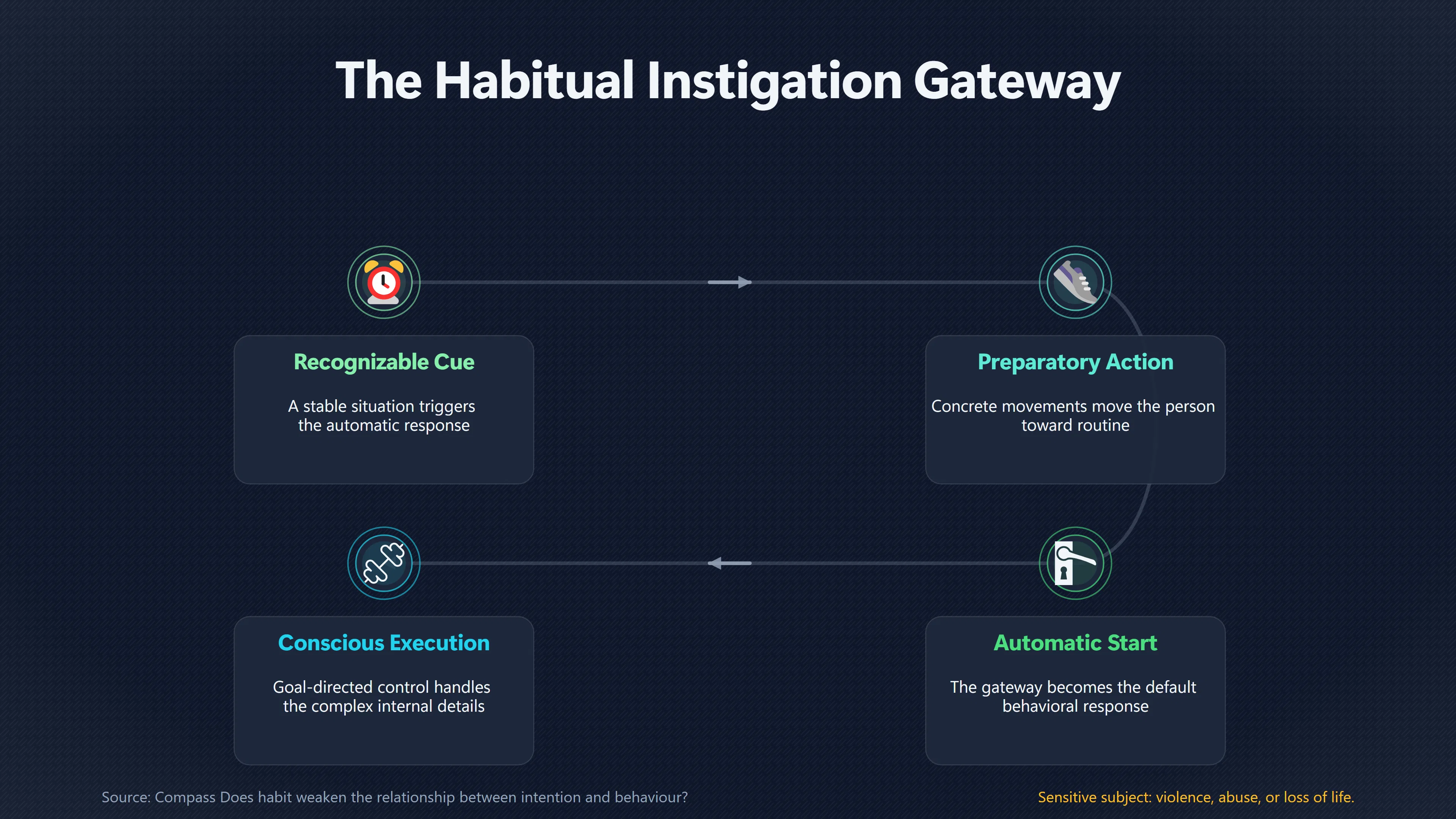
For workouts, study and similar routines, the cue to begin may become automatic long before the full sequence does.
On this page
- Habitual instigation versus habitual execution
- Why automatic starts predict repeated behaviour
- Which gateways are worth making automatic
Page outline Jump by section
Introduction
For a complex routine, the first part to become habitual may be the decision or movement that gets the routine under way, not the whole sequence. Habit researchers call this habitual instigation: a familiar cue begins to trigger action with less deliberation. By contrast, habitual execution means the later steps of the routine themselves unfold automatically. Research on exercise and other behaviours suggests that instigation is more closely tied to how often people actually perform a behaviour.[PubMed]pubmed.ncbi.nlm.nih.govHabitual exercise instigation (vs. execution) predicts healthy adults' exercise frequency - PubMedJanuary 1, 2016…
That distinction changes what “making exercise a habit” or “making studying a habit” realistically means. A workout can still require choices about exercises, weights and effort after arriving at the gym. A study session can still require deciding which problems to tackle. The useful habit may instead be the reliable gateway: when a recurring cue appears, beginning becomes the default response.
Instigation is different from execution
Consider “going for a run”. At one level, the behaviour involves choosing to run rather than continuing with whatever else you are doing. At another, it contains a chain of smaller actions: changing clothes, putting on trainers, leaving home, choosing a route, adjusting pace and eventually stopping. Gardner, Phillips and Judah formalised this distinction between automatically instigating an action episode and automatically executing its component actions.[PubMed]pubmed.ncbi.nlm.nih.govHabitual instigation and habitual execution: Definition, measurement, and effects on behaviour frequency - PubMed…
The two need not develop together. Someone might automatically reach for their running kit after finishing work but consciously decide almost everything about the run itself. Conversely, a highly practised gym-goer might perform familiar lifts smoothly once inside the gym yet still have to persuade themselves to go there. Habit strength therefore does not have to be uniform across an entire routine.
This helps resolve an apparent problem with applying habit theory to complex self-improvement behaviours. A simple cue–response association seems capable of explaining “after breakfast, take a tablet”, but less capable of specifying every action in a 45-minute workout. It does not need to. The learned association can operate at the gateway, automatically selecting or initiating “work out now”, while conscious goal-directed control handles much of what follows. As Gardner later argued, complex sequences are unlikely to unfold entirely through habit even when their initiation is strongly habitual.[Compass]compass.onlinelibrary.wiley.comCompass Does habit weaken the relationship between intention and behaviour?Revisiting the habit‐intention interaction hypothesis - Gardner - 2020 - Social and Personality Psychology Compass - Wiley Online Library…
That also explains why repetition of an identical routine is not the same thing as habit. Phillips and Gardner explicitly separated patterned exercise — repeatedly doing similar exercise actions — from the automaticity of instigating or executing exercise. Their study of 123 adults found that instigation habit was the only one of these measures that uniquely predicted exercise frequency.[PubMed]pubmed.ncbi.nlm.nih.govHabitual exercise instigation (vs. execution) predicts healthy adults' exercise frequency - PubMedJanuary 1, 2016…
Why automatic starts predict repeated behaviour
The central advantage of an instigation habit is that it acts at a decisive point: whether the behavioural episode happens at all. If arriving home at 6 pm reliably prompts changing into exercise clothes, or sitting down after dinner reliably prompts opening the material for a study session, one important choice has already been made before the difficult parts begin.
The exercise evidence is particularly revealing. In Phillips and Gardner’s month-long study, participants reported both how automatically exercise was instigated and how automatically it was executed, while recording their exercise in daily electronic diaries. Instigation habit strength uniquely predicted exercise frequency; changes in exercise frequency were also associated with changes in instigation habit rather than execution habit or simply following a patterned workout.[PubMed]pubmed.ncbi.nlm.nih.govHabitual exercise instigation (vs. execution) predicts healthy adults' exercise frequency - PubMedJanuary 1, 2016…
Gardner, Phillips and Judah subsequently examined the distinction in 229 students across flossing, snacking and eating breakfast. Measures specifically targeting habitual instigation were consistently more predictive of later behaviour frequency than measures of habitual execution. Their results also suggested that widely used self-report habit measures largely capture automatic instigation rather than automatic performance of every component of a behaviour.[PubMed]pubmed.ncbi.nlm.nih.govHabitual instigation and habitual execution: Definition, measurement, and effects on behaviour frequency - PubMed…
The same pattern has appeared when behavioural complexity was examined directly. A 2022 study assessed four activities ranging from drinking sugary drinks and checking a phone to using social media and public transport. Among 173 participants initially surveyed, with 118 providing follow-up frequency data, habitual instigation predicted behaviour across the activities whereas habitual execution did not. Crucially, the relationship between instigation habit and behaviour held across different levels of perceived complexity.[ScienceDirect]sciencedirect.comHabit and behavioural complexity: habitual instigation and execution as predictors of simple and complex behaviours - Scienc…
The practical interpretation should remain modest. These studies do not establish that making a start automatic will inevitably cause someone to maintain every complex routine. Much of the evidence relies on self-reported habit measures and observational associations, and the original instigation-versus-execution researchers explicitly called for more experimental work.[PubMed]pubmed.ncbi.nlm.nih.govHabitual instigation and habitual execution: Definition, measurement, and effects on behaviour frequency - PubMed… What the evidence supports more strongly is a narrower proposition: automatic initiation appears to be an especially important component of the relationship between habit and repeated behaviour.
The gateway can be smaller than the routine
There is a further useful refinement. The habit worth developing does not necessarily have to be “start exercising” as an abstract mental decision. It can involve a concrete preparatory behaviour that reliably moves the person towards the larger routine.
A six-week study of 181 adults recruited from nine gyms and recreation centres separated exercise preparation from exercise performance. Intention and habitual preparation predicted exercise and changes in exercise over the study period, whereas habit of exercise performance did not. Temporal consistency — performing the relevant behaviour at a consistent time — was particularly important in both phases. The researchers concluded that establishing a consistent preparatory routine could help establish exercise habits.[BPS Psych Hub]bpspsychub.onlinelibrary.wiley.comBPS Psych Hub The role of habit in different phases of exerciseBPS Psych HubThe role of habit in different phases of exercise - Kaushal - 2017 - British Journal of Health Psychology - Wiley Online Lib…
More recent experimental evidence points in a similar direction. A 2025 factorial study of new users of an online exercise-class platform tested several motivational and habit-focused intervention components. The preparation-habit intervention produced the clearest effects on exercise participation and increased both preparation and instigation habit strength. The authors interpreted the findings as evidence that habitualising preparation may help people initiate and maintain exercise, while noting greater uncertainty around some longer-term estimates as participant numbers declined during follow-up.[IAAP Journals]iaap-journals.onlinelibrary.wiley.comOpen source on wiley.com.
This suggests a useful hierarchy for complex routines. “Exercise regularly” may be too broad to function as one repeatable response. “When I finish work, put on my exercise clothes” is much more specific. Once that gateway repeatedly leads into exercise, the cue can become increasingly associated with beginning the behavioural episode, even while the workout remains flexible.
The same mechanism can plausibly be applied to study and other self-improvement routines, although the direct evidence is much stronger for exercise than for elaborate study routines. A study gateway might be putting the phone away and opening the same study application after dinner; a writing gateway might be opening the current document after making morning coffee. These are applications of the mechanism, not evidence that every such gateway has been experimentally shown to form a habit.
Which gateways are worth making automatic?
A useful gateway is not merely the easiest action imaginable. It should sit close enough to the desired routine that repeatedly performing it makes continuation likely. “Drink coffee” is a poor study gateway if coffee is followed by ten different activities; “after putting my dinner plate away, sit at the desk and open today’s practice questions” links a recognisable situation to an action that has already crossed the threshold into studying.
Three characteristics matter particularly:
- A recognisable cue. Habit theory depends on repeated cue–behaviour associations. A recurring time, place, preceding activity or other stable situation can provide the trigger. Habit research broadly defines habits as behaviours prompted automatically by such learned contextual associations.[PubMed Central (PMC)]pmc.ncbi.nlm.nih.govOpen source on nih.gov.
- A concrete first response. “Be productive” leaves another decision to make. Changing into gym clothes, opening the textbook or beginning the warm-up specifies what happens when the cue arrives.
- A genuine bridge into the routine. The gateway should reduce the remaining distance to the target behaviour rather than becoming a substitute for it. Packing a gym bag is useful insofar as it reliably helps produce exercise.
Planning can help establish this cue–response link before ordinary repetition has had time to strengthen it. Implementation intentions — plans of the form “if situation X occurs, then I will do Y” — make the relevant cue more accessible and connect it more strongly to the intended response. A 2024 meta-analysis covering 642 independent tests found implementation intentions beneficial across cognitive, emotional and behavioural outcomes, with stronger effects for contingent if–then plans, highly motivated participants and rehearsed plans.[DOI]doi.orgOpen source on doi.org. Earlier experimental work likewise indicates that such planning can facilitate detecting the specified cue and initiating its associated response efficiently and quickly.[PubMed Central (PMC)]pmc.ncbi.nlm.nih.govOpen source on nih.gov.
Implementation intentions and habits are not identical: deliberately making an if–then plan is a self-regulation strategy, whereas a habit is a learned cue–behaviour association strengthened through experience. But the planning research illustrates why a well-defined gateway is useful. It transfers some control from repeated moment-to-moment deliberation to a recognisable situation and a prepared response.
Automatic starting is enough to change the goal
The important shift is from asking, “When will this entire routine become effortless?” to asking, “Which decision do I want to stop having to remake?”
For a complex routine, complete automatic execution may be neither realistic nor desirable. Study content changes. Training programmes progress. Workouts need adjustment for fatigue, injury and equipment. Productive routines often require attention precisely because their later stages involve judgement. Habit can still contribute by repeatedly getting the person to the point where those judgements need to be made.
This interpretation is also consistent with the broader habit-formation literature. A recent systematic review found wide variation in the time needed for health behaviours to develop automaticity and identified contextual stability, repetition, planning and preparatory habits among the factors associated with formation. It therefore gives little support to expecting every component of a substantial routine to become automatic on a fixed timetable.[PubMed Central (PMC)]pmc.ncbi.nlm.nih.govOpen source on nih.gov.
For self-improvement that works, the most valuable automaticity may consequently be quite small. The workout does not have to run on autopilot if finishing work reliably gets you into your exercise clothes. The study session does not have to require no thought if the end of dinner reliably gets you to the desk. With complex behaviours, making the transition from not doing to doing habitual can matter more than trying to automate everything that comes afterwards.
Amazon book picks
Further Reading
Books and field guides related to Why Starting the Routine May Be the Real Habit. Use these as the next step if you want deeper reading beyond the article.
Good Habits, Bad Habits
'The world's leading expert on habits' - Matthew Syed, bestselling author of Black Box Thinking and Rebel IdeasWhat if you could harness...
Atomic Habits
Rating: 3.5/5 from 7 Google Books ratings
The #1 New York Times bestseller. Over 25 million copies sold! Translated into 60+ languages! Tiny Changes, Remarkable Results No matter...
Tiny Habits
Improving your life is much easier than you think. Whether it’s losing weight, sleeping more, or restoring your work/life balance – the s...
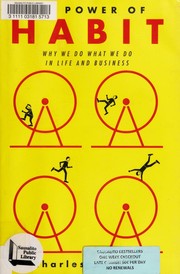
The Power of Habit
Rating: 4.0/5 from 145 Google Books ratings
Duhigg takes us to the edge of scientific discoveries that explain why habits exist and how they can be changed. Distilling information i...
eBay marketplace picks
Marketplace Samples
Live-tested eBay searches with available results related to this page.
Selected fromhabit tracker board oneBay.co.uk.
Endnotes
1.
Source: sciencedirect.com
Link:https://www.sciencedirect.com/science/article/pii/S266651822200016X
Source snippet
Habit and behavioural complexity: habitual instigation and execution as predictors of simple and complex behaviours - Scienc...
2.
Source: doi.org
Link:https://doi.org/10.1080/10463283.2024.2334563
3.
Source: doi.org
Link:https://doi.org/10.3390/healthcare12232488
4.
Source: sciencedirect.com
Link:https://www.sciencedirect.com/science/article/pii/S0300571220302165
5.
Source: sciencedirect.com
Link:https://www.sciencedirect.com/science/article/pii/S1469029219301967
6.
Source: sciencedirect.com
Link:https://www.sciencedirect.com/science/article/abs/pii/S0065260106380021
7.
Source: sciencedirect.com
Link:https://www.sciencedirect.com/science/article/abs/pii/S1469029219301967
8.
Source: sciencedirect.com
Link:https://www.sciencedirect.com/journal/current-research-in-behavioral-sciences/vol/3/suppl/C
9.
Source: pubmed.ncbi.nlm.nih.gov
Link:https://pubmed.ncbi.nlm.nih.gov/26148187/
Source snippet
Habitual exercise instigation (vs. execution) predicts healthy adults' exercise frequency - PubMedJanuary 1, 2016...
Published: January 1, 2016
10.
Source: pubmed.ncbi.nlm.nih.gov
Link:https://pubmed.ncbi.nlm.nih.gov/26991427/
Source snippet
Habitual instigation and habitual execution: Definition, measurement, and effects on behaviour frequency - PubMed...
11.
Source: compass.onlinelibrary.wiley.com
Title: Compass Does habit weaken the relationship between intention and behaviour?
Link:https://compass.onlinelibrary.wiley.com/doi/10.1111/spc3.12553
Source snippet
Revisiting the habit‐intention interaction hypothesis - Gardner - 2020 - Social and Personality Psychology Compass - Wiley Online Library...
12.
Source: bpspsychub.onlinelibrary.wiley.com
Title: BPS Psych Hub The role of habit in different phases of exercise
Link:https://bpspsychub.onlinelibrary.wiley.com/doi/abs/10.1111/bjhp.12237
Source snippet
BPS Psych HubThe role of habit in different phases of exercise - Kaushal - 2017 - British Journal of Health Psychology - Wiley Online Lib...
13.
Source: bpspsychub.onlinelibrary.wiley.com
Title: BPS Psych Hub The role of habit in different phases of exercise
Link:https://bpspsychub.onlinelibrary.wiley.com/doi/10.1111/bjhp.12237
Source snippet
BPS Psych HubThe role of habit in different phases of exercise - Kaushal - 2017 - British Journal of Health Psychology - Wiley Online Lib...
14.
Source: iaap-journals.onlinelibrary.wiley.com
Link:https://iaap-journals.onlinelibrary.wiley.com/doi/10.1111/aphw.12597
15.
Source: pmc.ncbi.nlm.nih.gov
Link:https://pmc.ncbi.nlm.nih.gov/articles/PMC11652125/
16.
Source: pmc.ncbi.nlm.nih.gov
Link:https://pmc.ncbi.nlm.nih.gov/articles/PMC4566897/
17.
Source: pmc.ncbi.nlm.nih.gov
Link:https://pmc.ncbi.nlm.nih.gov/articles/PMC4500900/
18.
Source: pmc.ncbi.nlm.nih.gov
Link:https://pmc.ncbi.nlm.nih.gov/articles/PMC11641623/
19.
Source: bpspsychub.onlinelibrary.wiley.com
Link:https://bpspsychub.onlinelibrary.wiley.com/doi/10.1111/bjop.70065
20.
Source: pubmed.ncbi.nlm.nih.gov
Link:https://pubmed.ncbi.nlm.nih.gov/40965419/
21.
Source: pubmed.ncbi.nlm.nih.gov
Link:https://pubmed.ncbi.nlm.nih.gov/39702740/
22.
Source: iaap-journals.onlinelibrary.wiley.com
Link:https://iaap-journals.onlinelibrary.wiley.com/doi/10.1111/aphw.12600
23.
Source: compass.onlinelibrary.wiley.com
Link:https://compass.onlinelibrary.wiley.com/doi/full/10.1111/spc3.12975
24.
Source: compass.onlinelibrary.wiley.com
Link:https://compass.onlinelibrary.wiley.com/doi/10.1111/spc3.12975
25.
Source: compass.onlinelibrary.wiley.com
Link:https://compass.onlinelibrary.wiley.com/doi/abs/10.1111/spc3.12975
26.
Source: pmc.ncbi.nlm.nih.gov
Link:https://pmc.ncbi.nlm.nih.gov/articles/PMC11891988/
27.
Source: pmc.ncbi.nlm.nih.gov
Link:https://pmc.ncbi.nlm.nih.gov/articles/PMC10669490/
28.
Source: pmc.ncbi.nlm.nih.gov
Link:https://pmc.ncbi.nlm.nih.gov/articles/PMC9540191/
29.
Source: pubmed.ncbi.nlm.nih.gov
Link:https://pubmed.ncbi.nlm.nih.gov/36211848/
30.
Source: pmc.ncbi.nlm.nih.gov
Link:https://pmc.ncbi.nlm.nih.gov/articles/PMC9226889/
31.
Source: pmc.ncbi.nlm.nih.gov
Link:https://pmc.ncbi.nlm.nih.gov/articles/PMC8961486/
32.
Source: pmc.ncbi.nlm.nih.gov
Link:https://pmc.ncbi.nlm.nih.gov/articles/PMC7969808/
33.
Source: pmc.ncbi.nlm.nih.gov
Link:https://pmc.ncbi.nlm.nih.gov/articles/PMC7645026/
34.
Source: onlinelibrary.wiley.com
Link:https://onlinelibrary.wiley.com/doi/10.1002/9781119568124.ch48
35.
Source: pmc.ncbi.nlm.nih.gov
Link:https://pmc.ncbi.nlm.nih.gov/articles/PMC7020232/
36.
Source: pubmed.ncbi.nlm.nih.gov
Link:https://pubmed.ncbi.nlm.nih.gov/29945470/
37.
Source: compass.onlinelibrary.wiley.com
Link:https://compass.onlinelibrary.wiley.com/doi/10.1111/spc3.12323
38.
Source: pubmed.ncbi.nlm.nih.gov
Link:https://pubmed.ncbi.nlm.nih.gov/28374463/?dopt=Abstract
39.
Source: bpspsychub.onlinelibrary.wiley.com
Link:https://bpspsychub.onlinelibrary.wiley.com/doi/10.1111/bjhp.12189
40.
Source: bpspsychub.onlinelibrary.wiley.com
Link:https://bpspsychub.onlinelibrary.wiley.com/doi/abs/10.1111/bjhp.12189
41.
Source: pubmed.ncbi.nlm.nih.gov
Link:https://pubmed.ncbi.nlm.nih.gov/26236214/
42.
Source: ouci.dntb.gov.ua
Link:https://ouci.dntb.gov.ua/en/works/7nNN23j7/
Additional References
43.
Source: doaj.org
Link:https://doaj.org/article/db83a09493274ca292a497f71922ed61
Source snippet
Directory of Open Access JournalsHabit and behavioural complexity: habitual instigation and execution as predictors of simple and complex...
44.
Source: kclpure.kcl.ac.uk
Link:https://kclpure.kcl.ac.uk/portal/en/publications/habitual-instigation-and-habitual-execution-definition-measuremen/
Source snippet
King's College LondonHabitual Instigation and Habitual Execution: Definition, Measurement, and Effects on Behaviour Frequency - King's Co...
45.
Source: kclpure.kcl.ac.uk
Link:https://kclpure.kcl.ac.uk/portal/en/publications/habitual-exercise-instigation-vs-execution-predicts-healthy-adult/
Source snippet
King's College LondonHabitual exercise instigation (vs. execution) predicts healthy adults' exercise frequency - King's College London...
46.
Source: youtube.com
Title: How To Change with Prof. Katy Milkman
Link:https://www.youtube.com/watch?v=crdFZHA_z1U
Source snippet
The Psychology of Habits | Dr. Benjamin Gardner | 3 The Mental Wellbeing College · 924 views...
47.
Source: youtube.com
Title: The Psychology of Habits | Dr. Benjamin Gardner | 3
Link:https://www.youtube.com/watch?v=83cKQylK7zo
Source snippet
PAN Podcast #6 | Dr. Phillippa Lally | Habits and Health...
48.
Source: youtube.com
Title: Good Habits, Bad Habits: Wendy Wood, Ph D
Link:https://www.youtube.com/watch?v=RRcJhyJGR08
Source snippet
Forget big change, start with a tiny habit: BJ Fogg at TEDxFremont...
49.
Source: youtube.com
Title: PAN Podcast #6 | Dr. Phillippa Lally | Habits and Health
Link:https://www.youtube.com/watch?v=7A5AgZLd5bY
Source snippet
Good Habits, Bad Habits: Wendy Wood, PhD...
50.
Source: researchgate.net
Link:https://www.researchgate.net/publication/362509175_Habit_and_behavioural_complexity_habitual_instigation_and_execution_as_predictors_of_simple_and_complex_behaviours
51.
Source: researchgate.net
Link:https://www.researchgate.net/publication/279807291_Habitual_Exercise_Instigation_vs_Execution_Predicts_Healthy_Adults%27_Exercise_Frequency
52.
Source: researchgate.net
Link:https://www.researchgate.net/publication/298790980_Habitual_instigation_and_habitual_execution_Definition_measurement_and_effects_on_behaviour_frequency