Within Physical Capacity
What Happens to Your Thinking After Exercise?
Even a single bout of exercise can produce modest short-term gains in attention, memory, processing and executive function.
On this page
- Which cognitive abilities improve after a single session
- How large and reliable the average effects appear to be
- Using movement before demanding mental work realistically
Page outline Jump by section
Introduction
A short bout of exercise can sharpen some aspects of thinking soon afterwards. The effect is not dramatic, and it does not turn an ordinary working day into a state of exceptional mental performance, but the average result across a large research literature is positive: attention, executive function, memory and information processing can all improve modestly after a single exercise session. A 2025 meta-review combining 30 previous meta-analyses, 383 unique studies and 18,347 participants estimated an overall small-to-medium benefit, with the clearest effects when cognition was measured after exercise rather than during it.[PubMed]pubmed.ncbi.nlm.nih.govEffects of acute exercise on cognitive function: A meta-review of 30 systematic reviews with meta-analyses - PubMedJanuary 30, 2025…
That makes exercise unusual among self-improvement habits. Some of its value accumulates over months and years, but part of the return can arrive on the same day. For someone about to study, write, solve problems or return to mentally demanding work, a short movement break may therefore serve two purposes at once: physical activity in its own right and a temporary improvement in readiness for cognitive work.
Which mental abilities improve after one session?
The strongest recent overview is the 2025 Psychological Bulletin meta-review of acute exercise — meaning one exercise session rather than a training programme. Across the meta-analyses it examined, acute exercise improved overall cognitive performance by a standardised mean difference of 0.33. Benefits appeared across all five broad categories reported: attention (0.37), executive function (0.36), memory (0.23), information processing (0.20) and mixed or other cognitive measures (0.36).[PubMed]pubmed.ncbi.nlm.nih.govEffects of acute exercise on cognitive function: A meta-review of 30 systematic reviews with meta-analyses - PubMedJanuary 30, 2025…
Those categories translate into different everyday mental demands. Attention concerns selecting and maintaining focus. Executive functions include processes such as suppressing an inappropriate response, holding information in working memory and switching between rules or tasks. Information processing includes how efficiently someone detects, interprets and responds to information. Memory effects concern learning, storage or retrieval, depending on when exercise occurs relative to the material being learned.
The pattern is important because the post-workout effect is not simply “feeling more awake”. Controlled experiments use cognitive tasks and compare performance under exercise and control conditions. An individual-participant-data meta-analysis of acute aerobic exercise, for example, found beneficial post-exercise effects even after accounting for participants’ performance before exercise. Interestingly, people who began with poorer cognitive performance tended to benefit more.[PubMed]pubmed.ncbi.nlm.nih.govOpen source on nih.gov.
A 2024 Bayesian meta-analysis provides a useful reality check. It synthesised 113 studies involving 4,390 healthy young adults and found only a small improvement in overall cognition, with an effect size of g = 0.13. The more conspicuous change was in reaction time: exercise made responses faster, whereas there was no credible overall improvement in accuracy. Within executive-function tasks, the analysis found evidence of improvements in inhibition and working memory.[PubMed Central (PMC)]pmc.ncbi.nlm.nih.govPubMed Central (PMC)A systematic review and Bayesian meta-analysis provide evidence for an effect of acute physical activity on cognition…
This distinction between faster thinking and more accurate thinking is one of the most useful ways to understand the literature. Earlier meta-analytic work likewise found that speed accounted for much of the cognitive benefit, particularly around moderate-intensity exercise, while changes in accuracy were much smaller.[PubMed]pubmed.ncbi.nlm.nih.govOpen source on nih.gov. A post-exercise boost should therefore not be interpreted as a temporary increase in intelligence. It is closer to a modest change in the efficiency with which some mental operations are performed.
Why can moving your body change thinking so quickly?
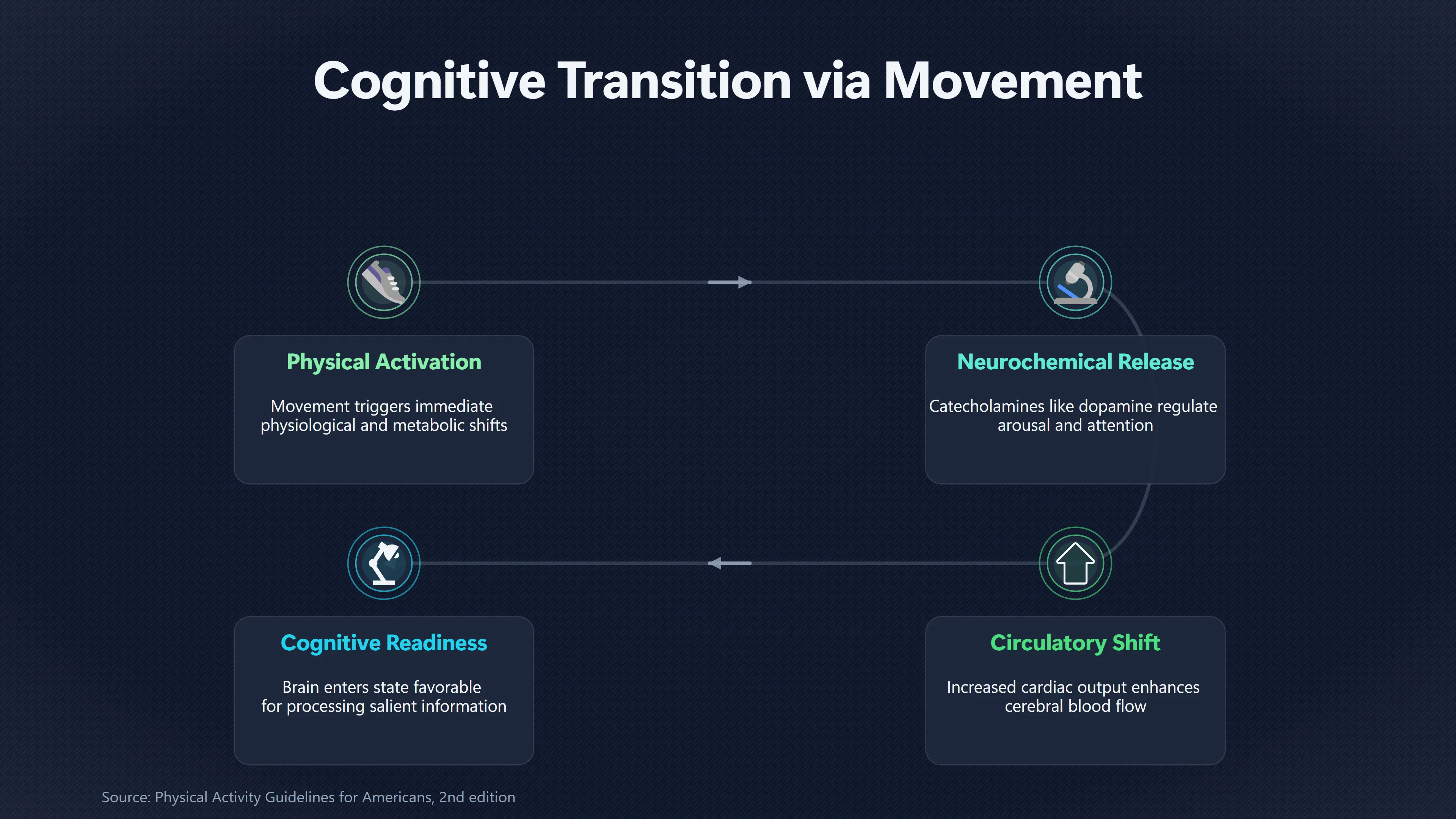
There is no single proven “exercise molecule” that explains the immediate cognitive effect. Exercise simultaneously alters arousal, neurotransmitter activity, circulation, metabolism and signalling between peripheral tissues and the brain. Researchers have several overlapping explanations, and the evidence is stronger for the existence of the cognitive effect than for any one complete causal account of it.[PubMed]pubmed.ncbi.nlm.nih.govThe acute exercise-cognition interaction: From the catecholamines hypothesis to an interoception model - PubMedOctober 16, 2021…
One prominent mechanism involves catecholamines, particularly dopamine and noradrenaline. These neurotransmitters help regulate arousal, attention and cognitive control. Models of the acute exercise–cognition relationship propose that the physiological stimulation produced by exercise can move the brain into a state more favourable for processing salient information and exercising top-down control. Moderate exercise has often fitted this account particularly well, although newer models emphasise that intensity, perceived effort, motivation and the cognitive task all interact rather than following one simple “more exercise equals more arousal equals better thinking” rule.[PubMed]pubmed.ncbi.nlm.nih.govDeveloping the catecholamines hypothesis for the acute exercise-cognition interaction in humans: Lessons from animal studies - PubM…
Exercise also changes cerebral blood flow and neurobiological signalling. Brain-derived neurotrophic factor (BDNF), a protein involved in synaptic plasticity, is frequently discussed in this context. Exercise can increase circulating BDNF and other signalling molecules, while greater cardiac output and changes in cerebral circulation may contribute to the brain’s response. However, measuring BDNF in the blood does not straightforwardly reveal what is happening inside the brain, so it is premature to attribute the immediate cognitive improvement to BDNF alone.[PubMed Central (PMC)]pmc.ncbi.nlm.nih.govPubMed Central (PMC)Molecular mechanisms underlying physical exercise-induced brain BDNF overproduction - PMC…
A 2026 scoping review of acute exercise, cognitive performance and neurobiological markers illustrates both the plausibility and the uncertainty. Studies have reported post-exercise changes involving BDNF, lactate, catecholamines and prefrontal activation alongside improvements particularly in executive function and processing speed. But variation in exercise protocols, biomarker measurements and testing times makes it difficult to establish a neat causal chain from a particular biological change to a particular improvement in thinking.[PubMed]pubmed.ncbi.nlm.nih.govOpen source on nih.gov.
The safest interpretation is therefore mechanistic but not reductionist: exercise briefly changes the physiological state in which cognition operates, and several interacting brain and body systems probably contribute to the resulting performance changes.
How large and reliable is the boost?
The evidence is convincing enough to say that there is an average acute benefit, but not convincing enough to promise a noticeable improvement every time someone exercises. Estimates vary substantially according to which studies, populations and cognitive tests are included.
The 2025 meta-review’s overall estimate of 0.33 is encouraging, but the 2024 analysis restricted to healthy young adults produced a considerably smaller estimate of 0.13. An influential 2012 meta-analysis of 79 studies also found a small overall effect, g = 0.097, including small benefits both immediately after exercise and following a delay.[nih.gov]pubmed.ncbi.nlm.nih.govEffects of acute exercise on cognitive function: A meta-review of 30 systematic reviews with meta-analyses - PubMedJanuary 30, 2025… These differences are not necessarily contradictions: reviews make different inclusion decisions and combine different kinds of experiments.
There is also substantial variation from study to study. The 2024 Bayesian review found high heterogeneity within studies and evidence of publication bias in the literature, even though its analyses designed to address that bias continued to indicate a small positive overall effect.[PubMed Central (PMC)]pmc.ncbi.nlm.nih.govPubMed Central (PMC)A systematic review and Bayesian meta-analysis provide evidence for an effect of acute physical activity on cognition… This is a good reason to resist eye-catching claims based on one experiment showing a large improvement after a particular workout.
Nor does the evidence support one universally optimal exercise prescription. In the large 2025 meta-review, exercise intensity, type and duration did not significantly moderate the overall positive effect.[PubMed]pubmed.ncbi.nlm.nih.govEffects of acute exercise on cognitive function: A meta-review of 30 systematic reviews with meta-analyses - PubMedJanuary 30, 2025… Earlier and more narrowly defined analyses have found differences by intensity or modality, so this does not mean those variables never matter. Rather, the combined literature does not justify a rule such as “exactly 20 minutes at moderate intensity is the cognitive sweet spot”.
Short sessions can nevertheless be sufficient. The 2024 young-adult meta-analysis included exercise bouts of 16 minutes or less as a distinct duration category, alongside longer sessions. Its broader findings did not indicate that a long workout was necessary to obtain an acute effect.[PubMed Central (PMC)]pmc.ncbi.nlm.nih.govPubMed Central (PMC)A systematic review and Bayesian meta-analysis provide evidence for an effect of acute physical activity on cognition… In a randomised crossover study of healthcare workers, ten-minute outdoor or exercise-game activity breaks after four hours of work produced better subsequent performance on tests of attention and executive function than a passive break, although the study was small, with only 27 participants.[PubMed Central (PMC)]pmc.ncbi.nlm.nih.govOpen source on nih.gov.
That is the practical attraction of the phenomenon: the potentially useful unit is a bout of movement, not necessarily a full gym session.

Timing matters more than “exercise is good for the brain”
When exercise happens relative to the mental task can change the result. The 2025 meta-review found assessment timing to be a significant moderator, with the largest overall benefit when cognition was tested after exercise.[PubMed]pubmed.ncbi.nlm.nih.govEffects of acute exercise on cognitive function: A meta-review of 30 systematic reviews with meta-analyses - PubMedJanuary 30, 2025… An earlier meta-regression similarly found an average improvement after exercise but showed that performance during exercise could be worse under some conditions, particularly early in the bout.[PubMed]pubmed.ncbi.nlm.nih.govOpen source on nih.gov.
That makes intuitive as well as physiological sense. Trying to solve a complicated problem while running hard divides resources between the physical task and the mental one. Finishing the movement first removes that competition while leaving some of the exercise-induced physiological changes in place.
Memory adds another complication because learning is not one event. Information is first encoded and then consolidated into a more durable memory. A meta-analysis of 25 studies found that exercise during memory encoding produced a small detrimental effect, whereas exercise during early and late consolidation periods was associated with better subsequent episodic memory. Exercise immediately before encoding produced only a small, statistically uncertain average effect.[PubMed Central (PMC)]pmc.ncbi.nlm.nih.govOpen source on nih.gov.
So “exercise before studying” is too crude a prescription. If the task requires carefully absorbing unfamiliar material, exercising simultaneously is unlikely to be clever. A separate bout followed by focused study is more consistent with the general post-exercise literature, while movement after learning may interact differently with memory consolidation.
There is no equally solid universal countdown for how long the boost lasts. In the 2024 young-adult synthesis, executive-function benefits were detectable immediately after exercise and in analyses covering roughly 20–75 minutes afterwards; estimates at three hours or more were much less convincing.[PubMed Central (PMC)]pmc.ncbi.nlm.nih.govPubMed Central (PMC)A systematic review and Bayesian meta-analysis provide evidence for an effect of acute physical activity on cognition… The sensible unit is therefore a post-exercise window, not a claim that cognition will be enhanced for an exact number of minutes.
Using movement before demanding mental work realistically
The evidence supports a low-stakes strategy rather than a productivity hack: when practical, put a manageable bout of movement shortly before a period in which attention or executive control matters.
For example, someone who has been sitting through meetings all morning might take a brisk walk before beginning an analytical task. A student could separate a short exercise break from the next study block rather than attempting to learn difficult material while exercising. Someone experiencing an afternoon decline in alertness might test whether ten or twenty minutes of movement works better for them than remaining seated and pushing harder.
The research suggests several useful boundaries:
- Expect a nudge, not a transformation. Average effects range from small to small-to-medium depending on the evidence synthesis, and an individual session may produce little noticeable difference.[PubMed Central (PMC)]pmc.ncbi.nlm.nih.govPubMed Central (PMC)A systematic review and Bayesian meta-analysis provide evidence for an effect of acute physical activity on cognition…
- Do not assume harder is better. High-intensity exercise can produce acute executive-function benefits, but a meta-analysis found it was not significantly superior to low-to-moderate exercise for executive function.[PubMed]pubmed.ncbi.nlm.nih.govOpen source on nih.gov.
- Separate exercise from tasks requiring undivided attention. Post-exercise testing generally produces clearer benefits than attempting demanding cognition during the workout.[PubMed]pubmed.ncbi.nlm.nih.govEffects of acute exercise on cognitive function: A meta-review of 30 systematic reviews with meta-analyses - PubMedJanuary 30, 2025…
- Choose something repeatable. Because large reviews do not identify one indispensable exercise type or duration, convenience can reasonably carry considerable weight. Walking, cycling, resistance exercise and other forms of movement have all appeared in the acute-exercise literature.[PubMed]pubmed.ncbi.nlm.nih.govEffects of acute exercise on cognitive function: A meta-review of 30 systematic reviews with meta-analyses - PubMedJanuary 30, 2025…
- Judge the strategy by the work that follows. Feeling energised is not the same as performing better. If using exercise deliberately as a pre-work routine, the meaningful question is whether the subsequent reading, writing, problem-solving or concentration actually becomes easier or more effective.
There are concrete examples showing why modest expectations matter. In one classroom experiment involving 96 children, ten- and twenty-minute exercise breaks improved subsequent maths performance compared with a sedentary lesson, yet the researchers did not find improvements on their executive-function measures.[PubMed]pubmed.ncbi.nlm.nih.govOpen source on nih.gov. Different tests can therefore tell different stories even within the same experiment.
This is also why the immediate effect should not be confused with the broader benefits of regular physical activity. Public-health guidance recognises that some benefits of moderate-to-vigorous activity can occur on the day it is performed, while many other health and functional benefits depend on repeated activity over time.[CDC]cdc.govPhysical Activity Guidelines for Americans, 2nd editionPhysical Activity Guidelines for Americans, 2nd edition A ten-minute walk before concentrated work is not a substitute for maintaining an active life.

The useful takeaway: movement can be a mental transition
The most defensible version of the post-workout cognitive boost is pleasantly ordinary. A single bout of exercise appears to produce a modest temporary improvement in cognitive performance on average, especially when thinking is tested afterwards. Attention and executive function show relatively consistent benefits; processing speed and reaction time often improve; memory can benefit too, although its relationship with exercise depends especially strongly on timing.[PubMed]pubmed.ncbi.nlm.nih.govEffects of acute exercise on cognitive function: A meta-review of 30 systematic reviews with meta-analyses - PubMedJanuary 30, 2025…
For self-improvement, that creates a practical connection between physical activity and other goals. Exercise need not occupy a completely separate compartment labelled “fitness”. A short walk, cycle or other manageable bout of movement can also mark the transition from sitting to studying, from meetings to concentrated work, or from an unfocused period into a demanding task.
The advantage is probabilistic rather than magical. The workout does not supply knowledge, motivation or good judgement, and it cannot guarantee concentration. What it can do is temporarily shift the conditions under which those capacities operate. Used that way, the immediate cognitive effect of exercise is less a performance trick than a small piece of useful infrastructure: move first, then give the brain something worthwhile to do.
Amazon book picks
Further Reading
Books and field guides related to What Happens to Your Thinking After Exercise?. Use these as the next step if you want deeper reading beyond the article.
Spark
A groundbreaking and fascinating investigation into the transformative effects of exercise on the brain, from the bestselling author and...
The Joy of Movement
The bestselling author of The Willpower Instinct introduces a surprising science-based book that doesn't tell us why we should exercise b...
Move!
A New Scientist best book of 2021Shortlisted for the 'Sports Performance Book of the Year' Award for 2022Did you know that walking can im...
Exercised
The book tells the story of how we never evolved to exercise - to do voluntary physical activity for the sake of health. Using his own re...
eBay marketplace picks
Marketplace Samples
Live-tested eBay searches with available results related to this page.
Selected fromfitness poster oneBay.co.uk.
Endnotes
1.
Source: cdc.gov
Title: Physical Activity Guidelines for Americans, 2nd edition
Link:https://www.cdc.gov/physical-activity/media/pdfs/Physical_Activity_Guidelines_2nd_edition.pdf
2.
Source: cdc.gov
Title: Benefits of Physical Activity | Physical Activity Basics | CDC
Link:https://www.cdc.gov/physical-activity-basics/benefits/
3.
Source: cdc.gov
Link:https://www.cdc.gov/physical-activity-basics/health-benefits/adults.html
4.
Source: cdc.gov
Title: older adults
Link:https://www.cdc.gov/physical-activity-basics/health-benefits/older-adults.html
5.
Source: cdc.gov
Link:https://www.cdc.gov/physicalactivity/basics/index.htm
6.
Source: cdc.gov
Title: boost brain health
Link:https://www.cdc.gov/physical-activity/features/boost-brain-health.html
7.
Source: cdc.gov
Title: health benefits
Link:https://www.cdc.gov/physical-activity-basics/health-benefits/
8.
Source: stacks.cdc.gov
Link:https://stacks.cdc.gov/view/cdc/80657
9.
Source: stacks.cdc.gov
Link:https://stacks.cdc.gov/view/cdc/56637
11.
Source: pubmed.ncbi.nlm.nih.gov
Link:https://pubmed.ncbi.nlm.nih.gov/39883421/
Source snippet
Effects of acute exercise on cognitive function: A meta-review of 30 systematic reviews with meta-analyses - PubMedJanuary 30, 2025...
Published: January 30, 2025
12.
Source: pubmed.ncbi.nlm.nih.gov
Link:https://pubmed.ncbi.nlm.nih.gov/34147558/
13.
Source: pmc.ncbi.nlm.nih.gov
Link:https://pmc.ncbi.nlm.nih.gov/articles/PMC11358546/
Source snippet
PubMed Central (PMC)A systematic review and Bayesian meta-analysis provide evidence for an effect of acute physical activity on cognition...
14.
Source: pubmed.ncbi.nlm.nih.gov
Link:https://pubmed.ncbi.nlm.nih.gov/39242965/
Source snippet
A systematic review and Bayesian meta-analysis provide evidence for an effect of acute physical activity on cognition in young adul...
15.
Source: pubmed.ncbi.nlm.nih.gov
Link:https://pubmed.ncbi.nlm.nih.gov/23064033/
16.
Source: pubmed.ncbi.nlm.nih.gov
Link:https://pubmed.ncbi.nlm.nih.gov/34666105/
Source snippet
The acute exercise-cognition interaction: From the catecholamines hypothesis to an interoception model - PubMedOctober 16, 2021...
Published: October 16, 2021
17.
Source: pmc.ncbi.nlm.nih.gov
Link:https://pmc.ncbi.nlm.nih.gov/articles/PMC10585026/
Source snippet
PubMed Central (PMC)Molecular mechanisms underlying physical exercise-induced brain BDNF overproduction - PMC...
18.
Source: pubmed.ncbi.nlm.nih.gov
Link:https://pubmed.ncbi.nlm.nih.gov/27526999/
Source snippet
Developing the catecholamines hypothesis for the acute exercise-cognition interaction in humans: Lessons from animal studies - PubM...
19.
Source: pmc.ncbi.nlm.nih.gov
Link:https://pmc.ncbi.nlm.nih.gov/articles/5928534/
Source snippet
PubMed Central (PMC)The Effects of Acute Exercise on Mood, Cognition, Neurophysiology, and Neurochemical Pathways: A Review - PMC...
20.
Source: pubmed.ncbi.nlm.nih.gov
Link:https://pubmed.ncbi.nlm.nih.gov/42029567/
21.
Source: pubmed.ncbi.nlm.nih.gov
Title: Pub Med The effects of acute exercise on cognitive performance: a meta-analysis
Link:https://pubmed.ncbi.nlm.nih.gov/22480735/
22.
Source: pmc.ncbi.nlm.nih.gov
Link:https://pmc.ncbi.nlm.nih.gov/articles/PMC11205001/
23.
Source: pubmed.ncbi.nlm.nih.gov
Link:https://pubmed.ncbi.nlm.nih.gov/20381468/
24.
Source: pmc.ncbi.nlm.nih.gov
Link:https://pmc.ncbi.nlm.nih.gov/articles/PMC6523402/
25.
Source: pubmed.ncbi.nlm.nih.gov
Link:https://pubmed.ncbi.nlm.nih.gov/31003491/
26.
Source: pubmed.ncbi.nlm.nih.gov
Link:https://pubmed.ncbi.nlm.nih.gov/31365839/
27.
Source: pubmed.ncbi.nlm.nih.gov
Link:https://pubmed.ncbi.nlm.nih.gov/26009945/
28.
Source: pubmed.ncbi.nlm.nih.gov
Link:https://pubmed.ncbi.nlm.nih.gov/26009945/?dopt=Abstract
29.
Source: pubmed.ncbi.nlm.nih.gov
Link:https://pubmed.ncbi.nlm.nih.gov/42443952/
30.
Source: pmc.ncbi.nlm.nih.gov
Link:https://pmc.ncbi.nlm.nih.gov/articles/PMC13361387/
31.
Source: pmc.ncbi.nlm.nih.gov
Link:https://pmc.ncbi.nlm.nih.gov/articles/PMC13260539/
32.
Source: pmc.ncbi.nlm.nih.gov
Link:https://pmc.ncbi.nlm.nih.gov/articles/PMC13108221/
33.
Source: pubmed.ncbi.nlm.nih.gov
Link:https://pubmed.ncbi.nlm.nih.gov/41638541/
34.
Source: pubmed.ncbi.nlm.nih.gov
Link:https://pubmed.ncbi.nlm.nih.gov/41172983/
35.
Source: pmc.ncbi.nlm.nih.gov
Link:https://pmc.ncbi.nlm.nih.gov/articles/PMC12079670/
36.
Source: pmc.ncbi.nlm.nih.gov
Link:https://pmc.ncbi.nlm.nih.gov/articles/PMC12229068/
37.
Source: pubmed.ncbi.nlm.nih.gov
Link:https://pubmed.ncbi.nlm.nih.gov/39136270/
38.
Source: pubmed.ncbi.nlm.nih.gov
Link:https://pubmed.ncbi.nlm.nih.gov/39025386/
39.
Source: pmc.ncbi.nlm.nih.gov
Link:https://pmc.ncbi.nlm.nih.gov/articles/PMC13281107/
40.
Source: restoredcdc.org
Link:https://restoredcdc.org/www.cdc.gov/physical-activity-basics/health-benefits/adults.html
41.
Source: pubmed.ncbi.nlm.nih.gov
Link:https://pubmed.ncbi.nlm.nih.gov/37868812/
42.
Source: pubmed.ncbi.nlm.nih.gov
Link:https://pubmed.ncbi.nlm.nih.gov/37533754/
43.
Source: pubmed.ncbi.nlm.nih.gov
Link:https://pubmed.ncbi.nlm.nih.gov/37003561/
44.
Source: pubmed.ncbi.nlm.nih.gov
Link:https://pubmed.ncbi.nlm.nih.gov/37075733/
45.
Source: pmc.ncbi.nlm.nih.gov
Link:https://pmc.ncbi.nlm.nih.gov/articles/PMC9732176/
46.
Source: pmc.ncbi.nlm.nih.gov
Link:https://pmc.ncbi.nlm.nih.gov/articles/PMC9538359/
47.
Source: pubmed.ncbi.nlm.nih.gov
Link:https://pubmed.ncbi.nlm.nih.gov/34523365/
48.
Source: pmc.ncbi.nlm.nih.gov
Link:https://pmc.ncbi.nlm.nih.gov/articles/PMC8716584/
49.
Source: pubmed.ncbi.nlm.nih.gov
Link:https://pubmed.ncbi.nlm.nih.gov/34147558/?dopt=Abstract
50.
Source: pmc.ncbi.nlm.nih.gov
Link:https://pmc.ncbi.nlm.nih.gov/articles/PMC7371984/
51.
Source: pmc.ncbi.nlm.nih.gov
Link:https://pmc.ncbi.nlm.nih.gov/articles/PMC6920172/
52.
Source: pubmed.ncbi.nlm.nih.gov
Link:https://pubmed.ncbi.nlm.nih.gov/31824387/
53.
Source: pmc.ncbi.nlm.nih.gov
Link:https://pmc.ncbi.nlm.nih.gov/articles/PMC6881262/
54.
Source: pubmed.ncbi.nlm.nih.gov
Link:https://pubmed.ncbi.nlm.nih.gov/30838520/
55.
Source: pubmed.ncbi.nlm.nih.gov
Link:https://pubmed.ncbi.nlm.nih.gov/31036563/
56.
Source: pubmed.ncbi.nlm.nih.gov
Link:https://pubmed.ncbi.nlm.nih.gov/28829227/
57.
Source: pubmed.ncbi.nlm.nih.gov
Link:https://pubmed.ncbi.nlm.nih.gov/29031462/
58.
Source: pubmed.ncbi.nlm.nih.gov
Link:https://pubmed.ncbi.nlm.nih.gov/27556572/
59.
Source: pubmed.ncbi.nlm.nih.gov
Link:https://pubmed.ncbi.nlm.nih.gov/25746399/
60.
Source: pubmed.ncbi.nlm.nih.gov
Link:https://pubmed.ncbi.nlm.nih.gov/21163278/
61.
Source: pubmed.ncbi.nlm.nih.gov
Link:https://pubmed.ncbi.nlm.nih.gov/23795769/
Additional References
62.
Source: youtube.com
Link:https://www.youtube.com/watch?v=izWRm4-52l4
Source snippet
Exercise cognitive function brain boost Wendy Suzuki The Brain-Changing Benefits of Exercise | Wendy Suzuki | TED...
63.
Source: youtube.com
Title: The #1 way to strengthen your mind is to use your body | Wendy Suzuki
Link:https://www.youtube.com/watch?v=UTgkSO1lm6o
Source snippet
Change Your Brain: #1 Neuroscientist’s Exercise Protocol for Peak Energy and Focus...
64.
Source: youtube.com
Title: Grow your brain by moving your body—just 10 minutes a day | Wendy Suzuki
Link:https://www.youtube.com/watch?v=vlDUW9f8wIs
Source snippet
Boost Attention & Memory with Science-Based Tools | Dr. Wendy Suzuki...
65.
Source: youtube.com
Title: Boost Attention & Memory with Science-Based Tools | Dr. Wendy Suzuki
Link:https://www.youtube.com/watch?v=099hgtRoUZw
Source snippet
The #1 way to strengthen your mind is to use your body | Wendy Suzuki...
66.
Source: nature.com
Link:https://www.nature.com/articles/s41562-023-01554-4
67.
Source: youtube.com
Title: The Brain-Changing Benefits of Exercise | Wendy Suzuki | TED
Link:https://www.youtube.com/watch?v=BHY0FxzoKZE
Source snippet
Grow your brain by moving your body—just 10 minutes a day | Wendy Suzuki...
68.
Source: researchgate.net
Link:https://www.researchgate.net/publication/383524470_A_systematic_review_and_Bayesian_meta-analysis_provide_evidence_for_an_effect_of_acute_physical_activity_on_cognition_in_young_adults
69.
Source: researchgate.net
Link:https://www.researchgate.net/publication/335314029_Acute_Exercise_Psychological_Stress_Induction_and_Episodic_Memory
70.
Source: scribd.com
Link:https://www.scribd.com/document/773745878/2024-A-systematic-review-and-Bayesian-meta-analysis-provide-evidence-for-an-effect-of-acute-physical-activity-on-cognition-in-young-adults
71.
Source: visualize.jove.com
Link:https://visualize.jove.com/39242965-a-systematic-review-and-bayesian-meta-analysis-provide-evidence-for-an-effect-of-acute-physical-activity-on-cognition-in-young-adults