Within Small Habits
When a Tiny Habit Becomes Too Tiny
Making a habit easier can improve repeatability, but the minimum still needs to contain a real dose of the behaviour you want to build.
On this page
- Why ease improves perceived feasibility
- The difference between a starting ritual and meaningful practice
- Setting a minimum that advances the underlying aim
Page outline Jump by section
Introduction
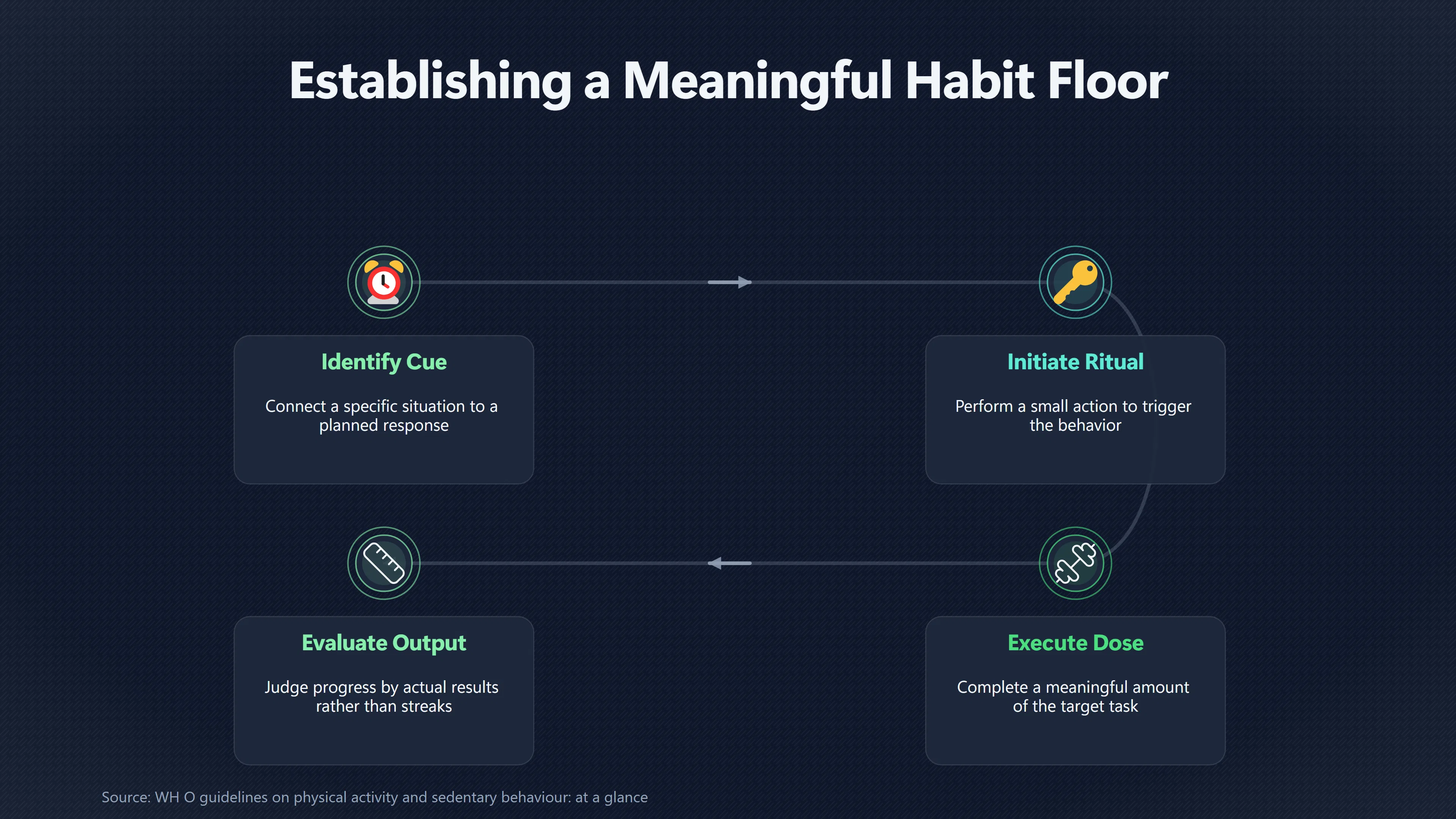
Making a habit easier is often sensible: a behaviour that survives busy, tired and inconvenient days gets more chances to be repeated. But “smaller” is not automatically “better”. A minimum habit becomes too small when it reliably preserves theritual of startingwhile delivering little or none of the behaviour that the person actually wants to develop.
That distinction matters because habit formation and goal progress are not the same thing. Repeating an action in a stable context can strengthen automaticity, but the action being automatised is the action actually performed. Research on habits distinguishes automaticallyinitiatinga behavioural episode from automaticallyexecutingits substantive components. A person can therefore become excellent at opening a book, putting on running shoes or opening a writing document without necessarily accumulating much reading, exercise or writing.
The useful minimum is consequently not the smallest action imaginable. It is the smallest repeatable action that still contains a meaningful dose of the behaviour being built.
Why ease improves feasibility
There is good reason to reduce the difficulty of a new habit. Habit formation depends substantially on repetition in recurring contexts. In Phillippa Lally and colleagues’ real-world study, participants chose an eating, drinking or activity behaviour and attempted it daily in the same context for 12 weeks. Automaticity generally increased with repetition, but the estimated time to reach 95% of its eventual level varied greatly, from 18 to 254 days among participants whose trajectories could be modelled. Missing a single opportunity did not materially disrupt the process.
A behaviour that is too demanding for ordinary life can therefore undermine itself. If the full version requires unusual motivation, abundant time or ideal circumstances, there may simply be too few repetitions for a dependable cue–behaviour relationship to develop. Clinical habit-formation guidance has accordingly recommended manageable, realistic changes rather than ambitious behaviours that are difficult to repeat.
Reducing the minimum can also make initiation less dependent on deliberation. Implementation intentions — plans that connect a situation to a specific response, such as “when X happens, I will do Y” — have been shown to improve action initiation and goal attainment. A meta-analysis covering 94 independent tests reported a medium-to-large overall effect on goal attainment, while experimental work has found that such plans can facilitate initiation even under cognitive load.
This gives small habits their legitimate advantage. “After breakfast, read for ten minutes” contains fewer opportunities for negotiation than “find time today to study properly”. A modest action with a clear cue is easier to enact repeatedly.
But ease solves aninitiation problem. It does not establish that the resulting dose is adequate for the underlying objective.
Starting is not the same as practising
The crucial failure mode appears when the minimum is reduced until its main accomplishment is triggering the beginning of an activity.
Habit research provides a useful distinction betweenhabitual instigationandhabitual execution. Instigation concerns automatically selecting and starting an action; execution concerns automatically performing the sequence of actions that follows. Research by Benjamin Gardner and colleagues found that habitual instigation predicted behavioural frequency, whereas habitual execution did not show the same relationship. Later work across behaviours of different complexity likewise found habitual instigation to be the more important predictor of frequency.
That makes a starting ritual valuable, but also exposes its limitation. Consider four deliberately extreme minima:
- opening a novel and immediately closing it;
- putting on running shoes without doing any physical activity;
- opening a language-learning application but completing no exercise;
- creating a blank document and calling the writing habit complete.
Each action can potentially become cue-driven and automatic. Yet each trains a behaviour that is importantly different from the stated objective. The book-opening habit does not by itself provide reading practice; the shoes do not provide exercise; the blank document does not develop written output.
This is not an argument that every repetition must be large. It is an argument aboutwhat counts as the target response. Habit research generally describes habits as context-linked responses strengthened through repeated performance. If the repeated response is merely preparation, preparation is what receives the repetitions.
A starting ritual can still be useful when it reliably leads onwards. Opening the document may be an excellent cue for writing; putting on trainers may remove friction from going outside. But in that case its value lies in being agateway, not in being an adequate substitute for the behaviour beyond the gate.

The minimum needs a real dose
The phrase “too small to matter” needs care because there is no universal minimum dose across self-improvement behaviours. In some domains, surprisingly small quantities genuinely count.
Physical activity is a particularly important counterexample to the idea that short automatically means worthless. The World Health Organization removed the old requirement that moderate-to-vigorous physical activity had to occur in bouts of at least ten minutes to count. Its guidelines state that some physical activity is better than none, that activity of any duration can contribute, and that inactive adults can begin with small amounts before increasing frequency, intensity and duration.
But the same evidence also demonstrates why “anything counts” should not be confused with “amount does not matter”. WHO describes a dose–response relationship in which greater volumes of activity are associated with greater benefits, while recommending 150–300 minutes of moderate aerobic activity per week, or its vigorous equivalent, for substantial health benefits in adults. One minute of walking is therefore not equivalent to a week containing 150 minutes simply because both are preferable to complete inactivity.
Skill development makes the same distinction from another direction. Research on deliberate practice emphasises repeated performance of tasks designed to improve particular aspects of performance, combined with feedback, evaluation and opportunities for refinement. The wider deliberate-practice literature contains genuine disputes about definitions and how much expertise it explains, so it should not be turned into a simplistic formula. Yet the basic point relevant here is modest:performing the skill is different from performing a ritual adjacent to the skill.
For someone learning a musical instrument, taking the instrument from its case may reduce the barrier to practice. It is not itself practice of timing, technique or repertoire. For someone learning a language, opening a vocabulary deck may be a useful cue, but recalling several words supplies a more defensible minimum because it actually exercises retrieval. The meaningful minimum contains at least some of the mechanism through which improvement is expected to occur.
Beware of optimising the streak
Tiny habits can create a measurement problem as well as a behavioural one. Once success is defined as completing an exceptionally easy minimum, a perfect record can coexist with weak progress.
Imagine that the goal is to read more deeply. A person defines success as “read one sentence per day” and completes it for 100 consecutive days. The streak accurately records 100 repetitions of the minimum. What it cannot establish is that the person has read a meaningful quantity, improved concentration or developed the capacity for sustained reading.
This matters because repetition can strengthen habits even when the behaviour’s connection to a larger goal is imperfect. Contemporary habit research emphasises that habits emerge as rewarding responses are repeated in stable contexts and can eventually be activated directly by those contexts rather than by fresh deliberation about the goal. The machinery of habit formation does not guarantee that the chosen response was well calibrated to the desired outcome.
Perceived reward may reinforce this effect. In a longitudinal study of flossing and vitamin C adherence, pleasure and intrinsic motivation strengthened the relationship between repetition and increasing habit strength. A satisfying tick on a tracker can therefore be motivationally useful, but the broader evidence gives no reason to assume that satisfaction with maintaining a streak substitutes for a sufficient dose of the target behaviour.
The practical danger ismetric substitution: “Did I advance the behaviour?” quietly becomes “Did I preserve the chain?” The streak is useful when it measures worthwhile repetitions. It becomes misleading when the easiest way to protect it is to make the counted behaviour almost empty.
Set a floor that advances the aim
There is no research-backed universal rule saying that a minimum must be five minutes, one page, ten repetitions or any other convenient number. The appropriate floor depends on what the behaviour is supposed to accomplish. The better test is functional:if I repeatedly performed only this minimum, would I still be doing some genuine version of the behaviour I want to develop?
Three distinctions make that test more useful.
First, separate the cue from the dose.“Put on running shoes after work” is a cue-and-initiation routine. “Walk briskly for five minutes after putting on my shoes” contains actual physical activity. “Open the document” is an initiation ritual; “write one complete paragraph” contains writing. Both parts can be useful, but only the latter examples specify a behavioural dose.
Second, choose a floor rather than a target ceiling.A minimum exists to protect repetition on difficult but ordinary days. It need not define what happens on good days. Ten minutes of practice might be the floor while 30 minutes remains typical. This preserves the feasibility advantage of a small habit without turning minimal performance into the ambition.
Third, periodically judge the habit by its underlying output.If the minimum is being completed reliably but weeks pass without appreciable reading, exercise, practice, writing or other intended activity, the system is producing adherence without enough substance. That is evidence to increase the minimum, improve the transition from starting ritual to practice, or redefine what counts.
The appropriate amount may also change as the behaviour becomes easier. Habit formation is gradual rather than a fixed 21-day process, and automaticity can develop at very different rates between people and behaviours. A minimum that was genuinely useful during the first difficult weeks can later become unnecessarily conservative.
Small enough to repeat, large enough to count
The critique of tiny habits is therefore narrower than “small habits do not work”. Small, manageable behaviours can make repetition more feasible, and repeated performance in stable contexts is central to habit formation. Short bouts can also have genuine value: physical-activity guidance is a clear example where even activity below recommended levels can produce benefits.
The problem begins when reducing friction changes the behaviour itself. A useful minimum preserves enough of the intended activity that repeating the minimum still accumulates something valuable: minutes moving, pages read, retrieval attempts made, sentences written, exercises practised or another outcome appropriate to the goal.
That yields a more durable rule for small habits designed to survive ordinary life:shrink the behaviour until it becomes reliably doable, but stop shrinking before success becomes merely symbolic. A starting ritual can get you through the door. The minimum should still take at least one meaningful step beyond it.
Amazon book picks
Further Reading
Books and field guides related to When a Tiny Habit Becomes Too Tiny. Use these as the next step if you want deeper reading beyond the article.
Tiny Habits
Improving your life is much easier than you think. Whether it’s losing weight, sleeping more, or restoring your work/life balance – the s...
Atomic Habits
Rating: 3.5/5 from 7 Google Books ratings
The #1 New York Times bestseller. Over 25 million copies sold! Translated into 60+ languages! Tiny Changes, Remarkable Results No matter...
Good Habits, Bad Habits
'The world's leading expert on habits' - Matthew Syed, bestselling author of Black Box Thinking and Rebel IdeasWhat if you could harness...
Mini Habits
Discover the Life-Changing Strategy of This Worldwide Bestseller in 17 Languages! Lasting Change For Early Quitters, Burnouts, The Unmoti...
eBay marketplace picks
Marketplace Samples
Live-tested eBay searches with available results related to this page.
Selected fromhabit tracker board oneBay.co.uk.

Endnotes
1.
Source: who.int
Link:https://www.who.int/publications/i/item/9789240015128
2.
Source: who.int
Title: WH O guidelines on physical activity and sedentary behaviour: at a glance
Link:https://www.who.int/europe/publications/i/item/9789240014886
3.
Source: who.int
Title: WH O guidelines on physical activity and sedentary behaviour: at a glance
Link:https://www.who.int/publications/i/item/9789240014886
4.
Source: tdr.who.int
Title: int WH O guidelines on physical activity and sedentary behaviour
Link:https://tdr.who.int/home/our-work/global-engagement/9789240015128
5.
Source: who.int
Title: WH O guidelines on physical activity and sedentary behaviour
Link:https://www.who.int/publications/b/55518
6.
Source: psychologicalscience.org
Title: Deliberate Practice
Link:https://www.psychologicalscience.org/journals/current-directions/0963721411421922/
Additional References
7.
Source: pmc.ncbi.nlm.nih.gov
Link:https://pmc.ncbi.nlm.nih.gov/articles/PMC4180306/
Source snippet
PubMed Central (PMC)‘On Your Feet to Earn Your Seat’, a habit-based intervention to reduce sedentary behaviour in older adults: study pro...
8.
Source: psychologicalscience.org
Link:https://www.psychologicalscience.org/journals/current-directions/09637214241246480/
Source snippet
Association for Psychological ScienceHabits, Goals, and Effective Behavior Change - Current Directions in Psychological Science - APS...
9.
Source: pubmed.ncbi.nlm.nih.gov
Link:https://pubmed.ncbi.nlm.nih.gov/26991427/
Source snippet
Habitual instigation and habitual execution: Definition, measurement, and effects on behaviour frequency - PubMedMarch 18, 2016...
Published: March 18, 2016
10.
Source: pmc.ncbi.nlm.nih.gov
Link:https://pmc.ncbi.nlm.nih.gov/articles/PMC3505409/
Source snippet
PubMed Central (PMC)Making health habitual: the psychology of ‘habit-formation’ and general practice - PMCDecember 1, 2012...
Published: December 1, 2012
11.
Source: sciencedirect.com
Link:https://www.sciencedirect.com/science/article/pii/S266651822200016X
Source snippet
Habit and behavioural complexity: habitual instigation and execution as predictors of simple and complex behaviours - Scienc...
12.
Source: onlinelibrary.wiley.com
Link:https://onlinelibrary.wiley.com/doi/10.1002/ejsp.674
Source snippet
Wiley Online LibraryHow are habits formed: Modelling habit formation in the real world - Lally - 2010 - European Journal of Social Psycho...
13.
Source: sciencedirect.com
Link:https://www.sciencedirect.com/science/article/abs/pii/S0065260106380021
Source snippet
Implementation Intentions and Goal Achievement: A Meta‐analysis of Effects and Processes - ScienceDirect...
14.
Source: pubmed.ncbi.nlm.nih.gov
Title: Pub Med Implementation intentions and efficient action initiation
Link:https://pubmed.ncbi.nlm.nih.gov/11708569/
Source snippet
Implementation intentions and efficient action initiation - PubMed...
15.
Source: youtube.com
Title: How to become 37.78 times better at anything | Atomic Habits
Link:https://www.youtube.com/watch?v=PZ7lDrwYdZc
Source snippet
Mini habits Stephen Guise Mini Habits: Smaller Habits, Bigger Results by Stephen Guise Full Audiobook...
16.
Source: doi.org
Title: bjsports 2020 102955
Link:https://doi.org/10.1136/bjsports-2020-102955
Source snippet
World Health Organization 2020 guidelines on physical activity and sedentary behaviourDecember 1, 2020...
Published: December 1, 2020