Within Physical Capacity
You Do Not Need to Start at 150 Minutes
Public-health targets are destinations, not minimum thresholds, so inactive adults can begin smaller and increase activity gradually.
On this page
- What the weekly activity guidelines actually recommend
- Why smaller increases still count
- How graded progression can turn a small start into a durable routine
Page outline Jump by section
Introduction
You do not need to start at 150 minutes of exercise a week. For an adult who is currently doing little physical activity, public-health guidelines are better understood as a destination to work towards than as an entry requirement. Both the World Health Organization (WHO) and the UK Chief Medical Officers explicitly say that some activity is better than none; WHO advises inactive people to begin with small amounts and gradually increase how often, how long and how intensely they are active.[NCBI]Increase one or more dimensions progressively.Open source on nih.gov.
That distinction matters for self-improvement that lasts. Starting below the guideline is not a failed version of an exercise programme. It can be the intended first stage: choose an amount that is manageable at current fitness, repeat it reliably, then build as capacity develops. Research on health outcomes and behaviour change supports this graded approach, while exercise-safety guidance gives a further reason not to make a sudden jump from inactivity to demanding training.[bmj.com]bjsm.bmj.comBritish Journal of Sports MedicineNon-occupational physical activity and risk of cardiovascular disease, cancer and mortality outcomes: a…
What the weekly guidelines actually recommend
For adults, the current UK guidance is to aim for at least 150 minutes of moderate-intensity activity a week, or 75 minutes of vigorous activity, or a combination. Adults should also aim to strengthen the major muscle groups on at least two days each week. Moderate activity includes efforts such as brisk walking or cycling that increase breathing while still allowing conversation.[GOV.UK]GOV.UKU K Chief Medical Officers' physical activity guidelinesUK Chief Medical Officers' physical activity guidelines - GOV.UK…
The easily missed part is what comes immediately before those numerical targets. The UK Chief Medical Officers say adults should aim to be active every day and emphasise that “any activity is better than none”. The updated supporting evidence goes further: health benefits are measurable below 150 minutes a week, at lower intensities and even at lower frequencies. It specifically warns that threshold recommendations such as 150 minutes can appear to be a barrier to people who are starting from low activity levels.[GOV.UK]GOV.UKU K Chief Medical Officers' physical activity guidelinesUK Chief Medical Officers' physical activity guidelines - GOV.UK…
WHO takes the same approach. Its guidelines recommend 150–300 minutes of moderate aerobic activity a week, or 75–150 minutes of vigorous activity or an equivalent combination, but also state that adults falling short of those recommendations still benefit from being active. Such adults should start with small amounts and progressively increase frequency, intensity and duration.[NCBI]Increase one or more dimensions progressively.Open source on nih.gov.
This changes how the target should be used. Someone presently doing virtually no deliberate activity does not have only two meaningful states — “meeting 150 minutes” and “failing”. Ten minutes of walking that was not happening before is an increase in activity. Thirty or sixty minutes across a week can be an intermediate stage rather than a disappointing score.
The disappearance of the old idea that exercise must occur in bouts of at least ten minutes reinforces the point. US physical-activity guidance removed its former ten-minute-bout requirement because evidence supports benefits from smaller amounts of moderate-to-vigorous activity accumulated through the day.[Health.gov]odphp.health.govquestions answersActivity Guidelines Questions & Answers | odphp.health.govNovember 19, 2025…
Why smaller increases still count
The relationship between physical activity and health is not a cliff at 150 minutes. Large observational studies generally find a dose-response curve: moving from very little activity to somewhat more is associated with meaningful reductions in health risk, with further activity adding benefits.
A 2023 dose-response meta-analysis in the British Journal of Sports Medicine combined evidence from 196 articles representing 94 cohorts and more than 30 million participants. It found that the relationship between non-occupational activity and several outcomes was non-linear. In practical terms, the largest potential gains occurred when people with inactive lifestyles added relatively small amounts of activity. The authors estimated that appreciable population-health benefits could arise from reaching only half the recommended level, while further gains continued towards and beyond the full guideline. As an observational synthesis, this cannot prove that every increment directly causes a particular reduction in an individual’s risk, but its dose-response pattern is important for interpreting public-health targets.[British Journal of Sports Medicine]bjsm.bmj.comBritish Journal of Sports MedicineNon-occupational physical activity and risk of cardiovascular disease, cancer and mortality outcomes: a…
Device-measured activity tells a similar story. A harmonised meta-analysis of 36,383 mainly middle-aged and older adults found lower all-cause mortality among people doing more total activity, including light-intensity activity. The relationship was non-linear, with the largest difference appearing between the least-active group and the next activity category.[BMJ]bmj.comOpen source on bmj.com.
Step-count research provides an especially intuitive example. A 2025 systematic review and dose-response meta-analysis covering 57 studies found that even modest daily step totals were associated with better health outcomes. Compared with 2,000 steps a day, 4,000 was associated with substantially lower all-cause mortality risk; around 7,000 steps was associated with sizeable improvements across several outcomes. The researchers did not present 7,000 as a magical cut-off — risk generally continued to decline as steps increased — but argued that it could be a more achievable target than the familiar 10,000-step figure for some people.[DOI]doi.orgOpen source on doi.org.
These studies should not be converted into a promise that adding a precise number of minutes or steps produces a precise personal benefit. They do support the more useful principle behind the guidelines: progress from inactivity has value before the full recommendation has been reached.
That is why “every minute counts”, the wording used in current UK public-health material, is more than motivational language. It reflects a shift away from treating exercise as valuable only after a prescribed threshold has been crossed.[GOV.UK]GOV.UKOpen source on gov.uk.
Build the routine before chasing the number
A graded start also makes sense as a behaviour-change strategy. The immediate objective for someone who has been inactive is not simply to accumulate as many exercise minutes as possible in week one. It is to establish an amount of activity that can be repeated and then expanded.
A systematic review and meta-analysis of interventions for healthy inactive adults found that physical-activity interventions produced small but significant improvements that persisted for at least six months. Among the behaviour-change techniques associated with better outcomes were “graded tasks”: beginning with achievable demands and progressively increasing them. At longer-term follow-up, effective interventions also tended to include action planning, prompts or cues, practice and clear instruction.[PubMed Central (PMC)]pmc.ncbi.nlm.nih.govA systematic review and meta-analysisPubMed Central (PMC)Are physical activity interventions for healthy inactive adults effective in promoting behavior change and maintenanc…
This does not prove that one particular progression formula is best for everyone. It does support a practical implementation pattern:
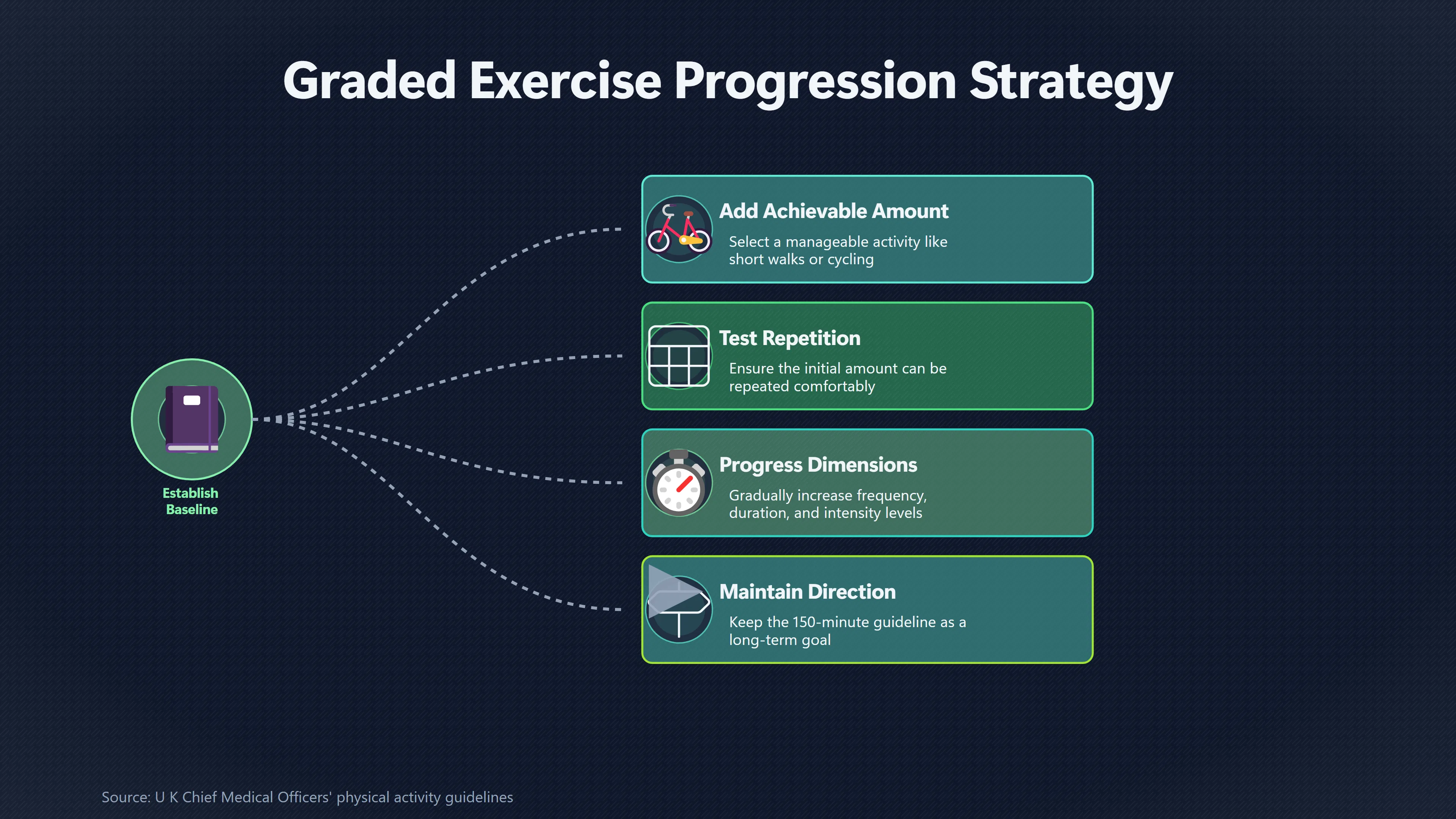
- Establish the baseline. Start from what is actually happening now rather than from the guideline number. Someone already walking regularly has a different starting point from someone who is almost completely inactive.
-
Add an achievable amount. That could mean a short walk, an easy cycle or another accessible activity on a few days of the week. The NHS advises people returning to activity to start with easy ways of moving more and build gradually. nhs.uk
- Make repetition the first test. An initial amount that can be repeated comfortably provides a more useful base than an ambitious session followed by several days of excessive soreness or avoidance.
-
Increase one or more dimensions progressively. WHO describes progression in terms of frequency, duration and intensity. A person might first walk on more days, then extend the walks, and only later make some of them faster. NCBI
- Keep the guideline as a direction of travel. As activity becomes routine and fitness improves, continue towards the recommended weekly volume rather than treating a small starting dose as the permanent ceiling.
This creates a different definition of progress. If a previously inactive person moves from two short walks a week to three, that is progress even though the total remains below 150 minutes. The relevant comparison during the build-up phase is often with the person’s previous sustainable level, not only with the final public-health benchmark.
Increase duration before intensity when starting from low fitness
Gradual progression is not only about making the habit psychologically manageable. It is also a safety principle.
The Physical Activity Guidelines for Americans explains injury risk partly in terms of the gap between a person’s usual activity and the new demand placed on the body. A small increase followed by time for adaptation and recovery produces less overload than a large sudden increase. Its guidance for people with low activity levels is therefore to begin with light or relatively moderate activity where appropriate, initially increase the duration and frequency, and increase intensity later if desired. Health.gov
That provides a useful alternative to the common “go hard to get fit” instinct. Someone unused to exercise does not need vigorous running simply because running accumulates guideline minutes quickly. Walking for manageable periods may be the more appropriate first intervention. As fitness improves, walking can become longer, more frequent or brisker; higher-intensity exercise can come later if it suits the person’s goals and circumstances.
There is no universally correct percentage increase from one week to the next. The US guidance notes that the relative size of an increase matters: adding 20 minutes to a 40-minute weekly baseline is a much larger jump than adding the same 20 minutes to a 200-minute baseline. Age, existing fitness and exercise experience also affect how quickly someone adapts. Health.gov
This is one reason rigid progression rules can be misleading. “Add ten minutes every week” sounds simple, but the same addition represents very different loads for different people. A better principle is to make increases small relative to what has already become comfortable and repeatable.
Starting small does not usually require a medical appointment
Safety advice can itself become a barrier if it implies that every inactive adult needs medical clearance before taking a walk. WHO’s guideline development group explicitly rejected that interpretation. For people who are not regularly active and have no relevant contraindications, pre-exercise medical clearance is generally unnecessary before beginning light- or moderate-intensity activity no more demanding than brisk walking or ordinary daily living. PubMed Central (PMC)
The American College of Sports Medicine similarly concluded that otherwise healthy, inactive people without symptoms can begin light- to moderate-intensity exercise without medical clearance and progress gradually. Lippincott Journals
That is not a rule to ignore symptoms or medical conditions. WHO advises people who develop new symptoms as they increase activity to seek healthcare advice. People whose health conditions, disability, pregnancy, medicines or functional limitations affect what activity is appropriate may need individual guidance; WHO specifically recognises these circumstances rather than assuming that the general progression advice fits everybody identically. PubMed Central (PMC)
For the typical inactive adult without such contraindications, however, the safety message is reassuring rather than restrictive: ordinary light-to-moderate movement can generally begin at a modest level, with demand increased gradually.
A small start can become a durable routine
The strongest case for starting below the guideline is therefore not that 150 minutes does not matter. It is that reaching a useful long-term level of physical activity is a process.
Imagine someone whose current week contains almost no purposeful activity. Jumping immediately to five 30-minute brisk walks would technically reach 150 minutes, but it would also impose a large change in schedule and physical workload at once. Starting with, for example, several short, comfortable walks creates a smaller behavioural and physical jump. Once those walks feel ordinary, duration or frequency can increase; later, some walking can become brisker or other forms of activity can be added. The precise starting dose and rate of progression should reflect the individual rather than this illustration.
That approach matches three different strands of evidence. Public-health authorities explicitly recommend small starts for inactive adults. Dose-response research indicates that benefits occur below the headline weekly target and that some of the largest relative gains are associated with moving away from very low activity. Behaviour-change research, meanwhile, identifies graded tasks among the techniques associated with maintaining increases in activity. NCBI+2British Journal of Sports Medicine
The result is a more useful way to treat exercise as capacity for other self-improvement goals. The first milestone need not be “I now meet every exercise guideline.” It can be “this amount of movement now fits reliably into my life.” From there, the next increase has somewhere stable to land.
The 150-minute recommendation remains worth working towards because larger volumes of regular activity bring substantial health benefits. But it need not become a pass-fail test imposed on the first week. For someone starting from little or no activity, start smaller, repeat it, and build gradually is not a compromise with the guidelines. It is part of what the guidelines themselves recommend. GOV.UK
Amazon book picks
Further Reading
Books and field guides related to You Do Not Need to Start at 150 Minutes. Use these as the next step if you want deeper reading beyond the article.
No Sweat
Do you secretly hate exercising? Struggle to stick with a program? Millions of people try and fail to stay fit. But what if "exercising"...
Atomic Habits
Rating: 3.5/5 from 7 Google Books ratings
The #1 New York Times bestseller. Over 25 million copies sold! Translated into 60+ languages! Tiny Changes, Remarkable Results No matter...
Exercised
The book tells the story of how we never evolved to exercise - to do voluntary physical activity for the sake of health. Using his own re...
The Joy of Movement
The bestselling author of The Willpower Instinct introduces a surprising science-based book that doesn't tell us why we should exercise b...
eBay marketplace picks
Marketplace Samples
Live-tested eBay searches with available results related to this page.
Selected fromself improvement wall art oneBay.co.uk.


Endnotes
1.
Source: GOV.UK
Title: U K Chief Medical Officers’ physical activity guidelines
Link:https://www.gov.uk/government/publications/physical-activity-guidelines-uk-chief-medical-officers-report/uk-chief-medical-officers-physical-activity-guidelines
Source snippet
UK Chief Medical Officers' physical activity guidelines - GOV.UK...
2.
Source: bjsm.bmj.com
Link:https://bjsm.bmj.com/content/57/15/979
Source snippet
British Journal of Sports MedicineNon-occupational physical activity and risk of cardiovascular disease, cancer and mortality outcomes: a...
3.
Source: pmc.ncbi.nlm.nih.gov
Title: A systematic review and meta-analysis
Link:https://pmc.ncbi.nlm.nih.gov/articles/PMC6305562/
Source snippet
PubMed Central (PMC)Are physical activity interventions for healthy inactive adults effective in promoting behavior change and maintenanc...
5.
Source: GOV.UK
Link:https://www.gov.uk/government/publications/physical-activity-guidelines-adults-and-older-adults/physical-activity-for-adults-and-older-adults-19-and-over-text-of-the-infographic
6.
Source: who.int
Link:https://www.who.int/europe/publications/i/item/9789240014886
7.
Source: odphp.health.gov
Title: questions answers
Link:https://odphp.health.gov/our-work/nutrition-physical-activity/physical-activity-guidelines/about-physical-activity-guidelines/questions-answers
Source snippet
Activity Guidelines Questions & Answers | odphp.health.govNovember 19, 2025...
Published: November 19, 2025
8.
Source: odphp.health.gov
Title: top 10 things know
Link:https://odphp.health.gov/our-work/nutrition-physical-activity/physical-activity-guidelines/current-guidelines/top-10-things-know
Source snippet
10 Things to Know About the Second Edition of the Physical Activity Guidelines for Americans | odphp.health.gov...
9.
Source: bmj.com
Link:https://www.bmj.com/content/366/bmj.l4570
10.
Source: doi.org
Link:https://doi.org/10.1016/S2468-2667%2825%2900164-1
12.
Source: odphp.health.gov
Title: Physical Activity Guidelines 2nd edition
Link:https://odphp.health.gov/sites/default/files/2019-09/Physical_Activity_Guidelines_2nd_edition.pdf?time=1725950270382
13.
Source: hct.nhs.uk
Title: Keeping healthy | Hertfordshire Community NHS Trust
Link:https://www.hct.nhs.uk/your-healthkeeping-healthy/
14.
Source: nhs.uk
Title: www.nhs.uk How to improve your strength and flexibility
Link:https://www.nhs.uk/live-well/exercise/how-to-improve-strength-flexibility/
15.
Source: GOV.UK
Title: www.gov.uk Physical activity for disabled adults: text of the infographic
Link:https://www.gov.uk/government/publications/physical-activity-guidelines-disabled-adults/physical-activity-for-disabled-adults-text-of-the-infographic
16.
Source: GOV.UK
Link:https://www.gov.uk/government/publications/physical-activity-guidelines-children-and-young-people-5-to-18-years/physical-activity-for-children-and-young-people-5-to-18-years-text-of-the-infographic
17.
Source: GOV.UK
Link:https://www.gov.uk/government/publications/physical-activity-guidelines-pregnancy-and-after-childbirth/physical-activity-for-women-after-childbirth-birth-to-12-months-text-of-the-infographic
18.
Source: GOV.UK
Title: www.gov.uk Physical activity for pregnant women (text of the infographic)
Link:https://www.gov.uk/government/publications/physical-activity-guidelines-pregnancy-and-after-childbirth/physical-activity-for-pregnant-women-text-of-the-infographic
19.
Source: GOV.UK
Link:https://www.gov.uk/government/publications/physical-activity-guidelines-early-years-under-5s/physical-activity-for-early-years-birth-to-5-years-text-of-the-infographic
20.
Source: GOV.UK
Link:https://www.gov.uk/government/publications/physical-activity-guidelines-uk-chief-medical-officers-report/uk-chief-medical-officers-physical-activity-guidelines-supplementary-information
21.
Source: GOV.UK
Title: www.gov.uk New UK CMO activity guidelines show every movement counts
Link:https://www.gov.uk/government/news/new-uk-cmo-activity-guidelines-show-every-movement-counts
22.
Source: cuh.nhs.uk
Title: measuring baselines
Link:https://www.cuh.nhs.uk/patient-information/measuring-baselines/
23.
Source: nhs.uk
Title: www.nhs.uk Exercise for depression
Link:https://www.nhs.uk/mental-health/self-help/guides-tools-and-activities/exercise-for-depression/
24.
Source: odphp.health.gov
Title: get active
Link:https://odphp.health.gov/myhealthfinder/health-conditions/diabetes/get-active
25.
Source: odphp.health.gov
Title: help loved one get more active quick tips
Link:https://odphp.health.gov/myhealthfinder/health-conditions/diabetes/help-loved-one-get-more-active-quick-tips
26.
Source: odphp.health.gov
Title: current guidelines
Link:https://odphp.health.gov/our-work/nutrition-physical-activity/physical-activity-guidelines/current-guidelines
27.
Source: odphp.health.gov
Title: scientific report
Link:https://odphp.health.gov/our-work/nutrition-physical-activity/physical-activity-guidelines/current-guidelines/scientific-report
28.
Source: odphp.health.gov
Title: about physical activity guidelines
Link:https://odphp.health.gov/our-work/nutrition-physical-activity/physical-activity-guidelines/about-physical-activity-guidelines
29.
Source: odphp.health.gov
Title: media resources
Link:https://odphp.health.gov/our-work/nutrition-physical-activity/physical-activity-guidelines/current-guidelines/media-resources
30.
Source: odphp.health.gov
Title: charge 2018 physical activity guidelines advisory committee
Link:https://odphp.health.gov/our-work/nutrition-physical-activity/physical-activity-guidelines/current-guidelines/advisory-committee/resources/charge-2018-physical-activity-guidelines-advisory-committee
31.
Source: odphp.health.gov
Title: advisory committee
Link:https://odphp.health.gov/our-work/nutrition-physical-activity/physical-activity-guidelines/current-guidelines/advisory-committee
32.
Source: nhs.uk
Title: www.nhs.uk Sitting exercises
Link:https://www.nhs.uk/live-well/exercise/sitting-exercises/
33.
Source: nhs.uk
Title: www.nhs.uk Flexibility exercises
Link:https://www.nhs.uk/live-well/exercise/flexibility-exercises/
34.
Source: nhs.uk
Title: www.nhs.uk Self-help tips to fight tiredness
Link:https://www.nhs.uk/live-well/sleep-and-tiredness/self-help-tips-to-fight-fatigue/
35.
Source: nhs.uk
Title: keep your bones strong over 65
Link:https://www.nhs.uk/live-well/bone-health/keep-your-bones-strong-over-65/
36.
Source: odphp.health.gov
Title: physical activity guidelines
Link:https://odphp.health.gov/our-work/nutrition-physical-activity/physical-activity-guidelines
37.
Source: doi.org
Title: bjsports 2020 102955
Link:https://doi.org/10.1136/bjsports-2020-102955
38.
Source: bmj.com
Link:https://www.bmj.com/content/370/bmj.m2031
39.
Source: GOV.UK
Title: www.gov.uk Health matters: physical activity
Link:https://www.gov.uk/government/publications/health-matters-physical-activity/health-matters-physical-activity-prevention-and-management-of-long-term-conditions
40.
Source: who.int
Title: WH O guidelines on physical activity and sedentary behaviour
Link:https://www.who.int/publications/b/55518
41.
Source: GOV.UK
Title: www.gov.uk Physical activity guidelines: UK Chief Medical Officers’ report
Link:https://www.gov.uk/government/publications/physical-activity-guidelines-uk-chief-medical-officers-report
42.
Source: GOV.UK
Title: www.gov.uk Physical activity guidelines
Link:https://www.gov.uk/government/collections/physical-activity-guidelines
43.
Source: GOV.UK
Title: www.gov.uk New physical activity guidelines issued by UK Chief Medical Officers
Link:https://www.gov.uk/government/news/new-physical-activity-guidelines-issued-by-uk-chief-medical-officers?dm_i=25MS%2C6H3Z0%2COV92Z5%2CPOUNX%2C1
44.
Source: GOV.UK
Title: www.gov.uk Physical activity guidelines: adults and older adults
Link:https://www.gov.uk/government/publications/physical-activity-guidelines-adults-and-older-adults
45.
Source: GOV.UK
Title: www.gov.uk Physical activity guidelines: UK Chief Medical Officers’ report
Link:https://www.gov.uk/government/publications/physical-activity-guidelines-uk-chief-medical-officers-report?form=MG0AV3
46.
Source: gov.wales
Title: U K Chief Medical Officers’ physical activity guidelines | GOV.WALE S
Link:https://www.gov.wales/uk-chief-medical-officers-physical-activity-guidelines
47.
Source: bmjopen.bmj.com
Link:https://bmjopen.bmj.com/content/9/9/e028653
48.
Source: bmj.com
Link:https://www.bmj.com/content/366/bmj.l4570/related
49.
Source: bjsm.bmj.com
Link:https://bjsm.bmj.com/content/53/14/886
50.
Source: who.int
Title: Physical activity
Link:https://www.who.int/news-room/facts-in-pictures/detail/physical-activity
51.
Source: who.int
Link:https://www.who.int/health-topics/noncommunicable-diseases/physical-activity
52.
Source: doi.org
Link:https://doi.org/10.1249%2FMSS.0000000000000664
53.
Source: odphp.health.gov
Title: physical activity guidelines americans 2nd edition
Link:https://odphp.health.gov/healthypeople/tools-action/browse-evidence-based-resources/physical-activity-guidelines-americans-2nd-edition
54.
Source: nwtyanetwork.nhs.uk
Title: Excercise & Activity
Link:https://nwtyanetwork.nhs.uk/excercise-activity/
55.
Source: bjsm.bmj.com
Link:https://bjsm.bmj.com/content/59/17/1228
56.
Source: bjsm.bmj.com
Link:https://bjsm.bmj.com/content/54/20/1195
57.
Source: bmjopensem.bmj.com
Link:https://bmjopensem.bmj.com/content/11/3/e002774
58.
Source: nhs.uk
Title: www.nhs.uk Get running with Couch to 5K
Link:https://www.nhs.uk/better-health/get-active/get-running-with-couch-to-5k/?wt.tsrc=display
59.
Source: myhealthlondon.nhs.uk
Link:https://www.myhealthlondon.nhs.uk/be-healthier/move-more/exercise-safely-with-cvd/
61.
Source: pubmed.ncbi.nlm.nih.gov
Link:https://pubmed.ncbi.nlm.nih.gov/36854652/
Source snippet
Non-occupational physical activity and risk of cardiovascular disease, cancer and mortality outcomes: a dose-response meta-analysis...
62.
Source: pmc.ncbi.nlm.nih.gov
Link:https://pmc.ncbi.nlm.nih.gov/articles/PMC7719906/
63.
Source: ncbi.nlm.nih.gov
Title: NCBIEVIDENCE TO RECOMMENDATIONS
Link:https://www.ncbi.nlm.nih.gov/books/NBK566033/
64.
Source: journals.lww.com
Title: Lippincott Journals Medicine & Science in Sports & Exercise
Link:https://journals.lww.com/acsm-msse/fulltext/2015/11000/updating_acsm_s_recommendations_for_exercise.28.aspx
65.
Source: cdc.gov
Title: physical activity
Link:https://www.cdc.gov/disability-and-health/conditions/physical-activity.html
66.
Source: pubmed.ncbi.nlm.nih.gov
Link:https://pubmed.ncbi.nlm.nih.gov/38901742/
67.
Source: pubmed.ncbi.nlm.nih.gov
Link:https://pubmed.ncbi.nlm.nih.gov/38663855/
68.
Source: cdc.gov
Link:https://www.cdc.gov/physical-activity-basics/guidelines/adults.html
69.
Source: pubmed.ncbi.nlm.nih.gov
Link:https://pubmed.ncbi.nlm.nih.gov/37925162/
70.
Source: pubmed.ncbi.nlm.nih.gov
Link:https://pubmed.ncbi.nlm.nih.gov/37523952/
71.
Source: pmc.ncbi.nlm.nih.gov
Link:https://pmc.ncbi.nlm.nih.gov/articles/PMC10423495/
72.
Source: pubmed.ncbi.nlm.nih.gov
Link:https://pubmed.ncbi.nlm.nih.gov/35953241/
73.
Source: pubmed.ncbi.nlm.nih.gov
Link:https://pubmed.ncbi.nlm.nih.gov/35819337/
74.
Source: pmc.ncbi.nlm.nih.gov
Link:https://pmc.ncbi.nlm.nih.gov/articles/9289978/
75.
Source: pmc.ncbi.nlm.nih.gov
Link:https://pmc.ncbi.nlm.nih.gov/articles/PMC9289978/
76.
Source: pubmed.ncbi.nlm.nih.gov
Link:https://pubmed.ncbi.nlm.nih.gov/35022163/
77.
Source: pubmed.ncbi.nlm.nih.gov
Link:https://pubmed.ncbi.nlm.nih.gov/34808011/
78.
Source: pmc.ncbi.nlm.nih.gov
Link:https://pmc.ncbi.nlm.nih.gov/articles/PMC8724621/
79.
Source: pubmed.ncbi.nlm.nih.gov
Link:https://pubmed.ncbi.nlm.nih.gov/34547483/
80.
Source: pubmed.ncbi.nlm.nih.gov
Link:https://pubmed.ncbi.nlm.nih.gov/34417979/
81.
Source: pmc.ncbi.nlm.nih.gov
Link:https://pmc.ncbi.nlm.nih.gov/articles/7719906/
82.
Source: pmc.ncbi.nlm.nih.gov
Link:https://pmc.ncbi.nlm.nih.gov/articles/9582631/
83.
Source: pmc.ncbi.nlm.nih.gov
Link:https://pmc.ncbi.nlm.nih.gov/articles/PMC6411298/
84.
Source: pmc.ncbi.nlm.nih.gov
Link:https://pmc.ncbi.nlm.nih.gov/articles/PMC7059860/
85.
Source: niddk.nih.gov
Title: tips starting physical activity
Link:https://www.niddk.nih.gov/health-information/weight-management/tips-get-active/tips-starting-physical-activity
86.
Source: ncbi.nlm.nih.gov
Title: diet treatment obes.table32008
Link:https://www.ncbi.nlm.nih.gov/books/NBK278991/table/diet-treatment-obes.table32008/
87.
Source: pubmed.ncbi.nlm.nih.gov
Link:https://pubmed.ncbi.nlm.nih.gov/25391096/
88.
Source: ncbi.nlm.nih.gov
Link:https://www.ncbi.nlm.nih.gov/books/NBK566048/
89.
Source: niddk.nih.gov
Title: staying active at any size
Link:https://www.niddk.nih.gov/health-information/weight-management/staying-active-at-any-size
90.
Source: pubmed.ncbi.nlm.nih.gov
Link:https://pubmed.ncbi.nlm.nih.gov/35247352/?dopt=Abstract
91.
Source: pubmed.ncbi.nlm.nih.gov
Link:https://pubmed.ncbi.nlm.nih.gov/21694556/
92.
Source: pubmed.ncbi.nlm.nih.gov
Link:https://pubmed.ncbi.nlm.nih.gov/26473759/
93.
Source: pubmed.ncbi.nlm.nih.gov
Link:https://pubmed.ncbi.nlm.nih.gov/25347259/
94.
Source: pubmed.ncbi.nlm.nih.gov
Link:https://pubmed.ncbi.nlm.nih.gov/27301799/
95.
Source: archive.cdc.gov
Link:https://archive.cdc.gov/www_cdc_gov/nccdphp/sgr/adults.htm
96.
Source: acsm.org
Title: Team Physician Consensus Statements
Link:https://acsm.org/education-resources/pronouncements-scientific-communications/team-physician-consensus-statements/
Additional References
97.
Source: youtube.com
Title: The Best Beginner Workout: How to Start Exercising Safely!
Link:https://www.youtube.com/watch?v=yhUR862hhIE
Source snippet
This guide on How to Start Exercising Safely provides a practical, gradual routine tailored for beginners who need to start below standar...
98.
Source: cdc.gov
Link:https://www.cdc.gov/nccdphp/dnpao/features/getting-more-active-minutes/index.html
99.
Source: academic.oup.com
Link:https://academic.oup.com/tbm/article/9/1/147/4913688
100.
Source: scienceopen.com
Link:https://www.scienceopen.com/document?vid=f5188746-49b6-4c20-8915-080e12dff9b0
101.
Source: sciencedirect.com
Link:https://www.sciencedirect.com/science/article/pii/S0738399118307699
102.
Source: ehps.net
Link:https://www.ehps.net/ehp/index.php/contents/article/view/1910
103.
Source: tandfonline.com
Link:https://www.tandfonline.com/doi/full/10.1080/17437199.2026.2618195
104.
Source: jamanetwork.com
Link:https://jamanetwork.com/journals/jamainternalmedicine/fullarticle/2212267
105.
Source: medrxiv.org
Link:https://www.medrxiv.org/content/10.1101/2022.03.02.22271753v1
106.
Source: medrxiv.org
Link:https://www.medrxiv.org/content/10.1101/2022.03.02.22271753v2