Within Stable Contexts
Should a Habit Follow a Routine or a Clock?
Linking a habit to an existing routine can work as well as using a fixed clock time when the cue reliably recurs.
On this page
- What routine based and time based cues have in common
- What the 84 day randomised trial found
- Choosing the cue that survives your normal schedule
Page outline Jump by section
Introduction
A habit does not have to happen at exactly the same clock time to acquire a stable cue. Linking a new behaviour to an existing routine — “after breakfast, take my vitamins” or “after brushing my teeth, floss” — can work about as well as linking it to a fixed time such as 8:00 am, provided the chosen cue reliably occurs and the behaviour is repeatedly performed when it does. The strongest direct evidence comes from an 84-day randomised trial in which routine-based and time-based plans produced similar increases in automaticity.[PubMed]pubmed.ncbi.nlm.nih.govHabit formation following routine-based versus time-based cue planning: A randomized controlled trial - PubMedJanuary 6, 2021…
That result changes the practical question. Rather than asking whether routines are inherently better than clock times, it is more useful to ask which cue will remain dependable in your actual life. A routine anchor can accommodate a breakfast that shifts from 7:30 to 9:00; a clock cue can be excellent when 9:00 itself is reliably actionable. In either case, repeated enactment at the chosen cue appears to matter more than belonging to the “right” cue category.[DOI]doi.orgHabit formation following routine‐based versus time‐based cue planning: A randomized controlled trial - Keller - 2021 - British Journa…
What routine and time cues have in common
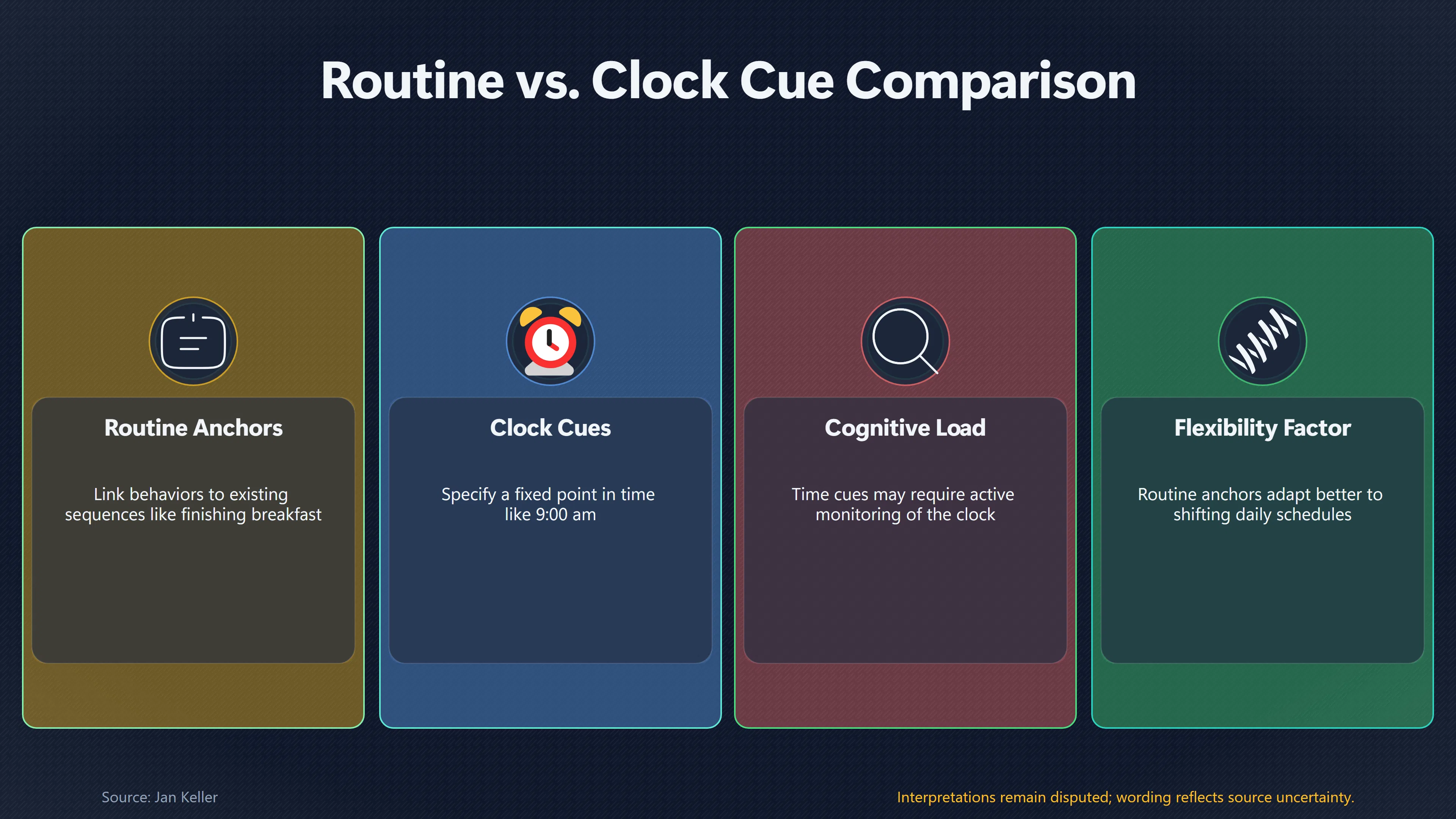
A routine-based cue is an event in an existing sequence: finishing breakfast, brushing your teeth, arriving home or making the first coffee of the morning. A time-based cue specifies a point in time: “at 8:00 am” or “at 6:30 pm”. Both can provide the stable context needed to repeatedly pair a cue with a behaviour.
The distinction is therefore smaller than it can sound. Suppose someone wants to drink a glass of water every morning. “Drink it after breakfast” ties the behaviour to another action, whereas “drink it at 9:00 am” ties it to the clock. If breakfast reliably finishes around 9:00 anyway, those plans may expose the person to almost the same real-world context. The researchers behind the principal randomised trial explicitly raised this possibility when interpreting their results: participants allocated to clock-time cues may have selected times that already coincided with regular routines.[BPS PsycHub]bpspsychub.onlinelibrary.wiley.comBPS PsycHubHabit formation following routine‐based versus time‐based cue planning: A randomized controlled trial - Keller - 2021 - Britis…
There is nevertheless a meaningful cognitive difference. Event-based prospective-memory tasks require remembering to act when an external event occurs, while time-based tasks require acting at a specified time and can involve monitoring the passage of time or checking a clock. Laboratory prospective-memory research confirms that monitoring differs between event- and time-based intentions, although these experiments should not be treated as direct tests of long-term habit formation.[PubMed Central (PMC)]pmc.ncbi.nlm.nih.govPubMed Central (PMC)Looking for cues over time: A study on self-initiated monitoring in event-based and time-based prospective memory - P…
This gives routine anchors a plausible practical advantage when schedules move around: the event itself can announce the opportunity. “After I finish lunch” remains interpretable whether lunch ends at 12:30 or 1:45. But plausibility is not the same as evidence that routine cues always form stronger habits. The head-to-head trial did not find that superiority.
What the 84-day randomised trial found
Jan Keller and colleagues tested the comparison directly in a randomised controlled trial published in the British Journal of Health Psychology. They recruited 192 adults aged 18–77 and randomly assigned them to create either a routine-based or time-based plan for a self-selected everyday healthy eating behaviour. Participants then completed daily assessments for 84 days, reporting whether they had enacted their plan and how automatic the behaviour felt.[PubMed]pubmed.ncbi.nlm.nih.govHabit formation following routine-based versus time-based cue planning: A randomized controlled trial - PubMedJanuary 6, 2021…
The study was designed around an interesting prior expectation. Earlier observational research had given routine cues reasons to look promising. In a study of 1,244 Australian adults, for example, greater consistency of routine cues was associated with stronger physical-activity automaticity, whereas consistent time cues were associated with physical-activity behaviour but not automaticity. Because that research was cross-sectional, however, it could not establish that choosing a routine cue caused stronger habit formation.[PubMed]pubmed.ncbi.nlm.nih.govCue Consistency Associated with Physical Activity Automaticity and Behavior - PubMedApril 11, 2015…
The randomised trial did not confirm a routine-cue advantage. Automaticity increased over time in both conditions, as did enactment of the cue-behaviour plans, but the researchers found no significant between-group difference. In this experiment, attaching a healthy eating behaviour to an existing routine was therefore not demonstrably better or worse than attaching it to a particular time.[BPS PsycHub]bpspsychub.onlinelibrary.wiley.comBPS PsycHubHabit formation following routine‐based versus time‐based cue planning: A randomized controlled trial - Keller - 2021 - Britis…
What did stand out was enactment. People who more frequently carried out the behaviour in response to their planned cue were more likely to show increasing automaticity. The researchers found this relationship both within individuals over time and between individuals. Multiple omissions, by contrast, were associated with relatively flat automaticity trajectories.[DOI]doi.orgHabit formation following routine‐based versus time‐based cue planning: A randomized controlled trial - Keller - 2021 - British Journa…
That finding is more useful than turning the experiment into another “how many days?” rule. Among participants whose habit development followed the study’s successful asymptotic pattern, the median estimated time to reach 95% of peak automaticity was 59 days. Individual estimates ranged much more widely, from 4 to 335 days. A 2024 systematic review subsequently placed the Keller trial within a still-small experimental literature and likewise concluded that the time needed for health-habit formation varies substantially.[PubMed Central (PMC)]pmc.ncbi.nlm.nih.govOpen source on nih.gov.
There is an important qualification: the trial was a comparison between two planning strategies, not proof that either strategy was superior to making no plan. There was no no-planning control group. The measures of enactment and automaticity were also self-reported, and only 135 of the original 192 participants supplied enough longitudinal data to be retained in the principal analyses. The authors additionally noted that the sample contained many women and younger participants, limiting how confidently the result can be generalised.[BPS PsycHub]bpspsychub.onlinelibrary.wiley.comBPS PsycHubHabit formation following routine‐based versus time‐based cue planning: A randomized controlled trial - Keller - 2021 - Britis…
So the appropriate conclusion is fairly narrow but useful: for the self-selected nutrition behaviours studied, routine anchors and clock times performed similarly at group level. It is not evidence that cue choice never matters for any person, behaviour or schedule.

When a routine anchor earns its flexibility
Routine cues become particularly attractive when the event is dependable but its timing is not. Someone who always eats breakfast but does so at 7:00 on workdays and 9:30 at weekends may find “after breakfast” more robust than “at 7:15”. The cue moves with the relevant part of the day instead of becoming detached from it.
There is some supporting evidence that placement within an existing sequence can matter. In a small exploratory study of 50 people learning to floss, participants were instructed to floss either before or after tooth-brushing. Those assigned to floss after brushing tended to develop stronger flossing habits and, at eight-month follow-up, reported stronger habits and more frequent flossing. The authors argued that characteristics of everyday routines deserve attention when designing habit interventions.[BPS PsycHub]bpspsychub.onlinelibrary.wiley.comBPS PsycHubForming a flossing habit: An exploratory study of the psychological determinants of habit formation - Judah - 2013 - British J…
That study does not establish a general rule that a new behaviour should always follow an old one. It does, however, illustrate what a routine anchor can provide: a clearly recognisable transition point. “After brushing” supplies an immediate event that can become associated with the next action.
Routine anchoring can fail for exactly the same reason. A supposedly daily anchor that is actually irregular — “after lunch” for someone who frequently skips lunch, or “when I get home from work” for someone working partly from home — produces fewer reliable learning opportunities. The word routine is not what makes the cue useful; recurrence is.
When the clock is the better cue
Clock times should not be treated as an inferior substitute. The 84-day trial provides no basis for doing so. A time cue may be particularly practical when the person’s day is organised around fixed schedules and the target behaviour does not have an obvious preceding action. Someone consistently free at 12:30 may have little reason to invent an event-based anchor if 12:30 itself reliably signals the opportunity.
Clock cues do have one potential weakness: knowing that a particular time has arrived may require attention to time. Prospective-memory research distinguishes this from an external event that presents itself as the cue, and laboratory studies have observed increased clock checking as a target time approaches.[Taylor & Francis Online]tandfonline.comTaylor & Francis OnlineComparing time-based and event-based prospective memory over short delays: Memory: Vol 26, No 7 - Get Access… That does not mean a clock-based habit necessarily remains effortful — repeated cue-response learning is precisely intended to increase automaticity — but it explains why a badly chosen time can be fragile when attention is elsewhere.
A useful distinction is therefore between precise and reliable. “At 7:00 pm” sounds precise, but if commuting, childcare or variable working hours routinely make 7:00 unavailable, precision buys little. “After dinner” may be less precise chronologically while being more consistent behaviourally. Conversely, a worker whose 10:30 break is genuinely protected may have an extremely stable clock cue.
Choosing the cue that survives your normal schedule
The research supports a practical selection rule: choose the cue that gives the behaviour the most repeatable opportunity, rather than choosing routine or time cues on principle. The direct comparison found no group-level winner, while the strongest predictor in the trial was repeatedly enacting the behaviour in response to the planned cue.[PubMed]pubmed.ncbi.nlm.nih.govHabit formation following routine-based versus time-based cue planning: A randomized controlled trial - PubMedJanuary 6, 2021…
Three questions make that decision more concrete:
- Does the cue actually occur most days? “After my first coffee” is useful only if the first coffee is genuinely dependable; 8:00 am is useful only if you can normally act at 8:00.
- Does the cue occur when the behaviour is feasible? A highly consistent cue is still poor if the necessary place, equipment or time is usually unavailable when it appears.
- Will ordinary schedule variation break the link? If the clock time moves but the sequence of activities survives, use the sequence. If the routine varies but a scheduled time remains protected, the clock may be stronger.
There is also no need to pretend that real-life cues are perfectly pure. A plan such as “take a short walk after my 1:00 pm lunch” contains both temporal and routine information. Indeed, the Keller trial’s authors cautioned that the two kinds of cue may naturally overlap in everyday life. That overlap is one reason its null difference should not be interpreted as proof that cues are interchangeable under every circumstance.[BPS PsycHub]bpspsychub.onlinelibrary.wiley.comBPS PsycHubHabit formation following routine‐based versus time‐based cue planning: A randomized controlled trial - Keller - 2021 - Britis…
The broader experimental evidence remains limited. A 2024 systematic review found only 20 experimental studies of health-related habit formation across several behaviours, with 11 rated as having a high risk of bias; only four studies specifically reported time to automaticity. The review nevertheless retained the Keller trial’s central finding: within that evidence base, time-triggered and routine-triggered healthy eating behaviours did not significantly differ in habit formation.[PubMed Central (PMC)]pmc.ncbi.nlm.nih.govOpen source on nih.gov.
For self-improvement that works in ordinary life, that is a useful constraint on the usual “habit stacking” advice. An existing routine is not magic, and an exact clock time is not automatically disciplined. Both are ways of supplying a recurring cue. The better anchor is the one that keeps showing up when you can actually perform the behaviour — because repeated successful pairings, rather than the label attached to the cue, are what give automaticity the opportunity to develop.
Amazon book picks
Further Reading
Books and field guides related to Should a Habit Follow a Routine or a Clock?. Use these as the next step if you want deeper reading beyond the article.
Atomic Habits
Rating: 3.5/5 from 7 Google Books ratings
The #1 New York Times bestseller. Over 25 million copies sold! Translated into 60+ languages! Tiny Changes, Remarkable Results No matter...
Tiny Habits
Improving your life is much easier than you think. Whether it’s losing weight, sleeping more, or restoring your work/life balance – the s...
The Power of Habit
Rating: 4.0/5 from 145 Google Books ratings
Duhigg takes us to the edge of scientific discoveries that explain why habits exist and how they can be changed. Distilling information i...
Good Habits, Bad Habits
'The world's leading expert on habits' - Matthew Syed, bestselling author of Black Box Thinking and Rebel IdeasWhat if you could harness...
eBay marketplace picks
Marketplace Samples
Live-tested eBay searches with available results related to this page.
Selected fromhabit motivation poster oneBay.co.uk.

Endnotes
1.
Source: doi.org
Link:https://doi.org/10.1111/bjhp.12504
Source snippet
Habit formation following routine‐based versus time‐based cue planning: A randomized controlled trial - Keller - 2021 - British Journa...
2.
Source: doi.org
Link:https://doi.org/10.3390/healthcare12232488
3.
Source: doi.org
Link:https://doi.org/10.1111/j.2044-8287.2012.02086.x
4.
Source: pubmed.ncbi.nlm.nih.gov
Link:https://pubmed.ncbi.nlm.nih.gov/33405284/
Source snippet
Habit formation following routine-based versus time-based cue planning: A randomized controlled trial - PubMedJanuary 6, 2021...
Published: January 6, 2021
5.
Source: bpspsychub.onlinelibrary.wiley.com
Link:https://bpspsychub.onlinelibrary.wiley.com/doi/abs/10.1111/bjhp.12504
Source snippet
BPS PsycHubHabit formation following routine‐based versus time‐based cue planning: A randomized controlled trial - Keller - 2021 - Britis...
6.
Source: pmc.ncbi.nlm.nih.gov
Link:https://pmc.ncbi.nlm.nih.gov/articles/PMC11641623/
7.
Source: pmc.ncbi.nlm.nih.gov
Link:https://pmc.ncbi.nlm.nih.gov/articles/PMC12589293/
Source snippet
PubMed Central (PMC)Looking for cues over time: A study on self-initiated monitoring in event-based and time-based prospective memory - P...
8.
Source: tandfonline.com
Link:https://www.tandfonline.com/doi/full/10.1080/09658211.2018.1432662
Source snippet
Taylor & Francis OnlineComparing time-based and event-based prospective memory over [short delays]({{ 'short-delays/' | relative_url }}): Memory: Vol 26, No 7 - Get Access...
9.
Source: pubmed.ncbi.nlm.nih.gov
Link:https://pubmed.ncbi.nlm.nih.gov/25864705/
Source snippet
Cue Consistency Associated with Physical Activity Automaticity and Behavior - PubMedApril 11, 2015...
Published: April 11, 2015
10.
Source: pubmed.ncbi.nlm.nih.gov
Link:https://pubmed.ncbi.nlm.nih.gov/39685110/
Source snippet
Time to Form a Habit: A Systematic Review and Meta-Analysis of Health Behaviour Habit Formation and Its Determinants - PubMed...
11.
Source: bpspsychub.onlinelibrary.wiley.com
Link:https://bpspsychub.onlinelibrary.wiley.com/doi/10.1111/j.2044-8287.2012.02086.x
Source snippet
BPS PsycHubForming a flossing habit: An exploratory study of the psychological determinants of habit formation - Judah - 2013 - British J...
12.
Source: bpspsychub.onlinelibrary.wiley.com
Link:https://bpspsychub.onlinelibrary.wiley.com/doi/abs/10.1111/j.2044-8287.2012.02086.x
13.
Source: pubmed.ncbi.nlm.nih.gov
Link:https://pubmed.ncbi.nlm.nih.gov/29380656/
14.
Source: pmc.ncbi.nlm.nih.gov
Link:https://pmc.ncbi.nlm.nih.gov/articles/PMC13269919/
15.
Source: pubmed.ncbi.nlm.nih.gov
Link:https://pubmed.ncbi.nlm.nih.gov/41981065/
16.
Source: pmc.ncbi.nlm.nih.gov
Link:https://pmc.ncbi.nlm.nih.gov/articles/PMC12593889/
17.
Source: pubmed.ncbi.nlm.nih.gov
Link:https://pubmed.ncbi.nlm.nih.gov/40080255/
18.
Source: pmc.ncbi.nlm.nih.gov
Link:https://pmc.ncbi.nlm.nih.gov/articles/PMC12001907/
19.
Source: pubmed.ncbi.nlm.nih.gov
Link:https://pubmed.ncbi.nlm.nih.gov/39401504/
20.
Source: pubmed.ncbi.nlm.nih.gov
Link:https://pubmed.ncbi.nlm.nih.gov/38787601/
21.
Source: onlinelibrary.wiley.com
Link:https://onlinelibrary.wiley.com/doi/full/10.1111/cogs.13216
22.
Source: onlinelibrary.wiley.com
Link:https://onlinelibrary.wiley.com/doi/10.1111/cogs.13216
23.
Source: pmc.ncbi.nlm.nih.gov
Link:https://pmc.ncbi.nlm.nih.gov/articles/PMC9274250/
24.
Source: pmc.ncbi.nlm.nih.gov
Link:https://pmc.ncbi.nlm.nih.gov/articles/PMC9183219/
25.
Source: pmc.ncbi.nlm.nih.gov
Link:https://pmc.ncbi.nlm.nih.gov/articles/PMC12318445/
26.
Source: tandfonline.com
Link:https://www.tandfonline.com/doi/full/10.1080/08870446.2021.2003362
27.
Source: bpspsychub.onlinelibrary.wiley.com
Link:https://bpspsychub.onlinelibrary.wiley.com/doi/10.1111/bjhp.12504
28.
Source: pubmed.ncbi.nlm.nih.gov
Link:https://pubmed.ncbi.nlm.nih.gov/32730052/
29.
Source: tandfonline.com
Link:https://www.tandfonline.com/doi/full/10.1080/08964289.2015.1017549
30.
Source: tandfonline.com
Link:https://www.tandfonline.com/doi/abs/10.1080/08964289.2015.1017549
31.
Source: tandfonline.com
Link:https://www.tandfonline.com/doi/full/10.1080/20445911.2014.975816
32.
Source: tandfonline.com
Link:https://www.tandfonline.com/doi/abs/10.1080/20445911.2014.975816
33.
Source: pmc.ncbi.nlm.nih.gov
Link:https://pmc.ncbi.nlm.nih.gov/articles/PMC4407997/
34.
Source: pubmed.ncbi.nlm.nih.gov
Link:https://pubmed.ncbi.nlm.nih.gov/19130080/
35.
Source: pubmed.ncbi.nlm.nih.gov
Link:https://pubmed.ncbi.nlm.nih.gov/18604955/
36.
Source: pubmed.ncbi.nlm.nih.gov
Link:https://pubmed.ncbi.nlm.nih.gov/22989272/
37.
Source: independent.academia.edu
Title: Jan Keller
Link:https://independent.academia.edu/JanKeller
Additional References
38.
Source: nature.com
Link:https://www.nature.com/articles/s41467-025-65678-z
39.
Source: youtube.com
Title: Atomic Habits vs. Tiny Habits: Clear vs. Fogg Explained
Link:https://www.youtube.com/watch?v=pmlfg2ae5I4
Source snippet
BJ Fogg: Behavior Scientist and Expert on Habit Formation...
40.
Source: youtube.com
Title: How to Use Existing Habits to Build New Ones (EFFECTIVE!)
Link:https://www.youtube.com/watch?v=7yTQPPW3cQE
Source snippet
What Is Implementation Intention For Building Habits?...
41.
Source: youtube.com
Title: What Is Implementation Intention For Building Habits?
Link:https://www.youtube.com/watch?v=tKVv5YlUcMI
Source snippet
Atomic Habits vs. Tiny Habits: Clear vs. Fogg Explained...
42.
Source: psychologicalscience.org
Title: Implementation Intentions and Facilitation of Prospective Memory
Link:https://www.psychologicalscience.org/journals/psychological-science/1467-9280.00385/
43.
Source: researchgate.net
Link:https://www.researchgate.net/publication/348328187_Habit_formation_following_routine-based_versus_time-based_cue_planning_A_randomized_controlled_trial
44.
Source: researchgate.net
Link:https://www.researchgate.net/publication/370452549_Reducing_student_spending_by_using_behavioural_insights_the_SAVINGS_Trial_informed_by_a_qualitative_study
45.
Source: researchgate.net
Link:https://www.researchgate.net/publication/230878389_Forming_a_flossing_habit_An_exploratory_study_of_the_psychological_determinants_of_habit_formation
46.
Source: titancapability.com
Link:https://titancapability.com/read/sec-7k-096/
47.
Source: eurekamag.com
Link:https://eurekamag.com/research/057/541/057541410.php