Within Useful Feedback
Do Humans Give Better Feedback Than Algorithms?
Current studies do not show that human coaches or algorithmic feedback consistently outperform the other across self-monitoring tasks.
On this page
- What direct human versus algorithm comparisons found
- Where personalised algorithmic feedback looked promising
- Why no clear winner has emerged
Page outline Jump by section
Introduction
For self-monitoring, the evidence does not support a simple rule that human feedback is better than algorithmic feedback, or vice versa. The relatively small number of direct comparisons points in different directions. An early internet weight-loss trial found automated tailored feedback matched human email counselling over three months but fell behind it by six months. A more recent trial found that adding human coaching to an automated monitoring-and-feedback system produced greater weight loss. Yet a 2025 randomised trial found a fully automated artificial-intelligence programme non-inferior to a human-coached diabetes-prevention programme on a composite outcome covering weight, physical activity and blood glucose.[JAMA Network]jamanetwork.comJAMA NetworkA Randomized Trial Comparing Human e-Mail Counseling, Computer-Automated Tailored Counseling, and No Counseling in an Interne…
That mixed record matters for self-improvement because “human versus algorithm” is not really a contest between two uniform treatments. Algorithms range from fixed rules to systems that adapt messages from tracked behaviour; human support ranges from brief emails to recurring coaching. What seems to matter is whether feedback interprets self-monitoring data well enough, arrives when it can influence action and keeps people engaged over time.
What Direct Human-versus-Algorithm Comparisons Found
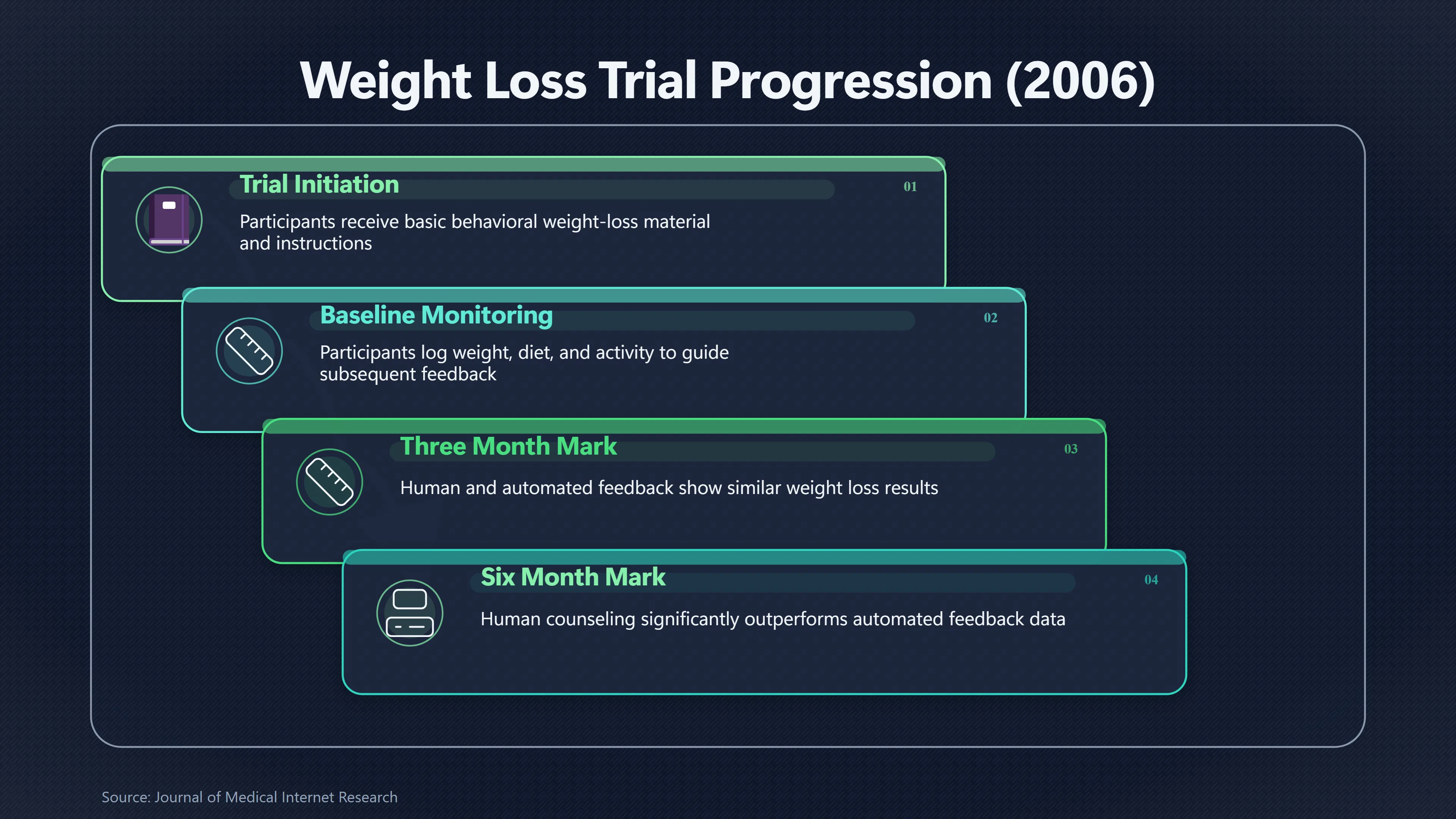
One of the clearest early comparisons came from a 2006 randomised trial of 192 adults in an internet weight-loss programme. Everyone received basic behavioural weight-loss material, while participants were assigned to no counselling, weekly computer-automated tailored feedback or weekly human email counselling. Both feedback conditions used participants’ monitoring of weight, diet and activity to guide subsequent messages.[JAMA Network]jamanetwork.comJAMA NetworkA Randomized Trial Comparing Human e-Mail Counseling, Computer-Automated Tailored Counseling, and No Counseling in an Interne…
At three months, the distinction between human and automated feedback barely mattered to the outcome: participants completing follow-up had lost an average of 6.1 kg with human counselling and 5.3 kg with automated feedback, versus 2.8 kg with no counselling. The human and automated groups did not significantly differ from each other. By six months, however, the trajectories had separated. Average losses were 7.3 kg with human counselling, 4.9 kg with automated feedback and 2.6 kg without counselling; human counselling was then significantly better than either alternative.[JAMA Network]jamanetwork.comJAMA NetworkA Randomized Trial Comparing Human e-Mail Counseling, Computer-Automated Tailored Counseling, and No Counseling in an Interne…
This is an important warning against judging feedback systems only by their initial effect. An algorithm can use logged data to recognise whether someone met a target and return an appropriate prewritten response cheaply and consistently. A human can do that too, but can also interpret unusual circumstances, respond to questions and vary the conversation when adherence starts to weaken. The 2006 trial did not isolate which of these differences caused the longer-term divergence, so it cannot establish a general human advantage. It does show that short-term equivalence does not guarantee that automated feedback will remain equally effective.
A newer test reached a similar conclusion in a different design. A 2024 randomised trial assigned 400 adults with overweight or obesity either to a wireless feedback system alone or to that same system plus human coaching. The system collected activity and weight through a tracker and wireless scale and returned daily smartphone feedback about progress; coaches in the second condition could see participants’ monitoring data and provided weekly telephone support.[JAMA Network]jamanetwork.comOpen source on jamanetwork.com.
At six months, the system-alone group had lost an average of 2.8 kg, compared with 4.8 kg in the group that also received coaching. The trial was designed to test whether the automated system was non-inferior — close enough to coaching according to a prespecified margin — and it failed that test. Differences were similar at three and 12 months.[JAMA Network]jamanetwork.comOpen source on jamanetwork.com.
But this was not a clean contest between a person and an algorithm supplying otherwise identical feedback. Human coaching was added to an existing automated system, giving that group more support overall. The appropriate conclusion is therefore narrower: in this setting, automated self-monitoring feedback did not make the additional human contact redundant.
A Newer AI Trial Complicates the Picture
The strongest recent counterexample comes from a pragmatic randomised trial reported in JAMA in 2025. Researchers assigned 368 adults with prediabetes and overweight or obesity to referral either to a fully automated AI-powered Diabetes Prevention Program or to a programme delivered remotely by human coaches. Unlike many earlier digital studies, this was a genuine automated-versus-human comparison rather than an app-versus-nothing study.[JAMA Network]jamanetwork.comJAMA NetworkAn AI-Powered Lifestyle Intervention vs Human Coaching in the Diabetes Prevention Program: A Randomized Clinical Trial | Tria…
The automated system was more sophisticated than the rule-based feedback typical of early digital interventions. It combined actively recorded information, including weight and meal logs, with passively collected information such as activity and location. A reinforcement-learning algorithm adapted the content and timing of prompts according to patterns of engagement. It could, for example, connect a person’s previous behaviour and current circumstances with a prompt about physical activity, eating or weighing. It did not use a large language model.[JAMA Network]jamanetwork.comJAMA NetworkAn AI-Powered Lifestyle Intervention vs Human Coaching in the Diabetes Prevention Program: A Randomized Clinical Trial | Tria…
At 12 months, 31.7% of people assigned to the AI programme and 31.9% assigned to human coaching achieved the study’s primary composite outcome. That outcome required maintaining blood glucose below the diabetes threshold while also achieving a specified improvement in weight, physical activity or glycated haemoglobin. The difference met the study’s prespecified criterion for non-inferiority. Initiation was also higher after referral to AI: 93.4% began the programme, compared with 82.7% of those referred to human coaching.[JAMA Network]jamanetwork.comJAMA NetworkAn AI-Powered Lifestyle Intervention vs Human Coaching in the Diabetes Prevention Program: A Randomized Clinical Trial | Tria…
This is unusually strong evidence that human involvement is not intrinsically necessary for every effective feedback loop. If monitoring data are collected continuously and the system can personalise when and how it responds, automation can remove practical constraints associated with scheduled human contact.
Yet a 2026 analysis of participants’ experiences in the same trial reveals why declaring an algorithmic victory would be equally premature. AI participants started sooner — a median of 11 days after referral versus 26 days with human coaching — and engagement was higher and more evenly spread over the year. But participants rated the human programme more favourably across measures of acceptability, with particularly large differences in satisfaction. Among people assigned to AI, 46.5% said they would have preferred a human coach; among those assigned to human coaching, 31.5% would have preferred a fully automated programme.[Nature]nature.comPatient engagement, acceptability, and preference of artificial intelligence versus human coaching for diabetes prevention | npj Di…
The striking result is therefore not that people preferred algorithms. They generally did not. It is that the automated system could achieve comparable measured outcomes while offering faster access and sustained engagement, even though the human experience was rated more highly. Effectiveness, convenience and subjective preference are not necessarily the same thing.
Where Personalised Algorithmic Feedback Looked Promising
Algorithmic feedback has a particular potential advantage when self-monitoring generates more information than a person could conveniently review in real time. Instead of merely reporting “you walked 6,400 steps”, a system can potentially use recent behaviour to decide which target or suggestion is most attainable next.
A small 2015 randomised pilot called MyBehavior illustrates the idea. The app collected activity, location and food information and used a machine-learning method to generate contextualised suggestions based on a person’s own previous behaviour. Rather than prescribing entirely new routines, it could recommend repeating or slightly modifying behaviours that appeared feasible from the user’s history.[PubMed Central (PMC)]pmc.ncbi.nlm.nih.govPubMed Central (PMC)Automated Personalized Feedback for Physical Activity and Dietary Behavior Change With Mobile Phones: A Randomized Co…
Only 17 participants took part, so the findings are preliminary rather than decisive. Nevertheless, people receiving the personalised algorithmic suggestions walked significantly more during the three-week experiment than those receiving non-personalised suggestions created by professionals, and they rated the personalised suggestions more positively. Dietary differences between groups were not statistically significant.[PubMed Central (PMC)]pmc.ncbi.nlm.nih.govPubMed Central (PMC)Automated Personalized Feedback for Physical Activity and Dietary Behavior Change With Mobile Phones: A Randomized Co…
A separate 10-week randomised study of 64 participants tested machine-learning-generated adaptive step goals against a fixed target of 10,000 steps per day. Its premise captures an important use of algorithmic feedback: the system can repeatedly update the reference point against which monitoring data are interpreted rather than giving everybody the same target.[PubMed]pubmed.ncbi.nlm.nih.govEvaluating Machine Learning-Based Automated Personalized Daily Step Goals Delivered Through a Mobile Phone App: Randomized Controll…
These studies do not demonstrate that algorithms outperform human coaches. MyBehavior compared personalised automated suggestions with generic professionally created suggestions, while the adaptive-goal study compared one automated goal-setting strategy with another kind of target. Their value is more specific: they demonstrate how algorithms can turn streams of self-monitoring data into feedback that changes with the individual.
Nor does increasingly sophisticated personalisation guarantee behavioural effects. In a 2026 microrandomised study involving people with hypertension, tailored push notifications were experimentally switched on or off at many individual decision points. Across 187,517 randomisations, activity notifications did not significantly increase steps during the following hour, and dietary notifications did not significantly improve lower-sodium food choices over the next day. They did, however, sharply increase immediate engagement with the app.[JMIR]jmir.orgJournal of Medical Internet ResearchJournal of Medical Internet Research - Impact of Push Notifications on Physical Activity and Sodium Intake Among Patients with Hypert…
That distinction is useful. An algorithm may successfully make somebody look at their data without successfully changing the behaviour those data describe. Personalisation is a capability, not evidence of effectiveness by itself.
Human and Automated Feedback Can Also Be Complements
The human-versus-algorithm framing can obscure a third possibility: each may compensate for limitations of the other.
A 2021 meta-analysis examined 13 studies with 1,471 participants in which automated digital interventions were added to human coach-delivered weight-loss treatment. The combined conditions produced an estimated 2.18 kg advantage at the end of treatment compared with coaching alone, although the studies were heterogeneous and the authors flagged possible publication bias. Interestingly, automated additions appeared most useful where the amount of coach contact was relatively low.[PubMed]pubmed.ncbi.nlm.nih.govIncorporating automated digital interventions into coach-delivered weight loss treatment: A meta-analysis - PubMed…
That pattern makes practical sense without proving a universal formula. Automation is well suited to repetitive, high-frequency work: collecting measurements, comparing them with targets, recognising simple patterns and delivering reminders or immediate feedback. A coach’s limited time can then be reserved for situations where interpretation, negotiation or a change of strategy is needed.
The wider digital weight-management literature reinforces the uncertainty rather than resolving it. A systematic review of 39 studies found that greater engagement with digital self-monitoring was associated with greater weight loss in 74% of the reported relationships, but counselling did not straightforwardly produce higher self-monitoring engagement than standalone interventions.[PubMed]pubmed.ncbi.nlm.nih.govOpen source on nih.gov. A 2023 meta-analysis of self-monitoring apps combined with health coaching found benefits for several weight-related outcomes, yet concluded that more evidence was required to establish the added value of coaching over app use itself.[PubMed]pubmed.ncbi.nlm.nih.govOpen source on nih.gov.
Likewise, a 2025 component network meta-analysis covering 68 prioritised digital weight-loss trials found no single digital component — including feedback, self-monitoring or specialist contact — consistently associated with success. Specialist contact was among the more promising components, but its estimate was generally not statistically decisive.[JMIR]jmir.orgJournal of Medical Internet ResearchJournal of Medical Internet Research

Why No Clear Winner Has Emerged
The contradictory findings are less surprising once the comparisons are examined closely. “Human feedback” and “algorithmic feedback” each cover interventions that differ substantially in intensity and capability.
The comparison is rarely feedback source alone. Adding a coach often adds conversation, accountability, problem-solving and social support at the same time. Conversely, a digital programme may add continuous sensing, immediate reminders and automated goal adjustment. When outcomes differ, it can be impossible to attribute the difference solely to whether a human or machine generated the feedback. The 2024 wireless-system trial, for example, compared automation with automation plus weekly coaching, not two otherwise identical feedback sources.[JAMA Network]jamanetwork.comOpen source on jamanetwork.com.
Automation itself has changed. The tailored messages used in the 2006 weight-loss trial were not equivalent to a modern system continuously adapting prompts using reinforcement learning and passively collected data. Treating both simply as “algorithmic feedback” hides a substantial technological difference.[JAMA Network]jamanetwork.comJAMA NetworkA Randomized Trial Comparing Human e-Mail Counseling, Computer-Automated Tailored Counseling, and No Counseling in an Interne…
The outcome and time horizon matter. Automated and human feedback were essentially tied at three months in the 2006 trial but separated by six months. In the newer diabetes-prevention trial, automated and human programmes produced almost identical rates on the primary 12-month clinical-behavioural outcome even though participants reported greater satisfaction with human coaching.[JAMA Network]jamanetwork.comJAMA NetworkA Randomized Trial Comparing Human e-Mail Counseling, Computer-Automated Tailored Counseling, and No Counseling in an Interne…
Engagement is part of the intervention, not a side issue. A theoretically excellent coach is of little help if appointments are difficult to start or maintain; a sophisticated algorithm is of little help if its notifications become background noise. The 2026 diabetes-prevention analysis neatly exposes this trade-off: automation enabled faster initiation and sustained engagement, whereas human coaching generated greater satisfaction.[Nature]nature.comPatient engagement, acceptability, and preference of artificial intelligence versus human coaching for diabetes prevention | npj Di…
For someone using self-monitoring to improve behaviour, the evidence therefore supports a more useful question than “Are humans or algorithms better?” It is: what kind of feedback does this monitoring problem require? Routine interpretation of frequent, structured data is particularly compatible with automation. Situations that repeatedly defeat standard prompts may justify human attention. The current research does not establish a universal threshold for switching between them, but it does undermine the assumption that either source should automatically be preferred.
The Practical Takeaway
Human feedback retains plausible advantages where the difficulty lies in interpreting complicated circumstances, maintaining a relationship or revising a plan after repeated failure. Algorithmic feedback has different strengths: it can operate continuously, respond rapidly to incoming monitoring data, personalise at scale and avoid the scheduling constraints of human support.
Direct trials have now produced examples of all three important outcomes: short-term equivalence followed by a human advantage, an advantage from adding coaching to automated feedback, and non-inferiority of a fully automated AI programme to human coaching.[JAMA Network]jamanetwork.comJAMA NetworkA Randomized Trial Comparing Human e-Mail Counseling, Computer-Automated Tailored Counseling, and No Counseling in an Interne… That is not enough evidence to rank one feedback source above the other across self-monitoring tasks.
The stronger conclusion is narrower but more useful for self-improvement that works: judge feedback by what it does with the monitoring data, not simply by whether a person or an algorithm delivers it. The best source is the one that can turn the particular pattern being tracked into timely, credible and actionable adjustment — and keep doing so for long enough to matter.
Amazon book picks
Further Reading
Books and field guides related to Do Humans Give Better Feedback Than Algorithms?. Use these as the next step if you want deeper reading beyond the article.
Algorithms to Live By
A fascinating exploration of how computer algorithms can be applied to our everyday lives. In this dazzlingly interdisciplinary work, acc...
The Power of Habit
Rating: 4.0/5 from 145 Google Books ratings
Duhigg takes us to the edge of scientific discoveries that explain why habits exist and how they can be changed. Distilling information i...
The Coaching Habit
Coaching is an essential skill for leaders. But for most busy, overworked managers, coaching employees is done badly, or not at all. They...
Human + Machine
AI is radically transforming business. Are you ready? Look around you. Artificial intelligence is no longer just a futuristic notion. It'...
eBay marketplace picks
Marketplace Samples
Live-tested eBay searches with available results related to this page.
Selected fromtechnology poster oneBay.co.uk.




Endnotes
1.
Source: nature.com
Link:https://www.nature.com/articles/s41746-026-03063-w
Source snippet
Patient engagement, acceptability, and preference of artificial intelligence versus human coaching for diabetes prevention | npj Di...
2.
Source: jmir.org
Title: Journal of Medical Internet Research
Link:https://www.jmir.org/2026/1/e78218/
Source snippet
Journal of Medical Internet Research - Impact of Push Notifications on Physical Activity and Sodium Intake Among Patients with Hypert...
3.
Source: jmir.org
Title: Journal of Medical Internet Research
Link:https://www.jmir.org/2025/1/e65443
5.
Source: nature.com
Link:https://www.nature.com/articles/s44401-026-00118-8
6.
Source: formative.jmir.org
Link:https://formative.jmir.org/2026/1/e94036
7.
Source: mhealth.jmir.org
Link:https://mhealth.jmir.org/2026/1/e79995
8.
Source: jmir.org
Title: Journal of Medical Internet Research
Link:https://www.jmir.org/2026/1/e91338
9.
Source: formative.jmir.org
Link:https://formative.jmir.org/2026/1/e75133/
10.
Source: jmir.org
Title: Journal of Medical Internet Research
Link:https://www.jmir.org/2026/1/e81070
11.
Source: preprints.jmir.org
Link:https://preprints.jmir.org/preprint/81070
12.
Source: mhealth.jmir.org
Link:https://mhealth.jmir.org/2026/1/e81779
14.
Source: nature.com
Link:https://www.nature.com/articles/s41746-025-01701-3
15.
Source: nature.com
Link:https://www.nature.com/articles/s41366-025-01746-0
16.
Source: nature.com
Link:https://www.nature.com/articles/s41746-024-01321-3
17.
Source: mental.jmir.org
Link:https://mental.jmir.org/2024/1/e51366/
18.
Source: formative.jmir.org
Link:https://formative.jmir.org/2024/1/e38803
19.
Source: jmir.org
Title: Journal of Medical Internet Research
Link:https://www.jmir.org/2023/1/e42432/
20.
Source: jmir.org
Title: Journal of Medical Internet Research
Link:https://jmir.org/2023/1/e42864
22.
Source: humanfactors.jmir.org
Link:https://humanfactors.jmir.org/2022/2/e37372
23.
Source: publichealth.jmir.org
Link:https://publichealth.jmir.org/2022/5/e37820
25.
Source: jmir.org
Title: Journal of Medical Internet Research
Link:https://www.jmir.org/2021/5/e19688/
26.
Source: jmir.org
Title: Journal of Medical Internet Research
Link:https://www.jmir.org/2018/12/e11321/
27.
Source: mhealth.jmir.org
Link:https://mhealth.jmir.org/2018/10/e10471/
28.
Source: mhealth.jmir.org
Link:https://mhealth.jmir.org/2018/1/e28/
29.
Source: jmir.org
Title: Journal of Medical Internet Research
Link:https://www.jmir.org/2016/11/e278/
30.
Source: jmir.org
Title: Journal of Medical Internet Research
Link:https://www.jmir.org/2016/6/e159/
31.
Source: mhealth.jmir.org
Link:https://mhealth.jmir.org/2015/2/e42/
33.
Source: jmir.org
Title: Journal of Medical Internet Research
Link:https://www.jmir.org/2012/4/e96/
34.
Source: jmir.org
Title: Journal of Medical Internet Research
Link:https://www.jmir.org/2012/2/e53
35.
Source: jmir.org
Title: Journal of Medical Internet Research
Link:https://www.jmir.org/2012/1/e1/
36.
Source: jmir.org
Title: Journal of Medical Internet Research
Link:https://www.jmir.org/2009/2/e16
38.
Source: jmir.org
Title: Journal of Medical Internet Research
Link:https://www.jmir.org/2007/2/e7/
39.
Source: formative.jmir.org
Link:https://formative.jmir.org/2021/5/e23974/
40.
Source: nature.com
Link:https://www.nature.com/articles/s41598-022-08078-3
41.
Source: nature.com
Link:https://www.nature.com/articles/s41598-023-33703-0
42.
Source: jamanetwork.com
Link:https://jamanetwork.com/journals/jamainternalmedicine/fullarticle/410781
Source snippet
JAMA NetworkA Randomized Trial Comparing Human e-Mail Counseling, Computer-Automated Tailored Counseling, and No Counseling in an Interne...
43.
Source: jamanetwork.com
Link:https://jamanetwork.com/journals/jama/fullarticle/2818967
44.
Source: jamanetwork.com
Link:https://jamanetwork.com/journals/jama/fullarticle/2840703
Source snippet
JAMA NetworkAn AI-Powered Lifestyle Intervention vs Human Coaching in the Diabetes Prevention Program: A Randomized Clinical Trial | Tria...
45.
Source: pmc.ncbi.nlm.nih.gov
Link:https://pmc.ncbi.nlm.nih.gov/articles/PMC4812832/
Source snippet
PubMed Central (PMC)Automated Personalized Feedback for Physical Activity and Dietary Behavior Change With Mobile Phones: A Randomized Co...
46.
Source: pubmed.ncbi.nlm.nih.gov
Link:https://pubmed.ncbi.nlm.nih.gov/29371177/
Source snippet
Evaluating Machine Learning-Based Automated Personalized Daily Step Goals Delivered Through a Mobile Phone App: Randomized Controll...
47.
Source: pmc.ncbi.nlm.nih.gov
Link:https://pmc.ncbi.nlm.nih.gov/articles/PMC5806006/
Source snippet
PubMed Central (PMC)Evaluating Machine Learning–Based Automated Personalized Daily Step Goals Delivered Through a Mobile Phone App: Rando...
48.
Source: pubmed.ncbi.nlm.nih.gov
Link:https://pubmed.ncbi.nlm.nih.gov/34618500/
Source snippet
Incorporating automated digital interventions into coach-delivered weight loss treatment: A meta-analysis - PubMed...
49.
Source: pubmed.ncbi.nlm.nih.gov
Link:https://pubmed.ncbi.nlm.nih.gov/33624440/
50.
Source: pubmed.ncbi.nlm.nih.gov
Link:https://pubmed.ncbi.nlm.nih.gov/37071452/
51.
Source: pmc.ncbi.nlm.nih.gov
Link:https://pmc.ncbi.nlm.nih.gov/articles/PMC10155083/
52.
Source: pmc.ncbi.nlm.nih.gov
Link:https://pmc.ncbi.nlm.nih.gov/articles/PMC13139757/
53.
Source: pubmed.ncbi.nlm.nih.gov
Link:https://pubmed.ncbi.nlm.nih.gov/42081742/
54.
Source: pmc.ncbi.nlm.nih.gov
Link:https://pmc.ncbi.nlm.nih.gov/articles/PMC12560030/
55.
Source: jamanetwork.com
Link:https://jamanetwork.com/journals/jama/fullarticle/2840703?guestAccessKey=eb61e148-17cf-454f-a972-7b738ca7222e
56.
Source: pmc.ncbi.nlm.nih.gov
Link:https://pmc.ncbi.nlm.nih.gov/articles/PMC12397713/
57.
Source: pubmed.ncbi.nlm.nih.gov
Link:https://pubmed.ncbi.nlm.nih.gov/40631347/
58.
Source: pmc.ncbi.nlm.nih.gov
Link:https://pmc.ncbi.nlm.nih.gov/articles/PMC12235231/
59.
Source: pubmed.ncbi.nlm.nih.gov
Link:https://pubmed.ncbi.nlm.nih.gov/40418819/
60.
Source: pmc.ncbi.nlm.nih.gov
Link:https://pmc.ncbi.nlm.nih.gov/articles/PMC12058678/
61.
Source: pmc.ncbi.nlm.nih.gov
Link:https://pmc.ncbi.nlm.nih.gov/articles/PMC11660288/
62.
Source: pmc.ncbi.nlm.nih.gov
Link:https://pmc.ncbi.nlm.nih.gov/articles/PMC11541063/
63.
Source: pmc.ncbi.nlm.nih.gov
Link:https://pmc.ncbi.nlm.nih.gov/articles/PMC11496924/
64.
Source: pmc.ncbi.nlm.nih.gov
Link:https://pmc.ncbi.nlm.nih.gov/articles/PMC11489803/
65.
Source: pubmed.ncbi.nlm.nih.gov
Link:https://pubmed.ncbi.nlm.nih.gov/38996332/
66.
Source: pmc.ncbi.nlm.nih.gov
Link:https://pmc.ncbi.nlm.nih.gov/articles/PMC11245659/
67.
Source: pubmed.ncbi.nlm.nih.gov
Link:https://pubmed.ncbi.nlm.nih.gov/38848556/
68.
Source: pmc.ncbi.nlm.nih.gov
Link:https://pmc.ncbi.nlm.nih.gov/articles/PMC11975838/
69.
Source: pmc.ncbi.nlm.nih.gov
Link:https://pmc.ncbi.nlm.nih.gov/articles/PMC11094642/
70.
Source: pmc.ncbi.nlm.nih.gov
Link:https://pmc.ncbi.nlm.nih.gov/articles/PMC10765525/
71.
Source: pmc.ncbi.nlm.nih.gov
Link:https://pmc.ncbi.nlm.nih.gov/articles/10482795/
72.
Source: pmc.ncbi.nlm.nih.gov
Link:https://pmc.ncbi.nlm.nih.gov/articles/PMC10007007/
73.
Source: pmc.ncbi.nlm.nih.gov
Link:https://pmc.ncbi.nlm.nih.gov/articles/PMC9912959/
74.
Source: pubmed.ncbi.nlm.nih.gov
Link:https://pubmed.ncbi.nlm.nih.gov/35889956/
75.
Source: pmc.ncbi.nlm.nih.gov
Link:https://pmc.ncbi.nlm.nih.gov/articles/PMC9297147/
76.
Source: pmc.ncbi.nlm.nih.gov
Link:https://pmc.ncbi.nlm.nih.gov/articles/PMC9212136/
77.
Source: pmc.ncbi.nlm.nih.gov
Link:https://pmc.ncbi.nlm.nih.gov/articles/PMC8660785/
78.
Source: pmc.ncbi.nlm.nih.gov
Link:https://pmc.ncbi.nlm.nih.gov/articles/PMC8439432/
79.
Source: pmc.ncbi.nlm.nih.gov
Link:https://pmc.ncbi.nlm.nih.gov/articles/PMC8928602/
80.
Source: pmc.ncbi.nlm.nih.gov
Link:https://pmc.ncbi.nlm.nih.gov/articles/PMC9605038/
81.
Source: pmc.ncbi.nlm.nih.gov
Link:https://pmc.ncbi.nlm.nih.gov/articles/PMC6374735/
82.
Source: pmc.ncbi.nlm.nih.gov
Link:https://pmc.ncbi.nlm.nih.gov/articles/PMC6315269/
83.
Source: pmc.ncbi.nlm.nih.gov
Link:https://pmc.ncbi.nlm.nih.gov/articles/PMC6245957/
84.
Source: pmc.ncbi.nlm.nih.gov
Link:https://pmc.ncbi.nlm.nih.gov/articles/PMC5875102/
85.
Source: pmc.ncbi.nlm.nih.gov
Link:https://pmc.ncbi.nlm.nih.gov/articles/PMC4930527/
86.
Source: pmc.ncbi.nlm.nih.gov
Link:https://pmc.ncbi.nlm.nih.gov/articles/PMC4846785/
87.
Source: pmc.ncbi.nlm.nih.gov
Link:https://pmc.ncbi.nlm.nih.gov/articles/PMC4999041/
88.
Source: pmc.ncbi.nlm.nih.gov
Link:https://pmc.ncbi.nlm.nih.gov/articles/PMC4892311/
89.
Source: pmc.ncbi.nlm.nih.gov
Link:https://pmc.ncbi.nlm.nih.gov/articles/PMC4845232/
90.
Source: pubmed.ncbi.nlm.nih.gov
Link:https://pubmed.ncbi.nlm.nih.gov/24349392/
91.
Source: pmc.ncbi.nlm.nih.gov
Link:https://pmc.ncbi.nlm.nih.gov/articles/PMC3849440/
92.
Source: jamanetwork.com
Link:https://jamanetwork.com/journals/jamainternalmedicine/fullarticle/1485082
93.
Source: pmc.ncbi.nlm.nih.gov
Link:https://pmc.ncbi.nlm.nih.gov/articles/PMC3479049/
94.
Source: pmc.ncbi.nlm.nih.gov
Link:https://pmc.ncbi.nlm.nih.gov/articles/PMC3996838/
95.
Source: pmc.ncbi.nlm.nih.gov
Link:https://pmc.ncbi.nlm.nih.gov/articles/PMC3415265/
96.
Source: pmc.ncbi.nlm.nih.gov
Link:https://pmc.ncbi.nlm.nih.gov/articles/PMC3374543/
97.
Source: pubmed.ncbi.nlm.nih.gov
Link:https://pubmed.ncbi.nlm.nih.gov/22281837/
98.
Source: pmc.ncbi.nlm.nih.gov
Link:https://pmc.ncbi.nlm.nih.gov/articles/PMC3268702/
99.
Source: pmc.ncbi.nlm.nih.gov
Link:https://pmc.ncbi.nlm.nih.gov/articles/PMC2762806/
100.
Source: pmc.ncbi.nlm.nih.gov
Link:https://pmc.ncbi.nlm.nih.gov/articles/PMC1874722/
101.
Source: pubmed.ncbi.nlm.nih.gov
Link:https://pubmed.ncbi.nlm.nih.gov/17197015/
102.
Source: pmc.ncbi.nlm.nih.gov
Link:https://pmc.ncbi.nlm.nih.gov/articles/PMC3140844/
103.
Source: pubmed.ncbi.nlm.nih.gov
Link:https://pubmed.ncbi.nlm.nih.gov/18020844/
104.
Source: ncbi.nlm.nih.gov
Link:https://www.ncbi.nlm.nih.gov/books/NBK591572/
105.
Source: pmc.ncbi.nlm.nih.gov
Link:https://pmc.ncbi.nlm.nih.gov/articles/PMC5487285/
106.
Source: pubmed.ncbi.nlm.nih.gov
Link:https://pubmed.ncbi.nlm.nih.gov/16908795/
107.
Source: pmc.ncbi.nlm.nih.gov
Link:https://pmc.ncbi.nlm.nih.gov/articles/PMC4274778/
Additional References
108.
Source: youtube.com
Link:https://www.youtube.com/watch?v=WD9YlmAEo4c
Source snippet
"Human coaching" OR "human" "automated" OR "AI" feedback digital health behavior change Harari Explains Why Society Is Dying from Within...
109.
Source: youtube.com
Title: Sustainable Health with Kara Collier: CGM Tracking and Human Coaching vs AI
Link:https://www.youtube.com/watch?v=zV9ZLRSgjPA
Source snippet
Reimagining Chronic Care: Combining Self-Monitoring, AI Feedback, and Human Coaching...
110.
Source: youtube.com
Title: The Harvard Coach Who Changes Lives in One Conversation: AI vs. Human Coaching
Link:https://www.youtube.com/watch?v=iFwzV-dOP0g
Source snippet
Is ChatGPT the Secret to Easy Weight Loss? AI Nutrition vs Human Dietitian...
111.
Source: youtube.com
Title: Is Chat GPT the Secret to Easy Weight Loss? AI Nutrition vs Human Dietitian
Link:https://www.youtube.com/watch?v=ZiCR3QOK3A4
Source snippet
Sustainable Health with Kara Collier: CGM Tracking and Human Coaching vs AI...
112.
Source: youtube.com
Title: AI Workout Apps Tested: Fitbit Gemini vs Peloton IQ vs WHOOP
Link:https://www.youtube.com/watch?v=LhcSIkgQxZI
Source snippet
The Harvard Coach Who Changes Lives in One Conversation: AI vs. Human Coaching...
113.
Source: researchgate.net
Link:https://www.researchgate.net/publication/26696085_Periodic_Prompts_and_Reminders_in_Health_Promotion_and_Health_Behavior_Interventions_Systematic_Review
114.
Source: researchgate.net
Link:https://www.researchgate.net/publication/371833535_The_Effectiveness_of_eHealth_Interventions_for_Weight_Loss_and_Weight_Loss_Maintenance_in_Adults_with_Overweight_or_Obesity_A_Systematic_Review_of_Systematic_Reviews
115.
Source: researchgate.net
Link:https://www.researchgate.net/publication/349419242_Project_Step_A_Randomized_Controlled_Trial_Investigating_the_Effects_of_Frequent_Feedback_and_Contingent_Incentives_on_Physical_Activity
116.
Source: researchgate.net
Link:https://www.researchgate.net/publication/377155498_Impact_of_feedback_generation_and_presentation_on_self-monitoring_behaviors_dietary_intake_physical_activity_and_weight_a_systematic_review_and_meta-analysis
117.
Source: sciencedirect.com
Link:https://www.sciencedirect.com/science/article/pii/S2561326X22004218