Within Reduce Friction
Make Bad Habits Harder to Reach
The same friction that blocks good habits can be deliberately placed in front of unwanted actions to make them less convenient.
On this page
- What proximity studies reveal about small barriers
- Adding distance and steps to unwanted actions
- Keeping barriers proportionate and practical
Page outline Jump by section
Introduction
Adding friction means deliberately putting a small obstacle between yourself and an unwanted action: moving tempting food out of reach, keeping a distracting device in another room, logging out of an absorbing website, or introducing a short delay before an app opens. The principle is the mirror image of reducing friction for good habits. When an unwanted behaviour becomes even slightly less convenient, fewer automatic impulses make it all the way to action.
The strongest evidence comes from research on proximity, food consumption and digital behaviour. Experiments suggest that surprisingly small increases in distance or delay can reduce consumption, although the size and durability of the effect vary and the evidence is not equally strong across behaviours. A broad meta-analysis of behavioural field experiments also found that interventions changing effort had comparatively large effects, while warning that publication bias makes precise estimates uncertain.[PubMed Central (PMC)]pmc.ncbi.nlm.nih.govPub Med Central (PMC)A meta-analytic cognitive framework of nudge and sludgePubMed Central (PMC)A meta-analytic cognitive framework of nudge and sludge - PMCNovember 29, 2023…
The practical aim, then, is not to make ordinary life punitive. It is to place a modest, repeatable cost exactly where an unwanted behaviour would otherwise happen almost automatically.
What proximity studies reveal about small barriers
Physical distance is one of the clearest demonstrations of behavioural friction because it can be measured in centimetres or footsteps. A snack within arm’s reach can be taken almost without interrupting another activity. Move it far enough away that someone must reach, stand or walk, and the decision acquires a small cost.
An influential 2006 office experiment illustrates the idea vividly. Forty participants were given chocolates in bowls that varied in visibility and location. When the sweets sat on the participant’s desk rather than two metres away, participants ate an average of 1.8 more chocolates per day. Visibility had a separate effect: visible chocolates produced an additional 2.2 sweets consumed per day on average.[PubMed]pubmed.ncbi.nlm.nih.govThe office candy dish: proximity's influence on estimated and actual consumption - PubMed…
That individual study should not carry the argument by itself. Later randomised research has also manipulated snack distance. In one UK experiment, for example, a bowl of chocolate was positioned either 20 centimetres or 70 centimetres from seated participants, explicitly testing whether moving food from easy reach reduced consumption.[PubMed]pubmed.ncbi.nlm.nih.govEffect of snack-food proximity on intake in general population samples with higher and lower cognitive resource - PubMedFebruary 1… A subsequent experiment examined the effect when healthier and less healthy foods were simultaneously available, addressing the more realistic situation in which increasing friction for one option leaves another option accessible.[PubMed]pubmed.ncbi.nlm.nih.govImpact of proximity of healthier versus less healthy foods on intake: A lab-based experiment - PubMedFebruary 1, 2019…
A larger workplace study provides an especially useful real-world example. Researchers examined snack-taking around beverage stations at Google offices. Among men, 23% of those using the drinks station nearer the snacks took a snack, compared with 12% at the more distant station. Among women, the corresponding figures were 17% and 13%. Nothing had been forbidden or priced differently; the relationship between the normal walking route and the tempting option had changed.[ScienceDirect]sciencedirect.comProximity of snacks to beverages increases food consumption in the workplace: A field study - ScienceDirectAugust 1, 2016…
The broader evidence points in the same direction, but with an important qualification. A Cochrane systematic review identified 18 randomised studies of food-proximity interventions. Across 15 comparisons from 12 studies involving 1,098 participants, placing food farther away produced a moderate reduction in consumption, with a standardised mean difference of −0.60. However, the reviewers rated the certainty of this evidence as low, partly because many studies had methodological limitations and much of the research occurred in laboratories rather than sustained everyday settings.[PubMed Central (PMC)]pmc.ncbi.nlm.nih.govPubMed Central (PMC)Altering the availability or proximity of food, alcohol, and tobacco products to change their selection and consumpti…
That qualification matters for self-improvement. The evidence supports “distance can influence behaviour” much better than it supports a precise rule such as “move something two metres away and consumption will fall by X per cent”. The useful mechanism is the interruption of easy access, not a magic distance.
Add distance and steps before the unwanted action
The proximity findings suggest a simple design principle: identify the shortest route from impulse to behaviour and lengthen that route slightly. Friction works particularly well when the unwanted action currently has virtually no starting cost.
Consider a packet of biscuits beside a desk. Eating one requires a hand movement. Put the packet in a kitchen cupboard and the same impulse now requires standing up, leaving the room, opening the cupboard and returning. None of those actions is difficult. Their value lies in creating a boundary between wanting and doing.
The same reasoning applies beyond food. A phone sitting beside the bed is available at the first hint of boredom; a phone charging outside the bedroom requires getting up. A bookmarked distracting site is one click away; logging out introduces authentication before entry. A television that automatically opens a streaming service presents a shorter path than one where the user must deliberately choose the service and programme.
These changes need not make the unwanted behaviour impossible. Indeed, that distinction is useful. Friction preserves a choice while changing its convenience. If you genuinely want the biscuits, phone or website, you can still reach it. What becomes less likely is the low-intention behaviour that occurs because the option was immediately available.
Research on precommitment provides a related explanation. In behavioural science, precommitment means voluntarily restricting future access to temptation before encountering it. Experimental work has found that people can use such restrictions as an alternative to resisting temptation in the moment. The underlying logic is to make the earlier, goal-aligned decision constrain the later choice made under temptation.[PubMed Central (PMC)]pmc.ncbi.nlm.nih.govPub Med Central (PMC)Restricting Temptations: Neural Mechanisms of PrecommitmentPub Med Central (PMC)Restricting Temptations: Neural Mechanisms of Precommitment
For everyday habits, however, full restriction is often unnecessary. There is a continuum:
- Increase reach: put the object in a drawer rather than on the desk.
- Increase distance: store it in another room rather than beside you.
- Add a step: log out, remove a shortcut or require a deliberate confirmation.
- Add a delay: make access possible, but not instantaneous.
- Restrict access: use a stronger precommitment device when weaker barriers repeatedly fail.
The best starting point is usually the smallest barrier that reliably interrupts automatic behaviour.

Digital friction shows that time can work like distance
Modern digital habits make the mechanism particularly easy to see because opening an app can require almost no physical effort. Removing an icon from the first screen is a weak form of friction; requiring an extra action or waiting period is stronger.
A 2023 study of the self-nudging app one sec provides unusually direct evidence. The intervention intercepted attempts to open selected apps and inserted several features, including a short delay and an option to abandon the opening attempt. In field data from 280 participants over six weeks, users dismissed 36% of intercepted attempts, and their attempts to open targeted apps fell by 37% over the study period. Taken together, actual target-app openings were 57% lower after six weeks than during the first week.[PubMed Central (PMC)]pmc.ncbi.nlm.nih.govPub Med Central (PMC)Directing smartphone use through the self-nudge app one secPub Med Central (PMC)Directing smartphone use through the self-nudge app one sec
Crucially, the researchers also tried to separate the intervention’s ingredients in a preregistered experiment involving 500 participants. A time delay alone reduced consumption, showing that friction itself could matter. But the most effective component was giving people an easy opportunity to abandon consumption. Adding every component together was not necessarily better.[PubMed Central (PMC)]pmc.ncbi.nlm.nih.govPub Med Central (PMC)Directing smartphone use through the self-nudge app one secPub Med Central (PMC)Directing smartphone use through the self-nudge app one sec
This sharpens the practical lesson. Friction need not merely make a bad habit annoying. Its more useful role may be to create a decision point where none existed before. The original sequence might be:
impulse → tap → consumption
A barrier changes it to:
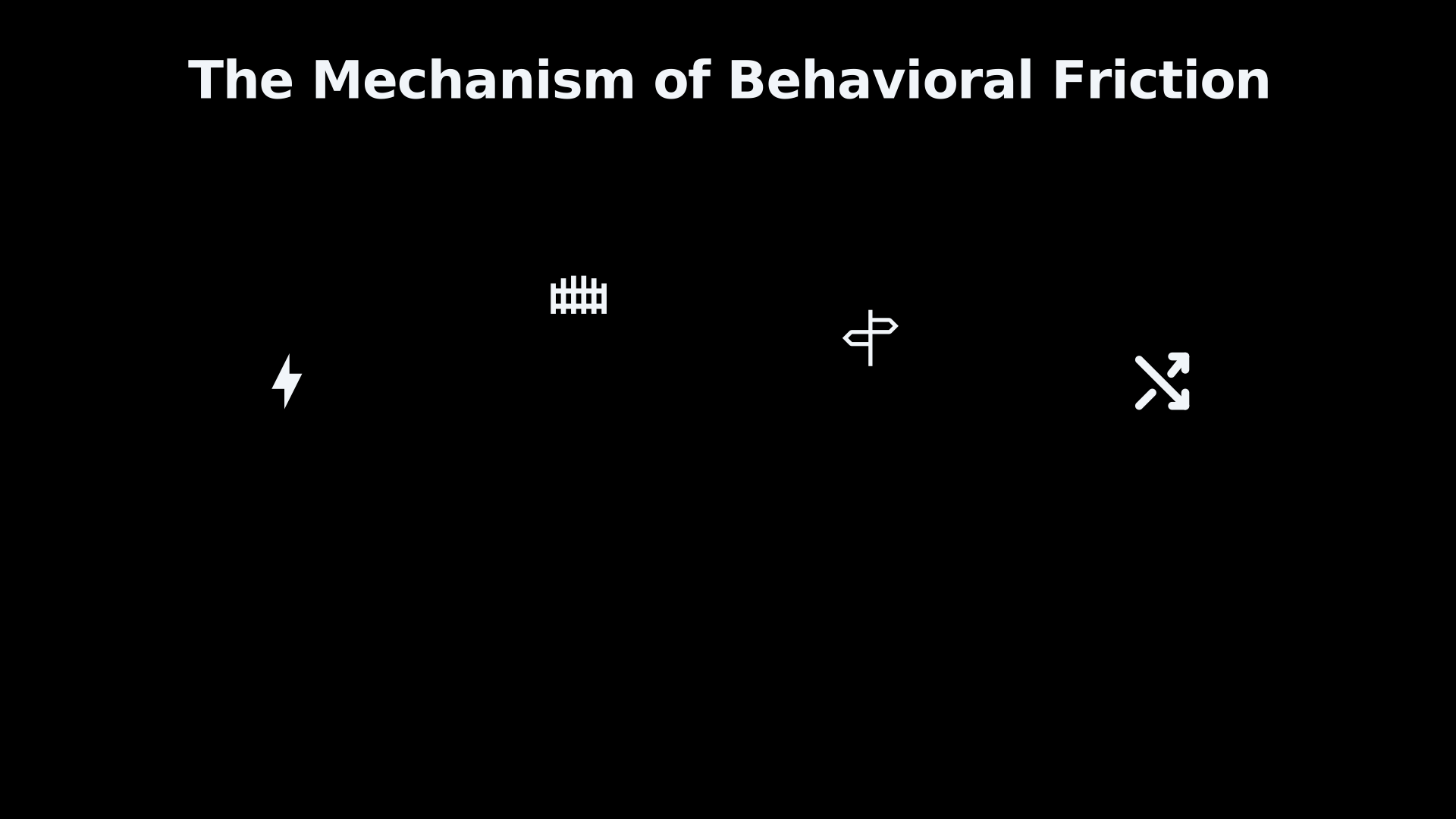
impulse → tap → interruption → choose whether to continue
Those few seconds or extra actions give a weak, fleeting impulse an opportunity to disappear.
Other smartphone research is more mixed, which cautions against treating every inconvenience as an effective intervention. A field experiment in which students either moved problematic apps to another phone page or switched their displays to greyscale found reductions in objective smartphone use across intervention and control groups, making it difficult to attribute the change cleanly to the added barriers.[Taylor & Francis Online]tandfonline.comOpen source on tandfonline.com. A 2023 review of apps intended to reduce maladaptive phone use concluded that approaches including app limits, greyscale and combined interventions can help, but found effectiveness ranging from weak to strong and called for better evaluation.[PubMed Central (PMC)]pmc.ncbi.nlm.nih.govOpen source on nih.gov.
So the defensible claim is narrower: well-placed digital friction can interrupt habitual access, but simply making an interface less pleasant or rearranging icons does not guarantee lasting behavioural change.
Keep barriers proportionate and practical
More friction is not automatically better. The purpose is to discourage low-value automatic behaviour without making legitimate use needlessly difficult. A barrier that takes five seconds may stop reflexive checking while remaining trivial when there is a genuine reason to proceed. A barrier that takes five minutes may instead be disabled or circumvented.
Research on digital interventions supports this concern. In the one sec experiment, the most elaborate combination of interventions did not outperform the simpler option-to-dismiss mechanism; the researchers suggested that additional complexity could itself become counterproductive.[PubMed Central (PMC)]pmc.ncbi.nlm.nih.govPub Med Central (PMC)Directing smartphone use through the self-nudge app one secPub Med Central (PMC)Directing smartphone use through the self-nudge app one sec More recent research on digital self-control tools similarly notes a tension between interventions strong enough to interrupt habitual use and restrictions so rigid that users resist or abandon them.[PubMed Central (PMC)]pmc.ncbi.nlm.nih.govOpen source on nih.gov.
A proportionate barrier therefore has three useful properties. It is close to the moment of temptation, so it actually interrupts the behaviour; small enough to tolerate repeatedly, so it remains in place; and easy to reverse deliberately but not reflexively, so legitimate use remains possible.
This also explains why friction should be targeted rather than scattered everywhere. If evening social-media checking is the unwanted behaviour, putting the phone outside the bedroom directly changes that situation. Making the entire phone inconvenient throughout the working day may interfere with useful communication while doing little to address the specific cue that triggers the habit.
The asymmetry between good and unwanted actions can be deliberately engineered. If fruit is visible on the counter while sweets require opening a cupboard, or a book is beside the bed while the phone charges elsewhere, two mechanisms operate together: the preferred behaviour has a shorter route and the competing behaviour has a longer one. Research on food environments shows why this relative positioning matters: proximity can affect what is consumed, and experiments have specifically examined environments where healthier and less healthy foods compete for choice.[ScienceDirect]sciencedirect.comOpen source on sciencedirect.com.
The broader behavioural literature gives reason to take these seemingly trivial effort differences seriously. A meta-analysis covering 184 field experiments and more than 2.2 million participants found that interventions changing effort had stronger average effects than interventions aimed at intrinsic motivation, while also finding similar effect sizes for interventions that facilitated and inhibited actions. The authors caution that publication bias may exaggerate the apparent advantage, so this is evidence for the importance of effort rather than proof that friction always beats motivation.[PubMed Central (PMC)]pmc.ncbi.nlm.nih.govPub Med Central (PMC)A meta-analytic cognitive framework of nudge and sludgePubMed Central (PMC)A meta-analytic cognitive framework of nudge and sludge - PMCNovember 29, 2023…
For self-improvement, that is enough to change the question worth asking. Instead of relying solely on “How can I resist this next time?”, examine the environment before the next temptation arrives. Ask what makes the unwanted action exceptionally quick, close or automatic, then insert one modest obstacle there. A cupboard door, another room, a logout screen or a ten-second delay can look insignificant in isolation. Repeated at the exact point where an automatic behaviour normally begins, that small inconvenience can change how often the behaviour gets started at all.
Amazon book picks
Further Reading
Books and field guides related to Make Bad Habits Harder to Reach. Use these as the next step if you want deeper reading beyond the article.
Tiny Habits: The Small Changes That Change Everything
Improving your life is much easier than you think. Whether it’s losing weight, sleeping more, or restoring your work/life balance – the s...
The Power of Habit: Why We Do What We Do in Life & Business
For use in schools and libraries only. Identifies the neurological processes behind behaviors, explaining how self-control and success ar...
Nudge
Rating: 3.5/5 from 29 Google Books ratings
Thaler and Sunstein offer a groundbreaking discussion of how to apply the science of choice to nudge people toward decisions that can imp...
Digital Minimalism: Choosing a Focused Life in a Noisy World
A New York Times, Wall Street Journal, Publishers Weekly, and USA Today bestseller "Newport is making a bid to be the Marie Kondo of tech...
eBay marketplace picks
Marketplace Samples
Live-tested eBay searches with available results related to this page.
Selected fromself improvement wall art oneBay.co.uk.

Endnotes
1.
Source: sciencedirect.com
Link:https://www.sciencedirect.com/science/article/pii/S0195666316301465
Source snippet
Proximity of snacks to beverages increases food consumption in the workplace: A field study - ScienceDirectAugust 1, 2016...
Published: August 1, 2016
2.
Source: sciencedirect.com
Title: ScienceDirect Restricting Temptations: Neural Mechanisms of Precommitment
Link:https://www.sciencedirect.com/science/article/pii/S0896627313004480
3.
Source: sciencedirect.com
Link:https://www.sciencedirect.com/science/article/pii/S019566631830583X
4.
Source: sciencedirect.com
Link:https://www.sciencedirect.com/org/science/article/pii/S2291522226000781
5.
Source: sciencedirect.com
Link:https://www.sciencedirect.com/science/article/pii/S1438887123006660
6.
Source: sciencedirect.com
Link:https://www.sciencedirect.com/science/article/pii/S2451958823000271?pubDate=20251126
7.
Source: sciencedirect.com
Link:https://www.sciencedirect.com/science/article/pii/S019566631830847X
8.
Source: sciencedirect.com
Link:https://www.sciencedirect.com/science/article/pii/S0195666317312655
9.
Source: sciencedirect.com
Link:https://www.sciencedirect.com/science/article/abs/pii/S0195666316301465
10.
Source: sciencedirect.com
Title: Epidemics in markets with trade friction and imperfect transactions
Link:https://www.sciencedirect.com/science/article/pii/S002251931500096X
11.
Source: sciencedirect.com
Link:https://www.sciencedirect.com/science/article/pii/S0195666314000920
12.
Source: sciencedirect.com
Title: It takes some effort. How minimal physical effort reduces consumption volume
Link:https://www.sciencedirect.com/science/article/pii/S0195666313003437
13.
Source: sciencedirect.com
Link:https://www.sciencedirect.com/science/article/pii/S1057740807000071
14.
Source: groups.google.com
Title: vw8xc m HWPY
Link:https://groups.google.com/g/alt.support.diet.weightwatchers/c/vw8xc_mHWPY
15.
Source: sciencedirect.com
Link:https://www.sciencedirect.com/science/article/pii/S2451958823000271
16.
Source: sciencedirect.com
Link:https://www.sciencedirect.com/science/article/pii/S0950329326001576
17.
Source: sciencedirect.com
Title: Commitment and self-control
Link:https://www.sciencedirect.com/science/article/pii/S0022053106001827
18.
Source: sciencedirect.com
Title: Promoting prospective self-control through abstraction
Link:https://www.sciencedirect.com/science/article/pii/S0022103110001290
19.
Source: one-sec.app
Link:https://one-sec.app/research/
20.
Source: books.google.com
Title: The Office Candy Dish
Link:https://books.google.com/books/about/The_Office_Candy_Dish.html?id=pofbzwEACAAJ
21.
Source: pmc.ncbi.nlm.nih.gov
Title: Pub Med Central (PMC)A meta-analytic cognitive framework of nudge and sludge
Link:https://pmc.ncbi.nlm.nih.gov/articles/PMC10685127/
Source snippet
PubMed Central (PMC)A meta-analytic cognitive framework of nudge and sludge - PMCNovember 29, 2023...
Published: November 29, 2023
22.
Source: pmc.ncbi.nlm.nih.gov
Link:https://pmc.ncbi.nlm.nih.gov/articles/PMC6953356/
Source snippet
PubMed Central (PMC)Altering the availability or proximity of food, alcohol, and tobacco products to change their selection and consumpti...
23.
Source: pubmed.ncbi.nlm.nih.gov
Link:https://pubmed.ncbi.nlm.nih.gov/16418755/
Source snippet
The office candy dish: proximity's influence on estimated and actual consumption - PubMed...
24.
Source: pubmed.ncbi.nlm.nih.gov
Link:https://pubmed.ncbi.nlm.nih.gov/29183701/
Source snippet
Effect of snack-food proximity on intake in general population samples with higher and lower cognitive resource - PubMedFebruary 1...
25.
Source: pubmed.ncbi.nlm.nih.gov
Link:https://pubmed.ncbi.nlm.nih.gov/30367891/
Source snippet
Impact of proximity of healthier versus less healthy foods on intake: A lab-based experiment - PubMedFebruary 1, 2019...
Published: February 1, 2019
26.
Source: pmc.ncbi.nlm.nih.gov
Link:https://pmc.ncbi.nlm.nih.gov/articles/PMC6335384/
Source snippet
PubMed Central (PMC)Impact of proximity of healthier versus less healthy foods on intake: A lab-based experiment - PMC...
27.
Source: pubmed.ncbi.nlm.nih.gov
Link:https://pubmed.ncbi.nlm.nih.gov/27112315/
Source snippet
Proximity of snacks to beverages increases food consumption in the workplace: A field study - PubMed...
28.
Source: pmc.ncbi.nlm.nih.gov
Link:https://pmc.ncbi.nlm.nih.gov/articles/PMC6710643/
29.
Source: pmc.ncbi.nlm.nih.gov
Title: Pub Med Central (PMC)Restricting Temptations: Neural Mechanisms of Precommitment
Link:https://pmc.ncbi.nlm.nih.gov/articles/PMC3725418/
30.
Source: pmc.ncbi.nlm.nih.gov
Title: Pub Med Central (PMC)Directing smartphone use through the self-nudge app one sec
Link:https://pmc.ncbi.nlm.nih.gov/articles/PMC9974409/
31.
Source: pubmed.ncbi.nlm.nih.gov
Title: Pub Med Directing smartphone use through the self-nudge app one sec
Link:https://pubmed.ncbi.nlm.nih.gov/36795756/
32.
Source: tandfonline.com
Link:https://www.tandfonline.com/doi/full/10.1080/0144929X.2021.2007284
33.
Source: pmc.ncbi.nlm.nih.gov
Link:https://pmc.ncbi.nlm.nih.gov/articles/PMC10498313/
34.
Source: pubmed.ncbi.nlm.nih.gov
Link:https://pubmed.ncbi.nlm.nih.gov/37643002/
35.
Source: pmc.ncbi.nlm.nih.gov
Link:https://pmc.ncbi.nlm.nih.gov/articles/PMC13062480/
36.
Source: pubmed.ncbi.nlm.nih.gov
Title: Pub Med A meta-analytic cognitive framework of nudge and sludge
Link:https://pubmed.ncbi.nlm.nih.gov/38034123/
37.
Source: GOV.UK
Link:https://www.gov.uk/government/publications/social-media-restriction-pilots-qualitative-research-with-13-to-17-year-olds-in-the-uk/social-media-intervention-research-2026-social-media-restriction-pilots-qualitative-research-with-13-to-17-year-olds-in-the-uk
38.
Source: pmc.ncbi.nlm.nih.gov
Link:https://pmc.ncbi.nlm.nih.gov/articles/PMC12685522/
39.
Source: pmc.ncbi.nlm.nih.gov
Link:https://pmc.ncbi.nlm.nih.gov/articles/PMC12407418/
40.
Source: pmc.ncbi.nlm.nih.gov
Link:https://pmc.ncbi.nlm.nih.gov/articles/PMC12426363/
41.
Source: pmc.ncbi.nlm.nih.gov
Link:https://pmc.ncbi.nlm.nih.gov/articles/PMC12128782/
42.
Source: doi.org
Title: Understanding food choice: A systematic review of reviews: Heliyon
Link:https://doi.org/10.1016/j.heliyon.2024.e32492
43.
Source: doi.org
Link:https://doi.org/10.1016/j.chbr.2023.100294
44.
Source: doi.org
Link:https://doi.org/10.1111/obr.13569
45.
Source: pmc.ncbi.nlm.nih.gov
Link:https://pmc.ncbi.nlm.nih.gov/articles/PMC10909420/
46.
Source: pubmed.ncbi.nlm.nih.gov
Link:https://pubmed.ncbi.nlm.nih.gov/36577008/
47.
Source: pubmed.ncbi.nlm.nih.gov
Link:https://pubmed.ncbi.nlm.nih.gov/36501120/
48.
Source: pmc.ncbi.nlm.nih.gov
Link:https://pmc.ncbi.nlm.nih.gov/articles/PMC9265892/
49.
Source: pubmed.ncbi.nlm.nih.gov
Link:https://pubmed.ncbi.nlm.nih.gov/35600564/
50.
Source: pmc.ncbi.nlm.nih.gov
Link:https://pmc.ncbi.nlm.nih.gov/articles/PMC9112639/
51.
Source: pubmed.ncbi.nlm.nih.gov
Link:https://pubmed.ncbi.nlm.nih.gov/35388348/
52.
Source: pubmed.ncbi.nlm.nih.gov
Link:https://pubmed.ncbi.nlm.nih.gov/33922185/
53.
Source: research-live.com
Title: Behavioural friction | Opinion | Research Live
Link:https://www.research-live.com/article/opinion/behavioural-friction/id/5077432
54.
Source: pubmed.ncbi.nlm.nih.gov
Link:https://pubmed.ncbi.nlm.nih.gov/32483615/
55.
Source: pubmed.ncbi.nlm.nih.gov
Link:https://pubmed.ncbi.nlm.nih.gov/33081130/
56.
Source: pmc.ncbi.nlm.nih.gov
Link:https://pmc.ncbi.nlm.nih.gov/articles/PMC7322874/
57.
Source: pubmed.ncbi.nlm.nih.gov
Link:https://pubmed.ncbi.nlm.nih.gov/32134317/
58.
Source: pmc.ncbi.nlm.nih.gov
Link:https://pmc.ncbi.nlm.nih.gov/articles/PMC8314248/
59.
Source: pubmed.ncbi.nlm.nih.gov
Link:https://pubmed.ncbi.nlm.nih.gov/31654731/
60.
Source: pubmed.ncbi.nlm.nih.gov
Link:https://pubmed.ncbi.nlm.nih.gov/31452193/
61.
Source: pubmed.ncbi.nlm.nih.gov
Link:https://pubmed.ncbi.nlm.nih.gov/31194900/
62.
Source: pubmed.ncbi.nlm.nih.gov
Link:https://pubmed.ncbi.nlm.nih.gov/31060018/
63.
Source: pubmed.ncbi.nlm.nih.gov
Link:https://pubmed.ncbi.nlm.nih.gov/29885662/
64.
Source: pmc.ncbi.nlm.nih.gov
Link:https://pmc.ncbi.nlm.nih.gov/articles/PMC5872569/
65.
Source: pmc.ncbi.nlm.nih.gov
Link:https://pmc.ncbi.nlm.nih.gov/articles/PMC5768324/
66.
Source: pubmed.ncbi.nlm.nih.gov
Link:https://pubmed.ncbi.nlm.nih.gov/28797048/
67.
Source: pmc.ncbi.nlm.nih.gov
Link:https://pmc.ncbi.nlm.nih.gov/articles/PMC6464351/
68.
Source: pubmed.ncbi.nlm.nih.gov
Link:https://pubmed.ncbi.nlm.nih.gov/27297225/
69.
Source: pmc.ncbi.nlm.nih.gov
Link:https://pmc.ncbi.nlm.nih.gov/articles/PMC4906733/
70.
Source: pubmed.ncbi.nlm.nih.gov
Link:https://pubmed.ncbi.nlm.nih.gov/27185414/
71.
Source: pmc.ncbi.nlm.nih.gov
Link:https://pmc.ncbi.nlm.nih.gov/articles/PMC4579823/
72.
Source: pubmed.ncbi.nlm.nih.gov
Link:https://pubmed.ncbi.nlm.nih.gov/25747774/
73.
Source: pmc.ncbi.nlm.nih.gov
Link:https://pmc.ncbi.nlm.nih.gov/articles/PMC4313683/
74.
Source: pmc.ncbi.nlm.nih.gov
Link:https://pmc.ncbi.nlm.nih.gov/articles/PMC3881502/
75.
Source: pubmed.ncbi.nlm.nih.gov
Link:https://pubmed.ncbi.nlm.nih.gov/23889938/
76.
Source: pubmed.ncbi.nlm.nih.gov
Link:https://pubmed.ncbi.nlm.nih.gov/21678172/
77.
Source: pmc.ncbi.nlm.nih.gov
Link:https://pmc.ncbi.nlm.nih.gov/articles/PMC9421913/
78.
Source: pubmed.ncbi.nlm.nih.gov
Link:https://pubmed.ncbi.nlm.nih.gov/31797233/
79.
Source: pmc.ncbi.nlm.nih.gov
Link:https://pmc.ncbi.nlm.nih.gov/articles/PMC5322997/
Additional References
80.
Source: nature.com
Link:https://www.nature.com/articles/0803217
Source snippet
The office candy dish: proximity's influence on estimated and actual consumption | International Journal of Obesity...
81.
Source: youtube.com
Title: How to change your behavior for the better | Dan Ariely
Link:http://www.youtube.com/watch?v=tPBFVIxnbDw
Source snippet
Wendy Wood friction habits Habit Expert, Wendy Wood, breaks down the three bases of habit formation! (Behavioral Science)...
82.
Source: youtube.com
Link:http://www.youtube.com/watch?v=SihwUFcKAwk
Source snippet
How to Break Bad Habits | James Clear & Dr. Andrew Huberman...
83.
Source: youtube.com
Title: The secret habits that control your life | Wendy Wood
Link:http://www.youtube.com/watch?v=Ywec1MbeQDk
Source snippet
Habit Expert, Wendy Wood, breaks down the three bases of habit formation! (Behavioral Science)...
84.
Source: researchgate.net
Link:https://www.researchgate.net/publication/377774169_A_Longitudinal_In-the-Wild_Investigation_of_Design_Frictions_to_Prevent_Smartphone_Overuse
85.
Source: researchgate.net
Link:https://www.researchgate.net/publication/376030390_A_meta-analytic_cognitive_framework_of_nudge_and_sludge
86.
Source: researchgate.net
Link:https://www.researchgate.net/publication/343756368_Habits_to_Save_our_Habitat_Using_the_Psychology_of_Habits_to_Promote_Sustainability
87.
Source: researchgate.net
Link:https://www.researchgate.net/publication/319134895_Impact_of_altering_proximity_on_snack_food_intake_in_individuals_with_high_and_low_executive_function_Study_protocol
88.
Source: cambridge.org
Link:https://www.cambridge.org/core/journals/experimental-economics/article/reassessment-of-the-potential-for-lossframed-incentive-contracts-to-increase-productivity-a-metaanalysis-and-a-realeffort-experiment/E7D1C909740053327DE800BADD3B4AFE
89.
Source: elevify.com
Link:https://www.elevify.com/en-nz/courses/health-and-medicine/psychology/atomic-habits-course-115a0