Within Evidence Limits
Why a Positive Average Effect May Not Predict Your Result
A positive pooled effect can hide large differences across people, settings, behaviours, and study designs.
On this page
- What a pooled effect actually represents
- How heterogeneity changes practical interpretation
- Why prediction intervals can be more informative
Page outline Jump by section
Introduction
A positive average effect does not mean that the same technique will produce that effect for you. Meta-analysis combines results across studies, so its headline number answers a population-level question: what was the average difference across the studies included? It does not directly answer the individual question: what will happen if I try this? Cochrane explicitly warns that, when effects vary between studies, a random-effects meta-analysis estimates the centre of a distribution of effects rather than a single effect shared by everyone.[Cochrane]cochrane.orgChapter 10: Analysing data and undertaking meta-analyses | CochraneChapter 10: Analysing data and undertaking meta-analyses | Cochrane…

This distinction matters unusually much in self-improvement research. Behaviour-change studies can differ in their participants, goals, intervention intensity, comparison groups, follow-up periods and outcome measurements. A technique can therefore have a credible positive average while producing large gains in some circumstances, little change in others and occasionally results compatible with harm. The practical question is not simply whether the pooled effect is positive, but how much variation sits behind that average and how closely the evidence resembles your situation.
What a pooled effect actually represents
A meta-analysis usually gives more weight to studies that estimate their effects more precisely and combines them into a summary estimate. Under a random-effects model, the studies are allowed to have different underlying effects. The resulting pooled number is therefore an estimate of their average effect, conditional on the studies and statistical model being used.[Cochrane]cochrane.orgChapter 10: Analysing data and undertaking meta-analyses | CochraneChapter 10: Analysing data and undertaking meta-analyses | Cochrane…
That is valuable evidence, but it is easy to translate it into a stronger claim than the analysis supports. Suppose a meta-analysis of a self-regulation technique reports a standardised mean effect of 0.40. That does not mean that every participant improves by 0.40 standard deviations, nor that a new user should expect precisely that improvement. It means that the studies collectively support an average difference of that approximate magnitude.
Real self-improvement evidence illustrates the distinction. A meta-analysis of 138 randomised studies involving 19,951 participants found that interventions encouraging people to monitor their goal progress improved goal attainment by an average standardised effect of d = 0.40. Yet the same review found larger effects when progress was physically recorded and when outcomes were made public. The intervention labelled “progress monitoring” therefore did not operate as an invariant treatment: how monitoring was implemented mattered.[PubMed]pubmed.ncbi.nlm.nih.govDoes monitoring goal progress promote goal attainment? A meta-analysis of the experimental evidence - PubMedFebruary 1, 2016…
Implementation intentions — plans that link a situation to a response, commonly framed as “if X happens, then I will do Y” — provide another example. A well-known meta-analysis of 94 independent tests reported an average effect of d = 0.65 on goal achievement, while also finding significant variation that prompted analyses of moderators.[ScienceDirect]sciencedirect.comImplementation Intentions and Goal Achievement: A Meta‐analysis of Effects and Processes - ScienceDirect… The sensible interpretation is that implementation intentions have evidence of benefit across many studies. The number 0.65 should not be converted into a personal forecast.
There is another important distinction. Variation between studies is not identical to variation between people. A meta-analysis might show that effects differ across universities, workplaces, delivery formats or measurement methods without establishing exactly which individuals benefit. Conversely, similar study averages can conceal different individual responses within each study. Research on heterogeneous treatment effects emphasises that estimating the average effect in a population and determining the best intervention for one person are fundamentally different statistical problems.[PubMed]pubmed.ncbi.nlm.nih.govOpen source on nih.gov.
Heterogeneity changes what “it works” means
The technical term for variation in effects across studies is heterogeneity. Cochrane distinguishes clinical diversity — differences in participants, interventions and outcomes — from methodological diversity, such as differences in study design, measurement and risk of bias. Either can produce statistical heterogeneity, in which observed intervention effects vary more than would be expected from sampling error alone.[Cochrane]cochrane.orgChapter 10: Analysing data and undertaking meta-analyses | CochraneChapter 10: Analysing data and undertaking meta-analyses | Cochrane…
For self-improvement, those sources of variation are not minor details. A behaviour-change technique can be embedded in very different programmes. A reminder on a phone, weekly coaching and a carefully designed intervention may all contain “goal setting” or “self-monitoring”, but they do not necessarily represent equivalent experiences.
A systematic review of interventions promoting physical activity and healthier eating among adults with overweight or obesity makes the point concrete. Across 50 short-term outcome reports, the pooled effect was 0.37, but heterogeneity was substantial at I² = 71.3%. For 32 long-term reports, the average fell to 0.24 and I² remained 59.4%. Goal setting and self-monitoring were associated with outcomes, but intervention characteristics and reporting bias also helped explain differences between studies.[PubMed Central (PMC)]pmc.ncbi.nlm.nih.govOpen source on nih.gov.
The I² statistic is often treated as a simple “heterogeneity score”, but it needs care. Cochrane notes that its importance depends on the magnitude and direction of effects and on the strength of evidence for heterogeneity; estimates are particularly uncertain when few studies are available.[Cochrane]cochrane.orgChapter 10: Analysing data and undertaking meta-analyses | CochraneChapter 10: Analysing data and undertaking meta-analyses | Cochrane… More importantly for an ordinary reader, I² does not directly say whether a technique is likely to help you.
Heterogeneity can arise for several reasons that have different practical meanings:
- The intervention really works differently in different circumstances. A technique may depend on motivation, opportunities, feedback, social context or how faithfully it is used.
- Studies may be testing meaningfully different versions of the technique. “Mindfulness”, “goal setting” or “self-monitoring” can describe interventions differing greatly in duration and delivery.
- Outcomes may differ. Improving steps per day is not the same outcome as improving long-term fitness, and reducing a questionnaire score is not necessarily equivalent to a meaningful change in everyday functioning.
- Study methods can create apparent variation. Differences in measurement, comparison conditions, missing data, study quality and reporting bias can alter observed effects even without genuine differences in efficacy.[Cochrane]cochrane.orgChapter 10: Analysing data and undertaking meta-analyses | CochraneChapter 10: Analysing data and undertaking meta-analyses | Cochrane…
This is why unexplained heterogeneity should reduce the precision of a practical claim. A random-effects model does not make heterogeneity disappear. Cochrane specifically cautions that such a model incorporates variation statistically but is not a substitute for investigating why results differ.[Cochrane]cochrane.orgChapter 10: Analysing data and undertaking meta-analyses | CochraneChapter 10: Analysing data and undertaking meta-analyses | Cochrane…
A narrow confidence interval can still hide wide variation
One of the easiest meta-analytic results to misread is a narrow 95% confidence interval around a pooled effect. A confidence interval around a random-effects mean primarily describes uncertainty about the location of the average effect. It does not describe the full spread of underlying effects across settings. With enough studies, researchers can estimate the average quite precisely even while individual study effects remain highly variable.[Cochrane]cochrane.orgChapter 10: Analysing data and undertaking meta-analyses | CochraneChapter 10: Analysing data and undertaking meta-analyses | Cochrane…
Mindfulness research offers an unusually clear demonstration. A systematic review of 136 randomised trials involving 11,605 participants examined mindfulness-based programmes for adults in non-clinical settings. Against no intervention, the pooled estimates favoured mindfulness for several outcomes. For psychological distress, for example, the standardised mean difference was −0.45, with a 95% confidence interval of −0.58 to −0.31. Read alone, that looks like a consistently beneficial result.
But the corresponding 95% prediction interval was −1.04 to 0.14. For wellbeing, the pooled effect was 0.33 with a confidence interval of 0.11 to 0.54, while the prediction interval stretched from −0.29 to 0.94. The average was favourable, but the expected range across comparable settings included effects on the other side of zero.[PubMed]pubmed.ncbi.nlm.nih.govOpen source on nih.gov.
That does not show that mindfulness “doesn’t work”. It shows why “positive on average” and “reliably positive in every setting” are different propositions.
The same research programme later obtained individual participant data from 13 trials involving 2,371 people and reanalysed them consistently. It found a small-to-moderate average reduction in psychological distress and no clear evidence that prespecified characteristics such as age, gender, education or baseline dispositional mindfulness modified the primary effect. The researchers nevertheless stressed that further work was needed to identify sources of individual variability.[Nature]nature.comOpen source on nature.com.
That result highlights an important restraint: unexplained variation is not permission to invent personalised rules. If researchers have not established that “people like you” respond differently, a self-help author cannot legitimately fill the gap with intuition.
Why prediction intervals can be more informative
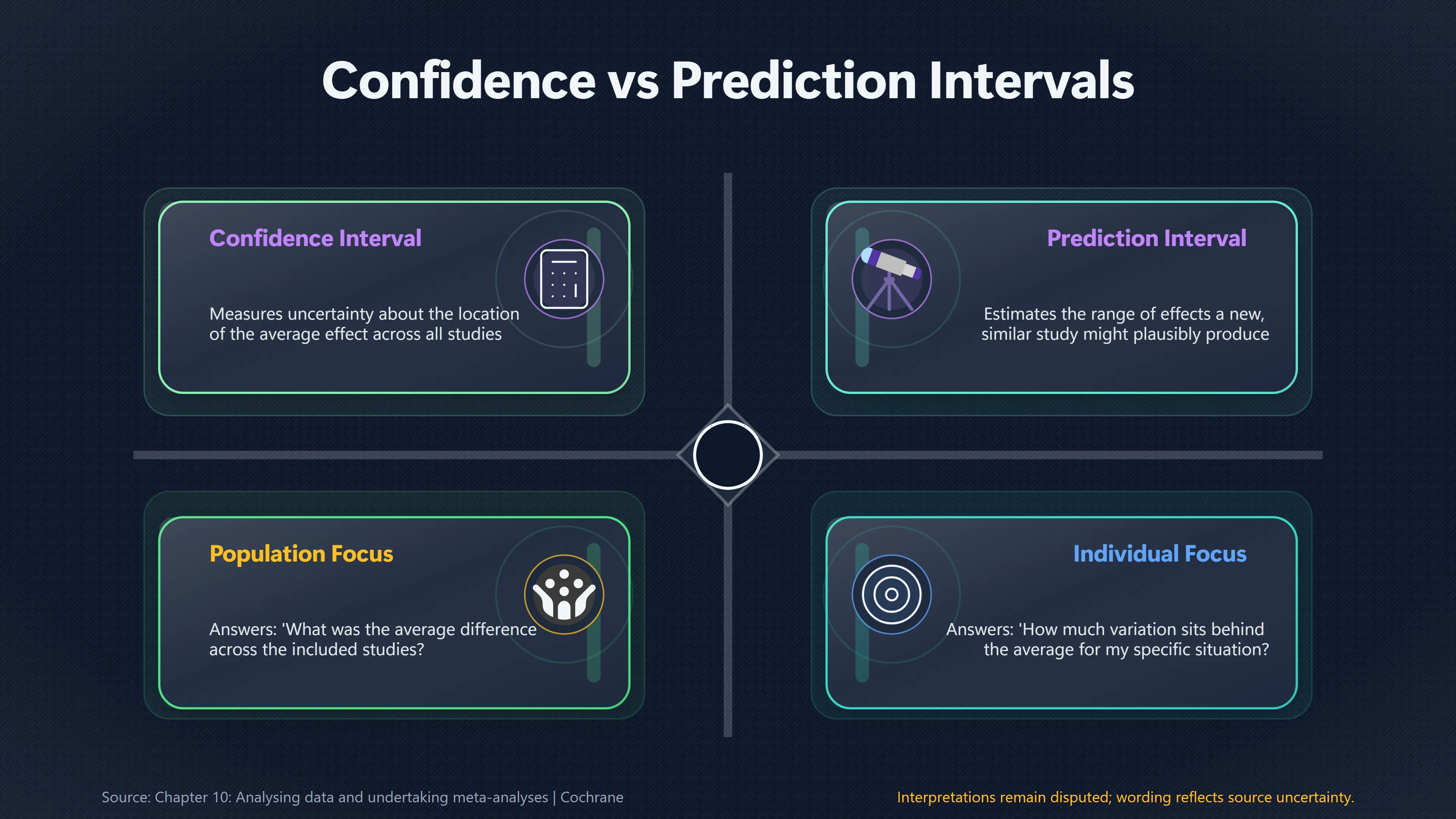
When a random-effects meta-analysis contains enough suitable studies, a prediction interval can make heterogeneity much easier to interpret. Rather than asking only where the mean effect probably lies, it estimates a range in which the underlying effect of a new, sufficiently similar study could plausibly fall. Cochrane recommends prediction intervals as a useful way to communicate between-study variation, while cautioning that they can be unreliable with few studies and depend on modelling assumptions.[Cochrane]cochrane.orgChapter 10: Analysing data and undertaking meta-analyses | CochraneChapter 10: Analysing data and undertaking meta-analyses | Cochrane…
The difference between the two intervals is therefore practical:
Confidence interval: How uncertain are we about the average effect?
Prediction interval: Given the observed heterogeneity, how widely might effects vary across comparable settings?
A large empirical analysis shows how much that distinction can change the message. Researchers calculated prediction intervals for thousands of meta-analyses from Cochrane reviews. Among 479 statistically significant random-effects meta-analyses that had some heterogeneity, 72.4% had 95% prediction intervals compatible with a null effect or an effect in the opposite direction. In 20.3%, the interval allowed effects completely opposite to the pooled point estimate.[PubMed]pubmed.ncbi.nlm.nih.govPub Med Plea for routinely presenting prediction intervals in meta-analysisPub Med Plea for routinely presenting prediction intervals in meta-analysis
Those figures are not specific to self-improvement, so they should not be used to claim that 72% of self-help findings are unreliable. Their value is methodological: they demonstrate how often a statistically convincing average can coexist with much greater uncertainty about what happens in another setting.
Prediction intervals have limits of their own. They generally assume that the studies being compared can reasonably be regarded as coming from a common distribution of effects. Their reliability deteriorates when there are few studies or heterogeneity is poorly estimated, and they predict an underlying effect in a similar study or setting, not the exact response of one individual.[Cochrane]cochrane.orgChapter 10: Analysing data and undertaking meta-analyses | CochraneChapter 10: Analysing data and undertaking meta-analyses | Cochrane…
So even a prediction interval is not a personal fortune-teller. It is simply closer to the practical question than the pooled confidence interval when effects genuinely differ across studies.

From group evidence to your own result
The central difficulty is that population evidence and individual prediction operate at different levels. Conventional randomised trials are excellent tools for estimating whether an intervention causes better outcomes on average than a comparator. They usually cannot reveal the counterfactual that matters to one person: how that same individual would have done both with and without the intervention.
Researchers studying personalised behavioural interventions have therefore explored N-of-1 trials, in which one person experiences different conditions repeatedly and acts as their own control. Such designs can sometimes estimate whether a reversible intervention works for that particular individual, although they require repeatedly measurable outcomes, suitable timing and interventions whose effects can reasonably be started and stopped. They are complementary to conventional trials rather than replacements for them.[PubMed Central (PMC)]pmc.ncbi.nlm.nih.govOpen source on nih.gov.
For ordinary, low-risk self-improvement choices, the underlying logic is useful even without conducting a formal experiment. Research evidence can be used first to identify techniques with a credible average advantage; personal observation can then test whether the technique is producing the intended outcome in your circumstances. The important part is not to confuse those two stages.
A positive meta-analysis should therefore change your prior expectation — it gives a reason to think a method is more promising than an unsupported alternative — without dictating your personal result. The stronger the heterogeneity, the less justified it is to convert the pooled effect into a numerical expectation for yourself. And where a prediction interval spans negligible or adverse effects, the evidence is explicitly telling you that context matters.
The most defensible reading of self-improvement research is consequently conditional rather than cynical or credulous. An average benefit is evidence that a technique can improve outcomes and tends to do so across the studied evidence base. It is not evidence that everyone benefits, that the pooled effect size is your expected gain, or that researchers already know which side of the average you will occupy. The difference between those claims is precisely where heterogeneity, prediction intervals and individual-level evidence become essential.
Amazon book picks
Further Reading
Books and field guides related to Why a Positive Average Effect May Not Predict Your Result. Use these as the next step if you want deeper reading beyond the article.
The Art of Statistics
'A statistical national treasure' Jeremy Vine, BBC Radio 2 'Required reading for all politicians, journalists, medics and anyone who trie...
How to Read a Paper
The best-selling introduction to evidence-based medicine In a clear and engaging style, How to Read a Paper demystifies evidence-based me...
The Book of Why
The hugely influential book on how the understanding of causality revolutionized science and the world, by the pioneer of artificial inte...
Calling Bullshit
Bullshit isn’t what it used to be. Now, two science professors give us the tools to dismantle misinformation and think clearly in a world...
eBay marketplace picks
Marketplace Samples
Live-tested eBay searches with available results related to this page.
Selected fromstatistics poster oneBay.co.uk.


Endnotes
1.
Source: cochrane.org
Title: Chapter 10: Analysing data and undertaking meta-analyses | Cochrane
Link:https://www.cochrane.org/authors/handbooks-and-manuals/handbook/current/chapter-10
Source snippet
Chapter 10: Analysing data and undertaking meta-analyses | Cochrane...
2.
Source: sciencedirect.com
Link:https://www.sciencedirect.com/science/article/abs/pii/S0065260106380021
Source snippet
Implementation Intentions and Goal Achievement: A Meta‐analysis of Effects and Processes - ScienceDirect...
3.
Source: nature.com
Link:https://www.nature.com/articles/s44220-023-00081-5
4.
Source: nature.com
Link:https://www.nature.com/articles/s41746-026-02844-7
5.
Source: nature.com
Link:https://www.nature.com/articles/s44277-026-00062-3
6.
Source: nature.com
Link:https://www.nature.com/articles/s41562-026-02429-0
7.
Source: nature.com
Link:https://www.nature.com/articles/s41380-026-03467-w
8.
Source: nature.com
Link:https://www.nature.com/articles/s41746-026-02356-4
9.
Source: nature.com
Link:https://www.nature.com/articles/s41562-025-02369-1
10.
Source: sciencedirect.com
Link:https://www.sciencedirect.com/science/article/pii/S0165032725009796
11.
Source: nature.com
Link:https://www.nature.com/articles/s41467-025-64593-7
12.
Source: nature.com
Link:https://www.nature.com/articles/s41746-025-01906-6
13.
Source: nature.com
Link:https://www.nature.com/articles/s41746-025-01449-w
14.
Source: methods.cochrane.org
Title: issue 3 january 2025 newsletter
Link:https://methods.cochrane.org/statistics/news/issue-3-january-2025-newsletter
Published: january 2025
15.
Source: nature.com
Link:https://www.nature.com/articles/s41598-024-73714-z
16.
Source: cochrane.org
Link:https://www.cochrane.org/authors/handbooks-and-manuals/handbook/current/chapter-13
17.
Source: sciencedirect.com
Link:https://www.sciencedirect.com/science/article/pii/S1697260023000674
18.
Source: nature.com
Link:https://www.nature.com/articles/s41746-023-00794-y
19.
Source: nature.com
Link:https://www.nature.com/articles/s41598-022-07801-4
20.
Source: nature.com
Link:https://www.nature.com/articles/s41539-021-00117-4
21.
Source: sciencedirect.com
Link:https://www.sciencedirect.com/science/article/abs/pii/S0165032720328317
22.
Source: sciencedirect.com
Link:https://www.sciencedirect.com/science/article/pii/S2468266719302208
23.
Source: cochrane.org
Title: Chapter 24: Including non-randomized studies on intervention effects | Cochrane
Link:https://www.cochrane.org/authors/handbooks-and-manuals/handbook/current/chapter-24
24.
Source: training-noproxy.cochrane.org
Title: chapter 10
Link:https://training-noproxy.cochrane.org/handbook/archive/v6.2/chapter-10
25.
Source: training.cochrane.org
Title: chapter 10
Link:https://training.cochrane.org/handbook/current/chapter-10
26.
Source: training.cochrane.org
Title: chapter 15
Link:https://training.cochrane.org/handbook/current/chapter-15
27.
Source: training-noproxy.cochrane.org
Link:https://training-noproxy.cochrane.org/handbook/archive/v5.1/chapter_10/10_4_4_1_comparing_fixed_and_random_effects_estimates.htm
28.
Source: training-noproxy.cochrane.org
Link:https://training-noproxy.cochrane.org/handbook/archive/v5.0.0/chapter_9/9_5_4_incorporating_heterogeneity_into_random_effects_models.htm
29.
Source: sciencedirect.com
Link:https://www.sciencedirect.com/science/article/abs/pii/S2212144726000207
30.
Source: sciencedirect.com
Link:https://www.sciencedirect.com/science/article/pii/S1469029218307970
31.
Source: sciencedirect.com
Link:https://www.sciencedirect.com/science/chapter/bookseries/abs/pii/S0065260106380021
32.
Source: sciencedirect.com
Link:https://www.sciencedirect.com/science/article/pii/S1747938X24000575
33.
Source: sciencedirect.com
Link:https://www.sciencedirect.com/science/article/abs/pii/S2215036620301309
34.
Source: pubmed.ncbi.nlm.nih.gov
Link:https://pubmed.ncbi.nlm.nih.gov/26479070/
Source snippet
Does monitoring goal progress promote goal attainment? A meta-analysis of the experimental evidence - PubMedFebruary 1, 2016...
Published: February 1, 2016
35.
Source: pubmed.ncbi.nlm.nih.gov
Link:https://pubmed.ncbi.nlm.nih.gov/27864403/
36.
Source: pmc.ncbi.nlm.nih.gov
Link:https://pmc.ncbi.nlm.nih.gov/articles/PMC5370453/
37.
Source: pubmed.ncbi.nlm.nih.gov
Link:https://pubmed.ncbi.nlm.nih.gov/28351367/
38.
Source: pubmed.ncbi.nlm.nih.gov
Link:https://pubmed.ncbi.nlm.nih.gov/33428616/
39.
Source: pmc.ncbi.nlm.nih.gov
Link:https://pmc.ncbi.nlm.nih.gov/articles/PMC7615230/
40.
Source: pubmed.ncbi.nlm.nih.gov
Title: Pub Med Plea for routinely presenting prediction intervals in meta-analysis
Link:https://pubmed.ncbi.nlm.nih.gov/27406637/
41.
Source: pmc.ncbi.nlm.nih.gov
Link:https://pmc.ncbi.nlm.nih.gov/articles/4947751/
42.
Source: pmc.ncbi.nlm.nih.gov
Link:https://pmc.ncbi.nlm.nih.gov/articles/PMC4175746/
43.
Source: pmc.ncbi.nlm.nih.gov
Title: Pub Med Central (PMC)Personalized (N-of-1) Trials: A Primer
Link:https://pmc.ncbi.nlm.nih.gov/articles/PMC8351788/
44.
Source: pmc.ncbi.nlm.nih.gov
Link:https://pmc.ncbi.nlm.nih.gov/articles/PMC13204972/
45.
Source: pubmed.ncbi.nlm.nih.gov
Link:https://pubmed.ncbi.nlm.nih.gov/41992906/
46.
Source: pubmed.ncbi.nlm.nih.gov
Link:https://pubmed.ncbi.nlm.nih.gov/42060453/
47.
Source: pmc.ncbi.nlm.nih.gov
Link:https://pmc.ncbi.nlm.nih.gov/articles/PMC13117039/
48.
Source: pmc.ncbi.nlm.nih.gov
Link:https://pmc.ncbi.nlm.nih.gov/articles/PMC13126221/
49.
Source: pubmed.ncbi.nlm.nih.gov
Link:https://pubmed.ncbi.nlm.nih.gov/41354774/
50.
Source: pubmed.ncbi.nlm.nih.gov
Link:https://pubmed.ncbi.nlm.nih.gov/40449740/
51.
Source: pmc.ncbi.nlm.nih.gov
Link:https://pmc.ncbi.nlm.nih.gov/articles/PMC12823212/
52.
Source: pmc.ncbi.nlm.nih.gov
Link:https://pmc.ncbi.nlm.nih.gov/articles/PMC12367546/
53.
Source: pubmed.ncbi.nlm.nih.gov
Link:https://pubmed.ncbi.nlm.nih.gov/39023887/
54.
Source: pmc.ncbi.nlm.nih.gov
Link:https://pmc.ncbi.nlm.nih.gov/articles/PMC11960000/
55.
Source: pubmed.ncbi.nlm.nih.gov
Link:https://pubmed.ncbi.nlm.nih.gov/38560998/
56.
Source: pmc.ncbi.nlm.nih.gov
Link:https://pmc.ncbi.nlm.nih.gov/articles/PMC11341641/
57.
Source: pubmed.ncbi.nlm.nih.gov
Link:https://pubmed.ncbi.nlm.nih.gov/39184307/
58.
Source: pubmed.ncbi.nlm.nih.gov
Link:https://pubmed.ncbi.nlm.nih.gov/39491391/
59.
Source: pubmed.ncbi.nlm.nih.gov
Link:https://pubmed.ncbi.nlm.nih.gov/37771175/
60.
Source: pmc.ncbi.nlm.nih.gov
Link:https://pmc.ncbi.nlm.nih.gov/articles/PMC10565195/
61.
Source: pubmed.ncbi.nlm.nih.gov
Link:https://pubmed.ncbi.nlm.nih.gov/37867573/
62.
Source: pmc.ncbi.nlm.nih.gov
Link:https://pmc.ncbi.nlm.nih.gov/articles/PMC10524575/
63.
Source: pmc.ncbi.nlm.nih.gov
Link:https://pmc.ncbi.nlm.nih.gov/articles/PMC11272747/
64.
Source: pmc.ncbi.nlm.nih.gov
Link:https://pmc.ncbi.nlm.nih.gov/articles/PMC10673634/
65.
Source: ncbi.nlm.nih.gov
Link:https://www.ncbi.nlm.nih.gov/books/NBK612209/
66.
Source: pubmed.ncbi.nlm.nih.gov
Link:https://pubmed.ncbi.nlm.nih.gov/35410936/
67.
Source: pmc.ncbi.nlm.nih.gov
Link:https://pmc.ncbi.nlm.nih.gov/articles/PMC9003609/
68.
Source: pmc.ncbi.nlm.nih.gov
Link:https://pmc.ncbi.nlm.nih.gov/articles/PMC8740589/
69.
Source: pubmed.ncbi.nlm.nih.gov
Link:https://pubmed.ncbi.nlm.nih.gov/33593124/
70.
Source: pubmed.ncbi.nlm.nih.gov
Link:https://pubmed.ncbi.nlm.nih.gov/34537665/
71.
Source: pmc.ncbi.nlm.nih.gov
Link:https://pmc.ncbi.nlm.nih.gov/articles/PMC8207572/
72.
Source: pmc.ncbi.nlm.nih.gov
Link:https://pmc.ncbi.nlm.nih.gov/articles/PMC8361666/
73.
Source: pmc.ncbi.nlm.nih.gov
Link:https://pmc.ncbi.nlm.nih.gov/articles/PMC8365685/
74.
Source: pubmed.ncbi.nlm.nih.gov
Link:https://pubmed.ncbi.nlm.nih.gov/33587109/
75.
Source: pmc.ncbi.nlm.nih.gov
Link:https://pmc.ncbi.nlm.nih.gov/articles/PMC8364929/
76.
Source: pmc.ncbi.nlm.nih.gov
Link:https://pmc.ncbi.nlm.nih.gov/articles/PMC7799763/
77.
Source: pubmed.ncbi.nlm.nih.gov
Link:https://pubmed.ncbi.nlm.nih.gov/32445689/
78.
Source: pmc.ncbi.nlm.nih.gov
Link:https://pmc.ncbi.nlm.nih.gov/articles/PMC7571594/
79.
Source: pmc.ncbi.nlm.nih.gov
Link:https://pmc.ncbi.nlm.nih.gov/articles/PMC7429262/
80.
Source: doi.org
Title: Cochrane Handbook for Systematic Reviews of Interventions | Wiley Online Books
Link:https://doi.org/10.1002/9781119536604
81.
Source: pmc.ncbi.nlm.nih.gov
Link:https://pmc.ncbi.nlm.nih.gov/articles/PMC6693254/
82.
Source: pmc.ncbi.nlm.nih.gov
Link:https://pmc.ncbi.nlm.nih.gov/articles/PMC5904006/
83.
Source: pubmed.ncbi.nlm.nih.gov
Link:https://pubmed.ncbi.nlm.nih.gov/30425028/
84.
Source: pubmed.ncbi.nlm.nih.gov
Link:https://pubmed.ncbi.nlm.nih.gov/29745296/
85.
Source: pmc.ncbi.nlm.nih.gov
Link:https://pmc.ncbi.nlm.nih.gov/articles/PMC6128372/
86.
Source: pmc.ncbi.nlm.nih.gov
Link:https://pmc.ncbi.nlm.nih.gov/articles/PMC5711967/
87.
Source: pubmed.ncbi.nlm.nih.gov
Link:https://pubmed.ncbi.nlm.nih.gov/26988928/
88.
Source: pubmed.ncbi.nlm.nih.gov
Link:https://pubmed.ncbi.nlm.nih.gov/26445201/
89.
Source: pubmed.ncbi.nlm.nih.gov
Link:https://pubmed.ncbi.nlm.nih.gov/25810242/
90.
Source: pmc.ncbi.nlm.nih.gov
Link:https://pmc.ncbi.nlm.nih.gov/articles/PMC3972259/
91.
Source: pmc.ncbi.nlm.nih.gov
Link:https://pmc.ncbi.nlm.nih.gov/articles/PMC2963698/
92.
Source: pmc.ncbi.nlm.nih.gov
Link:https://pmc.ncbi.nlm.nih.gov/articles/PMC2575558/
93.
Source: pubmed.ncbi.nlm.nih.gov
Link:https://pubmed.ncbi.nlm.nih.gov/11813224/
94.
Source: pubmed.ncbi.nlm.nih.gov
Link:https://pubmed.ncbi.nlm.nih.gov/25267928/
95.
Source: pubmed.ncbi.nlm.nih.gov
Link:https://pubmed.ncbi.nlm.nih.gov/31662031/
96.
Source: pubmed.ncbi.nlm.nih.gov
Link:https://pubmed.ncbi.nlm.nih.gov/27918191/
Additional References
97.
Source: youtube.com
Title: Self-Help is Broken
Link:https://www.youtube.com/watch?v=5D2jEvTFKzU
Source snippet
The End of Average | Todd Rose | Talks at Google breaks down the scientific fallacy of designing interventions around aggregate group ave...
98.
Source: youtube.com
Title: The End of Average with Todd Rose
Link:https://www.youtube.com/watch?v=EobYa3EkOWw
Source snippet
Self-Help is Broken - Why 99% of Advice is Useless (And What to Do Instead)...
99.
Source: researchgate.net
Link:https://www.researchgate.net/publication/291335719_Does_Monitoring_Goal_Progress_Promote_Goal_Attainment_A_Meta-Analysis_of_the_Experimental_Evidence
100.
Source: researchgate.net
Link:https://www.researchgate.net/publication/290193001_Implementation_Intentions
101.
Source: scispace.com
Link:https://scispace.com/papers/systematic-review-and-individual-participant-data-meta-2vxd4yc7h4
102.
Source: researchgate.net
Link:https://www.researchgate.net/publication/372267810_Systematic_review_and_individual_participant_data_meta-analysis_of_randomized_controlled_trials_assessing_mindfulness-based_programs_for_mental_health_promotion
103.
Source: researchgate.net
Link:https://www.researchgate.net/publication/372267810_Systematic_review_and_individual_participant_data_meta-analysis_of_randomized_controlled_trials_assessing_mindfulness-based_programs_for_mental_health_promotion?_tp=eyJjb250ZXh0Ijp7InBhZ2UiOiJzY2llbnRpZmljQ29udHJpYnV0aW9ucyIsInByZXZpb3VzUGFnZSI6bnVsbCwic3ViUGFnZSI6bnVsbH19
104.
Source: researchgate.net
Link:https://www.researchgate.net/publication/378870694_The_When_and_How_of_Planning_Meta-Analysis_of_the_Scope_and_Components_of_Implementation_Intentions_in_642_Tests
105.
Source: doi.org
Link:https://doi.org/10.1007/s12671-026-02809-7
106.
Source: bmj.com
Link:https://www.bmj.com/content/344/bmj.d7762