Within Complex Habits
Why Complex Habits Often Fail Before They Start
Cooking and other multi-step habits can fail before the main action begins because ingredients, equipment and preparation all have to align.
On this page
- How extra steps multiply opportunities to stop
- Healthy cooking as a higher order habit
- Reducing preparation without oversimplifying the goal
Page outline Jump by section
Introduction
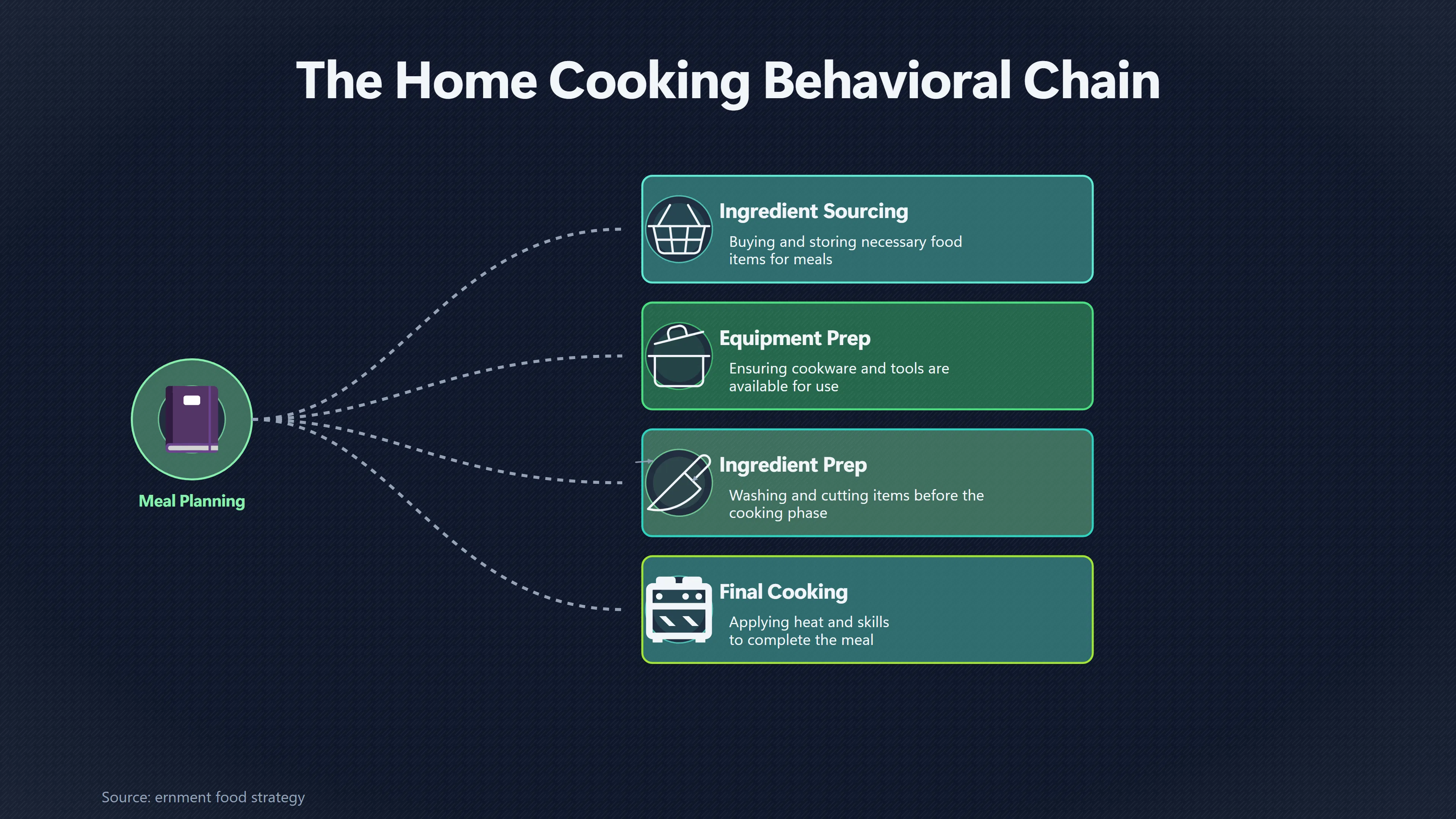
Healthy routines can fail before the behaviour a person actually cares about has begun. Cooking a nutritious dinner, for example, is not one action. Someone may first need to decide what to eat, check what is already at home, buy missing ingredients, find suitable equipment, allow enough time, prepare ingredients and only then cook. Exercise can have the same structure: clothes need washing, a bag may need packing, equipment must be available and travel may be required.
That distinction matters for complex habits. Preparation is not merely background administration; it is part of the behavioural chain. Research on physical activity explicitly describes preparatory action as a stage between planning and the target behaviour, while food research shows that time, facilities, cooking skills, ingredient availability and planning can all determine whether healthy eating is practical.[IAAP Journals]iaap-journals.onlinelibrary.wiley.comIAAP JournalsPreparing for Physical Activity: Pedometer Acquisition as a Self‐regulatory Strategy - Koring - 2013 - Applied Psychology: H…
The practical lesson is not that healthy routines should always be made tiny or effortless. It is that a routine with five prerequisites has five opportunities to become impossible before its main cue arrives. Effective self-improvement therefore involves making the supporting actions reliable as well as repeatedly practising the headline behaviour.
How extra steps multiply opportunities to stop
Consider two evening habits: eating a piece of fruit and cooking a vegetable-rich meal from basic ingredients. The first can be close to a single cue-response relationship when fruit is already available: see or finish dinner, take fruit, eat it. The second is better understood as a small system.
A home-cooked dinner can depend on several conditions being satisfied at once: a meal has been chosen, its ingredients have been bought and stored, perishable ingredients are still usable, the necessary cookware is available, there is enough preparation and cooking time, and the person has the skills and energy to complete the recipe. The systematic review literature on home cooking accordingly finds that its determinants extend well beyond cooking ability itself. Time availability, employment and social and cultural circumstances all influence cooking behaviour.[ScienceDirect]sciencedirect.comHealth and social determinants and outcomes of home cooking: A systematic review of observational studies - ScienceDirectApr…
This produces what might be called upstream failure. The intended behaviour at 7 pm may be “cook dinner”, but the decisive failure could have occurred at lunchtime, when no meal was chosen; yesterday, when shopping was postponed; or several days earlier, when the ingredients that would make a quick meal possible were never bought. By the time hunger is strong, the convenient alternative can require far fewer remaining steps.
Time scarcity makes these chains particularly fragile. Longitudinal Australian research found that new episodes of time or income scarcity were associated with deterioration in health behaviours; time scarcity could contribute to lower fruit and vegetable consumption and more eating out, while combinations of income and time scarcity increased constraints further. The authors emphasised that nutritious eating consumes time through provisioning and preparation, not simply through eating itself.[DOI]doi.orgYour money or your time? How both types of scarcity matter to physical activity and healthy eating - ScienceDirectJanuary 1, 2017…
That is an important correction to the idea that preparation problems are simply failures of motivation. A person can strongly intend to eat well and still encounter a chain that cannot be completed with the resources available that evening. A 2024 review of healthy eating among disadvantaged adults in the UK identified lack of time, fatigue, cooking skills, food costs, access to shops and lack of facilities for storing, warming or cooking food among the barriers reported in the literature. Environmental context and resources were the most commonly represented theoretical domain across the studies reviewed.[PubMed Central (PMC)]pmc.ncbi.nlm.nih.govPubMed Central (PMC)Barriers and facilitators to healthy eating in disadvantaged adults living in the UK: a scoping review - PMC…
The UK Government’s food strategy makes a similar point at policy level: dietary inequalities are not explained by food prices alone, because people also need equipment, skills and time to prepare healthier food rather than use convenient alternatives.[GOV.UK]GOV.UKernment food strategyernment food strategy - GOV.UKJune 13, 2022…
Preparation barriers should therefore not automatically be interpreted as weak willpower. For someone working irregular shifts, caring for children or living without adequate kitchen facilities, removing one preparation step can have considerably more value than another reminder to “stay disciplined”.
Healthy cooking is a higher-order habit
Cooking illustrates particularly well why some healthy behaviours resist becoming automatic. “Cook a healthy dinner” sounds like one habit, but in practice it contains several behaviours operating at different times.
Planning is one of them. In a study of 40,554 adults from the French NutriNet-Santé cohort, 57.4% reported planning meals at least occasionally. Meal planning was associated with better adherence to nutritional guidelines and greater food variety. Because the study was observational and cross-sectional, it cannot establish that planning caused the healthier diets; people who are already more interested in healthy eating may simply be more inclined to plan. Even so, the association illustrates how an apparently peripheral preparation behaviour is connected with what eventually reaches the plate.[DOI]doi.orgMeal planning is associated with food variety, diet quality and body weight status in a large sample of French adults | International…
Shopping is another. Deciding to cook vegetables does little at the critical moment if vegetables are not available. Research on preparatory planning has specifically treated actions such as ensuring that fruit is available as distinct from planning when and where to eat it. That distinction is useful beyond the particular experiment: action plans organise the target behaviour, while preparatory plans create the conditions under which that behaviour is possible.[PubMed]pubmed.ncbi.nlm.nih.govEffects of preparatory and action planning instructions on situation-specific and general fruit and snack intake - PubMedJanuary 1…
Skills create another potential bottleneck. UK evidence identifies lack of food-preparation skills as a barrier for some groups, including the difficulty of producing enough variety with the cooking skills people possess. But this evidence also cautions against treating cooking lessons as a complete solution: improved skills cannot compensate for unreliable access to affordable ingredients, time or adequate facilities.[PubMed Central (PMC)]pmc.ncbi.nlm.nih.govPubMed Central (PMC)Barriers and facilitators to healthy eating in disadvantaged adults living in the UK: a scoping review - PMC… A population analysis of UK National Diet and Nutrition Survey data likewise notes the relationship between cooking skills, meal preparation and reliance on convenience foods, although these associations do not by themselves demonstrate causation.[PubMed Central (PMC)]pmc.ncbi.nlm.nih.govOpen source on nih.gov.
Finally, healthy cooking competes against alternatives designed to remove preparation. Convenience food can collapse planning, ingredient assembly, preparation and sometimes washing-up into a much shorter sequence. Economic analyses consequently warn that the “cost” of a meal includes time as well as its supermarket price. One review notes that when researchers incorporated the value of preparation time into calculations, home preparation could become substantially more costly in practical terms than its ingredients alone suggested.[PubMed Central (PMC)]pmc.ncbi.nlm.nih.govPub Med Central (PMC)Costing a healthy diet: measurement and policy implicationsPub Med Central (PMC)Costing a healthy diet: measurement and policy implications
This helps explain a familiar pattern: someone successfully cooks on quiet Sundays but repeatedly abandons the same goal after late working days. The difference need not be a mysterious fluctuation in commitment. The Sunday environment supplies enough time and attention for the entire chain; the weekday environment exposes every preparation dependency.

Preparation can become a habit of its own
The obvious response is to plan more, but this needs qualification. Adding elaborate planning can itself create another complex routine. A weekly system involving recipe research, nutritional calculations, multiple shops, batch cooking and carefully portioned containers may reduce friction later in the week while demanding a large preparation session upfront.
The more useful distinction is between productive preparation and preparation overhead. Productive preparation removes a predictable future obstacle. Preparation overhead adds work without reliably making the target behaviour easier.
Research on implementation intentions — specific plans connecting a situation with an intended response — provides some support for planning as a behavioural tool. A systematic review and meta-analysis of 23 healthy-eating studies found stronger effects for adding healthy foods than for reducing unhealthy eating, although study quality affected the results.[PubMed]pubmed.ncbi.nlm.nih.govOpen source on nih.gov. A later meta-regression covering 70 interventions and 9,689 participants also found positive but modest effects, and importantly reported that specific if-then and action plans performed better than more complex plans for promoting healthy eating.[PubMed]pubmed.ncbi.nlm.nih.govOpen source on nih.gov.
That last finding fits the preparation problem especially well. The goal is not to construct the most sophisticated possible routine. It is to settle recurring questions before they become points of failure.
For cooking, that might mean maintaining a small set of ingredients used across several meals rather than choosing entirely new recipes every week. For exercise, it could mean keeping necessary equipment in a fixed location rather than searching for it before each session. For a packed lunch, it could mean linking preparation to clearing up after dinner rather than relying on remembering it during the morning rush.
In each case, part of the complex routine is moved earlier and attached to a more stable cue. The target behaviour has not necessarily become simpler, but fewer conditions remain unresolved when it is time to start.
Reducing preparation without oversimplifying the goal
There is a risk in turning “reduce friction” into “make every habit trivial”. A nutritionally varied diet genuinely involves more complexity than eating one convenient food repeatedly. A worthwhile exercise programme may require equipment and progression. Some preparation exists because the underlying goal is valuable, not because the routine has been badly designed.
The better objective is to remove avoidable variability while preserving the substance of the goal.
One approach is to standardise inputs rather than outcomes. A person can keep a predictable shopping day and a core collection of ingredients while still cooking varied meals. Equipment can have a permanent storage location. A handful of familiar meals can act as defaults on busy evenings without becoming the entire diet. This reduces the number of decisions and missing prerequisites without requiring the person to eat exactly the same meal every day.
Another approach is to create a lower-preparation version of the same goal. Healthy cooking need not always mean cooking every component from raw ingredients. Frozen vegetables, canned pulses, pre-cut ingredients and other appropriate convenience foods can shorten preparation while retaining important nutritional features. The point is to distinguish convenience from nutritional quality rather than treating “from scratch” as the habit itself. The World Health Organization’s healthy-diet guidance focuses on the composition of the diet and appropriate cooking methods, not on culinary complexity for its own sake.[World Health Organization]who.intWorld Health Organization Healthy dietWorld Health Organization Healthy diet
Preparation can also be consolidated. In a small evaluation of Scotland’s Eat Better Feel Better cooking programme, participants reported improvements in planning before shopping and cooking in bulk as well as preparing more meals from scratch. The study’s follow-up sample was only 17 people, so it is weak evidence for effectiveness on its own, but the strategies illustrate how preparation can be reorganised rather than repeatedly performed from zero.[PubMed Central (PMC)]pmc.ncbi.nlm.nih.govOpen source on nih.gov.
The final safeguard is to identify the actual bottleneck before adding solutions. If a person regularly has ingredients but lacks time, a more detailed shopping list will not solve the problem. If food spoils because plans change, buying more ingredients may make matters worse. If the kitchen lacks appropriate equipment, motivation strategies address the wrong constraint. If exhaustion is the recurring obstacle, a routine designed around the person’s most energetic day may be inherently unreliable.
That is why preparation barriers matter within complex habit formation. Repetition can make familiar actions easier, but it cannot make a missing ingredient appear or create an hour that is not available. A healthy routine becomes more dependable when the conditions required for it are dependable too. The useful question is therefore not only “How do I make myself do this behaviour regularly?” but “What has to be true before I can do it, and which of those conditions keeps failing?”
For complex self-improvement habits, that second question often reveals the real place to intervene.
Amazon book picks
Further Reading
Books and field guides related to Why Complex Habits Often Fail Before They Start. Use these as the next step if you want deeper reading beyond the article.
Tiny Habits
Improving your life is much easier than you think. Whether it’s losing weight, sleeping more, or restoring your work/life balance – the s...
Atomic Habits
Rating: 3.5/5 from 7 Google Books ratings
The #1 New York Times bestseller. Over 25 million copies sold! Translated into 60+ languages! Tiny Changes, Remarkable Results No matter...

The Power of Habit
Rating: 4.0/5 from 145 Google Books ratings
Duhigg takes us to the edge of scientific discoveries that explain why habits exist and how they can be changed. Distilling information i...
How to Change
Wall Street Journal bestseller “A welcome revelation.” --The Financial Times Award-winning Wharton Professor and Choiceology podcast host...
eBay marketplace picks
Marketplace Samples
Live-tested eBay searches with available results related to this page.
Selected fromself improvement wall art oneBay.co.uk.



Endnotes
1.
Source: sciencedirect.com
Link:https://www.sciencedirect.com/science/article/pii/S0195666316309576
Source snippet
Health and social determinants and outcomes of home cooking: A systematic review of observational studies - ScienceDirectApr...
2.
Source: doi.org
Link:https://doi.org/10.1016/j.socscimed.2016.10.023
Source snippet
Your money or your time? How both types of scarcity matter to physical activity and healthy eating - ScienceDirectJanuary 1, 2017...
Published: January 1, 2017
3.
Source: GOV.UK
Title: ernment food strategy
Link:https://www.gov.uk/government/publications/government-food-strategy/government-food-strategy
Source snippet
ernment food strategy - GOV.UKJune 13, 2022...
Published: June 13, 2022
4.
Source: doi.org
Link:https://doi.org/10.1186/s12966
Source snippet
Meal planning is associated with food variety, diet quality and body weight status in a large sample of French adults | International...
5.
Source: who.int
Title: World Health Organization Healthy diet
Link:https://www.who.int/news-room/fact-sheets/detail/healthy-diet
6.
Source: who.int
Title: Supporting healthy diets and safe foods in urban food environments
Link:https://www.who.int/publications/i/item/B09723
7.
Source: food.gov.uk
Title: F&Y2 Wave 10 Chapter 5: Eating at home | Food Standards Agency
Link:https://www.food.gov.uk/research/fy2-wave-10-chapter-5-eating-at-home
8.
Source: who.int
Title: Healthy diet
Link:https://www.who.int/en/news-room/fact-sheets/detail/healthy-diet
9.
Source: who.int
Title: Healthy diet
Link:https://www.who.int/news-room/fact-sheets/detail/healthy-diet%E2%81%A3%E2%81%A0
10.
Source: sciencedirect.com
Link:https://www.sciencedirect.com/science/article/pii/S1499404625000429
11.
Source: GOV.UK
Link:https://www.gov.uk/government/statistics/united-kingdom-food-security-report-2024/united-kingdom-food-security-report-2024-theme-4-food-security-at-household-level
12.
Source: who.int
Link:https://www.who.int/publications/i/item/9789240101876
13.
Source: GOV.UK
Link:https://www.gov.uk/government/statistics/united-kingdom-food-security-report-2021/united-kingdom-food-security-report-2021-theme-4-food-security-at-household-level
14.
Source: who.int
Title: Fiscal policies to promote healthy diets: WHO guideline
Link:https://www.who.int/publications/i/item/9789240091016/
15.
Source: food.gov.uk
Title: Kitchen Life 2 | Food Standards Agency
Link:https://www.food.gov.uk/research/behaviour-and-perception/kitchen-life-2
16.
Source: food.gov.uk
Link:https://www.food.gov.uk/research/consumer-insights-tracker-chapter-4-food-affordability-and-insecurity
17.
Source: food.gov.uk
Title: Consumer Insights Tracker: Chapter 1 Executive
Link:https://www.food.gov.uk/research/consumer-insights-tracker-report-march-2022-march-2023
18.
Source: food.gov.uk
Title: Chapter 6: Eating at home | Food Standards Agency
Link:https://www.food.gov.uk/research/chapter-6-eating-at-home
19.
Source: doi.org
Link:https://doi.org/10.1111/bjhp.12595
20.
Source: who.int
Link:https://www.who.int/europe/publications/i/item/WHO-EURO-2021-4360-44123-62247
21.
Source: who.int
Title: Healthy diet: Keys to eating well
Link:https://www.who.int/news-room/questions-and-answers/item/healthy-diet-keys-to-eating-well
22.
Source: sciencedirect.com
Link:https://www.sciencedirect.com/science/article/pii/S1499404620303559
23.
Source: GOV.UK
Title: www.gov.uk Food safety for community cooking and food banks
Link:https://www.gov.uk/government/publications/food-safety-for-community-cooking-and-food-banks/food-safety-for-community-cooking-and-food-banks
24.
Source: sciencedirect.com
Link:https://www.sciencedirect.com/science/article/pii/S0195666319305550
25.
Source: sciencedirect.com
Link:https://www.sciencedirect.com/science/article/pii/S0195666318314363
26.
Source: sciencedirect.com
Link:https://www.sciencedirect.com/science/article/abs/pii/S0195666318314363
27.
Source: who.int
Title: Healthy diet
Link:https://www.who.int/publications/m/item/healthy-diet-factsheet394
28.
Source: sciencedirect.com
Link:https://www.sciencedirect.com/science/article/pii/S149940461730828X
29.
Source: sciencedirect.com
Link:https://www.sciencedirect.com/science/article/abs/pii/S149940461730828X
30.
Source: GOV.UK
Title: www.gov.uk Health matters: obesity and the food environment
Link:https://www.gov.uk/government/publications/health-matters-obesity-and-the-food-environment/health-matters-obesity-and-the-food-environment–2?trk=public_post_comment-text
31.
Source: GOV.UK
Title: www.gov.uk Helping older people maintain a healthy diet: A review of what works
Link:https://www.gov.uk/government/publications/helping-older-people-maintain-a-healthy-diet-a-review-of-what-works/helping-older-people-maintain-a-healthy-diet-a-review-of-what-works
32.
Source: sciencedirect.com
Link:https://www.sciencedirect.com/science/article/abs/pii/S0195666316304640
33.
Source: sciencedirect.com
Link:https://www.sciencedirect.com/science/article/pii/S0195666316304640
34.
Source: sciencedirect.com
Link:https://www.sciencedirect.com/science/article/abs/pii/S0277953616305913
35.
Source: sciencedirect.com
Link:https://www.sciencedirect.com/science/article/pii/S0195666316304391
36.
Source: sciencedirect.com
Title: Planning and preparatory actions facilitate physical activity maintenance
Link:https://www.sciencedirect.com/science/article/abs/pii/S1469029214000612
37.
Source: sciencedirect.com
Title: Effects of habit on intentional and reactive motivations for unhealthy eating
Link:https://www.sciencedirect.com/science/article/pii/S0195666313001517
38.
Source: sciencedirect.com
Title: Effects of habit on intentional and reactive motivations for unhealthy eating
Link:https://www.sciencedirect.com/science/article/abs/pii/S0195666313001517
39.
Source: sciencedirect.com
Link:https://www.sciencedirect.com/science/article/pii/S1499404612005726
40.
Source: doi.org
Link:https://doi.org/10.1002%2F%28SICI%291099-0992%28199908%2F09%2929%3A5%2F6%3C591%3A%3AAID-EJSP948%3E3.0.CO%3B2-H
41.
Source: sciencedirect.com
Link:https://www.sciencedirect.com/science/article/abs/pii/S0195666310005192
42.
Source: sciencedirect.com
Link:https://www.sciencedirect.com/science/article/pii/S0002916523052383
43.
Source: sciencedirect.com
Link:https://www.sciencedirect.com/science/article/pii/S0195666310005325
44.
Source: who.int
Link:https://www.who.int/initiatives/behealthy/healthy-diet
45.
Source: who.int
Link:https://www.who.int/publications/b/76012
46.
Source: who.int
Link:https://www.who.int/health-topics/healthy-diet
47.
Source: science.food.gov.uk
Link:https://science.food.gov.uk/article/158620-consumers-food-safety-practices-in-the-home-trends-and-insights-from-2020-to-2025
48.
Source: iaap-journals.onlinelibrary.wiley.com
Link:https://iaap-journals.onlinelibrary.wiley.com/doi/10.1111/aphw.12003
Source snippet
IAAP JournalsPreparing for Physical Activity: Pedometer Acquisition as a Self‐regulatory Strategy - Koring - 2013 - Applied Psychology: H...
49.
Source: pmc.ncbi.nlm.nih.gov
Link:https://pmc.ncbi.nlm.nih.gov/articles/PMC11221142/
Source snippet
PubMed Central (PMC)Barriers and facilitators to healthy eating in disadvantaged adults living in the UK: a scoping review - PMC...
50.
Source: pubmed.ncbi.nlm.nih.gov
Link:https://pubmed.ncbi.nlm.nih.gov/27839899/
Source snippet
Your money or your time? How both types of scarcity matter to physical activity and healthy eating - PubMed...
51.
Source: pubmed.ncbi.nlm.nih.gov
Link:https://pubmed.ncbi.nlm.nih.gov/28153017/
Source snippet
Meal planning is associated with food variety, diet quality and body weight status in a large sample of French adults - PubMed...
52.
Source: pubmed.ncbi.nlm.nih.gov
Link:https://pubmed.ncbi.nlm.nih.gov/27671975/
Source snippet
Effects of preparatory and action planning instructions on situation-specific and general fruit and snack intake - PubMedJanuary 1...
53.
Source: pmc.ncbi.nlm.nih.gov
Link:https://pmc.ncbi.nlm.nih.gov/articles/PMC4524366/
54.
Source: pmc.ncbi.nlm.nih.gov
Title: Pub Med Central (PMC)Costing a healthy diet: measurement and policy implications
Link:https://pmc.ncbi.nlm.nih.gov/articles/PMC10273252/
55.
Source: pubmed.ncbi.nlm.nih.gov
Link:https://pubmed.ncbi.nlm.nih.gov/21056605/
56.
Source: pubmed.ncbi.nlm.nih.gov
Link:https://pubmed.ncbi.nlm.nih.gov/31125588/
57.
Source: pmc.ncbi.nlm.nih.gov
Link:https://pmc.ncbi.nlm.nih.gov/articles/PMC5409581/
58.
Source: pmc.ncbi.nlm.nih.gov
Link:https://pmc.ncbi.nlm.nih.gov/articles/PMC13353532/
59.
Source: pmc.ncbi.nlm.nih.gov
Link:https://pmc.ncbi.nlm.nih.gov/articles/PMC12722098/
60.
Source: pmc.ncbi.nlm.nih.gov
Link:https://pmc.ncbi.nlm.nih.gov/articles/PMC12016669/
61.
Source: pmc.ncbi.nlm.nih.gov
Link:https://pmc.ncbi.nlm.nih.gov/articles/PMC11782107/
62.
Source: pmc.ncbi.nlm.nih.gov
Link:https://pmc.ncbi.nlm.nih.gov/articles/PMC11578820/
63.
Source: pmc.ncbi.nlm.nih.gov
Link:https://pmc.ncbi.nlm.nih.gov/articles/PMC11071252/
64.
Source: pmc.ncbi.nlm.nih.gov
Link:https://pmc.ncbi.nlm.nih.gov/articles/PMC11891988/
65.
Source: pmc.ncbi.nlm.nih.gov
Link:https://pmc.ncbi.nlm.nih.gov/articles/PMC10346164/
66.
Source: pubmed.ncbi.nlm.nih.gov
Link:https://pubmed.ncbi.nlm.nih.gov/37019361/
67.
Source: pmc.ncbi.nlm.nih.gov
Link:https://pmc.ncbi.nlm.nih.gov/articles/PMC9412361/
68.
Source: pubmed.ncbi.nlm.nih.gov
Link:https://pubmed.ncbi.nlm.nih.gov/35742582/
69.
Source: pubmed.ncbi.nlm.nih.gov
Link:https://pubmed.ncbi.nlm.nih.gov/35664117/
70.
Source: pmc.ncbi.nlm.nih.gov
Link:https://pmc.ncbi.nlm.nih.gov/articles/PMC8700847/
71.
Source: pmc.ncbi.nlm.nih.gov
Link:https://pmc.ncbi.nlm.nih.gov/articles/PMC8624651/
72.
Source: pmc.ncbi.nlm.nih.gov
Link:https://pmc.ncbi.nlm.nih.gov/articles/PMC7468761/
73.
Source: pmc.ncbi.nlm.nih.gov
Link:https://pmc.ncbi.nlm.nih.gov/articles/PMC8009798/
74.
Source: pmc.ncbi.nlm.nih.gov
Link:https://pmc.ncbi.nlm.nih.gov/articles/PMC7429262/
75.
Source: pubmed.ncbi.nlm.nih.gov
Link:https://pubmed.ncbi.nlm.nih.gov/31557495/
76.
Source: pmc.ncbi.nlm.nih.gov
Link:https://pmc.ncbi.nlm.nih.gov/articles/PMC6835904/
77.
Source: pmc.ncbi.nlm.nih.gov
Link:https://pmc.ncbi.nlm.nih.gov/articles/PMC7050805/
78.
Source: pubmed.ncbi.nlm.nih.gov
Link:https://pubmed.ncbi.nlm.nih.gov/30336306/
79.
Source: pubmed.ncbi.nlm.nih.gov
Link:https://pubmed.ncbi.nlm.nih.gov/28833976/
80.
Source: pubmed.ncbi.nlm.nih.gov
Link:https://pubmed.ncbi.nlm.nih.gov/28572070/
81.
Source: pubmed.ncbi.nlm.nih.gov
Link:https://pubmed.ncbi.nlm.nih.gov/28854196/
82.
Source: pubmed.ncbi.nlm.nih.gov
Link:https://pubmed.ncbi.nlm.nih.gov/28393743/
83.
Source: pubmed.ncbi.nlm.nih.gov
Link:https://pubmed.ncbi.nlm.nih.gov/28244173/
84.
Source: pmc.ncbi.nlm.nih.gov
Link:https://pmc.ncbi.nlm.nih.gov/articles/PMC5288891/
85.
Source: pmc.ncbi.nlm.nih.gov
Link:https://pmc.ncbi.nlm.nih.gov/articles/PMC5288891/?_kx=RbX9B181XpjFSkyQeYiqSDTIRFkygr9D07tdf3D0YxiIkE_HvcESaeXkqYemq3hz.TKHRHv&bxid=%7B%7BuserId%7D%7D&mbg_hash=%7B%7B+email%7Cmd5_hash+%7D%7D&mbg_mcid=01JQPFM84F6Y8CSGP20ASQT1MG
86.
Source: pubmed.ncbi.nlm.nih.gov
Link:https://pubmed.ncbi.nlm.nih.gov/27567551/
87.
Source: pubmed.ncbi.nlm.nih.gov
Link:https://pubmed.ncbi.nlm.nih.gov/26155825/
88.
Source: pubmed.ncbi.nlm.nih.gov
Link:https://pubmed.ncbi.nlm.nih.gov/26164120/
89.
Source: pubmed.ncbi.nlm.nih.gov
Link:https://pubmed.ncbi.nlm.nih.gov/24973168/
90.
Source: pmc.ncbi.nlm.nih.gov
Link:https://pmc.ncbi.nlm.nih.gov/articles/PMC4254327/
91.
Source: pubmed.ncbi.nlm.nih.gov
Link:https://pubmed.ncbi.nlm.nih.gov/20883734/
92.
Source: pubmed.ncbi.nlm.nih.gov
Link:https://pubmed.ncbi.nlm.nih.gov/19825172/
93.
Source: pubmed.ncbi.nlm.nih.gov
Link:https://pubmed.ncbi.nlm.nih.gov/17553212/
94.
Source: onlinelibrary.wiley.com
Link:https://onlinelibrary.wiley.com/doi/10.1002/%28SICI%291099-0992%28199908/09%2929%3A5/6%3C591%3A%3AAID-EJSP948%3E3.0.CO%3B2-H
95.
Source: onlinelibrary.wiley.com
Link:https://onlinelibrary.wiley.com/doi/abs/10.1002/%28SICI%291099-0992%28199908/09%2929%3A5/6%3C591%3A%3AAID-EJSP948%3E3.0.CO%3B2-H
96.
Source: pubmed.ncbi.nlm.nih.gov
Link:https://pubmed.ncbi.nlm.nih.gov/39887628/
97.
Source: pubmed.ncbi.nlm.nih.gov
Link:https://pubmed.ncbi.nlm.nih.gov/37545087/
98.
Source: ncbi.nlm.nih.gov
Link:https://www.ncbi.nlm.nih.gov/books/NBK81362/
99.
Source: pmc.ncbi.nlm.nih.gov
Link:https://pmc.ncbi.nlm.nih.gov/articles/PMC7872013/
100.
Source: pubmed.ncbi.nlm.nih.gov
Link:https://pubmed.ncbi.nlm.nih.gov/32077050/
101.
Source: pubmed.ncbi.nlm.nih.gov
Link:https://pubmed.ncbi.nlm.nih.gov/27731291/
Additional References
102.
Source: youtube.com
Title: How to Build Habits That Actually Last: A Neuroscience Approach
Link:https://www.youtube.com/watch?v=ObA4ne4TVsE
Source snippet
Solving Habit Failure Points explains how upstream friction and multi-step preparatory barriers cause behavioral routines to break down b...
103.
Source: nature.com
Link:https://www.nature.com/articles/s41562-025-02215-4
104.
Source: youtube.com
Title: Atomic Habits Is Not About Habits — It’s About Systems
Link:https://www.youtube.com/watch?v=sYATq3xv3aU
Source snippet
How to Build Habits That Actually Last: A Neuroscience Approach...
105.
Source: researchgate.net
Link:https://www.researchgate.net/publication/313265513_Meal_planning_is_associated_with_food_variety_diet_quality_and_body_weight_status_in_a_large_sample_of_French_adults
106.
Source: frontiersin.org
Link:https://www.frontiersin.org/journals/psychology/articles/10.3389/fpsyg.2025.1518834/full
107.
Source: etude-nutrinet-sante.fr
Link:https://etude-nutrinet-sante.fr/article/view/134-La-planification-des-repas-est-associ%C3%A9e-%C3%A0-la-diversit%C3%A9-des-aliments%2C-la-qualit%C3%A9-du-r%C3%A9gime-alimentaire-et-au-statut-pond%C3%A9ral-dans-un-large-%C3%A9chantillon-d%E2%80%99adultes-fran%C3%A7ais
108.
Source: tandfonline.com
Link:https://www.tandfonline.com/doi/full/10.1080/08870446.2015.1070157
109.
Source: researchgate.net
Link:https://www.researchgate.net/publication/309888499_Your_money_or_your_time_How_both_types_of_scarcity_matter_to_physical_activity_and_healthy_eating
110.
Source: researchportalplus.anu.edu.au
Link:https://researchportalplus.anu.edu.au/en/publications/your-money-or-your-time-how-both-types-of-scarcity-matter-to-phys/
111.
Source: openresearch-repository.anu.edu.au
Link:https://openresearch-repository.anu.edu.au/items/7f032224-914b-47d7-ad2c-4d2e7bdce97e